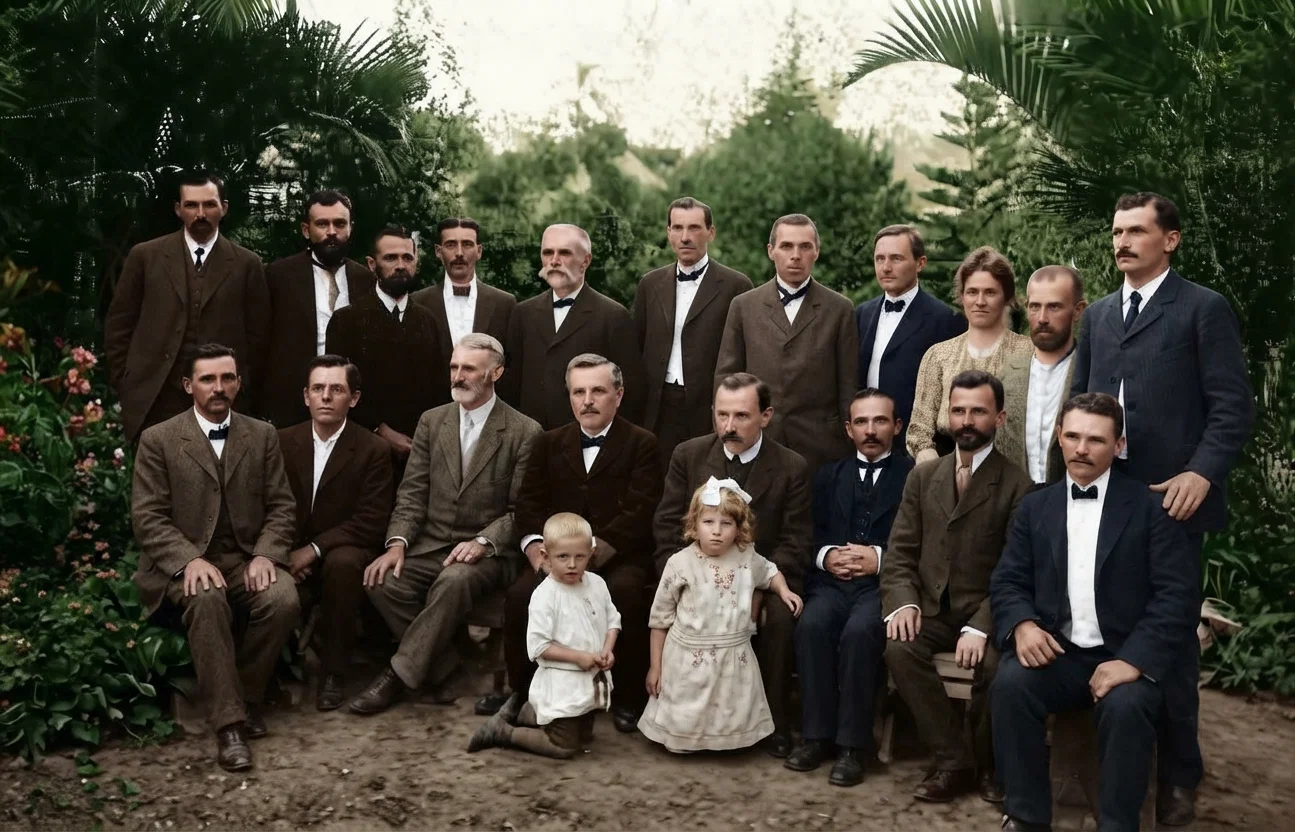
ON our way from the Argentine headquarters to Brazil, Elder J. W. Westphal and I went to Posadas, just across the river from Paraguay, for the annual meeting of the Upper Parana Mission. Thirty-six hours took us there. Notwithstanding the red dust flying and the cramped wood benches of the second-class car, we were thankful for a train across the plains of Missiones. The last time that Elder Westphal had visited the field, he must needs ride two days by horse to cover a gap in the railway construction.
Our brethren in South America rejoice that every year the railways are making it easier to reach their fields.
Coming up through Brazil with Elder F. W. Spies, he pointed out to me a region that we crossed in a few hours by train, over which he and Sister Spies once traveled by mules for five days. The providence of God is opening the way for a faster work. And wherever a region is opened by a railway, and commerce enters, there is more or less breaking down of fanatical anti-Protestant intolerance. So our brethren see the hand of God in the development of railway enterprise in this Catholic continent.
Our three conference sessions in Brazil were held in the three southernmost states—Rio Grande, Santa Catharina, and Parana. These states lie side by side like Ohio, Indiana, and Illinois; yet to get from one meeting-place to the next took as much time as going from America to Europe.
The Lord blessed the believers in these gatherings. They love the truth, and the “blessed hope” is dear to their hearts. There was growth reported, though not what they mean by the grace of God to see in future years. These conferences have had but one ordained minister each, the president; and two of the fields have not had even that all the year. Yet the Rio Grande Conference reported sixty-seven added to the churches during the year. And the conference gave one thousand dollars tithe to the union, while another thousand came to the union treasury from the offerings of the brethren. There is not the prosperity among the colonists of Brazil that seems to obtain in Argentina.
SOUTH AMERICAN WORKERS
They grub their living out of rather rocky soil in these south Brazilian states, where our work had its beginning, for the most part. Yet the fifteen hundred believers in Brazil are raising fifteen thousand dollars for the work of God every year, and this is sure to increase with increasing faithfulness and prosperity.
One thing that encouraged me was to find a larger proportion of Brazilian believers than I saw six years ago. The providence of God sent many German colonists into Brazil years ago, and it was among these people of an open Bible that our work found a foothold. Most of our membership is German. But now the work is reaching out to the people of the land, and henceforth the great work will be in the Portuguese tongue.
Elder Westphal accompanied us to the second conference meeting, in Santa Catharina, which was also the union conference session. He then returned to Buenos Aires, his counsels being a blessing to the brethren of the Brazilian Union. Elder J. Lipke, of the East Brazil Mission, brought a cheering report to the union conference from the new work in Bahia and Pernambuco, away to the northward. The message is winning hearts in those most Catholic regions. In less than two years over one hundred new believers have been gathered out, and some are getting a good experience in the colporteur work.
Our brethren feel that they are now getting where they can soon hope to have their field fairly manned—for Brazil—7so far as this southeastern coast is concerned. Yet they have no one for the great state of Minas Geraes, the Colorado of Brazil. It was decided that Elder F. W. Spies, president of the union, should move to San Paulo, to be nearer the printing-office and headquarters. Elder H. Meyer, who recently came down from Philadelphia, is appointed to the oversight of the evangelistic work in Rio de Janeiro and the surrounding districts. Half the population of Brazil is in those central states of San Paulo, Minas, Rio, and the city of Rio de Janeiro. And little has as yet been done here. Railways open all this country fairly well, and now our brethren want to work the populous portions, where the most prosperous portion of Brazil is found.
Elder W. Ehlers, of Germany, is in charge in the state of Rio Grande; Elder F. R. Kuempel, recently from Germany, is president of the Santa Catharina Conference; while Elder J. G. Kroeker, of Nebraska, has the Parana Conference.
Brother H. Tonjes, formerly of New York City, is leading the canvassing work in Rio Grande, and training some promising workers for other parts. All our workers are pressed to the utmost, and all speak the word of courage. I was glad to find that Brother E. Ehlers, who came to Brazil from Missouri about four years ago, had made so good progress with the language that he could render unusually good service as a translator. In most of my own work in these South American meetings, I have had two translators — a brother on one side putting the sentences into Spanish or Portuguese, while on the other side stood the German translator. No matter how it is done, the word of God works, and it is that word that is the channel of blessing to the people.
After the Parana meeting I visited the union headquarters and publishing house near the city of San Paulo. Our brethren have a good office for the publishing work, Brother A. Pages being in charge. They are planning for larger and better books; for the canvassers are able to sell books at a good price. The reading public is small, however, in these Catholic lands. Catholicism stands for darkness and ignorance among the common people in these lands where Rome has had its own way so long.
Our brethren in Brazil have city problems, as well as we in the United States. We hope for a good work in this city of Rio de Janeiro, with over one million in city and suburban towns. We must help the brethren in Brazil to develop their work; and they will need a few more laborers to give even one experienced man to each state. The crying need is education for the young people growing up here. There are some church-schools, but no union training-school. It is a hard problem in a land so broken up, where it may take eight or ten or more days to get from one state to the next. But our brethren are praying and planning for training-school work one of these days. It is a dire need in Brazil.
Here in Rio I have just held the last meeting with the brethren. Now I take steamer for England, thankful to God for all his blessings that I have shared with our believers in these lands during the last four months. I have found them seeking God for a deeper experience, and longing for more of his Holy Spirit, and to see the message going with greater power. The brethren and sisters everywhere have sent greetings to the believers in North America. The workers love the truth and the people for whom they labor. I have enjoyed my association with them all. The message is bearing its fruit in South America. But this is indeed a dark and needy field. Pray for it still, brethren in North America, and stand by it in missionary offerings and effort.
W. A. S.
Rio de Janeiro.
The Sabbath a Definite Part of Time
By F. M. Wilcox
MANY claim to-day that the requirement of the Sabbath institution is for one seventh of time, and not for one definite seventh day. This argument, allied to others that have been advanced against the perpetual obligation of the Sabbath institution, is a product of nineteenth- and twentieth-century thought, and its ostensible purpose is to evade the claims of God's great memorial. The object-lesson given the children of Israel in the wilderness forever silences this objection.
By the exhibition of his mighty power, God brought his chosen people out of the land of servitude. Their triumphal egress from the land of Egypt marked the overthrow of their oppressors. They were at last free, and it would seem that every sense of gratitude which they possessed would have been called out in response to the marvelous workings of divine power in their behalf. They started on their journey to the land of promise. The wilderness of Sin encompassed them. They were shut in on every side by fruitless wastes. The food supply, which they had hastily prepared and taken with them in their flight from Egypt, was exhausted. Where would food be found to feed this vast multitude in their journeyings? He who had undertaken their deliverance was abundantly able to supply the lack. From heaven the Lord rained bread for his people. Every morning for six days in the week they were to gather the fallen manna. Here on this occasion, in a great threefold miracle extending over a period of forty years, God pointed out in a definite and unmistakable manner the day which he had ordained that his people should regard as sacred: —
1. The manna fell for six days in the week. This of itself was a miracle: it was contrary to any natural order.
2. An exception was made to this special order of events in that on the seventh day the manna was withheld.
3. During the week the children of Israel were commanded to gather from day to day for immediate daily use. The manna left over from one week-day to another became corrupt and unfit for food. On the sixth day they were commanded to gather a double portion, to make up for the failure in the falling of the manna on the seventh day. The second portion which they gathered on the sixth day maintained its sweetness and freshness on the seventh day, and was then eaten as food.
Had any of the Israelites been advocates of the seventh-part-of-time theory, and planned to keep the Sabbath on another day than the seventh, they would have been thrown into much embarrassment. The day which they might choose would necessarily become an enforced fast day through the circumstances attending the food supply. Had they chosen the first day of the week, their search for food on the seventh day would have been fruitless. Had they chosen the fifth or sixth day and laid in a double supply of manna on the day preceding, they would have found it utterly unfit for use. It was necessary for them to conform to God's order, and accept the plain distinctions in the days of the week which he made back in the beginning, and which he emphasized by this threefold miracle.
Referring to this experience in the falling of the manna, in his comment on Ex. 16: 23, Dr. Adam Clarke says: —
There is nothing either in the text or context that seems to intimate that the Sabbath was now first given to the Israelites, as some have supposed; on the contrary, it is here spoken of as being perfectly well known, from its having been generally observed. The commandment, it is true, may be considered as being now renewed; because they might have supposed that in their unsettled state in the wilderness they might have been exempted from the observance of it. Thus we find (1) that when God finished his creation, he instituted the Sabbath; (2) when he brought the people out of Egypt, he insisted on the strict observance of it; (3) when he gave the law, he made it a tenth part of the whole: such importance has this institution in the eyes of the Supreme Being.
Some of the children of Israel, neglectful of the preparations for the Sabbath which the Lord had enjoined, went out to gather manna as usual on the8seventh day. They searched in vain. Their perverseness called forth from the Lord a stern rebuke. Of Moses he inquired, "How long refuse ye to keep my commandments and my laws? See, for that the Lord hath given you the Sabbath, therefore he giveth you on the sixth day the bread of two days; abide ye every man in his place, let no man go out of his place on the seventh day. So the people rested on the seventh day." Ex. 16: 28-30.
These words of the Lord clearly indicate the existence of God's law, and that it was known by the children of Israel at this early period in their deliverance. In withholding the manna on the seventh day of the week, God tested Israel as to whether they would walk in his commandments.
God to-day is no less particular with reference to Sabbath observance. He requires not only that we shall observe the day he has enjoined,—the seventh day,—but that we shall observe it in the manner which he has ordained. To-day, as with Israel in the wilderness, the sixth day of the week is given as a day of preparation. The following excellent instruction from "Patriarchs and Prophets," page 296, is to the point in this connection: —
God requires that his holy day be as sacredly observed now as in the time of Israel. The command given to the Hebrews should be regarded by all Christians as an injunction from Jehovah to them. The day before the Sabbath should be made a day of preparation, that everything may be in readiness for its sacred hours. In no case should our own business be allowed to encroach upon holy time. God has directed that the sick and suffering be cared for; the labor required to make them comfortable is a work of mercy, and no violation of the Sabbath; but all unnecessary work should be avoided. Many carelessly put off till the beginning of the Sabbath little things that might have been done on the day of preparation. This should not be. Work that is neglected until the beginning of the Sabbath should remain undone until it is past. This course might help the memory of these thoughtless ones, and make them careful to do their own work on the six working-days.
We see from the record contained in the sixteenth chapter of Exodus, as we found last week in considering the Sabbath in Egypt, that this institution was known to the Jews before the giving of the law at Sinai. Ordained of God in the garden of Eden, it had been handed down from family to family and from generation to generation. The knowledge of the Sabbath, as well as the knowledge of the true God, had been kept alive in the hearts and in the experience of his people. F. M. W.
Ending of the 1260 Years of Papal Supremacy
By Uriah Smith
The Hand of God in History — No. 15
Notes on Important Eras of Fulfilling Prophecy
Ending of the 1260 Years of Papal Supremacy*
THE prophetic measuring line of 1260 years, assigned to the special supremacy of the Papacy, reaches from date to date in the history. But more than that, it also links together two great world crises of profound significance in the development of the work of God, and of deepest interest to the student of history.
As the Papacy rose to supremacy, its wrath fell upon those who stood for God's truth. The work of this apostasy is thus described:—
"And there was given unto him a mouth speaking great things and blasphemies; and power was given unto him to continue ['make war,' margin] forty and two months. And he opened his mouth in blasphemy against God, to blaspheme his name, and his tabernacle [the sanctuary above, by substituting a priestly service below], and them that dwell in heaven. And it was given unto him to make war with the saints, and to overcome them: and power was given him over all kindreds, and tongues, and nations." Rev. 13:5-7.
That was the day of the Papacy. And the noontide of the Papacy, as Wylie says, was the world's midnight. It was the rule of absolute authority that asked only to be obeyed. And the spiritual tyranny in the papal system set the mold for the civil and political life of the nations. It was the reign of absolutism and intolerance.
The prophecy assigned 1260 years to this phase of the supremacy of the Papacy. The supremacy was established in that remarkable period of history when, as Finlay says, the change of centuries passed before men's eyes within a few years. The measuring line of the prophecy runs on 1260 years, and, lo, its end touches another great epoch-making crisis of history — Europe in the throes of the French Revolution. Allison says, in the opening words of the Introduction to his "History of Europe," Vol. I, page 1:—
There is no period in the history of the world which can be compared, in point of interest and importance, to that which embraces the progress and termination of the French Revolution. In no former age were events of such magnitude crowded together, or interests so momentous at issue between contending nations. From the flame which was kindled in Europe, the whole world has been involved in conflagration; and a new era has dawned upon both hemispheres from the effects of its extension.
Then we have at the beginning of the prophetic period the notable decree (by the Papacy's chief supporter) in A. D. 533, formally recognizing papal supremacy, and a decisive stroke with the sword at Rome, cleaving the way, in 538.
Exactly 1260 years later we have the notable decree of the French government (which had been the Papacy's chief supporter), abolishing church and religion, in 1793, and a decisive stroke with the sword at Rome, in 1798. The parallel is complete.9
The narrative of events so striking and the comments thereon must be brief. Of the decree of 1793 against all religion,—because, in the minds of the French, the Papacy represented religion,—W. H. Hutton says:—
On Nov. 26, 1793, the convention of which seventeen bishops and some clergy were members, decreed the abolition of all religion.—"The Age of Revolution," page 256.
That revolutionary movement, stripped of the frenzy and the fury of the days of terror, was a revolt against absolutism and tyranny, for which the Papacy had stood. It was the bull of Pope Innocent III that annulled the Great Charter of English liberties which the barons had wrested from King John at Runnymede; and in the papal scheme had originated the doctrine of the divine right of kings, bestowed through the Pope, whose position was that of king of kings.
But a new time was to come,—the time of the prophecy. The full reign of papal principles had been cut short by the great Reformation. By the preaching of the word of God and the gospel of Christ's free grace, the people of Europe were awakened. The apprehension of spiritual liberty worked for general enlightenment and political and civil liberty. The old federation of kingdoms called the Holy Roman Empire began to break up. Politically and religiously, northern Europe had broken with the middle ages, and had set its face resolutely forward. But in the affairs of the civil order much of the medieval remained. Dury says of the time just before the French Revolution:—
Thus the middle ages, destroyed in the political system, in the civil system still existed.—"History of Modern Times," page 498.
The Papacy, as has been shown, stood for the middle ages. And absolutism was still trying to keep the thoughts and aspirations of the new time repressed and confined in the old forms. But the new wine broke the old bottles. The time of the prophecy came, and in the French Revolution was presented the symbol of outraged humanity goaded to madness, rising up and tearing away its fetters; and because the Papacy stood for religion in the eyes of the people, they plunged into stark atheism.
But all history recognizes that, in spite of the indescribably wicked excesses and the suicidal anarchy and the defiance of God, the time of that terrible convulsion was a turning-point in the history of mankind. "Absolute monarchy," as Edmund Burke said at the time, "breathed its last without a struggle." The dawn of the era of constitutionalism and liberty began to spread in blessings over the world. It was not the terrible revolution that did it; that was simply one of the events marking the time of the prophecy. The "sure word" had declared that then the reign of papal supremacy should be broken.
The decree of the convention, in 1793, was followed by the stroke with the sword, at Rome, in 1798. In the Revelation, the prophet was shown this apostate power "wounded to death" (Rev. 13:3); for "he that leadeth into captivity shall go into captivity: he that killeth with the sword must be killed with the sword" (verse 10).
An English Jesuit writer, Rev. Joseph Rickaby, tells the story of the fulfilment of this prophecy. Of course he would not admit the application of the prophecy for a moment; but nevertheless he supplies the record of facts:—
When, in 1797, Pope Pius VI fell grievously ill, Napoleon gave orders that in the event of his death no successor should be elected to his office, and that the Papacy should be discontinued.
But the Pope recovered; the peace was soon broken; Berthier entered Rome on the tenth of February, 1798, and proclaimed a republic. The aged pontiff refused to violate his oath by recognizing it, and was hurried from prison to prison into France. Broken with fatigue and sorrows, he died on the nineteenth of August, 1799, in the French fortress of Valence, aged eighty-two years. No wonder that half Europe thought Napoleon's veto would be obeyed, and that with the Pope the Papacy was dead.—"The Modern Papacy," page 1 (Catholic Truth Society, London).
The prophecy was fulfilled. The "deadly wound" was given. And the blow with the sword was struck at Rome in 1798, just 1260 years from the year 538, when the sword of empire turned the scale in the campaign that won the city of Rome for the Papacy, and placed in the papal chair the first of that new order of popes, no longer to be listed in the martyrologies, but as "men of the state, and then rulers of the state."
Napoleon had given orders that the Papacy should be discontinued in the event of the Pope's death. And in those days Napoleon was pretty generally having his way. But in the vision in which the prophet saw the deadly wound given, he was shown a further turn of events:—
"And I saw one of his heads as it were wounded to death; and his deadly wound was healed: and all the world wondered after the beast. . . . And they worshiped the beast, saying, Who is like unto the beast? who is able to make war with him?" Rev. 13:3, 4.
"No wonder that half Europe thought Napoleon's veto would be obeyed," says the Jesuit writer, "and that with the Pope the Papacy was dead;" and he adds:—
Yet since then, the Papacy has been lifted to a pinnacle of spiritual power unreached, it may be, since earliest Christian history: we have seen England, which went mad over Garibaldi, enthusiastic over the unimargued splendors of Leo's jubilee, and, with all Europe, awestruck, as she watched him die. And to whom of modern rulers does our press apply the noblest of Christian epithets, if not to the pontiff, and to him alone, now reigning?—Ib.
And so the deadly wound is being healed. The "sure word of prophecy" has been fulfilled to the letter.
Many who lived in the days of the French Revolution and just after, were profoundly convinced that the world had been passing through a crisis in which prophecy was fulfilled. Dr. Adam Clarke, the famous Methodist commentator, who lived in those times, in 1825 (or earlier) wrote on Dan. 7:25, 26:—
The end [of the Papacy] is probably not very distant; it has already been grievously shaken by the French. In 1798 the French republican army under General Berthier took possession of the city of Rome, and entirely superseded the whole papal power. This was a deadly wound, though at present it appears to be healed.—"Commentary."
The attention of all the world was called to the events that marked the ending of the 1260 years. What a remarkable measuring line of prophecy! Truly it does more than connect date with date. It links together two great crises of human history in which the prophetic word of the living God was being fulfilled.
One end of that thread of years touches a time when the figure of Justinian, like a colossus, as Bury described it, bestrode the point where ancient and medieval history met; when "the changes of centuries," as Finlay said, "passed in rapid succession before the eyes of one generation." And out of these events came the special exaltation of the Papacy.
The other end of the measuring line touches a time when another colossal figure—that of Napoleon—strode through history, when again two eras met; and again "the changes of centuries passed in rapid succession before the eyes of one generation." And at that time the wound was given the Papacy. Commenting on the "era of Napoleon" and the time of the French Revolution, Allison says:—
Within the space of twenty years, events were in that era accumulated which would have filled the whole annals of a powerful state in any former age.—"History of Europe," Vol. I, Introduction, page 2.
And with the completion of the great prophetic period of the 1260 years, the world was hastening on into the "time of the end," and toward the last scenes in the great controversy between truth and error.
Fierce as the prophetic scriptures show the closing conflict to be, the same scriptures give assurance that the victory will be on the side of truth. At times in the long reign of apostasy through the dark ages, it must have seemed to true hearts in the midst of the conflict that evil would hold the world in darkness. Witnesses to the true light were hurried from the dungeon to the stake. They could only hold for God and right, and fall with faces to the front. But even these fell victorious over apostasy:—
"And they overcame him by the blood of the Lamb, and by the word of their testimony; and they loved not their lives unto the death." Rev. 12:11.
The words of their Captain rang in their ears above the shouting and the tumult: "I am he that liveth, and was dead; and, behold, I am alive forevermore, Amen; and have the keys of hell and of death." He watched over his own through the long night of papal supremacy; and when the time of the prophecy came, his overruling power wrought his purposes out of those days of convulsion and change. He keeps watch over his children to-day.
As we face the closing conflict, with many an hour of darkness yet to come, when the enemy will apparently triumph, we have the Lord's assurance: "Lo, I am with you alway, even unto the end of the world."
"Careless seems the great Avenger; history's pages but record
One death-grapple in the darkness 'twixt old systems and the Word;
Truth forever on the scaffold, wrong forever on the throne,—
Yet that scaffold sways the future, and behind the dim unknown
Standeth God within the shadow, keeping watch above his own."
Come Unto Me
“Come unto me all ye that labor, and are heavy-laden, and I will give you rest.”
Seeking God’s Will
"No service in itself is small;
None great, though earth it fill;
But that is small that seeks its own,
And great that seeks God's will."
Note and Comment
By Editor
Is the Papal Throne to Be Moved to America?
THIS is a question which a correspondent of the Herald and Presbyter, in its issue of June 5, 1912, raised. Quoting the Central Christian Advocate, he claimed that in the papal organ called Rome of Jan. 6, 1912, the following appeared as an appeal to the new cardinals:—
Eminence, you will not forget the corner, here where your shield hangs, which is your title, which is yours. And, Eminence, will you ask your people not to forget that they, too, have a share in that corner and in Rome? We here never know, year in and year out, what may be out in the lands of free nations. And when your people are strong enough to force your rulers to do right, when the cry reaches you, "Come over and help us," yours to say, "No longer a prisoner within four walls, at the will of an enemy, no longer exposed to the insults in his own city, but independent, free, free to take the right place that is here by right."
The papal seat will probably never be transferred to the New World, but that Rome proposes to make the United States more dominantly Catholic than even Italy at the present time is clearly apparent, not only from her utterances, but from the earnest propaganda which she is carrying forward. Through her representatives her power will be felt quite as potently as if the papal see itself should be transferred to America.
Preparing for the End
By C. M. S.
WHILE the work of God does not depend upon war for its completion, yet the closing of God's work in the earth and the preparation for Armageddon are simultaneous. This is proved both from the divine Word and from present experience.
The last message committed to men for the world is now going to the world, while at the same time the spirit of war has breathed into the nostrils of every nation on the earth, and in the power of that breath they have stood up and begun to fashion the weapons of their master. It would seem that about all has been done that could be done to make ready the nations for that great and terrible event. In every nation on earth the fever of war is quickening the pulse of the people, and the trip-hammer has displaced the sledge in beating out the implements of death. Look where you will, the forges of Vulcan are in full blast, and war-ships are dragging anchor on the rising tide.
The culmination toward which these preparations look is no longer distant. In the language of the prophet, "The nations were angry, and thy wrath is come, and the time of the dead, that they should be judged, and that thou shouldest give reward unto thy servants; . . . and shouldest destroy them which destroy the earth." Rev. 11:18.
Now, war is entirely outside the purpose of God. He is "the everlasting Father, the Prince of Peace." He is the One who is to make "wars to cease unto the end of the earth." God's voice does not speak in the blare of the war-trumpets. His Spirit is not moving the engines of war. The hand that bears war's standard is not his. The eye that sights down the rifle barrel is not the eye nor the agent of him who has declared himself to be the God of love. "Peace, good will toward men," was the theme of the Redeemer's annunciation; and peace and reconciliation was the mission of the Son of man. But the world is filled with violence, and the cruelties of war are wringing the hearts of the people. God is planning peace for man, and for the earth upon which he placed him; and failure in that purpose can never be. His word will not return unto him void, but will accomplish that which is pleasing to him, and will prosper in the thing whereto it is sent. It is sent for peace, and the gospel of peace is the gospel of Christ.
The gospel of Christ stands for the effacement of self in the service of others; but the spirit of war is the spirit of federated selfishness. It is the weapon of the common enemy of God and man. It is Satan's answer to the second table of God's law. It is Satan's contradiction of all that God designed for man.
It was born in heaven in the envy and jealousy of him who has fostered it from then till now. It was born into the human family in the envy and jealousy of him who slew his brother without cause. And this scourge of the heavens and bane of the earth has become the science through which the ends of selfishness have ever been attained. It is not to be wondered at, then, that it should reach its culmination and should plan for its mightiest demonstration at the time when the work of God is reaching its culmination in the world, when the last sheaves of the Master's reaping are being gathered in the earth.
As we see what God is doing in the many nations of this world in raising up witnesses to his truth, and as we see how that from those witnesses the light is shining out to others, making them in turn new nuclei of dissemination; and then as we turn to the world and see what is being accomplished by the spirit of war, we are forced to exclaim, Surely the time is drawing near when God will give the promised reward to his servants, and "destroy them which destroy the earth."
With the culmination of the work of sin and of that work which is set against sin, there comes the long-promised reward of the tired hands that have wrought for God and the tired feet that have run to speed his message. The earth that has been marred by war and by sins of every kind will be purified and made new in God's refining fire (Mal. 4:1, 2; 2 Peter 3:10-13), and sin will be found no more in all the universe of God (Matt. 13:41-43). Then indeed "truth shall spring out of the earth" that once was cursed, and then will it be true that "righteousness and peace have kissed each other." War will no more return to wreck and ruin the earth, for "He maketh wars to cease unto the end of the earth." Ps. 46:9. Even the dread of its memory shall pass away; for the righteous nation which "shall inherit the earth" shall "delight themselves in the abundance of peace." With war swept out of the universe, the conquest of love will be the science and the song of the redeemed. In anticipation of that glad fruition, the child of God has a right to be joyous and to be brave in spite of the ravages of sin and the devastations of war. We look for a world purified by fire and peopled with righteousness and peace, and for "a city which hath foundations, whose builder and maker is God." C. M. S.
Tobacco Using and Church-Membership
By Editor
If a man who uses tobacco is eligible to membership in a Christian church, by what logical reason can he be barred from filling a church office? Should the church have one standard of Christian living for its ministers and another for its lay members? This is evidently the position taken by the General Conference of the Methodist Episcopal Church. At its recent session in Minneapolis a resolution was adopted to the effect that no man who used tobacco in any form should be elected to a General Conference office.
We are heartily in accord with the spirit of this resolution, but we believe that it should be carried a step further, and that our good Methodist brethren should exclude from church-membership those who indulge in this filthy habit. The Seventh-day Adventist Church insists not only that its ministers refrain from using tobacco, but that its members shall as well. The Word of God recognizes but one standard of Christian living. The Lord Jesus Christ is the one example for all his children. We can not conceive him as using tobacco in any form.
Beware Lest Ye Fall
"Ye therefore, beloved, seeing ye know these things before, beware lest ye also, being led away with the error of the wicked, fall from your own steadfastness."