MARCH 18 I left Hamburg, to attend the general meeting in the Levant field. At Vienna I was met by Dr. V. Pampaian's wife and baby, coming from Gland, and we traveled together to Constantinople, reaching that city March 22.
A number of our people met us, and I found quarters at our mission home in Galata, with Brother C. Voigt. Brother Guy Dail had come up from his trip in Egypt and Syria. Brother Z. G. Baharian was there from Armenia. Brother and Sister R. S. Greaves, Brother Fr. Scior, and Sister Loxandra Keanides came somewhat later from the Greek field. Elder A. M. Buzugherian and Brother E. Ayvazian came from the interior, and one brother arrived later who had come all the way from Tarsus.
We noticed some changes for the better in the city of Constantinople. Quite a number of good new buildings were going up, and some of the narrow streets were being widened. Although there was considerable talk about war, the inhabitants of Constantinople did not seem to be much alarmed. The city feels quite secure, being so well protected by both the Dardanelles and the Bosporus. But the many soldiers and officers, who were to be seen everywhere, and the recruits coming in from the interior, gave evidence that Turkey is doing her utmost to prepare to meet any foe that may attempt to attack her.
I was much pleased to have the opportunity at this time of looking over our depository and school quarters. The location in the city is very advantageous. The only trouble is that we occupy the first and fourth stories, which makes necessary the climbing of many stairs. We were pleased to become acquainted with the students of the school, who are mostly young men.
From Friday night till Sunday night we had public meetings in Galata and Stambul, and also held a number of committee meetings. On Monday about forty of us left on a steamer for Bardizag, in Asia Minor. Our committee managed to get a free corner on the steamer, and there continued its meetings. In the afternoon we reached our destination safely.
That evening our meeting-room was crowded to overflowing, as it was at every meeting until March 28, when I left. There was quite a good attendance from our surrounding churches. All our students and workers were present. Much of the time was spent in prayer and social meetings and Bible studies, and the rest was devoted to business and committee meetings. It was a busy time indeed. Considerable attention was given to the discussion of school-matters, and it was finally decided to hold our school in the future in the summer and not in the winter, thus leaving the ministers free in the most favorable season for field work. Accordingly, it was decided to postpone the opening of the next term until the spring of 1913.
The publishing work is also doing well. I visited the Bible House with Brother Voigt, where our printer has his office. The owner seems to be quite experienced in the printing business, and is in close touch with the leading printing centers of Europe. One peculiarity noticeable in the East is that no women are employed to do factory work. The printer told us that the Turkish women prefer to stay at home and do fine needlework at a third of the wage they would earn in a factory, because at home they are not so much molested. Another thing is evident that although they receive a small wage, so many hours are idled away over lunch, etc., that they accomplish but little work, and therefore are well paid. Translating and proof-reading seem to be rather expensive. Although the Orient is noted for the fact that most of the natives speak a number of languages, when it comes to a perfect knowledge of the language and careful work, very few can be found who are capable of doing the work properly. Such workers are at a premium.
We are grateful indeed that during the past year the book sales in the Levant Union amounted to one thousand dollars. When we remember that only a little while ago permission for printing was scarcely obtainable, and that we could not obtain permission for canvassing, we must indeed thank the Lord for the progress that has been made. As nearly all the people are ignorant, many not being able to read or write, our canvassers have quite limited sales, and yet some have traversed good-sized sections of territory, reaching far into the interior.
As to the field work, twenty-nine members were received in the Levant portion and nine in the Arabic portion of the field during 1911. In order to enable the superintendent to do more field work, and to simplify matters of language, we separated the Arabic portion from the Levant Union at this meeting, and placed it directly under the European Division. On the other hand, because the Turkish Central Mission was quite large, it was decided to cut off the Cilician Mission, and Elder Buzugherian was given charge of it. The new mission will consist of the vilayets, or provinces, of Iconia, Aleppo, and Adana. We were very happy indeed that both Elder Buzugherian and Elder Baharian could bring such good reports concerning the growing interest in their mission fields; and they received letters during the meeting which showed that a number of persons were really accepting the truth.
Brother Ayvazian, who has been a successful Bible worker and preacher for the last eight years, was ordained to the ministry. The Levant Union has, as it now stands, five ordained ministers, five licentiates, five Bible workers and nurses, and nine canvassers.
We were pleased to notice that there had been considerable increase in the tithe. It amounted to $1,300 in the Levant portion, and $765 in the Syro-Egyptian portion, in 1911.
Brother A. J. Girou, one of our French workers who has joined that field and married one of our Bible workers there, will prepare for work in the Turkish language. Brother Voigt is making good progress in the language. The new union committee will be composed of Brethren Frauchiger, Baharian, Voigt, Buzugherian, Greaves, and Pampaian.
As the audits for 1911 showed that the12deficits had increased to $7,000, in view of the augmented staff of workers, we estimated that $8,000 would be needed for this year. We hope that quite a number of new native workers can be secured. On the other hand, we are sorry that not less than seven of our young people have left this field for America, thus robbing us of nearly one fifth of our year's growth in the Levant field. The prospects are indeed brightening for the Levant, and may the Lord richly bless this field during 1912.
Hamburg, Germany.
The Call From Macedonia
By J. M. Hopkins
J. M. HOPKINS
"Come over into Macedonia, and help us." Acts 16 : 9.
In my dreams at night, in vision by day,
I hear them calling, O, pitiful plea!
"Come over and help us, our need is great;
Come over and help e'er it be too late."
In regions beyond I see them stand,—
A father, a mother, with outstretched hand;
Around them are gathered their loved ones dear,
Who know but poverty, pain, and fear.
In vain on their idol gods they call,
In vain at their shrines they prostrate fall;
No answering voice their hearts do bless,
No peace and joy their lives express.
Can we to whom God has so lavishly given
His blessing of grace and the promise of heaven
Withhold from our brothers far over the sea
The light he has given to you and to me?
O Master, we gladly would answer thy call!
Though feeble our efforts, our gifts be but small,
Our hearts shall go with them, our prayers shall ascend
That thy rich benediction our gifts may attend.
Inspire our hearts with the message of heaven,
And strengthen our hands for the work thou hast given,
Till thou shalt proclaim, "Faithful servant, well done;
Enter into my joy, and sit down on my throne."
Hewitt, Minn.
Nyassaland, Africa
By MRS. RUTH KONIGMACHER
AFTER spending a year at Cholo, we left Sunday, March 31, to return to our former station at Neno. We traveled all day Sunday in a one-seated top buggy, drawn and pushed by eight men, usually three at a time, one leading and the others pushing. We stayed at Blantyre till Tuesday morning, and then proceeded in the same conveyance twenty-five miles farther, to the Shire River. The roads were very bad, so we had to go slowly. My husband walked fully half the way, and reached the river some time before baby and I. Brother C. Robinson went from Cholo to the river on a bicycle.
After resting a little and having something to eat, baby and I left the river about 10 P. M., and traveled twenty-five miles more in the night, arriving at the Mantandane Mission at 3:30 A. M. This was making splendid time, as there are mountains to climb. However, I had eight fresh strong men for the pull up the hills.
Brother Robinson and my husband slept at the river, and took the donkeys from there on, arriving at 5 P. M. on Wednesday night. They helped me to settle the house, and then the following Monday left for Portuguese territory. They have gone to look out a site for our new mission in this great land. They will probably be away three or four weeks, and may possibly be obliged to go to Tete, the Portuguese headquarters for these parts. We are not in Portuguese East Africa, but Portuguese Central Africa, or Portuguese Angoni Land. I forgot to give them some of their cooking utensils, and sent a runner after them. He found them very near the governor's station. I have had no further news from them.
The day after my husband left, the district resident sent me word that he was passing through our place on the following Thursday, and would like to stop to dinner. My husband and Mr. Robinson stopped at his place at Neno on their way here and had a good dinner, so I invited him to come.
We opened seven out-schools and the station schools, but the other school buildings need repairs before we can use them. Most of the teachers have returned, though some from Cholo have not come back.
The South African Union Conference, I believe, has no money for the Portuguese work this year. At Malamulo we tore down an old but very good building and rebuilt, furnishing new doors and windows, for Brother G. A. Ellingworth and his wife. Miss Edie will occupy one room until a small cottage can be built for her. There are two brick buildings, the bricks of which can be used for her cottage.
Were we to go to Portugal, we could learn the language, we are told, in four months, whereas here it will take us a year. So the country will be without missionaries until we are able to pass the examination at Tete. There are no Portuguese-speaking people within seventy-five miles of us, and we are not allowed, according to their laws, to live in their country without knowing their language.
Some time ago Mr. Konigmacher broke his arm. The doctor, it seems, did not set it properly, and it became stiff. On our way here he had another accident, injuring the left arm at the shoulder-joint. So he had one stiff arm, and the other he could not lift out from the shoulder, and in this way he started on a donkey for a month's trip.
We thoroughly enjoy our work. It is good to know that we can hold up the gospel light in this dark field. Pray for us and the work here.
Blantyre.
Inspiring Occasions in Spain
By Frank S. Bond
FRANK S. BOND
ON Sunday, March 24, I went with my brother to the city of Murcia, and we immediately set out in search of a suitable place for baptism. We found an ideal spot in the Segura River, about half a mile above the city. Sunday evening my brother spoke to a very appreciative little audience of believers and friends, and on Monday morning we retired to the river, where three earnest believers followed their Lord in baptism. In the afternoon we celebrated the ordinances of the Lord's house.
In my last report I referred to a saloon-keeper who had begun to walk in the light. Later we learned that he was selling tobacco, and was opposing the truth. So it appears that he gave up one evil only to turn his attention to another. His own confession revealed that he was merely seeking employment. When Jesus was upon earth, there were those who followed him for the loaves and fishes.
Many would pretend to obey this message if we could promise them employment where they could keep the Sabbath. It means much to the laboring classes in Spain to give up their employment in order to observe the Sabbath. As a rule, they must have a living faith before they will take such a step, and of course only those who possess such a faith will ever make a success of obeying God's truth.
On Wednesday, March 27, we held a baptismal service at Cartagena, and here also three believers were buried in the watery grave of the Mediterranean, arising, I hope, to walk in newness of life. These three and another brother were formally received into church fellowship at an afternoon service.
After months of faithful effort, both in public and in house-to-house labor, if one can see a few new recruits entering the ranks of God's chosen people, he feels inspired to press the battle until every corner of this dark land is warned. We are thankful for a part in this closing work.
I enjoyed very much a few days' association in labor with my brother Walter, after several months of separation. Soon this message will have accomplished its work in the earth, and then, if faithful, we shall be gathered home to our Father's house.
Barcelona.
Rio Grande do Sul (Brazil) Conference
By F. W. Spies
F. W. SPIES
THE seventh session of the Rio Grande do Sul conference was held at Porto Alegre, March 26-31. The brethren, being unable to obtain either a hall in the city or a lot upon which to pitch their tent, were obliged to rent a large but new warehouse in which to conduct their conference. But as the Lord is not limited by any circumstances, we enjoyed his rich blessings during the conference, even though the place in which it was held was not in all respects an ideal one.
Elders W. A. Spicer and J. W. Westphal attended the Rio Grande do Sul conference, and their labors were much appreciated. Especially were Elder Spicer's talks on the sureness and definiteness of our message a great source of blessing to our people, and we are sure that their faith and confidence in this message are greater than ever before.
The president's report showed a very encouraging gain in tithes and offerings, as also in members. The gain in finances being relatively greater than the gain in members, indicates that during the year 1911 there has been greater faithfulness on the part of the brethren and sisters of the Rio Grande do Sul Conference in the paying of tithes and offerings.
It was also encouraging to see that as a result of the faithful work of the canvassing agent, Brother Tonjes, both the number of canvassers and the amount of books sold had materially increased. During the year 1911 there had been over four thousand dollars' worth of books sold in Rio Grande do Sul.
Elder Waldemar Ehlers was again unanimously elected president of the conference for the coming year. Our desire and prayer is that the rich blessings of God may abundantly be with the workers of Rio Grande during this year, so that its close may reveal even a greater record of blessings and progress in the work so dear to us.
Rio de Janeiro.
The Nampa (Idaho) Camp-Meeting
By Alonzo O. Tait
ONE of the best meetings that it has ever been my privilege to attend was that of the Idaho camp-meeting and conference held at Nampa, May 20-26.
This is one of our youngest conferences, but it gives good evidences of a healthy growth. The attendance of our own people this year was twice as large as last, while that of those not of our faith was very remarkable. The interest awakened during the week of the camp-meeting proper was so great that it was voted for the entire force of conference laborers to remain on the ground to care for it. Of course the conference is small as yet, and its force of laborers is not very large, but all felt that it was none too large to care for the interest that was awakened. This seems to be an encouraging feature of our camp-meetings in this part of the field this year. Inquiry and interest on the part of those not of our faith are becoming more and more marked.
The spiritual atmosphere on the Nampa camp-ground was vigorous and healthful. From the very beginning, there were seen the deep movings of the Spirit of God. On Sabbath the entire congregation, with the possible exception of half a dozen or so, arose to express their determination to advance with this message. After the congregation was dismissed, a special meeting was held for the benefit of those who needed special help; and there were rejoicings all through the camp by those who were finding liberty in God.
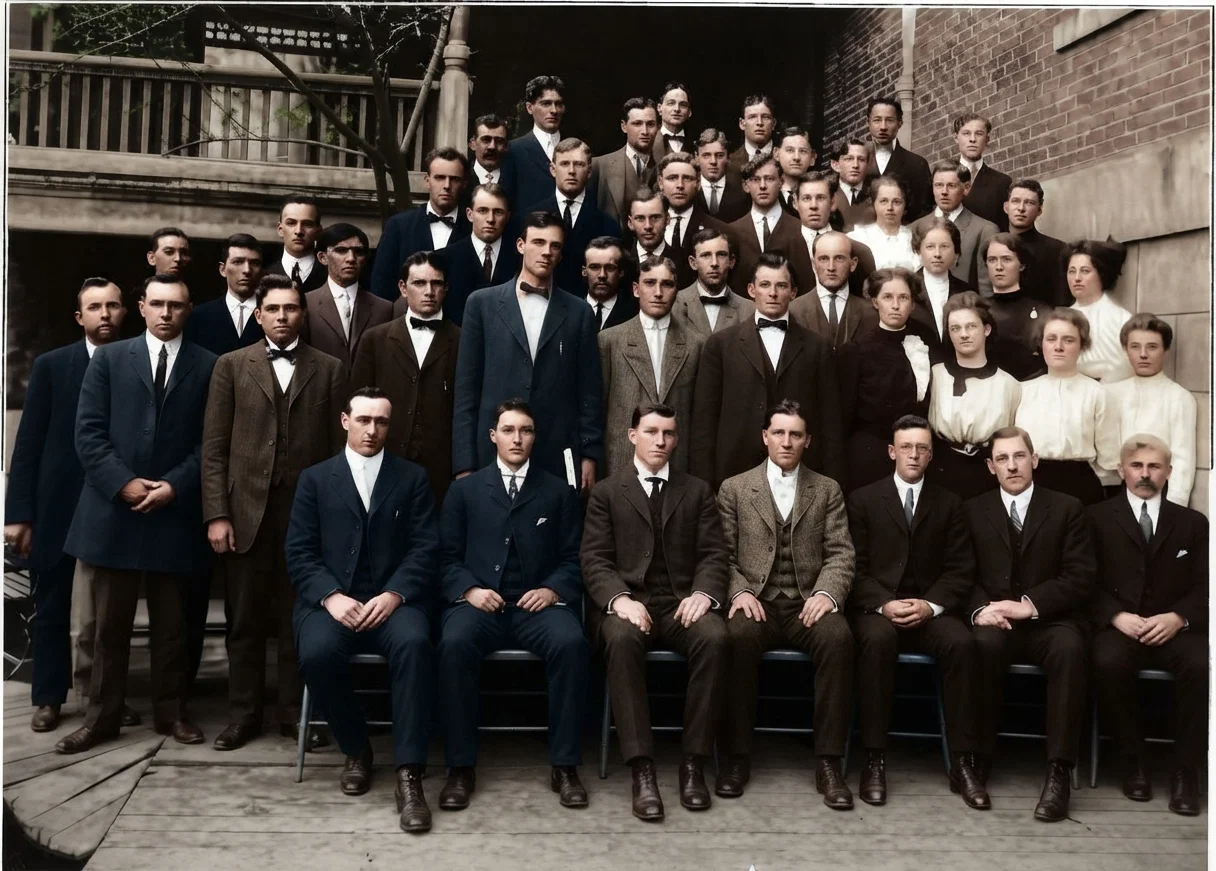
MEMBERS OF THE CANVASSERS' INSTITUTE IN WALLA WALLA COLLEGE
There were about three hundred of our people encamped on the ground. At the close of the meeting, seventeen were baptized in a near-by lake.
The donations of the Sabbath-school for foreign missions amounted to $119, and the people responded liberally to other calls for money to assist in the various branches of the work.
The conference was convened in connection with the camp-meeting, and as Elder J. M. Willoughby had expressed for some time a desire to be relieved from the presidency, Elder A. M. Dart, of the Western Oregon Conference, was called to Idaho and elected to the position of president.
Mr. L. B. Genness, the editor of the Nampa Leader, was very kind, and gave us good reports of the meeting.
A. O. TAIT.
The Walla Walla College Canvassers' Institute
By W. R. Beatty
THIS institute convened just before the close of college, and was the most important one ever held in the Walla Walla College. About thirty-five of the brightest young persons in the college availed themselves of this opportunity to prepare for active service in spreading the message.
The time allowed for institute work was taken up with practical studies and drills. The good attendance and the deep interest of the students in every feature of the publishing work added much to the success of the institute.
Five of the State field agents of the union, together with the union field agent, were present to carry on the work.
The key-note sounded was the pushing forward of the publishing work as a means of bringing the message for this time, in the most practical and speedy manner, to the attention of the two and a half million people of the North Pacific Union Conference. The earnest desire for the salvation of those for whom the Master gave his life, bound the hearts of the students closer together, and all seemed to be of one spirit.
The ability to create a desire in the hearts of the people for the truth, depends upon the worker's connection with the Source of all power. This fact was emphasized, and the workers were shown how to lead the people step by step till they create desire strong enough to bring about decision.
Some of experience were present who told of precious souls that had come into the truth as a result of their labors in selling our books. One young man, although14a cripple from infancy, had recently learned of three families who have embraced the truth through reading "Thoughts on Daniel and the Revelation," which he sold them two years ago.
We are looking forward with much pleasure to the returns in souls as a result of the work of these young people who will enter the field at the close of school.
W. R. BEATTY.
Korea
By Riley Russell, M. D.
I HAVE just been up in the northern part of Korea, where we have interests started in two places. From there I went over into Manchuria, to the barracks of the revolutionary soldiers, and bought two Manchu ponies. They were quite wild, as they had never seen any one but Chinese. I got them for eighty roobles each, the soldiers being anxious for money. I put a saddle on one, and led the other, and we went home in three and one-half days, a distance of 500 li, or 167 English miles. Of course, this is not fast riding, but if you could see a Korean road! I suppose I crossed twenty-five hills or small mountain ranges, forded a great many creeks, and ferried over rivers.
One of the horses is for Brother H. M. Lee to use in looking after the school farm. The other is for me to use in church work, as there are about fifteen churches that I can reach from Soonan by horseback.
After one day's rest, Elder C. L. Butterfield and I started out to organize a church in Chin-Cho-Dong.
Our tithe came up quite well last year, and our churches show good, healthy advancement in all branches of work, which is a source of much encouragement to us.
I have just been having studies with a blind man who has been a Christian for seventeen years, and has a good knowledge of the Bible. He desires baptism and to unite with us.
RILEY RUSSELL, M. D.
Mendota (Mo.) Church
By A. R. Ogden
Dedication and Organization
THE new church at Mendota was dedicated Sunday, June 2. It is a neat little building, twenty by thirty-six feet, with an entrance, and an alcove in the rear, so that the rostrum sets back, leaving practically all the thirty-six feet for seating capacity. Elder E. T. Russell delivered the dedicatory sermon, and the house was filled to overflowing with interested listeners.
Contrary to the regular order, the building was erected and dedicated before a church organization was perfected, as the company of believers was not organized until the following Sabbath, June 8. The erection of the building was somewhat a matter of faith, yet not of faith, for we have been advised that "when an interest is aroused in any town or city, that interest should be followed up. The place should be thoroughly worked, until a humble house of worship stands as a sign, a memorial of God's Sabbath, a light amid the moral darkness. These memorials are to stand in many places as witnesses to the truth. . . . Wherever a company of believers is raised up, a house of worship should be built. Let not the workers leave the place without accomplishing this."—"Testimonies for the Church," Vol. VI, page 100. If this simple and plain instruction had always been carried out in all our denominational activities, how many good strong churches might be in existence at the present time where we now have only scattered fragments as the result of the efforts of the past.
"As persons become interested in the truth, they are told by the ministers of other churches,—and these words are echoed by the church-members,—'These people have no church, and you have no place of worship. You are a small company, poor and unlearned. In a short time the ministers will go away, and then the interest will die down.'" Have we, as workers, been as diligent to give permanency to our work as we should have been? There are ministers in our ranks who have worked five, ten, twenty years, and never left a church building, and but few organizations, in their track. Like the phosphorescent lights in the track of an ocean steamer in the tropical waters, so there should be a streak of churches, as lights, following in the wake of our efforts as ministers.
It is true that in some cases buildings have been erected where they have afterward fallen into disuse because of deaths, removals of members, etc.; but in such cases the property (when it has been properly deeded in trust to the conference) has remained intact to the work of the cause of the third angel's message. Where sales of properties have been deemed advisable, they have brought into the cause much-needed means that would otherwise never have been invested in the Lord's work, as the people of the communities where buildings are erected will nearly always contribute liberally to their erection, so that they can usually be dedicated without much if any debt.
The work at Mendota was begun last summer by Brother E. W. Swap, in a tent effort, assisted by Brother and Sister W. H. Turner. The meetings were continued about fifteen weeks without interruption, Brother Swap not even stopping the work to attend camp-meeting. A public discussion was held in the fall near the close of the effort, with a Church of Christ minister, which we believe helped in establishing the confidence of many in the message of present truth. Immediately after the discussion, Brother Swap began laying plans for the erection of a plain house of worship, laboring very hard all winter with his own hands to the accomplishing of the desired end. While this has called for his constant effort, yet we believe that the time has been well spent, and that more is accomplished to the conference by the raising up and establishing of one church, though it takes months to do it, than by efforts here and there without anything of a permanent nature accomplished. Credit is due Brother Swap for his untiring efforts at Mendota and for his hard work on the church building, all of which is most highly appreciated by the people of Mendota.
A. R. OGDEN.
City Work in the Chesapeake Conference
By Roscoe T. Baer
THE question of how to get the message before the great masses in our congested cities is one of absorbing interest to every believer and worker whose lot it is to live or labor in these centers of population. The recent council for city evangelists, held at Takoma Park, helped to solve many difficult problems, and we believe that the Lord directed in the instruction given.
We have seen a great need in our city work in this conference, and we have often sought the Lord for light and help that plans might be laid whereby more effectual work could be done for those who have not known our message. In our study of this problem we found that the Lord had a plan which is clearly outlined in "Testimonies for the Church," Vol. IX, pages 111, 112:—
"A well-balanced work can be carried on best when a training-school for Bible workers is in progress. While the public meetings are being held, connected with this training-school or city mission should be experienced laborers of deep spiritual understanding, who can give the Bible workers daily instruction, and who can also unite whole-heartedly in the general public effort being put forth. And as men and women are converted to the truth, those standing at the head of the city mission should with much prayer show these new converts how to experience the power of the truth in their lives. This united effort on the part of all the workers would be as a nail driven in a sure place."
In harmony with the counsel from the Lord, we began to look for a suitable location where we could properly organize our city work. We finally secured a large semidetached building in one of Baltimore's beautiful suburbs, easy of access15from any part of the city; and here the conference headquarters and the city mission home are now established. The building is so constructed that the conference office and officials occupy one half, and the city evangelist and Bible workers occupy the other half. On the conference side there is a system of work carried on, with regular hours for work; and on the mission home side, a daily program is carried out, which provides time for devotion, breakfast, Bible study, reports by workers, and for different kinds of city work. Elder F. W. Paap carries the responsibility of the mission home. He has had experience in this kind of work, and we therefore expect good results.
The conference committee spent a day in the city looking for a suitable location, and have approved this combination of the conference-mission home, as well as the location. We can accommodate a few earnest young people who are desirous of entering the Bible work, but who find it necessary to take some training for this work. This training we believe can be given in our mission home, where city Bible work is studied. The large population of Baltimore offers a field for real, practical work along with the studies given.
With this organization of city workers, we expect to see fruits from our labors in the salvation of many more souls than have come to us in the past. Though the cities appear walled up to heaven, yet if we follow out the plan of God, we shall be able to gather out the honest in heart, and the kingdom of Christ will come. What we have been able to do in effecting a combination of city workers in Baltimore, we hope to do for other cities in our field, such as Wilmington, Del., and Hagerstown and Cumberland, Md. The Lord has promised to bless our efforts proportionate to our willingness to walk in the light of his counsel.
ROSCOE T. BAER.
Spartanburg, S. C.
By C. G. Manns
WE began our tent-meetings on the second of May, with a good attendance. The interest is still good. As a result of our meetings, nine have connected with us. Seven of these have become members of the Sabbath-school. When the writer came to Spartanburg, there was no regular Sabbath-school; now our membership is twenty-three. The prospect for future success is encouraging.
We also have an interest about four miles in the country, where the members of our tent company go every Sunday to conduct a Bible reading. Last Sunday there were about thirty or forty present. We hope to bring out a number of Sabbath-keepers. We need your prayers.
A word in regard to our camp-meeting which will be held for the colored people in Orangeburg, S. C., August 29 to September 9. Let not any of us say that we are too poor to attend this meeting. Have faith in God. Plan to come, and work as you plan. You who have never attended a camp-meeting, make this one your first, and you will not wish to miss another. Bring your children. Let us call a solemn assembly and sound an alarm in Orangeburg, and let its inhabitants know that the coming of the Lord is near. We shall give further information about the meeting later. Get ready for the camp-meeting.
Our tent company is composed of five workers, who were formerly Oakwood students,—C. G. Manns, minister in charge; W. E. Strother, assistant; Miss Louise Lawrance, organist; Mrs. Mamis Strother and Miss Lillian Saxon, magazine sellers. C. G. MANNS.
What Can Be Done in Six Months' Time
By David Paulson, M. D.
SCATTERED all through our ranks are mature Christian women whose children are grown up, so they are largely free from home cares and responsibilities. Some of these women are beginning to realize that unless they plunge into active service for others, their interests and usefulness will shrivel up long before their Creator intended. But they feel handicapped because they lack a practical training. They do not feel that at their age they can undertake several years of preparation.
Again, there is a large number of consecrated Bible workers in our midst who are fully aware that in recent years we have been instructed again and again that they should be prepared not only to open the Bible to the people, but also to give instruction in healthful living and to treat simple disorders. They know from personal experience that very often it has been difficult for them to secure entrance into the homes of the people; but that, if when the heavy hand of sickness has laid some loved one low, the Bible worker was prepared to minister to the sick one, she not only would be welcome, but she would have a tenfold better opportunity to reach that family with the truth for this time. But the majority of our Bible workers feel they have neither the time nor inclination nor, in some cases, the necessary strength to spend three years in one of our sanitariums taking a full nurses' course.
Furthermore, there are hundreds of other earnest, wide-awake Seventh-day Adventist sisters who are beginning to realize that they need a training of some kind if they are properly to represent the third angel's message before their neighbors.
Two years ago my attention was providentially called to a very excellent six-months' training course for domestic nurses, which had been organized by a prominent physician in Albany, N. Y. It was his purpose to give a practical nurses' training in these few months' time, to fit women to go into the homes of the sick poor who could not afford to pay the large prices that are now demanded by the ordinary trained nurse. His work had already been indorsed by the governor of New York, the State medical society, and by leading citizens who recognized that these domestic nurses were filling a great need.
Knowing from personal experience the enormous opportunities for just this class of workers in our large cities, I felt strongly impressed that if we could organize a similar short course, laying special stress upon the sanitarium methods of treatment, and at the same time combine with it live Bible instruction, it might prove a tremendous factor in solving the problem of our large cities; for when it is remembered that the population of Chicago increases a hundred thousand each year, it can be readily seen that the regular conference force of workers can not accomplish what should be done.
We leased the old branch sanitarium on the South Side, which under most providential circumstances was built by Elder Geo. B. Starr and his associates nearly twenty-five years ago for a Chicago training-school for Bible workers.
A year ago last October the first class was organized. The majority of this class was composed of women belonging to our Chicago churches, who saw in this a valuable opportunity to enlarge their field of usefulness in the immediate vicinity of their own homes. The Lord added his signal blessing to the effort from the very beginning. His Spirit was manifestly present through the entire six months. Although many of these sisters have important home cares, they have been gratified to find that this course of training has opened doors of usefulness to them of which they little dreamed.
Last October a class of twenty-four was begun, many of whom were from adjoining States. Several of these students were already successful Bible workers, some were well-seasoned magazine workers, and others had had extensive experience in various ways in building up the Master's kingdom. The majority of them had had sufficient experience in missionary work to appreciate the rare opportunity they were enjoying, and they took hold of the class work with the utmost enthusiasm. It was the unanimous testimony of the teachers that they had never instructed a more studious and earnest class. The Spirit of Christ seemed to hover over every session. The majority of the students spent some portion of every day in some form of practical missionary work. They disposed of more than one thousand dollars' worth of magazines in the homes of the people, and thousands of tracts were circulated. Bible readings were held, any number of treatments were given to the sick, and doors were opened for the gospel to enter.
No charge was made for tuition. Students were given room and board in the institution at actual cost, or three dollars a week. In most instances the members of the class managed to be self-supporting,—from the sale of magazines, from what they earned by treating the sick who could pay, and in other ways.
During these six months, 120 Bible lessons were given; 32 lessons in anatomy, physiology, and hygiene; 24 lessons and demonstrations in hydrotherapy; 24 hours were devoted to instruction in practical bedside nursing; 15 to the principles and methods of treating simple diseases; 8 hours to bandaging, surgical nursing, and to what to do in accidents; 9 hours to dietetics and cookery; 8 hours to the care of obstetrical cases. In addition, members of the class had opportunity under the supervision of our doctors to help to care for this class of cases among Chicago's poor.
This six months' course of training opened up an entirely new world of missionary opportunity to some who saw no chance for them to have an opportunity in active, aggressive missionary warfare.
The next six months' course will begin the first week in October. The times demand that a large number of our laity shall secure a speedy training for immediate service, for God will have a quick work done in the earth. Steps are being taken for the establishment of similar courses for practical training in various large cities; but meanwhile it would be well for all those who can do avail themselves of this unique opportunity offered here in Chicago.
It is expected, as far as Providence so directs, that those who come from other parts of the country should return again to their home fields to put in active practise the principles and experience that they have acquired while taking this course of training. Those who are interested and desire full printed information may secure the same by addressing the writer at Hinsdale, Ill.
It is, of course, unnecessary to add that only those need to apply who have a definite Christian experience, and a real desire in their hearts to bring the saving gospel of Christ for this time to the attention of their fellow men.
DAVID PAULSON, M. D.
A Mohammedan of Rank Studying the Bible
ONE of our missionaries near Calcutta relates the following incident:—
“Sukejon, a Mohammedan of the better class, came to me for Bible study. He said: ‘I want to know the true way. Let me hear what your Bible has to say, that I may know if truth is found therein.’
“I laid aside my usual habit of prayer before the first study, fearing I should startle him. As we took up the prophecy of Jesus' first coming, the greatest interest was manifested; and at its close he asked if we could not have prayer, that God might show him his will and give him strength to obey.
“He is fearful that his wife, a strictly purdah woman, and his child will be taken from him by her parents as soon as it becomes known that he is searching the Bible for truth.”