The Youth’s Instructor, Vol. 47, No. 22.

THE HAGUE

The Youth’s Instructor

Jun 1, 1899

Review and Herald Publishing Company · Battle Creek, Mich. · Jun 1, 1899

THE HAGUE.
It seems as if the prophet Jeremiah must have had a view of our day when he spoke of a people saying, “Peace, peace; when there is no peace.” Not many months ago there was proposed a peace and disarmament conference of representatives from the leading nations of the world, with the ostensible purpose of bringing about universal peace, and yet at the same time the very ruling power that has proposed and furthered this move has been, and continues to be, the most eager and active in extensive preparation for war. What, then, did the czar of Russia, that most despotic of all civilized rulers on earth, mean by his proposed “peace conference”?
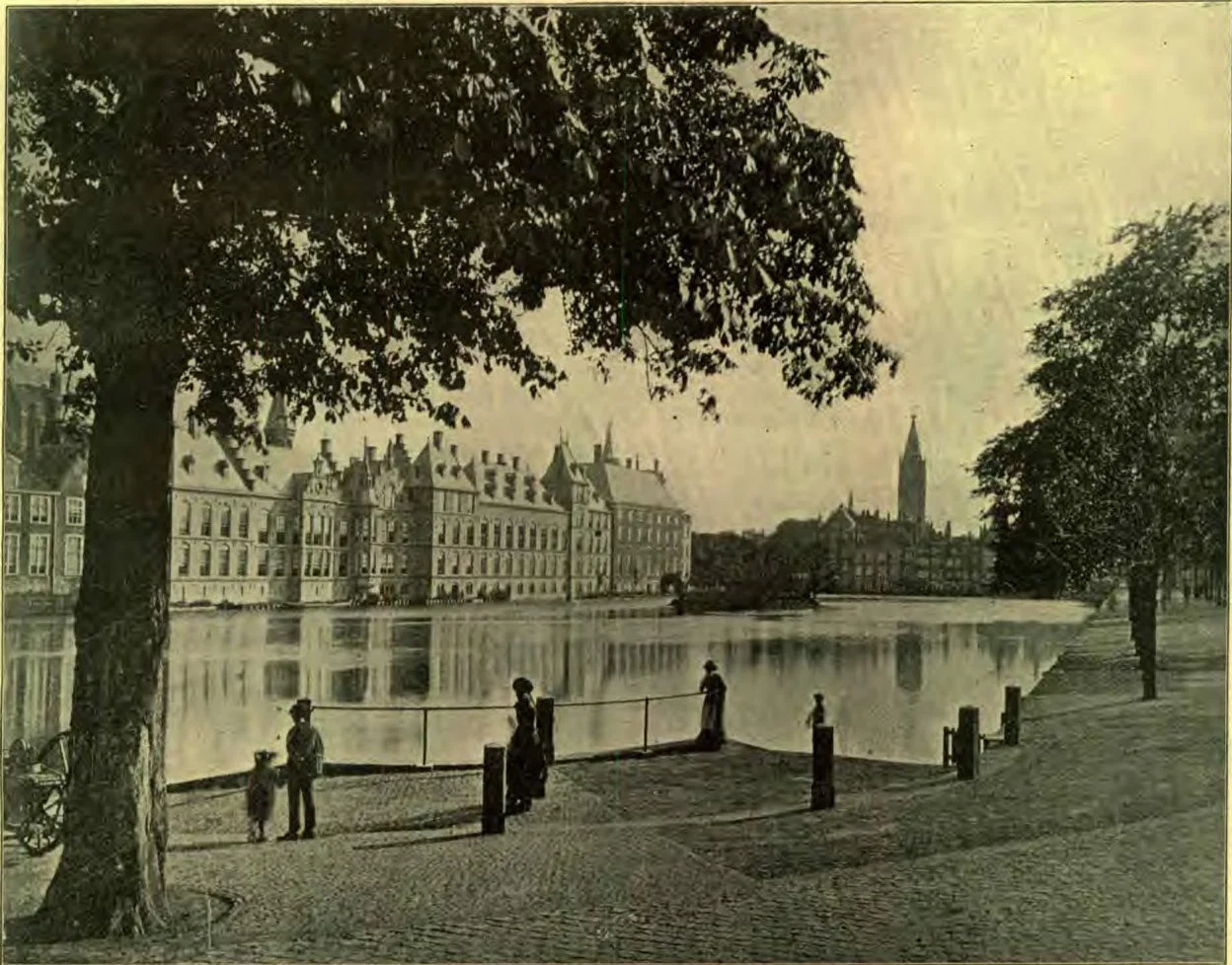
VIEW OF VYVERBERG.
VIEW OF VYVERBERG.
The 18th of May was the day when this peace conference convened. It was made up of delegates from all the leading civilized powers of the world. Our own government sent no fewer than six prominent men to represent its interest in bringing about that much-desired universal peace. There were Andrew D. White, educator, historian, and diplomat; Stanford Newel, a typical Western citizen; Seth Low, administrator; Alfred T. Mahan, interpreter of naval history; Captain Wm. Crozier, military inventor; and Frederick W. Holls, lawyer.
The place selected for this extraordinary convention was the beautiful city of The Hague, in southern Holland; and the purpose of this article is to give the readers of the INSTRUCTOR some idea of this noted place. It lies about thirty-six miles from Amsterdam, thirteen miles northwest of Rotterdam, and two miles inland from the North Sea. In 1874 the total population was stated at 94,895.
Though Amsterdam, from its size and importance, is looked upon as the commercial capital of Holland, The Hague is the real governmental capital, being the residence of the ruler and the foreign ambassadors, and also the place for all diplomatic and legislative assemblies, in this respect corresponding to our Washington, D. C. On account of its political character, the population is largely made up of government officials, members of the nobility, and of the army and the navy. Broad, regular streets, extensive avenues and drives, and spacious squares, all beautifully lined with trees, also numerous shady canals, large and beautiful buildings,—these, in brief, constitute the general features of the city. It is described as “the handsomest, the most fashionable, and the most modern-looking” city in the Netherlands.
The Hague is mentioned as early as 1097 in a document by Count Floris II, and seems originally to have been a shooting-lodge, or hunting-park, of the counts of Holland. During the reign of William II it became the residence of the court. In the fifteenth century it attained the importance of a town, though frequently called a village, even down to the time of Louis Napoleon. In 1479 Austrian soldiers put the place to ransom; in 1525 Johannes Pistorius suffered martyrdom there; in 1528 it was plundered by the people of Guelderland; and in 1572-4 it was laid waste by the Spaniards. In 1576 it was restored by William I, and became, in 1584, the seat of the sessions of the states of Holland. Important conventions of European powers have been held at this place from time to time. In 1808 it became the seat of the government administration. Such, in brief, is the history of The Hague.
In the center of the city stand the buildings of the court, the oldest of which date back as far as 1249. A beautiful Gothic building, with towers at each corner of the façade, contains the historic knights’ hall, a noble chamber one hundred and thirty feet in length, sixty-two feet in breadth, and sixty-nine in height. Among the public institutions may be mentioned the royal library, with upward of one hundred thousand volumes, and a valuable collection of manuscripts, coins, and gems; the museum, with many wonderful antiquities and curiosities; the royal picture-gallery; the Vyverberg hotel, which also has a fine collection of curiosities; the town museum of antiquities and modern art; the zoological gardens, founded in 1862; the royal school of design and music; and the new buildings for arts and sciences, erected in 1874. Of the twenty or more churches, the Groote Kerk (Great Church) is architecturally the most noted, being three hundred feet long and one hundred and fifty-four broad, with a lofty hexagonal tower, in which is a carillon of thirty-eight bells. This church was founded in 1308. The country around the city is embellished with many handsome residences.
The industries of the city are printing, lithographing, metal-founding, silk-dyeing, carriage-building, cabinet-making, distilling, and a few others.
From the city leads a broad causeway, beautifully skirted with trees, to Scheveningen, a favorite bathing-place on the seacoast.
From a large book on the world’s great nations we quote the following:—
“Notwithstanding the drawbacks of its situation, it is a splendid town; the public buildings are stately; the streets broad and regular, well paved with small bricks, traversed by canals, crossed by bridges, and lined with trees; and surrounded by a moat with drawbridges. The principal streets are the Voorhout, containing many fine hotels; the Prinsengracht, Kneuterdyk, and Noordende. A trifling rise of the ground here, dignified with the name of a hill, forms the site of the Vyverberg (the hill of the pond), which is a square, planted with trees in formal avenues on one side, forming the public promenade, with the pond on the other. . . . Tame storks are seen parading about the fish-market; and a residence something like a dog-kennel has been built for them.”
Between the Vyverberg and the Binnenhof lies the prison gate-house, in which Cornelius de Witt was confined on a charge of conspiracy against the Prince of Orange in 1672, and whence an infuriated mob dragged him and his brother John, who had been induced to visit him, and murdered them in a most inhuman manner, literally tearing them to pieces. The humble dwelling in which the elder of these brothers lived stands within a few yards of this spot, in the Kneuterdyk. A. SWEDBERG.

LOVE'S LABOR-LIGHT.

We live to love and labor. Labor does not beget love, but love insures labor. Love can not be idle; for labor is the joy and life of love. Love does not merely labor, but delights in labor. Love goes about doing something,—doing good,—and she goes, too, with buoyant feet and a glad heart. All true labor is a self-sacrifice, is done for God and our neighbors. In this,—self denial, doing, toiling, for the good of others,—Love rejoices greatly.
If we would live truly, if we would live greatly, we must work, and work hard. God has given to every man his work. Work or starve—starve physically, starve mentally, starve spiritually—is nature's sternest law. But the same kind Father has provided for us the oil of gladness with which to make life's labor smooth, easy, and even delightful. Love does not look upon labor as an evil to be endured, but as a blessing to be enjoyed. Of course mere work, without the fragrance and sweetness and brightness and inspiration of love, is irksome and galling enough. But love takes the most menial service, and transfigures it into a thing of beauty, and makes it a joy forever.
First, I must love Him whose love has called me to labor; then his yoke will be easy, and his burden light. Our gracious Father would have us enter his vineyard, not as mere servants, but as sons. The hireling, the mercenary, in quest of the loaves and fishes, working only for wages, has put his neck under a yoke of bondage,—a yoke that ever chafes and galls. He never sings over his work; for his heart is far from it. His daily work is a daily drudgery, a grinding slavery, from which he yearns to escape. He is a slave simply because he refuses to be lifted up into the glorious light and liberty of the Father's love. Let him once open his mind and heart to the light and warmth and power of his Master's love; and that same love will lift him in triumph from the dark dungeon of the slave into the free, glad sonship of his Father's house. Dwelling in God, he dwells in love, and henceforth labors in love; and love makes his labor one grand, sweet song.
Love lightens, love lifts, love lets the oppressed go free. Love does not release from toil, but makes toil delightful. Jesus went about doing good, and left his footprints stained with blood; but the song and the trumpet were always in his heart. Love enabled the disciples to count it all joy that they were thought worthy to suffer shame for his name's sake. The soul that labors in love is always jubilant with music. What a spring in his every movement! what a sparkle in his every look! what interest, what eagerness, what hope, fill his soul! The self-sacrificing labor of love will experience some pain, but the pain only serves to give emphasis to the joy. Shall we not, then, put our hearts into the homely duties of our workaday life,—strike them through with the light and fire of love, and thus invest them with that charm, that beauty, that dignity, which ennobled and glorified every act in the one perfect life that this world has seen?
Again: no one can do well what he does not do gladly. Delight in what we do is not a mere luxury, it is a necessity for the more perfect doing of our work. A happy mind is a fertile mind; a glad hand is a deft hand. The exquisite finish of the artist's work is due to the fact that the real artist is in love with his work; he rejoices over it. He begins each day's work eagerly, and leaves it regretfully. It is his meat and drink. This thorough enjoyment of his work deepens his insight, sharpens his wit, whets his ingenuity, quickens his eye, and puts cunning into his hand. To hate one's work is to lose nine tenths of one's power for doing it effectively. Love, making all things easy, delightful, does all things well. Jesus is love, and of him it was said, “He doeth all things well.” GEORGE W. RINE.

MAKING HOME PEACEFUL.

XXVI.

What is it that sometimes, in hours of extreme danger, or moments of unusual trial, comes to us as with a message of warning,—a premonition of impending trouble? Who can say but it may be the touch of the angel whose especial mission it is to watch over us? Who knows but it may be a faint whisper from his sacred lips, which reaches our inner consciousness, and in some mysterious manner impresses its message of warning upon our hearts?
“Wait, James! Let me go down,—I must go!” she exclaimed, springing from her bed in nervous haste.
“Why, Ellen! I’ll go, of course; what’s the matter? You’re nervous; you’ve been working too hard to get Regie ready to go. You’ll be sick if you’re not careful; now go back to bed; it’s quite cold in the room. You need not be alarmed at all. I presume it’s John Dillon, on some little matter of business: he often comes late, you know. I’ll soon be back,” he continued, reassuringly, from the top of the stairs.
Ellen Beardsley sank back upon her pillow and listened. For a moment that seemed an age to the overwrought woman; she could hear nothing but the loud beating of her own heart. Then she was sure she heard Reginald’s name and an exclamation of astonishment from her husband.
It was the work of but a moment for the excited woman to throw a shawl about her shoulders and follow her husband. She reached the door of the hall just in time to see him partly lead and partly drag a seemingly half-insensible form across the room to the sofa.
“James! James! is it my boy? What has happened? What is it? Tell me, Reginald! O have pity on me! Are you hurt? Has he been hurt, James?”
Her only answer was a stupid stare, accompanied with an oath, and an unintelligible medley of words, uttered with a thick tongue.
“Do I live to hear my son curse me? James! James! I can not bear it!” moaned the wretched woman, wildly wringing her hands, and falling upon her knees by the side of the half-unconscious lad.
Already the nauseating smell of liquor has filled the room, the warmth of which is beginning to tell on the poor boy with sickening effect. Reader, let us draw a friendly curtain over this scene. Heart-breaking as it is, there is many a home that has witnessed its counterpart; many a mother’s heart that has felt the numbing pain, the anguish unspeakable, that Ellen Beardsley felt that night. Many a loving father has trembled under a burden of like anguish, as he felt that he was draining to the dregs the cup of bitterness.
It is nearly noon of the next day before, thoroughly sobered and chagrined, the boy awakens. His head is aching still; but as he sees his well-packed trunk standing in the hall, his desire to go is as strong as ever. But he rightly judges that his father will be more determined than he has ever been not to trust him away from home. He is heartily ashamed of his conduct, and deeply regrets yielding to temptation. At last he decides that he will humble himself before his father, and ask him to forgive his folly when he comes home to dinner. This is an unusual resolution for the self-willed youth to form, but he sees no other way out of the trouble. Still he fears that his father will not have confidence enough in him to give him money, and allow him to go. If not, he decides so to work upon his mother’s sympathies that she will give him the needed amount; or, should all else fail, he will help himself.
James Beardsley was gratified beyond words to see that his son appeared to sense the shame he had brought upon them, and listened eagerly to his expressions of sorrow and his fair promises. And indeed there was a deal of sincerity in them; for Reginald was not yet altogether hardened in evil, and his sorrow and shame over his conduct were not wholly feigned.
“Uncle Earl will expect me to start to-night, father,” he urged; “and I can never do any better as long as I stay here; if I can only get away from the boys, I shall be all right.”
“I guess he’s right, James,” said his mother, sadly. But it was plain to see that she did not speak with her usual assurance. For the first time in her life she questioned the wisdom of her course in training her son. So James Beardsley thought the matter over, and prayed over it earnestly, and finally decided that perhaps it would be as well for the boy to go.
Nevertheless it was a sad home-leaving. Flossie sobbed convulsively: the strong, impulsive lad had always loved the little sister for her very weakness. She clung to him now, until papa unclasped the little white arms gently.
“Brother must go now, little sister. Good-by.”
Then the child placed one tiny hand lovingly on the jetty locks, and said, tremulously: “Flossie’s going to ask God to let a pretty angel go with Regie, and I guess it won’t ever leave him.”
“God grant it!” said James Beardsley, earnestly.
Everything went on in about the old way, after Reginald left; and now the snow and ice of winter have melted away, and the early spring violets lift up their brave little faces cheerfully to the passer-by, as if to say: “See! here we are again. God is good; if he remembers us, surely he will not forget you.”
Frequent letters from Reginald, and one occasionally from Uncle Earl, told pleasant stories of the absent boy’s prosperity, of his diligence in school, and of his success with his studies, until finally James Beardsley began to hope that his fears had been quite unfounded. But unaided human nature is utter weakness.
One morning Grandmother Sharpe awakened with a severe pain in her side. She was almost always strong and well; and as is usually the case in such instances, she feared and dreaded the least symptom of disease, which she watched with wonderful solicitude. But as the weary hours dragged by, it became evident that the poor old woman’s case was really serious. She rebelled all day against calling a doctor, on the ground that it would make her appear very ill. There was one thing rather remarkable about her,—it mattered not how querulous and disagreeable she might be in health, it took but an hour or two of pain, or even of indisposition, to render her so kind and good-tempered that the contrast was wonderful. This instance was no exception to the rule. Whether it was fear of death that prompted these sudden reformations, or a real desire to make as little trouble as possible, no one could tell; but let us hope it may have been the latter.
MRS. L. D. AVERY-STUTTLE.
(To be continued.)

Speaking Simple Words to the Weak

“It may be glorious to write Thoughts that shall glad the two or three High souls, like those far stars that come in sight Once in a century; But better far it is to speak One simple word, which now and then Shall waken their free nature in the weak And friendless sons of men.”

THE SNAKE AMONG THE BOOKS.

Not long ago I read of a military officer in India, who one day went to his library to get a book, which he found wedged in between two large books. In moving one of these, he felt a slight pain, like a pin-prick, in one of his fingers. As he turned the book around, to examine it, a small snake was dislodged from its hiding-place. With one dash of his military boot, the snake was killed, and the incident was forgotten until, a few hours later, the officer felt a slight pain in his arm, and noticed that his finger was beginning to swell. In two days he was dead.
There are many snakes among books. They are coiled within the leaves of the pleasing story-book; they are lurking in books for girls, for boys, and for older readers. At first one may not realize that he has taken poison into his mind; but it will make itself felt. Do not think that because a book has a taking title or a pretty cover, it will do you no harm. Too often a poisonous snake lies coiled within, ready to sting. The serpents of infidelity, discontent, disobedience, Sabbath-breaking, and many others, lie coiled between the covers of fictitious books. There are many more good books than you can ever read; then why waste the time given you in reading that which will finally destroy both soul and body?
MRS. MARIETTA CARPENTER.

WHAT TO CULTIVATE.

An unaffected, soft, distinct, silver-toned voice. The art of pleasing those around you, and seeming pleased with them and all they may do for you. The charm of making little sacrifices quite naturally, as if of no account to yourself. The habit of making allowances for the opinions and prejudices of others. An erect carriage and a sound body. A good memory for faces and facts connected with them, thus avoiding giving offense through not recognizing or bowing to people, or saying to them what had best be left unsaid. The art of smiling at the twice-told tale or joke. A generous heart and hand for all in distress.—Selected.

THE WANDERER.

Upon a mountain height, far from the sea, I found a shell; And to my listening ear the lonely thing Ever a song of ocean seemed to sing,— Ever a tale of ocean seemed to tell.
How came that shell upon that mountain height? Ah, who can say Whether dropped there by some too careless hand, Or whether cast when ocean swept the land, Ere the Eternal had ordained the day?
Strange, was it not? Far from its native deep, One song it sang,— Sang of the awful mysteries of the tide, Sang of the misty sea, profound and wide,— Ever with echoes of the ocean rang.
And as the shell upon the mountain height Sings of the sea, So do I ever, leagues and leagues away,— So do I ever, wandering where I may,— Sing, O my home! sing, O my home! of thee.
— Eugene Field.

PACK-ANIMALS IN MEXICO.

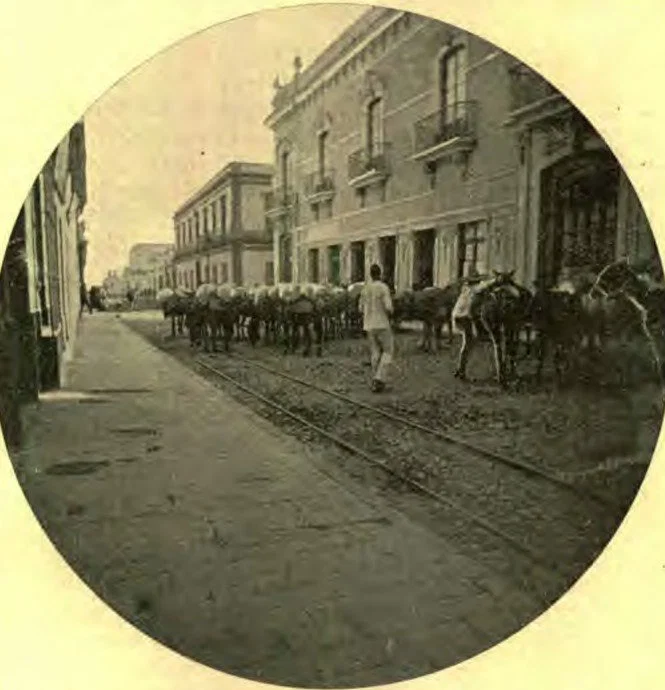
The accompanying illustration represents a pack-train of mules, laden with corn, ready to start overland. Owing to the scarcity of railroads, and to the mountainous surface of the country, merchandise, machinery, and agricultural and mineral products are largely transported on the backs of horses, mules, and burros. Mules are more used for this purpose than burros, and burros more than horses. Mules and horses travel about twenty miles a day, with a load of from three hundred to three hundred and fifty pounds; and a burro travels forty miles, with about one hundred and fifty pounds’ burden.
A well-padded pack-saddle is strapped tightly on the animal, and the load is made into two bundles of equal weight. The mule or horse is blindfolded, so he will not move away as the load is being lifted and secured with rawhide ropes by two muleteers. The mule soon learns to brace himself with his feet, in order to preserve his balance when the load is being put on his back.
Two mounted muleteers have charge of ten or twelve animals, and they are kept busy hastening from one animal to another, and adjusting the packs, which frequently become disarranged by the mules’ running against one another, lying down, or grazing by the wayside.
The pack-animals are put out to graze, when the end of the day’s journey brings them to a country town or village; and when they come to a large city, they are put into an enclosure in an inn-yard, and fed straw and corn.
Some of the Indian charcoal-burners carry a load of one hundred and fifty pounds of charcoal on their own backs, as they drive their laden burros to market. The women, who go with the men to make purchases at the market, sometimes carry seventy-five or one hundred pounds of charcoal in this way.
The Bible colporteurs in this field carry their stock of Bibles and Testaments through the country on the backs of animals.
ALFRED COOPER.

THE ALLSPICE-TREE.

The allspice of commerce is the half-ripe fruit of the beautiful West Indian pimento tree. This tree belongs to the myrtle family, and grows to a height of about thirty feet. It has a straight trunk, covered with smooth bark, and leaves of dark, shiny green. The small white blossoms are very fragrant; and during July and August, when the trees are in bloom, the air is filled with their perfume.
It is next to impossible to propagate the young plants, or to raise them from seed where they do not grow spontaneously. When a new grove is to be formed, a piece of land near an old grove is chosen, and the timber on it cut down, but left on the ground for a year or two, to protect the young plants. At the end of that time it is cleared away, and the strongest plants are kept. They come to maturity in about seven years.
When the season is favorable, as much as a hundred pounds of dried spice is sometimes gathered from a single tree. The berries are picked when green, and dried in the sun for ten days, changing, during this time, from green to a reddish-brown color. The flavor of the pimento berries is thought by some to resemble that of cinnamon, nutmeg, and cloves; and from this fact it is called “allspice.”

FIVE MILES ABOVE THE EARTH.

A MOST interesting balloon ascent was made in September last by Mr. Stanley Spencer and Dr. Berson, when they succeeded in reaching an altitude of twenty-seven thousand five hundred feet.
When released, the balloon shot upward at a great rate, and the two men quickly found themselves at an altitude of two miles above the earth. At that height they could plainly hear the barking of a dog.
Up went the balloon, and the air became colder and rarer. At a height of three miles the thermometer registered seventeen. At four miles the temperature was two degrees below zero.
They could see the English Channel, and towns on the English and French coasts, with great distinctness with the naked eye.
Up to twenty-five thousand feet there was no difficulty in breathing; but above that height, dizziness was felt, and suffocation seemed to be near, and they were obliged to put the tubes of the oxygen inhalers into their mouths. Then a feeling of great buoyancy succeeded.
At twenty-seven thousand feet they were miles above the flights of the highest birds. The few thin cirrus clouds which they had sighted at a height of four miles were now below them, and there was nothing above and around them but an immense expanse of the deepest indigo blue, and a setting sun so dazzling in its brilliancy that they could not bear to look at it.
They now felt the effects of the terrible cold; their beards were crusted with frost; their faces were pale and bloodless. At twenty-seven thousand five hundred feet the temperature was twenty nine degrees below zero. If they hoped to bring the balloon safely to earth, now was the time to start on the return journey.
The descent was begun. In order to avoid the sea, Mr. Spencer pulled the valve, which so accelerated the descent that it was necessary to discharge ballast.
When they had dropped another mile, and had reached a denser layer of air, so that the rate of descent was decreased, the sand thus thrown out came pattering on the balloon. It had just caught up with them.
They reached the earth in safety, after an aerial trip lasting one hour and fifty minutes.—Saturday Evening Post.

AN ODD NEST.

THERE is said to be, in a museum in Solothurn, Switzerland, a bird’s-nest made of steel. There are several clock-making establishments at Solothurn, and the broken or imperfect clock-springs are thrown aside. A pair of enterprising wagtails discovered this material, and made their home almost entirely of it. The nest was more than four inches across, and so lined as to be very comfortable.

The Richness of Moral Goodness

“THE world was never impoverished in virtue by moral millionaires. The more each man accumulates of goodness, the richer we all are.”

PATTERN-MAKING

Our lesson this week is on making patterns for the foot-lathe spoken of in the previous number.
The trade of pattern-making is a good one, not only because it is pleasant work, but also because a first-class pattern-maker always commands good wages, and instead of having to seek employment, his services are in demand. The work is light; but it requires painstaking, and a workman who can readily understand a draft. It is well for boys who are interested in the use of tools to have some knowledge of this kind of work; for many times they can put it to good use in repairing some piece of household furniture. For instance, many times the grate to a cook-stove burns out, rendering the stove almost useless; but if one can make a pattern, he can get a new grate cast at a foundry, which, in its proper position makes it as good as new again.
In making patterns you need first to know something about the shrinkage of metal. A pattern-maker's rule is always one eighth of an inch longer to the foot than a carpenter's rule. All patterns that are required to fill a certain space must have this addition to size.
One who has never worked in iron hardly knows what can be done with cast iron. I have worked a good deal in a machine-shop and foundry, molding and making iron. At one time, when wanting a quantity of shafting for the shop, we made it of cast iron, in sections eight feet long and three inches in diameter. In cooling, some of it sprung an inch; but by peening (repeatedly striking) it upon the concave side, we straightened it.
My first experience in pattern-making was when I was about thirteen years old. I wanted to make a model for a trip-hammer; so I made my patterns for a drive-wheel, which had to be made in sections, and went out to the sand in the garden, and started a small foundry, using lead instead of iron for my castings. I had no thought then that I should ever work in a foundry; for at that time I had never seen one. All the knowledge I then had of one was imparted to me by a cousin. It is a good plan to study up these things, in order to be ready for any emergency.
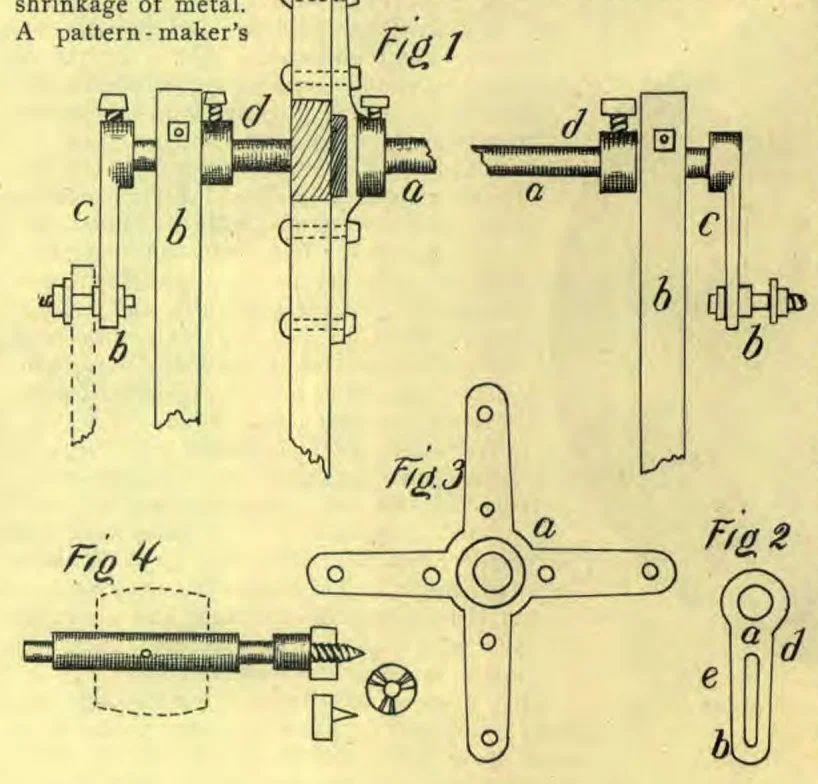
Now for the lathe patterns. In Fig. 1 you will see the shaft mentioned in the last article, broken in two at a, a. At b, b are the two end planks in which the shaft revolves. Upon each end of this shaft, at c, c, you will see a crank made of cast iron. In Fig. 2, d represents the face side of the crank. This crank should be about eight inches long, two and one-fourth inches wide at the largest end, with a hole in the center seven eighths of an inch upon the smallest end of the hole, which, by giving one-sixteenth-inch draft, makes it one inch upon the other side. At e, three fourths of an inch from the end of the pattern, you will notice a slot three and one-half inches long, and one-half inch wide. This gives place for the bolt to the treadle-rod to move up or down in adjusting the length of the tread.
In Fig. 3 you will see what is called the spider, in the center of which is a round ring two and one-half inches in diameter. At a this is placed upon the arms, which are made of two pieces twelve inches long, two inches wide in the center, and an inch and a half wide at each end. The ring should be made one inch thick, so that when placed upon the arms, it will be an inch and a half thick where the hole is made for shaft. Make the hole seven eighths of an inch upon one side, and one inch on the other. Make half-inch holes through the arm-pieces for bolting spider to driving-wheel.
At d, d, Fig. 1, are shown some movable collars for keeping the shaft in place. The pattern for these should be one inch thick and two and one-fourth inches in diameter, the center hole the same as in the spider.
In all these you will see a set-screw, as shown in Fig. 1 at d, d, so that when the holes are drilled out or filed to fit the shaft, the screws will hold them in place. File a little flat place in shaft for screws to rest upon to prevent their turning upon shaft. Now taper or bevel the edges of all your patterns about one sixteenth of an inch, placing the large size of hole upon the narrow side of patterns.
In the end of crank, c, at b, is a bolt with double nut for holding it in place in slot, e, also a nut and washer; or you can drill a hole, inserting a washer and a cotter-pin to hold the rod in place.
The mandrel is shown in Fig. 4. It is made with a screw upon the end, and the nut has three projecting spurs to hold the wood for turning.
This article is already so long it will be necessary to reserve for our next study the finishing up of patterns, making cores, moldings, etc.
W. K. LOUGHBOROUGH.

THE ANGELS CAME TO TOWN.

People tell the story yet, With pathos of regret,— How along the streets, one day, Unawares, from far away, Angels passed, with gifts for need, And no mortal gave them heed. They had cheer for those who weep, They had light for shadows deep, Balm for broken hearts they bore, Rest, deep rest, a boundless store; But the people, so they say, Went the old, blind, human way,— Fed the quack and hailed the clown, When the angels came to town.
It has been and will be so; Angels come, and angels go,— Opportunity and light,— 'Twixt the morning and the night, With their messages divine To your little world and mine; And we wonder why we heard Not a whisper of their word, Caught no glimpse of finer grace In the passing form and face; That our ears were dull as stones To the thrill of spirit tones, And we looked not up, but down, When the angels came to town.
— Alfred J. Hough, in Christian Herald.

BREATHING EXERCISES.

If the subject of physiology is reverently regarded, light will come to those who study; and they, in turn, will be channels of light to others. Statistics show that all children breathe with the diaphragm until about the age of fourteen, when girls change from abdominal and costal breathing to upper-chest breathing.
In breathing-exercises the easiest way to learn one's anatomy, and locate the lateral and forward action of the ribs and abdomen, is to practise the movements in a reclining position until control is obtained of the diaphragm. This can easily be done on retiring at night, and before rising in the morning. Lie on the back, and place one hand on the chest, and the other on the abdomen. Slowly exhale, emptying the lungs; then through the nostrils draw in a deep, full breath. The chest should remain passive during the exercise, but the ribs should be thrown out sidewise, and the abdomen forward and up. Begin breathing-exercises by exhaling. Inhale and exhale slowly.
Another exercise may be taken thus: Gently compress the ribs with both hands as exhalation occurs; then inhale deeply, still compressing the hands, so that when the lungs are full, the hands will be far apart. This exercise is valuable in strengthening the intercostal muscles and educating the action of the diaphragm. Persistent practise will enable one in a short time to use the diaphragm intelligently. The study of the action of this muscle shows that as it descends (flattens out), the ribs expand, and suction draws the lungs down. In expiration the diaphragm rises, pushing the lungs up with it. The muscular contraction of the abdomen in and out and sidewise is helpful in gaining control of waist-breathing. When control is obtained lying down, the exercises may be taken sitting, and then in a standing posture.
The following exercises are arranged for home practise: Sit on a low, comfortable chair (a camp-chair is good), erect, with the back unsupported; chest well up; arms at side. Empty lungs first; then slowly inhale, raising the arms sidewise until they are even with the shoulders. Allow the hands to droop at the wrist as the arms rise. Hold the breath a second, swelling the waist out full by muscular effort, then gently lower the arms, hands bending upward at the wrist as the arms descend. Exhale with this arm-movement; take care to keep the chest passive and well up. Notice that the abdomen swells and recedes, and the ribs expand and contract. The arm-movement assists in widening the chest, thus strengthening the intercostal muscles, and allows free action of the auxiliary arteries. Take the exercises with arms in front, raising and lowering as before. Next extend arms straight out in front, palms facing; on inhaling carry arms back even with the shoulders, hands turned in, fingers loose. On exhaling, bring the arms forward, wrists leading, hands floating loosely behind. The more feathery, floating, light, and airy the movement of the arms and hands in these exercises, the more graceful, and free from tension they are. As we learned in previous lessons, grace is essential to health; in fact, it is health, and awkwardness is deformity. With arms at side, take a deep, full breath (always remember to exhale first), bringing arms up in front and high over the head (lungs are full at this point); then with an easy sweep, bring arms out to the side, palms of hands up; when the arms are even with the shoulders, turn palms down, wrists drooping, and gently lower arms to side. Exhalation begins as the arms leave the upper curve over the head, and is complete as the arms sink. From three to five minutes should be given to each of the movements, care being taken that the poise of the body and the waist action are correct.
MRS. M. D. McKEE.
Continue reading: MOTHER'S GIRL