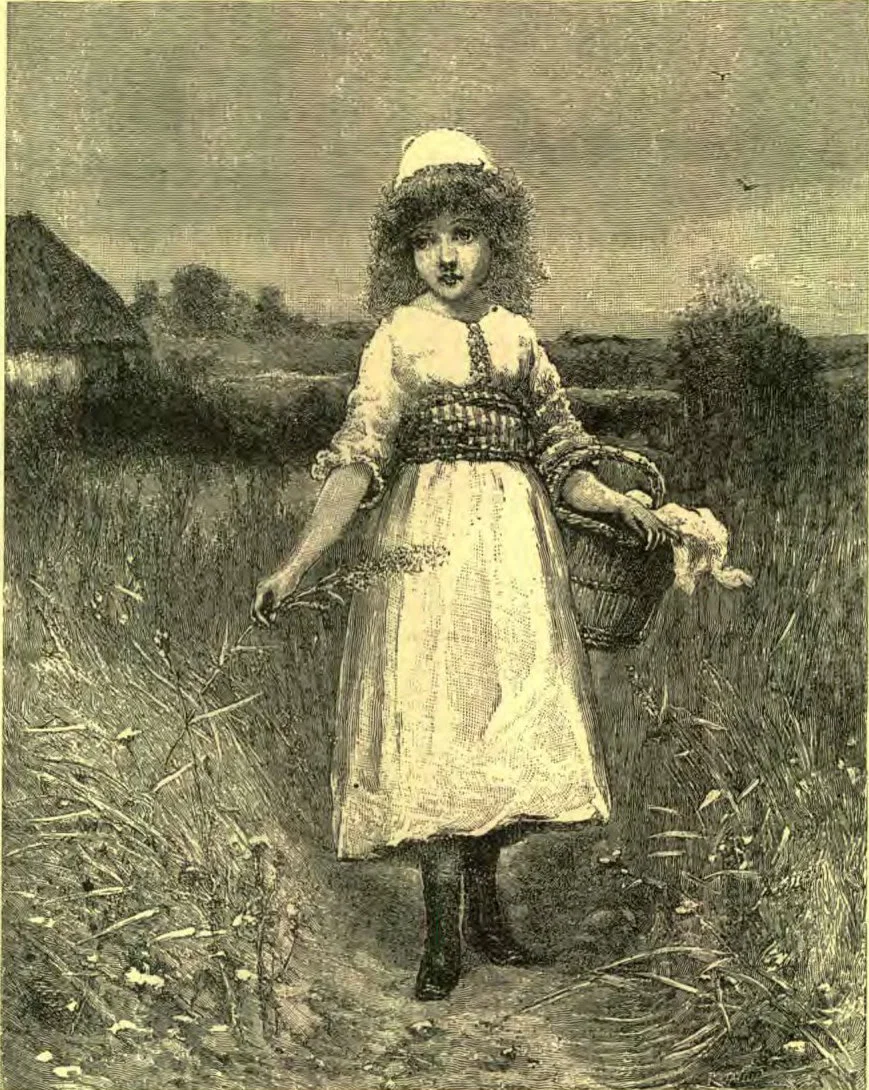
SLEEVES to the dimpled elbow,
Love in the sweet blue eyes,
To and fro upon errands
The little maiden flies.
Now she is washing dishes,
Now she is feeding the chicks,
Now she is playing with pussy,
Or teaching Rover tricks.
Wrapped in a big white apron,
Pinned in a checkered shawl,
Hanging clothes in the garden,—
O, were she only tall!
Hushing the fretful baby,
Coaxing his hair to curl,
Stepping around so briskly,
Because she is mother's girl.
Hunting for eggs in the haymow,
Petting old Brindle's calf,
Riding Don to the pasture
With many a ringing laugh,
Coming whene'er you call her,
Running wherever sent,—
Mother's girl is a blessing,
And mother is well content.
— Selected.
A GLIMPSE OF THE WORLD WONDERFUL.
“I wish somebody’d tell me a true story,” sighed Jessie; “I’m tired of make-believes.” “Somebody” clearly meant Uncle Waldo, since he was the only member of the family who was gifted in storytelling. He looked up from his drawing, and smiled promisingly.
“TO AND FRO UPON ERRANDS.”
“Did I ever tell you about a trip I made—let me see—three weeks ago to-morrow?”
“To Boston?” asked Jessie.
“Yes, and no. ’Twas from Boston I set out for a place called ‘Wonderland.’”
“No, you didn’t tell me about that. Please tell me now.”
“I will, if Tom thinks he can stop playing leap-frog with Rover long enough to listen quietly for ten minutes. Oh, you’re seated, Tom? Well, then, one bright morning three weeks ago I set out from the city of Boston to visit an old college friend who lives in the midst of a beautiful wood called ‘Wonderland’ by his friends, much as your mother calls you ‘Sprite,’ Jessie, just among ourselves.
“It was a very quiet place, with not another house in sight; even the road was hidden by a thick hedge of flowering locusts. After I had admired everything about the beautiful grounds, I said to my friend, ‘You must be very lonely here.’”
“Lonely!” the professor echoed, with a smile; ‘how could I be lonely here? But you have not seen half of Wonderland. Come with me; I will show you my treasures.’”
“So he led me through the sunny corridors of his great house, up and up to a tower-room, with many large windows and a glass roof.”
“Now close your eyes,’ he said, ‘and wait till I tell you to look.”},{
OLD TOWSER AND THE CHICKS.
One evening when Towser, the Newfoundland dog, went to bed in his straw-carpeted kennel, he saw something round and white and smooth lying in one corner; but being a good dog, he did not interfere with it, but lay down and went to sleep. The next night there was another, and then another and another, until thirteen lay in the corner together.
On the fourteenth night old Towser found something else in his kennel,—a little bantam hen covering the round, white eggs with her body and wings.
Now Towser and the bantams were the best of friends, often eating out of the same dish; and I dare say Towser felt not a little complimented as he lay with his nose just a little nearer the door of his kennel, that he might the better guard his little friend, who had apparently sought his protection.
And so every night for three weeks old Towser found the bantam snuggled in one corner of his kennel. On the twenty-first night he heard strange sounds. There were faint “peeps,” the cracking of egg-shells, and the soft “cluck” of the bantam hen.
Old Towser didn’t understand what was going on, but it made him wakeful, and he pricked up his ears and barked a little; but the next day, when he saw his little friend walking about the yard with eleven little chicks, he was delighted, showing his expressions of joy by frisking about the hen, and in many other ways.
A week later, when the poor little hen was run over and killed, old Towser took the chicks into his kennel, and lay down in the corner; and when they snuggled close up under the long hair of his body, he lay very quiet, that he might not disturb nor injure them. In that way he took care of them all night, led them out the next day, and with a bark of delight was seen scratching the ground vigorously, that the chicks might find a soft place to scratch for themselves. It was a funny sight to see Towser going about the yard followed by the little chicks.
The people here still love to tell how Towser raised all those chicks.—Christian Work.
A QUEER CRADLE.
By Viola E. Smith
The funniest cradle you ever did see
Is swung from the limb of the old maple tree;
Peep over the side, and you surely will spy
Three babies; but softly! for they are so shy.
Sweet winds sway them gently to slumbers serene,
And whispering leaves tell them stories, I ween;
When naught but the green, leafy foliage they see,
What wonder they think the whole world is a tree?
But do they not fear when the drenching rain pours,
When the loud thunder rolls, and the hurricane roars?
Ah, no! for they come at the Father's behest,
Who cares e'en for orioles, safe in a nest.
VIOLA E. SMITH.
The Burden of Hatred Toward Others
“It is best to think twice before taking upon us the burden of hatred for any fellow being. It weighs heavier every year, and exhausts the strength that ought to go in loving and bettering others.”
NOTES AND COMMENTS
A Sanitary Measure.— Any one who gives the subject a moment's thought will appreciate the value of the step taken by a savings-bank in Brussels, which has recently adopted a plan of sterilizing all bank-notes passing through its offices. The money is exposed for several hours to a strong disinfecting vapor.
Magnetic Rocks.— There is said to be, in the Baltic Sea, ninety miles from Zealand, a small island formed of magnetic rocks, which so affect the compass that sailors in the vicinity are obliged to rely on stationary objects in steering their boats. One of these rocks is so charged with magnetism that a compass held over it dips straight downward.
A New Waterway.— A canal to connect Lakes Huron and Superior with the St. Lawrence has been begun. Between Montreal and Ottawa the canal already built will be utilized, and will be extended along the line of the Ottawa River to Lake Nipissing, and thence by French River to Georgian Bay. This canal is to be built deep enough to permit the passage of grain-laden barges and steamers, so that freight may be taken directly from Duluth, Port Arthur, and other points to the ocean. It is hoped that the canal may be finally deepened sufficiently to permit the passage of ocean steamers. If this is ever accomplished, wheat can be put on shipboard at Duluth, and taken to Liverpool without reshipping. The journey from Chicago to Liverpool will be seven hundred miles shorter by this route than by the Erie Canal.
At Our Doors.— Only a hundred miles from Key West is the island that Columbus called “the fairest land that ever human eyes rested on.” In a country where all tropical fruits may be grown; where iron, coal, and marble abound; whose forests are rich with rare woods,—mahogany, ebony, and cedar,—the great mass of the people live in abject poverty and ignorance. During the late revolution the population of the island was reduced nearly one third, there being now only about a million inhabitants. These poor people need schools and instruction in farming and home-making. Such help will open their hearts to receive the good news of salvation. We already have two sisters teaching in this needy field. One of these is over sixty years old, and not strong; but she is doing what she can, and says she hopes that other workers will enter the field next fall.
The Dowager Empress of China.— Professor John Fryer, who lived thirty-five years in China, thus describes the dowager empress,—the real power behind the throne in the Flowery Kingdom: “She is still wonderfully vigorous, although in her sixty-fourth year. Her hair is noted for its darkness and brilliancy, and her complexion is clearer than that of most of her countrywomen, being of a delicate cream color. Her eyes are large, bright, and piercing; and her feet are, of course, of natural size, as no Manchu binds the feet. . . . A more capable and wonderful woman is not to be found in the whole world. She is a strict disciplinarian, and considering the seclusion in which she has lived, possesses a surprising knowledge of the outside world.” A few months ago, at a crisis in the affairs of state, she seized the reins of government, setting aside the emperor, who was disposed to favor reforms of various sorts. The name of the empress, as nearly as it can be spelled in English letters, is Tsze-hsi-tsuan-kuang-ki-chao-ipi-chuangchêng-shokung-chinhien-chung-sih. Probably no one unfamiliar with the intricacies of the Chinese language can give it anything like the correct pronunciation.
PARABLES OF THE KINGDOM, AND THE OBEDIENT ELEMENTS
THE SABBATH-SCHOOL LESSON.—NO. 11.
(June 10, 1899.)*
PARABLES OF THE KINGDOM, AND THE OBEDIENT ELEMENTS.
While Christ was speaking to the people, what invitation did he receive? Luke 11:37. What conduct of the Saviour attracted the notice of his host? V. 38. How particular were the Pharisees with reference to these ceremonial washings? How did the Saviour use this occasion in imparting truth? Vs. 39-41. What rebuke did he administer to the scribes and Pharisees because of their formalities and empty ceremonies? Vs. 42-44. At this point who interrupted the Saviour? V. 45. What answer did this lawyer receive? Vs. 46-52. What were the scribes and Pharisees doing while Christ was speaking? V. 53. What wicked purposes prompted them? V. 54. Where did Jesus now go and teach? Matt. 13:1. As the multitude gathered, what point of vantage did he seek? Matt. 13:2. Relate the parable with which he began. Vs. 3-8. What question did the disciples ask? What was the Saviour’s answer? Vs. 11-17. Why were these things clear to the disciples, and so hard for these haughty Pharisees to understand? Give the Saviour’s interpretation of the parable of the sower. Vs. 19-23. Relate the parable of the tares. Vs. 24-30. How did Christ apply it? Vs. 37-43. What other parables did he speak, and what was the teaching of each? Vs. 31, 33, 44-48. After the multitude had been sent away at the close of the day, what did Jesus and his disciples do? Matt. 8:18; Mark 4:35, 36. As they were about to leave, who came to Christ, and for what purpose? Matt. 8:19. What did the Saviour reply? V. 20. What did another disciple request, and what was he told? Vs. 21, 22. After starting on their journey, what overtook them? Was Christ at all disturbed? V. 24. When the disciples had awakened their Lord, how did he tenderly rebuke them? Vs. 25, 26. What did he then proceed to do? How were the disciples affected by this miracle? What questions did they ask among themselves? V. 27.
NOTES.
For side-reading see “Desire of Ages,” pages 334-336.
TIME: First day of the week, April 9, A. D. 31. PLACES: A garden near Jerusalem, an upper room. PERSONS: Jesus, angels, Mary Magdalene, disciples.
QUESTIONS.
Where was Jesus’ body buried? How long was it in the tomb? Tell what happened on the morning of the third day. Who first believed in Jesus’ resurrection? Where did Mary linger? V. 11. Tell about the sepulcher. Whom did Mary see? V. 12. What conversation had she with the angels? V. 13. What caused her to turn away? V. 14. Why did she fail to recognize Jesus? What conversation followed? V. 15. How did Jesus make himself known? V. 16. How did Mary greet him? Vs. 16, 17. Of what did Jesus assure her? V. 17. On what mission did he send her? V. 17. What glad tidings had she to bear? V. 18. Where were the disciples gathered? V. 19. How did Jesus come to them? V. 19. How greet them? V. 19. How convince them he was the same? V. 20. What now filled their hearts? V. 20. Who conquered in the great conquest between Christ and the evil one? What can death now do to us?
NOTES.
1. After the crucifixion of Jesus, the priests urged that the death of the malefactors be hastened, and their bodies be removed from the crosses. They still feared the people, for the reaction soon began. The soldiers broke the legs of the thieves, but found it unnecessary to break those of Jesus. No bone of him was to be broken. To make sure that he was dead, they pierced his side, and blood and water burst from the wound. He had died from a broken heart. “Reproach hath broken mine heart.” Ps. 69: 20.
2. “Treason against the Roman government was the crime for which Jesus was condemned; and persons put to death for this offense were consigned to a burial-ground especially provided for such criminals. . . . The disciples could not leave the body of their Lord to be handled by the unfeeling soldiers, and buried in a dishonored grave. . . . In this emergency, Joseph of Arimathæa and Nicodemus came to the help of the disciples.”
3. The tomb where Jesus was laid was near Calvary, in a garden owned by Joseph of Arimathæa. It is supposed to have been either a natural cave or hewn from rock, and had never been used.
4. The report that Jesus had said he would rise in three days prompted the priests to ask for a large Roman guard. The stone was also bound down and sealed. All that human power and hellish hate could do to keep the Saviour the prisoner of death was done.
5. At the darkest hour—the hour just before dawn—the power of heaven was revealed. The puny powers of evil had done their worst: one hour more would prove their triumph. A moment’s flashing forth of God proved their utter weakness. They could do nothing against the truth. What was the Roman seal, the Roman guard, the stone, which shut in the Resurrection and the Life? The glory of the angel left the guards as dead; and when they recovered from the shock of the blinding brightness and of the mighty earthquake, the tomb was empty. Love divine had proved his victory over hate and force.
6. Life is irrepressible. To make a floor for a grain-elevator, a layer of gravel and two layers of hot asphalt were rolled on the ground. At the end of four years a little bulge showed in a conspicuous, much-trodden part. Men watched the bulge, and saw the asphalt crumble away. At the end of six hours, they stood amazed to see a beautiful, unscarred, white toadstool, which, through the power of life, had pressed its way up to light and air. If God’s life is in you, what can keep you down? “If the Spirit of him who raised up Jesus from the dead dwell in you,” you will rise with irrepressible life, spiritually, physically, eternally.
7. The infallible proofs of Christ’s resurrection were first brought to the ears of men through his enemies. The friends of Jesus were astonished at the report, and it was hard to convince them of the reality.
8. The shock that buried Lisbon in 1775 never ceased to vibrate till it reached the winds of Scotland and the vineyards of Madeira. It was felt among the islands of the Grecian Archipelago, and it changed the level of the solitary lakes that sleep beneath the shadows of the North Alps. Even so the shock that Satan’s kingdom sustained when Christ arose will not cease to vibrate till it moves the whole world.—Hardwick.
9. The women who first sought the sepulcher went weeping. They looked only for the dead, the grave, the stone, the bereavement; yet an hour before Love and Life had burst forth. “God is on the field when most invisible.” Shall we not trust him while it is yet dark? Heaven was singing while mortals wept,—for Christ had risen.
THE WONDERFUL EDISON LABORATORY.
“My greatest luxury,” said Thomas A. Edison, in his early days of struggle, “would be a laboratory more perfect than any we now have in this country. I want a splendid collection of material,—every chemical, every metal, every substance, in fact, that may be of use to me; and I hardly know what may not be of use. I want all this right at hand, within a few feet of my own house. Give me these advantages, and I will gladly devote fifteen hours a day to solid work. I want none of the rich men's usual toys, no matter how rich I may become. I want no horses nor yachts; for I have no time for them. I want a perfect workshop.”
In the last twelve years the great inventor has seen his dream fulfilled. In 1886 he bought a fine villa in Llewellyn Park. He took the house as it stood, with all its luxurious fittings, rather to please his wife than himself: a corner of the laboratory would suit him quite as well. Right outside the gates of the park, and within view of the house, he bought ten acres of land, and began his laboratory. Two handsome structures of brick, each sixty feet wide, one hundred feet long, and four stories high, accommodate the machine-shop, library, lecture-room, experimental workshops, assistants’ rooms, and storerooms. The boiler-house and dynamo-rooms are outside the main buildings. Also, in a separate room, the floor of which consists of immense blocks of stone, are the delicate instruments of precision used in testing electric currents. The instruments in this one room cost eighteen thousand dollars to make and import from Europe.
There are eighty assistants, who have charge of the various departments. The most expert iron-workers, glass-blowers, wood-turners, metal-spinners, screw-makers, chemists, and machinists in the country are to be found here. A rough drawing of the most complicated model is all they require to work from.
The storerooms contain all the material needed. Four men are employed to keep the supplies, valued at one hundred thousand dollars, in order, and ready for use at a moment’s notice. Each article is put down in a catalogue, which shows the shelf or bottle where it may be found. Every known metal; every chemical known to science; every kind of glass, stone, earth, wood, fiber, paper, skin, and cloth, is to be found here. In making up the chemical collection, an assistant was kept at work for weeks, going through the three most exhaustive works on chemistry in English, French, and German, making a note of every substance mentioned. This list constituted the order for chemicals,—an order, by the way, which required seven months to fill. In the glass department, for instance, there is every known kind of glass, from plate two inches thick to the finest films; and if anything else in the way of glass is needed, the glass-workers are there to make it.
The library is the only part of the main building that shows any attempt at decoration. It is a superb room, sixty feet by forty, with a height of twenty-five feet. Galleries run round the second story. The shelves contain nothing but scientific works, and files of the forty-six scientific periodicals in English, French, and German, to which Edison subscribes. They are indexed by a librarian as soon as received, so that the inventor can see at a glance what they contain concerning the special fields in which he is interested.
Nothing in this great establishment, often employing more than one hundred persons, is made for sale. It is wholly devoted to experimental work and tests. Its expenses, said to be more than one hundred and fifty thousand dollars a year, are paid by the commercial companies in which Edison is interested, he, on his part, giving them the benefit of any improvements made. Thus, in one room hundreds of incandescent electric lamps burn night and day the year through. Each lamp is specially marked; and when it burns out more quickly than the average, or lasts longer, a special study is made as to the contributing causes.
It may seem impossible that the suggestions of one man can keep busy a big workshop upon experiments the year round, but Edison says that the temptation is always to increase the force. When it is remembered that the list of Edison’s patents reaches to seven hundred and forty, and that on the electric light alone he has worked out several hundred theories, the wonder ceases. Ten minutes’ work with a pencil may sketch an apparatus that a dozen men can not finish inside a fortnight.—Wellspring.
MISSIONARY MONEY FROM BOUQUETS.
By W. S. Chapman
AS THE season advances, flowers become numerous, and green material abundant, with which to make bouquets that may be readily sold, or that will prove a welcome gift at the hospital or the sick bed. In summer more elaborate and variegated bouquets can be made. I am not now writing about the ordinary bouquets you are accustomed to see and to make, but of what I called, years ago, “mud bouquets;” in the construction of which your ingenuity and taste will find a wide and interesting field. I have two or three times sent to family papers directions for making these bouquets, but as some INSTRUCTOR readers may not have seen these directions or the bouquets, I will tell how to make them, as they last a long time, and are beautiful ornaments for parlor, dining-table, or sick-room.
First procure one or more wooden butter-dishes from your grocer. These may be oblong or circular, as you prefer. Next take a basket, scissors, and trowel, go into the woods, and gather everything you see that is odd, pretty, or in any way desirable, with which to make a green border all around the dish. There must be three or more layers,—the first two of leaves, next flat limbs or grasses, and then sprigs of green to put around the top, to finish the border. Cut everything with a stem at least two inches long, and longer if possible. Gather shiny greens, as soft or fuzzy leaves and twigs will soon wither. Anything that is hard and shines will last well. Do not forget to get some twigs with buds on the end, just about to open. These are to set all off well.
Bring home your prizes, and empty them in a cool place, where, if to remain long, they should be sprinkled. Then go out with your basket and scissors, and cut buds and blossoms from trees and plants, or if you desire to make your bouquet of one kind of flowers, cut only that kind. With an old flour-sifter, sift enough dirt or sand to make a heap, when moistened, in the plate or butter-dish you intend to use. Sift the earth into a pan into which you can pour water, making mud soft enough to mold readily into shape, but not so wet that water will ooze from it when handled. Put the mud on the dish, and round it up so it will be from two to three inches higher in the middle than at the sides. Be careful to have the mound well proportioned, neither too high nor too low. Push the dirt back from the edge, so there will be a clear margin from half to three quarters of an inch wide around the plate. Turn a bowl upside down on the table, and put your dish on top of it. If the plate is clear from the table, you can arrange the border better than if it rests directly upon it. At all times the plate should rest upon something that will elevate it above the flat surface of whatever holds it.
W. S. CHAPMAN,
(Conclusion in next number.)
TOOLS FOR SEWING.
By Nellie V. Dice
CHILDREN, I suppose you have heard about our little sewing-circle. This circle will be for all who want to learn to sew, mend, darn, etc., in order to become more useful in the home. Each week a lesson will be given in the INSTRUCTOR, in as plain and simple a way as possible, so you can do the work at your own home as easily and as well as if you were in a class at school. Take an interest in this work, and do your best; for what you make may be called for, to see how well it is made.
In our first lesson we will learn what tools we shall need in sewing. First of all, we must have needles; and we must be careful to get them the right size to carry our thread. A No. 8 needle will be needed for No. 50 and No. 60 thread; for No. 36 and No. 40 thread a No. 7 needle should be used. It will be a good plan to get a paper of assorted ground down needles, Nos. 5-10. We will use this kind because they will not break easily.
Next we shall need some thread, a thimble, and a pair of scissors. Let each get a celluloid thimble to fit the second finger of the right hand, a spool of No. 50 white thread, and a small pair of sharp scissors.
We must have something to learn to sew on; and as we are going to make this work practical, let each one get a piece of outing-flannel of a color that will not soil easily, about sixteen inches wide and twenty-four inches long. Of this we will make a little sewing bag to hold our tools, so we will always know where to find them.
Now we have needles, thread, thimble, scissors, and cloth. Do you think of anything more we shall need?—A paper of pins, an emery-bag, a tape measure, and a piece of wax, you say. Yes, each should have a pin-ball well filled with small pins, an emery-bag to brighten the needle when it does not go through the cloth easily, a tape-line to measure the work, and a piece of wax to wax the thread when it knots. This list of tools comprises all we shall need at present. Be sure to have all these articles ready before our next lesson.
NELLIE V. DICE.
HOW THIMBLES ARE MADE.
The thimble is a Dutch invention, and the first one was made in 1684 by a goldsmith named Nicholas Van Benschoten. Originally it was called a “thum-bell,” because it was worn on the thumb. In making thimbles the gold and silver ingots are rolled out into sheets of the desired thickness, and cut by a stamp into circular pieces of the required size. These circular pieces are bent into thimble shape by means of a solid metal bar that is of the same size as the inside of the intended thimble. This bar is moved by machinery up and down in a bottomless mold; and each time it descends, it presses one of the circular pieces into thimble shape.
When the thimble is shaped, the next work is to brighten, polish, and decorate it. First the blank thimble is fitted with a rapidly revolving rod. A slight touch of a sharp chisel cuts a thin shaving from the end of the thimble, a second chisel does the same on the side, and a third neatly rounds off the rim. A round steel rod, well oiled, is held against the surface of the revolving thimble, to polish it bright. The inside is brightened and polished in a similar manner, the thimble being held in a revolving mold. Then a delicate revolving steel wheel, with a raised ornamental edge, is pressed against the blank thimble, and prints the ornament seen just outside the rim. Another steel wheel, covered with sharp points, makes tiny indentations all over the remaining blank surface of the thimble. The last operation is to wash it thoroughly in soapy water, and brush it carefully.—Children's Visitor.
FREE BOOKLET
treating on Health and Hygiene mailed to your address
Why don’t you be good to yourself? Stop taking Drugs and patented poisons. Investigate the newest and saner method of curing diseases, by using—
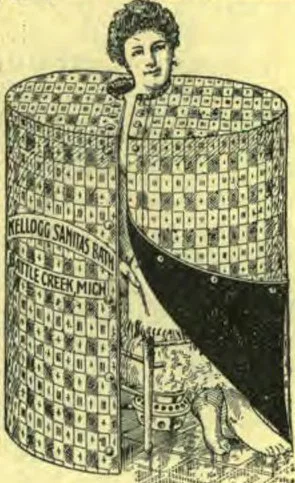
The Kellogg Sanitas Folding Hot Air, Medicated, and Vapor Bath,
Adapted to the hygienic and physiological requirements of every man, woman, and child. Recommended by leading physicians. Cures La Grippe, Colds, Rheumatism, Throat Affections, Aches, and Pains. Equalizes the circulation. Reduces flesh harmlessly and speedily, and beautifies the complexion.
Men and women make good wages managing agencies and bath parlors.
Address with stamp — THE KELLOGG SANITAS CO., 101 East Main St. Battle Creek, Mich.
Meeting Difficulties and Doing Hard Work
The world is full of hard things to do, of hard lessons to learn, of hard places to fill. Those who do not like hard study or hard work, who do not rejoice in meeting difficulties and conquering them, will have to stand back, and give place to the willing workers.
Thanking God for the Daily Task
“Thank God every morning when you get up that you have something to do that day which must be done, whether you like it or not,” said Charles Kingsley. Yes; and when you do that, and mean it, and set about doing your task pleasantly and well, because he has given it, his presence will be in it. Then you can not help liking your work, and can thank him for that.
Looking for the Best in Others
ONE usually finds what he looks for. If he looks for unselfishness, gentleness, courtesy, in his associates, he finds these qualities everywhere,—sometimes perhaps hidden out of sight, but still there, and ready to blossom into beauty in the sunshine of kindness. It is ever so much pleasanter, too,—this habit of looking for the best,—than to go through the world picking flaws, and seeing only the disagreeable in everything and everybody. “By beholding we become changed.” How important that our beholding shall be such that the change will be from “glory to glory.”
THE ART OF SILENCE.
It is a good thing to be able to speak,—and it is a fine art to be able to speak always a word in season. “How good is it!” exclaims the Wise Man,—“a word spoken in due season, how good is it!” There is another art, not so often thought about,—“the art of holding the tongue,” the silence that is golden. How often are words spoken in a thoughtless hour or in the heat of anger, that the speaker would give any earthly possession to recall! But words are living things,—as impossible to bring back into seclusion as a cage of wild birds set free in a wood. They spread their evil wings, and fly straightway where they will do the greatest harm. “Count three before you speak,” is a good rule; for sometimes even that brief space is long enough to hear and heed the warning voice of conscience: a better way is to have the door of the lips so guarded by the watch that King David prayed for, that no unadvised word can slip out to stir up mischief.
A Man's Manners Should Shape His Fortune
“A MAN’S manners should shape his fortune.”
READY
Ready to go, ready to wait;
Ready a gap to fill;
Ready for service, small or great,
Ready to do His will.
Ready to suffer grief and pain,
Ready to stand the test;
Ready to stay at home, and send
Others, if he sees best.
Ready to seek, ready to warn,
Ready o’er souls to yearn;
Ready in life, ready in death,
Ready for his return.
— Selected.
Grand Trunk Railway System
Time Card in Effect February 5, 1899.
C. & G. T. DIVISION.
WEST-BOUND FROM BATTLE CREEK.
LEAVE.
No. 11, Mail and Express, to Chicago — 12.00 M.
No. 1, Chicago Express, to Chicago — 9.00 A. M.
No. 3, Lehigh Valley Express, to Chicago — 3.40 P. M.
No. 5, Pacific Express, to Chicago, with sleeper — 12.55 A. M.
No. 75, Mixed, to South Bend — 7.30 A. M.
Nos. 11 and 75, daily, except Sunday. Nos. 1, 3, and 5, daily.
EAST-BOUND FROM BATTLE CREEK.
LEAVE.
No. 10, Mail and Express, to Pt. Huron, East, and Detroit — 3.45 P. M.
No. 4, Lehigh Express, to Pt. Huron and East — 8.27 P. M.
No. 6, Atlantic Express, to Pt. Huron, East, and Detroit — 2.25 A. M.
No. 8, Lehigh Exp. to Saginaw, Bay City, Pt. Huron, and East — 6.50 A. M.
No. 74, Mixed, to Durand (Starts at Nichols) — 7.35 A. M.
Nos. 10 and 74, daily, except Sunday. Nos. 4, 6, and 8, daily.
E. M. HUGHES, A. S. PARKER,
A. G. P. & T. Agt. Chicago, Ill. Ticket Agent, Battle Creek.
TAKE THE Canadian Pacific Railway
for . . . CHATHAM, OTTAWA, MONTREAL, LONDON, GALT, QUEBEC, WOODSTOCK, TORONTO, BOSTON, PORTLAND, and
All points in New England, the Maritime Provinces, Great Britain, and the Continent.
Illustrated literature, time-tables, and full particulars, upon application to—
J. FRANCIS LEE, GEN. AGENT,
Passenger Dept. 228 SOUTH CLARK ST., CHICAGO.
Branch Offices: 76 Ottawa St., Grand Rapids, Mich.; Room D, Chamber of Commerce, Cincinnati, Ohio; 315 Chestnut St., St. Louis, Mo.
INSECTS AND REMEDIES.
By Arthur F. Hughes
(Concluded.).
“GARDENER’S work, like woman’s, is never done.”
ANTS.—Although these insects are not destructive to vegetables, their presence is not usually welcomed, because of their habit of throwing up hills. Destroy them by pouring boiling water or a strong solution of saltpeter over the hills. Poisoned molasses placed near their nests will also prove effectual. They may be trapped very easily by placing a sponge moistened with sweetened water near their nests. When the sponge is filled with ants, throw it into boiling water; wash it out, and set the trap again.
CABBAGE-WORM.—The adult of this common caterpillar is a white butterfly. The eggs are laid on the cabbage leaves, and are soon hatched into the green caterpillars that make havoc during the rest of the season. In large fields of cabbage there is not much danger from this worm, as it is not common enough to do much harm; but if only a few plants are raised, the pest must be dealt with immediately. The arsenites, buhach, and hot water are all effectual. Cabbage will endure water heated to one hundred and eighty degrees Fahrenheit, while one hundred and thirty degrees will kill the caterpillars. It will take but a few minutes to heat a kettle of water, and carry it to the cabbage; then the work is done, and the plants are free from poisons and powders.
POTATO BEETLE.—This beetle is too well known to need description. Paris green is the only remedy for this pest. It should be applied in the form of a dust, one part to one hundred parts of flour or air-slaked lime, as soon as the potatoes are up. Another application should be made as soon as the young larvæ, or slugs, appear. If this is done promptly, it will greatly aid in their extermination. When the plants have grown about six inches high, apply Paris green in liquid form, about one ounce to four gallons of water. Repeat this application every three or four days until you are master of the situation.
TOMATO-WORM.—This large green worm is an annoyance to many persons because of its size and ungainly appearance. It is perfectly harmless to handle, and because of its size, is easily seen. Picking the worms off by hand is the best and simplest remedy. They are voracious eaters, and will strip a whole vine in a short time. This caterpillar is subject to the attacks of a parasite, a small black fly laying her eggs in the worm. Caterpillars thus infested may be known by the little eggs sticking to them. Those so infested should not be destroyed, as the eggs will soon hatch into flies, and they will continue the work of destroying the worms.
I have spoken only of those insects that are common garden pests. Time and space will not allow me to mention the myriads of insects, useful and harmful, that find a home in our gardens. If the simple remedies that have been recommended are faithfully applied, the inroads of the worst of these pests can be overcome. After you have done all you can possibly do, ask the Lord to do the rest. Never do anything without asking his help.
Last week I spoke of protecting some of our friends. Do not kill the beautiful singing birds. They are your friends, tried and true. “Are not two sparrows sold for a farthing? and one of them shall not fall on the ground without your Father.” Seeing, then, that the God of heaven takes so much interest in the birds as to note the fall of the humble sparrow, let us do all we can to protect them.