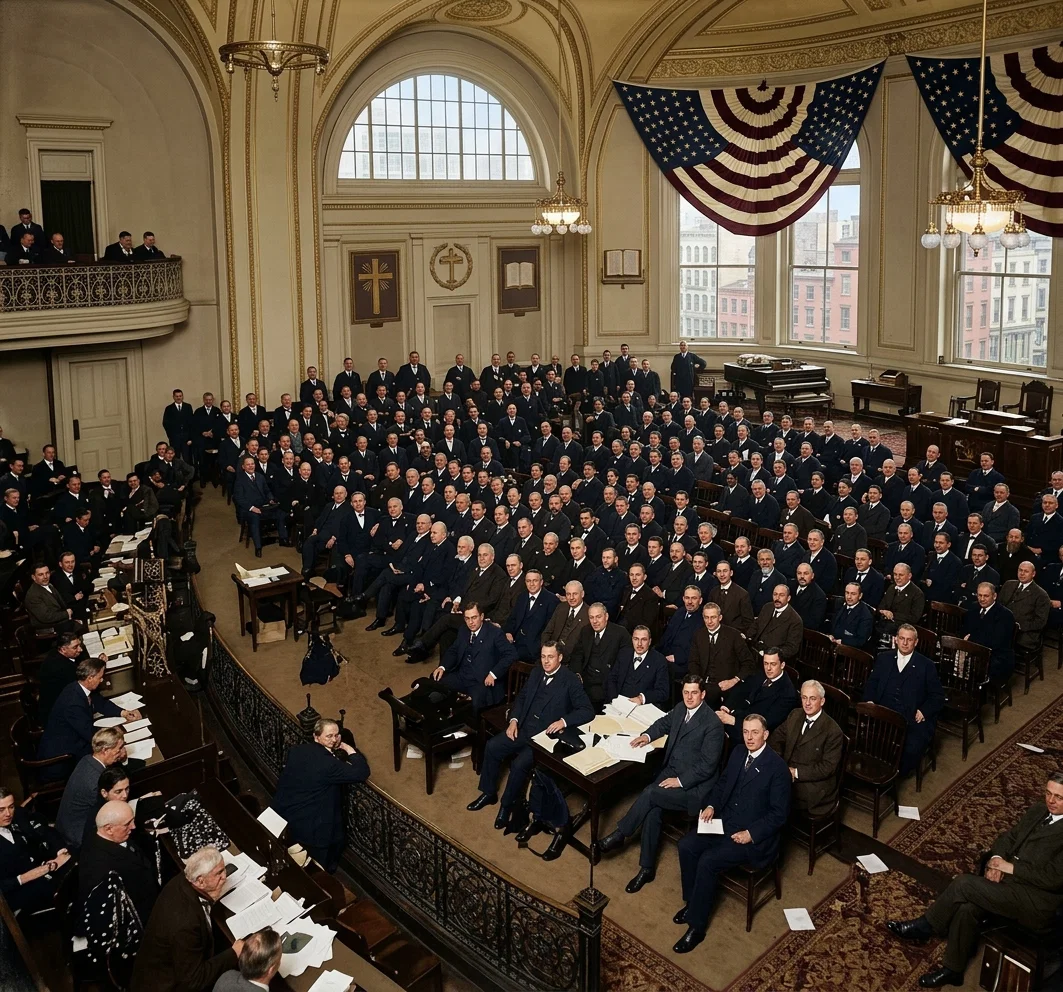
THERE has just closed in New York City probably one of the most remarkable conferences ever held in this country. If talented speakers and enthusiastic delegates could make a successful conference, surely this one was successful. That the promoters of the conference are delighted with the results is admitted on every hand, and so enthusiastic were they in achieving their ends, that they frequently burst out in the familiar hymns, “Blest be the tie which binds,” and “Praise God, from whom all blessings flow.”
The conference had its first inception in the work of local federations. This was first entered upon by certain clergymen, and laymen in New York City. The appalling needs of the great city hung like a terrible cloud over their souls, and they began to plan some way in which the city might be evangelized. First they corresponded with the clergy of the city, and laid before them the moral conditions as they appeared, with an appeal for unity, or federation, in this work of evangelization. A few of the clergy, at first, manifested a slight interest, while many looked upon the plan with distrust. From this small beginning, May 13, 1895, the movement to federate all the churches, Christians, Jews, and Catholics, has grown till it is confidently expected that by Jan. 1, 1907, the entire city of New York will be districted, and each district will be put under the general oversight of some clergyman, who will be held accountable to see that every family in his district is visited, and invited to attend some church service.
It should be observed that in this suggestion there is, on the face of it, no sign of coercion, nor anything but the great desire to help evangelize the wicked city. We can not even question the genuine sincerity of the gentlemen who are at present trying to perfect this plan, and yet we can not unite in their plan of federation.
From New York City the idea went to several neighboring States, where the plan of church federation was instituted, and a practical application of the principles was made.
The State federations proved so successful that a great national federation was planned. This plan was presented to nearly all the great religious bodies of the United States, with the request that delegates be selected by them, and that they be sent to counsel as to whether or not such a federation could be brought about. This council was called to meet in New York City, November 15-21, at Carnegie Hall, one of the largest auditoriums of the city.
To this appeal for delegates thirty-two denominations responded, and the following are now considered as members of the federation:— The Baptist Church (North), Baptist Church (South), Free Baptist Church, Negro Baptist Church, Christian Connection,7Congregational Church, Disciples of Christ, Evangelical Association, Evangelical Synod, Friends, Evangelical Lutheran Church (General Synod), Methodist Episcopal Church, Methodist Episcopal Church (South), Primitive Methodist Church, Colored Methodist Episcopal Church of America, Presbyterian Church in the U. S. A., Cumberland Presbyterian Church, Welsh Presbyterian Church, Reformed Presbyterian Church, United Presbyterian Church, Protestant Episcopal Church, Reformed Church in America, Reformed Church in the U. S. A., Reformed Episcopal Church, Seventh-day Baptist Church, United Brethren in Christ, United Evangelical Church, Methodist Protestant Church, African Methodist Episcopal Church, African Methodist Episcopal Zion Church, Mennonite Church, Moravian Church.
A most elaborate program was prepared, and interesting subjects assigned to the most distinguished clergymen and orators of this country. Among those assigned a part in the program were twenty-five bishops from the different Protestant churches; the presidents of the following-named universities and colleges: Andover Theological Seminary, Brown University, Dartmouth College, Hillsdale College, Missouri Valley College, Oberlin College, Princeton Seminary, Union Theological Seminary, Ursinus College of Theology, Washington and Jefferson College, Wesleyan University, and the Episcopal Theological College. Professors from the following-named colleges took an active part in the program: Bryn Mawr College, Cobb Divinity School, Drew Theological Seminary, Theological Seminary of the Reformed Church, University of Chicago, Wittenberg College, and Yale University; also others, seventeen of whom bear the title of “LL. D.,” forty-nine of “D. D.,” and five of “Ph. D.”
Editors of the following religious journals were also included in the program: The Cumberland Presbyterian Church, The Evangelical Messenger, The Methodist Protestant Recorder, The Christian Advocate (Methodist), The Examiner (Baptist), The Methodist Review, and The Sabbath Recorder (Seventh-day Baptist).
Besides a letter of indorsement from President Roosevelt, Justices Harlan and Brewer of the United States Supreme Court, Judge Grosscup of the United States Circuit Court, and the Lieutenant-Governor of New York gave stirring addresses.
We have given this long list of speakers that the reader may see the scope and magnitude of this movement, and the powerful influence it is bound to exert.
It will be noticed that this conference was not a legislative body. It had not the power to legislate for any one. The delegates were sent to the conference empowered simply to counsel as to the desirability and expediency of confederating. This they did, and not only decided it advisable, but actually federated together for the sole purpose of “establishing the kingdom of God on this earth.”
This, then, launches in the United States a movement more gigantic than any movement, we believe, since the great movement of the fourth century; and just as surely as that one developed into the “beast,” so this modern one will develop into the perfect “image to the beast.”
Next week we will present the reasons why this is so, and the basis of the “federation.”
C. H. EDWARDS.
DELEGATES TO THE INTER-CHURCH CONFERENCE
Faith’s Victory Over the World
“This is the victory that overcometh the world, even our faith.”
Note and Comment
THAT China is fast coming to the front as a military power is indicated by telegrams like the following from Shanghai, of recent date: “Chinese military maneuvers, conducted in accordance with the Western pattern, began yesterday. One army is defending Peking against the advance of another army from Shangtung. The foreign critics present are greatly impressed by the enormous improvement shown by the Chinese troops. Their progress in five years has been sensational.”
IN his address at the opening of the one hundred and fifty-second academic year of Columbia University President Nicholas Murray Butler gave some attention to the recent disclosures of modern business methods, and told some plain truth. We quote one paragraph:—
Put bluntly, the situation which confronts Americans to-day is due to lack of moral principle. New statutes may be needed, but statutes will not put moral principle where it does not exist. The greed for gain and the greed for power have blinded men to the time-old distinction between right and wrong. Both among business men and at the bar are to be found advisers, counted shrewd and successful, who have substituted the penal code for the moral law as the standard of conduct. Right and wrong have given way to the subtler distinction between legal, not-legal, and illegal; or better, perhaps, between honest, law-honest, and dishonest. This new triumph of mind over morals is bad enough in itself; but when, in addition, its exponents secure material gain and professional prosperity, it becomes a menace to our integrity as a people.
What will supply the needed moral principle? Surely not that which has brought about the lack. In the old-fashioned gospel there is a power which keeps men in the right path—“the power of God unto salvation.” It is the repudiation of this gospel which has prepared the way for the present moral collapse. The people need the message of the commandments of God and the faith of Jesus.
THE influence of socialism upon militarism is coming to be a matter of serious concern in Europe. One aim of socialism in Europe, it seems, is to abolish war through a refusal of the soldiers to perform military duty; in other words, through the principle of the strike. The strike idea, say European journals, is now being seriously urged upon the soldiers of Europe by socialist and radical agitators. “There is,” we are informed, “an International Anti-military Association in full operation, and its agents carry on a diligent propaganda by interviewing and disseminating their literature in the inns and cafes frequented by soldiers.” In these appeals to the conscripts, “these youth are reminded that they owe neither duty nor obedience to the state,” and “are bidden to throw away or break their weapons of destruction, or to discharge their rifles against their commanders, and are invited to join the ranks of civil workers.”
The recent general strike in Russia, which brought that government to terms and forced it to grant the demand for a representative government, was an object-lesson which workingmen everywhere will not forget. The threat of a general strike has already been made in Austria, and there are other countries where such a weapon might prove quite as effective as it did in Russia. Even the United States can not be said to be beyond the possibility of coercion by this powerful agency. The general distress and disturbance caused by the coal strike of 1902 are still fresh in every mind, nor is it forgotten that the settlement of that conflict exhausted the powers not only of the State of Pennsylvania, but of the national government, and was effected at last only by an extraordinary and extra-constitutional step on the part of the nation’s chief executive. In socialism, allied as it is or may become with the various workingmen’s organizations, the governments of the present day have an enemy with which they do not know yet how to reckon, and the fear of which is driving many of them to closer union with Rome. While socialism seems bent on abolishing war, in the form which makes use of armies and navies, it is impossible that its propaganda should fill the world with the spirit of peace, because it is not based on the principles of the Prince of Peace.
The Call of the Hour
By C. F. McVagh; Wm. A. Westworth; H. S. Shaw; A. J. Breed; W. M. Adams; G. W. Reaser; F. S. Bunch; O. O. Farnsworth
Brief Messages From Conference Presidents
What It Means
ONCE more the week of prayer and the time for our annual offering are at hand. What does this mean?—It means that we are one year nearer to the cutting-short of the Lord’s work in righteousness. Soon we must reach the last week of prayer. Think how much the disciples lost by their failure to appreciate the meaning of that opportunity to watch and pray with Jesus the last night in Gethsemane. We are admonished, “Not forsaking the assembling of ourselves together, as the manner of some is; but exhorting one another: and so much the more, as ye see the day approaching.” Heb. 10:25. If this should be the last annual week of prayer, can you afford to be found sleeping? Let all God’s people press together for one grand, united effort at home, and give a liberal, consecrated offering for the work in the fields beyond, to finish the work. C. F. McVAGH, of Western Pennsylvania.
Earnest Prayer Needed
THE necessity of the week of prayer is greater to-day than ever before, from the fact that we have before us a mightier effort against greater odds than our work has ever known. The burden of our prayer is for a deeper work of grace that a fuller consecration may be our condition. God has promised that when his people rise and shine, the riches of the Gentiles shall come to them. When our own hearts are consecrated, we shall withhold nothing. If, therefore, there is a lack of means in the treasury of the Lord to-day, it is because we are not showing our consecration in very deed, or because we are not in such a condition that the Master can trust us with the gold of the nations about us.
Then may this week of prayer be a constant cry, a heartfelt petition, an earnest wrestling with God, that we may be so filled with his Spirit that complete consecration may be seen in our lives, that we may go forth with great energy to this, the final triumph. WM. A. WESTWORTH, of Southern New England.
Improve the Opportunity
IN Mordecai’s day God’s people appointed a special season of prayer. Every soul engaged in it, and their cause was sustained. Now again, so nearly does our cause resemble theirs, that it is said that “the Protestant world to-day see in the little company keeping the Sabbath a Mordecai in the gate.” Do we not need special seasons of prayer, such as has been appointed for December 9-16? Let us not allow this great opportunity to slip by unheeded, and afterward we shall be heard to say, “And as I was busy here and there, it was gone.” H. S. SHAW, of Minnesota.
The Most Important of All
WE have had many such occasions in the past, and they have been great blessings to those who have engaged heartily in them; but surely this occasion is more important than any preceding one. Not only is there a great need of means to carry the work to all parts of the earth, but there is a great need of laborers as well; and we ask our brethren, as they assemble during this time, and as they look upon the fields already white for the harvest, especially to pray that God will lay the burden upon others in Upper Columbia to give themselves to this work. We have a number of young men and women who have been educated in our schools, with no other object in view but to have some part in the message, but as yet their way has not fully opened. Let us remember such before God at this time, asking that he will open the way before them, and that many may respond to the call that is now coming from all parts of the world.
How much we need the outpouring of the Holy Spirit for service! Word came to us years ago that it awaited “our demand and reception.” Shall we not especially pray at this time that we may have a large measure of the Holy Spirit, that we may be enabled to carry forward this work more successfully, and if another year ever dawns upon us, we may look back and see that a greater measure of success has attended our efforts? A. J. BREED, of Upper Columbia.
Seeing the Day Approaching
“Not forsaking the assembling of ourselves together, as the manner of some is; but exhorting one another: and so much the more, as ye see the day approaching.” Heb. 10:25.
What will be the incentive to cause “the assembling of ourselves together”?—“As ye see.” See what?—“See the day approaching.” Then it is evident that the clearer we “see the day” drawing near, the more often will we assemble “ourselves together.”
We are not only to see, but we are to know. “Knowing the time, that now it is high time to awake out of sleep.” Rom. 13:11. As surely as we know “the time,” just so surely there will be an awakening. Why?—“For now is our salvation nearer than when we believed.” “For my salvation is near to come,” saith the Lord. Isa. 56:1.
The Lord is soon coming, and the message to prepare a people for that event must be given to the world in a short space of time. We must have more power so the worker need not stay years in one place to develop the work. But how shall we get the power?—“Ye shall receive power, after that the Holy Ghost is come upon you: and ye shall be witnesses unto me both in Jerusalem, and in all Judea, and in Samaria, and unto the uttermost part of the earth.” Acts 1:8. But how shall we receive the Holy Spirit?—“I say unto you, Ask, and it shall be given you.” “If ye then, being evil, know how to give good gifts unto your children: how much more shall your Heavenly Father give the Holy Spirit to them that ask him?” Luke 11:9-13.
These scriptures make plain to all why a special season of prayer and seeking God is appointed. The answer is, We “see the day approaching,” and we also see the vast numbers of people who do not see it. We know “the time,” while so many are in darkness. So we assemble together to plead with God for pure hearts and clean hands that we may go forth with power to make known to others the meaning of the signs which are all around us.
The appointment of a week of prayer is the most natural course by a people who “see the day approaching.” It is also true that every one who knows the time will meet with those who assemble, and will seek God most earnestly. “Seek ye the Lord, all ye meek of the earth, which have wrought his judgment; seek righteousness, seek meekness: it may be ye shall be hid in the day of the Lord’s anger.” Zeph. 2:3. W. M. ADAMS, of Manitoba.
The Paramount Need
IF we were to appoint a time for meditation upon the necessities of the “little flock” who are commissioned of heaven to proclaim the last, and therefore the most important, message ever given to our race, upon what would our mind focus as the paramount need of the hour? We can not hope to give the message force by overwhelming numbers of believers, nor by securing the talent of the world to espouse our cause. We can not wield a money power in erecting imposing institutions that will give impetus to the message. But this people, who stand numerically as one to twenty thousand of earth’s teeming millions of judgment-bound mortals, should, by being surcharged with a power that transcends the motive force back of the mighty pulse-beat of the commercial world, make their influence felt wherever a son or daughter of Adam’s race finds abode.
We exist for a specific purpose. To espouse the cause comprehended in the last announcement of salvation to the race, from the motive simply and solely of self-salvation, might prove futile in securing salvation. At least a higher, nobler motive than this should form the mainspring of our lives.
He who professes Christianity should be inspired by the motive power of the Author of Christianity, else what right9has he to take the name? To be a Christian means to be Christlike. It is written, “If any man have not the spirit of Christ, he is none of his.” To be Christlike means to be swallowed up in that blessed work which made him the Saviour of men. In speaking of his mission, he said, “The zeal of thine house hath eaten me up.” Why should I, by taking the title “Christian,” profess Christlikeness, and then not be consumed with the impulses, the undying life-purpose, which made him the Christ, the Saviour of men?
If seventy-five thousand people counted fully that their very existence was for the purpose of winning souls, this message would receive a new impetus. A drawing power will surely accompany every one who lifts up the Saviour. Should not our commandment-keeping be the revelation of the life and love of Christ to the world? The life of devoted sacrifice will bear fruit, even as the sacrifice of Christ is fruitful in the salvation of every believer in him.
My special burden for the welcome week of prayer is that the people who are commissioned of heaven to carry the message of salvation to every nation, kindred, tongue, and people, shall fully awake to a true sense of their mission, and by faith, through prayer, receive that baptism of the Spirit of Christ which alone will energize them for their heavenly calling.
As we contemplate the millions of souls yet to be warned, the work yet to be accomplished, and the necessity of the development of that faith in the remnant people which may truly be called the “faith of Jesus,” who can but pray, “Lord, increase our faith,” and send forth more laborers into the great, white harvest-field? G. W. REASER, of Southern California.
The Time Has Come
THE conviction has been growing upon me during the weeks just past that the time has fully come for us to rise and quickly finish the work. This week of prayer ought to be, and I believe it will be, the greatest inspiration we have ever had to faithful service in carrying this precious message to the world in this generation. F. S. BUNCH, of Western Oregon.
Claim the Promised Blessing
WHAT should this coming week of prayer be to us? To me it would seem that the time had come for the invitation in Joel 2:12-14 to be accepted by turning wholly to the Lord, and the promised blessing claimed by the Lord’s waiting children. Are we not fully warranted in expecting this?
Then the deliverance foretold in verse 32 will be realized, and the captives bound in sin will be set free, all who are longing for freedom, and then will the Lord be able to close the work in triumph. O. O. FARNSWORTH, of Chesapeake.
The Glory of Solomon’s Early Reign
By Ellen G. White
Lessons From the Life of Solomon—No. 12
The Glory of Solomon’s Early Reign
MRS. E. G. WHITE
The wealth and the wisdom of Solomon, the magnificent buildings and public works constructed during the early years of his reign, the energy and the piety revealed in word and deed, made a deep impression upon all Israel, and brought to him fame and honor from the surrounding nations. By his justice and magnanimity he won the loyalty of Israel, and the admiration of the rulers of many lands.
“God gave Solomon wisdom and understanding exceeding much. . . . He was wiser than all men; . . . and his fame was in all nations round about.” Solomon took special interest in natural history, but his researches were not confined to any one branch of learning. Through diligent study of all created things, both animate and inanimate, he gained a clearer conception of the Creator. In the forces of nature, in the mineral and the animal world, and in every tree and shrub and flower, he saw a revelation of God’s infinite wisdom; and as he sought to learn more and more, his knowledge of God and his love for him constantly increased.
The Tribute of Kings
“And all the kings of the earth sought the presence of Solomon, to hear his wisdom, that God had put in his heart. And they brought every man his present, vessels of silver, and vessels of gold, and raiment, harness, and spices, horses, and mules, a rate year by year.”
As the people from many lands visited Solomon, he taught them of God as the Creator of all things. These visitors returned to their homes with clearer conceptions of the God of Israel, and of his compassionate love for the human race. In the works of nature they now beheld an expression of his love and a revelation of his character; and many were led to worship him as their God.
Never was Israel more greatly honored than during the first part of Solomon’s reign. The righteousness and wisdom revealed by the king bore to all nations continual witness of the power of God. For a time the Israelites shone forth as the light of the world, showing, by their nobility of character, the greatness of Jehovah.
The Visit of the Queen of Sheba
One of those deeply interested in Solomon’s wisdom, the queen of Sheba, determined to “prove him with hard questions,” and “came to Jerusalem,” attended by a retinue of servants, with camels bearing “spices, and gold in abundance, and precious stones.”
“And when she was come to Solomon, she communed with him of all that was in her heart.” The queen talked with him of the mysteries of nature, and Solomon taught her of the God of nature, the great Creator, who dwells in the highest heaven and rules over all. “And Solomon told her all her questions: there was not anything hid from the king, which he told her not.”
“When the queen of Sheba had seen all Solomon’s wisdom, and the house that he had built, and the meat of his table, and the sitting of his servants, and the attendance of his ministers, and their apparel, and his cupbearers, and his ascent by which he went up unto the house of the Lord; there was no more spirit in her.”
“It was a true report,” she acknowledged to the king, “which I heard in mine own land of thine acts, and of thy wisdom: howbeit I believed not their words, until I came, and mine eyes had seen it:” “and, behold, the half was not told me: thy wisdom and prosperity exceedeth the fame which I heard. Happy are thy men, happy are these thy servants, which stand continually before thee, and that hear thy wisdom.”
Recognizing the source of Solomon’s wisdom and prosperity, the queen exclaimed: “Blessed be the Lord thy God, which delighted in thee to set thee on his throne, to be king for the Lord thy God: because thy God loved Israel, to establish them forever, therefore made he thee king over them, to do judgment and justice.”
The queen “gave the king an hundred and twenty talents of gold, and of spices very great store, and precious stones: there came no more such abundance of spices as these which the queen of Sheba gave to King Solomon.”
“King Solomon gave unto the queen of Sheba all her desire, whatsoever she asked, beside that which Solomon gave her of his royal bounty. So she turned and went to her own country, she and her servants.”
“The Lips of the Wise Disperse Knowledge”
The real glory of Solomon’s reign was not the surpassing wisdom, the fabulous riches, and the far-reaching10power and fame that were his. It was by a wise use of these gifts of heaven, in revealing to the world a knowledge of the King of kings, that Solomon brought glory to the name of the God of Israel.
With the passing of the years and the increase of his fame, Solomon sought to honor God by adding to his mental and spiritual strength, and by imparting to others the blessings he received. He realized that he had come into possession of a kingdom, and of power, wisdom, and glory, through the favor of Jehovah. None understood better than he that these gifts were bestowed in order that he might give to the world a knowledge of God.
It was to give in his own life a revelation of his Father’s character, that Christ came in the form of humanity. In his life no ostentatious display, no act to gain applause, was ever witnessed. Christ was hid in God, and God was revealed in the character of his Son. To this revelation Jesus desired the minds of the people to be directed, and their homage to be given.
Solomon’s divinely given wisdom found expression in songs of praise, and in many inspired proverbs. In these writings are outlined principles of holy living and high endeavor,—principles that should govern every act of life,—principles that are heaven-born and that lead to godliness. The wide dissemination of these truths, and the recognition of God as the one to whom belongs all praise and honor, made Solomon’s early reign most glorious.
“Happy is the man that findeth wisdom, and the man that getteth understanding. For the merchandise of it is better than the merchandise of silver, and the gain thereof than fine gold. She is more precious than rubies: and all the things thou canst desire are not to be compared unto her. Length of days is in her right hand; and in her left hand riches and honor. Her ways are ways of pleasantness, and all her paths are peace. She is a tree of life to them that lay hold upon her: and happy is every one that retaineth her.”
“Wisdom is the principal thing; therefore get wisdom: and with all thy getting get understanding.” “The fear of the Lord is the beginning of wisdom.” “The fear of the Lord is to hate evil: pride, and arrogancy, and the evil way, and the froward mouth, do I hate.”
O that Solomon had heeded in later years these wonderful words of wisdom that he was inspired to write! O that he who once declared that “the lips of the wise disperse knowledge,” and who himself wisely taught the kings of the earth to ascribe to the King of kings the glory they desired to give him, had never with a “froward mouth,” in “pride and arrogancy,” taken to himself the glory due to God alone!
_The Way_
By Mary McGee Hall
THE Way is narrow, straight, and long,
I go in tears, sometimes in song,
But not one step of joy or pain
Shall ever more be walked again;
For only once I pass this way
In traveling to the Gates of Day.
'Tis only once. Shall my heart break
Because no more this Way I take?
Shall I bewail that every night
Forever shuts the past from sight?
When sunset comes, the stars arise,
And morning never fails the skies.
Upon this Way of earthly sod
Are tented angels sent of God!
So on I go, the Way is straight,
The cross of Christ my only weight,—
The weight of wings the lark must bear
In soaring heavenward through the air.
—Mary McGee Hall, in Sunday School Times.
Diffusion Versus Concentration
By Francis M. Wilcox
FRANCIS M. WILCOX
The history of this world from the entrance of sin presents a record of opposing principles. The governments of God and Satan, and the principles upon which they are based, have stood in direct opposition. At every step Satan has sought to circumvent the plan of God. Between them there has been a deadly conflict,—a conflict which can give no quarter or know no compromise.
The difference between these principles is well illustrated in the methods by which God has sought to carry forward and extend his work, and the methods by which Satan has sought to extend his. Satan’s plan has been that of concentration and self-centered interests. God’s plan has been the plan of diffusion, of giving, of sacrifice.
To Adam the command was given, “Be fruitful, and multiply, and replenish the earth, and subdue it.” The garden of Eden was planted as a model of God’s husbandry; but instead of settling around it, the human family were to scatter abroad, subdue the earth, and bring it into the same high and glorious state of cultivation as was the model given them by the Creator.
Satan sought to thwart the plan of God. He inspired men to begin the building of cities, and encouraged them to associate together in large colonies. Cain, the wicked one, conceived the idea, and others rapidly followed in his steps, until the earth became so corrupt that God was forced to destroy the whole human race, with the exception of Noah and his family.
Upon Noah’s liberation from the ark the same principle of diffusion was again enunciated. “Be fruitful, and multiply, and replenish the earth.” But the same principle of evil which had proved so successful in the antediluvian age once more prevailed, and just in proportion as the human family departed from God, they again began to disregard his command and centralize their efforts and their influence. The result of the second apostasy culminated in the building of the tower of Babel. The second time God was compelled to resort to extreme measures. He destroyed the tower, and “scattered them abroad from thence upon the face of all the earth;” and in order that his plan should not again be turned aside, he confounded their language, thus creating the beginnings of nations and the distinctive and lasting separation of the human family.
In the call extended to Abraham, the principle of diffusion is again witnessed. “Get thee out of thy country, and from thy kindred, and from thy father’s house, unto a land that I will show thee;” and the subsequent history of Abraham’s experience demonstrates that he did not receive the fulness of God’s blessing until this command was literally carried out, and there came about the complete separation between himself and Lot.
Abraham dwelt in tents, and was a wanderer from one part of the country to the other. This was in God’s order, that the light and knowledge of the true God might be diffused to the people of that country. Their iniquity was not yet full, and God was still giving them opportunity for repentance. In later years God called the seed of Abraham to the land of Egypt. Here in the courts of the mightiest nation of earth, and before the millions of Egypt, Joseph and his brethren were to vindicate the majesty and glory of the one true God. But now Egypt had been given her opportunity, and the time comes in God’s providence when his people are to return to the land given to their fathers, there to stand as the mightiest of the nations of the earth, as the chosen people of God, to spread abroad his truth and the glory of his name. Of them at this time God says that they should stand as a peculiar people, and should not be “reckoned among the nations.”
The land bestowed upon them as an inheritance was peculiarly situated. It was on the great highway of travel between the east and the west. During all its history, in the changes that took place among the nations of the earth, it occupied a unique position. The mightiest kingdoms were its neighbors. To these God would have go out a knowledge of his truth, and so long as Israel were consecrated to him, their influence was potent for good; but as soon as they became self-centered, as soon as they came to glory in their possession, then God, in order that his plan might be carried out, sold them into captivity, and scattered them as individuals among the nations of earth.
The scattering of Israel and of Judah was not without its results in a missionary way. We find Daniel and his companions at the court of Babylon, and brought into positions of trust in the government, thus revealing to the heathen the knowledge of the true God.
That this principle of diffusion is a true gospel principle, Christ himself demonstrated by every act of his life and in all of his teachings. He “went about doing good.” His efforts were not for one city, nor even for one nation. His visit to Samaria was but the first fruits of the glorious work to be done among the Gentile nations of the earth. He commissioned his disciples, “Go ye into all the world, and preach the gospel to every creature.” With their Jewish prejudices they ill comprehended the significance of his words and the world-wide commission committed to their hands. Even after the resurrection of our Lord they approached him with the question, “Wilt thou at this time restore again the kingdom to Israel?” He answers them, “Ye shall be witnesses unto me both in Jerusalem, and in all Judea, and in Samaria, and unto the uttermost part of the earth.” But Jerusalem continued to be the center of their hopes and the field of their labor, and in order for the purpose of the Lord to be carried out there came11again a scattering of the people. “And at that time there was a great persecution against the church which was at Jerusalem; and they were all scattered abroad throughout the regions of Judea and Samaria, except the apostles. . . . Therefore they that were scattered abroad went everywhere preaching the word.”
Throughout the entire history of the church of God this principle of diffusion can be traced; and as opposed to it, the principle of concentration has likewise been manifested. These two principles are operating mightily in the world today. The principle of concentration is seen in the congested centers of population, the tendency to leave the rural districts and flock to the cities, which in consequence are becoming hotbeds of vice. It is seen in the concentration of wealth and capital, the hoarding of gold and silver, the self-centered interests of trades and professions and unions.
And there is greater danger to-day that this principle of concentration shall circumvent God’s plan, and affect the professed people of God as never before in the history of the church. Have we not already seen its influence in the operation of our own work? and has not the call of God during the last two or three years been to break the bands with which this principle has bound us, and put in operation the blessed gospel principle of diffusion? Our churches have become self-centered. The principle of colonization has been carried out to the detriment of our work. Building has been added to building and institutions multiplied in great centers, leaving other great cities without a witness to the truth.
God calls us now to leave the tower of Babel around which we have centered our efforts, to cast to the winds the glory of building up for ourselves a great name, and go forth to the nations of earth to carry the gospel of this generation to a lost and dying world. And the awakening which has come to our people during the last few months with reference to this principle is an omen of coming victory and deliverance. We see the breaking away from our great centers, a separating and a scattering of the great interests that have been congregated there. The movement out of that which has been the great center of our work in the past is an illustration of this. The removal of our work to Washington is in direct line with this gospel principle, and this movement has set the pace for our denomination.
It is most encouraging to-day to see churches and whole conferences responding to the call of God and sending out into the regions beyond men and means for aggressive and pioneer work. In some States one half of the tithe has been given for work in other fields. May God bless as applied to his special work in these days, the principle of diffusion. May he enable us to recognize the principle of concentration as opposed to the doctrine of the gospel. The keynote of the gospel is “give.” God gave his only begotten Son. He gives us all; he asks us to give him all in return. Diffusion or concentration—which principle shall control our lives?
Boulder, Colo.
Giving Dues Back to God
“If God gives the dews on your crops, see that out of your crops you give your dues back to God.”