In a recent number of the REVIEW a very helpful article appeared from the pen of Elder G. B. Thompson, entitled, “Our Greatest Need.” It was shown to be the gift of the Holy Spirit.
In reading a passage in that beautiful book, “Education,” from the pen of Sister White recently, I found these very helpful words:—
“An intensity such as never before was seen is taking possession of the world. In amusement, in money making, in the contest for power, in the very struggle for existence, there is a terrible force that engrosses body and mind and soul. In the midst of this maddening rush, God is speaking. He bids us come apart and commune with him. ‘Be still, and know that I am God.’”
“Many, even in their seasons of devotion, fail of receiving the blessing of real communion with God. They are in too great haste. With hurried steps they press through the circle of Christ’s loving presence, pausing perhaps a moment within the sacred precincts, but not waiting for counsel. They have no time to remain with the divine Teacher. With their burdens they return to their work.”
Brother, sister, how often this very experience has been ours. Instead of taking the place that Mary took at the footstool of Jesus, there to ponder his words, listen for his counsels, we say a prayer—in other words, do all the talking—and hasten on to our many duties, to become anxious and worried, as was Martha, thus missing that precious sweetness that might be ours. Can we wonder that we find ourselves barren, tempest-tossed, and heavy laden? Ponder carefully the way marked out for us to obtain that divine power in the precious gift of the Holy Spirit in this which follows:—
“These workers can never attain the highest success until they learn the secret of strength. They must give themselves time to think, to pray, to wait upon God for a renewal of physical, mental, and spiritual power. They need the uplifting influence of his Spirit. Receiving this, they will be quickened by fresh life. The wearied frame and tired brain will be refreshed, the burdened heart will be lightened.”
It is daily contact with Christ in prayer that brings to us the Spirit of God. The Spirit comes only as he is sent by Christ. Christ is our friend, and to him has been granted all power. He will grant us his Spirit to meet our need, and no more. We must sense our need. This will cause us to yearn for Christ’s presence, and that request will be granted by giving us the Spirit.
“Not a pause for a moment in his presence, but personal contact with Christ, to sit down in companionship with him,—this is our need. Happy will it be for the children in our homes and the students of our schools when parents and teachers shall learn in their own lives the precious experience pictured in these words from the Song of Songs:—
“As the apple-tree among the trees of the wood,
So is my Beloved among the sons,
I sat down under his shadow with great delight,
And his fruit was sweet to my taste.
He brought me to the banqueting house,
And his banner over me was love.””
Rome, N. Y.
Praise God From Whom All Blessings Flow
By J. B. GOODRICH
J. B. GOODRICH
As I read in the REVIEW the article written by Elder G. A. Irwin regarding the coming week of prayer, my heart rejoices, and I praise God for the special help given me last year during the week of prayer. For two years preceding that meeting, I had been in feeble health, and was troubled with hoarseness. I went to the meeting at Washburn so hoarse I could not preach much, but the Lord gave me back my voice; and since then I have labored with my usual freedom. As a result, I have seen some accept the truth, and I praise God for what he has done for me, and I still hunger and thirst for Christ’s righteousness. O for a fresh baptism of the Holy Spirit, sent down from above, which will give success to the third angel’s message wherever it is proclaimed! God grant there may be a turning unto the Lord with the whole heart, that we may have a special fitting up for the work before us.
Blaine, Maine.
Do You Know?
Do you know that all Christians combined are giving at the rate of one tenth of a cent a day for the evangelization of the world?
Do you know that of every dollar given for Christian work, only about two cents are sent to heathen countries for the propagation of the gospel?
Do you know that selfishness causes professed Christians to build costly churches, put in pipe-organs, cushioned pews and Brussels carpets, while the heathen are left without the gospel?
Do you know that pride and selfishness cause some to build fine houses and buy costly furnishings, and adorn themselves with costly apparel, while thousands near their doors are unable to get the necessaries of life, and millions of heathen die without hearing the name of Jesus?
Do you know that Jesus will come soon? Have you done all you can do to get the gospel to every creature? Have you given all you could for the support of the gospel? Are you sure of the “Well done”?—Selected.
News From Haran—4
By Z. G. BAHARIAN
Z. G. BAHARIAN
OUR fourth trial was on March 9. While I was preparing myself to answer a question asked at the former trial, we were told by the president that there was another new question. After some secret deliberation, the clerk was commanded to read a paper which had been sent from the general attorney of Aleppo. The paper was read; to our great astonishment, it was the translation of an Armenian national hymn, which had been found at the house of our Brother Antioch, for which he was arrested and imprisoned in Aleppo. As he was a Sabbath-keeper, and as we had correspondence with him, now we were considered partakers in politics.
HIGH PORTE, CONSTANTINOPLE
At first, one by one, we were asked if we had acquaintance with this George of Antioch. We answered, “Yes; we can have had acquaintance with him for four or five years, and have sent him many Bible readings and letters, to teach him our religion.” Next we were asked: “Did you not know that he was such a man—harmful to the government?” One by one we answered that we did not know that he was such a man, and even now we do not know him to be so; on the contrary, we know him not to be such. “He does not mingle himself in political questions, and stands against all political revolutionists. We have had no correspondence about such harmful questions. But now that such a harmful writing has been found on him, we do not know the real story of it. We are not responsible for it, because it has not been sent by us, nor written by us. If there is a responsibility, it is on him. We preach the gospel to all sinners. Now, the political insurgents are among the sinners, and if you can prove that our Brother George is such a man, we have done good in preaching him the gospel. Preaching the gospel to revolutionists is not a mingling in politics.” I clearly opened to them our principle of love to all men. We have no national patriotism. All who unite with us as a church first put away the national patriotism, and become man-lovers. Unless they do this, they can not unite with us.
Brother Ayvazian testified bravely about Brother George—that he is a Christian, a good man, having no part at all in politics, and that we obey the government. Just at this point the president stopped him from talking more, and commanded me to stand. I arose, and was asked if I approved what Mr. Ayvazian spoke. I answered, “Yes.” Then I was asked, “Why did you tell, at your former trial, that you can not obey the government?” God gave me another opportunity to testify about our relation with governments. This was my brief answer:—
“Let me repeat what I have said before—that the preaching of the gospel has been commanded us by our Lord Jesus Christ, who is the ruler of the kings of the earth, to whom is given all authority in heaven and on earth, who is now sitting at the right hand of God in heaven, far above all rule and authority, and power, and dominion, and every name that is named, not only in this world, but also in that which is to come. Now, the Turkish government is one which is under the rulership of Jesus. Then the government must not hinder us from preaching his gospel. If we are commanded not to preach the gospel, we can not obey the government, because our obedience to Jesus is first. If the government does not remove its prohibition laws against the preaching of the gospel, it stands against Jesus, and we are not obliged to unite with it in disobedience, but rather should we obey Jesus Christ, because he is our God.”
At this point the president could not bear any more. He stopped me from speaking, and said, “Now it is well known that you do not obey the government.”
As to that Armenian national hymn found at Brother George’s, we have learned lately that for some political question some Armenian houses were searched at Antioch. Nothing was found in Brother George’s rooms. The owner of the house was also living in the same house, and in his room the Armenian hymn was found, his daughter having written it. The officers took it, and had it translated into Turkish. The story is that they saw money in Brother George’s box, in their search, and being anxious to get some, they called him, and asked ten Turkish liras, else they would impute the hymn to him. He refused to give them the money, then they imprisoned him, and sent him to Aleppo. He has been in jail one year, and his trial has not yet taken place. Because of that paper, he is taken as an insurgent, and we also, as his companions, because we have had correspondence with him. We were saved from that imputation, and are sure God will save this brother, also. He was very sincere in the truth, very faithful in his duties, and very active in preaching. Remember him in your prayers.
Aintab, Turkey.
The Bible in Many Tongues
How the Scriptures Are Being Sent to Distant Lands
THE annual report of the British and Foreign Bible Society is an extraordinary record of world-wide work well done. The year 1904-05 was the opening year of the second century of its history, and the issues of the Scriptures in many tongues rose to a total only once before surpassed. Some idea of the scope of the organization is conveyed by the single sentence that since it came into existence, the total issues of the society amount to 192,537,746 copies of the Holy Scriptures, complete or in parts, of which not more than 77,000,000 were in English.
Last year's output as compared with that of 1903-04 is tabulated as follows:—
1904-05
1903-04
Bibles
942,024
1,057,154
New Testaments
1,366,674
1,449,808
Portions
3,548,947
3,190,399
5,857,645
5,697,361
One of the features of the report is that twelve new languages were added to the list of versions during the year, bringing the number up to three hundred and ninety.
Of the new tongues thus added to the list six belong to Africa, three to Oceania, two to Asia, and one to Central America. The Gospel of St. John will soon be in circulation in Susieh, the13speech of a Berber tribe in South Morocco, and in the colloquial Arabic of Algeria. St. Matthew has been printed in Se-kalana, the language of a people living west of Matabeleland, South Africa; while the language of the fierce Masai of East Africa has been made to express St. Mark. The same Gospel has been printed in Gang for an Acholi tribe north of Uganda, and that of St. Luke for the naked Dinka, who inhabits the region round Fashoda.
The other six new languages are Mukawa for New Guinea; Santo Bay and Tafasao for the New Hebrides; Balti for Kashmir; Brahui for Baluchistan; and Mosquito, which is spoken on the eastern coast of Nicaragua.
The society's circulation in China alone exceeded a million, and 350,000 books were given away among the soldiers and sailors of Russia and Japan. During the year there were 950 colporteurs employed, at a cost of £45,000 and they sold over 2,250,000 copies of the Scriptures.—Washington Post.
Death and Burial in Fiji
By C. H. Parker
C. H. PARKER
You may be interested in the death and burial rite of the Fijians. Everything of any importance in Fiji must be attended with great feasting, as this is the only way, they say, in which they can show their love and affection.
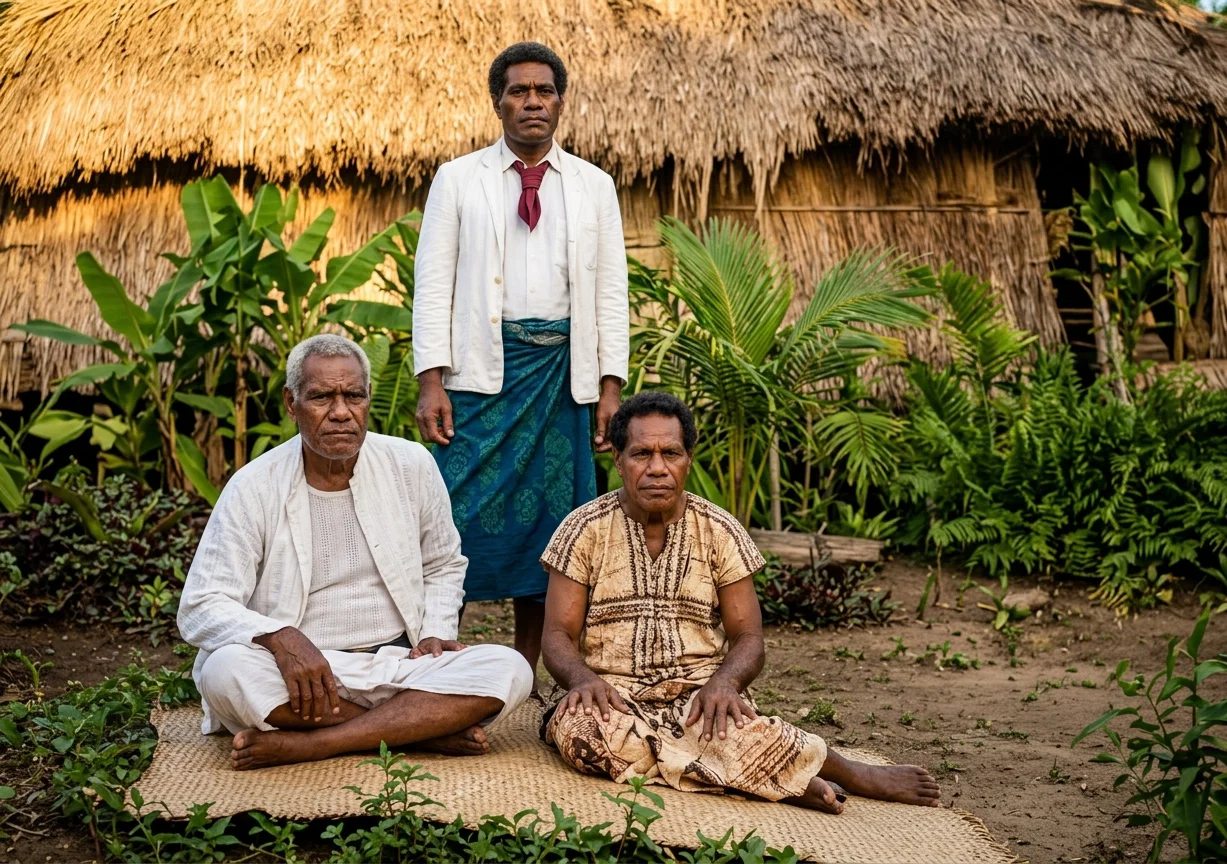
A FAMILY OF FIJIANS
Several days before death takes place, large numbers of the friends will crowd into the house, anxiously waiting for the end. No more fitting illustration occurs to the writer's mind, than the vultures watching the lagging steps of some animal near death's door. When the individual breathes his last, immediately a howl is set up, lasting for a short time. Then preparations are begun for the feast while the person is being prepared for burial.
The common method of burial is to dress the corpse in its best, placing with it many of its belongings, such as a Bible, or a lamp, or a sewing-machine, etc. Then they wrap the body up in many mats, lastly cording it with their native rope. It is then carried in the hands of four or more men, or placed upon two sticks and carried upon the shoulders, to the burial-ground, which is generally only thirty or forty rods from the town. Here a hole is dug in the ground about three feet deep and as long as the corpse. A mat lines the bottom and sides, upon which the dead is laid.
The service is conducted much the same as in European countries. Then the earth is filled in and mounded over. This accomplished, all retire to the house, where they feast and revel. Large amounts of yaqona, the native grog, is drunk.
Very little sorrow is manifested; but, on the other hand, a great deal of laughter and joking. In fact, one would be made to think that they are glad when some one dies.
Ten days later another feast is made, when the grave is built up with special stones and anointed with oil. At the end of the year another feast is given, and sometimes at the end of five years. Upon many of the graves may be seen lanterns or cups and saucers.
How cruel a master is tradition, and how many a string on the human harp of affection has it broken. Yet the multitude seem to love to have it so. True are the words which old Thomas Tyron wrote more than two hundred years ago: ‘He that follows the multitude has a knave for a master and a fool for a tutor.’
Like Europeans, all think they are going directly to heaven when they die, though they may be the darkest-dyed sinners. O, that their eyes might be opened to understand the awfulness of death, and that it is an enemy's hand!
Lomaloma, Lau, Fiji.
Great Souls Have Wills
GREAT souls have wills, feeble ones have wishes.—Chinese Proverb.
Mission Notes
THE company at San Fernando, Trinidad, is reported as growing in numbers, and several await baptism.
ELDER J. A. MORROW, of Bermuda, reports that five were baptized in those islands recently. Others were expecting to go forward.
THE Brownie Orphanage (Presbyterian) at Kodoli, north India, had a bright service not long ago, when sixty-three of the orphans made open profession of faith in Christ.
A MISSIONARY of the Presbyterian Church of England describes a ten-days' touring among the villages near Chiang-hoa, Formosa, and adds: “It is a great comfort to be able to roam all over a heathen country, and yet seldom be more than a mile from a Christian dwelling.”
THERE has been a great extension in the work of the Chinese post-office. The number of articles with which the postal authorities deal has increased from 49,350,000 in 1903 to 72,150,000 in 1904. Couriers are traveling unmolested throughout the empire, except in two districts on the borders of Kwang-si and Kwei-chau Provinces, and 1,192 post-offices are now open.
HENRY KIMURA, a native preacher in Japan, thus tells how God answered his prayers for his own family: “On the third day of July, we had a wonderful and blessed time at my home. My father was baptized at the Niigita church. He has persecuted me fourteen years, since I gave my heart to God, but my prayer was finally answered, according to his promise. He came to the same common Saviour.”
MORE than two hundred of the native agents of the Wesleyan Missionary Society in the Fiji Islands owe the awakening of a sense of sin, as well as the peace of Jesus Christ, solely to reading the New Testament. Scripture alone, without counsel, admonition, or spiritual instruction from any one, does the work of conviction and conversion in many mission fields. When missionaries are lacking either at home or abroad, the Bible should be sent out the more abundantly.
ONE of the secretaries of the American Board says that some forty years ago, he, a small boy, was inveigled by a sister into giving a precious (and regretted) fifty cents to a mission band for the education in Turkey of an Armenian girl named Kohar. Years may well tend to make one forget a vaguely distant Kohar, and even a painful sacrifice of which she was the innocent cause. But the other day Kohar came to light again; this time to astonish the good man with a gift of two hundred and fifty dollars for the treasury of the American Board. The true convert knows the emotion of gratitude exactly as well as her teacher.
Children’s Missionary Exercise
By ESTELLA HOUSER
For Sabbath, December 30, 1905
Prepared by ESTELLA HOUSER
Suggestive Program
I. OPENING SONG: “All hail the power of Jesus’ name.” (“Hymns and Tunes,” No. III; “Christ in Song,” No. 226.)
II. PRAYER.
III. SCRIPTURE READING:—
“Bible Answers to Missionary Questions.”
IV. SONG: “A Missionary Hymn.” (Music, “Hymns and Tunes,” No. 775; “Christ in Song,” No. 570.)
V. RECITATIONS:—
“The Need of Haste.”
“A Plea for Korea.”
“Wunwang’s Story of His Life.”
VI. SONG: “China’s Call.” (Music, “Christ in Song,” No. 397.)
VII. RECITATIONS:—
“Only a Little Baby Girl.”
“The Young Missionaries.”
VIII. BLACKBOARD EXERCISE:—
“Africa’s Need.”
IX. RECITATIONS:—
“Is It Nothing to You?”
“Missionary Exercise for Four Children.”
X. SONG, By the Children: “Freely Give.” (“Christ in Song,” No. 407.)
XI. RECITATIONS:—
“Two Pennies.”
“Please Don’t Refuse.”
XII. COLLECTION.
XIII. CLOSING SONG: “Work and Wait.” (“Hymns and Tunes,” No. 1253.)
Bible Answers to Missionary Questions
1. What are missionaries?
“We are ambassadors for Christ, as though God did beseech you by us: we pray you in Christ’s stead, be ye reconciled to God.” 2 Cor. 5: 20.
2. Are there enough missionaries?
“The harvest truly is plenteous, but the laborers are few.” Matt. 9: 37.
3. What is our duty, then?
“Pray ye therefore the Lord of the harvest, that he will send forth laborers into his harvest.” Matt. 9: 38.
4. What is the state of the heathen world?
“The dark places of the earth are full of the habitations of cruelty.” Ps. 74: 20.
5. Why do they not worship the true God?
“How shall they believe in him of whom they have not heard?” Rom. 10: 14.
6. Who are sent to teach them?
“Ye shall be witnesses unto me both in Jerusalem, and in all Judea, and in Samaria, and unto the uttermost part of the earth.” Acts 1: 8.
SOUTH SEA ISLANDER
7. Who sends these witnesses?
“Then said Jesus to them, . . . as my Father hath sent me, even so send I you.” John 20: 21.
8. What is the great commission?
“Go ye therefore, and teach all nations, baptizing them in the name of the Father, and of the Son, and of the Holy Ghost.” Matt. 28: 19.
9. Can children be missionaries?
“The Syrians . . . had brought away captive out of the land of Israel a little maid; and she waited on Naaman’s wife. And she said unto her mistress, Would God my lord were with the prophet that is in Samaria! for he would recover him of his leprosy.” 2 Kings 5: 2, 3.
10. What help has Jesus promised?
“Lo, I am with you alway, even unto the end of the world.” Matt. 28: 20.
11. What have missionaries accomplished?
“The people that walked in darkness have seen a great light: they that dwell in the land of the shadow of death, upon them hath the light shined.” Isa. 9: 2.
12. What reward has Jesus promised to the faithful missionary?
“They that turn many to righteousness [shall shine] as the stars forever and ever.” Dan. 12: 3.
13. When will missions end?
“This gospel of the kingdom shall be preached in all the world for a witness unto all nations; and then shall the end come.” Matt. 24: 14.
A Missionary Hymn
(Music, “Hymns and Tunes,” No. 775.)
For a witness to all nations
Must the gospel news be told,
Till the ransomed countless number
Are within the open fold
Of the Shepherd,
Whom their eyes shall then behold.
We would send the joyful message
Far where death and darkness reign,
Telling out among the heathen
Of the Lamb who once was slain,
Who in triumph
In the clouds shall come again.
We are toilers in the harvest:
Fields are ripe, but reapers few.
Ere the day of his appearing
There is much for us to do.
Jesus calls us,
To his call may each be true.
Grant, O Lord, that from our number
Some may go to preach the Word—
Hear our prayer that none may slumber
When the midnight cry is heard.
Come, Lord Jesus;
For thy reign be each prepared.
—W. F. Edgerton.
The Need of Haste
THEY are dying by tens! don’t you know it?
Dying without the light.
They know not Christ as their Saviour;
His cross is hid from their sight.
They are dying by hundreds! O hear it!
In the chains of ignorance bound.
They see not their need of a Saviour,
The Saviour whom you have found.
They are dying by thousands! Believe it!
O what are you going to do?
Your Saviour cares for these lost ones,
And longs to bless them through you.
They are dying by millions! Yes, millions!
All over the world’s wide lands;
In Africa, India, and China,
Can you sit with idle hands?
Dying while you are sleeping,
Dying while you are at play,
Dying while you laugh and chatter,
Dying by night and by day.
Some do not know they are needy;
Some of them care not at all,
But some of them hunger for Jesus,
Yet know not on whom to call.
They grope for a light, in their darkness;
They call on their gods for aid;
There is no one to tell them of Jesus,
And the sinner’s debt which he paid.
None, did I say? ’Twas an error;
For God has a few lights out there;
But when it’s not three to a million,
O won’t you begin to care?
—The Kingdom.
A Plea for Korea
HEARD ye the voice from over the sea,
Not far from the Flowery Land?
’Tis the Hermit Kingdom that calls to thee,
From the land of the “Morning Calm:”
“Come over and help us.” Heard ye the cry?
“Come quickly. The harvest is white;
Say not ‘Four months,’ or ‘By and by.’”
Korea asks now for the light.
Millions of hands are outstretched there
To receive the Living Bread,15
And multitudes by her rocky shores
Stand waiting to be fed.
Heard ye the voice? ’Tis the Master’s now;
As he speaks the word of command,
Harken attentive, and to it bow:
“Go ye into all the world.”
Africa's Need
The term “Dark-Continent” applied to Africa by Stanley, has a threefold application. Africa, until the nineteenth century, was the one continent whose vast interior, as far as geographical certainties are concerned, lay in impenetrated darkness. It is the one continent whose population is composed almost entirely of dark peoples. It is the one continent whose native religion is without sacred writings and definite systems,—a religion whose followers are but wanderers in “the blackness of darkness.”
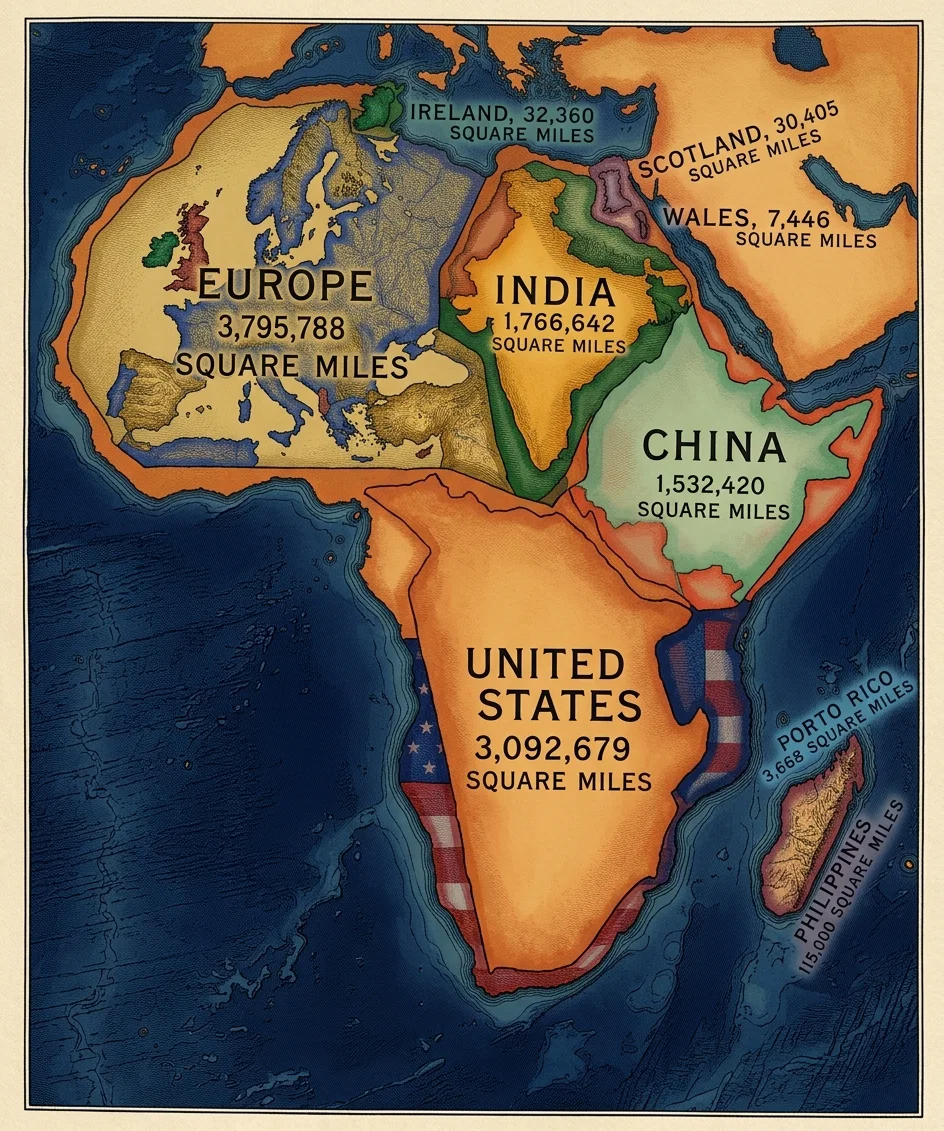
Of all the continents, Africa is second in size to Asia alone. With the islands, Madagascar, the Madeiras, the Canaries, and others, Africa has about 11,500,000 square miles of territory. A striking comparison between the size of Africa and that of other continents has been suggested. “There is room enough in the lower end of the continent for the16whole of the United States, with her eighty-two million people; Europe, with her many states and hundreds of millions, can be placed on one side of Central Africa; China, with her vast population of four hundred million, could be accommodated on the other half, and there is room for all India and Wales, Scotland, and Ireland, in the lower valley of the Nile, and along the coast of the Mediterranean; while there is plenty of room for Porto Rico and the Philippines on the island of Madagascar.”
This vast territory, with her one hundred and ninety million people, waits for the gospel. At a cost beyond all reckoning, the continent has passed from prehistoric darkness to twentieth-century daybreak. It is estimated that over six hundred explorers died as a direct result of the death-dealing climate and the consequent hardships of travel. Of missionaries, the number is unknown. Seven societies, up to 1902, reported one hundred and ninety-five losses by death, in their missionary force, during their operations in Africa. Our own Board has laid upon the altar of Africa a number of our pioneer workers. Scarcely a mission has been opened without loss of life. But the work continues, and the fruits of these lives eternity will reveal.
Besides an organized conference in the south, we have mission stations in Egypt, Matabeleland, Nyassaland, Basutoland, Barotseland, Sierra Leone, and German East Africa. It is only a beginning, but Africa is open and ready for the message. The responsibility lies with us. What shall we do? Shall the message be hastened to Ethiopia? or shall we who are here to-day delay it? We may hasten it if we will, by our prayers and our gifts. One of our laborers in Africa sends this message:—
“We earnestly request you to hear the cry of the millions of Africa as it ascends to heaven, pleading for the light of the everlasting gospel, and to place men in training for this work; also that missions be opened as soon as possible in a few great centers, such as Sudan, Uganda, and the Kongo country, in order that the light of present truth may shine into the heart of darkest Africa, and thus assist in giving the bread of life to Ethiopia, as she waits, pleading with outstretched hands.”
AFRICA AS MEASURED BY OTHER COUNTRIES
“They are waiting in the wild,
Sick and weary and defiled,
And the Saviour’s healing word
They have never, never heard;
Ever hungry and unfed,
Left without the Living Bread—
Waiting! waiting!”
— Arranged.
NOTE.— One of the young people or older members of the school should present this number. The map may be drawn on the blackboard or a large sheet of paper, before the exercise. Then, as the speaker makes the statements concerning the size of Africa, he can illustrate it with the map. As he mentions the stations where we are working, place a star or some prominent mark on the map so that the long distances between our several stations may be made plain. Also locate the central points mentioned in the message from one of our workers. The one presenting this number need not be confined to what is given here, but can arrange his talk as he chooses. The one point is to show the vast country, to every part of which the message must go before the end, and which we have touched only here and there with our finger-tips.
China's Call
By Mrs. A. C. Selmon
(Tune: No. 397, “Christ in Song.”)
Adapted by Mrs. A. C. Selmon, Honan, China.
NEARER fields, the reapers toiling,
Gather in the golden grain,
Still the distant eastern borders
To the workers' skill remain.
CHORUS
Lord of harvest, send forth reapers.
Hear us, Lord, to thee we cry;
Send them, China's sheaves to gather,
Ere the harvest time pass by.
Long the shadows there have tarried;
Late the precious seeds were sown;
Now the world's great Light is shining
On a harvest fully grown.
China, with its teeming millions,
Souls for whom our Saviour died,
Knowing heaven, but not the pathway,
Lost, is waiting for a guide.
Now the word from home has reached them,
Are there none to lead the way?
Ere the harvest time is over,
Will you help, as well as pray?
Wunwang's Story of His Life
(Little boy dressed as a Chinese.)
I HAVE been asked to tell you the story of my life, so I will begin at the beginning. My home is in China. When I was a little baby, my mother tied a red cord about my wrists, to make me obedient, and another, with charms strung on it, about my neck, to keep me from having the colic or smallpox.
When I was a month old, they had a party for me, to which my grandmother and a great many other people came, and brought me presents. They shaved my head, and gave me my milk name, which was “Little Stupid,” so that when the spirits heard my mother call me, they would think she didn't care much about me, and so let me live to grow up.
When I was six years old, I had my real name, which is Wunwang, and I began to go to school; but I didn't think it was very interesting, for I couldn't understand what we were studying, and I got tired saying, over and over again, “Confucius; how great is Confucius!”
One day, as I was going home from school, some big boys were fighting, and they ran into and knocked me down, and my leg was broken. They carried me home, and my father brought in a native doctor, who felt my pulse in five or six places, gave me something to take, put a knitting-needle into the fire until it was red-hot, then stuck it into my leg, and said I should be all well soon.
I didn't get better, and I used to cry with the pain. One day a missionary was passing by our house, and came in to see what was the matter. When he saw my leg, he asked my father to let him take me to the hospital, where they could cure me. My father was afraid to let me go, for we both thought they might do something dreadful to me there. But at last he said Yes, and they took me on a wheelbarrow. When I saw the doctor coming to look at my leg, with some queer things in his hand, I thought he was going to take out my eyes, to make medicine of them. So I screamed and screamed.
A lady came, and held my hand, and talked quietly to me, and had me smell something which put me to sleep, and when I woke, my leg was all nicely fixed. Now I can walk again, and my father is so happy that he says I may go to school where they teach about Jesus, who makes these foreigners so kind and good.— Mission Dayspring.
FLORA (3)
By Mrs. W. M. Gray
I'd tell them of God, who made all men free,
To him alone we bend the knee.
FLORA (3)
If seed to sow were given to me,
I'd cross at once the deep, deep sea;
I'd spend my life in faithful toil
On India's dark and bloody soil,
Where little girls of seven are sold, to be
The slaves of men, without a plea.
HORACE (4)
If I were left to choose and plan,
I'd sow my seed in old Japan;
The work that was there begun
By Neesima, Japan's own son,
I'd like to see at last complete,
A trophy cast at Jesus' feet.
MINNIE (5)
The field I love, of all the best,
Is where the Judsons found their rest;
And if the Lord to me would give
Some seed to sow, and let it live,
In Burma I would find delight,
Toiling from morning until night.
HARRY (6)
On islands in the Southern Sea
I'd sow my seed, to set men free;
No longer then would man eat man,
But live according to God's plan,
In peace, and happiness, and love,
And dwell at last with him above.
SOPHIA (7)
I'd store my heart and hands with seed,
And go where there was greatest need;
And if I could not quite decide,
I'd ask God to be my guide,
And choose for me the very field
In which to sow for future yield.
ALL TOGETHER
Yes, missionaries true we stand,
Ready to go at Christ's command.
'Tis thus we'll honor him who gave
His only Son, our souls to save.
TEACHER
May the Lord bless you, my little missionaries. Before separating, let us unite in singing one stanza of that beautiful hymn,—
"Can we, whose souls are lighted
With wisdom from on high,—
Can we, to men benighted,
The lamp of life deny?
Salvation, O, salvation!
The joyful sound proclaim
Till earth's remotest nation
Has heard Messiah's name."
—Mrs. W. M. Gray.
The Young Missionaries
(This exercise may be given by children in the costumes of the natives if desired.)*
TEACHER
Dear children of the mission band,
As hand-in-hand for Christ you stand,
If the Saviour should bid you go,
With seeds of gospel truth to sow,
Tell me, where would you choose a field,
In hopes of reaping a rich yield?
CLEO (1)
I think, dear teacher, I would go
To Chinaland, my seed to sow.
I'd scatter broadcast in the street,
That all who bind girl-babies' feet
Might know that He who made them so
Intended they should grow and grow.
WILLIE (2)
To Africa I would speed away,
And sow with might, day after day.
I'd deal witchcraft a deadly blow,
Traffic in human lives lay low;
Only a Little Baby Girl
ONLY a little baby girl,
Dead by the riverside;
Only a little Chinese child,
Drowned in the floating tide.
If she had only been a boy,
They would have heard her cry;
But she was just a baby girl,
And she was left to die.
So they have left her little form
Floating upon the wave.
She was too young to have a soul,
Why should she have a grave?
Yes, and there's many another lamb
Perishing every day,
Thrown by the road, or the riverside,
Flung to the beasts of prey.
Think, as you lie on your little bed,
Smoothed by a mother's hand,
Think of the little baby girls
Over in China's land.
Ask if there is not something more
Even a child can do,
And if perhaps in China's land
Jesus has need of you.