Your ShelfYour Projects

Review and Herald, Vol. 84, No. 41.

LIBERTY
Earlier text: Atlantic Union Conference

The Centenary Conference in China

J. N. ANDERSON
A very interesting and important representative conference of all the missions operating in China was held in the city of Shanghai, April 25 to May 2, in commemoration of the coming of Robert Morrison to this land. It marked a missionary period of one hundred years of Protestant evangelistic endeavor in this empire. In actual results this centenary period has far surpassed the most sanguine expectations of the most hopeful of one of the first pioneers (Milne), who accounted it a great venture of faith to look for one thousand converts at the end of the first hundred years of missionary effort in China. In view of this, it is interesting to think of the one hundred and seventy-five thousand converts who now stand as a memorial to the grace of God in this heathen land. As compared with the great mass of Chinese who still remain the slaves of idolatry, this number is not very great; but when considered by itself, it is a cause for rejoicing. It is indeed a most hopeful promise for the future, in that it is the basis for the final work of carrying the gospel to this race.

The Personnel of the Conference

The total number of persons present at the conference was eleven hundred and seventy. Of this number one hundred and twenty-two were ex officio members, three hundred and fifty-four were missionary delegates elected by the various missionary societies, and six hundred and ninety-four were visitors either from China or from countries outside. The voting members of the conference were from the various provinces of China, while the visitors from foreign lands came from the following countries: Africa, Australia, Burma, Canada, Ceylon, Finland, Formosa, France, Germany, Great Britain, Holland, Hawaii, India, Italy, Japan, Macao, Norway, Philippine Islands, Siam, Straits Settlements, Sweden, Switzerland, and the United States. The missionary societies at work in China (something over sixty) were represented from their home boards by over one hundred men and women.

The Work of the Conference

For months before the time of the conference the special topics or subjects to be dealt with had been assigned to representative committees composed of missionaries from different parts of the field, thus representing a large number of the different missionary societies at work in China. In this way much of the work of the conference had not only been prepared, but actually done, prior to the date set for the conference itself. These committees had prepared papers on the various subjects to be dealt with at the conference, and as these papers had been printed and placed in the hands of all who cared to purchase and read the same before the gathering, it was so arranged that only the resolutions growing out of these subjects and papers were brought in and discussed in the meeting. In this way it was possible to devote practically all the time to the discussion of the resolutions. The subjects dealt with were the following: “The Chinese Church,” “The Chinese Ministry,” “Women’s Work,” “Education,” “Evangelistic Work,” “Medical Missions,” “Comity and Federation,” “Christian Literature,” “Ancestral Worship,” “The Holy Scriptures,” “The Missionary and Public Questions.” Resolutions dealing with all these subjects were submitted to the conference, and discussed with much enthusiasm. In general there was remarkable unanimity of feeling and opinion, though there were some questions brought forward which called forth no little diversity of opinion. The question of federation in particular, which has been agitated very vigorously and extensively in China, provoked a great deal of discussion, and it was manifest that the time has not come for an organic union of the missions in this land. (A fuller statement of the question of federation in China is reserved for a separate article.)

The Chinese Church

With reference to the Chinese church, or more properly the church in China, it was quite unanimously agreed that the native Christians be not merely allowed independence, but that they be encouraged and aided in their growing desire to be independent and self-supporting. It was voted that the missionaries should be quick to recognize the national spirit that is at the present time sweeping over the whole empire, which in many ways manifests a restless impatience of foreign control, or even influence. Along with this it was contended that there is a feeling on the part of the Chinese Christians that the foreign missionaries are in truth the real cause of all these denominational divisions, which, it was argued, we ourselves regret, and which to the Chinese can never be fully explained, and surely not justified. Furthermore, the opinion prevailed that missionaries should not only hail the day when all Chinese Christians become one united church, but that this church should be a national church developed and perpetuated on Chinese soil. Thus was it voted, but as to how many really believe in this great scheme it is not so easy to say. Federation and the spirit of union ran high from the very first day. In harmony with the above opinion, it was urged that all foreign missionaries should seriously and thoroughly set themselves to the task of training young men and women to assume the duties that must fall to them in view of the new conditions in this land. Young men must be carefully selected for the ministry; and these young men, it was voted, must be given a careful and thorough training to fit them not only for the present situation in China, but for the intellectual and social difficulties that are certain to confront the church in her future enlargement.

Medical Missions

The importance and value of medical missions were forcefully and emphatically stated by the conference, much stress being laid on the fact that the medical missionary is first and last a gospel missionary, seeking first and always the eternal well-being of the unsaved. It was also argued that a medical mission must not be looked upon as a mere entering wedge in the sense that it serves only a temporary purpose; it is indeed an integral part of the gospel in every situation, as is abundantly illustrated in the life of our Lord. Let the healing hand be laid on the unfortunate of all classes—blind, lepers, deaf and dumb, opium slaves, sick, etc.—that they may be healed of their physical maladies, and above all, that they may receive the life eternal. Resolutions setting forth the evils of opium and intoxicants were adopted, and it is to be regretted that tobacco was not in like manner dealt with. It is difficult to explain why physicians laboring as missionaries in a land like China can not squarely set their face against this filthy and soul-destroying habit.
The topic “Women’s Work,” as might have been expected, called forth a great deal of very interesting discussion. Chinese women are, if possible, in this day of general awakening in this empire, called to a larger emancipation and to graver responsibilities than the men; and in view of this fact the missionary’s responsibilities with reference to the training and preparation of China’s women for a true and strong womanhood are correspondingly great and difficult. It was strongly urged that all missionaries having this work in charge should give themselves to the task of giving them the Bible and of making them intelligent students of the same. This it was felt would call for a Romanized Bible in the Mandarin language as well as in other dialects, since so very few of the women of the day have any knowledge whatever of the Chinese characters. The agent of the British and Foreign Bible Society assured the conference that such Bibles were now in process of publication. In view of the new conditions attending China’s hurried reforms and the many temptations arising therefrom, it was felt that special efforts should be made to safeguard and protect the virtue and purity of Chinese girls and women. More native women should be trained to act as Bible women, and a call should be made for a larger force of foreign lady missionaries to carry forward this very important work. Strong resolutions favoring broader and more thorough education for Chinese women were passed with enthusiasm; and at the same time some positive recommendations were passed, urging that in this day of “New China” great care should be exercised to conserve all that is good, and to take a positive stand against everything that has the appearance of being extreme. There is a very grave danger that in this hour of female emancipation in China, the women may be so led, through ignorance or otherwise, to adopt customs and fashions that will shame even the most advanced women of the West.
The subject of the “Evangelistic Work” was one of great interest, and the entire conference entered into its discussion with a hearty interest. It was felt that of all the agencies contributing to the evangelization of this land, this was first and foremost, and for that reason it should be duly emphasized and be kept continually before all missionaries. Greater care should be exercised in, and more effort be directed to, the work of selecting and training native evangelists, since in the last analysis the great work of evangelizing this people must fall to the Chinese themselves. The different missions in China were urged to provide for training-schools to prepare men for this all-important work. It was resolved to work steadily to the end of making this feature of the work self-supporting by the contributions of the churches themselves, since in this way alone can the work be permanently established. One of the resolutions on this subject urged that all believers in the gospel give a definite part of their time to the spread of the gospel message beyond their homes. In line with this feature of the work of evangelizing this empire, great stress was laid on the urgency and the importance of Bible distribution and the preparation and wide circulation of a greatly increased volume of Christian literature.
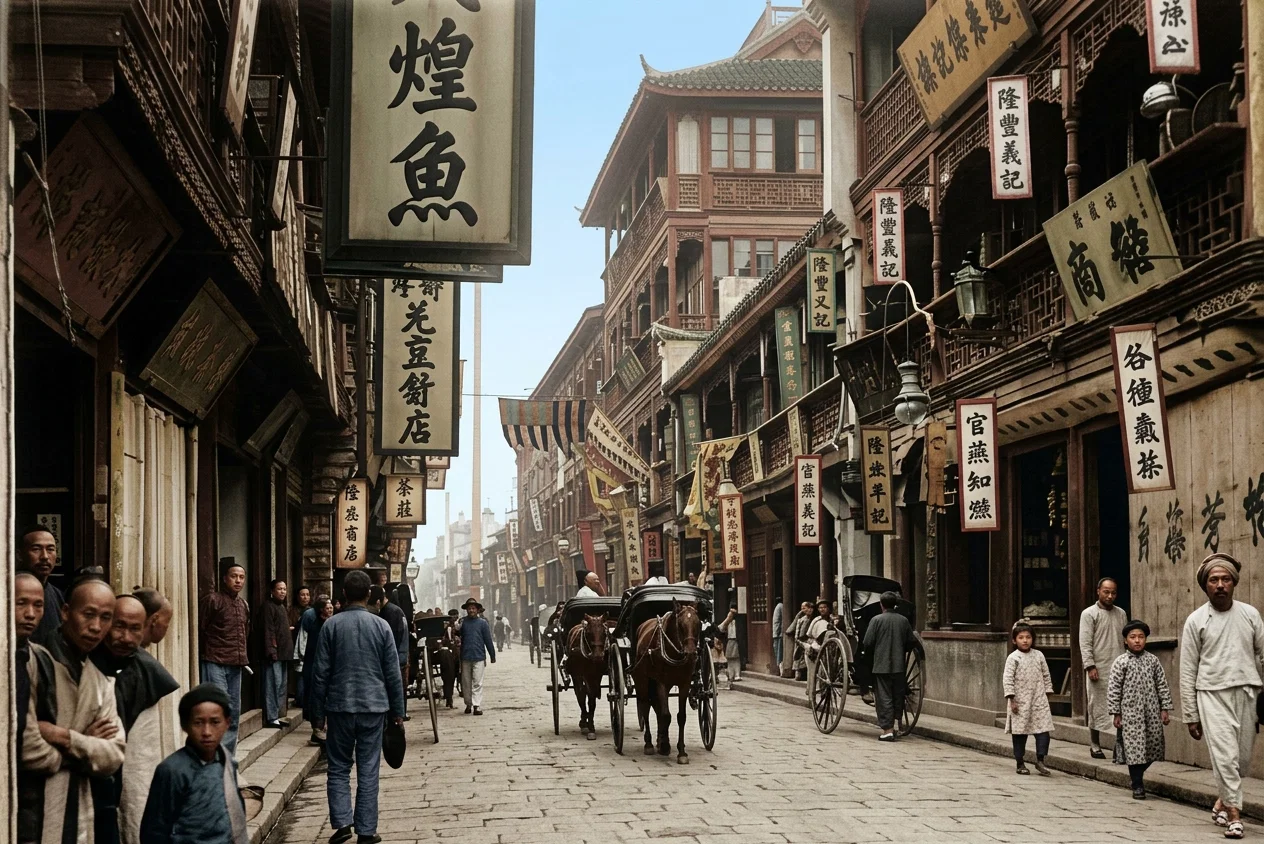
A STREET IN SHANGHAI

Education

With the very great interest in the subject of education, and the almost phenomenal changes that are to-day taking place in China, it was only natural that this topic should occupy a very prominent place in the conference. It was urged and voted that the already existing schools and colleges be greatly strengthened, and that new ones be speedily set in operation. It was felt by a large number of the delegates at the conference that the different missions might successfully unite in the educational work, and so secure larger and better results, and at the same time avoid overlapping and reduplication of efforts. Particular attention was called to the advisability of establishing normal schools in the different centers of the various provinces, supported by the combined efforts of the mission bodies working therein. But the one educational item that enlisted the greatest amount of enthusiasm was the proposition to found a union Christian university in one of the great centers of the empire. The aim of those advocating this institution was to make it in every respect a university of higher education in which every subject belonging to modern scholarship should be taught by educators of the first rank and according to approved methods. It is evident that the conference as a whole was not prepared to launch this great university scheme at this time. The whole question was finally referred to a committee with instructions to study the subject of education in China in a general way, and report to the next conference.

Comity and Federation

The all-absorbing, transcending question of the entire conference, sweeping over the entire meeting as a great wave, was the subject of federation. Beyond a peradventure it was the paramount question of the conference, and as such it enlisted the highest enthusiasm, and provoked a vast deal of more or less heated discussion. All, with very few exceptions, were in favor of federation of some kind; but when it came to definitions, and to looking at the proposition in the light of a scheme to be actually put into practise, there was a great diversity of opinion—an apparently irreconcilable difference of opinion, which, if it ever would allow of federation or union, would certainly necessitate not only many compromises, but even open surrender of what heretofore has been counted vital and permanent. The two extremes in this federation scheme, which to the majority in the conference meant either the success or the failure of the entire gathering, were the Anglicans on the one side, and the Baptists, especially the Southern Baptists, on the other. With the former, federation has little value, except in so far as it involves organic church union, and “the church,” as everybody knows, spells episcopacy, creeds, apostolic succession, etc.; while in the case of the latter, federation must not seriously be taken to mean more than co-operation or spiritual union in the sense of being spiritually joined to Christ the Head. In spite of these differences, however, it was voted almost unanimously to set about to federate all the missionary bodies working in China by way of provincial and general councils made up of representative members from the different societies at work in China.
In closing, the conference memorialized the throne, expressing gratitude for past imperial favors, and requesting full religious liberty to all Chinese subjects in professing Christianity. A second memorial on the opium question, intended for all the rulers and peoples represented by the different nationalities at the missionary conference, was voted with a great deal of enthusiasm. Two letters, one of fraternal greeting to the native Christian church, and the second to the home churches, were voted, after which the conference adjourned.
Canton.

A Trip Through Cuba

U. BENDER
THE first glimpse I had of Cuba was on the morning of January 11 while en route from New York to Kingston, Jamaica, to attend the West Indian Union Conference. As I came on deck that morning, Elder Warren pointed to a dark outline to the southwest, and said, “They say that is Cuba.” Nearly all day we kept close to the shore as we sailed around the eastern end into the Windward Passage, the outlet of the Caribbean Sea between Cuba and Hayti. Any bit of land draws the attention of people aboard ship, but Cuba was especially interesting to us, as it is the largest island in this field, and also has the largest population. The area is forty-seven thousand square miles, with a population of two million.
After spending some time in Jamaica, I took passage for Cuba, March 26, landing in Santiago the next morning. As we steamed into the long, narrow channel that leads to the harbor, I remembered the account given in the papers of the desperate attempt of the Spanish fleet to escape from this bay, where they had been bottled up by the American squadron. Old Moro Castle stands on the right hand near the sea, grim and solemn as a Roman guard. The marks of battle are still to be seen upon its walls and tower, giving evidence to the familiar history of those stirring times. Santiago is a beautiful city of about seventy-five thousand people. It is very strongly built, after the Spanish fashion, of brick and cement. I stayed in the city from 8 A. M., the time we landed, until 6 A. M. the next day, when I took the train for Havana.
The distance between Santiago and Havana is five hundred and forty miles, and it takes twenty-five hours to make the trip by rail. Cuba is about eight hundred miles long. It is one of the great islands that are told to rejoice and be glad when the Lord reigns.
I enjoyed this car ride across Cuba very much. As soon as we passed out of the mountains in the eastern end, we came to long level stretches of country heavily timbered. Beyond this came the beautiful savanas (prairies) for which central Cuba is noted. Western Cuba is given largely to the sugar industry. I arrived in Havana in the morning, very glad to reach the end of the journey. Five hundred and forty miles is not a long trip, but when one rides second class and endures all the tobacco smoke the Cubans can puff, the last station is reached none too soon.
With her population of two hundred and twenty-five thousand souls, Havana sits proudly by the sea with an ease and grace seldom seen. She is fair to behold, and travelers leaving on the steamers usually gaze as long as a tower remains in sight. After some difficulty I reached the home of Elder E. W. Snyder. I was glad to meet Elder Snyder and wife, for it is unpleasant to travel when one is unable to understand the language of the country, and has no one with him to tell him the meaning of so many sounds and gestures.
Elder Snyder is the only worker we have in this field. Think of stretching the area of the State of Pennsylvania out into a narrow strip reaching from Philadelphia to Chicago, and then making it the field of labor for one man! If you were the one laboring alone in such a large field, would you feel that you were selfish to ask that some one come to help you?
I remained in Cuba only two weeks, but during this time I became deeply interested in the work there. Although Elder Snyder is alone, yet I thank God that he has a message which is “the power of God unto salvation.” As I visited among the people with him, I was glad to see that in some lives the seeds of truth are steadily growing. Since leaving the island, I have received good reports of the work being done near Havana.
The Church of Rome has hidden the truth from the people of this country, but through the darkness hanging over them, God will cause the rays of his truth to shine, and the honest in heart will see the beams of his glory, and will walk in that light which leads to the everlasting kingdom. I trust that our brethren and sisters will not forget this needy field, but that they will remember it in their prayers and by their means.
Bog Walk, Jamaica.

The Eastern Polynesian Mission

B. J. CADY
THE Eastern Polynesian field comprises the Society, Cook, Marquesas, Tuamotu, Gambier, and Austral Island groups, and Easter and Pitcairn and some other lone islands. There are probably as many as one hundred and ten inhabited islands in this mission. Some work has been done, and we now have Sabbath-keepers in seven of these islands, but the larger part of them have never yet been reached by the truth. We have in this field six organized churches, four companies, five church buildings, one hundred and seventy-three church-members, and three hundred and seventeen members in the Sabbath-schools.
A ROAD THROUGH A RAROTONGAN VILLAGE, COOK ISLANDS
We came out on the second trip of the “Pitcairn” thirteen years ago. When we arrived at Raiatea, in the Society Islands, the natives of that island urged that a missionary be left with them to teach them the gospel, and it was decided that my wife and I should stop there.
The people promised to put up a house for us, and the leading governor kindly offered the use of one of his houses until our own should be ready. This was only a rude hut, about twelve by fourteen feet in size, with a pole floor carpeted with hay, in which lived a great many fleas. We lived here for three months, and then had the pleasure of moving into our own home, which had the advantage of being new and clean, and of having a board floor.
We began a school in a part of this building, and soon had about one hundred children in attendance. We had no school supplies to begin with, except a map of the world and the Bible, but a little later we secured a lot of slates and pencils, and a small Tahitian primer. After we had worked in this way for some time, the circumstances were such that we felt compelled to close our school. The Raiatea natives were in rebellion against the French government, which had taken the Society Islands under its control, and we were notified that if we continued our school for these people, we also would be counted as rebels against that government, so we thought advisable to discontinue it. In the meantime, we had found that the reason that the Raiateans were so anxious for us to stop with them was not because they wanted spiritual help, but because they hoped that we might intercede for them with the government of the United States, and get it to come to their assistance.
Soon after this, Brother A. J. Read and wife left Tahiti and returned to the States, and we were advised to move to Tahiti, which we did.
We saw that the training of children in the islands was very erroneous. The natives have no word for “home,” and do not know what it means. Parents give away their own children, and adopt others instead, and the children are allowed to run around and do about as they please, and as a natural consequence they form many evil habits. We felt like doing what we could to help them, so we began to take them into our home to teach and train them to habits of usefulness. Our family gradually increased till we had ten children. In time we found that the expense of keeping so large a family in the city was more than we would be able to carry continually.
About that time, a cocoanut plantation on Raiatea was offered for sale. We thought it might be a suitable place for training our youth, and after making the matter a subject of prayer, we decided to purchase it. There was then a blight on the cocoanut trees all over the island. They were not bearing any nuts, and looked as if they might not recover; but within a year our trees were beginning to bear, and have done very well ever since.
There was not a building on the plantation when we got it, but we soon put up a copra house and a small dwelling-house, and later a larger building for a home and other smaller buildings were added. We now have a small sugar mill, twenty-four head of cattle, and six horses. We have started and carried on this enterprise without any financial help except that some of our brethren gave donations to help erect the home building. All our laborers on the plantation have been supported by the income from the plantation, except the teacher. She receives her board there, but her wages are paid by the conference. On account of the existing school laws in these islands, we do not take children under thirteen years of age into the home unless their parents are foreigners. We require our young people to work four hours a day each for their board and tuition, then pay them by the hour for all extra time they work. This furnishes a way for them to earn money to buy clothes, books, etc., so they are better fed and clothed than those outside usually are. We feel that this is one of our most important lines of work, as efforts put forth in this way nearly always prove fairly satisfactory.
We expect soon to start a small paper in both the Tahitian and Rarotongan languages. As these islands are widely scattered and difficult of access, it would be a long time before they could all be reached by the living preacher, but the paper can be sent out everywhere. Nearly every native can read, and they are always very anxious to get something new to read, for there is very little literature in the native languages.
We are not asking for more laborers, because we feel that the need is much more urgent in the large and thickly populated islands of the East Indies, which have not even one representative of our truth. We hope to raise up additional laborers right in our field. We want to take our young people out with us as Christ took his disciples, and train them in the work.
Papeete, Tahiti.

More Southern Camp-Meetings

North Carolina

THE North Carolina meeting was held in Thomasville, a manufacturing town near the center of the State. There was a most encouraging public interest, which is to be followed up.
Our brethren of North Carolina came to the meeting to seek the Lord, and truly he was found of them. There were most blessed seasons, and decisive victories were gained that cheered all hearts. A devoted and united body of field workers and people—all of whom are to be workers also—are pressing on in North Carolina.
There has been growth in this conference. The book work is forging ahead. The sales for 1905 were $1,300, and for 1906, $3,860. Notwithstanding the necessity of raising a considerable amount on local issues, the meeting raised $200 on the large fund, and by the end of the year there is prospect that the conference will have raised its share, though the sentiment was that they meant to keep lifting till the whole enterprise is completed.
Three industrial schools are being operated, by Brethren Beach, Johnston, and Shireman, and there are young people in the conference growing into the work. Elder T. H. Jeyes was re-elected to the presidency of the conference.

Cumberland

The Cumberland Conference (eastern Tennessee and Kentucky) held its meeting in Cleveland, Tenn., another manufacturing town. There was a large attendance and a deep interest on the part of the public. It was the largest of the camp-meetings in the South. The conference business session preceded the camp-meeting. There was reported encouraging growth during the year. The brethren in the churches seem to be especially active, and good interests have been developed for ministerial laborers to follow up. The Bible work has also been an important factor in bringing people into the truth.
The Lord blessed in the meetings. One family, that of a German brother whose father is a believer in Wisconsin, took a stand for the truth during the meetings, and this brother, his wife, and two daughters were baptized with others during the meetings. There will surely be further fruit as the interest is followed up. The camp-meeting raised $1,700 for conference work and general work, including $358 on the large fund. Elder J. H. Pogue was again elected president.

Georgia

This meeting was held in a beautiful part of Atlanta, close to a residential section, and the public interest was good. The Georgia Conference is the smallest in membership of any of the Southern conferences, except South Carolina, just organized, while Georgia's population is the largest of any State in the South.
The believers in Georgia are earnestly at work, and their testimonies have the old-time ring of the blessed hope. The tithe shows a healthy increase. The book work is coming up. As we met with these Georgia brethren, we felt an earnest longing to see more workers come into this empire State of the South to scatter the literature, and more people to engage perhaps in other business.
The sanitarium work in Atlanta is getting a start, though still needing funds to complete its equipment. Every inch of advantage that the brethren find, they are making the most of. The service conducted by the young people at the camp, one afternoon, touched all hearts, and showed that the Georgia young people are a good resource for the work of the future.
The blessed Spirit of God was in the camp day by day.

Notes

In all these meetings Elders Butler and Parmele have borne a special burden as representing union conference work. Elder Butler has carried daily studies in the fundamentals of the message and the experiences of the past which have special lessons for our own time, Elder Parmele has represented publishing interests and borne a leading part in the public preaching. Wherever these camp-meetings are held, there is a friendly and hospitable reception by the public. The South is full of beautifully situated towns and cities where a hearing can be had for this message. As far and as fast as the brethren can enter, they are pushing forward, and fruit of their labor is appearing. But everywhere more laborers are needed.

The Cumberland Conference

THE seventh annual session of the Cumberland Conference of Seventh-day Adventists was held Aug. 20-22, 1907, at Cleveland, Tenn., just preceding the camp-meeting at that place. There were fifty-five delegates present, and some visitors. Three churches were admitted to the sisterhood of churches. Eighty-five new Sabbath-keepers were reported, though not all these are as yet members. The present membership in the conference is over six hundred and thirty, divided among the twenty-one churches. There are also about fifty-five or sixty meeting weekly in seven unorganized companies. There are nine church buildings in this conference, with a prospect of three or four others in the near future. Plans are on foot also for running three new church-schools, in addition to those that have been conducted heretofore, making altogether one intermediate, five church, and two mission schools, with an attendance of about one hundred and eighty-five. There are twenty-seven Sabbath-schools, with a membership of six hundred and twelve; and five Young People's Societies, with a combined membership of ninety-seven.
The conference pay-roll includes four ministers and one licentiate, and sometimes four and sometimes five Bible workers. This includes the paid officers, except the secretaries, only one of whom has any considerable employment. Two ministers and two Bible workers devote their entire time to the work among the colored people.
Notwithstanding the generally poor crops in this part of the country, the tithe shows but little decrease during the last eight months, being an average of $7.47 a member for the eight months, as against $12.18 a member the previous twelve months.
Other interesting statistics can not now be given, owing to the fact that few, if any, expected the conference year would be changed to end August 31, instead of December 31, as heretofore. Thus the various departments are not yet prepared with summaries or with general reports. The conference is doing a good work in the support of two native workers in African missions.
The work of the Young People's Societies is growing. Some of the old-fashioned church missionary societies have been revived, and are doing a noble work. We trust there may be more, and that they may greatly enlarge in usefulness.
The medical missionary work is having much prosperity, for which all are thankful. In addition to several individuals working in a private way, there are found in flourishing condition the Sanitarium Treatment Parlors, at Knoxville, Tenn., and the Graysville Sanitarium, at Graysville, Tenn. The directors of the latter are now planning on enlarging their capacity for patients by building a cottage for some of the helpers, and five or six tents are being pitched for immediate necessities.
The following officers and committees were unanimously elected for the ensuing year: President, J. F. Pogue; Vice-President, Cyrus Simmons; Executive Committee, J. F. Pogue, Cyrus Simmons, W. W. Williams, S. M. Jacobs, W. L. Bird, A. F. Harrison, A. M. Minnis; Conference and Field Secretary and Agent, E. B. Melendy; Associate Secretary, Mrs. E. B. Melendy; Secretary of Sabbath-school and Young People's Work, Mrs. A. F. Harrison; Assistant Secretary of Sabbath-school and Young People's Work, Miss Flora Dortch; Religious Liberty Secretary, M. B. Van Kirk; Educational Secretary, E. B. Melendy; Medical Secretary, L. A. Hansen; Assistant Medical Secretary, R. A. Lovell; Treasurer, S. M. Jacobs; Incorporators for Legal Association, the members of the Executive Committee; Auditors, Ben Auten, H. U. Jacobs, A. D. West, R. A. Lovell, R. L. Williams, A. Schellberg.
The following were granted the indicated papers of recognition, with the understanding that they do not imply conference employment, many being in private and institutional employment, as well as in the employ of the Southern Union Conference: Ministerial credentials, J. F. Pogue, W. L. Bird, E. L. Sanford, J. F. Brice, Smith Sharp, R. M. Kilgore, W. W. Williams, Prof. J. E. Tenney, G. H. Baber, Prof. M. B. Van Kirk, Dr. J. E. Caldwell, W. W. Webster, H. W. Pierce, C. G. Howell, Prof. H. S. Miller, Dr. O. C. Godsmark; ministerial licenses, R. A. Lovell, Cyrus Simmons, Milo E. Emmerson, A. F. Harrison, L. A. Hansen, Dr. A. J. Hetherington; missionary licenses, Mrs. Clara Russell, Miss Maude Dortch, Mrs. Anna Agee Hall, Miss Minnie Hildebrand, Mrs. A. F. Harrison, L. A. Jacobs, Mrs. Elizabeth Whitman, E. B. Melendy, Mrs. Mettie Lenker, Miss Annie Horning, Mrs. W. W. Williams, S. M. Jacobs, Mrs. Anna Hansen, Mrs. A. J. Hetherington, A. M. Minnis.
It was the general opinion that this was one of the best meetings ever held in this conference. Perfect unity prevailed. Truly a spirit of love and regard for the brethren was seen as never before.
Among others, resolutions of acknowledgment were voted to certain citizens of the place, for the free use of land and water for the encampment.
J. F. POGUE, President.
E. B. MELENDY, Secretary.

The Fijian's Answer

AN English earl who was an infidel, went to visit the Fiji Islands. “You are a great chief,” he said to one, “and it is a pity for you to listen to those missionaries. Nobody believes any more in that old book called the Bible that they try to teach you, nor in that story of Jesus Christ; we have all learned better.” The eyes of the chief flashed as he replied: “Do you see that great stone over there? On that stone the heads of our victims were crushed. Do you see that native oven over yonder? In that oven we roasted the human bodies for our great feasts. Now if it had not been for the missionaries and that old Book, and the great love of Jesus Christ, which has changed us from savages into God's children, you would never leave this spot. You have reason to thank God for the gospel, for without it you would have been killed and roasted in yonder oven, and we would soon be feasting on you.”

Jamaica

On the last page of the REVIEW of July 11, of this year, reference is made to the Kingston (Jamaica) church building. The membership is over four hundred, and they wish to dedicate this building on the fourteenth of next January, one year from the disaster. It is no easy task that this membership has undertaken. Kingston is practically the same to-day as immediately after the disaster, in many respects. With homes all injured, if not entirely destroyed, how these dear souls alone, without help, can build to meet the present needs, I do not see.
On Sabbath, July 13, the writer spoke to this church from Num. 21:4, bringing before them God’s willingness and power to help so that they need not become “discouraged because of the way,” but I was indeed sorry to see so many standing outside because the first floor of the old church, which is now a shed where they congregate, could not accommodate all. Sunday night Elder Strickland spoke to a large congregation, one half having to stay in the open yard; and among these were many respectable people, including Jews. It is indeed a pity that the new church is not yet finished so that these people whose hearts are now turned to the message, could assemble and be taught the meaning of the current signs. We do believe in getting “out of the cities,” but these unwarned souls in the cities must be taught the message. The new site is indeed a good one, being away from the crowded business centers and near by respectable homes.
Elders Strickland and Kneeland have already cried out for help; and, brethren in the more favored lands, I want to tell you that your help is needed badly. Will you not help the distressed church of Kingston at this juncture? Other churches of Kingston have been sending to England and the States for help to rebuild. While most of them are building on the old sites, we have removed to a better place; and shall we not call and expect our home-land believers to come to our help?
The greatest drought the writer has ever seen has ravaged the entire island before and since the earthquake. Domestic animals have died for water. Almost all crops are spoiled. Famine has now set in. People are dying in one parish (St. Elizabeth) of starvation. The governor was called there last week. The authorities and press have been collecting funds for the stricken districts. We have a church (Southfield) in one of these districts. Will not some dear ones send us something to help these dear brethren through this crisis? Brother, sister, think of men, women, and children dying of hunger, and those not yet dead too weak to leave their homes to go for relief bread.
Earthquakes and famines in divers places — signs of the Lord’s coming — have at last reached Jamaica. Who will help us? Send all money to H. H. Cobban, Bog Walk, Jamaica, telling for what it is to be used.    A. N. DURRANT.
Continue reading: The Vermont Camp-Meeting