One cold winter’s day, on going out into the yard, I heard the sound of approaching sleigh bells. Soon the team came into our dooryard and stopped. The woman in the sleigh was crying, but the husband made no move either to help her or to get out himself. I went out, and found that they were both nearly helpless from cold and drink. It was with difficulty that I got them into the house, though I had some help. I cared for them the best I could till about twelve o’clock at night, when the man started up, saying, “I’m going home.” The boy and I got the horse out and harnessed him the best we could, not an easy task with the harness tied in many places and the weather bitterly cold. Then we helped the man into the sleigh. The horse was strong and in a hurry to go, and rushed on in spite of the vigorous pulls on the reins, as he called back, “I want my dim-i-john!” Fortunately the horse rushed on; and in the meantime I had spirited the demijohn away. The next morning the wife wanted to go home, so I got a team and started with her; but on the way we met the husband, who, having become somewhat sobered, had started back after—well, was it his wife or the “dim-i-john”? At any rate, the first words we heard him say were, “Wife, have you got the dim-i-john?” Thus does the demijohn take first place in the life.
The following incident is another illustration of how good men are sometimes betrayed by the deceptive drink evil:—
County commissioners from Maine and New Hampshire, with their packman, started from the lower settlement to go to the Canadian boundary line to find the iron monument placed on the corner. From this they were to run the line down between Maine and New Hampshire to the ocean, or very near there.
The first night after starting from the Magalloway settlement, they camped in an old logging camp. The packman carried a good supply of different kinds of “spirits.” As they had arrived at their destination weary with their tramping and climbing, most of them soon dropped off to sleep in a near-by bunk, or place they called their bed. After a while one man awoke and thought the camp was on fire; but on hastily looking around, he saw that Mr. — had taken all the sperm candles from the pack, and after sticking them all over the rude boards which formed the table, lighted them and placed the various bottles from the pack in array, and was busily tending bar. Over and over he cried, “Walk up, gentlemen, ten cents a drink!” Before he left the camp, he got so drunk he had to be helped around. Many of the other men were about as helpless as he was.
The men who came with this dispenser of the liquor and lived near his home, said he was never before known to drink a drop, went to church and Sunday school with his family, and was considered a very fine temperance man! Surely in his case wine was a mocker and strong drink was raging, for he was deceived by them; and so it has been and always will be by those who indulge in alcoholic liquors. “Touch not, taste not, handle not,” is the only safe rule.
SARAH E. BATES-BARTLETT.
The Workshop or the School
CHILD labor still exists in America. There are about two million children, it is estimated, between the ages of ten and fourteen who are now employed in industry and denied educational opportunities. The last eight years, through the efforts of friends of childhood, some substantial improvements in child life have been made. Five of our States limit child labor to eight hours a day; eight prohibit night work; six do not permit night-messenger service under eighteen; four prohibit it under twenty-one years of age; and no child under sixteen is allowed to work in the coal mines of Pennsylvania.
These prohibitions and regulations are just. The nation has not only a right, but a duty, to look after the welfare of its future citizenship. Free education is provided by the government for all children, for it expects to benefit by this expenditure. Then after considering such advantages of sufficient importance to warrant the expenditure of millions of dollars, it is right that the government see that no person or corporation deny children the school privilege thus provided for them.
The personal liberty of parents or corporations is not trampled upon by this provision; for the government is only demanding that no one interfere with the child’s right to the opportunities provided for it.
But the government discriminates; for the liquor traffic robs more children of their rights than do all the other industries of the country. And yet the government stands by and not only fails to prohibit such abuses, but licenses the traffic that commits them. How long shall we as citizens permit such outrages? An incensed people should arise and demand at once the abolition of the traffic that enslaves millions of our children, making life far more unendurable for them than does any other and all other money-scheming industries. How shall we do it? — Vote always and forever for the annihilation of the liquor traffic. Scatter educational literature freely, and make a business of discussing temperance principles with both acquaintances and strangers. Give of our means generously for an extensive temperance propaganda. Three things to do. Let us be up and at them.
Be True to the Best You Know
“Be true to the best you know.”
The Power of Personality
By Helen M. Richardson
I WONDER why it is that every one flocks around that girl. She is “as plain as a pipe-stem,” to use a hackneyed phrase, but she makes more friends in a day than I can in a whole year.
The speaker’s eyes enviously followed the figure of a girl who was making her way through a group of people at a social gathering. An elder woman, by whose side the speaker was standing, turned to look at the girl about whom the remarks were addressed.
“I think that I can solve your riddle, Margaret,” this lady observed a little later, when the two happened to meet again.
“Riddle?” Margaret’s tone was inquiring.
“I think that I can tell you why Thelma Davis is so admired and sought after.”
“Well, do tell me, Mrs. Arnold, for if it is anything that can be acquired I’d like to be made acquainted with the art.”
“In the first place, watch Thelma when she is talking. Notice to whom she addresses her conversation. If you observe carefully, you will see that it is most often to the ones who would not be spoken to at all if it were not for her thoughtfulness. Then, again, she never seeks to monopolize the conversation, but also allows others the privilege of expressing their opinions; and if these do not happen to agree with her own she does not contradict, but tactfully and good-naturedly turns the conversation into another channel. As I stood watching Thelma I wondered how you could call her plain.”
“Why, Mrs. Arnold!” Margaret broke in, impulsively, “she hasn’t a decent feature! Her eyes are—no color, her nose is the first thing you see when she approaches, she has freckles galore, and her mouth stretches from ear to ear!”
“But it opens over a set of teeth that any one might envy. And her smile lights her face.”
“Oh, well! if a smile is all that does it, I’ll immediately begin cultivating a grin,” the girl answered somewhat flippantly.
“There is more in a smile than many people imagine, yet a smile is not all that is necessary to render a person lovable. Kind thoughtfulness for the feelings of others, and a self-forgetfulness that is for the time being transforming, must be back of it. Have you never met a man or a woman who unconsciously called forth the best that was in you? one who somehow gave you the impression of being almost a mind reader, so understandingly were all your hopes and aspirations translated? While talking with such a person you do not stop to consider, if she be a girl, whether her nose is straight or crooked, whether her eyes are brown or blue, or whether her complexion is clear or sallow. You are thinking simply how very agreeable your companion is; and if questioned as to her looks, you would be apt to say, offhand, that she was good-looking rather than the reverse.”
The listener’s face grew thoughtful. “I begin to understand the secret of Thelma’s wonderful power,” Margaret declared. “To sum it all up: Thelma’s personality so transforms her facial defects as to make people with whom she converses unconscious that they exist. I wonder if these attributes can be acquired,” she said, after a pause.
“Only by an entire forgetfulness of self, and a determination to make others happy even at a sacrifice of our own pet theories,” was the gentle answer.—Helen M. Richardson.
The Silent Hour
By Llewellyn A. Wilcox
WHEN the cold, gray dawn is breaking,
And the birds to song are waking,
When the morn is robed in beauty,
In the freshness of its flower,—
Then, before the fevered flurry,
Then, before the care and worry,
Ere the labor of thy duty,
Give thy soul a silent hour!
Ere the stillness blest is broken,
Ere the teeming world hath spoken,
Through its thousand mouths ejecting
Woe and want—life’s bitter-sour:
Ere earth’s duties loom as giants,
Ere man’s service claims alliance,
Lest thou be thine Aid neglecting.
Pray—within thy silent hour!
In the world is tribulation,
Hate, and strife, and vile temptation.
For its whirlwind of persistence,
Hast thou strong, unswerving power?
Whispering demons will assail thee;
Till thy heart will almost fail thee!
Look above for thine assistance
In the morning’s silent hour.10
Mid the long day’s sultry nooning
Comes the din’s diurnal swooning,
When there is a moment’s ceasing
Of the care that doth devour;
Seize it! though ’tis but a minute,
There is peace sublime within it!
From the dizzying daze releasing,
It shall be a silent hour.
After all the stress is finished,
And the tension is diminished,
When thy wounded soul is yearning
For some cool, refreshing shower;
In thine ears the clang of clamor,
In thine eyes the glare and glamour,
Thou shalt find, on upward turning,
Love’s bright rainbow in that hour.
In the haven of His quiet
Lose the world and all its riot!
He hath love and joy and gladness,
Sunshine when the shadows lower;
So within the silent even,
Be thou lifted up to heaven,
And no shadowing of sadness
Shall molest thy silent hour!
Go thy way! Thy soul is stronger!
Thou canst strive and struggle longer
For that brief, yet glorious vision
Of thy Father’s promised power.
But Love’s essence cannot grant it
Save thou tellest him thou want it;
By thy call he is beside thee,—
Nearest in the silent hour!
LLEWELLYN A. WILCOX.
Winsome Christians
By G. W. Tuttle
A BRICK manufacturer, a very fleshy man, advertised for a boy. A boy appeared. His first question was:— “How much wages do you pay?” “Five dollars a week and board,” was the manufacturer’s reply. “What kind of board?” said the sharp applicant for a position. “Well,” said the corpulent and good-natured manufacturer, “I eat it.” “Give me the job,” said the boy, with a smiling glance at his prospective employer.
This is a humorous story, but it has a point that we can see with our eyes shut. The brick manufacturer was a good advertisement of the board that he gave his workmen. If you and I should ask some one to become a Christian, would he look at the gospel’s results in our lives, and say, “I want the job”? In other words, do we look, speak, and act as if religion agreed with us and we agreed with religion? Are we a living recommendation of our spiritual fare? Are we a good recommendation for the gospel? Would other people long to be fed with our food, to think our thoughts, to speak our words, to dream our dreams, and do our work?
A dear, sunshiny old man, with whom I was long acquainted, loved a phrase that we rarely hear nowadays, “winsome Christians.” Just divide that word, win-some. Winsome Christians are magnets that are always charged, lights that are always burning. They radiate hope and faith and good cheer to all with whom they come in contact. Young people do not need more signboards to point out the way to heaven; what they need is to company with winsome young people who are headed that way and who always keep their eyes upon the goal.—G. W. Tuttle.
For the Finding-Out Club
By Mrs. Grace Hoover
Answers to Questions in “Instructor” of September 26
THE picture represents a starfish and an oyster.
The common starfish consists of a flat central disk, with five arms radiating from it, with an eye at the end of each arm. The whole upper surface is covered with numerous calcareous plates, somewhat flexible, supporting short spines.
On the under surface, in the center of the disk, is situated the mouth, and from this radiate five grooves, or furrows, extending to the tips of the rays. These furrows are pierced with four rows of minute holes, through which extend the sucker-like tentacles which are the organs of locomotion and prehension.
The mouth leads into the stomach, which extends into the rays, ending in a short intestine, to which is attached the green, branching liver.
The starfish is a very voracious animal and the worst enemy of the oyster.
The oyster is a salt-water mollusk having two irregular and unequal shells, formed of carbonate of lime. The part of the shell where growth commences is called the beak, and that where the shell opens, the base. Near the beak is the hinge, where the two valves are connected by a horny ligament, which always tends to throw them apart.
Opening the valves, we see the muscular-like body wall called the mantle, whose function is to secrete the shell in successive layers. The mantle incloses a chamber into which project a pair of gills, and above the gills lie the digestive and other organs, and also the adductor muscle, which closes the shells. A deep-blue mark on the inside of the shell marks the point where the muscle is attached.
Oysters are propagated by eggs. The young are at first able to move about, but finally settle upon the bottom, where they remain for life. They generally lie upon their side and prefer rather shallow water.
MRS. GRACE HOOVER.
Questions
1. WHERE is Robert College?
2. When and by whom was it founded?
3. What work has it accomplished?
4. Who were the first women to demand their rights? See Bible.
5. Name the first city of the Bible. By whom was it built?
6. Tell how to turn in a fire alarm.
What War Has Done to American Materials
THE wholesale prices of the following staple articles have increased as follows since July 1, 1914:—
PER CENT
Bleaching powder 431
Blue vitriol 245
Sulphuric acid 233
Glycerin 162
Wrapping paper 122
Copper 97
Silk 85
Galvanized sheet iron 73
Gasoline 72
Nails 67
Tin 47
Pig iron 47
Leather 44
White lead in oil 44
Clay worsted cloth 40
Paper (news roll) 33
Worsted serge 33
Wool 30
Flour 25
Gingham cloth 22
Builder's lath 17
Brick 14
— American Review of Reviews, August, 1916.
The Knitting Lesson
By Esther M. Spicer
ESTHER M. SPICER
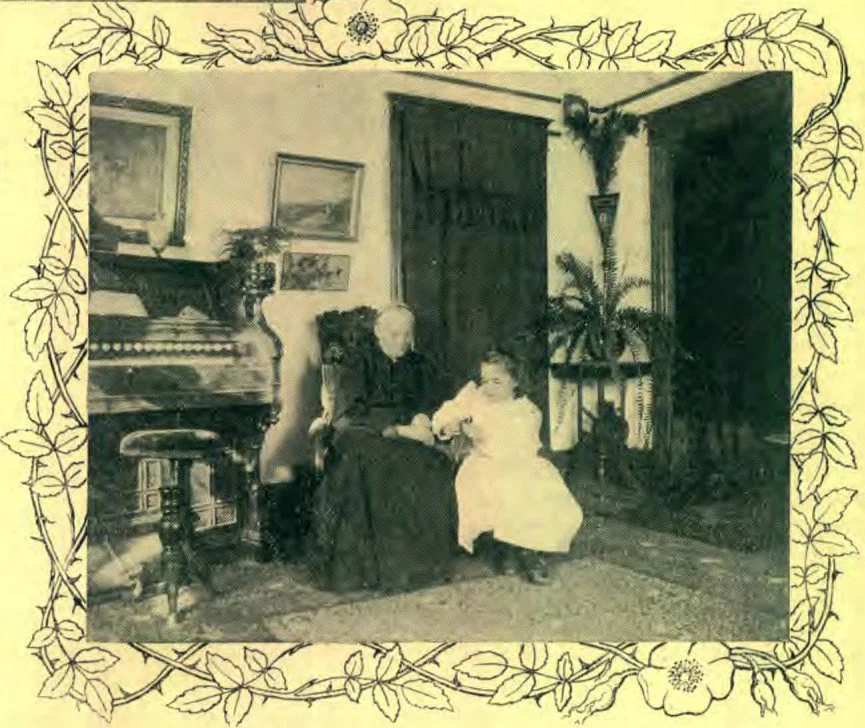
GRANDMA is knitting stockings,
As happy as can be;
Sometimes she knits for daddy,
For Dorothy, and for me.
I wonder how she does it—
The needles go click, click;
Wish I could learn to do it,
I want to, awful quick.
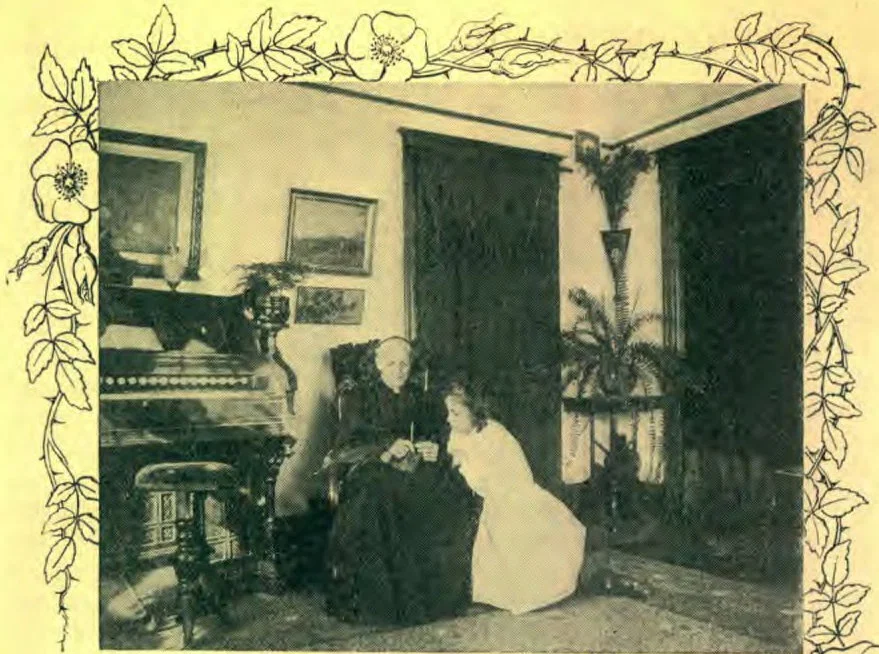
I think I’ll sit beside her
And watch her for a while.
She shows me how to make the stitch;
Her face is all a-smile
Cause I think it takes so long,
Just one stitch at a time;
And grandma says she’s eighty,
While I am only nine,
And that if I should live to be
As old as ninety-nine,
I could not live a year at once,
But one day at a time.
Three Little Faith Stories
By W. S. Chapman
W. S. CHAPMAN
Do we believe God? Some time ago we were told that we did not, as yet, understand even the first principles of faith, and a recent personal experience has helped me to appreciate the meaning of this statement.
Away back in the eighties, during one of the morning parlor talks at the old sanitarium at Battle Creek, the woman in charge of the sewing-room where six young girls were kept busy making uniforms for the sanitarium nurses, came in. She did all the cutting and fitting, and on her work the girls depended from day to day to keep them busy.
She said that one night she went to bed with an aching pain in the finger on which she used her thimble. This, by midnight, had become so intense that she could not sleep; a felon was forming. At last she rose from her bed, and kneeling beside it, asked God to rebuke the pain and heal her, basing her plea on the fact that in the condition she was in she could not wear a thimble or use the shears, so that the six girls would have no work prepared for them and would be idle until the finger healed. She returned to her bed and slept soundly the rest of the night. When she awoke the next morning not a sign of the felon remained—she had been healed.
At the time I listened to this story I comprehended but little about God. While I did not doubt that by some unusual but natural process the advance of the disease had been checked and the inflammation had subsided, yet my mind made no effort to believe that God had had anything to do with it, as this thought seemed childish and purely imaginative. I, of course, admired the simplicity of the woman’s faith, and tacitly admitted the charm of such a confiding trust, but never for a moment did I think of accepting it as true. At that time I was, practically, an infidel.
Later, during the years that passed, changes came to me, and one summer found me boarding at a farmhouse, giving Bible readings, and on alternate nights doing the same thing at a village seven miles distant, walking back and forth to meet my appointments. Halfway between the farm and the village the road passed through a hemlock swamp, and a rude log bridge, without railings, spanned a turbulent little brook with water, at that point, some six feet in depth—an undesirable spot at which to fall overboard in the dark.
One night when I started home from a meeting, the clouds began to gather and threaten a storm. As it was a moonless night, I borrowed a lantern to light12my way across the bridge. Before I reached the swamp the storm broke and became a raging tempest, the wind howling and the lightning flashing incessantly, with an occasional distant boom of a falling hemlock tree.
My attire consisted of a thin linen coat and pants, with a shirt. I had with me my Bible, the first I ever owned, purchased for me by Elder Elam Van Deusen, who brought the Sabbath to me. The book was precious to me on account of its associations, and because it was filled with notes, annotations, and references, mostly written with red ink. I felt certain that if the leaves became wet, the ink would run and blur all, so that my Bible would be ruined.
As a forlorn hope I opened my shirt and put the Bible inside, buttoning my coat over it. By that time I was near the center of the swamp and close to the bridge. The wind increased to such a pressure that I could no longer stand before it, so holding my lantern up inside the umbrella so that it would not be blown out, I kneeled down and drew it close over my head. The storm continued to rage and the limbs of trees to fall about me until I was hedged in by a natural cage which partly screened me. Finally the lantern went out, leaving me in darkness, and I gradually became soaked through. I thought of my Bible, and cried to God to spare it if the favor was a consistent one to ask; but the sequel shows that I had little faith in God’s willingness to interfere in so trifling a matter.
The storm passed over, and through the intense darkness I groped my way, feeling the road by sliding my feet through the muddy track, and so passed over the bridge safely, finally reaching my boarding place. My room was in the attic, and I had no lamp. I took out my Bible and laid it on the bureau, mentally ejaculating, “Well, I have used the old Bible for the last time, for it is ruined now.” Dropping my clothes in a pile on the floor, I prepared for bed as quickly as possible and was soon fast asleep.
The next morning my first thought was of my Bible. Springing out of bed, I saw on the floor my clothes in a little heap surrounded by a puddle of water. “Poor Bible,” I said as I took it in my hands, but nearly dropped it in my surprise. There was not a sign of moisture on it anywhere, nor was it injured in any way! It had been miraculously preserved. Was it in answer to my prayer? Had I believed when I prayed that God would so preserve it? — No.
That occurred over thirty-five years ago. Has my faith grown since then? I hope so — I know so; but a recent revelation makes me think that even now, possibly, I do not yet understand “the first principles of faith.”
About twenty-five years ago I was laboring in the Atlantic Union Conference. At the time I carried a little $1.50 clock watch made for boys’ use, a faithful little ticker whose tick, tick, could be heard several feet away from my vest pocket where it was carried. I had secretly hoped that the day would come when a better-looking watch would take its place, but I always had two uses for every dollar that came my way. One morning my faithful old watch refused to tick longer, and quit.
To be sure it was only an old $1.50 clock watch. Most boys would be too proud to carry it, but for years it had been my companion, comforting and encouraging me with its faithful ticking. On a dusty road, when sales were slow, and the sun was hot and water not easily found, and things, generally, went hard, its ringing “tick, tick,” speaking hope and courage, would seem to say, “It’s better farther on:” so that the hills did not seem to be so very steep, nor the distance to the next house so very far, nor my hunger quite so provoking, as I would look ahead and speculate as to the probabilities of a sale and of getting my dinner at the next stopping place. In many ways that little cheap watch had been a help and comfort; but now — what should I do? Buy another? Alas, I had but a five-dollar bill in my pocket, and what would that purchase?
On the way to the ferry at Jersey City, which I had to take to reach New York City, and the book depository in Bond Street, I thought that I would give the watch to some child for a plaything; but as I was crossing in the boat, I took it out of my pocket and gently dropped it overboard. It sank in that turbulent watery highway, where I trust that it still lies quietly resting in its muddy bottom. I could not let strange hands abuse the old thing, for it had earned its right to a peaceful end. But what was I to do now for a timepiece? I had determined that I would have something better than before, and go without until I could obtain a suitable one.
After transacting my business, I walked down to Third Avenue on my way to Brooklyn. As I turned into the avenue, I saw a sign, “Levy Brothers, Pawnbrokers.” Like a flash it came to me: The Levys, father and son, have been pawnbrokers for a great many years, and undoubtedly have an immense stock of pawned watches to select from for the money I have on hand. I stopped at the entrance, and standing there, mentally asked God to let an angel guide me in a purchase, and grant that I be caused to select one that would answer my needs as long as my probation might last, or until the Lord should come; then I went in.
“Mr. Levy, I wish to buy a watch, and I want a good, serviceable timepiece that will last as long as I am likely to live; but I have only five dollars to spend. Now if you have a genuine bargain that you can let go for that amount, please show it to me.”
“I have just what you want, sir,” and going to a huge safe in the rear he took out a large tray holding some fifty watches, all silver cases, and brought it before me. They all proved to be Waterbury watches, railroad timekeepers, too large to carry in the vest pocket and too heavy for my use. This I explained to Mr. Levy, and when he saw that he could not sell me one of those, he pushed a felt mat before me, and opening his hand laid down the watch I am now carrying. As soon as I caught sight of it, the impression grew strong that it was the one to buy, and without a word I picked it up, put it in my pocket, and laid down my five-dollar bill.
Over twenty years passed by, and during all that time this watch had never varied over a minute a year from correct time. It was never cleaned or in the hands of a watch repairer for any purpose until last August, when it stopped. Believing it to be worn out, I questioned the advisability of having it repaired. I had always been half ashamed of the purchase, it having cost such a trifle, and thought that it could not, in reason, be worth much more than that. I do not doubt that had I been offered five dollars for it the temptation to sell it would have been a strong one.
One day, being lonesome for want of its company, for a watch is company, I decided to call on an acquaintance of mine, a jeweler, and have him tell me if the watch could be made serviceable at a small cost. I explained to him how I had obtained it, and that I did not care to spend much more money upon it. As13soon as he saw the movement, to my surprise he seemed at once greatly interested. Quickly removing it from the case, he examined it with his glass very carefully. At last he spoke:—
“Mr. Chapman, there is nothing the matter with the watch except that it needs cleaning.” Then laying down the movement and picking up the case, he continued:—
“You have an exceptionally fine watch. I doubt if I have any in my stock to compare with it as a time-keeper. It is an old English movement made by a specialist. You will notice the gold bands on the front and the back. This was the style on all the cases made for him. It was to distinguish his watches from all others. He died before he succeeded in introducing them to any extent. Notice that the number on your case is 400. This was about the total output, so that you own a very rare timepiece, and one that, if properly cared for, will prove to be a very reliable watch. You may consider yourself extremely fortunate in having found such a prize.” And then I thought of what I had asked God to do for me, and oh, how humble I felt! Carrying this perfect timepiece, a gift from my Father, for over twenty years, and ashamed to let any one examine it!
Well, have you a faith any stronger than mine has been in an ability to trust God in small affairs? How does the record stand with you?
A Blueberry and Camp-Meeting Trip
By Blanch Maguire
THERE are six of us — papa, mamma, my sister, two brothers, and I — who live on a small farm in Mercer, Maine. In the summer of 1913, just two days before our camp meeting, we all got ready to go blueberrying about five miles from our home. As we have no horse, we went with our oxen. We planned to stay all night, so took bedding and provisions with us. Bossy went along also to supply the usual milk for the table.
Having got an early start, we reached the blueberry place in time to do some picking in the forenoon. When we were hungry we came out where our cattle were, and papa made a small arch out of some bricks that were there, and we warmed our food over the fire he had made.
We worked hard all day picking blueberries, and just before dark, papa and my brothers built a small house of boughs, in which we made up our beds for the night. After supper, papa milked the cow. After finishing the necessary tasks, we lay down in our leafy bower. Playing Gypsy was great fun.
In the night we heard a noise, and mamma said, “Surely that cow has got loose and is eating the blueberries,” which we had stored in the cart. So papa hastened to investigate, and found that the cow had not disturbed the berries, but had eaten nearly all the potatoes we had with us.
In the morning we built a fire and fried some fritters for breakfast. Then after papa had milked the cow, we picked berries until noon. Only one place had attraction for us after the morning’s strenuous work, and that was where we had breakfasted. After finding plenty of food to supply our noon hunger, we continued picking in the afternoon until about four o’clock, when a heavy thunderstorm seemed to be coming. We started for home, though we had planned to work until late. After two or three miles’ travel, the clouds began to clear away, and the shower passed by. We reached home about dark, and I found a letter from Aunt Jennie Bates saying I could go to camp meeting at Camden if I could go with Brother Edmond Taylor’s family, who lived about eleven miles from us.
I went to a neighbor’s house to see if a telephone message had been received for me, and I found that Mrs. Taylor had sent word that they were going to start the next morning at three o’clock. We had no horse, so I thought I could not go. I could scarcely keep from crying, as I was very anxious to go to camp meeting. Soon our neighbor came to the door, and said if papa would get their horse from the pasture, we might drive it to Mr. Taylor’s. I greatly appreciated this unexpected favor.
You may be sure I was not long in getting together the necessary things for my trip. Papa and mamma got some blueberries ready to take to Norridgewock. We started about ten o’clock, and reached Brother Taylor’s about one o’clock. Because papa had been driving oxen, sometimes when he was almost asleep he would call “Whoa hish” to the horse. I was so pleased because I could go to camp meeting that I sang almost all the way, not feeling sleepy in the least.
Mr. and Mrs. Taylor and I a little later drove to Skowhegan, where we took the train for Belfast. I had never before been on a train or a boat. I enjoyed both of these; but I cared most about the camp meeting. We had some excellent meetings.