The Youth’s Instructor, Vol. 64, No. 48.

Household Suggestions

The Youth’s Instructor

Nov 28, 1916

Review and Herald Publishing Assn. · Takoma Park Station, Washington, D. C. · Nov 28, 1916

Household Suggestions

Linoleum which has been rolled up for some time should be placed before the fire for a few minutes before unrolling. This will prevent cracking.
Dumplings will retain their lightness if pricked open when first taken from the kettle. Also the lid should be kept on tight while they are cooking.
All traces of the damage done by too hot an iron may be quickly removed by dampening with peroxide of hydrogen, then pressing and putting in the sun to dry.
White lead is one of the few cements that resists both heat and water. Apply thinly to the edges of the broken pieces, press them tight together, and set aside to dry.
When cooking sirup over a quick fire, drop in three or four clean marbles. The heat will motion, and will not only prevent the sirup from burning on the bottom but will do most of the stirring. If you think the sirup may boil over, butter the inside of the vessel about two inches from the top. The sirup will not rise higher than the butter.
It is better to shrink cloth before making it up. Fold the cloth smoothly, place in a tub, or other large receptacle, and pour in enough cold water to cover it. When the material is thoroughly saturated, pour in hot water, gradually increasing the temperature until the water is as warm as the hand can stand. Leave for two or three hours. Pour off the water, and press as much out of the material as possible, but do not wring. Hang on a line in the open air, stretching out smooth and pinning along one selvage.
“Last summer while on a camping trip,” says A. I. Jenkins, “my fountain pen went dry, and I discovered that I had forgotten to bring an extra supply of ink. However, I chanced to have an indelible pencil in my pocket; and, taking about one half inch of the lead, I dissolved it in water and filled my pen. The result was a free-running, noncorroding ink so satisfactory in appearance and so economically contrived that I have used it ever since, and am given to understand by a bank clerk to whom I passed my suggestion that they use it altogether now in their business.”
In sewing on buttons, if the knot in the thread is placed on the right side of the cloth, under the button, the thread will be less likely to break and become loosened, and the wrong side of the cloth will look much neater.—Selected.

Abram I. Elkus Appointed Ambassador to Turkey

Hon. Abram I. Elkus, of New York, was appointed to succeed Mr. Morgenthau as ambassador to Turkey.
A tablet from Nippur, dating about 2250 B. C., has been found to contain a record of the flood closely paralleling that of the Bible. One more answer to skeptics.
Miss Kathleen Parkin, of San Rafael, California, at the age of fifteen, is an expert wireless operator, and holds a government license. She made her own wireless apparatus.
One of Austria’s scientists has discovered that the fiber of the thistle can be successfully substituted for cotton in the manufacture of cloth. It is, therefore, expected that in time Austria will become independent of foreign cotton.
Bread, now six cents a loaf instead of five, is by no means the only food to pay a “war tax.” In 1912 flour sold for $4.65 a barrel; now it brings $8.40. Beans sold for $4.95 per hundred pounds; now they bring $9.45, nearly twice as much.
The British Y. M. C. A. has collected between two and three million dollars to be used in supplying European soldiers with reading matter. The association spends about $3,000 a day to supply its huts and other activities with books and papers. In Germany a similar effort has been made, more than 100,000 books having already been furnished the prisoners of war in Russia alone.

It Takes Courage

To speak the truth when, by a little prevarication, you can get some great advantage.
To live according to your convictions.
To be what you are and not pretend to be what you are not.
To live honestly within your means, and not dishonestly upon the means of others.
When mortified and embarrassed by humiliating disaster, to seek in the wreck or ruin the elements of future conquest.
To do your duty in silence, obscurity, and poverty, while others about you prosper through neglecting or violating sacred obligations.—Success Magazine.

“Finding Out God’s Secrets”

THERE is a small book, “Finding Out God’s Secrets,” written by Rev. Claude Allen McKay, that is of special interest to small children. It is a book of forty-four short story sermons for children. Mothers would find it an excellent book for Sabbath reading with their children. Some of the chapter headings are: “When the Sundial Lost Its Tongue,” “A Builder Who Cheated Himself,” “A Look at the House You Live In,” “Catching Good Things,” “God’s Two Great Regulators,” “A Visit to God’s Incubator,” “The Dream Telephone,” “Why the Carrot Broke,” “In a Blind Man’s Shoes,” “How to Get in Tune,” “The Ship That Never Comes Back,” “Wanted—A Bunch of Keys,” “Mighty Little Things,” “What Did the Arab Mean?” “It Can’t be Done,” “Trading Thorns for Roses.” Price, 50 cents.
Order of Review and Herald, Takoma Park, D. C.

The Gray Days of November

The gray days of November No plaint from me shall win; I shut the fog and mist all out, And shut the fire-shine in; I draw my chair the closer To where its warm glow cheers, And, dreaming in the firelight, Dream back across the years.
No happier days, no better, My lost youth gave to me, With flowers in every meadow And songs from every tree; That was the time of growing; This is the time of rest; Bloom falls, but fruiting follows, And each in turn is best.
God giveth of his glory An ever-changing view; The old things pass forever; He maketh all things new; Life knoweth here no beauty That shall not fade away; Some better things he sendeth, And these are mine today.
Mine is the riper wisdom That comes with graying hair; Mine is the fuller knowledge Of God's great love and care; Mine is the clearer vision; Mine is the wider view; And mine the hoarded memories Of friendships kind and true.
Mine is a steadier patience To bear the ills of life; Mine is a sturdier courage To meet the daily strife; Mine is a faith serener Than ever youth could know, To walk the way appointed Through sunshine or through snow.
The gray days lead to white days Of peace and silence deep, A stiller hush of resting When Earth and I shall sleep; And then—a glorious waking When broken ties all mend. Through gray days of November I wait the long year's end.
—Annie Johnson Flint.

The Armenian Massacre

J. G. MANDALIAN
WHENEVER we hear the word “Armenian,” our minds instantly revert to another word which by virtue of continuous association has become supplementary to it. It is the word “massacre.”
The Armenians are a small Christian nation dominated by a cruel, non-Christian people, the Turks. Armenia has had no active friends.
When the 1895 massacre shocked the civilized world, the Armenians had many sympathizers. The leading papers of this country and of Europe were full of lofty editorials. There were orators everywhere who thrilled their audiences with sympathy for a helpless nation. The world was full of sympathy. But not a single nation stretched an arm to rescue the persecuted from the butcher’s knife. Thus Abdul-Hamid went on with his bloody work unhampered. Poor Armenia cried for help, but no one came to her aid. And so for centuries she has been abused, robbed, dishonored, persecuted, and butchered.
When the revolution of 1908 put an end to the despotic rule of the bloody Hamid, the Armenians welcomed the constitutional régime with open arms. They forgot the bitter past, and forgave. They soon found, however, that the Turk’s fond embrace had been the traitor’s clasp. The massacres of Adana and Cilicia demonstrated this. They found the rule of the Young Turk even more galling than that of Hamid. But they forgave again, and tried to live with their butchers as best they could.
When October of 1915 saw the Turk enter the whirlpool of the present war, it was clear to all intelligent Armenians that a serious calamity awaited their nation. No denial can be made of the fact that Armenian sympathy was with the Allies from the start. When Turkey enlisted on the side of the Central Powers, the Armenians fought in the Turkish armies against their patrons and sympathizers. In every instance they were put in the front, where they were exposed to the severest fire. As long as the Turkish arms were victorious, the Armenian people were safe. But as soon as the Turks met with reverses in the Caucasus, they took their revenge on the innocent Armenians.
When the victorious Russian army conquered northeastern Armenia, the people hailed them as their deliverers from Turkish tyranny. In view of these reverses the Turk wanted to be revenged. Armenia was his natural victim. The only thing necessary was a pretext, and this was easily found; for presently the serious charge of general uprising was brought against the Armenians. Prominent Armenians were arrested everywhere. Many of the Armenian soldiers were shot down in cold blood. About twenty of the best men of the nation, statesmen, lawyers, editors, were publicly hanged in Constantinople. Massacres began to take place in various cities. It seemed that the calamity was not local or accidental, but had the character of organized effort. Armenians everywhere became alarmed. All the able-bodied men were in the army, and those at home were the old men, women, and children. The greater the reverses of the Turk, the more intense became his revenge upon the Armenians.
Finally, Talast Bey and Enver Pasha, the dictators in Constantinople, gave the command for carrying out the scheme known as Armenian deportation. The helpless Armenians were ordered to leave their property, their lands, their cherished homes, and prepare to go—who knew where? The thought was revolting. In many places they resented and fought. Against these “rebels” regular troops, cannon, and other means were sent to enforce their deportation. Then followed heart-rending scenes. Husbands were separated from their wives, brothers from their sisters. The men and women were first separated, then huddled together like sheep. Then they began the long journey—miles, scores, hundreds of miles, until they reached their destination. Hungry, exposed, exhausted—but who cared? If an old woman lagged behind, she was instantly struck down to save trouble.
The defenseless companies were exposed to the attacks of hostile Kurds, the perpetual enemies of the Armenians. These Kurds rushed upon the timid women and girls like wild beasts upon their prey. The terrified women shrieked and cried for mercy. The Turkish officers told the Kurds they could do as they pleased with their victims. So these innocent women were abused, kidnapped, some shot down, others cut to pieces. In many places whole companies were driven into the sea, others massacred in cold blood. Perhaps not one tenth of the deported arrived at their destination. The Armenians were charged with insurrection. It is now known too well that it was all a scheme for exterminating an innocent nation. The population in the vicinity of Constantinople was driven to central Asia Minor, and that of the sea coasts to the Syrian deserts.
It is estimated that one million Armenians perished in these deportations. Among them perished the best of the nation, university men, college professors, scholars, statesmen, authors, and poets. There have been shames and horrors inflicted upon the mothers and sisters of my nation that make me shudder, and wonder if the Turk can really have a heart. I dip my pen in tears and carve my heart into words to tell the story.
O my sweet Armenia, my bleeding Armenia! Thou hast been intrusted to the caresses of a butcher. Thy heart has been drained of its blood. Thy cries have fallen on deaf ears. Thy tears have been scorned. Yet, with all thy wounds, thou hast been true to the trust that was committed to thee. Some day the Master himself shall appear, when wrongs shall be avenged, and tears shall be wiped away. Then shall thy faithful ones live once more in true liberty and love throughout eternity.

Gleanings from Norwegian History — No. I

“Proud mem’ries awaken, as ’gainst the strand The North Sea waves dash loud resounding,— Of fathers who came to this far-off land In barks, o’er the billows swift bounding.” — Norriges Unge Flag.
“HIGH up in the north” lies Norway. It is a land of gleaming waterfalls and rushing rivers; of wooded valleys and barren fields; of silver lakes and snow-crowned mountains,—withal a glorious land. Whether bathed in the dreamy effulgence of the midsummer sun, or canopied by the flaming splendor of the winter Aurora, Norway is always sublimely beautiful. And the Norwegian loves his homeland with a fervency unexampled elsewhere. The national motto is a succinct expression of this patriotism: “All to Norway!”
Notwithstanding his patriotism, the Norwegian goes much abroad. On many a bloody battle field, in many a mighty achievement of peace, in all lands and climes where men have been wont to risk life or limb, or to perform Herculean labors, there have the sons of Norway gone. And be it said, “On Fame’s eternal camping ground” not a few have pitched their tents. For, with all its grandeur, Norway is, generally speaking, a barren land. Hence, its inhabitants have been compelled to seek sustenance from the sea; and the sea became a ready highway to other lands.
An old legend ascribes the prevailing rockiness of the country to the forgetfulness of the Almighty, who, through an oversight, neglected to give Norway its proper complement of soil. Perceiving this, says the tradition, the angels were directed to gather up such fragments of earth as remained from the work of creation, and these particles were scattered upon the rocky surface.
The Norwegians have not always lived in Norway. They emigrated thither from the south shores of the Baltic, before the dawn of history. Norway was peopled by Gothic tribes, and the Norwegian today is the purest representative of the once mighty Gothic race.
Anciently the Norwegians were pagans, worshiping Odin, the All-Father; Thor, the Thunderer; Baldur, the Beautiful; etc. According to the pagan myth, winter, sickness, and death came about by the fall of Idun. One day she lay wrapped in slumber on a branch of the world-tree, Yggdrasil. The squirrel, Ratatosk, running noisily upon the bough which supported Idun, caused her to start up quickly, and, losing her balance, down, down she fell, even unto Niflhel, the darksome, the dismal. But Idun was permitted to return to earth for a time each year. Her approach is heralded by soft winds, and her stay is marked by genial skies and verdant meadows. At her going, flowers die, leaves wither, and cold winds blow.
The story of Idun is the most beautiful in Northern mythology, for in the old paganism was much uncouthness. There is no question, however, but that these same pagans believed in the “strenuous life.” In Valhalla, the fabled paradise of heroes, they imagined that the hosts went forth daily to battle, and that their wounds were healed at eventide. The ancient Norse believed that, ultimately, at the “twilight of the gods,” the powers of the deities would fail and that the universe would crumble to ruin. A grim view of the future, assuredly!
But enough of tradition. Let us sojourn in the realm of history, leaving behind the domain of Saga Night.

Harold Harfagr and the Expatriates

“Harold to the throne ascended By his mighty sword.” — Norwegian National Hymn.
The year of our Lord might still have been written with three figures, when, a thousand years before our Civil War, Harold of the Beautiful Hair succeeded his father as jarl (petty king; later, earl) of a portion of western Norway. At that time the country was under the rule of several jarls, brave but unprincipled men, who led their warlike followers in many a predatory expedition upon neighboring nations. Neither did they scruple to wage war upon each other, sometimes for the sake of plunder, but oftener for the purpose of conquest or to obtain military glory. The inherited animosities of the various tribes, or nations, if they may be so called, the plotting of the rival jarls, together with the frequent assassinations of these worthies, contributed to that wretchedness which marks the beginning of the historical era in Norway. Plunderings, ambuscades, and butcheries unnumbered, celebrated with bacchanalian revels—such were the pastimes of these barbarians. Lands, women, and slaves were the property of those who could keep them, for that was an age when might made right. But think not that these men were offenders above their kind; barbarism ever places human life and human rights at a low valuation.
Tempted by Harfagr’s youth, for Harold was but a stripling, the neighboring jarls attempted his overthrow. However, after having been rendered considerably hors de combat in several sanguinary conflicts, they were fain to sue for peace. But the doughty Harold’s ambition was aroused, and he resolved to make himself master of Norway. The eagle soared above the craggy heights of Dovrefjeld, the pines murmured solemnly in the valleys, and the North Sea thundered against the rock-bound coast, just as today, when, so many years ago, under the open sky, before his assembled followers, Harold vowed to leave his locks unshorn until his ambition should be realized. Those aiding him in this enterprise he promised should be great in Norway, if haply they abode not in Valhalla ere the country was subjugated. Many years passed. The paradise of heroes must have been filled to overflowing, if all who fell in Harold’s wars found entrance there. But at length the mighty task was accomplished, the coalition of the Norse was effected, and, at Trondhjem, Harfagr was crowned with barbaric éclat, king of united Norway, with the title of Harold I. This was in the year 895.
The vanquished jarls, such as remained alive, sought refuge in foreign lands. At this time Iceland was settled, and the inhabitants of that land still speak, with little variation, the language spoken in Norway in Harfagr’s time. Modern Norway uses the Danish language, which is radically different from old Norse, though an outgrowth of that tongue, just as the English of today is an outgrowth of the Anglo-Saxon. The expatriated Norse founded a republic in Iceland which endured for several centuries.
Large numbers of these Norse, under Rolf, or Rollo, so harassed the coasts of France that the French king, to make peace, gave them one of his fairest provinces. This province was subsequently called Normandy, and its people Normans. These same Norsemen, or Normans, with Duke William as their leader, invaded and conquered England in 1066. Duke William, or as he was afterward called, William the Conqueror, founded a dynasty which rules England to this day.
Long years Harold Harfagr ruled Norway, for he lived to an advanced age. But sooner or later we all die, kings as well as commoners, and the year 933 saw the death of Norway’s greatest pagan king, Harold I.
“The tumult and the shouting dies, The captains and the kings depart; Still stands Thine ancient sacrifice, A humble and a contrite heart.
. . . . .
“Far-called, our navies melt away, On dune and headland sinks the fire; Lo, all our pomp of yesterday Is one with Nineveh and Tyre!” — Kipling’s “Recessional.”
J. FRED SANTEE.

The Grace of Courtesy

THROUGHOUT the Bible story of Paul’s ministry to Jew and to Gentile, his conduct was that of a Christian gentleman. Ever he remembered that he was an ambassador of Christ, whose life work reveals no trace of discourtesy to friend or foe.
In going from place to place on the first missionary tour, Paul and Barnabas refrained from antagonizing unnecessarily those with whom they came in contact. They endeavored to find some ideas or ground common both to themselves and to their hearers; and having found such, they set forth truth with simplicity and clearness. How different is this from the course of those who attack error with no serious thought as to how they might teach precious truth without arousing a spirit of controversy on the part of their hearers: “Nothing of this kind will ever be found in the wise, courteous teaching of the apostle Paul, whose few recorded speeches to Jews and Gentiles may be commended to the careful study of all teachers at home or abroad as models of mission preaching, being at once prudent and loving, faithful and courageous. . . .
“The apostles felt indeed that they were intrusted with a great mission, important for the human race, but yet they knew right well that feverish impetuosity or restless activity was not the true way to advance the cause they had in hand. They did not believe in wild, irregular actions which only stir up opposition. They were calm and dignified in their methods, because they were consciously guided by the divine Spirit of Him concerning whom it was said in the days of his flesh, ‘He shall not strive nor cry, neither shall any man hear his voice in the streets.’”— Expositor’s Bible, Acts of the Apostles, Vol. II, pp. 197-206.
When the enemy of all truth stirred the unbelieving Jews to opposition, Paul and Barnabas often left the cities where large companies of Jews were to be found, and entered regions inhabited chiefly by the heathen. As messengers of the cross, they continued preaching the everlasting gospel; but their innate sense of courtesy led them to adapt their discourses to the understanding of those whose knowledge of God’s dealings with mankind was very limited.
Thus it was at Lystra, where Paul proved himself “a born orator, able to adapt himself to a different class of hearers, and, grasping their special ideas and feelings, to suit his arguments to their various conditions.”— Id., p. 214.
The noble courtesy revealed by Paul in later life, in the temple courts on the occasion of his arrest at Jerusalem, before Lysias, Felix, and Herod Agrippa, before the emperor Nero himself, is an object lesson to teachers of truth today, and especially to the youth who are called upon to stand before men as advocates of the unpopular truths connected with the proclamation of the third angel’s message. Whatever his surrounding circumstances, and however unbelieving and rude his congregation, Paul always remembered that he was a Christian gentleman. Often his courtesy won for him instant respect and prompt justice.
The worker for God who expects to coöperate fully with heavenly intelligences in the salvation of souls, can never afford to ignore the example of the apostles who were specially endowed with the grace of courtesy.
C. C. CRISLER

— Henry Burton

Consecration

ONLY today is mine, And that I owe to Thee. Help me to make it thine, As pure as it may be; Let it see something done; Let it see something won; Then at the setting sun, I'll give it back to thee.
What if I cannot tell The cares the day may bring? I know that I shall dwell Beneath thy sheltering wing; And there the load is light, And there the dark is bright, And weakness turns to might, And so I trust and sing.
What shall I ask today? Naught but thine own sweet will. The windings of the way Lead to thy holy hill; And whether here or there, Why should I fear or care? Thy heavens are everywhere, And they are o'er me still.
Give me thyself today; I dare not walk alone. Speak to me by the way, And “all things” are my own,— The treasures of thy grace, The secret hiding place, The vision of thy face, The shadow of thy throne!

— Henry Burton

A Factory That Employs Spiders

SPIDERS are probably the most indispensable workmen in one of the largest English surveying-instrument factories. It is their duty to spin the delicate thread which is used for the cross hairs to mark the exact center of the object lens in the surveyor’s telescope, states a writer in a recent issue of the New York American.
Spider web is the only suitable material yet discovered for the cross hairs of surveying instruments. Almost invisible as this fiber is to the naked eye, it is brought up in the powerful lenses of the telescope to the size of a man’s thumb, so that all defects, if there happened to be any, would be magnified to such a degree that the web would be useless.
Human hair has been tried, but when magnified it has the apparent dimensions of a rough-hewn lamp-post. Moreover, human hair is transparent, and cross hairs must be opaque.
The spiders produce during a two months’ spinning season thousands of yards of web, which is wound upon metal frames and stored away until needed.
A spider “at work” dangles in the air by its invisible thread, the upper end being attached to a metal wire frame whirled in the hands of a girl. The girl first places the spider on her hand until the protruding end of the thread has become attached. When the spider attempts to leap to the ground this end is quickly attached to the center of the whirling frame, and as the spider pays out thread, this line is wrapped around the frame. Several hundred feet of thread can be removed from a spider at one time.
The spiders are kept in a large room under the supervision of three girls and a forewoman. When not spinning, the little workmen are placed in a large wooden cage. Flies are the chief article of diet.
During the winter months the spider colony usually dies, so that an entirely new corps of workmen must be recruited. Not every spider will do—only large fat fellows that spin a tough, round thread are suitable.
Singularly enough the girls who have charge of the spiders in this English factory are not in the least afraid of them or their bites. On the contrary, they regard them as pets, are able to tell them apart, and call them by nicknames which humorously describe their appearance or their peculiar habits of work.—Every Week.

Junk Collecting Becomes Profitable Business During the War

$100,000 for Junk Thought Worthless

THOUSANDS of men and women are finding the collecting of junk a profitable business, and gradually are denuding the back yards and dumping grounds of all salable metals. It is estimated that the war prices have added from $75,000 to $100,000 to the profits of junk dealers in cities of from 50,000 to 100,000, so that the value of the junk business in the larger cities may be said to be well up in six figures.
A typical case of this new-found prosperity is that of Thomas Robinson, an Iowa junk dealer who had used every available resource in collecting 11,000 tons of old iron and scrapped metals. His supply covered a three-acre lot from ten to sixty feet deep; but before the war began there was not enough money to be made in selling the material to pay for breaking it up for the market. Before the war had been in progress many months, Robinson disposed of his entire holdings to an Eastern manufacturer for $100,000.
The markets in many cities are being swamped with materials brought in by schoolboys, who are making dollars now where dimes and nickels came in before. Many metals that had no cash value before the war are forging to the front as profitable side lines for the junkmen. This is true especially of worn-out battery plates.
A year ago heavy copper commanded a market price of 15¼ cents a pound; today the latest quotations range from 22 to 25 cents a pound, with no limit in sight. Brass junk has increased more than 100 per cent, and is still climbing; while the quotations for aluminum cuttings are more than twice the prices offered two years ago. Zinc prices have jumped more than 100 per cent, as have pewter, electrotype, and stereotype metals.
In five months’ time more than 1,000 carloads, or about 400,000 tons, of scrap iron and other metals, have been shipped out of Sioux City, Iowa, alone. Railroad yards in some of the Middle West river cities are nothing but mountains of junk.—Every Week.

A Great Expert on Mutilated Money

Mrs. A. E. Brown, the world's greatest expert in handling mutilated money, was appointed for service by President Grant in 1875, and began counting fractional currency. When the department of mutilated money became a separate department, she was made its chief. She has been upon her present work thirty-five years.
Almost every day some of Uncle Sam's money comes back for identification as to former values. Tiny bits of red and yellow paper from a threshing machine, notes that have been burned to a crisp, money that has been partly digested by animals, gnawed into bits by mice, turned into pulp by water, rotted by damp—all pass through Mrs. Brown's hands. Her skill is quite remarkable, and if there is anything left to identify she is sure to succeed.
A Missouri farmer was leaning over to feed his pigs when he dropped his purse into the pen. When he discovered his loss an hour later, he searched the pen and found the purse, but none of the contents. Did he sit helplessly down and bewail the fact that his money was gone? Not a bit of it. He, the neighbors, and the telephone became very busy.
Before night that entire pen of greedy pigs were slaughtered, and the remains of the money were on their way to Washington, accompanied by a voucher drawn up by a notary certifying how the money was injured. Later, three hundred dollars were returned to the farmer.
The method of determining just what part of the money remains is most interesting. Each mutilated bill is carefully pasted on a backing of paper the size of the complete bill. A piece of glass the exact size of the bill is divided into forty squares.
When this glass is placed over the bill, if Mrs. Brown or her helpers find that the remains of the bill fill twenty-four of the squares, or three fifths of them, she recommends that the bill be redeemed at face value. If more than two fifths and less than three fifths, half value will be given. Any part less than two fifths is not redeemable, unless proof is brought in showing that the rest was destroyed.
Burned money is the hardest to work on, Mrs. Brown and her experts agree, with the possible exception of money that has been gnawed by mice. A cigar box full of charred money was received from Philadelphia, with an affidavit showing it had been inside a poorly constructed safe. Some silver coins were inclosed with the pieces, evidently with the idea that the original package should not be broken. In its passage through the mails the heavy silver was shaken through the charred bills until there was hardly a piece as large as the head of a pin.
It looked like a hopeless undertaking, but Mrs. Brown was undaunted. She called two of her best helpers, and the three, by the aid of magnifying glasses, soon brought out four fifty-dollar bills, and recommended they be redeemed by the Treasury.
Only infinite care and patience can bring any result with the mice-chewed bills. Each of the bills is laid out on a hard, smooth surface, and with the use of magnifying glasses they are placed in their proper position. The experts have a copy of every bill which has been issued by the government. These are used as models as soon as enough of the bill has been laid out to establish its issue.
After money has been identified and paid by the government, the detector must bear any loss which has been sustained by her mistake. Mrs. Brown, during her thirty-five years of service, has had to refund twenty-five cents.
“I am a plain, modest woman,” asserts Mrs. Brown, “and I have succeeded because those under whom I have worked and those with whom I have been associated have been uniformly kind and have given me all needed encouragement. And,” she continued, in quaint, old-fashioned phrase, “my work would not have attracted the attention it has, had it not been that unfortunate people have been pleased to have restored to them that which they had thought to be lost.
“This was especially true at the time of the great fire in San Francisco, where so many of the safety vaults proved insufficient in their protection. With our glasses and with the discrimination that comes from experience, we were able to save the larger part of the money supposed to be lost. Thousands of dollars were restored to needy people in this way. It was a source of great joy to them, and of satisfaction to us.
“It has taken patient endeavor and great care; but, after all, isn't that characteristic of women and their work in all walks of life?” concluded Mrs. Brown, who without question is one of the most remarkable, unique, and useful characters in the employ of the great American government.—Lillian M. Montanve, in American Magazine

Different Tops — How to Make Them

Of tops there is an endless variety, from the wonderful Chinese ones to the simple whip top that can be purchased for a cent. There are large buildings devoted to the manufacture of tops; but why buy tops when you can make better ones yourself? There is the pleasure of making them, and then you value them more afterward.
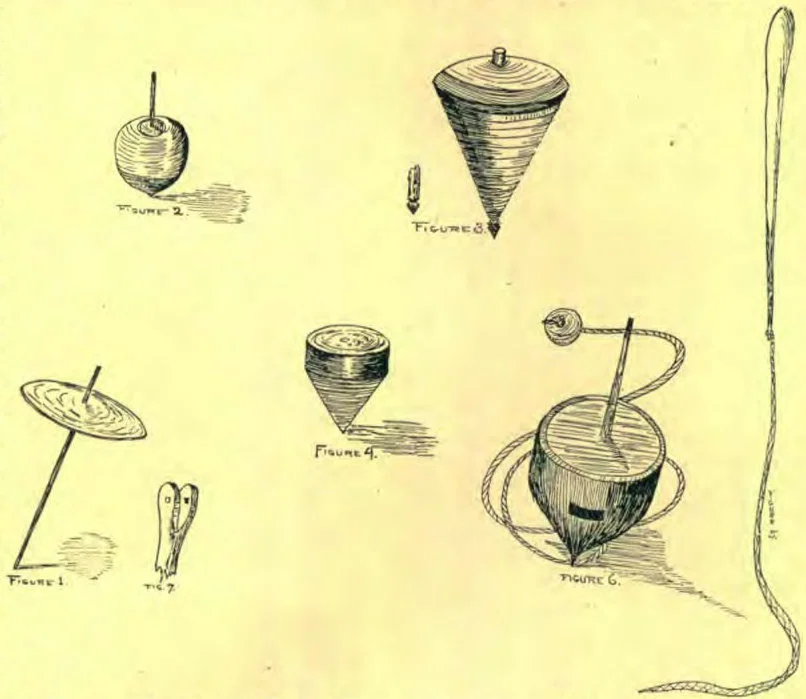
The wheels of an old clock will spin, and wooden buttons, with a peg, will spin. Obtain from your mother the largest wooden button she has; sharpen a match, insert through center of button; and whirl them between the thumb and finger on the long end, and you will see them do queer antics. (Fig. 1.) After that try the large red acorn as in Fig. 2.
Figure 1. Figure 2. Figure 3. Figure 4. Figure 6. Fig. 7.
Every boy probably has a top like the one in Fig. 3. If not, it is not hard to whittle if one is careful. Did you ever make the whip top? (Fig. 4.) It is the same as Fig. 3 except that it must be square on top, and it does not need the grooves for the string. Make it like the drawing. For a peg you can drive in a short nail and file off the head, leaving a dull point. The whip consists of a round handle a foot long, to which is attached a light piece of braided rope as in Fig. 5. The top is set in motion by the finger, and then is whipped to keep it going. By practice you can make it do various peculiar things at your will by the manner and way you whip it.
Fig. 6 is a humming top. Make this out of a maple roller two and a half inches in diameter. Shape the outside as in the drawing. Bore a hole in the center, then saw it off two and a quarter inches; hollow it out from the top with an augur, then finally burn it out with a hot iron, leaving only a thin shell, which you should carefully scrape. Cover the opening with thin basswood, carefully fitting it on. Bore a hole in the center. Place through this a long hardwood peg, which must project three eighths of an inch at the bottom. Glue carefully the various parts,—peg, top, etc.
After cutting a hole with sharp edges on the side, as in the drawing, make a handle like the drawing in Fig. 7, from hard wood. Spin it this way: The string is wound about the spindle, while the handle is held in the left hand; the right pulls away the string, the handle is at the same time lifted off the spindle. The various tones in the humming of the top will surprise you.
UTHAI V. WILCOX.

Standing Up Under Rebuffs and Criticism

“PROGRESS in life depends largely on how we stand up under rebuffs and criticism.”

Full Many a Gem of Purest Ray Serene

“FULL many a gem of purest ray serene The dark unfathomed caves of ocean bear; Full many a flower is born to blush unseen, And waste its sweetness in the desert air.”

Common Sense Defined

COMMON sense is the knack of seeing things as they are, and doing things as they ought to be done.— C. E. Stove.

“Only a Glass!”

WOULD that it were so! No harm would result therefrom; for glasses, properly used, are a blessing. But O, the woe, the crime, penury, want, and utter disgrace that lurk within the glass! Its contents, taken by the presumptuous palate tickler, start him speeding down the slippery decline toward hell, so deceiving his benumbed senses as to make him think he can stop at any time; and the false sense of security is the more fondly and vainly nursed as one increasingly speeds on and on, until at last the would-be moderate tippler does stop—stops suddenly, sadly, disgracefully, eternally.
Only a glass! Would that it were so! But if you must fill the glass, use what all God’s other creatures use, the only thing that will truly slake thirst—water.
STEMPLE WHITE.
Continue reading: Incidents from Life