Is David in Heaven?—Immortal Life Inseparably Connected with the Resurrection
By LUCAS A. REED
IT is never a pleasant task to teach along lines where prejudice is apt to control people's understanding. Under the subject of this article, we have the disagreeable task of telling something that many people do not like to know; yet it is absolutely necessary that these things be told, regardless of who believes or disbelieves.
The watchman is told to give the warning, whether the people will hear or not. The truth must be told.
With reference to the question of man's immortality, there is almost universally one belief, and that is that “death is the gateway of life”—that at death, man does not cease consciousness, that he enters into a more ecstatic or a more terrible state of existence, depending upon his life here. This belief is held by the great majority of Christians, without warrant from the Bible. This teaching lays the foundation for spiritualism.
In order to get at the matter definitely, we will allow a well-known minister to state this doctrine of life after death. But before we do so, let us place the following responsibility before the reader: In the Bible, most serious warning is given against spiritualism. Among the Israelites, that any should seek to familiar spirits, or attempt to communicate with the dead, was absolutely forbidden. In the book of Revelation, the warning is plainly given that in the last days, spirits of devils will work miracles to deceive, going forth to “the kings of the earth and of the whole world,” to mislead them. Rev. 13: 13, 14; and 16: 12-16.
The Christian churches, almost without exception, believe, or have believed, that it was wrong to dabble in any way with spiritualism, or to attempt to talk with the dead. There is over it all a glamour of suspicion and doubt. Yet if the dead are alive, why should they not visit the earth?
Laying the Foundation of Spiritualism
WE will now quote from one of many ministers who have taught that the dead could communicate with the living; who helped—perhaps unwittingly and unintentionally—to lay the foundation upon which spiritualism will rear its terrible fabric of deception for the last days. The quotation follows:
“Often the glories of heaven have struck the dying pillow, and the departing man has said he saw and heard those who had gone away from him. How often it is, in the dying moments, parents see their departed children, and children see their departed parents! I came down to the banks of the Mohawk River. It was evening, and I wanted to go over the river; and so I waved my hat and shouted, and after a while I saw some one waving on the opposite bank, and I heard him shout, and the boat came across, and I got in and was transported. And so I suppose it will be in the evening of our life. We will come down to the river of death, and give a signal to our friends on the other shore, and they will give a signal back to us, and the boat comes, and our departed kindred are the oarsmen, the fires of the setting day tinging the tops of the paddles.
“Oh, have you never sat by such a deathbed? In that hour, you hear the departing soul cry, ‘Hark! Look!’ You hearkened and you looked. A little child pining away because of the death of its mother, getting weaker and weaker every day, was taken into the room where hung the picture of her mother. She seemed to enjoy looking at it, and then was taken away, and after a while died. In the last moment, that wan and wasted little one lifted her hands, while her face lighted up with the glory of the next world, and cried out, ‘Mother!’ You tell me she did not see her mother? She did.”—Dr. Talmage, sermon, “Shall We Know Each Other There?”
Do the Spirits Return?
IN his sermon on the death of Thomas Guard, a noted preacher of Baltimore, Mr. Talmage said:
“This man of God has only moved on and moved up. He passed out of a room where the air was heavy with opiates into an atmosphere exhilarant, and from a body pain-struck into conditions rubicund with health immortal. He has become one of the athletes of heaven—deathless as God is deathless, never to know pain or sickness or suffering or sorrow except as a vivid reminiscence. His mission is widened out. He has come to higher appointment, not to this church or to that church, or this denomination or that denomination, or this city or that city, or this world or that world. He has the universe to range in. What velocities! What circuits! What momentum! What orbits in which the star shall be as silvery as before the occultation, and the sun shall be as radiant as before the eclipse!
“You could not understand thoroughly Thomas Guard here, you cannot understand Thomas Guard there. More difference than between an eagle in an iron cage and an eagle pitching from Chimborazo toward the sun. His work on earth is not done. It is not half done, it is not a fourth done, it is not a thousandth part done. He resumes it now under better auspices. How do I know? ‘Are they not all ministering spirits, sent forth to minister to them that shall be heirs of salvation?’ The lines of telegraphy and of rail track connect no two earthly cities so well as earth is connected with heaven. Did Thomas Guard, after he was established in this land, go to South Africa to get his family and bring them to this better country? And shall he not now come back sometime to that earthly home, and at the right time take his loved ones to the still better country? But he shall not come alone. The twain shall come, they who were side by side for so many years, bending over the same cradle, weeping over the same grave, now coming side by side, wing and wing, to hover over those children when they sleep, and to escort them heavenward when they die. Father and mother coming to help! Father and mother coming down to comfort! Father and mother coming down to defend! . . .”
“Is yonder a soul in great excruciation of pain, and shall Thomas Guard refuse the ministry when he knows about suffering? Is yonder a soul awfully bereft? Surely Thomas Guard cannot refuse his ministry, for he knows what it is to be bereft. Shall we have revivals of religion in our churches, and Thomas Guard not join in the hallelujah? Shall there come a great Armageddon, in which all the good are on one side, and all the bad on the other side, earth and hell and heaven drawn out in battle array, and the gallant spirit just ascended not mingle in the fight, not draw his sword, not lift his battle shout? Passing on to fatigueless service!”
Is David in Heaven?
IN this quotation, Dr. Talmage quotes a passage in the first chapter of Hebrews which applies to the angels: “Are they not all ministering spirits, sent forth to minister for them who shall be heirs of salvation?” This cannot by any means be made to apply to the spirits of the dead. The Bible nowhere suggests such a thing. Mr. Talmage's talk about Thomas Guard or any one else coming back is without any Scriptural warrant whatever.
Of course, we wish it most distinctly understood that we are not seeking to cast any disparagement upon Mr. Talmage as a man or as a Christian. We simply wish to correct wrong teaching. A man may very honestly put forth an error; but an error never can do any good, no matter how honestly it may have been taught. The Bible does not teach that when a Christian dies, he goes at once to heaven, although Mr. Talmage, in the quotations given, teaches that they do.
And what says the Bible with reference to these things? Take, for example, David. No one, I think, doubts that David died a saved man, an heir to immortal life. Paul says of him, “For David, after he had served his own generation by the will of God, fell on sleep, and was laid unto his fathers [in the grave], and saw corruption.” Acts 13: 36. This is very plain as to where David went and what happened to him; yet the belief in inherent immortality—that all go to heaven at death—is so strong that many will think, in spite of this, that in some way David, or part of David, went to heaven anyhow.
But we have the fact further stated by Peter on the day of Pentecost. He said, “For David is not ascended into the heavens” (Acts 2: 34); and to settle the question forever, he says plainly, “Men and brethren, let me freely speak unto you of the patriarch David, that he is both dead and buried, and his sepulcher is with us unto this day.” Acts 2: 29.
Lest you fail to get the importance of this statement, note that the argument which Peter made on the day of Pentecost is this: He quoted from the Psalms where David said, “The Lord said unto my Lord, Sit Thou on My right hand.” He raised the question, Does David mean that the Lord said to him that he is to sit upon the right hand of God? Then Peter, in carrying out the argument to show that this is Christ, and not David, said8that David had not gone to heaven, had not sat down on the right hand of the Lord, and that this statement of David was a prophecy of Christ, because it could not in any wise apply to David, who was dead and buried, and whose sepulcher was with them at that time. This entirely eliminates any possible thought of David's going to heaven when he died. It is plain, Scriptural teaching. And if one like David did not, then how shall we believe that any do? The Lord could make no exception. None who die, live again until their resurrection.
The Work of Deceiving Devils
THE Bible is very plain regarding man's condition in death. For example: “In death there is no remembrance of Thee: in the grave who shall give Thee thanks?” Ps. 6: 5. “For the living know that they shall die: but the dead know not anything, neither have they any more a reward; for the memory of them is forgotten. Also their love, and their hatred, and their envy, is now perished; neither have they any more a portion forever in anything that is done under the sun.” Eccl. 9: 5. “His sons come to honor, and he knoweth it not; and they are brought low, but he perceiveth it not of them.” Job 14: 21.
Thus it is apparent why God has forbidden any communication with those spirits which claim to be the spirits of the departed dead. There are none such; any who claim to be such are deceiving. They are the spirits of devils, working miracles. Rev. 16: 12-16. They are masquerading as our friends. It was for this purpose — to enter into the affections and the secret thoughts of humanity — that the enemy of all truth has fostered and encouraged the belief in inherent immortality. God promises immortal life, but every such promise is connected with a resurrection from the dead. There is no intimation, anywhere in the Bible, of a promise of life otherwise. See 1 Corinthians, the fifteenth chapter. Next week we will consider this subject further.
WITHIN SPEAKING DISTANCE OF ATHEISM
By G. B. T.
Unavoidable Conclusions from “No-Law” Arguments
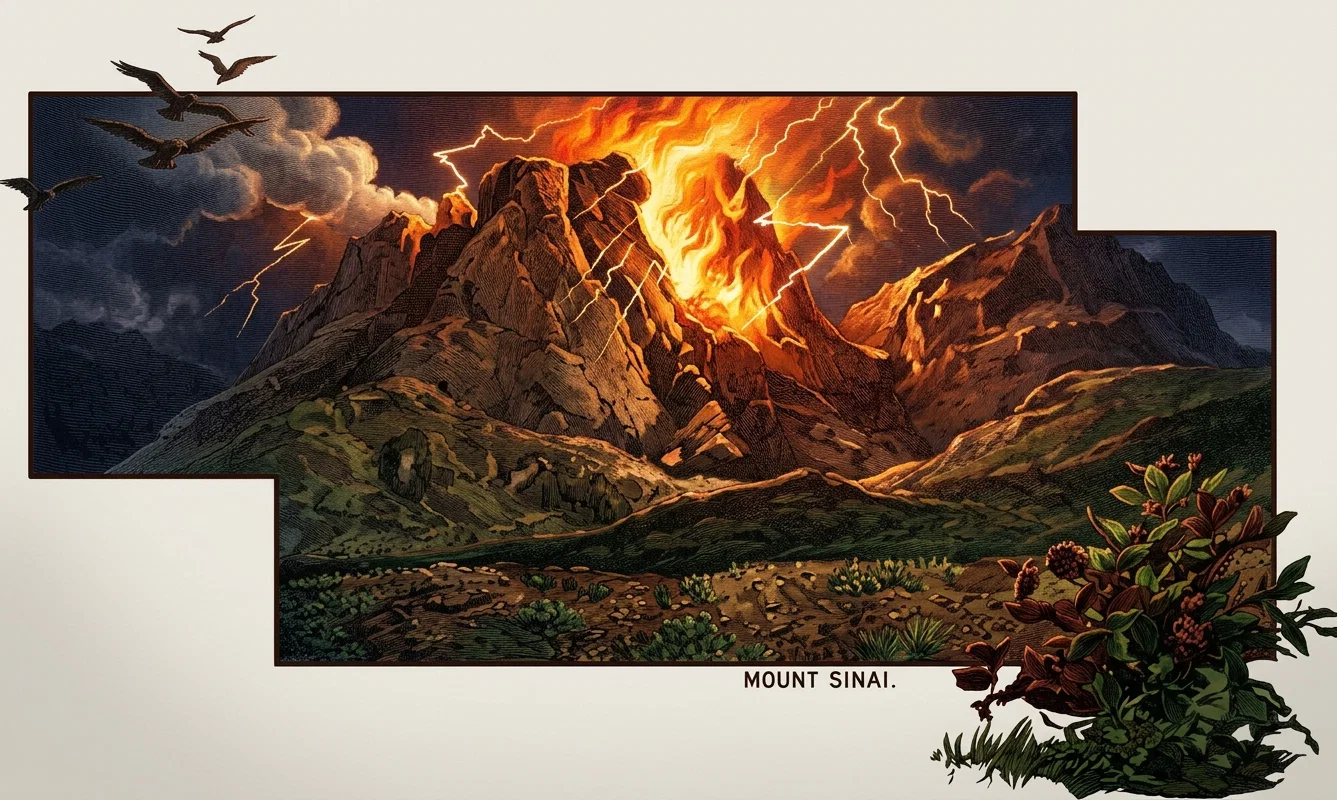
“From the blazing top of Sinai . . . spoke the law in tones that shook the world.”
“THINK not that I am come to destroy the law, or the prophets: I am not come to destroy, but to fulfill. For verily I say unto you, Till heaven and earth pass, one jot or one tittle shall in no wise pass from the law, till all be fulfilled.” Matt. 5: 17, 18. These words are taken from the sermon of Christ on the mount. In very plain language, He states His attitude toward the Decalogue.
The one who here speaks is the same who, from the blazing top of Sinai, in majesty and grandeur such as men have never since seen, spoke the law in tones that shook the world. It was Christ who spoke the law from Mount Sinai. “And Thou didst divide the sea before them, so that they went through the midst of the sea on the dry land; and their persecutors Thou threwest into the deeps, as a stone into the mighty waters. Moreover Thou leddest them in the day by a cloudy pillar; and in the night by a pillar of fire, to give them light in the way wherein they should go.” Neh. 9: 11, 12. Compare with 1 Cor. 10: 1-4. What folly to argue, as some do, that Christ abolished the law which He spoke with His own voice from the top of the trembling mount! Does Christ affirm only to disannul? It cannot be.
Plainly and clearly He informed the vast multitude assembled about Him that His Father’s law will remain unchanged until all things are “fulfilled.” There are many things not yet fulfilled. The Lord has promised that all who sleep in the grave will come forth. This is not yet fulfilled. He has promised that He will make a new heaven and a new earth, wherein righteousness shall dwell. This is not fulfilled. All the prophets of the Bible have looked forward to that grand and awful day when Christ will descend to earth the second time, to gather His people home. He has not yet made His second advent. He has promised that Satan will be bound on this earth for a thousand years. Satan is not yet bound, as we all can readily see. God has promised that the time will come when He will make this earth empty and turn it upside down, when desolation and chaos will cover the face of creation, when there will be no man, when the fruitful place shall be a wilderness, and all the cities of the earth will be broken down at the presence of the Lord. Jer. 4: 23-27. All this is yet unfulfilled. These tremendous events, and many more, are yet impending. Therefore the law of God stands secure, for not all things are fulfilled.
Does “Fulfill” Mean Abolish?
THE “no-law” advocates seek to parry the force of this declaration by arguing that Christ fulfilled the law in obeying it, and that hence it is no longer binding. But does obedience to a law abolish it? Is the constitutional law of the nation abolished because it is obeyed? Are the statutes of the state abrogated because the citizens obey them? What folly! Before such a conclusion can be reached in reference to the Decalogue, it will be necessary to show that fulfilling means abolishing. What confusion confronts those who put forth such a claim!
When Jesus came to John to be baptized, He said, “Suffer it to be so now: for thus it becometh us to fulfill all righteousness.” Matt. 3: 15. Hence if “fulfill” means abolish, all righteousness was abolished by the Saviour. Again, in Gal. 6: 2, Paul exhorts us to bear “one another’s burdens, and so fulfill the law of Christ.” In the law of Christ, we are enjoined to love one another; but on the ground of the claim put forth concerning the abolishing of the law, we are no longer required to love one another, for the law of Christ has been abolished.
Again, speaking of Christ, the prophet says: “The Lord is well pleased for His righteousness’ sake; He will magnify the law, and make it honorable.” Isa. 42: 21. The word “magnify” in this text has the same force as the word “fulfill” in Matt. 5: 17; and in order to harmonize with the “no-law” theory, it must mean abolish. None who put forth that argument will dare to deny this. If they do, their whole gossamer fabric is at once rent into shreds.
Unavoidable “No-Law” Conclusions
LEAVING them to grapple with the problem as to how the law could be magnified, or made more honorable, by being abolished, let us look at an incident in Peter’s experience. When he was preaching at the house of Cornelius, the Holy Spirit fell upon all present; and they were heard to “speak with tongues, and magnify God.” Acts 10: 46. Now since “magnify,” as applied to the law, means abolish, why would it not mean the same as applied to God? Then it would follow that even the Lord Himself is abolished.
Summing up the argument in harmony with the “no-law” idea, we have the law abolished, righteousness abolished, love abolished, and God abolished. Would not the apostles apply most vigorously to such a doctrine the cutting term “damnable heresy”? It is to such monstrous conclusions that “no-law” advocates, and other opponents of God’s law, are driven in seeking to escape the binding claims of that fiery law which came from the hand of Jehovah.
Is it necessary to ask why such a doctrine is taught? The answer is at hand. The purpose is none other than to evade the claims of the fourth commandment of the Decalogue, which reads as follows: “Remember the Sabbath day, to keep it holy. Six days shalt thou labor, and do all thy work: but the seventh day is the Sabbath of the Lord thy God: in it thou shalt not do any work, thou, nor thy son, nor thy daughter, thy manservant, nor thy maidservant, nor thy cattle, nor thy stranger that is within thy gates: for in six days the Lord made heaven and earth, the sea, and all that in them is, and rested the seventh day: wherefore the Lord blessed the Sabbath day, and hallowed it.” Ex. 20: 8-11.
Rather than turn from the precept of man to that of God, they resort to a line of argument which leads to the conclusion10that the Creator of the universe Himself has passed away. This is coming within speaking distance of atheism, to say the least. This same spirit would, if possible, burst into the sanctuary, enter the most holy place, drive God from His throne, rend the ark into fragments, and, seizing the tables of the Ten Commandments, hurl them from heaven.
Its Claims Will Be Met
CHRIST fulfilled His Father’s law, not by abolishing it, but by meeting its claims. “The wages of sin is death.” Rom. 6: 23. “Sin is the transgression of the law.” 1 John 3: 4. All have sinned, and are doomed to eternal death. God gave His only-begotten Son to die in the sinner’s stead, thus preparing a way by which we can, through obedience to the law, secure entrance into the city of God, and recover our lost right to the tree of life. Matt. 19: 17; Rev. 22: 14.
Instead of the Sabbath’s ending at the cross, it survived the world’s midnight, the Dark Ages, when all Christendom was suffering beneath the iron heel of Rome. And when sin and sinners shall be destroyed, and this earth is restored to its Edenic beauty, the Sabbath will be kept as in the beginning, and all flesh will come to worship before the throne on that blessed day. “For as the new heavens and the new earth, which I will make, shall remain before Me, saith the Lord, so shall your seed and your name remain. And it shall come to pass, that from one new moon to another, and from one Sabbath to another, shall all flesh come to worship before Me, saith the Lord.” Isa. 66: 22, 23.
G. B. T.
PERILOUS BECAUSE OF GREED
Piling Up Fabulous Hoards — War Profits and the Sufferings of Others
ANY one who is following the reports given out from Wall Street in regard to the manufacturing activities of the nation, must be impressed with the thought that the kings and princes of finance are crazed and maddened by their insane greed to grasp wealth.
Mercantile Marine’s earnings for March are at “a rate of about 65% for preferred.”
It was officially published, following the recent directors’ meeting of United States Steel, that their earnings for the first quarter of this year were $60,713,624. The next day after the announcement of these tremendous gains of United States Steel for the first quarter of this year, Wall Street gave out that this big corporation would add about $42 a share to its surplus, a sum that would equal $212,000,000, this surplus to be in addition to the dividends that are declared from quarter to quarter for the stockholders.
Wall Street also informs us that American Locomotive’s earnings for March will be at an annual rate of about 60%.
The Midvale Steel Company is working on a $60,000,000 order for rifles, and Wall Street estimates that the gain of this corporation will be $30,000,000 for this year.
The profits for the General Chemical Company, according to the estimates of Wall Street, will be 75% for this year, after all deductions are made for depreciation, and what is set aside for surplus, etc.
The Submarine Boat Company is to show a profit of $15,000,000 on its war contract. Of this amount, $12,000,000 will come from the construction of submarines and launches, and $3,000,000 in the shape of royalties from foreign governments that are using the plans of the company for the construction of boats. We are informed that this company will this year have earnings that will be equivalent to nearly three and a half years’ dividends at the present rate of $6.00 a share.
Concerning the Reading Company, Wall Street says, “Estimates of upward of 25% earnings on Reading common this year appear conservative.”
The same high financial authority, referring to the Midwest Refining Company, says, “If the present rate of earnings should be maintained throughout the year,” it “will show better than 30% on its outstanding eighteen million capital stock.”
The foregoing are only a few of the facts and statements that might be gathered at length from the Wall Street reports.
The Barrier to World Peace
IT will be observed that the corporations that are making these tremendous gains are in the manufacturing or shipping industries that permit them to reap these large profits from war orders. The war furnishes an excuse for the leaders in finance to advance prices on everything. The orders for war supplies from the contending nations are taken at a tremendous profit. The shipping of these supplies to Europe is of course at a big risk, and the shippers take advantage of this to charge high prices for their services. And while millions of suffering men and women are praying for peace, there are a few thousand financial lords who are taking advantage of this situation, regardless of suffering and sorrow, to pile up their fabulous hoards.
How striking are the words of the apostle Paul, that the last days would be made perilous by the love of self and the love of money! How tremendous, how overwhelming, are the conditions of this time which show the fulfillment of the inspired apostle’s prediction!
It is generally conceded that the real cause of the Old World war, and the reason why it is prolonged through such rivers of blood, is desire for commercial supremacy. As never before in the world’s history, men to-day are selling their souls that they may gratify their greed for gain.
The greatest and most insuperable barrier to the peace of the world is the selfishness of men, and their love for money. At all hazards, they will seize and hold the trade of the world; and they will promote and extend this trade regardless of gore, suffering, sorrow, and distress.
“But know this, that in the last days grievous times shall come. For men shall be lovers of self, lovers of money.” 2 Tim. 3: 1, 2.
NEAR, AND YET SO FAR
By L. E. F.
One may study until his fame for orthodoxy spread from pole to pole, until his opinions on exegesis be consulted in every theological seminary, and known in every household; until his decisions on controverted questions shall be considered the end of all controversy — and yet be farther away from Jesus than the most lowly and obscure follower of the Christ.
The eminent rabbis of nineteen hundred years ago were the personification of orthodoxy, yet they were as dry and barren of the water of life as the Sahara Desert.
One may study until first place in the rank of scientists be conceded him; until nature shall yield to his indefatigable research many of her closely veiled secrets concerning life; until his textbooks on the subject are acknowledged from kindergarten to university as the standard — and yet be farther away from Jesus, the true Life of the world, than when first he learned that “science is systematized knowledge of any one department of mind or matter.”
Life comes not through science. It comes through Jesus; and the reason men do not have life, says Jesus, is because they will not come to Him, that they might have it.
If it were possible for one to study until he masters every art and science; until he becomes the embodiment of the sum of human wisdom; until he has won every academic laurel, and received every degree conferred by man — yet he might be farther away from the truth than when he first stepped upon the pathway of wisdom.
Humanity cannot by wisdom find out God. The vast majority of earth’s greatest and wisest will spend eternity in the embrace of eternal death.
Picture, if you will, a devout Bible student, critically studying creeds, systems, methods, ever searching for the way. He almost has it, yet not quite. One more book, a little more comparison — but it is like chasing the rainbow that is always on the neighboring hill.
Take again a sincere lover of truth, turning the musty pages of ancient volumes,— the writings of the godly men of old,427and the philosophies of earth’s wisest thinkers. The volumes are yellow with age. Surely he will find the truth. Almost — not quite. Perhaps on the next page — but he finds it not.
Think once more of others whose brows are crowned with the white harvest of many years. The grave looms near before them. They look beyond. They are searching for life. If an angel were to wing his way through space from the throne of God, and offer any one thing, what would it be? Riches? Pleasure? Dress? — No! It would be life — eternal life. But life, too, is like the rainbow. It is so illusive, so transient; its thread so frail, so brittle.
Listen. To the first, Jesus says, “I am the way”; to the second, “I am the truth”; and to the third, “I am the life.” Jesus is heaven’s answer to all who are searching for “the Way, the Truth, and the Life.” He is the complement of every human need. In Him, and in Him alone, can we be made complete.
L. E. F.
The Meaning of Calamities
In describing the conditions that brought disaster and ultimate ruin upon Judah and Jerusalem anciently, the prophet Isaiah said: “The show of their countenance doth witness against them; and they declare their sin as Sodom, they hide it not. Woe unto their soul! for they have rewarded evil unto themselves.” Isa. 3: 9.
This scripture is striking, and is worthy of special study in this time. The people in that day “rewarded evil unto themselves.” In other words, they were the direct cause themselves of their own deceptions and calamities.
They were proud of their sinning, for they declared their sin as Sodom; and they were so far removed from shame, that they did not attempt to hide the evil deeds they were performing.
The history of the iniquity of ancient Israel was written for the express purpose of admonishing us at this time. “Now these things were our examples, to the intent we should not lust after evil things, as they also lusted. Neither be ye idolaters, as were some of them; as it is written, The people sat down to eat and drink, and rose up to play. Neither let us commit fornication, as some of them committed, and fell in one day three and twenty thousand. Neither let us tempt Christ, as some of them also tempted, and were destroyed of serpents. Neither murmur ye, as some of them also murmured, and were destroyed of the destroyer. Now all these things happened unto them for ensamples: and they are written for our admonition, upon whom the ends of the world are come.” 1 Cor. 10: 6-11.
Study this language of the apostle as he comments on the experiences of the Israel of old. Note what he says: “These things were our examples, to the intent we should not lust after evil things, as they also lusted.” And again, “Now all these things happened unto them for ensamples: and they are written for our admonition, upon whom the ends of the world are come.”
Those lessons and experiences of ancient Israel were recorded that they might admonish us in this time, else they will be repeated in the history of each individual. And in the aggregate, the sins of the individual will produce both national and international calamities.
Moral principle is the same through all the ages. That which would produce the overthrow of Israel in the time of Moses and of Isaiah, would produce the overthrow of any nation at any time. Let us heed these admonitions. Let us recognize the great fact, that it is sin that is ever the destroyer of men and of nations.
When sin reaches the point that it is open rebellion against God, His protection must be withdrawn. He cannot protect such a course. Open, flagrant, rebellious sin, as was the sin of Sodom, lays the individual open to the direct attacks of Satan, without any protection from on high.
It is because of the conditions of sin so prevalent in these times, that the judgments are falling from God in many parts of the world. On every hand we see storms, earthquakes, floods, fires, and other calamities and disasters. We should be admonished, and should see to it that the atoning blood of Christ cleanses and keeps us free from all iniquity.
BREAKING POINT OF DISCONTENT
Bishop Lawrence, of the Episcopal Church, recently spent some time in Wall Street, “seeking to raise a few millions there, toward the fifty million dollar church pension plan” for caring for superannuated preachers.
The Wall Street Journal said the bishop “was astonished to find so many cases of wealth suddenly thrust upon an heir who had never been educated to deal with an income and its relation to personal expenditure, the church, charities, and the advancement of one’s fellow man.”
The bishop gave as an illustration, the case of a young man who had always received from his father an allowance of spending money, but suddenly inherited an income of a hundred thousand a year. The young man said, “The wonder is that I did not go to pieces under such sudden freedom and large income.”
Another young man, suddenly inheriting a large fortune, expanded his household and automobile expenditures, servant hire, etc., only to find that his liabilities were increasing and his pleasures and freedom decreasing.
As suggested by the Wall Street Journal, in commenting upon these facts, “millions and millionaires have been made quickly in this country.”
Large fortunes are indeed suddenly thrust upon many men at this time. Millions and millionaires are indeed made quickly; and the discussions of socialism, and the voices from the laboring men, are the unmistakable symptoms of the consequent disease that is becoming deeply rooted in the social system of the world. These conditions of concentrated wealth are growing more and more in every nation. Perhaps they have been developed more suddenly in this nation, but they are nevertheless quite as strong in other nations of the world. Men have many theories concerning them; and in the presentation of these theories, the discussions are becoming more and more pronounced and angry.
The reaping time cannot be long delayed. When a few men, comparatively, have hundreds of thousands of dollars to spend annually, while others do not know which way to turn for bread, there can be but one result. The discontentment will finally reach the point where it will break over all bounds; and revolution, anarchy, and violence will be the consequence. The Bible has strongly pictured these things for this time. Among the most striking prophecies of the sacred Word are those pertaining to the disturbances that will be created in the world over the questions of wealth and poverty.
And God does not give us one sign alone to tell us when the end is approaching. He gives us very many of them; and among the many unmistakable signs which the reverent believer in God’s word was to note as showing the approaching end, is the great amassing of wealth, and the perilous times that grow out of it. Who can regard the conditions of this time without a conviction of some great, impending event, whose forerunner is strife, revolution, and anarchy running riot? Only he who studies carefully and trusts in the infallible statements of the divine Book can have a sense of calmness before this approaching storm.
Look Upward
By J. E. F.
AT great cost, men delve into the bowels of the earth for riches. They are looking downward, while above are the pearly gates, walls of precious stones, and streets of gold, all offered as a home to those who will look upward.
The gatherer of pearls, at great danger to health and life, dives down into the seas for his riches. He also is looking downward, while above is the pearl of great price. Earthly riches are deceitful, and when seemingly within the grasp, take to themselves wings and fly away. Set the affection on things above. Look upward. J. E. F.