“Teach the children that they should eat to live, not live to eat.”
PARENTS should make it their first object to become intelligent in regard to the proper manner of dealing with their children, that they may secure to them sound minds in sound bodies. The principles of temperance should be carried out in all the details of home life. Self-denial should be taught to children, and enforced upon them, so far as consistent, from babyhood. Teach the children that they should eat to live, not live to eat; that appetite must be in abeyance to the will, and that the will must be governed by calm, intelligent reason. To parents is committed the sacred trust of guarding the physical and moral constitution of their children. Those who indulge a child's appetite, and do not teach him to control his passions, may afterward see, in the tobacco-loving, liquor-drinking slave, whose senses are benumbed, and whose lips utter falsehood and profanity, the terrible mistake they have made.”
This quotation from a noted writer clearly portrays mistakes that are made only too frequently. Children should be taught self-control from their earliest moments; and when this lesson is taught, the child is satisfied to eat his meals at stated periods, and is also satisfied with a given quantity.
The digestive organs can be trained to desire food at almost every hour of the day, but this plan is not consistent with physiological action. The juices are made during the resting period of the digestive organs; but if there is no resting period, what about a supply of gastric juice? The continual crowding of food into an already filled stomach soon results in sluggish work in the digestive system. Fermentation and decomposition follow, poisonous substances are produced and thrown into the circulation, and serious troubles develop.
No Need of a Colicky Baby
It is not a difficult thing to train the appetite. If the baby's earliest meals are at regular periods — two, two and one half, or three hours apart, as the age may demand — and nothing but water is given between those periods, the child soon learns to sleep until the hour for its feeding arrives.
There will be no colicky baby if the mother attends well to her own diet; but gaseous vegetables and wrong combinations of food produce a bad quality of milk for the child, and colic is the result. The writer has seen it demonstrated frequently that with careful mothers, nursing children never have colic at all, and grow to young childhood without vomiting a meal.
If for any reason this care has not been given in infancy, and a conscientious mother finds her child developing wrong habits of eating, she can still begin, though with more difficulty, the process of training the appetite.
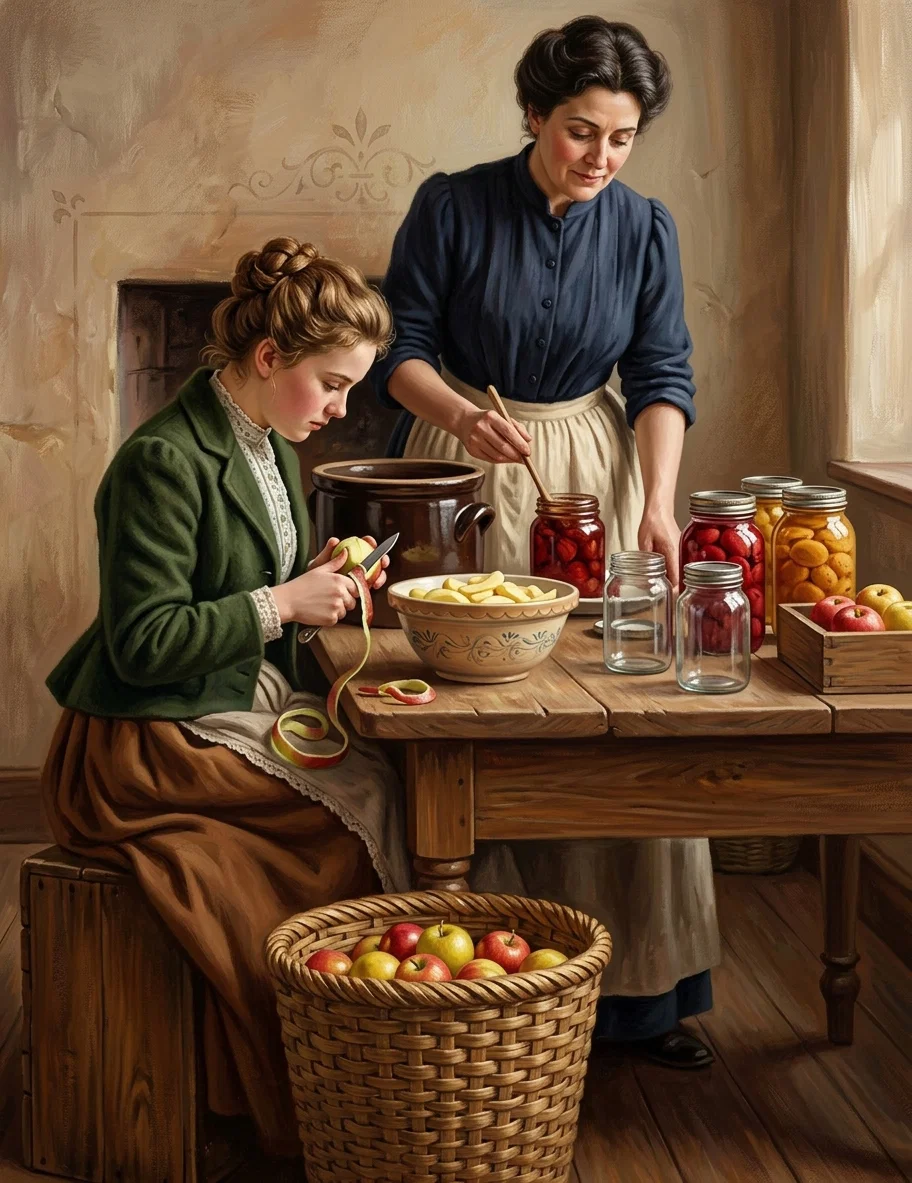
The child should masticate his food. He should eat slowly. To teach this important lesson, dry foods, which cannot be swallowed without mastication, should be given. A good plan is to tell the child a story of how the birds pick up the kernels of wheat, and have him count each piece as he picks it up. A piece of crust, or of zwieback, or a hard cracker — anything that must be thoroughly chewed before it can be swallowed — is best; and it must be some of the baked starches, for they are changed in the mouth, by the action of the saliva, into dextrose.
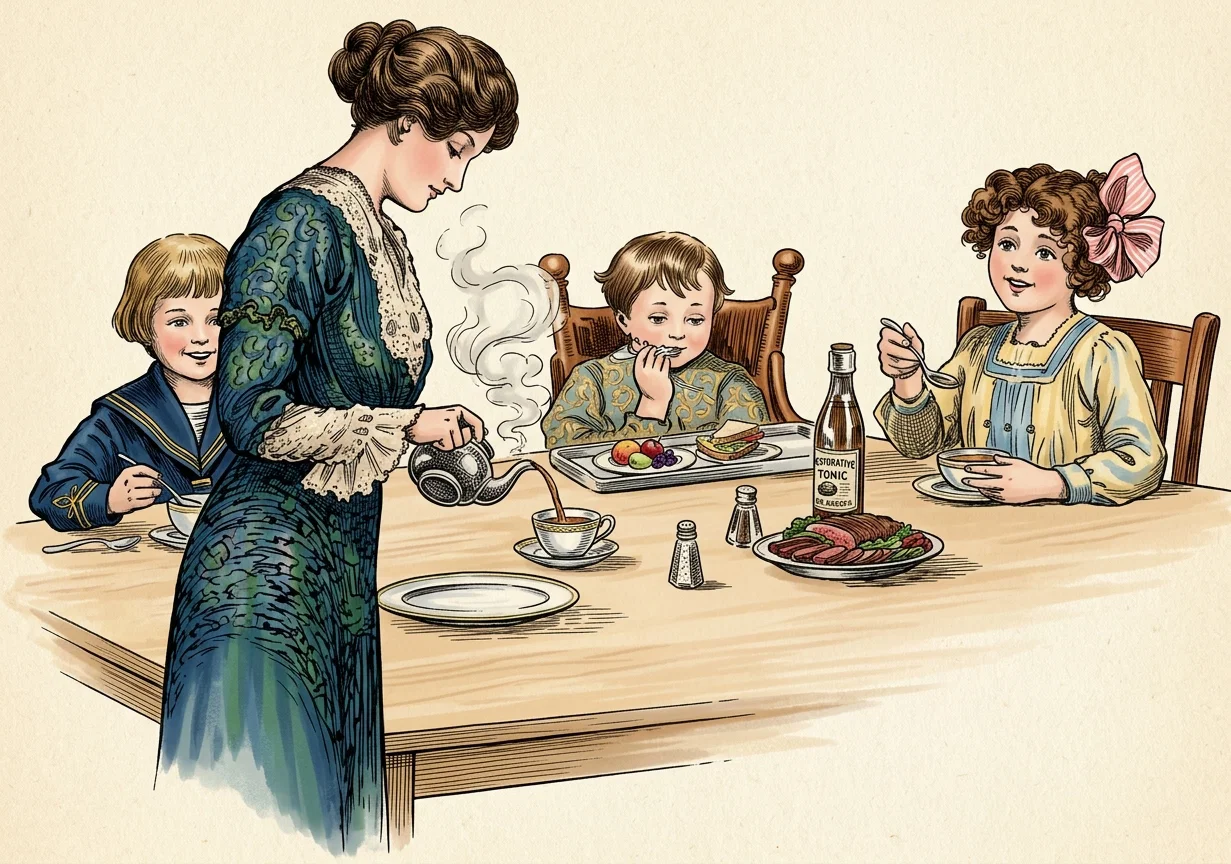
When the family is gathered around the table at mealtime, the children can be engaged in conversation to attract their attention, so that the food be not eaten too rapidly. Table topics can be introduced that will be both interesting and educational. Beginning with a, and running through the alphabet to z, familiar topics can be selected — apples, apricots, apes, antelopes, ants, bees, beans, buffaloes, bricks, etc. Then allow the children time to express themselves on the topic, while spoon and fork rest on the plate, and the mouth is empty.
The parents should serve the food to the children, that they may know what has been given. If the food is eaten slowly and masticated thoroughly, it will be more fully enjoyed, and less will satisfy them. Hurried eating produces irritation of the stomach, and causes, within a short time after the meal, a desire for more food. Thus the habit of eating between meals is developed — a most pernicious habit, laying, as it does, the foundation for many ills. Nothing should pass the lips between the meals — candy, peanuts, popcorn, apples, oranges — in fact, any kind of food. Children trained in this way will save such articles of food for the next meal — and save their digestive organs the burden of caring for the extra meals. In this way, better health is insured for their later life.
The Habit of Eating Dirt
SOME children develop habits of eating dirt, chalk, slate pencils, book corners, wood, etc. Usually lack of some element in their diet produces these unnatural desires. If the diet is carefully ordered, these habits are quickly broken. Often food is given to quiet children when they are worrying. This is a great wrong to a child, especially when he has been hurt, as by falling. For the mother to take time to soothe the impatient worrying by other means is much wiser, and she thus saves herself and her child from much trouble in the future.
A judicious mother will act, in training her children, not merely in regard to her own personal comfort, but for their future good. Parents should impress upon their children that in violating the laws of their being, they sin against their Maker. Children thus educated will not be difficult to restrain. They will not be subject to irritable, changeable tempers, and will be in a far better condition to enjoy life. Such children will more clearly understand their moral obligations. Children who have been taught to yield their wills and wishes to their parents will more readily yield their wills to God, and will submit to be controlled by the Spirit of Christ.
If the food is eaten slowly and masticated thoroughly, it will be more fully enjoyed.
TOO MANY BOOKS
By Louis H. Christian
Solomon, the wisest of men, wrote one little eight-page book, a love song, in his youth; and near the close of his career, he wrote a small treatise of divine philosophy on human life and destiny, the Ecclesiastes. Now and then, as the years passed by, he jotted down a thought or two, which thoughts were gathered into a book called Proverbs. This was the extent of his writings, so far as we know. Some of his fellow men evidently were not so modest. He found their many volumes “a weariness of the flesh,” and he exclaims, “Of making many books—there is no end.” What would he have said if he had lived to-day, with our pyramids — or should we say mountains? — of books?
Little brains make large books, and young authors write books that quickly grow old. We do not complain if a book contains two or three or even one good, well developed idea. What we object to is a book that consists of nothing but Russian leather, glue, wood pulp, and printer’s ink. Of course, we believe in the freedom of the press; but we only wish some good genius would soon discover a serum to cure author’s itch.
It is often said that parents should buy more books for their children. This is true; yet we think there is more need of parents’ teaching their children to read thoroughly and slowly one good book at a time, and also to reread a few of the same books a year or two later. One noted educator has said that people of our day have lost the art of reading to others. Perhaps so; but have not many more lost the faculty of thinking for themselves, on what they read? The twentieth century mind needs fewer books, slower reading, and more thinking.
L. H. CHRISTIAN.
FREDERICK BULPITT
By Frederick Bulpitt
MOST people eat too much. They consume excessive quantities of food. This is not only an economical loss, but, what is worse, results in injury to the health. The digestive organs must exert themselves to remove this extra material from the body. Such treatment, continued, results in irregularities of their function and serious impairment of health. Probably the worst sufferers in this class are those who lead sedentary lives, specially brain workers. The appreciation of the best in life can only be secured when our energies are liberated from this continual drain upon their source. Many a man who appears “thick-headed,” is merely suffering from an overloaded stomach.
FREDERICK BULPITT
What We Do Not Overcome
“WHAT we do not overcome, will overcome us, and work out our destruction.”
Flowers That Bloomed to Die
By Mary Alice Hare Loper
“Next to Immanuel’s story is heard the tale of Rum”
Flowers That Bloomed to Die
By MARY ALICE HARE LOPER
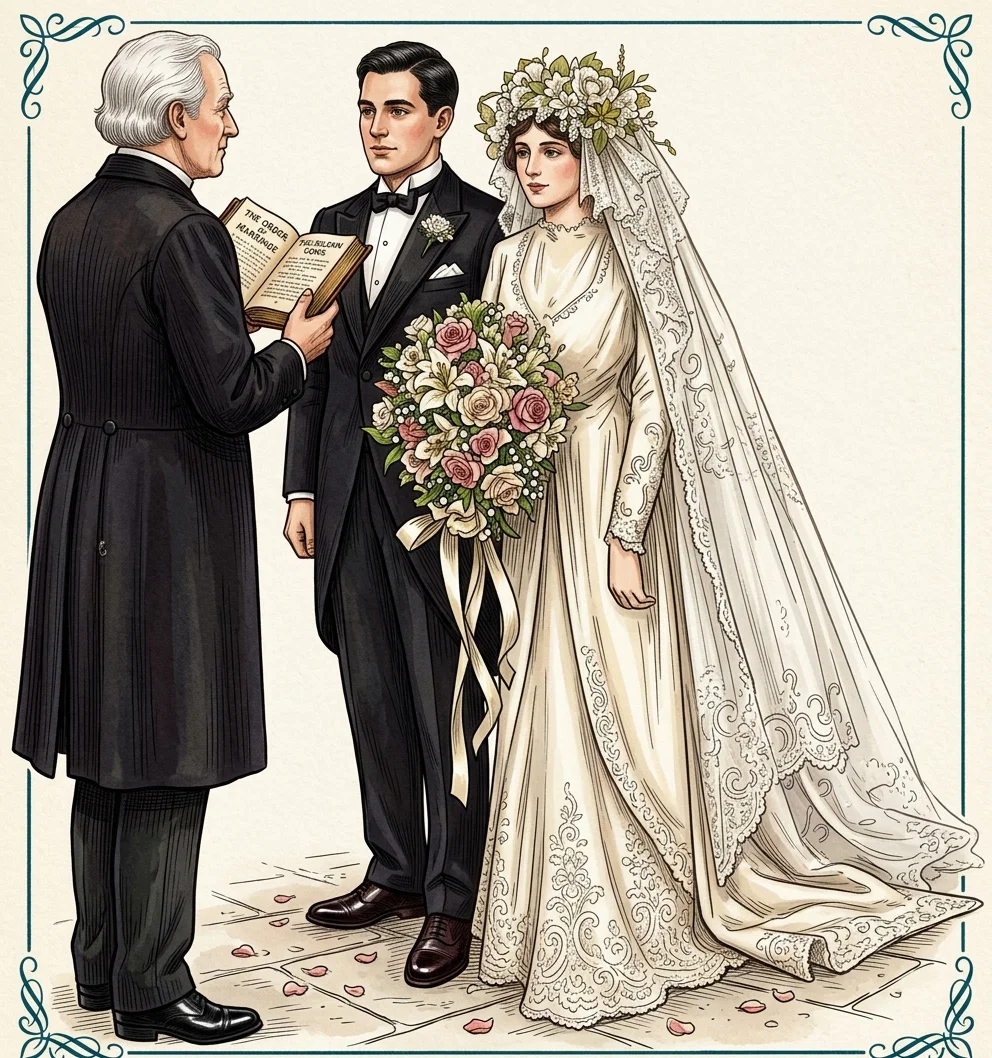
Took the solemn vows which united their lives into one.
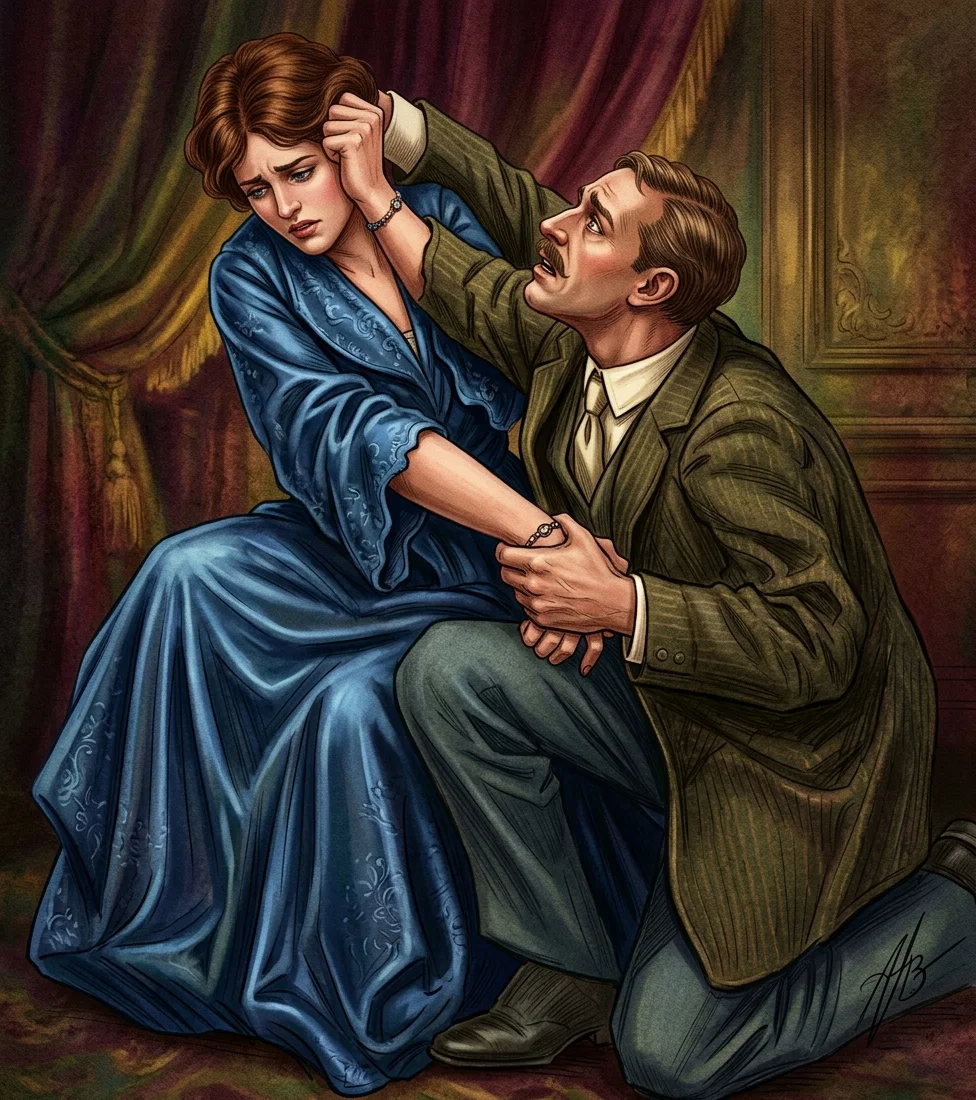
The demon rum entered the sacred inner circle.
“HUSTLE him off! Hustle him off! We’ve no time for woman’s pleadings or children’s tears. Hustle him off, I say, to jail! That’s where he belongs.”
A thin, emaciated woman, with two small children clinging to her skirts, turned away amid sobs and tears, as the police patrol disappeared with the husband and father of this poverty-stricken family, who lived in a forbidding-looking tenement in the poorest quarter of a great city.
ONE beautiful evening in the month of June, a bridal party was seen entering a pretentious church in a popular residence district of a flourishing city. Amid the delicate perfume of roses and the beauty of artistically arranged greenery, a promising young business man and his sweet bride knelt at the sacred altar, and with happy hearts took the solemn vows which united their lives into one. A beautiful home awaited their occupancy in a distant city; and after a honeymoon of several weeks, it was there they settled, hoping to see their fondest dreams of life come true.
Mr. McCune himself, like his accomplished wife, won many friends through his large-heartedness and personal congeniality. He had a wide circle of acquaintances, among whom he was very popular. Some of these, however, we are sorry to say, were accustomed to imbibe liquor occasionally, when society seemed to demand it. As time passed, Mr. McCune was persuaded to join exclusive clubs, where, on banquet occasions, wine and champagne flowed freely, and he was finally led to indulge like the rest.
Never before in all his life had he tasted intoxicating liquor; for he had been reared in a temperance home, and always had declined it. But the lesson, “Touch not, taste not, handle not,” had not been thoroughly learned. Not until too late was its full meaning realized.
The Tread of the Approaching Thief
MR. MCCUNE, at the time of his marriage, held a responsible position with a prosperous lumber company. The most joyful moment of the day, however, was when he could drop his business cares, and return to the sweet companionship of her who was to him the dearest person in all the world. And no time was to her quite so happy as when his cherished footstep was heard at the door.
By and by a sweet baby girl came to share their comforts, paying her board in smiles and little acts of cheer. Their happiness knew no bounds. Mr. McCune could not reach home soon enough after his day’s work was done; for the wee bit of human clay, beautifully robed and in its own little bed, caused life to take on a new aspect of joy. When occasionally he attended club meetings, it was under protest rather than because he enjoyed them. Beware of the little foxes that spoil the precious vine of domestic happiness.
As time swiftly passed, a change came, almost imperceptibly at first, like the stealthy tread of an approaching thief. Little by little, Mrs. McCune realized that something was wrong; that the affections of her husband were waning. For the first time in his life, he was becoming unkind and discourteous in manner, and was not so thoughtful as formerly in regard to the comfort of his family. On many home-comings, with sinking heart she had discerned the taint of alcohol upon his breath. She had kindly remonstrated with him, but he had given her no heed. His greetings were becoming less and less affectionate, until at times he almost resented the clinging of childish arms about his neck, and no more did his back serve as a saddle for many a jolly ride.
Another baby came to grace the tottering home; and as years went by, a third joined the unhappy family circle. Mrs. McCune had now learned to dread her husband’s homecoming; for usually he was in an ugly mood from drink, and at times became boisterous and even dangerous. She had pleaded with him through all the years to reform, and quit the saloon and the clubs; but to no avail.
The Work of a Demon
ONE evening at the dinner table, after criticizing the work of the cook and the waiter, he threw a dish at the latter as he was leaving the room, then rose, upsetting his chair roughly, and unceremoniously left the house, slamming the door behind him.
After a night of revelry, he returned, and announced to his terror-stricken wife that they would be compelled to move, as their home had passed into other hands. He did not tell her what she discerned, that this public demonstration of financial failure had come through a partnership with the graft demon alcohol.
With heavy heart and many pleadings for her husband’s reformation, Mrs. McCune saw her beautiful furniture placed in a van. With dire forebodings, she found herself and her three children in a rented house on the outskirts of the city. Her husband absented himself more and more from his family, until the children, who retired early and rose late, scarcely saw him from one week’s end to another. And instead of sitting by the crib, as he once did, and singing little love songs while his baby slept, Mr. McCune scarcely ever looked upon the crib, or the tiny heads peeping from the snow-white coverlet of the little bed beside it.
Slowly but surely, through drink, he was being transformed into a demon—he who had once been most considerate of his wife’s happiness and comfort, and a most loving and compassionate father.
One winter night, Mr. McCune came home in an especially ugly mood. He seized the baby, and thrust it outdoors into a snowdrift. His wife fled from his presence, rescued her baby, and fearing what might be the result should she return, ventured to a neighbor’s house and pleaded for help. Mrs. Harvey returned with her, and remained through the night, while the children slept, and a stupor caused their father to do likewise.
Poor Mrs. McCune! How bright life had appeared to her before the rum fiend had gained possession of her husband! But how thickly the clouds had now settled down over her pathway, while she seemed powerless to dissipate them!
Down, Down, Down
ONE bleak day in December, her husband made to her the gruff announcement that he had sold their best furniture, including her cherished piano, to raise money, as he put it, “to get along on.” The fact was, he was in debt at the various clubs to which he belonged; and should he not keep up his usual habit of treating at saloons and elsewhere, he would soon be held in disfavor.
It is a terrible thing when a loving husband, an affectionate father, becomes so benumbed to all sense of obligation to his family as to permit the demon rum to enter the sacred inner circle of domestic bliss, and rob it of every comfort and convenience, of every token of companionship, of everything that goes to make life happy, leaving only disgrace, sickness, starvation.
Broken-hearted Mrs. McCune burst into a flood of tears, and once more pleaded with her husband to quit his evil associations, cease from drink, and lead a sober life. She drew from him that which she had not known before,—that through drink, he had lost his position with the lumber company, and thus their only source of support had been cut off, while winter had begun in earnest, and winter clothing was sadly needed. She threw herself upon the bed so soon to be taken from her, and wept as only a woman can weep who can intelligently answer, “Who hath woe? who hath sorrow? who hath contentions? . . . who hath wounds without cause?”
“What are you so babyish about?” came the rough voice of her husband.
“O Henry, how can you spend your money for drink, and idle away your time in saloons and luxuriously furnished clubrooms, and thus rob your family of the necessities of life?”
“Well, if this doesn’t suit your fancy, how would you like to move to a tenement on South Clark Street? That’s where we are to go next Monday?”
“O Henry, do not talk so! Were it not for these poor children, I could die of grief.”
A Drink-Crazed Murderer
THE next week, however, found the family in a tumble-down tenement in one of the worst districts of the city, where demons in human form stalked forth in search of prey. After a night of debauchery, Mr. McCune came home one morning, still crazed with drink, and was in a surly mood. The breakfast menu, prepared by his wife’s own hands—for they had no servants now—did not appeal to his fancy, although it included all there was in the house to eat. The baby, hungry for milk, was crying in its crib. In a rage, Mr. McCune hurled at the crib a heavy chair, which hit the baby, killing it instantly. He then drew his fist to hit his wife, when a policeman, hearing a woman scream, entered the hovel, and placed the drink-crazed man under arrest.430
“Hustle him off! Hustle him off!” was the gruff command to the driver of the patrol wagon. “We’ve no time for woman’s pleadings or children’s tears. Hustle him off, I say, to jail! That’s where he belongs.” And he was gone, while the grief-stricken mother clasped her dead baby in her arms!
Oh, gruesome sight! No language can overdraw the awful spectacle of sorrow, sin, crime, and degradation that are the direct result of strong drink. But the world has become so accustomed to tragedy, so accustomed to the curse of drink, that well may humanity exclaim in one voice:
“Alas for the rarity
Of Christian charity
Under the sun!”
The little white form was placed in a rude box by the hand of public benevolence; and while wintry winds howled in the forsaken streets, it was taken from the family hovel, and laid to rest in the potter’s field.
But One of the Struggling Mass
WITH husband behind prison bars, her rent coming due, and two little mouths to feed, Mrs. McCune saw nothing before her but to spend her little remaining strength over the washtub, not knowing what might become of her children if that little strength should become spent.
Had her husband died an honorable death, had her penury been the result of continued illness in the family, she could have faced the world in her direful need. But her present disgrace and heart-breaking sorrow were beyond her revealing. She chose rather to suffer until, released by death, she too might find rest, as had her loved babe, in the potter’s field. She hoped, however, that she might be spared until some way was provided whereby her children would be rightly reared.
Poor Mrs. McCune was but one in the struggling mass of women and children who suffer the agonies of remorse and the deprivations of hunger because thousands and multiplied thousands of husbands and fathers rob their families—take the bread from their mouths and the shoes from their feet—to satisfy a fiendish thirst for drink. To follow the career of one in this vast throng, would be like seeking to follow the movements of a single pebble washed back and forth by the restless tide upon the seashore, where myriads of other pebbles have a similar experience.
Look upon the struggling women and starving children in this land of plenty, and answer the call of duty to help release these poor slaves from the demoniacal bondage of the liquor traffic. How?—By voting the white ballot.
All Points in California
Yosemite---
*More Beautiful This Year than Ever
Its Waterfalls Are Magnificent
Its Laughing Streams Foam Joyously*
Reduced
Round Trip Excursion Fares
Via Merced and El Portal
from
All Points in California
FOR TRAIN SERVICE ASK AGENT
Southern Pacific
CHILDREN'S Reading Cards
The following cards have been prepared by Miss Katherine B. Hale, formerly Normal Director of Pacific Union College, and author of True Education Readers Nos. 1 and 2. They have been developed at the request of the Educational Department, and are based on the primary reading lessons contained in the author's Readers and explained in her Primary Reading Manual. They are therefore the result of ripe experience and wide counsel. Through their use the child entertains itself and at the same time becomes acquainted with words and names in both script and type. Please read the following description carefully:
No. 1. Dissected Alphabet Two cards, 7 x 11 inches, on which are printed, in large, bold type, from four to ten of each letter and punctuation mark. These cards are ruled for cutting with shears, thus giving an abundance of material for assembling the words and spelling lists found in Readers Nos. 1 and 2. Printed on both sides, so the letter is always up. Price, 10 cents.
No. 2. Object Cards Fifty-nine cards, 2 x 3 inches, picturing the objects introduced in the early vocabulary of Reader No. 1, such as tree, flower, leaf, boy, girl, etc., on one side, with the name in script and print on the reverse side. The script used is the same as in Reader No. 1. This picture word method not only interests the children, but makes the learning of the new object words a real delight. For their use, see Primary Reading Manual, page 42. Price, 25 cents.
No. 3. Sentence Slips The sentences used by the author of Readers Nos. 1 and 2 in her manual development of reading, are here given to the child in script form for sentence building. There are 126 sentences, for pasting into little reading books. See Primary Reading Manual, pages 33 and 49. Price, 15 cents.
No. 4. Sentence Builder Eight cards, 7 x 11 inches, with 444 phrases and 634 words for sentence building, covering the vocabulary used in Reader No. 1, and following the suggestive development of "Foundation Work" as given in Primary Reading Manual, beginning with page 30. For the first twelve weeks of school. Printed on both sides, and ruled for cutting apart. These cards are arranged by weeks, therefore the teacher or parent cuts the sentences out only as they are used. A very fine set. Price, 20 cents.
No. 5. Phonetic Builder Eight cards, 7 x 11 inches, printed in bold type, on both sides. Ruled for cutting. From five to fifteen of each word and word part used in supplementary drills, to prepare for phonetic reading. With these builders, the drill tests may be built by the child, following the order suggested in Primary Reading Manual. See page 63. Price, 20 cents.
Prices 25% higher in Canada.
OTHER HELPS
In addition to the above, the following cards and charts for the parent and the teacher have been completed by Miss Hale:
No. 11. Word Flash Cards. 100 cards, 5½ x 9 inches. In box........................................$1.00
No. 12. Phonogram Presentation Cards. 26 cards, silhouette picture in center. In box........ .75
No. 13. Phonogram Flash Cards. Year 1, 87 cards, 3½ x 6 inches............................1.00
No. 14. Phonogram Flash Cards. Year 2, 41 cards, 2½ x 6 inches............................ .80
Price of True Education Readers Nos. 1 and 2, 60c each. Reading Manual, 45c. Outline Patterns for Grades 1, 2, and 3, 25c each. Description sent on request. Address your State Depository.
PACIFIC PRESS PUBLISHING ASSOCIATION, Mountain View, California
Portland, Ore. Calgary, Alberta, Canada Kansas City, Mo.
August · Signs · Magazine
NOW READY
Some of the Contents
The August number of the Signs of the Times Magazine deals with the great eternal verities of God, the things which man needs to know, not simply for the life that is to come, but which will be of untold benefit in this life.
HUMANITY'S GREATEST NEED
A. G. DANIELLS
An exceedingly helpful and spiritual article, showing that the greatest need of the world and the church is the abiding presence of the Holy Spirit. This help is offered to every soul that will grasp it.
HUMAN EMANCIPATION
DR. L. A. REED
This article shows, contrary to the religious philosophy of the present day, that man is not saved by social reformation or by natural regeneration, but that a power from above must take hold of the weaknesses and degeneracy of humanity, and make of the individual a new man.
REVELATION THIRTEEN
EDITORIAL
A very illuminating presentation of this wonderful prophecy. The time of its application; the ten horns; the beast—what is it? the deadly wound—when inflicted. There is much misunderstanding as to what this prophecy really means. This article clearly shows that it is not a church or a man, but a system under various phases.
EVOLUTION AND THE PROBLEM OF EVIL
GEORGE MC CREADY PRICE
Showing the wisdom of God manifested in permitting sin. Teaching of evolution. No power outside of Christ to uplift the imperfect human.
THE LAW OF CHRIST'S KINGDOM
R. S. OWEN
The infinite responsibility of choice; God will not compel obedience; the law is the law of liberty.
“THY KINGDOM COME”
This article is illustrated by the splendid cover design.
WITNESSING FOR CHRIST
MRS. E. G. WHITE
The possibilities and duties of Christ's followers.
THE WORLD OUTLOOK
The above are only a few of the many good things to be found in the August number.
Pacific Press Publishing Assn.
Mountain View, Cal.
Dr. Godsmark's HYGIENIC COOKING OIL
The shortening used by vegetarians. Shipped everywhere from Louisville, Ky.
Write for prices and descriptive circulars
Address Dr. O. C. Godsmark, Chattanooga, Tenn.
OLIVE OIL.—Pure, clean, and wholesome. Made by myself, from olives fresh from the trees. Per gallon, $2.00.
CHOICE DRIED FRUIT.—Muir peaches, 5½c.; prunes, 8¼c.; pears, 8c.; apricots, 11c.; ripe olives, full quart cans, $2.25 a dozen; full gallon cans, small size, 55c. Quality excellent. Will keep 12 months. Hydrated or evaporated olives, 60c a gal. Only a small part of store prices. A. E. Crist, Chico, California.
WANTED AT ONCE, at Long Beach Sanitarium, Long Beach, California, ten Seventh-day Adventist, strictly first class graduate lady nurses.
THERE were seven suicides within twelve hours, the other day, in New York City. A new and gruesome record, indeed.
The Marks of Identification
By L. E. F.
A SYSTEM of Bertillon measurements, as it were, has been given to the Christian, by which to identify the last generation—the one which will witness the return of Christ Jesus and the close of this age.
The identification marks are complete. The measurements are perfect. The thumb marks coincide exactly.
One feature called for is described in James 5: 1-9, where we are told that “in the last days” men will “heap” treasures together, and that as a result, the laborers will be oppressed, and defrauded of their wages.
One cannot but be impressed with the accuracy of such a statement when it is examined in the light of twentieth century conditions, and studied from the viewpoint of accurate statistics obtained from most reliable sources.
Mr. Frank P. Walsh, chairman of the Federal Commission of Industrial Relations, says: “We found that in this country of greatest resources and education, one third of the toilers are receiving remuneration that barely brings them above the poverty line. Two thirds are in abject poverty. . . . There are more than 9,000,000 women workers in this country, more than one half of whom are receiving less than $6.00 per week. . . . In all industries of the United States, we found that the willing workers are out of work one fifth of the time because it is impossible for them to get employment.”
And the divine description was, “Behold, the hire of the laborers who have reaped down your fields, which is of you kept back by fraud, crieth.” How accurately they correspond! When God speaks, it is with the precision of eternity.
The age in which we live stands without a parallel in history. Never before has there been such a heaping “together” of treasures by corporations and syndicates as at the present time. Formerly fortunes were independent; but the idea was conceived of forming trusts that would bring these together, to shut out competition. To-day it is estimated that one half of the nation’s wealth—which is about $120,000,000—is in corporate form. How accurately present conditions fit the prophetic mold! We may know “of a surety” that these are the last days. L. E. F.
Strength of Moses
CHRIST, in His teaching, presents Moses and the prophets as furnishing the strongest evidences that can be adduced for the inspiration of the Scriptures. On one occasion He said to the higher critics of His day: “Do not think that I will accuse you to the Father: there is one that accuseth you, even Moses, in whom ye trust. For had ye believed Moses, ye would have believed Me: for he wrote of Me. But if ye believe not his writings, how shall ye believe My words?” John 5: 45-47.
Of a similar import to the foregoing are the concluding words of the parable of the rich man and Lazarus, which read: “Abraham saith unto him, They have Moses and the prophets; let them hear them. And he said, Nay, Father Abraham: but if one went unto them from the dead, they will repent. And he said unto him, If they hear not Moses and the prophets, neither will they be persuaded, though one rose from the dead.” Luke 16: 29-31.
According to this teaching of Christ, greater is the evidence presented in the writings of Moses and the prophets than would be the miracle of an individual rising from the dead. Men might be led to think that if they should see an individual rise from the dead, they would have the strongest evidence that could be adduced on which to rest their faith; but Christ impresses upon us the fact that Moses and the prophets furnish the strongest possible evidence. We may rest our faith upon them securely, for the great Teacher, Jesus Christ Himself, regarded them as of highest importance.