Your ShelfYour Projects

Review and Herald, Vol. 88, No. 23.

A Time for Everything

Review and Herald

Jun 8, 1911

Review and Herald Publishing Association · Washington, D. C. · Jun 8, 1911

A Time for Everything

To everything there is a season, and a time to every purpose under the heaven; a time to be born, and a time to die; a time to plant, and a time to pluck up that which is planted; a time to kill, and a time to heal; a time to break down, and a time to build up; a time to weep, and a time to laugh; a time to mourn, and a time to dance; a time to cast away stones, and a time to gather stones together; a time to embrace, and a time to refrain from embracing; a time to get, and a time to lose; a time to keep, and a time to cast away; a time to rend, and a time to sew; a time to keep silence, and a time to speak; a time to love, and a time to hate; a time of war, and a time of peace.—Eccl. 3:1-8.

Why Are You A Protestant?

You are not a Protestant unless you are actually protesting against the principles and the practises of the Roman Catholic Church.
But, for you to protest against the Roman Catholic Church, you must be familiar with her teachings, and know why to protest against them, and also how.
“There is not, there never was, on this earth,” said Lord Macaulay, “a work of human policy so well deserving of examination as the Roman Catholic Church. . . . It is impossible to deny that the polity of the Church of Rome is the very masterpiece of human wisdom.”—Essay on Von Ranke.

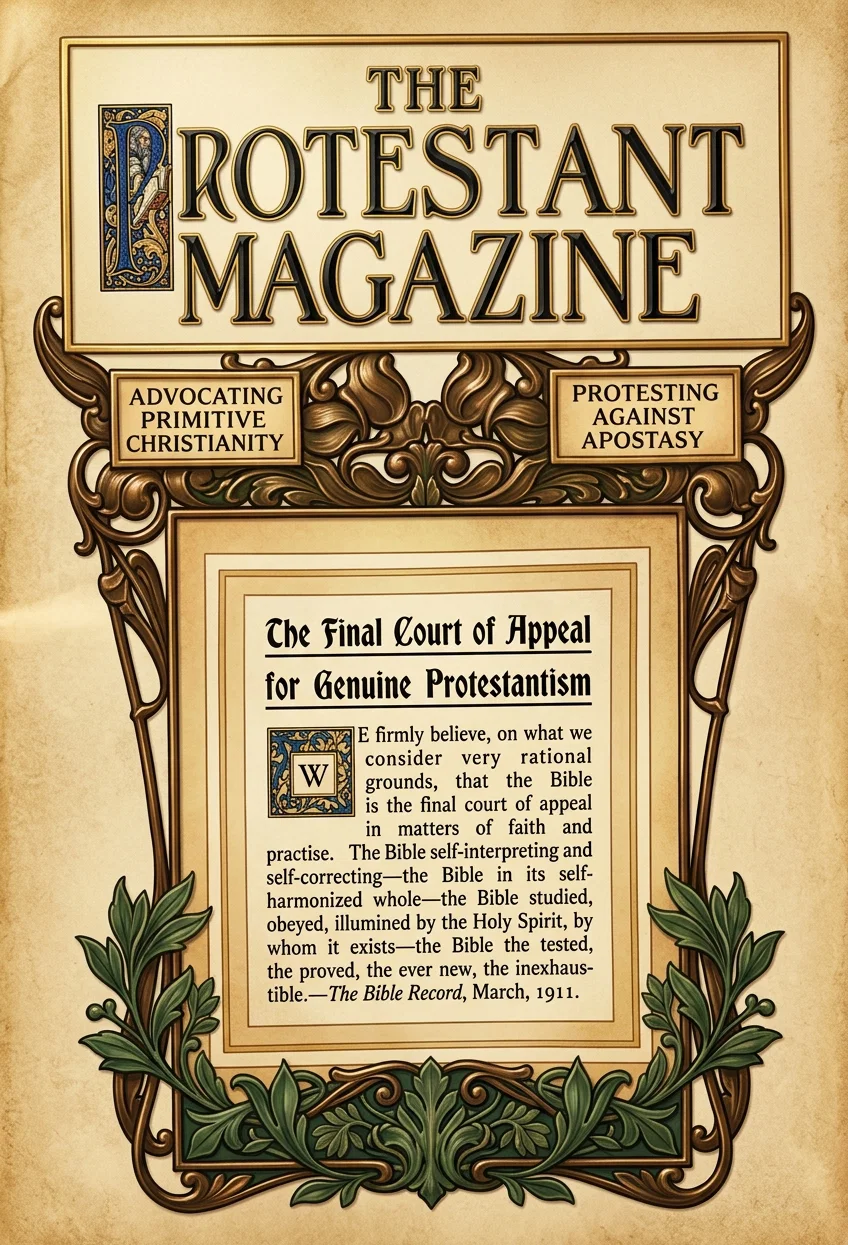
The Protestant Magazine

For the Second Quarter of 1911
JUST ISSUED
It is a very arsenal of timely facts for the use of every Christian soldier. Like the preceding eight numbers issued since May, 1909, it will serve the double purpose of helping to make good Protestants, and also of furnishing the Christian controversialist with good weapons of offense and defense.

SPECIAL OFFER

Ten or more copies, one year to one address or to different addresses, cash with order, only 15 cents each. Regular price 25 cents.
Our agents and friends are sending in all the way from ten to two hundred yearly subscriptions at one time; $6 pays for 40 yearly subscriptions, $3 for 20, and $1.50 for 10. Send in your lists of names and addresses of clergymen, business men, attorneys, judges, legislators, mayors, university and college professors, or other leading thinkers. If you are short of names, ask your conference tract society or us to furnish you more.

PARTIAL CONTENTS

COVER PAGES.—Final Court of Appeal for Protestantism—Our Theses—Recognizing the Authority of God—A Usurpation of Divine and Human Authority.
EDITORIALS.—Positive Protestantism—One Mediator—Contradictory Statements Regarding Persecution by Roman Catholics—A Live Issue (Episcopalians on Romanism)—Typical and Antitypical Babylon (explains Babylon of to-day)—Comparing Spiritual With Worldly (review of Paulist sermon)—Need of Gospel Among Catholics in South America—A Horrible Thing (Anglicans and Cardinal Gibbons on proposed changes in decalogue).
GENERAL ARTICLES.—What Think Ye of Christ?—The “Privilege” of Peter—The Bible’s Appeal to “Private Judgment”—A Remarkable Document (Catholic Confession of Faith prescribed to Protestant Converts—in parallel columns of Latin and English)—Rome’s Teaching About Protestants (who are heretics, etc.)—Bible and Modern Criticism.
NOTES AND EXTRACTS.—Boycotting Italy’s Celebration—Rome Versus Portugal—Mixed Marriages—Protestantism as “Anarchist Church”—Catholic Chief Justice—A Catholic Attack Upon the Y. M. C. A.

Are You Aware

1. That Rome plans to rule the world through the United States, according to Bible predictions? That she calls America “the church’s land of promise”?
2. That Rome seeks to control national, State, and city elections in America? That she also largely controls the politics of Germany, England, and Canada through her “center” or “balance of power” party?
3. That the United States Census Bureau reports show that the membership of the Catholic Church in this country had increased 93.5 per cent, while that of the Protestant bodies increased only 44.8 per cent during the years 1890 to 1906?
4. That at its ninth convention, held in New Orleans, La., Nov. 13–16, 1910, the American Federation of Catholic Societies passed the following resolution, aimed at anti-Catholic publications: “Resolved, That the Congress of the United States be earnestly requested to amend Section 3893 of the revised statutes . . . so that the same may include the mailing of books, papers, writings, and prints which outrage religious convictions of our citizens, and contain scurrilous and slanderous attacks upon Faith”?
5. That the chief justice and one associate justice of the United States Supreme Court are Roman Catholics? That an ex-president has predicted the election of a Roman Catholic for President of the United States?
6. That the plans of the Papacy with reference to our country are, as expressed in a letter from the Vatican (New York “Sun,” July 11, 1892): “What the church has done in the past for others she will now do for the United States”?

Sold to Catholics and Protestants Alike

The articles in the “Protestant Magazine” are in no sense attacks upon Roman Catholics. The principles of the Roman Catholic Church system are strongly opposed and refuted in every number. And the evidences published are gleaned from authentic sources only—in most cases Catholic sources. This accounts for the sale of the magazine to both Catholics and Protestants. Agents wanted wherever the English language is spoken.

PRICES

Per copy, 10 cents; yearly subscription, 25 cents; 5 to 40 copies, 5 cents each; 50 or more copies, 4 cents each.
Bound Volumes, Vols. I and II in one, manila paper cover, $1.00; full cloth, $1.50.
Address Your Conference Tract Society, or
The Protestant Magazine :: Takoma Park Washington, D. C.

Our Truest Friend

WILLIAM BRICKEY
There is not another friend Like our Saviour, when in trouble; He will comfort to the end, Even though your grief be double.
When your sorrow is so deep Words can not express your feeling, If you humbly bow and weep, He will comfort while you’re kneeling.
When all other friends forsake, He can understand your trouble; Though your heart should melt and break, Then his comfort will be double.
For a broken, contrite heart He will not despise, when kneeling; He has realized the smart, And he has the balm for healing.
O the depths of Jesus’ love! Human words can not express it; And that holy, heavenly Dove Can but sanctify and bless it To the good of every soul Who will trust him when in trial, He can understand the whole; For he drank the bitter vial.
O the riches of his grace! When his tender heart was broken, When his Father hid his face, His most gracious words were spoken. Knowing how he’d been betrayed, How he’d suffered in the garden, For his enemies he prayed To his Father for their pardon.
Kamiah, Idaho.

The Miracle at the Temple Gate

MRS. E. G. WHITE
Before leaving his disciples, Christ told them that they were to be the executors of the will in which he bequeathed to the world the treasures of eternal life. To them he said: You have been witnesses of my life of self-sacrifice in behalf of the world. You have seen my labors for Israel. And although my people would not come unto me, that they might have life, although priests and rulers have done unto me as they listed, although they have rejected me, they are to have still another opportunity of receiving me as their Saviour. You have seen that all who came unto me confessing their sins, I have freely forgiven. To you, my disciples, I commit this message of mercy. It is to be given to all nations, tongues, and peoples. All who believe are to be gathered into one church.
The disciples were to carry their work forward in Christ's name. Their faith was to center in him as their source of power. In his name they were to present their petitions to the Father, and they would receive answer. Christ's name was to be their watchword, their badge of office, their bond of union, the authority for their actions, and the source of their success.
The men to whom this trust had been committed realized the greatness of their work. They knew that they held in their hands the bread of life for a famishing world. The love of Christ constrained them, and they could not forbear breaking the bread of life to all who were in need. The commission given them was constantly sounding in their ears.
A short time after the descent of the Holy Spirit, and immediately after a season of earnest prayer, Peter and John, going up to the temple to worship, saw at the gate of the temple a cripple, forty years of age, whose life, from his birth, had been one of pain and infirmity. This unfortunate man had long desired to see Jesus, that he might be healed; but he was almost helpless, and was far removed from the scene of the Great Physician's labors. His earnest pleadings at last induced some friends to bear him to the gate of the temple; but upon arriving there, he found that the One upon whom his hopes were centered had been put to a cruel death.
His disappointment excited the pity of those who knew how long he had eagerly hoped to be healed by Jesus, and they daily brought him to the temple, that the passers-by might be moved to give him a trifle to relieve his wants. As Peter and John passed, he asked an alms from them. The disciples looked on him compassionately, and Peter said: “Look on us. . . . Silver and gold have I none.” The countenance of the cripple fell as Peter thus declared his own poverty, but it grew bright with hope and faith as the apostle continued, “But such as I have give I thee: In the name of Jesus Christ of Nazareth rise up and walk.”
“And he took him by the right hand, and lifted him up: and immediately his feet and ankle-bones received strength. And he leaping up stood, and walked, and entered with them into the temple, walking, and leaping, and praising God. And all the people saw him walking and praising God: and they knew that it was he which sat for alms at the Beautiful gate of the temple: and they were filled with wonder and amazement at that which had happened.” They were astonished to think that the disciples could perform miracles similar to those performed by Jesus. Yet here was this man, for forty years a helpless cripple, now rejoicing in the full use of his limbs, free from pain, and happy in believing in Jesus.
The apostles saw the amazement of the people, and asked why they should be astonished at the miracle, or why they should regard them with awe, as if they had performed this miracle in their own power. Peter assured them that the cure had been wrought in the name and through the merits of Jesus of Nazareth, whom they had rejected and crucified, but whom God had raised from the dead. “His name through faith in his name,” the apostle declared, “hath made this man strong, whom ye see and know: yea, the faith which is by him hath given him this perfect soundness in the presence of you all.”
Having spoken plainly of the great sin of the Jews in rejecting and putting to death the Prince of Life, the apostles were careful not to drive their hearers to despair. “And now, brethren,” Peter said, “I wot that through ignorance ye did it, as did also your rulers. But those things, which God before had showed by the mouth of all his prophets, that Christ should suffer, he hath so fulfilled.” He declared that the Holy Spirit was calling upon them to repent and be converted, assuring them that there was no hope of salvation except through the mercy of the One whom they had crucified. Only through faith in him could their sins be forgiven.
“Repent ye therefore, and be converted,” he cried, “that your sins may be blotted out, when the times of refreshing shall come from the presence of the Lord.”
These words should come to us to-day with impelling force. “Godly sorrow worketh repentance to salvation not to be repented of: but the sorrow of the world worketh death. For behold this selfsame thing, that ye sorrowed after a godly sort, what carefulness it wrought in you, yea, what clearing of yourselves, yea, what indignation, yea, what fear, yea, what vehement desire, yea, what zeal, yea, what revenge!” This is genuine repentance. It will lead to a transformation in the life. It is the absence of this true sorrow for sin that makes many conversions superficial. Reformations are not made in the life. But when sin is viewed in the light of the law of God, and its true character is realized, it will be put away from the heart and life. True sorrow for sin brings the penitent soul near to the side of Jesus. There he may effectually plead for pardon, and obtain grace to conquer. There his darkened understanding may be enlightened, and the stony heart transformed into a heart of flesh. There the rebellious sinner is subdued, and his will is brought into conformity to the will of God.
“Ye are the children of the prophets,” Peter continued, “and of the covenant which God made with our fathers, saying unto Abraham, And in thy seed shall all the kindreds of the earth be blessed. Unto you first God, having raised up his Son Jesus, sent him to bless you, in turning away every one of you from his iniquities.”
Thus the disciples preached the resurrection of Christ. Many among those who listened were waiting for this testimony, and when they heard it, they believed. It brought to their minds the words that Christ had spoken, and they took their stand in the ranks of those who believed the gospel. The seed that the Saviour had sown sprang up and bore fruit.
“And as they spake unto the people, the priests, and the captain of the temple, and the Sadducees, came upon them, being grieved that they taught the people, and preached through Jesus the resurrection from the dead.”
After Christ rose from the dead, the priests spread far and near the lying report that his body had been stolen by the disciples while the Roman guard slept. We can not be surprised that they were grieved when they heard Peter and John preaching the resurrection of the One they had murdered, and when they saw that converts to the new faith were multiplying rapidly. The captain of the temple and some of the other officials were Sadducees. These were greatly roused by the preaching of the disciples. They felt that their favorite doctrine was in danger, and their reputation was at stake. The captain, with the help of a number of Sadducees, arrested Peter and John, and put them in prison, as it was too late that day for them to be examined.
The opponents of the disciples could not but believe that Christ had risen from the dead. The evidence was too convincing to be doubted. Nevertheless, many hardened their hearts, refusing to repent of the horrible deed they had committed in putting Jesus to death. When power from heaven came upon the apostles in so remarkable a manner, fear kept the Jewish leaders from violence, yea, but their bitterness and malice were unchanged.
Five thousand individuals had already accepted the truth proclaimed by the disciples, and both Pharisees and Sadducees agreed that if these teachers were suffered to go unchecked, their own influence would be in greater danger than when Jesus was upon the earth.
The Holy Spirit is often rejected because it comes in unexpected ways. Abundant evidence that the apostles were speaking and acting under divine inspiration had been given to the Jewish rulers, but they firmly resisted the message of truth. Christ had not come in the way they expected, and though at times they were convinced that he was the Son of God, yet they stifled conviction, and crucified him. In mercy God gave them still further evidence, and another opportunity to turn to him. He sent the disciples to tell them what they had done, and in the terrible charge that they had killed the Prince of Life, he gave them another call to repentance. But feeling secure in their own righteousness, the Jewish teachers were not prepared to admit that the men charging them with crucifying Christ were speaking by the direction of the Holy Spirit.
Having committed themselves to a course of opposition to Christ, every act of resistance became to the priests an additional incentive to pursue the same course. Irrespective of the fear or favor of men, the apostles proclaimed the truths which had been committed to them. But though the Jews could not fail to see their guilt in refusing the evidence sent by God, they would not cease their wicked strife. Their obstinacy became more and more determined. It was not that they could not yield; they could, but would not. It was not alone because they were guilty and deserving of death, not alone because they had put to death the Son of God, that they were cut off from salvation; it was because they armed themselves with the attributes of Satan, and determined to be opposed to God. They persistently rejected light, and stifled the convictions of the Holy Spirit. The spirit that works in the children of disobedience worked in them, leading them to abuse the men through whom God was working. The malignity of their rebellion was intensified by each successive act of resistance against God, and against the message he had given his servants to declare. Every day, in their refusal to repent, the Jewish leaders took up their rebellion afresh, preparing to reap that which they had sown.
The wrath of God is declared against unrepentant sinners not merely because of the sins they have committed, but because they choose to continue in resistance, repeating the sins of the past in defiance of the light given them. If the Jewish leaders had submitted to Christ, they would have been pardoned, but they were determined not to yield. In the same way, the sinner, by continued resistance, places himself where he knows nothing but resistance.

L. D. SANTEE

Prophecy

L. D. SANTEE

“Searching what, or what manner of time the Spirit of Christ which was in them did signify, when it testified beforehand the sufferings of Christ, and the glory that should follow.” 1 Peter 1:11.
Many are afraid of prophecy, yet with how little reason! In it are locked up the secrets of futurity. The infidels of France placed over the gates of their cemeteries, “Death is an eternal sleep.” We are wiser than they, but only because prophecy has opened to our view the life to come. By it friends, as they part on earth, promise one another that in the better land they will sing the eternal alleluiah together around the throne of God. The darkness of death is softened by the radiance of the star of hope. Well has the apostle said: “We have also a more sure word of prophecy: whereunto ye do well that ye take heed, as unto a light that shineth in a dark place, until the day dawn, and the day-star arise in your hearts.” 2 Peter 1:19.
“Holy men of God spake as they were moved by the Holy Ghost.” In their writings, we see our friends, white-robed and glorified, visions of angel harpers, streets of gold, the throne of God, and the river of life, gleaming before our eyes in matchless beauty. Eternal hands have rolled back the curtains of blindness, and have shown us the home and the associations of the redeemed.
“Searching what, or what manner of time the Spirit of Christ which was in them did signify.” The Spirit of Christ dictated all prophecy. Is it any wonder that it is unfailing when the same Spirit, clothed in flesh, fulfils what it has foretold? Well has Jesus said, “I am one that bear witness of myself.” John 8:18. One sad thought connected with this is that every one who refuses to study the prophecies is ignoring the Spirit of Christ.
Prophecy is grouped into two grand divisions,—first, “the sufferings of Christ,” or his first coming; and second, “the glory that should follow,” or his second coming. Of these two comings, and the events that attend them, prophets have written what the Spirit of Christ has revealed. From the manger in Bethlehem to the cross on Golgotha, every act has been a subject of prophecy. The first division of prophecy is a thing of the past. The Gospels record its fulfilment. As we read the fifty-third chapter of Isaiah and the twenty-second psalm, and then read carefully the closing acts in the Gospels, we say, as did the eunuch, “I believe that Jesus Christ is the Son of God.” Acts 8:37.
Every fulfilled prophecy is an evidence of the divinity of its Author and of the unfailing character of his Word. How natural that Jesus should remind us, “Heaven and earth shall pass away, but my words shall not pass away.” Matt. 24:35. No wonder the prophet exclaims: “The grass withereth, the flower fadeth, but the word of our God shall stand forever.” Isa. 40:8.
With unwavering faith, with unquestioning confidence, we come to the consideration of the second division of prophecy; namely, “the glory that should follow.” Here, as we study coming events in the light of eternity, language fails. We stand with uncovered head, and with hearts thrilled and awed, and think what no speech can ever tell. The spring-time of earth is cheerless, compared to the endless summer that smiles on us from the vistas of the future. The sunshine here is dark, compared to the everlasting sunshine that gilds with glory the gates of an endless day. All the gladness of earth is dull when we consider the rapture of heaven, which we by faith can feel, but which we can never express.
The great corner-stone of all the ages is the second coming of Christ. Here is the resurrection of the dead. Here the lives of men are tried, and their destiny is decided. Here the army of the lost, with pale faces, leave hope behind, while the white-robed throng, veterans in the conflict, and victors through the blood of the Lamb, ascend to the pearly gates, beyond which lie the glory-crowned hills of heaven.
Let us go back a little in considering this grand chain of prophecy that ends in paradise. Let us begin at Joseph’s new tomb. What a nucleus with which to build a kingdom!—the King dead; a few fishermen, who had lost faith in him; a few grief-stricken women, who were kept from a too near approach by the spears of the Roman guard! Had we been there, we would perhaps have said, “The King is dead; his mission is a failure.” But a few days later the commission was given to these same fishermen, “Go ye into all the world, and preach the gospel to every creature;” and as a result of this, a multitude has been gathered that no man can number, dipped in the baptism of tribulation and washed in the blood of the Lamb.
“From desert waste and cities full, From dungeons dark, they’ve come; And now they claim their mansions fair; They’ve found their long-sought home.”
The Spirit of Christ in the prophets has, with no uncertain tongue, made clear the signs of the times, and outlined the nations that should precede this wondrous consummation. In Daniel 2 we have a dream given to a barbaric king, revealing a chain of events reaching to the close of this world’s present history. Step by step the centuries have chronicled their fulfilment. Amid the wild storm of human passions, Babylon, Medo-Persia, Grecia, and Rome have arisen, become world powers, and been overthrown. The record continues, in verse 35: “Then was the iron, the clay, the brass, the silver, and the gold, broken to pieces together, and became like the chaff of the summer threshing-floors; and the wind carried them away.”
One writer has well said, as he considers this and similar prophecies: “We stand on the threshold of the millennium. Through what scenes the predicted day of a thousand years will be ushered in, we know not; but they are rapidly rising on our field of vision. We tremblingly expect the fulfilment of prophecy, and the explication of these symbols, to present which, heaven, earth, and hell were exhausted of their imagery. Relieved against the background of history, stands the great image of gold and silver and brass and iron, looming up between us and the sky, from which the sun has just descended. Right opposite, with beams of the morning reddening its summit, rises in majestic grandeur the mountain of the house of God. Invisible hands are heaving from its side a living Stone. It trembles on its poise, and in the pathway along which it must speedily rush, the monument of the empires is reared. Who can conceive or describe the terrors of the collision? The solid earth will shake. The sea will depart from its place and unwrap itself from its dead. The heavens will be rolled together as a scroll, and the stars will cease their shining. The beast and the false prophet will be thrust into the bottomless pit, and the angel will lock them in. And Christ will come! Already he makes ready for his coming. The chariots of salvation are gathering for their triumphal career. The attendant hosts are waiting for the signal. Christ is coming! In due time the earth will be purged by fire, swept with the besom of divine vengeance. No ark can ride that molten sea, no power can stay that terrible overthrow. Jehovah will be glorified in his enemies,—glorified in the old heavens and earth, which shall pass away,—glorified in the new heavens and earth, in which the lost harmony of the creation shall be restored.”
Daniel 7 contains the same prophecy under different symbols, closing with the fearful statement: “Ten thousand times ten thousand stood before him: the judgment was set, and the books were opened.” Matthew 24 gives an outline of the events that must occur between “the sufferings of Christ, and the glory that should follow.” The Man of Sorrows named the stepping-stones that intervened between his humiliation and his coronation,—between Calvary and the marriage supper of the Lamb. If the antediluvians needed Noah, if Sodom needed Lot, if Nineveh needed Jonah, how much more do we need the prophecies to show us events that are appalling in their nature and eternal in their consequences!
When these prophecies are fulfilled, the Judge will stand at the door. James 5:9. Thank God for prophecy! By it we can see beyond the perils of earth to the eternal home of the blessed. Well has the prophet said that it is “as a light that shineth in a dark place.”
Shine on, O star of hope! Shine on, O prophecy of Jesus! Drive from our hearts the darkness of unbelief, and fill them with the glory of desire. Spirit of Christ, that spoke through the prophets, be with us to the end of the world!
Moline, Ill.

H. I. MORSE-FARNUM

Faithfulness

H. I. MORSE-FARNUM

AMID a world of sorrow The soul that fears the Lord, Unworried by the morrow, Rests safely on his Word.
Encompassed by his mercy, Go humbly, fearless, forth, Fulfilling every duty, The chiefest thing of earth.
That One who guides all nature, Suns, planets, all the years, Sustaining every creature, Hath balm for all our fears.
“Mine eyes shall watch the faithful, And they shall dwell with me.” Though earth decay and pass away, Thine eyes shall surely see A far-off clime, unscathed by time, Bright immortality.
Peterborough, Ontario.

Its Schools

Tracings of the Prophetic Gift—No. 5

Its Schools

J. O. CORLISS
It would seem from one explanatory expression found in I Sam. 9:9, that the term prophet was not at first applied to the man of God chosen to point out the ways of the Lord. The expression referred to is this: “Beforetime in Israel, when a man went to inquire of God, thus he spake, Come, and let us go to the seer: for he that is now called a prophet was beforetime called a seer.” This would convey the idea that a seer (roeh), or gazer (chozeh), was not considered so exalted a personage as one chosen to be a prophet (nabi). The first-named title does not appear to cover so much latitude as the last. While the former was supposed to be able to gaze, or see, beyond ordinary mortals, the latter was reckoned at that time to be in such direct relation with God as to be always able to make known his will in matters of importance to his people.
David, a man after God's own heart, ascended the throne as prophet-king of Israel during Samuel's prophetic administration. He had for a chief counselor, Nathan, a highly exalted prophet. The hand of Samuel transferred the crown from Saul to David. I Sam. 16:13. Nathan conferred the crown upon Solomon. I Kings 1:45. The influence of these two men of God had much to do with shaping the policy of Israel's government.
Toward the close of Solomon's reign, great confusion came in, making the need of the prophetic order greater than ever. Its work at that time gave it a more important standing in the state than it had before reached. Upon the death of Solomon the threatened rupture of the nation came, which created a new kingdom of ten tribes, leaving Judah, with a portion of Benjamin, as a remnant of the once united empire.
In the meantime, schools, or seats of prophetic instruction, had been established within the bounds of the ten tribes—at Bethel, Jericho, Gilgal, and Carmel. This gave the northern kingdom the bearing monopoly of prophets, of which there were many. See I Kings 18:4; 19:18. The sanctuary being located in Judah, the priests naturally chose the southern kingdom as an abiding-place, but for at least two hundred years the prophets were mostly found in the northern kingdom, in which their schools were located. Prominent among these were Ahijah of Shiloh (2 Chron. 9:29), Jehu son of Hanani (I Kings 16:7), Obadiah (I Kings 18:3), Micaiah (I Kings 22:8), and chiefest of all, Elijah and Elisha. Contemporary with these were a few in the southern kingdom, like Azariah (2 Chron. 15:1-8), Hanani (2 Chron. 16:7), and Eliezer (2 Chron. 20:37).
This distribution of prophetic talent seems quite providential when we consider the later tendency of both the northern and southern kingdoms to repudiate prophetic testimony. For a long time the free passage of these men of God between the rival kingdoms served to keep alive a general sentiment of national religion, and also to preserve a true history of the two kingdoms, as related to each other.
One name, however, was omitted from the list before made of the southern prophets, which should be mentioned in this connection, by way of illustrating the thought just expressed. This is “Iddo the seer,” spoken of in 2 Chron. 9:29. He is there said to be the prophet who testified against Jeroboam the son of Nebat. It will be remembered that this Jeroboam was made king of Israel upon its separation from Judah, immediately following the death of Solomon. Very soon thereafter, we find Jeroboam standing at the altar in Bethel to offer incense, and an unnamed prophet from Judah withstanding him. I Kings 13:1, etc. Coupling this incident with the statement made in 2 Chron. 9:29, led Josephus and Jerome to identify the Judean prophet as Iddo the seer.
At first it seems as if the prophets were satisfied with simply oracular deliverances of their messages. But in later times they were careful to commit the most of them to writing. This may be partially accounted for from the fact that they became chosen instruments to compile the history of their respective kingdoms, and so to record the lives of their principal actors. It is a matter of record that at least Samuel, Gad, and Nathan traced the life of David (2 Chron. 29:29, 30), and Nathan and Iddo described the lives of Solomon and Jeroboam. 2 Chron. 9:29.
Among the older written prophecies are the strong denunciations of Joel against sin. His statements are truly bold and unequivocal. They call for decided action in repentance on the part of the nation. He points out, briefly but clearly, the future of God's people, even to the final consummation, and reveals the design of Heaven in their varied experiences.
But according to Usher's chronology another prophecy dates back of the one bearing the name of Joel. That is the one attributed to Jonah. He was the son of Amittai, whose nativity was in Gath-hepher. 2 Kings 14:25. Gath-hepher was a city of Zebulon well toward the northern part of Israel, and not far from the border of the New Testament Syrophenecia. Instead of confining his work to the people of Israel, or even of Judah, he was sent to the heathen of Nineveh, to whom he became a “sign” of God's infinite mercy. Luke 11:29. When the Saviour was asked by the Jews to prove his mission from God by some sign from heaven, he said that he would give them no sign but that of the prophet Jonah. He, too, spent the most of his time among other people than his own, and completed the “sign” by being held three days and nights in the power of those who sought his death.
Following these notable prophetic characters come Hosea, Amos, and the great school of prophets which rose in the Judean kingdom under Uzziah,—Isaiah, Micah, Nahum, and Zechariah. This last-named prophet, who, it is distinctly said, “had understanding in the visions of God” (2 Chron. 26:5), evidently should not be confounded with that prophet of like name whose prophecy was written nearly three hundred years later. This one is probably identical with Zechariah, the “son of Jeberechiah,” mentioned in Isa. 8:2, to whom many Bible expositors have ascribed most of the prophecies which are quoted by Matthew under the name of Jeremiah (particularly Matt. 27:9, 10), and which are found in the later Zechariah's writings. The mixing of names might have been easily done by carelessly transcribing the name in Isa. 8:2, given as the father of Zechariah.
Conspicuous among the later prophets are the names of Jeremiah, Ezekiel, Isaiah, and Daniel. It may have been noticed by most people that while the titles to the books of Jeremiah, Ezekiel, and Isaiah distinguish them as prophetic, the book of Daniel receives no such acknowledgment in its title. This may have been through the influence of the Jewish canon, which refuses to acknowledge the prophetic character of the book.
Furthermore, it may be well to mention that most of the early manuscripts omit from Mark 13:14 any reference to Daniel as a prophet, and the Syriac Version does the same for Matt. 24:15. It can only be conjectured why this strong prejudice has existed among the Jews. Certainly the book of Daniel clearly and strongly points out the world's future as no other prophetic book does, and from no other source comes the almost exact date to the day for the appearance of the expected Messiah. Herein may lie the secret of the Jewish refusal to acknowledge the prophetic character of the book.
* Mountain View, Cal.

A Worker's Prayer

“For I have received of the Lord that which also I delivered unto you.” 1 Cor. 2:23.
LORD, speak to me, that I may speak In living echoes of thy tone; As thou hast sought, so let me seek Thy erring children, lost and lone.
O lead me, Lord, that I may lead The wandering and the wavering feet; O feed me, Lord, that I may feed Thy hungering ones with manna sweet.
O strengthen me, that while I stand Firm on the Rock, and strong in thee, I may stretch out a loving hand To toilers on life's troubled sea.
O teach me, Lord, that I may teach The precious things thou dost impart; And wing my words, that they may reach The hidden depths of many a heart.
— Selected.
Continue reading: What if It Were You?