The writer submits the following, after twelve months’ field experience in house-to-house work in connection with churches in four conferences. We have the plea of the relief work, which may be used in getting the order; but, in the mind of the writer, there is a stronger factor in selling the book, one that commends itself to the public, and leaves a better influence after the worker has gone, as it really sells the book more upon its merits.
As we start out, we may consider that a book may be the remotest thing in the thoughts of those upon whom we are about to call; that they now possess all the books they want, and perhaps have not been reading even these. Because of these common excuses, we must point to the great need of the book that we are about to present, and show how it meets that need.
Introduce yourself at the door always as in the interest of a Christian work, and, after stating that you have called to see the person with whom you are speaking for a few moments, step right forward; nine times out of ten the door swings open, and you are invited in. After being seated, mention may again be made of the nature of your work before introducing your book.
Call the attention of your prospective customer to the great spread of disease in the world, especially mentioning the great white plague, cancer, and various epidemics, calling attention to the fatality of la grippe and pneumonia, and to the great increase of stomach trouble. State that this spread of disease has caused a demand for sanitariums, in which to care for the suffering and afflicted, and that you represent a system of about sixty such institutions in this country and about twenty in foreign fields; these are Christian institutions, doing a great deal of philanthropic work. Explain the plan of securing help to place these institutions on a basis where they can do more for the sick and suffering, not by soliciting donations, but by the sale of a book which presents some of the latest researches on scientific principles of protection against disease, and gives helpful suggestions on their cure. Though not a doctor-book, it presents health principles clearly, and combines spiritual healing with physical. Mention that you are giving a few hours of your time to this work without remuneration, and that no one derives any financial benefit from it, but that its sale is altogether in behalf of the suffering.
Now present the book, calling attention to the second paragraph on page 8, “It is a dedicated book,” etc. Show some of the beautiful illustrations. Read, or let the individual read, some beautiful paragraph, such as that at the bottom of page 94, or one of many others that might be selected. Refer to the poetry on page 258, and call attention to the index, both Scriptural and topical, showing how easily the comment on the text and the different topics can be found.
In closing, say: “Now you can see,17Mrs. — (or Mr.), that the book is really worth more than the price asked for it, $1.50; and besides making a good book for your home, you are, by its purchase, helping along a worthy cause. We sell the books for cash, or deliver them any time you may designate. As I stated, Mrs. —, I do not receive a penny from the profits on this book, but the entire profit is devoted to the benefit of suffering humanity.”
One of the best selling-points on the book is the two chapters, “The Mother” and “The Child,” pages 371 and 379. Pointing to the picture on page 377, read, or ask the person to read, the paragraph beginning under the picture “The Mother’s Opportunity.” Don’t be afraid to call upon, and present the book to, the different merchants, especially those with whom you are dealing. Hundreds of these books have been sold in this way, and many have thanked the worker for the visit.
I. G. BIGELOW,
Field Miss. Sec., Col. Union Conf.
Religious Liberty and State Neutrality
By Henry M. Stanley
A STATE should not interfere in matters of conscience; for be a man pagan or Christian, Protestant or Roman Catholic, Brahman or Mussulman, his religious beliefs or ignorance of religion should not bias a government, nor debar a citizen from the enjoyment of his rights and privileges.—Henry M. Stanley.
News and Miscellany
— Wheat sold at wholesale in Chicago, May 29, for $27 a ton. This is declared to be the highest price ever reached for this staple in that city.
— A destructive wind- and rain-storm swept over northern Ohio on May 30. Several persons were killed and a large number injured. Much property also was destroyed.
— May 29 fourteen persons were killed and twenty-one injured at McCook, Neb., in a head-on collision of two passenger-trains on the Chicago, Burlington, and Quincy Railroad.
— Henry L. Stimson, of New York, has been appointed Secretary of War in place of Jacob N. Dickinson, of Tennessee, who voluntarily resigned in order to look after his own business interests.
— One of the worst fires seen for many years in Quebec, Canada, swept through the business section of that city on May 27, wiping out two large factories, several dwellings, and entailing a property loss of $250,000.
— Ten acres of burned territory in the center of Coney Island, where “Dreamland” stood, resulted from a fire which swept over that section, May 27. Losses to property-owners will amount to $3,000,000. It is thought that the fire was of incendiary origin.
— May 23 the New York Public Library was dedicated, and passed into the hands of the public. The building cost $9,000,000. The merging of several book collections furnishes a large collection of books for the reading public. President Taft spoke at the dedication of the building.
— The Hukwang loan for the construction of railroads in China was signed at Peking, May 20, by the representatives of American, British, French, and German groups of bankers. Thirty million dollars is provided for the enterprise. Twenty million dollars more is provided as an additional sum in case of emergency.
— The capital of Oklahoma will remain Oklahoma City, according to the decision of the United States Supreme Court, rendered May 29. The tribunal declared constitutional the Oklahoma statute enacted last December to remove the capital from Guthrie to Oklahoma City.
— The United States Weather Bureau Service states that this year has seen the hottest and driest weather during the month of May which has existed for forty years. It is feared that great damage to crops will result from the prolonged drought. The heat, especially in Eastern cities, has been very oppressive, and many prostrations, with a number of deaths, have resulted.
— In a decision rendered May 29, the Supreme Court of the United States sustains in all vital points the contention of the government for the dissolution of the Tobacco combine. Six months is allowed in which to effect the dissolution. The trust is held to be a combination in restraint of trade, and a monopoly in violation of law. The decision is regarded as a most comprehensive and sweeping victory for the government.
— According to the budget presented by Chancellor Lloyd-George in the House of Commons, the estimated expenditures for the current year for Great Britain amount to $906,170,000. This is $38,000,000 more than last year. Of the increased expenditure, the navy, civil service, and old-age pensions account for the greater part. Pay for the members of the House of Commons will absorb $1,750,000, while the coronation will add $1,500,000.
An Appeal to Our Young People
By Arthur G. Daniells
A Pressing Need
I am now on the steamship “Baltic,” nearing the coast of England. We have had an ideal voyage in every respect. As I have been cut off from the volume of work that presses upon me when on land, I have had time to do some serious thinking about this great advent movement with which we are connected. I have been reviewing its history, and studying its present position, with the result that I have been very deeply impressed with our great need of thoroughly qualified, efficient workers. We need money, and much of it, but we need strong, able, consecrated ministers and Bible workers much more. Thoroughly trained, Spirit-filled workers can render our cause to-day infinitely greater service than can money alone. Efficient, successful ministers, Bible workers, and medical missionaries will win souls to Christ; and that will bring the money required to extend the cause to the uttermost parts of the earth.
Development of Our Work
At different periods in the history of our cause its pressing needs have been different. In the early days there was great need of literature—tracts, pamphlets, books, and papers. The pioneers not only saw this need, but felt a great burden pressing upon them to write and publish. Now we have a large variety of excellent literature, and we are surely making good use of it.
At another period we were in sore need of organization, in order to carry forward a rapidly growing work. This burden was laid upon the hearts of the leaders, and they studied and struggled with this problem until they succeeded in developing a plan of organization that enables us to carry our work forward with great despatch and in necessary harmony in all parts of the world.
Then came our great need of schools, and of a suitable, well-developed system of education for our young people. God has greatly blessed us in our endeavors to supply this need. To-day nearly twenty thousand of our children and young people are receiving their education in our schools.
The Call to Evangelize the Cities
Now, after producing a good variety of literature, and developing a successful plan of organization, and providing excellent educational facilities, a most urgent call comes to us to give our message to the great masses congregated in the cities throughout the world. The instruction that has come to us through the spirit of prophecy to work these cities just now is truly solemn and impressive. It seems like a final summons to God’s people to arise and finish his work. It is surely a great undertaking—one to which we shall have to devote our energies while probation lasts.
It is this work in behalf of our cities which we are now called to carry forward everywhere that makes such a demand for specially qualified, efficient workers. These cities present to our workers obstacles which do not exist in the smaller towns and rural districts. In our endeavors to carry out the instruction regarding the city work, we find ourselves unprepared for it. And our greatest lack is suitable workers—men and women trained for, and adapted to, the conditions we are obliged to meet.
The call is now coming from conference officers and the ministers located in these cities for young men and women of good education and address who can readily adapt themselves to the varied conditions that exist, and who can stand the strain of the strenuous work they will have to do. Preachers are in great demand—preachers who are able, clear, and forceful in public work. Young women are wanted for Bible work who are educated, refined, tactful, and persevering. Competent missionary nurses are wanted, who can go into the highways and hedges, and minister to those who are sick, physically and spiritually. The demand for able workers is so great and pressing that it is really painful. It is necessary that we hasten the preparation and training of this class of workers.
Consecration and Preparation
In view of these considerations, I most earnestly appeal to our young men and women immediately to consecrate their lives to God for this service. Make a full surrender of all to him, and without delay take the first steps necessary to place yourselves where you can help18to supply the great, pressing need of this hour. You are wanted, and will be recognized and located as soon as you are ready for work. No one can tell just when, where, and how all this will be worked out; but no one needs to know this now. The preparation is the first and most essential thing. When that is made, the providence of God will guide. That is the experience of hundreds of workers who are now rendering the cause valuable service.
Our colleges and academies are making strenuous efforts to give our young people the education they must have for the foundation of their life-work; but it rests with our young men and women who attend these schools to address themselves to the task of building wisely upon this foundation.
The Foreign Mission Seminary
I find many who, having finished their regular school work, are making little use of what they have acquired in the direct work of our message. In our search for missionaries for foreign fields we have found many of these who have responded to the call, and, after taking special work at our Foreign Mission Seminary, have entered upon active work in either the home or foreign fields. The calls for these Seminary students this year can not all be filled. We must now gather another company for next year.
I hope every young man and young woman who reads this will take it as a personal appeal to begin immediately to prepare for the work the Lord is now calling upon us to do for lost souls, whose destiny must soon be forever fixed. If you have finished your regular school work, turn your face toward the Foreign Mission Seminary. Correspond with Prof. M. E. Kern about the plans and terms for next year. Watch for the announcements that will appear in the REVIEW and other papers. And may a large number of our young people whom the Lord wants just now, consecrate their lives this year to his service.
A. G. DANIELLS.
Young People’s Work
Conducted by the Young People’s Missionary Volunteer Department of the General Conference
M. E. KERN - Secretary
MATILDA ERICKSON - Corresponding Secretary
Western Sanitariums
By Daniel H. Kress
On account of the important meetings in connection with the Loma Linda Medical College and the Paradise Valley Sanitarium, I was detained in California longer than I had planned. In order to meet some previous appointments, I found it necessary to limit my stay at the sanitariums on my homeward trip.
The same prosperity which has attended the sanitariums in California has been with the institutions all through the West. At Portland, Ore., Dr. W. B. Holden and his co-workers had a successful year during 1910, and the prospects for the year 1911 are encouraging. I was pleased to note that the same harmony prevailed among the workers here as elsewhere. When there is unity and harmony among the members of the faculty and board, harmony usually exists throughout the entire family.
At Walla Walla the sanitarium has had the best year of its existence. The workers are all of good courage. The splendid supply of good artesian water is a great help to this institution. At Boulder the outlook is very promising. Improvements and repairs, which will add greatly to the appearance of the institution, are now being made. It pays to keep everything orderly and neat, even if to do so entails some expense. The impressions made upon the sick by well-kept, clean dining-rooms, kitchens, treatment-rooms, halls, and bedrooms, go a long way toward satisfying them, and also aid in their restoration. A badly kept place has a depressing effect upon workers and patients. The surroundings at Boulder are certainly all that could be desired. So far Boulder has been known chiefly as a summer resort; in the future it will gain a reputation as a winter resort as well. The winters are invigorating yet pleasant. There are probably as many sunshiny days to be enjoyed here during the year as in any part of the United States.
I also called upon the Drs. Shively, who are located in Denver. They are doing a good work. Recently they found it necessary to move into larger and better quarters. Dr. Richards is also located here. He has been greatly blessed in his work as a private practitioner.
During the past six years Dr. J. E. Froom and wife, of Boise, Idaho, have built up an excellent practise. Their treatment-rooms and offices are located in one of the best blocks in the city. Everything is neatly kept. We are glad that in so many places representative centers of this great message are building up.
I neglected to make mention of the excellent work done by the sanitarium at Long Beach, Cal., conducted by Dr. Winegar-Simpson and her husband. They have a desirable location and building, and have met with success.
Dr. L. J. Belknap, of San Jose; the Drs. W. H. Maxson, of Oakland; and Dr. A. J. Sanderson, of Berkeley, are all doing well, and have a good patronage.
Thus it will be seen that in the West, where most of our sanitariums are, we have none too many. There is plenty of room for more. When conducted in harmony with the third angel's message, each helps to build up the other. The more sanitariums we have, the more prominence will be given to the reforms they advocate, and to the truths for which they stand. The more prominence is given to the principles which brought them into existence, the more numerous will be the converts. The greater the constituency, the greater will be the demand for more sanitariums. On the other hand, “There is that withholdeth more than is meet, but it tendeth to poverty.”
The vegetarian cafeterias conducted by Brother Fulton in Los Angeles are a credit to the cause, and are accomplishing much good. Brother M. A. Hollister is conducting a neat vegetarian cafeteria at San Diego, and is meeting with success. It has been demonstrated that these places can be conducted in such a way that favorable impressions may be made upon those who come to them as patrons, and that thus prejudice may be removed, and the way paved for helpful spiritual truths. The St. Helena Sanitarium has also opened up a splendid cafeteria at San Francisco. The place is hardly able to accommodate its numerous patrons. We ought to have these restaurants and cafeterias in every city of the West and East. Never, in the history of our medical work in the West, have there been so many omens of good. D. H. K.
Camp-Meeting Suggestions
By Daniel H. Kress
To his chosen people anciently God gave definite instruction in regard to their encampment while in the wilderness. Everything pertaining to it was to be kept in order and scrupulously clean. Principles pertaining to their well-being physically and morally were also urged upon them through Moses. Through cheerful obedience to these, God purposed to make of them the cleanest and healthiest, and morally the best, people in the world. Through the favorable impressions made by such a people upon the nations about them, prejudice was to be removed, and the way prepared for the impartation of divine truths by priests and teachers.
In speaking to the people, Moses said: “Behold, I have taught you statutes and judgments, even as the Lord my God commanded me. . . . Keep therefore and do them; for this is your wisdom and your understanding in the sight of the nations, which shall hear all these statutes, and say, Surely this great nation is a wise and understanding people.” The Lord is no less particular to-day. He designs that these yearly encampments should be regarded as places where he in a special sense and manner will meet with his people.
Anciently, personal cleanliness was demanded, and the people were required to clean their garments, to meet with God. To Moses the instruction was given: “Go unto the people, and sanctify them to-day and to-morrow, and let them wash their clothes.” God’s demands are the same to-day. Those who come to these yearly convocations should be clean in person, and their clothing should be appropriate for the occasion. This cleanliness should extend to individual tents and to the entire encampment.
The sanitary arrangements in the camp of Israel were perfect. Garbage and other refuse were not permitted to accumulate within the sacred enclosure. The water-supply was above suspicion. The food and drink were simple and wholesome.
In all these wise arrangements, we have before us an object-lesson of what God demands of his people for all time.
In the past there has at times been much sickness in our camps, and many coming at a great expense have been deprived of the benefit of the meetings. This need not be. If we would follow out the instruction which God has given us, sickness would seldom be seen at our camp-meetings.
There have been some things about our encampments which have also tended to make an unfavorable impression upon visitors. In fact, in some instances, health officers have threatened to close the camp because of the unsanitary arrangements. Thus a reproach has been brought upon the cause of God; for his people should be the light of the world. The sanitary arrangements and the order maintained at19our camps, should appeal not only to the health officials, but also to persons of refinement. In order that this may be so, I will offer a few suggestions which, if followed, will aid in the attainment of the desired end:—
1. In the first place, the camp should not be located near a low or damp, marshy place, where mosquitoes breed. Mosquitoes are carriers of disease. Some very serious diseases are definitely known to be conveyed by them. It should not be located near barn-yards or manure heaps, where flies breed.
2. The water-supply should be above suspicion. If it is not, the people should be instructed, at the beginning of the camp, to boil all the water they drink. The life of many a Seventh-day Adventist has been sacrificed by ignoring this simple precaution.
3. Many diseases are conveyed through the medium of the fly. Flies should, therefore, be shut out of the dining-tent, the kitchen, and the grocery-tent, as far as possible. This is best done by a fly-netting. The garbage from the camp should be covered with a wire screen, so that flies can not enter it to breed.
4. Toilets should especially be kept clean. If possible, they should be connected with the city sewer. They should be a good distance from the camp, and located on the opposite side of the camp from the dining-tent and kitchen. A toilet naturally attracts flies; but by exercising a little precaution in its construction and afterward, flies may be practically excluded. Have the pit deep. The boards above the pit should be close-fitting, and the cracks well covered. The bottom boards should be banked with earth. Have each seat covered with a hinged door. This will effectually shut out flies, and the additional expense connected with providing such a toilet is a mere trifle. The cooperation of all in the camp is needed to keep these places clean. As a matter of modesty and respect, the seats should be separated from each other by a wall of board or canvas.
5. In the past there has been a tendency to crowd together too many in the various tents. By doing so, it is impossible to keep the tents neat and clean, or even to supply good, pure air. From the view-point of health, therefore, it is wise to discourage overcrowding as far as possible.
6. In these large gatherings, campers should have considerable privacy. They need time for seasons of secret devotion; and they should have a place where they can be alone, or where they can take, for prayer, those upon whom personal labor should be bestowed.
7. The foods best adapted for camp-meeting purposes are the well-baked cereals and breads, fresh fruits, and, in moderation, nuts or nut preparations. Crackers, zwieback, shredded wheat and granose biscuits, puffed wheat, puffed rice, and fruit crackers are wholesome foods to use. To make these crisp and palatable, they should be heated or exposed to the sun. Raw celery, raw cabbage, lettuce, and tomatoes are good relishes. Beans, lentils, and boiled cabbage should be avoided if the weather is hot, or, at most, used sparingly. If butter is desired, it should be used sparingly. Caramel coffees may be used occasionally. If milk is used, it should be sterilized.
D. H. K.
Medical Missionary Department
Conducted by the Medical Department of the General Conference
D. H. KRESS, M. D. - - - Secretary
L. A. HANSEN - - - Assistant Secretary
Clinton (Mo.) German Seminary Institute
By C. G. Bellah
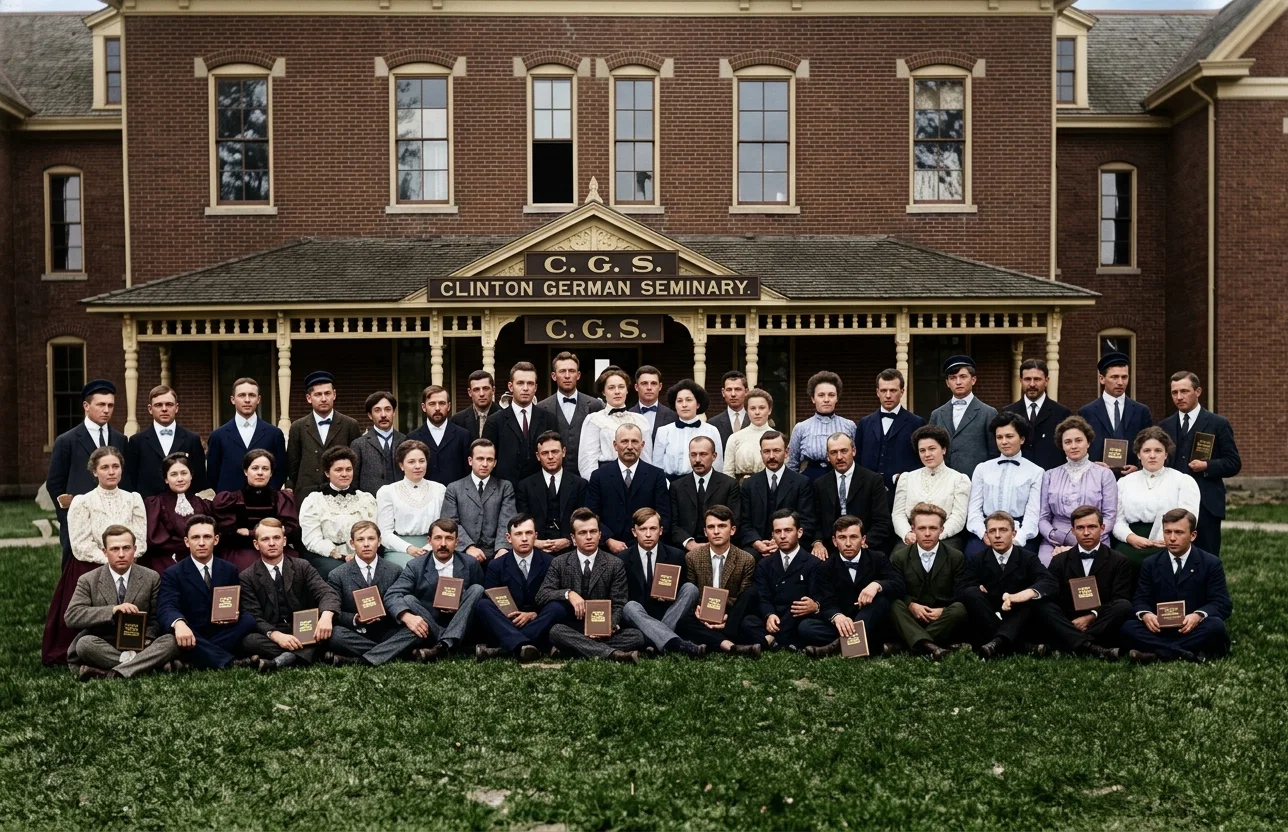
PROMPTLY at 5 P. M., April 28, about sixty enthusiastic students and members of the faculty assembled in the large, pleasant chapel of the Clinton German Seminary for the opening meeting of the canvassers’ institute. The great problem as to how the work is to be done seemed to have at least a partial answer as we looked into the earnest faces of these sturdy young men and women. Bookmen and faculty had prayed that the Lord of the harvest would “send forth laborers into his harvest;” and here was the answer.
The classes were quickly organized, and grew every day. Not only were those present who had never canvassed before, but the old pioneers also attended almost every meeting. The first session was good; but as the feast progressed, the Lord gave us better wine.
CANVASSERS AT THE CLINTON (MO.) INSTITUTE
After counsel with Prof. G. A. Grauer, a regular time each day was set apart for the institute, and no other meetings were allowed to encroach. This was appreciated very much. Besides the regular session each day, several evening meetings were held, that the brethren living outside the school home might attend. The chapel periods were also thrown open to us, and occupied by Elder E. T. Russell, and Brethren Cochran, Limerick, Wilson, and the writer.
We attribute the excellent interest largely to the splendid cooperation of the faculty, not only during the institute, but throughout the entire year. A band of forty-one was organized in January, and held regular meetings each week. These exercises were conducted during the chapel period, thus keeping the importance of the work constantly before the entire school.
We are sure many will be in the book work during the vacation who would not have entered it if these meetings had not been held. The pointed talks given by the president of the school, from time to time during the school year, also created a desire in the hearts of the students to take up the work of circulating our literature during vacation.
The spirit of consecration was marked; and the fact that about ninety-five per cent of the book workers are taking “Great Controversy” and “Thoughts on Daniel and the Revelation,” is an index of the spiritual condition of the seminary. I never saw young men and women with higher aims in what they expect to do for God. They are impelled by a burning purpose to accomplish much during vacation.
As we looked into the faces of these bright German youth, with their strength of mind and muscle, and their willingness to spend and be spent, we felt that many sin-darkened souls would have the light of the third angel’s message brought to their doors before vacation was over. These young workers are expecting much from God, and intend to labor earnestly in his service.
As bookmen we have pledged ourselves to give these students all the help possible in the field; and when they return to the Seminary, it will doubtless be with greater strength of muscle, mind, and heart, and with a consciousness of having done much to place present truth in the homes of the people.
C. G. BELLAH.
Recanvassing Territory
That there is success in the method of recanvassing territory time after time, is fully attested by the experience of C. J. Tolf, one of our canvassers in Saratoga Springs, N. Y. He writes:—
“I sold and delivered books in many homes here last December. Afterward I recanvassed them in January, taking orders for deliveries the seventh of March, and delivering books to the value of three dollars to four dollars and a half in each one. One day I visited five homes where I had previously sold books. I took one order in each of four of these, and two in the fifth, for ‘Practical Guide.’”
The Missionary and Publishing Work
Notes, Plans, Reports, Statistics, and Other Information Regarding Missionary Endeavor and the Circulation of Gospel Literature
Conducted by the Missionary and Publishing Department of the General Conference
E. R. PALMER . . . . . Secretary
N. Z. TOWN . . . . . Assistant Secretary