DURING the past year, my time has been mostly taken up with work connected with the mission station. It has been necessary to do considerable repairing on the place. When we came to Kolo, the thousand yards of wall surrounding the mission grounds was much of it fallen down; and the first two years the sheep and goats, which run at large in Basutoland, ate most of our garden, besides doing damage to the vines and fruit-trees. The dwelling-house was in such poor repair that when it rained, the water ran down the walls, and everything that it would damage had to be moved away from them. This made housekeeping difficult. Two other houses were weak, and showed signs of falling.
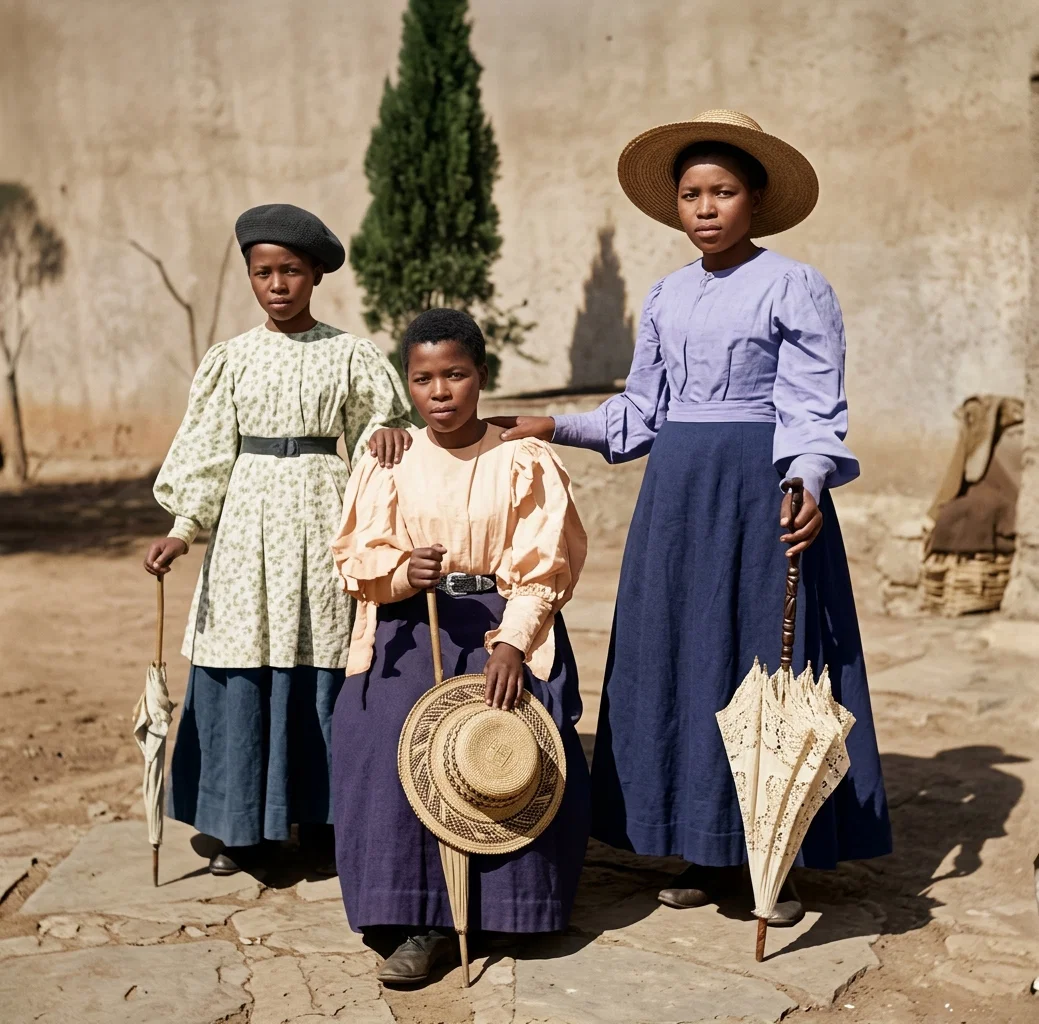
GIRLS OF THE HIGHER CLASS, BASUTOLAND
The dwelling-house has been substantially repaired inside and out, and the barn has been built in new on the weak side. About six hundred yards of good wall has been built, and seven hundred more is being erected. When this is finished, the place will be quite securely protected against all stock.
The old church is so poor that it is not worth repairing, so a new one is to be built, all of stone. Enough stone is cut to build a barn large enough to stall over thirty cows and calves. We have been very fortunate in securing thirty head of good dairy cattle, to support a boarding-school; but last winter was one of the worst the country has experienced. The dry weather set in about midsummer, and kept up until it was too late for the grass to grow. In consequence, hundreds of cattle died in Basutoland. The mission lost over twelve head of good dairy animals. This is a heavy loss, and we feel it keenly. Being new in the country, we did not know the uncertainty of crops; a lesson has been learned, and, though it was expensive, we shall try to make it worth the expense this year. It looks now as if this year would be just as dry as last; but we are prepared for it, as we have more than twenty-five tons of rough feed.
During the past year it has been necessary to enlarge the reservoir into which a spring from Kolo Mountain flows. The water-supply has not been strong enough to keep the garden fresh. The old reservoir held three hundred barrels of water; the new one holds approximately three thousand. This water-supply will enable us to grow enough green feed inside the mission wall to feed the cattle through the summer. It was a large task to undertake, as the reservoir had to be dug in solid stone.
We feel that these improvements will prove valuable in establishing the mission on a self-supporting basis.
Our cattle will support the school; and the school will raise up young men and women to carry the gospel of the soon-coming King to all Basutoland. It is not because we are engrossed in the affairs of this world that we are planning to place things on a self-supporting basis; our business is to preach the coming of Jesus; these other things we do to pay expenses. Our prospects for the school are good. During the past year, the number of students has increased from thirty to fifty-five.
The medical work has proved just as valuable as God's servant has told us it would. During the past year, over two hundred persons have come to the mission for treatment, and nearly all have been successfully treated. To God's name be all the glory. This work has done more to convince the natives that we are interested in their souls than all the rest that we have done. One old man, suffering from a bad cold, which had settled in the chest, said, when we offered to give assistance, “Will this white man help me with his hands?”
We gave the treatment, which greatly relieved the suffering. The old man said: “You must surely be a Christian; I have never seen this kind of thing before.”
Said another, after receiving help, “Well, we read in the Bible how that Christ did this kind of work, but we never saw it before.” This native was a member of the church.
Still another heathen said, “You are the kindest man that I have ever seen.” I replied, “It is not I; for I am doing only what God has told me.”
Christian people, in doing acts of kindness, do them not on their own account, but obey orders from their great Leader. Not to be kind is not only ill-treating our fellow men, but also openly disobeying God's direct command. Pray that we may always carry out the instruction of our great Leader in this respect.
Caste in India
By LOUISE M. SCHOLZ
LOUISE M. SCHOLZ
THE caste system is one of the greatest evils in India; and it is indeed a miracle to save a soul from among the heathen. It can not be done by our own strength; it cost Heaven the experience of Calvary to win souls.
We are in a great battle, the powers of light are fighting against the powers of darkness; but we know Satan would not trouble to fight if he saw nothing worth attacking. The people believe that our religion is a good one, but they argue that its acceptance results in the destruction of caste.
What is caste?—It is not merely birth, nor class, nor a code of rules, though it includes all these; it is a great system of evil. Miss Amy Wilson Carmichael, a missionary in South India, speaking of caste, says:—
“A boy twelve years old resolved to be a Christian; his clan, eight thousand strong, were enraged. There was a riot in the streets; in the house the poison-cup was ready—better death than loss of caste. Another boy took his stand, and his caste men got hold of him afterward. The next time he was seen, he was a raving lunatic; the caste was avenged. These things are not confined to one part of the field.”
“A poor low-caste woman and her husband learned the way of life in their home, and both thought of becoming Christians. The village soothsayer warned them that their father’s god would be angry, but they did not heed him. Suddenly their baby died. This was too much for their faith then, and both went back to their idolatry. A few years afterward their eldest child began to learn to read; and the mother’s faith revived. The soothsayer and her husband reminded her of the infant’s13fate, but she was brave, and let her child learn. Then her cow suddenly died. ‘Did we not tell you so?’ they said. For a moment she was staggered, but she recovered, and became more earnest in her faith. So the soothsayer threatened more.”
“A caste meeting was called to determine what could be done with this woman. The husband attended the meeting, and was treated to some rice and curry; before he reached home, he was taken violently ill, and in three days he died. The relatives denounced the woman as the cause of her husband’s dysentery and death, took her only son from her, and entreated her to return to her father’s gods before they should all be annihilated. They gave her two weeks to fast and to mourn for her husband. Then, finding her mind as firmly fixed on Christ as before, they sent her to Burma, which meant as much to her, who had never been away from her native village, as to be sent to a foreign country. Remember, the caste was ‘low;’ and you can judge, perhaps, what the hate would have been had the caste been ‘high.’”
Look at caste in the kitchen, and see how it rules there. The kitchen of every Indian household is a kind of sanctuary, or holy ground. The mere glance of a “holy ground” man of inferior caste makes the finest delicacies uneatable; and if such a glance happens to fall on the family supplies during cooking, when the ceremonial purity of the water used is a matter of almost life and death to every member of the household, the whole repast must be thrown away as if poisoned, and the family is for that day without dinner. According to their belief, food thus contaminated would, if eaten, communicate a taint to the souls as well as to the bodies of the eaters,—a taint which could be removed only by long and painful expiation. Sir Monier Williams, quoted as a great authority, says: “Think of the defilement which would be contracted if a member of the household who had broken caste took any part in the cooking; it would never be allowed. Such a woman could take no share in the family life. Her presence, her shadow, and above all, her touch, would be simply pollution. Therefore, and for many other reasons, her life at home is impossible.”
In commercial life if a merchant becomes a Christian, no one will patronize him; for it must be remembered that every occupation in life represents a particular caste. A man, either a blacksmith or a carpenter, wants to become a Christian; he loves his trade, and he can not attempt to learn other work. “Let the Christians employ him,” you might say. Some do; but this involves other questions far too complicated for discussion here.
I was once called to attend a baby who suffered from infection, a native barber having lanced an abscess. It was lying on dirty rags, with its wounds exposed to the dust, and moaning so piteously that it made my heart ache. I pleaded with the parents to let me take the child to our dispensary, so that I could give it the necessary treatment. I offered them a room, and a place for cooking by themselves, if they would come with the child; but no, he might die away from home, and that would disgrace their caste. It was not that they were heartless, but they would rather see their baby die in torture than destroy their caste.
A low-caste man, who had only a little child and his brother left of all his relatives, was brought to our dispensary on a bullock-cart. He had suffered from dysentery and dropsy for more than a year; and, as he had no one to care for him, I succeeded in keeping him in one of our rooms, where he died fourteen days afterward. Because he died in a Christian compound, we could not get men to bury him, even those of his own caste refusing. At last they offered to bury him for six rubles, or about two dollars. I could not give this amount; so we put him on our gharry, and took him two miles from our bungalow, to the river, where we buried him.
A child of twelve may be legally held competent to undertake the responsibility of wifehood, but six years more must pass before she may be legally held free to obey her conscience; she is never really free. A widow in India may be legally free; a wife, never!
Do you wonder why the work goes so slowly in India, compared with other countries? This is one glimpse of one phase of a power which is only a name at home—caste. It does strange things, hard things, things most cruel. All who fight it are agreed that it is the strongest foe to the gospel of Christ on the fields of India. Sometimes it seems to me that if only the people at home could understand things as they really are, more prayers for the outpouring of the Holy Spirit would ascend to God.
Calcutta, India.
China Union Training-School
By H. W. MILLER
(Concluded)
H. W. MILLER
It was a source of considerable gratification to us to listen, on the closing day of school, while these four men from the western part of Honan read the essays they had prepared on present truth, giving in their own tongue explanations of the sanctuary, the little horn, the three messages, and other doctrines we hold as present truth, which they had prepared during their short stay of twelve weeks. Previously these men knew no history, being unlearned in their own language, yet they grasp this message and love it.
We allowed six weeks’ vacation before the spring term began, and during this time the students were advised to sell our literature from village to village, and thus earn a scholarship for the spring term. They were anxious to improve this opportunity to get back into school. They had to go so far to reach their home village that they could not return for more literature when they had sold out; therefore we bought them a wheelbarrow for forty-five cents, and they loaded on it all their literature and bedding, and pushed the wheelbarrow themselves. When all was in readiness for leaving, they came into my study, and wept that they must be separated from those of like precious faith and experience, but expressed strong confidence that God would help them to dispose of their literature, and that they would return to the school. They left their mother with us, as the expense of her going home would be considerable. On rainy days, when they could not sell literature, they planned to carry brick or saw wood.
Within two weeks from the date of opening the school, we had all the students we could conveniently accommodate; and even after this many applied for entrance, most of whom we had to advise to wait until the spring term, when they could start their work at the beginning of the classes.
Brother Han, our leading evangelist in Anhwei, said, after attending school a few weeks: “Before I learned this truth, I thought I had about mastered the doctrines of the Bible. I received compliments from foreigners and Chinese alike; but after these few weeks of study here, I do not feel I dare to preach a sermon, lest I get some error into it.” This brother, whom we feel we can hardly spare from the field work in that section, is pleading at this time for the privilege of spending more time in school. Although he is about fifty years of age, he is a student, and has been used of God to bring many souls to this truth. While in attendance at the school, he and his wife held some Bible readings with his sister and her companion, both of whom were Bible women in another society. They took their stand for the Sabbath, and entered the training-school. They were both quite familiar with the phraseology of the New Testament; but now they freely confess they did not know the meaning of the Scriptures. They desire to stay in the school until we consider them prepared for service.
Our students have been missionaries, and have been doing active work for souls all through the school term. As a result of their missionary efforts, which were seconded by their teachers, six persons began the observance of the Sabbath. Four of these came from heathenism. Only one student, the son of one of our evangelists, made no profession of religion, but he gave his heart to the Lord before the close of the term. Four students were baptized, and taken into church fellowship. Seven others will, we think, be ready for baptism this spring. They are in harmony with us on all points of the truth; in their case baptism was delayed to give them further knowledge, and a little longer experience. Fourteen of the advanced students were baptized church-members when they entered the school.
Our Chinese brethren are hungering for more knowledge of this wonderful truth, and the prospects for the future of this school are very bright. We trust that we shall be able to meet this growing14demand in an acceptable manner. To do so we shall have to have more room and suitable buildings. The teaching has been done in the cold, brick-floored, unheated, thatch-roofed, mud-walled houses. The climate is as cold as Michigan winters. In these rooms the shivering teachers stand, teaching the half-frozen students from two to three hours each day. The pupils are wonderfully patient. Such accommodations, however, are not conducive to the best results. We should have land and a dormitory, and have some class-rooms built.
The houses may be after the Chinese style, but well lighted, and built so that they can be heated. The greater part of Honan lies in the Great Plain of China. Its soil is one of the most fertile to be found in the world. Many of our students come from farms, and they would do good service in farm work, and thus be enabled to earn their tuition and board.
Two prominent lines of instruction will be given in connection with the school at present, and as our teaching force and facilities increase, we hope more may be given later. The course of study provides, first of all, for strong Biblical training. A four years’ course is offered for evangelists and Bible workers.
A five years’ medical course is also offered. The medical course includes all the branches of the Biblical course, except two years in Chinese literature; in other words, those desiring to fit themselves to work as medical evangelists take, in addition to the Biblical course, six subjects, running an hour a day throughout the year, and for their four hours’ daily industrial work during the five years of the course, they work either in the laboratory or in the dispensary or hospital. This arrangement cuts down the number of classes, gives the medical students the same Biblical training as the evangelists need, and their theoretical medical instruction is quite sufficient for China.
Our hope of carrying the message to China is centered in our Chinese brethren. We must develop them. Every one of talent, and giving promise of becoming a laborer, must be urged into the work of soul-saving. Schools must meet the great demand for their training.
Now that we have in China a rapidly increasing constituency of church-members, and a publishing plant issuing periodicals and tracts in the Chinese, we must exert ourselves to train an efficient native ministry, to be leaders of companies, which must be urged forward into unentered territory. These people give promise of being just as enthusiastic in carrying this message to the outskirts of this mighty empire as we are. We desire the prayers and support of our brethren at home, in the establishment of this central training-school for the many millions of needy China.
Cheo Chia K’o, Honan, China.
South Caribbean Conference
By H. C. J. Walleker
The annual session of the South Caribbean Conference was held at Port of Spain, Trinidad, March 10-16. The meetings were well attended by our brethren from the different churches in the island of Trinidad, some coming also from Tobago and the Grenadines. The business of the conference and the election of officers passed off very harmoniously. The reports from the different laborers were listened to with great interest, as it was shown that the work is making advancement. The evening services were well attended by the citizens, a number took their stand for the truth, and some backsliders were reclaimed. We had several revival meetings, and a number came forward to seek the Lord. We feel sure that many gained victories, and returned home determined to be more faithful in their every-day life.
Elder J. B. Beckner was again elected president of the conference, with Elder C. E. Widgery as vice-president, Brother George Hingston as secretary and treasurer, and Brother P. C. Carrington as secretary of the Sabbath-school and Missionary Volunteer work.
The financial report was encouraging, showing that some ground had been gained. The aim of the brethren is to make the work self-supporting as soon as possible. Altogether, this was among the best meetings I have attended since coming to the West Indies.
Elder Beckner and I had to leave on the fourteenth, in order to reach Demerara in time for the annual meeting there, but Elder Widgery continued the meetings in the Port of Spain church until Wednesday evening.
In British Guiana the general meeting was held March 24-26. Meetings were held both at Georgetown and at New Amsterdam. A number of the brethren and sisters came in from the different churches and companies, and there was an earnest desire on the part of all to know more of God and his revealed will. The Lord blessed greatly in these meetings. The work in British Guiana is in a better condition than it has been for some time, and we hope it may continue to prosper.
Leaving British Guiana, March 31, by the Canadian steamer “Soho,” I reached Antigua, April 10; and our general meeting there was held from the twelfth to the sixteenth. It had been planned that Elder W. J. Tanner, of Haiti, should attend this meeting; but on account of the poor health of his wife, he was not able to come. This left us without any outside help, but the Master was with us by his presence.
One very sad thing occurred during the meeting, which threw a cloud over all, and that was the death of the wife of Elder J. H. Matthews. When we arrived, we found her sick; and while everything was done for her, she grew worse, and finally died April 16, leaving four little children. Our prayer is that God will sustain his servant in this hour of trial.
I reached home, April 24, after two months' absence. Truly, the Lord has been good to me amid the dangers of travel and disease. All praise is due to his name. H. C. J. WALLEKER.
Postgraduate Course for Nurses at the Washington (D. C.) Sanitarium
By R. S. Ingersoll
All who realize the times in which we are living appreciate the need of preparing workers to carry this message to earth’s remotest bounds as speedily as possible. Millions in heathen darkness must be reached. The heathen mind is quite satisfied with its condition; the people are content to live and dies as did their ancestors. They say, “What was good enough for my father and grandfather is good enough for me.” Extraordinary means are required to reach these people. The medical missionary has in these heathen lands more than ordinary power for breaking down the barrier which centuries of heathenism have reared. The internal life is touched effectually by attention to one’s physical needs; and the latch-string of the soul’s door being pulled, the way is open for the gospel to enter.
The medical missionary requires a dual education. He must develop ability to deal with the physical as well as the spiritual condition of individuals. Having in mind the greater efficiency of this balance between the medical and evangelistic sides of the medical missionary, the Foreign Mission Seminary and the Washington (D. C.) Sanitarium have seriously considered the necessity of a more complete education for the students in both institutions, and have concluded to combine their educational interests.
Realizing the need of training nurses who have a superior qualification and fitness for responsible positions, the medical men and women in attendance at the General Conference in 1909 advocated that certain of our sanitariums conduct a fourth year in the regular nurses’ course. This was intended to qualify nurses for various positions of responsibility. This work was to be given in some of our institutions which, on account of location or other advantages, could effectually conduct such a course.
Having spent eight years in one of the most needy mission fields in the world, I have learned to appreciate very much a school which will give to nurses the ability, without requiring of them the legal qualifications, of the physician. The first is the necessary requisite; the latter is the expensive qualification needed by a certain number, but not necessary for the large majority of missionaries15in such countries as India, China, Africa, and South America.
What is wanted in these lands of darkness is many little lights scattered all about, so that all can come closely enough in contact with them to realize what they are. The people need not simply to see a great light, but to come close, and learn what makes the light. The personal touch that healed the woman in the crowd is needed now. The Saviour’s representatives must be touched, and must touch, in order to be effective.
The education of these many light-bearers is going on all over our land. However, a special final preparation is necessary, and this is what the Foreign Mission Seminary aims to give. The Washington (D. C.) Sanitarium is so situated that it can cooperate with the Seminary in this work. This is what it is seeking to do in arranging for a practical postgraduate medical missionary course. This course is to give the student such advanced work in different branches as may be needed. It does not limit itself to the worker who is going to the mission field, but aims to prepare missionaries for work in our large cities as well as for positions of responsibility in our various institutions.
In order to make room for, and give experience to, those who come for this course, we are not taking any more undergraduates, and are concentrating our educational efforts upon the postgraduate course. The study of the Bible will receive special attention, the students having daily recitations therein.
Missionary plans and methods and the study of special mission fields will be taught by men who have been on the ground, and have had practical experience. This can not but awaken and deepen an interest. The man who has been in the field, and who is willing to say, “Come,” inspires more confidence than he who merely says, “Go.”
In strictly medical ways, due attention will be given to subjects which will help the worker in the field. A knowledge of applied anatomy, minor surgery, and anesthetics will enable the worker to care for the majority of surgical conditions which come to a mission dispensary in the form of boils, abscesses, wounds, bruises, etc. Physical diagnosis will enable the student to examine the patient, and determine what is the trouble with the lungs and other internal organs.
The poor, helpless natives of India, for example, look to the missionary for help physically, and are disappointed if they do not receive it. Their idea is that the power to heal and destroy is with the gods; and why should not the one telling them of the great new God be able to heal them?
The missionary who has the interests of the people at heart will seek a medical book ere he has been in his station long, and strive to learn something that will enable him to relieve the many who come. A study of skin diseases, tropical hygiene, tropical diseases, diseases of the eye, ear, nose, and throat, obstetrics and gynecology, special diseases, and accidents and emergencies will give the foreign missionary an efficient and practical preparation for his work. These subjects will receive due attention in this course.
Besides these, there will be advanced work in electricity and hydrotherapy, Swedish and medical gymnastics, the chemistry and microscopy of foods and excretions, dietetics, principles of hygienic dress, and mental diseases, all of which will be of value to the missionary, as well as to those who are to hold responsible positions in our various institutions or to work in the cities of our own country.
It is a part of our plan to have a dispensary in the city of Washington, where the students can gain an experience in dealing with conditions such as they will meet in their future fields of labor. The students will spend a part of their time in this dispensary work, helping the poor and needy in any way they can.
This cooperative plan comprehends the idea of shifting our nurses from their present home to the Foreign Mission Seminary dormitories, thus releasing the building at present occupied by them for use as a hospital. This will be a great blessing, not only to the students, but also to many of our people who can not afford the rates we are obliged to charge for care in the Sanitarium. A rate of one dollar a day will be given in the wards of this hospital. Prices in private rooms will range from $9 to $15 a week, depending upon the room chosen, and whether one person occupies the same, or whether it has two occupants. We hope to have the hospital in readiness in the course of four or five weeks.
Those who consider entering this course should write to the president of the Foreign Mission Seminary for application blanks. The writer solicits correspondence with any who may desire to avail themselves of the advantages of the Sanitarium or the Sanitarium Hospital. Be on the outlook, and send us a postal card with the address of some one in your vicinity who needs treatment. Tell us a word about their condition and circumstances. We shall be glad to send literature to such as might become Sanitarium patients.
We solicit your interest and cooperation with us in this great work. These, united with prayer and diligence on our part, will bring success.
R. S. INGERSOLL, M. D.,
Medical Superintendent.
Another Mass-Meeting
By K. C. R.
FRIDAY, May 26, the Johnston Sunday bill came up in the Senate for consideration, and was vigorously opposed in a speech by Senator Heyburn, of Idaho. After devoting about forty-five minutes to its consideration, it was decided to let the bill go over until the following Monday, when it would again be taken up.
Believing that the postponement of the measure for several days was in the providence of God, in order that we might further protest against the bill, we proceeded to call a mass-meeting for Sunday, May 28. Accordingly, we secured the use of the Pythian Temple for that evening, and began to advertise the meeting as best we could in the limited time at our disposal. We also prepared a formal protest, and had it printed for use at the meeting, besides preparing reports for the use of the public press of the city.
Owing to the limited time we had to advertise the meeting, we feared as to the results in securing an audience, but were gratified to see a good attendance. Excellent music for the occasion was furnished by the Seventh-day Adventist orchestra of Takoma Park.
After a short introductory address by the writer, Prof. W. W. Prescott delivered a convincing and enthusiastic address, in which he made use of fresh, up-to-date matter and arguments.
He examined the provisions of the bill, and the report of the District Senate Committee on the same, emphasizing the religious character of the proposed legislation. He also made reference in a complimentary way to the arguments presented by Senator Heyburn in the Senate in opposition to the bill.
Elder W. A. Hennig presented the formal protest, and moved its adoption. The motion was seconded by Elder W. A. Colcord, who presented in writing his reasons for seconding the resolution. After a few remarks by one in the audience, the protest was unanimously adopted by a rising vote.
All the daily papers gave good reports of the meeting, and we believe that the protest against the bill, as the result of this meeting, will be brought again to the attention of many thousands of people both within and without the District of Columbia.
The bill was not discussed Monday, the 29th; for when it was called up on the calendar, Senator Heyburn asked that it might go over. At this writing it has not been acted upon.
We can not say what the outcome of the measure will be. Let none cease from sending in their protests against the bill, by both letters and resolutions, until Congress has acted upon the measure.
The following is the protest that was made and adopted at the mass-meeting:—
“We, citizens of the District of Columbia, in mass-meeting assembled, desire16to place ourselves on record as being opposed to the passage of the Johnston Sunday bill (S. 237) now before the Senate, and for this opposition we give the following reasons:—
“1. While believing in and professing the Christian religion, we are not in favor of any attempt to enforce this religion upon others. The compulsory performance of religious exercises is contrary to the very genius of Christianity. We recognize the principle so clearly stated by the Author of our religion, ‘Render to Cæsar the things that are Cæsar’s, and to God the things that are God’s,’ and therefore protest against any interference in religious affairs on the part of the state.
“2. The principle of complete religious freedom was plainly interpreted by the Author of Christianity himself, who inculcated loyalty to civil government in its proper sphere, but refused to countenance compulsion of any kind in matters of religion. He declared, ‘If any man hear my words, and believe not, I judge him not;’ and to the suggestion of two of his disciples that fire should be brought down from heaven to consume those who would not receive him, he replied, ‘Ye know not what manner of spirit ye are of.’
“3. The founders of this government recognized the value of these divine principles in the fundamental law of the land by prohibiting Congress from making any law establishing religion or prohibiting the free exercise thereof. This provision against any compulsion in matters of religion was inspired by the highest regard for the welfare both of the church and of the state, as is witnessed by the words of Bancroft: ‘Vindicating the right of individuality even in religion, and in religion above all, the new nation dared to set the example of accepting in its relations to God the principle first divinely ordained in Judea. It left the management of temporal things to the temporal power; but the American Constitution, in harmony with the people of the several States, withheld from the federal government the power to invade the home of reason, the citadel of conscience, the sanctuary of the soul; and not from indifference, but that the infinite Spirit of eternal truth might move in its freedom, and purity, and power.’—History of the United States, Vol. VI, page 444, edition of 1888. After a full consideration of the principles involved, Congress in 1829-30 refused to enact legislation of a religious character, and has consistently maintained this position by refraining from the enactment of any compulsory legislation relating to Sunday observance until the present time. A departure from this principle would be injurious both to the Christian religion and to good government.
“4. This bill violates the principles already set forth, in that it is an attempt to unite the things that are Cæsar’s and the things that are God’s, by using the civil power to compel the proper observance of a religious institution. That the passing of this bill would be religious legislation, is evident from these plain considerations:—
“(a) It distinguishes Sunday from other days of the week by requiring altogether different conduct from citizens on that day than is required on other days, making honorable employment and legitimate business a crime on Sunday, punishable by fine and imprisonment. It must be evident that this is done on purely religious grounds.
“(b) By its proposal to exempt from its provisions ‘persons who are members of a religious society who observe as a sabbath any other day in the week than Sunday.’
“(c) By prohibiting ‘any circus, show, or theatrical performance’ on Sunday, but expressly permitting ‘sacred concerts’ as being appropriate to the supposedly sacred character of the day.
“(d) The author of this bill clearly indicated its religious character in a public address in this city when he deplored the fact that the fourth commandment had been repealed in the District of Columbia, and pledged himself to the effort to secure a Sunday law which would remedy this defect. Furthermore, in his report (No. 33) to the Senate accompanying the bill, he justifies the ‘attempt to enact into law the injunction of the fourth commandment’ by appealing to the belief that ‘an all-wise God and loving Father was the author of that commandment.’ And in arguing further for the passage of this measure, he uses in the report such strictly religious expressions as ‘reverence for the ten commandments,’ ‘sense of obligation or duty to carry out the divine law,’ and ‘faith in the existence of a Supreme Being.’
“5. The language employed in the Sunday Mail Report, communicated to the House of Representatives, March 4 and 5, 1830, in opposition to Sunday legislation then proposed, seems equally applicable to this bill: ‘If Congress shall, by the authority of law, sanction the measure recommended, it would constitute a legislative decision of a religious controversy, in which even Christians themselves are at issue. However suited such a decision may be to an ecclesiastical council, it is incompatible with a republican legislature, which is purely for political, and not for religious purposes.’
“6. The consistent record of Congress in maintaining for more than a century the principles enunciated by the founders of this government, and in refusing to pass any religious legislation contravening them, has served as an example to other nations, and has exerted a world-wide influence in favor of religious freedom. Any departure from this record, which would drag down into the arena of politics purely religious questions, is greatly to be deplored as a denial of that principle of religious liberty which has been both the boast and the glory of this nation, a step toward intolerance, and such an example of the disregard of the rights of conscience as would encourage all other nations to return to their old-time program of religious intolerance and oppression.
“For these and other reasons we protest against the passage of this bill (S. 237) or any similar legislation.”
K. C. R.
Basutoland, Africa
By Z. P. Mareane
ABOUT a fortnight ago some of our brethren, when returning from the Emmanuel Mission, came to a certain village where they spent a full day discussing the Sabbath question with the inhabitants. They seemed much pleased to hear that there is a church on earth that believes and teaches nothing but the inspired Word of God. “We perish!” they said to our brethren. “Come to help us. We will listen to the voice of the Great Shepherd, and obey his commandments.”
Pastor M. E. Emmerson has gone to see them, and I believe he will spend the Sabbath with them. I wonder how many thirsty souls there are who have not yet heard of the remnant church and its doctrine? We hope the pastor will bring us good news.
Z. P. MAREANE,
Native school-teacher at Kolo Mission.
Five Baptized at Tangier
At Tangier, Okla., five persons were recently baptized and taken into the church.
Christian Liberty
By K. C. Russell; S. B. Horton
Reports, Notes, and Comments Pertaining to the Current History of the Rights of Conscience