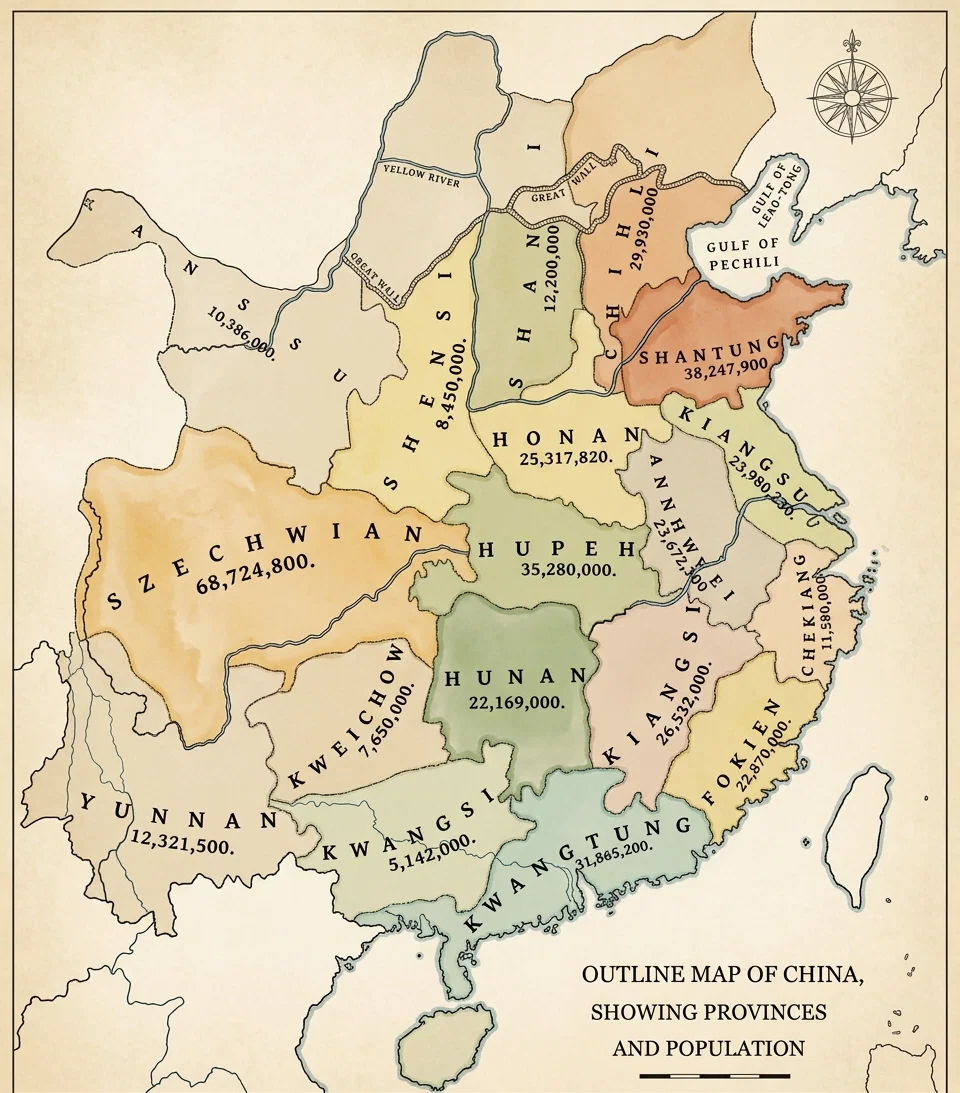
CHINA’S future and its commercial interests are rapidly commanding unusual international attention. With numerous concessions already granted to foreign powers, and with treaties favoring commerce with foreign nations, China, with her immense population and lack of modern facilities, presents to the leading nations of the world opportunities for trade expansion, the like of which is not known elsewhere.
With a population approximating four hundred thirty-five million; with almost every natural resource, such as coal, iron, lead, copper, and the precious metals; with a soil so fertile and so carefully husbanded that it has raised successive crops of wheat or rice or other cereals for perhaps two thousand years; with a civilization antique and negative to all that the last three centuries have brought to the Western nations of the world; with remarkable exaltation of the family, where filial duties are discharged with almost religious devotion, and where the home and the family burial-grounds are never lost sight of during the ages; where poverty and enforced economy have developed a people so discreet in finance that no people or nation in the world can compare with them in eking out a subsistence at a minimum of cost; where not a few of the people, notwithstanding all their poverty and lack of opportunities in life, have such a respect for learning that it is probably not excelled by any people in the world,—with all these and far more, China presents opportunities for exploitation in the fields of manufacturing, commerce, and material progress perhaps superior to any nation on earth.
Through international treaties, oftentimes enforced by compulsion, missionary endeavor is tolerated in every province in China. Since the first pioneer missionary, almost single-handed and unaided, undertook to do missionary work for the Chinese people, more and more have the barriers against Christianity been removed, until to-day both the life and the property of the missionary are generally protected.
Politically the Chinese empire is divided into eighteen provinces and four dependencies. The dependencies are Manchuria, Mongolia, Chinese Turkestan and Tibet. In what is known as China proper there are said to be one million five hundred thirty-two thousand square miles of territory, with a population of more than four hundred ten million. The four dependencies increase the territorial area to 4,277,542 square miles, while its population is increased to over four hundred thirty-five million. From every standpoint by which a nation can be measured, in population, in territorial extent, in natural resources, in the ability of the people who inhabit the country, in the long continuance of its government, China is one of the greatest nations that has ever existed.
OUTLINE MAP OF CHINA,
SHOWING PROVINCES
AND POPULATION
With the exception of what was done by Brother A. La Rue in the distribution of literature, no work had ever been done in China by Seventh-day Adventists until the year 1902, when Brother J. N. Anderson and wife and Miss Ida Thompson were sent by the Mission Board to take up work in that country. From this small beginning, new workers have been sent to the field from time to time, until to-day we have eighteen foreign families and single workers who have spent more or less time in China, though at present five of these are on a furlough in the home land.
At the late General Conference, steps were taken to greatly accelerate the prosecution of our work in China. Up to the present, the workers have had very limited facilities. The most meager printing plant conceivable has been set up, and is now being utilized to its fullest capacity in printing the third angel’s message in the native languages of China. This printing plant, however, is entirely inadequate for the needs of the work, and is such as would not be used in the home land for a single week. Think of printing the third angel’s message for four hundred thirty-five million people with a little pony press that is turned by hand, located in a private Chinese house, where, when the machinery is operated, the whole building trembles and shakes so that it is almost impossible to do good work.
A girls’ school at Canton has been started, and the last year it has had an attendance of about one hundred. Some of the students are boarded and kept in the home. This seems to be the most satisfactory way of helping these people to receive the true idea of home life, and to carry out the principles of the Christian religion.
Only five of the eighteen provinces have workers located in them, and these are wrestling against great odds, with so many interests on their hands that it is almost impossible for them to give the work the needed attention. At the late session of the General Conference, the delegates from China came with a most earnest petition to the General Conference that forty-two additional families should be sent to that kingdom during the coming two years. This was with the understanding that two workers should be placed in each province, so that we could have at least as many as two families of foreigners in each one of the eighteen provinces in China proper. It was also requested that the General7Conference place men in Manchuria, Chinese Turkestan, Mongolia, and Tibet. This seemed like a very large undertaking, but the delegates no sooner heard the needs of this great field than they promptly voted to grant the request of the Chinese workers, and authorized the General Conference Committee, as soon as suitable workers could be found who would take up this work, to place them in the field.
It may seem to some as if this was supplying China with altogether too many workers, but when the additional forty-two families have all been located in China, and should our present number of workers continue, still there would be a population in China of seven million people for each worker. Think of one worker to warn a community, largely rural, of more than seven million. Let us contrast this condition with what we find here in the United States. According to the census of 1900, the last one taken by the United States government, seven million people would take every soul in the States and territories of California, Washington, Oregon, Arizona, Utah, Colorado, Idaho, Wyoming, New Mexico, Oklahoma, Nebraska, Nevada, Montana, New Hampshire, Maine, Delaware, and Alaska. What would we think of asking one man to preach the third angel’s message to all of these States, to give the inhabitants the warning of the third angel’s message, and to get a people ready for the soon coming of Christ? This could be as readily done, as far as numbers are concerned, as can our present force of workers, with the forty-two additional families to be sent to China, give the Chinese people the third angel’s message. It would seem like a Herculean task for one man to undertake to warn all the people in the above States, and yet this is what will have to be done in China through the help and blessing of God.
Suppose that we take these people in the States named above and exclude from them all knowledge of the true God, all knowledge of the Christian religion of any nature whatsoever. Let us place them among heathen temples and shrines that have been built for ages, perhaps where their ancestors have worshiped for many generations. Let the people be steeped in the deepest superstitions concerning religion; let the great mass of them be without education, by far the larger per cent unable to read or to know their names when they see them in print; with scarcely a single convert or sympathizer in the whole country; and you can imagine what it means when we place the responsibility of giving the third angel’s message to the Chinese people upon the little band of workers in China.
We certainly do not have too many workers in the United States of America, and yet there are single provinces in China, with an enormous population, that have never seen or heard of a Seventh-day Adventist. The province to the far west known as Szechuen has an estimated population of sixty-seven millions, and yet never has a single worker entered that province. The province of Shan-tung is the most densely populated country in the world, having more than six hundred eighty people to the square mile for the entire province, and a population equal to half of that of the United States of America, and yet not a single worker has ever been placed in that province. In one of our divisions of China, known as the Central Mission Field, including the provinces of Honan, Hupeh, Hunan, and Kwang-si, there is a population of over one hundred nineteen million souls.
When we think of the dearth of workers in this great country of China, is it not time to distribute some of our forces in foreign fields? Will we weaken our work at home if we send to these distant lands some of our strongest and best men, that the work can be placed upon a proper footing? Is it not high time that a valiant army of consecrated, God-fearing young men and women was going to the Orient to give their lives to the advancement of the third angel’s message? We appeal to our people everywhere when they close their eyes at night, seriously to call to mind that there are over four hundred millions of poor Chinamen in the very depths of heathen darkness and superstitious idolatry,—individuals for whom Christ died, who have no knowledge of God or of a Christian Bible, or of the means of salvation. They live and die, hopeless and helpless, as far as they are concerned, and are dependent upon those who have the truth and the light, to send them the news of salvation through Jesus Christ.
One would think that the Christian’s heart, when he ponders such a proposition, must burn with zeal and enthusiasm to impart to these benighted souls the light which God has given to us concerning salvation. Every week we should give an offering to the Lord for these poor darkened souls. The small sum of ten cents a week could do much toward helping to sustain missionaries in foreign fields, and there are those who could even give hundreds, or thousands, of dollars and still have everything they need to make life comfortable, and to supply every necessity.
The General Conference has most earnestly looked for men and women to send to China, but up to the present time we find ourselves almost powerless to send even so many as half a dozen recruits to that great kingdom. We raise the question, “Who will go?” The Harvest Ingathering during the month of November will be a rare opportunity for us to interest our neighbors and friends in the gigantic work that we are undertaking, and to enlist their sympathy and financial help. Certainly something must be done to accelerate the giving of the message in these great darkened heathen lands. Let us all continually pray that God will raise up workers to go to that field under the anointing of the Holy Spirit, and that he will supply the means by which they may be supported.
I. H. EVANS.
The Demands of this Hour
By F. M. W.
THIS is the hour of responsibility. There is a world to be warned. To every nation, and kindred, and tongue, and people this message is to go, and upon us rests the burden of promulgating it. A solemn and terrible responsibility truly! It is also the hour of great privilege and glorious opportunity. Every soul may have a part in the work. Every energy may be enlisted, and every talent find fullest exercise. This is no time for bickering and faultfinding, for carping criticism and evil-speaking. Murmurers and faultfinders are never found among the advance guard in any enterprise. In this movement they have lost the spirit of the message, and need to have the work of grace renewed in their hearts. God now calls for every man to stand in his proper place. He calls for every man to do his best, faithfully, loyally, and devotedly.
The true-hearted will rise to meet the increasing demands upon their loyalty. They will toil and sacrifice for a cause which to them is dearer than life. They will not swerve nor fall back. They have counted the cost, and have decided to cast in their lot with this message and this people, and to witness the glorious finishing of this work. Upon these true and tried ones God will pour out his Spirit in the time of visitation. They will not have long to wait to see God's mighty workings. Already they witness that for which they have toiled, and hoped, and prayed,—the message going by leaps and bounds. Soon will they behold the grand consummation, and join in the shout of final victory. And when that time comes, they will realize, as they can not now fully understand, that it has paid to serve God, and to stand stiffly for his truth. They will realize that their labors and sacrifices and struggles have not been in vain, but that through God's grace they have been permitted to have a humble part in one of the greatest and grandest movements which this world ever saw; and that through their allegiance to the principles constituting this message, they have shared in its experiences here, and may joy and rejoice in its triumphs throughout eternity.
F. M. W.
My Prayer
By Pearl Hefty
PEARL HEFTY
BLESSED Saviour, hear my pleading!
Broken-hearted, now I cry;
Be my helper, strong exceeding,
Ever watchful, ever nigh.
Jesus, help me bear my crosses
Meekly, as thou didst bear thine;
Help me not to feel earth's losses,
Since thy loving heart is mine.
When the path seems dark and lonely,
And the way I can not see,
May I, looking to thee only,
Jesus, safely walk with thee.
Anlauf, Ore.
Words of Instruction to Workers
By Ellen G. White
MRS. E. G. WHITE
Representations have been made to me that show how greatly our physicians and ministers and teachers need a development of Christian character, that they may properly represent the love of God to a fallen world. They are to speak the word of God from hearts melted in tenderness. In the use of large assemblies there are those who will be reached by words that tell of God’s pardoning mercy and his matchless love; and these, in turn, will be the means of enlightening others in regard to the love of God. The Lord rejoices over the one repenting soul; he alone can measure the influence for good that one soul can be in drawing others to the foot of the cross. If the workers’ labors are prompted by devotion to God and a desire to see souls saved in his kingdom, the Lord will impress them with words to speak that will represent his grace and love; and through the aid of the Holy Spirit souls will be convicted and converted. Their words will inspire faith and hope in the heart, and large numbers will be blessed with the light of truth, and be led to rejoice in the mercy and love of God.
Christ consented to suffer much in order to save souls. Should we not manifest patience and gentleness and long-suffering in dealing with the perishing? The words were spoken, “Love as brethren, be pitiful, be courteous: not rendering evil for evil, or railing for railing: but contrariwise blessing; knowing that ye are thereunto called, that ye should inherit a blessing.”
We must expect to meet all classes of minds. And when we are falsely spoken of, let us remember that the Prince of life passed through the same experience. Let ministers, physicians, and teachers take a straightforward course, “having your conversation honest among the Gentiles: that, whereas they speak against you as evil-doers, they may by your good works, which they shall behold, glorify God in the day of visitation.”
And we are to be faithful in reproving wrong-doing. This God requires of every one of his laborers. Pure and unadulterated trust will always meet the elements of unsanctified profession. There will always be those who claim to be doing God service, but who are serving him not. Those who are blinded by erroneous opinions are to be treated with gentleness, yet labored for faithfully that their minds may be undeceived. Saving truth must be repeated over and over again. If these deceived souls can be convinced of their errors and converted, what rejoicing there will be in the heavenly courts!
Those who minister the word of God to the people are to remember that they are dealing with souls for whom Christ has died, and that they must meet the record of any unfaithfulness in the judgment. It is not merciful or just to allow a course of deception to be practised upon human minds. Satan will surely use erroneous theories to deceive and confuse minds, and we can not pass by these errors and be guiltless before God. Patiently, and in a spirit of meekness and gentleness, yet with a firmness that can not be misinterpreted, we are to reprove wrong, and to teach professed believers to adorn the doctrine of Christ our Saviour.
The work of the Lord is to be carried forward intelligently. Clear, well-defined plans must be laid for the extension of the message. Workers are needed who will reveal the spirit and mind of Christ, men who are consecrated to God, body, soul, and spirit, and who will carry out his will in meekness and humility, respecting the counsels given by his Spirit. Let every man stand in his lot and place, looking to Christ as his guide and counselor, and yoking up with his brethren in service for the Master. Christ will instruct those who manifest a teachable spirit.
We are engaged in an important and an essential work, and we must carry on an aggressive warfare. We are to stand for true Protestant principles: for the policies of the papacy will edge their way into every possible place to proscribe liberty of conscience. Every eye should now be single to the glory of God.
Those who have been seeking to undermine the confidence of our people in the testimonies of the Spirit of God, and in the leadings of Providence in our work, will one day be revealed as having acted a part similar to that of Judas. Judas was tempted and tried, but not rising above these temptations, he lost ground, and finally went so far as to betray his Lord. Christ permitted Judas to go with the other disciples on their evangelistic tours, but on these occasions, Judas often manifested a spirit of superiority. He sought to exercise authority over his brethren. This spirit, unchecked, opened the way for the enemy to work upon his heart and mind, until at length he went so far as to betray his Saviour with a treacherous kiss. There are to-day, among the professed people of God, some who are walking in the same path; and unless they are converted, they will one day be numbered with the open enemies of God’s work for this time.
My brethren, withhold not the testing truths that should come to every soul at this time, and which must be practised by those who would find acceptance with God. We are to let the word of God come to every appointed agency, for there is a crisis before the people of God. Labor that souls may receive that word of truth that refines and sanctifies the soul, finding delight in the truth because Christ is identified with truth.
Study the Master’s methods of labor and teaching. All his illustrations were so simple that even the lowliest could understand the truths they symbolized. It is said of his instruction, “The common people heard him gladly.” So to-day he would have ministers and teachers use words that all, even the most ignorant, can understand. The Lord rejoices when simplicity marks the words and works of his ministers. Let his followers copy his example, and thus magnify his name.
The end of all things is at hand, and there is much important work to be done. The work at our camp-meetings should be conducted, not according to man’s devising, but after the manner of Christ’s working. The church-members should be drawn out to labor. The light is to be taken from under the bushel, that it may reach to the many who need it. God calls upon believers to obtain an experience in missionary work by branching out into new territory and working intelligently for the people in the byways. To those who will do this, openings for labor will come. Angels of God will direct in the opening of fields nigh and afar off, that the work of warning the world may be accomplished.
To every church the instruction is given to gather in the ignorant and those who need help. Our brethren and sisters need to go forth as the first disciples went, to the byways and the highways, teaching the message of truth. They need to become laborers in the Lord’s vineyard. God’s servants must not be idlers, but must work diligently to win souls. One soul saved is of more consequence than all the riches of the world. Let our church-members ask themselves the question, Do I improve my opportunities? What fruit am I bearing to the glory of God?
Why did the Saviour choose as his missionary field places which others did not discern as being of special advantage? Why did he labor to sow the9seed in out-of-the-way places? Why did he travel slowly away from the villages where he had been communicating light and opening the Scriptures? There was a world to hear, and some souls would accept the truth who had not yet heard it.
My fellow workers, there is missionary work to be done in many unpromising places. The missionary spirit needs to take hold of our souls, inspiring us to reach classes for whom we had not planned to labor, and in ways and places that we had no idea of working. The Lord has his plan for the sowing of the gospel seed. In sowing according to his will we shall so multiply the seed sown that his word will reach thousands who have never heard the truth.
Opportunities are opening on every side; press into every providential opening. Eyes need to be anointed with the heavenly eye-salve to see and sense these opportunities. God calls now for wide-awake missionaries.
We need more of the love of Christ expressed in our lives for the souls perishing all around us. Christ looks upon these souls, not as they are in themselves, but as they may be if they will surrender themselves to him in sincerity, as did the thief on the cross. In the hour of his greatest suffering, Christ responded to the prayer of the penitent thief with the words, “Verily I say unto thee to-day. Thou shalt be with me in paradise.” The Son of God gave his life that he might uplift and ennoble all who would repent of their sins, accept his mercy, and trust in his power to save.
The Saviour in his labors had to deal with all classes of men, and all characters, and his life was the daily lesson book of those with whom he came in contact. Let us bear this in mind. The Lord is testing us individually; our motives are being held under close examination. As the truths of the Word are taught, let the evangelist and the physician remember that they have a part to act in bringing about the fulfilment of that word. If they will work in faith and humble dependence upon God, many will be led to accept the evidence of the word and to obey a “Thus saith the Lord.”
Robbing God
By G. B. THOMPSON
G. B. THOMPSON
The question is asked, “Will a man rob God?” Mal. 3:8. Hardly, one would think. Well might one shudder at the thought of a sin of such awful turpitude.
But the inspired seer continues, “Yet ye have robbed me.” Then some are guilty at the bar of God of this great sin. In the presence of such an indictment by the Holy Spirit each will do well to inquire, like the disciples of old, “Lord, is it I?”
But, you say, I do not rob God, for I pay him an honest tithe. Very well, but we may do all this and still rob God. Withholding our tithe is not the only way by which we can rob the Lord. The Great Benefactor says some have robbed him in tithes and offerings. We may pay a faithful tithe, and yet withhold offerings and in this way be guilty of the sin charged.
Are any doing this, you say? Well, in view of the shortness of time, and the vast import of the message with which we are entrusted, were all as liberal as they should be, we would certainly be able to raise a sum equal to ten cents a week a member. Do you not think so?
Reader, please look over your stuff, look over your farm, your store, your business, your bank account, and see if you have put all in the cause you should, or have withheld, and thus robbed the Lord. Look at this now, as you will when face to face with the record in the judgment.
Takoma Park, D. C.
Spiritual Gifts Designed for the Church in All Ages
By George I. Butler
GEORGE I. BUTLER
Our last article brought us to the remnant church, the last division of the true church of the gospel dispensation. The inspired description of it is found in these words: “Which keep the commandments of God, and have the testimony of Jesus Christ.” Rev. 12:17. “The testimony of Jesus is the spirit of prophecy.” Rev. 19:10. This church must be the one brought to view in the third angel’s message: “Here are they that keep the commandments of God, and the faith of Jesus.” Rev. 14:12.
We are logically compelled to conclude that the true spiritual gifts with which Christ endowed his church will be manifested in the last true church on earth. Before discussing the question as to whether they have been actually so manifested in connection with the proclamation of the messages of the three angels, let us consider briefly the question of the perpetuity of the spiritual gifts which Christ placed in his church. The general opinion of the Protestant churches is that those gifts were designed for the apostolic church and were particularly confined to that period. Do the Scriptures teach the truthfulness of that view? Let us examine their testimony.
On the very night of the Saviour’s arrest, in his last discourse previous to his crucifixion, he spoke these words: “If ye love me, keep my commandments. And I will pray the Father, and he shall give you another Comforter [Greek, Paraclete], that he may abide with you forever; even the Spirit of truth; whom the world can not receive, because it seeth him not, neither knoweth him; but ye know him; for he dwelleth with you, and shall be in you.” John 14:15-17.
Here is the direct promise of the Holy Spirit to be with his disciples in a measure and sense that it had never been with his believing people before. Behold the wonderful pentecost, when this promise began to be fulfilled in that special sense. “And suddenly there came a sound from heaven as of a rushing, mighty wind, and it filled all the house where they were sitting. . . . And they were all filled with the Holy Ghost, and began to speak with other tongues, as the Spirit gave them utterance.” Acts 2:2-4.
These one hundred twenty disciples gathered in that room, after ten days of humiliation of soul and confession of sin, were in a fit condition of mind and heart to receive this outpouring of “the former rain” of the Holy Spirit. In all of the four thousand years of previous history from creation till that point had there ever been a scene equal or like to it? It is not known that there was a single learned speaker of other tongues present. But in the large crowd which soon gathered were representatives of eighteen different nationalities. The Spirit of God present enabled these poor Galileans to speak the word of God in the languages which these visitors could readily comprehend. All these persons were greatly amazed. Nothing like it had ever been seen before.
Then Peter arose and distinctly declared this occasion to be a fulfilment of the prediction of an ancient prophet. He said: “This is that which was spoken by the prophet Joel; . . . I will pour out of my Spirit upon all flesh; and your sons and your daughters shall prophesy, and your young men shall see visions, and your old men shall dream dreams: and on my servants and on my handmaidens I will pour out in those days of my Spirit; and they shall prophesy.” Joel 2:28; Acts 2:17, 18. As the result of Peter’s brief discourse, three thousand souls were converted to God and baptized. This shows what can be done when the Spirit of God is powerfully present. What a contrast to many so-called “revivals” of the present age!
A prominent question worthy of consideration now confronts us. Was the outpouring of the Spirit on the day of pentecost a complete fulfilment of the Saviour’s promise of sending them the Comforter? Or was it but the beginning of the fulfilment of that promise? Let the record decide: “I will pray the Father, and he shall give you another Comforter, that he may abide with you forever.” The Comforter was not merely for the one hundred twenty assembled on one day, but for his disciples forever. John 14:16. Peter’s testimony is much to the point: “For the promise is unto you, and to your children, and to all that are afar off, even as many as the Lord our God shall call.” Acts 2:39.
How then can Christians, with any reason, claim that the promise of the outpouring of the Spirit was only designed for the apostolic age? How can they cut out of that promise the children of the apostolic church, and those afar off? yea, and “even as many as the Lord our God shall call”? Is not the Lord calling any one in our age? If not, why are all churches making such efforts to call in the unconverted? Spiritual gifts are still for the church.
“Wherefore he saith, when he10ascended on high, he led captivity captive [or “a multitude of captives,” margin], and gave gifts unto men. . . . And he gave some to be apostles; and some, prophets; and some, evangelists; and some, pastors and teachers; for the perfecting of the saints, unto the work of ministering, unto the building up of the body of Christ: till we all attain unto the unity of the faith, and of the knowledge of the Son of God, unto a full-grown man, unto the measure of the stature of the fulness of Christ.” Eph. 4:8-13, R. V. Do we not recognize as still in existence at least a portion of the gifts above mentioned?—Most assuredly. Evangelists are plentiful. Pastors abound. Teachers are everywhere. Their calling is an honorable one. Indeed, take out these three classes of gifts which the apostle mentions as given by Christ to his church, and its whole structure would be endangered. What could we do without pastors, evangelists, and teachers?
But there are two of these gifts, apostles and prophets, which modern Israel seems to have no use for, and yet they were placed in the church by Christ the same as the others. Here seems to be an inconsistency in modern teaching. The office of apostleship stands first always in position and rank. The term means one sent or entrusted with a message, a God-given message. It is very essential that from time to time men be sent with divine messages for the uplifting of the people when coldness, apathy, and apostasy are apparent in Zion. In such a condition was the Jewish church found at Christ’s first advent. Christ and his apostles gave the message needed at that juncture. Other crises have arisen. Men were called out by the providence of God to do an important work of arousing, inspiring, upbuilding the church of God, as really, though perhaps not as prominently, as were John the Baptist, Paul, and others anciently. They would not, from their modesty, have thought for a moment of applying the term apostle to their labors, yet they officiated in an important work which God designed to be done.
But how about the office of prophet? The great apostle to the Gentiles, speaking by inspiration, includes that term in the class here given as the gift of heaven for the establishment and building up of the church of the Lord God. Alas! centuries have passed and Christendom has recognized no living prophet. John the revelator was the last one generally so regarded. But let the thoughtful reader not forget that Rev. 12:17 plainly recognizes the fact that in the remnant church the spirit of prophecy will certainly exist. That being true, that gift is not lost or confined to the apostolic age.
We again notice the apostle Paul’s statements we are considering in Ephesians 4. What was the object of Christ in the bestowal of these gifts?—“For the perfecting of the saints, unto the work of ministering, unto the building up of the body of Christ.” Do not the saints need perfecting as much now as they did in the apostolic age? Never was there greater need of perfecting than in these last days. What agency was supplied by the Lord for this perfecting process?—The gifts he placed in the church. Is not a spiritual ministry greatly needed now? Does not the church need building up now especially?—Most certainly. Then these gifts are needed as much as they ever were. Hence it would be strange for God to remove the very agencies needed. He has never withdrawn them.
How long were these spiritual gifts to remain in the church?—“Till we all attain unto the unity of the faith.” Do we see that unity among God’s professed people yet? Never were there more of sects and divisions than now. Surely, then, with such a multitude of divisions, we have not come to the unity of the faith. Why is this?—Verily, because of the fact that the gifts of God’s Spirit are not in exercise. The spirit of prophecy is the divinely appointed agency designed to bring about unity. God will have a work of unity in the remnant church before time closes. The spirit of prophecy will help to bring it about. It is certain, then, that the time for the gifts of the Spirit to be withdrawn has not yet been reached.