The Youth’s Instructor, Vol. L., No. 38

Summer Birds
Earlier text: Summer Birds

Sunshine Circles

FROM Sister M. D. Snively, Louisville, Kentucky, come the following interesting facts concerning her work among the children of the church there, which, she says, is not “a regular report from the entire society.”—
“The leader of our Young People’s Society has allowed me to add my Sunshine Circle to her department, and our motto is, ‘If you have a kindness shown you, pass it on.’ In consequence we have real heart sunshine here always.
“We are helping to buy the church. We have all taken a barrel in which we divide our spending money with the Lord; and the little girls have had some collars and other small articles of ladies’ and children’s dress donated. These they sell, putting the proceeds in the barrels. The boys are cutting grass, running errands, and some one gave each a copy of “Best Stories,” the proceeds of which are to be used as capital to build up a fund for the church. The barrels are to be opened once a month.
“Last week one little girl reported three visits made to the sick. One of the boys helped his mother by scrubbing her kitchen floor; and another, whose father has been quite ill with typhoid fever, and whose mother is worn with nursing, helps her sometimes with the dishes, and then again gets the meals, thereby shedding sunshine all around the home.
“The little ones have a Bible reading circle, in which they are learning to give Bible readings. We expect a great revival in the work as soon as they are sufficiently advanced to give these readings among their friends.
“Each child has taken the name of a child in the mountains to whom he sends pictures and papers, and writes letters. A great many have already received answers to their letters. This makes it very interesting. We hope this work may be the means of bringing many souls to the Saviour.”
A letter from the church librarian accompanying Sister Snively’s, speaks of one of the boys who carries daily papers, and says that “he always incloses a Signs or some one of our papers, by so doing helping to spread the message.”
At a meeting where the barrels were opened, seven were present, and $6.30 was collected.
May God bless the dear children who have real heart sunshine always, and who are helping to “buy the church.” Surely “God hath chosen the weak things of the world to confound the things which are mighty”!.

Scatter Sunshine

Put a bit of sunshine in the day; Others need its cheer, and so do you— Need it most when outer sky’s dull gray Leaves the sunshine-making yours to do.
Give the day a streak of rosy dawn; Give it, too, a touch of highest noon; Make the ones about you wonder why Sunset crimson should appear “so soon.”
Sunshine-making is a blessed task; Cherry hearts, like lovely, wide blue sky, Banish weary gloom and give fresh hope, Check the rising tear or thoughtless sigh.
Put the golden sunshine in each day; Others need the cheer that comes through you— Need it most when outer sky’s dull gray Leaves the sunshine-making yours to do.
—Flowers of the Grasses.

EDITH MESERAULL

From Judds Corners, Michigan

OUR Society was organized over a year ago. We hold our meetings every evening after the Sabbath, using the lessons in the INSTRUCTOR. We have a text word given out a week ahead, in which nearly all take part. Our last field study was very interesting. The attendance was good, and the talk on “Christian Education” was enjoyed by all. We sent for a number of copies of the Signs, which we distributed among the people.
I am glad these Societies have been started. The Lord blesses us wonderfully, and we all want a part in his work, and to hasten the coming of Christ our Saviour.

EDITH MESERAULL

Salamanca, New York

Miss K. WEIBRECHT, the leader of the Young People's Society in Salamanca, New York, writes a very encouraging report of the work there, which, in substance, is as follows:—
“Seeing quite a number of reports in the YOUTH’S INSTRUCTOR from our young people, I wish to tell what we are doing here in Salamanca. We organized our Society a little over a year ago, and officers were chosen for six months. We took up the studies in the INSTRUCTOR, and found them very helpful in leading the youth to Jesus. I am sure that many a heart was made to rejoice in the Lord.
“During the school term we held our meetings in the church-school room, but now we are holding them in the home of one of our brethren. The Lord is helping us. We have taken a collection, and sent for the August number of the Life Boat. We endeavor to live up to the truth, and bring others to the Lord.
“I hope the young people will all help in selling ‘Christ’s Object Lessons.’ I have sold twenty-nine, and am going to have twenty more, which will make up the church quota. I want to encourage all the youth in this good work. I am a German girl, and have to work out for my living. Please pray for us all here, that we may walk in the strait and narrow way.”

The Harm of One Sharp Word

“ONE sharp word is worse than all the faults you see in others.”

How Ethel Served

In the middle of the kitchen floor stood Ethel gazing at sink dishes. How she did hate dishwashing!
Such a deal of work as was done each day in the large farmhouse! The mother's nimble feet kept up their ceaseless tread the livelong day. There was so much cooking to do for all the hungry farm-hands; so much pickling, preserving, butter-making, and cleaning.
Rebecca, the elder daughter, was her mother's faithful ally in all her labors. To Ethel fell the wearisome task of dishwashing.
For four months she had been a happy visitor in a cheerful Maine parsonage, where she had loved to read to Aunt Caroline, and to go on errands for Uncle Charles. They had taken delightful drives, and there had been many leisure hours for reading and fancy work. Janet, the kitchen maid, washed all the dishes. Ethel had been wont to leave the table with an air of great satisfaction, knowing it had no claims upon her. How she had delighted to write to May Emerson, “I have no dishes to wash now.”
Ethel had learned to love and trust her Saviour while away, and a new motive ruled her actions. Last night she had returned to her own home with Uncle Charles and Aunt Caro, who had come for a short visit.
No one asked her to resume her old task, but conscience spoke plainly, and with a look of determination she took her old place. Mama, coming in from the pantry, gave her a grateful smile. Becky said, with a kiss, “It is good to have your help again, Ethel.” Uncle Charles, coming in from the garden, stopped to give her shoulder an approving pat. But Aunt Caro saw the firmly set lips, and knew that, bravely as she was doing it, she hated her task.
“I have some letters to write, and then we will drive to the office together,” she said.
Tired of her work, it was a luxury to sit in the old chaise, with Aunt Caro holding the reins.
“Ethel, dear, you remember wishing that you could do some hard thing for Jesus?”
“Yes, auntie; I should so love to do it, to show him that I love him.”
“Well, he has given you something hard to do for him every day.”
“What is it, Aunt Caro?” asked Ethel, in surprise.
“Washing dishes,” replied Aunt Caro, with a smile.
“Why, auntie!”
“Yes, dear. It is a task not always appreciated. It is ‘only washing dishes,’ while baking and ironing are counted hard work. But Jesus has given it to you to do for him. He will know it is often hard, and he will know, too, how thoroughly and cheerfully you do it for him. Will not this thought help you, my dear child?”
“Will he take it as service rendered to him?”
“Then I will do it with my might, auntie,” said Ethel.
And Ethel kept her word.—Christian Intelligencer.

The Missing Melons

SARAH and Maro Quigley were sister and brother. Their grandfather and grandmother lived in a double log-cabin not far from their parents’ home. There were beautiful flower-beds in front, with roses and a wonderful garden back of the house.
And there were the two springs, and the little creek, and the great barn. It was a lovely place to go, the little ones thought. Grandfather always had some nice story to tell them, or a book of pictures to show, or a ride to give them behind Coly, the horse.
Grandmother was more quiet, but she liked them, they knew; for she gave them cookies, and praised them when they hunted the eggs or combed her.
One day grandma said, “You may go to the melon-patch, and eat all the melons you want. Go over the little creek beyond the spring, and you will find them.”
But grandmother forgot about the neighbor’s melons that were not far away. And Sarah and Maro, not knowing, ate the wrong melons. They ate a good many, too; for the vines had not been well tended, and the fruit was small.
“Some one has been stealing my melons,” said Mr. Eddy, when he went out that evening to get some for supper.
The children overheard him, and felt sure that they had made a mistake, and had been in Mr. Eddy’s melon-patch instead of grandfather’s.
What do you suppose they did? Run home? —Not a bit of it! It was hard work, but they went right up to him and said, “We took the melons, Mr. Eddy. We did not know they were yours; we thought they were grandfather’s, and grandmother told us we might have some. We are sorry.”
“Never mind, never mind, children! I don’t care for the melons. I was angry only because I thought some one had stolen them to plague me,” he said, heartily.
How happy they were because they had owned their fault, and had not acted a lie. They would have felt mean all their lives if they had kept back the truth. Telling it helped them to be braver always. It set their young feet in the right path. It gave them a reputation that was worth more to them than gold.
They told their mother about it, and she was glad. And when they knelt at her knee to pray, they thanked God that he had delivered them from evil, and asked him to help them always to overcome. S. ROXANA WINCE.

Grandma's Butter-Stamp

THEY were out in the cool little dairy. Grandma was making butter, and Barty was looking on.
“I must certainly have a new butter-stamp,” grandma said, between spats of the big wooden “paddle.” She was working the buttermilk out of the soft, golden mass, and working the salt in.
“I’ll div you one, g’amma, on your birfday day,” Barty said, promptly. And of course he plunged his hands into his small trousers’ pockets, and jingled the pennies.
“But to-day is my ‘birfday day,’” laughed grandma. “I’m sixty to-day, Little Pockets!”
“Then I’ll div you one this to-day,” Little Pockets answered, gravely. He meant to get right down from the high bench at once, and go and buy it; but he wanted to see grandma spat, spat, spatter first. It was such fun, and little salt drops kept spattering across into his face, and making him wink!
Pretty soon the golden butter was all “worked,” and grandma smoothed it out into a beautiful yellow sheet. Then she hurried away to get the worn-out butter-stamp. Barty thought he would go, too, but it was a high bench, and he was a short little boy. So it needed a good deal of time to get ready to jump down. And dear me, somehow something caught somewhere! For Barty tumbled forward on to the golden sheet of butter! Out flew his two small fat hands, and then, all in a minute, grandma’s butter was stamped!
When grandma came back, there was the print, clear and deep, of two little hands, with fat, widespread fingers, right in the middle of her golden butter. And grandma hugged Barty, and kissed his crestfallen little face.
“Why, bless the Little Pockets, it’s a beautiful butter-stamp he’s given grandma on her ‘birfday day!’” she cried. But although she didn’t mention a word of it to Barty,—dear, no!—still, she couldn’t help being glad that the fat little hands had been scrubbed and rubbed just before they stamped her butter.—Companion.

The Coming Man

I'll never chew tobacco, Nor smoke a cigarette; I'll never use a byword, Not even say, “You bet.”
I'll never swear nor quarrel, I'll never steal nor shirk; I'll never go a-fishing To get away from work.
I'll never act a falsehood, I'll never tell a lie; I'll never eat between meals, Not even on the sly.
I'll never rob a bird’s nest, Nor pull my kitten’s tail; I'll never torment Rover To listen to him wail.
I'll never tease my mama For what she thinks is wrong; I'll never bring her sorrow When I can bring her song.
I'll try to be like Jesus, So gentle, meek, and mild; And when he comes, he'll own me, And take me as his child.
Mrs. M. A. Loper.

A Story of the Tyrol

Our country has been called a land where there are no old castles. This may be one reason why, when we go to Europe, we are interested in the castles that crown so many hilltops. As we go through their grand halls, we often wish that we knew the stories of the lords and ladies who once lived there. Sometimes we can learn them from history; but, alas! too often it is a sad and bloody record.
There is one old castle in the Tyrol that remains to-day much as it was centuries ago, when occupied by the son of an emperor of Austria. Down in the town, at the foot of the hill, you will see in almost every house or shop the picture of his lovely wife. The story of their lives is as beautiful as any fanciful romance, and it all goes to show the truth of those words of the poet Tennyson: “Kind hearts are more than coronets, and simple faith than Norman blood.”
Centuries ago there lived in Augsburg a rich merchant named Welser. His great house, painted all over the outside with quaint pictures, exists to-day as a modern hotel, and inside you can see the grand old fireplaces and magnificent mantelpieces. Close by is a beautiful old square, and a cathedral full of soft, golden light,—one where God is worshiped according to the Protestant faith; for Augsburg was a city famed in the days of Luther and the Reformation. The merchant had a beautiful daughter, as sweet and true-hearted as she was lovely in form and face. Some fête day in the city, or perhaps some quiet hour in the church, Ferdinand, son of the emperor, saw her and loved her.
Now Philippine was no giddy girl, to be flattered out of all sense because a prince admired her; but, like a good maiden, she assured Ferdinand that his courtship must be open and honorable. She was educated and accomplished, according to the standards of those days; and because her father knew that she was the equal of any lady at court, and that he could give her large wealth, he insisted that the prince should marry her with as much honor as if she were a lady of rank. The old emperor, however, was beside himself with rage at the very thought that his son should marry a woman not of royal blood. The Count of the Tyrol, for that was Ferdinand’s title, did all that a dutiful son could do to persuade his father that Philippine was like the “gracious woman” told of in the Bible, and that her “price was above rubies,” but all in vain; then he said that he would marry her anyway, for he was a man old enough to judge for himself.
“Do so,” said the emperor, in anger, “and I will disown you, and will never recognize her.”
One day, not long after, there was a wedding in lovely old Augsburg, and then the young couple journeyed toward the Tyrol. In Castle Ambras they started housekeeping, and there they spent together a long, happy lifetime, full of good deeds and charity. To-day you can stroll up the hill from Innsbruck through fragrant pine woods, and can go all over the castle, seeing in the great halls the arms and weapons of Ferdinand, and, in other rooms, a great deal of the furniture, carefully kept by their descendants, who still own the castle. There are rare cabinets and organs, spinets, and writing-tables, beautifully carved, high-post bedsteads, and many enormous green-and-white terra-cotta stoves, on one of which is worked out the Lord’s prayer, with a number of proverbs.
Most interesting of all, is the countess’s own room, furnished as in her day. A high-backed chair stands near a window, overlooking an exquisite landscape; but we fancy the beautiful Philippine looked in and not out when she sat there; for close by the chair is a funny, hooded, old, carved cradle. One golden-haired baby after another snuggled into that cradle, and their mother’s heart would have been as happy as the days were long, but for one sore trouble; the stern old emperor would not forgive his son, and Philippine the girl, and Philippine the bride, could not think of any way to touch that father’s heart. But when two little children had laughed up at her from the cradle, they taught her a bit of heavenly wisdom. One day, unknown to the count, her husband, the countess dressed her little ones in dainty attire, and started away for the old emperor’s court. Getting leave to enter the royal presence, she came in leading a child at each side, and stood, or it may be knelt, before the old monarch. Now grandfathers’ hearts are very much alike, whether they beat under gold and ermine robes or rusty old coats, and somehow children always seem to know the very shortest road right into these hearts. The emperor saw his son in the boy, perhaps his own mother had blue eyes like the tiny girl’s,—anyway he looked and forgot to frown.
Who could scold two such babies for being born? Philippine, too, was looking at him through her tears; she was very beautiful, and her only fault was love for his son. He suddenly decided that he could not live a day longer without those grandchildren; yes, and his son and his daughter-in-law. He would have kept them all at court ever after, but Philippine took her babies back, and went on with life at Castle Ambras. Soon, everybody in trouble climbed up the hill to the countess; the poor blessed her, the sick were comforted by her, and, although she had not a drop of royal blood in her veins, she was a true daughter of a King; and because she lived for others’ good, her name is still as sweet in the Tyrol as the blue forget-me-nots that never fail to come with the spring.—Annette L. Noble.

Aconitum Uncinatum

Wild Aconite, or Monk's-Hood
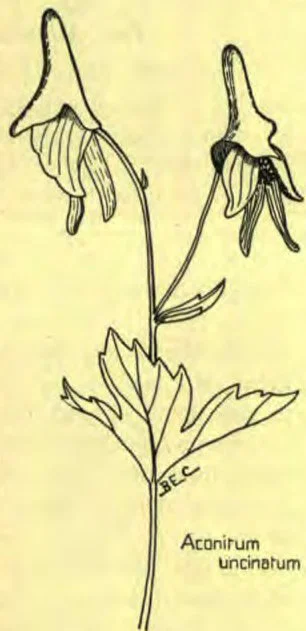
CLOSELY related to the larkspurs, but more poisonous, are the aconites, of which the Wild Aconite is perhaps the most common in the Eastern United States, and may be taken as the type.
The stem is rather weak and slender, erect, but inclined to climb, and from three to five feet high. The leaves are much like those of the larkspurs, being palmately cleft (incisions extending half way, or a little more than half way, to the apex of the petiole) or palmately parted (incisions extending nearly to the apex of the petiole) into from three to five deeply toothed divisions.
The flowers are arranged in an open, branched cluster, or panicle, the form of inflorescence common to oats and many of the grasses. The sepals, as in the larkspurs, constitute the most showy part of the flowers, which are blue in color, and of a peculiar shape. In fact, the petals are quite inconspicuous, consisting of but two small bodies with long stalks, hidden away under the large upper sepal, which from its shape is known as the hood, or helmet.
The root is thick and fleshy, and exceedingly poisonous.
Aconitum uncinatum
Aconitum uncinatum
Aconitum Napellus, the True Monk's-hood, or Officinal Aconite, is a cultivated species, the root of which is largely used in medicine. Cases of poisoning sometimes arise from its ignorant or excessive use for this purpose. In some instances the root has been mistaken for horse-radish and the leaves for parsley, a plant which is frequently cultivated for its pleasant-flavored foliage used in cookery.
Horses and cattle are sometimes poisoned by eating small portions of the plant.
Let us take warning from the aconites and larkspurs, and rid our soul-temples of every deadly principle, so that we may convey to all within the sphere of our influence the elements of buoyant life and health, not those of poison and death.

Questions

  1. Describe the Wild Aconite.
  2. In what particulars are the aconites similar to the larkspurs?
  3. What is a panicle?
  4. Describe the details of the Wild Aconite.
  5. What is the shape of the upper sepal? What is it called?
  6. What is the nature of the plant, especially the root?
  7. Which species of aconite is commonly used for medicinal purposes?
  8. In what way do cases of poisoning frequently arise?
  9. What lesson may we learn from these poisonous plants? B. E. Crawford.

The Weight of Lovely Actions

ALL the beautiful sentiments in the world weigh less than a single lovely action.—J. R. Lowell.

Esau and Jacob: Questions on the Birthright

Gen. 25:20. How long was it before God gave him any children?
3. Who were born when Isaac was sixty years old? Were these twins alike? What was the difference in their appearance?
4. What was the occupation of Esau? of Jacob? Tell the difference in the character of the two boys. What had God said about them before they were born?
5. Who was the father's favorite, and why? But whom did Rebecca love?
6. Who was really the elder son? What therefore belonged to him?
7. Tell what the benefits of the birthright were.
8. Did Esau value his birthright? How did he show that he despised it?
9. What was Esau willing to sell the birthright for? Is he the only one who has ever done this? Who was the first to sell his birthright? Is there any danger that we may do the same thing?
10. Who has won back for man the birthright that Adam lost? Was he ever tempted in the same way that Adam was? Tell how he overcame.
11. Who valued the birthright that Esau despised? Tell how he tried to get it for himself.
12. Why was it wrong for Jacob to do this? What should he have done?

I—The Vision of the Four Beasts

(October 4)
LESSON SCRIPTURE: Dan. 7: 1-8.
MEMORY VERSE: “Who is wise, and he shall understand these things? prudent, and he shall know them?” Hosea 14: 9; see also Dan. 12: 10.

Questions

  1. When was the vision of the four beasts given to Daniel?
  2. Where was the scene of this vision?
  3. What commotion arose upon the great sea?
  4. What came up from the sea?
  5. How did these beasts compare with one another?
  6. What was the first beast like?
  7. As the prophet beheld it, what became of its wings?
  8. What then happened to the beast? What was given to it?
  9. What was the appearance of the second beast?
  10. What was there peculiar about one side of this beast?
  11. What did it have in its mouth?
  12. What command was given unto it?
  13. What were three special characteristics of the third beast?
  14. What was given to this beast?
  15. After this what kind of beast did Daniel see in his night visions?
  16. What enabled it to devour and break in pieces?
  17. How did this beast treat the residue of the earth?
  18. How did it compare with the other beasts?
  19. What evidence of power did it have?
  20. As Daniel considered these horns, what came up among them? What did this little horn do?
  21. What were its eyes like? What did its mouth speak?

Questions for Further Study

  1. These four beasts represent what? Compare verses 17 and 23.
  2. Who will take their kingdom away from them and possess it forever?
  3. What other chapter in Daniel records a vision of four kingdoms succeeded by a fifth, which shall stand forever?
  4. What, therefore, shows that the kingdoms described in Daniel 2 are the same as those of Daniel 7?
  5. Name the four universal monarchies from Nebuchadnezzar’s time until now.
  6. From the two visions given concerning these monarchies, sum up the special characteristics of each. The following is an example:—
Glorious as gold. Strong as a lion. Swift as an eagle. Deceitful and desperately wicked as the heart of man.

Notes

Notice that the descriptions of these various kingdoms make no distinction between the kingdom and the king. Although the head of gold stood for Babylon, yet to Nebuchadnezzar, Daniel said, “Thou art this head of gold.” Nebuchadnezzar was himself a very part of his kingdom, and the vision revealed to him the pride and ambition of his heart. In the same way the four beasts represented four kings, but each king stood for a kingdom; and that the same as regards its purpose and power, but differing only in the character of its kings.
As to the history of these four kingdoms, let us see what the Bible says. The rise and fall of Babylon was foretold by both Isaiah and Jeremiah, and Daniel saw the thing enacted, and the kingdom pass into the hands of the Medes and Persians. The books of Esther, Nehemiah, and Ezra give us a complete account of the kingdom of Medo-Persia and her dealings with the people of God. When those kings fulfilled their mission, their kingdom passed over to Greece. The only Bible record concerning Grecia is a prophetic one, and is found in Daniel 11. This kingdom spans the period from the close of Old Testament history until the rise of Roman supremacy immediately preceding the birth of Christ. The history of Rome is written in prophecy; and her dealings with the church of God, as shown in the life of Christ and the apostles, are fully recorded in New Testament history. Her work is not yet done, her mission is not yet completed. From the prophecies we know what the end is to be. We are in the time of their fulfillment. Shall we not watch and be ready, that we may be of that number who shall “take the kingdom, and possess the kingdom forever”?

SOLID THROUGH TRAINS OF WIDE VESTIBULE COACHES and PULLMAN SLEEPING CARS BETWEEN

Battle Creek and Chicago, Buffalo, New York, Philadelphia, Toronto, Montreal, Boston
For time-tables, descriptive matter, and information, apply to any representative of the company.

Over 225 Years

Is the total length of time the eight men named below have written shorthand. They are the most widely known, and stand highest in their chosen branches of the profession, of any stenographers in the world; and hence an unusual weight is attached to the unsolicited opinions they have expressed regarding “The Rogers Compendium of the Graham System of Shorthand:” —
“Does away with all useless study.”—Henry L. Dietz, Stenographer and Notary, Chicago, Ill.
“The best condensation of any shorthand system I have ever seen.”—James W. King, Official Stenographer, Three Rivers, Mich.
“More ounces to the pound and pounds to the hundredweight than has hitherto been dreamed possible.”—Thomas I. Daniel, for 32 years Official Stenographer, Jackson, Mich.
“No better text-book could be put into the hands of a pupil.”—James H. Emery, Official Stenographer, Toledo, Ohio.
“A monument of conscientious and intelligent labor.”—David Wolfe Brown (since 1864), Official Reporter of Debates, House of Representatives, Washington, D. C.
“One of the most advanced text-books for the successful teaching of shorthand that I have seen.”—Francis H. Hemperley, editor of “The Stenographer,” Philadelphia, Pa.
“Replete with practical shorthand information, and will fill a long-felt need in the shorthand world.”—Prof. F. B. Cornwall, Shorthand teacher, Columbia Commercial College, Evansville, Ind.
“The best arrangement for the study and acquirement of Graham stenography that I have ever seen.”—Ruel Smith, for twenty years Official Stenographer of the Maine Supreme Judicial Court, Bangor, Me.
Our specially low tuition rates for correspondence instruction based on “The Rogers Compendium” are in effect only until October 15.
FIRESIDE CORRESPONDENCE SCHOOL, Battle Creek, Mich.

THE INTERMEDIATE LESSON

I—Jacob and Esau; the Birthright
(October 4)
LESSON SCRIPTURE: Gen. 26: 27–34.
MEMORY VERSE: “Man shall not live by bread alone, but by every word that proceedeth out of the mouth of God.” Matt. 4: 4.
It was twenty years after Isaac was married to Rebecca before God gave them any children. So their faith in the promise of God was tried, as Abraham’s had been. God had promised that through Isaac, Abraham’s seed should be multiplied, and the number of his children be as the stars of heaven and the dust of the earth for multitude.
Isaac knew the story of his own birth, and how his father and mother had prayed and waited for the gift of God. So he also prayed that God would give him a child, and in answer to his prayer, God gave twin sons to Rebecca, his wife. The firstborn was called Esau, and the younger, Jacob. Before their birth, God told Rebecca that the elder should serve the younger.
The birthright was the right of the eldest son to inherit the father’s property; besides this, it made him a prince or ruler in the family. But it was not the worldly good it brought that made Jacob set so much value upon it. The choicest possessions of Isaac were the promises of God to him and to his father Abraham. He who received the birthright was heir of the promise that in his line the Saviour of the world should come.
But Esau cared nothing for these things. His mind was set on the things of this world; he did not think of the world to come, that Abraham and Isaac loved and looked for. So when he was faint with hunger, he said, “Behold, I am at the point to die; and what good shall this birthright do to me?” He was like those of whom Paul speaks in 1 Cor. 15: 32, who, because they did not believe in the resurrection of the dead and the future life, said, “Let us eat and drink, for to-morrow we die,” as if the things of this world were all that were worth living for.
Jacob valued the blessings that Esau despised. Because God had foreseen the character of the two boys, he had told beforehand that the birthright should be given to Jacob. But Jacob did not know God well enough to trust him to bring his own word to pass. He made the same mistake that his grandfather once made, and tried to get the birthright for himself, instead of waiting for God to give it to him.
Esau despised his birthright, and sold it for a morsel of meat. Because of this he is called a “profane person,” and his act was very displeasing to God. He is the type of all those who through their love for this world lose the eternal riches.
Esau was not the first one who sold his birthright for a morsel of meat. Our first father Adam did the very same thing.
Jesus, the second Adam, was tempted in the same way by the same serpent that tempted Adam in Eden. When he was hungry, the devil said, “If thou be the Son of God, command that these stones be made bread.” But if he had obeyed the voice of the tempter to satisfy his hunger, he would have lost his birthright as the Son of God. So he conquered Satan by the word of God, “Man doth not live by bread alone, but by every word that proceedeth out of the mouth of God.”
There are many to-day who are selling their birthright as sons of God for the sake of a morsel of meat. As his children, it is our right to be filled with his Holy Spirit, to give us clean minds, good judgment, and strong bodies in this world, and an inheritance in the world to come. If we eat or drink what God has told us is not good for us, or even too much of what is good, we are in danger of clouding our minds, and driving away the Spirit of God, and shutting ourselves out from the new earth that God has promised for the home of all his children.

Questions

  1. What did God say about Isaac before he was born? Gen. 21: 12.
  2. How old was Isaac when he was married?
Continue reading: Nickel-Steel Alloy and New Sugar Plants