The Youth’s Instructor, Vol. L., No. 38

Summer Birds

The Youth’s Instructor

September 25, 1902

Review and Herald Publishing Company · Battle Creek, Michigan · September 25, 1902

Summer Birds
Resplendent in the summer choir, The redbird folds his wings of fire, And sings; and how the oriole's note Translates his gold of breast and throat!
Deep in the holy woods the thrush Breaks with ecstatic praise the hush; And o'er wide meadows bathed in sun The bluebirds' dialogue is spun.
White-chaliced daisies lean to drink The cascades of the bobolink, And cheerful robin from the wall Sings mellow matins for them all.
O God! how artless and sincere Thy little feathered hymnists here! So true the song and feeling fit! No bird was e'er a hypocrite.
Out of my heart, I pray, may rise Tribute as earnest to the skies. Unless my words be heart-true words, I lack the faith of summer birds.
—Selected.

The Baltimore Oriole

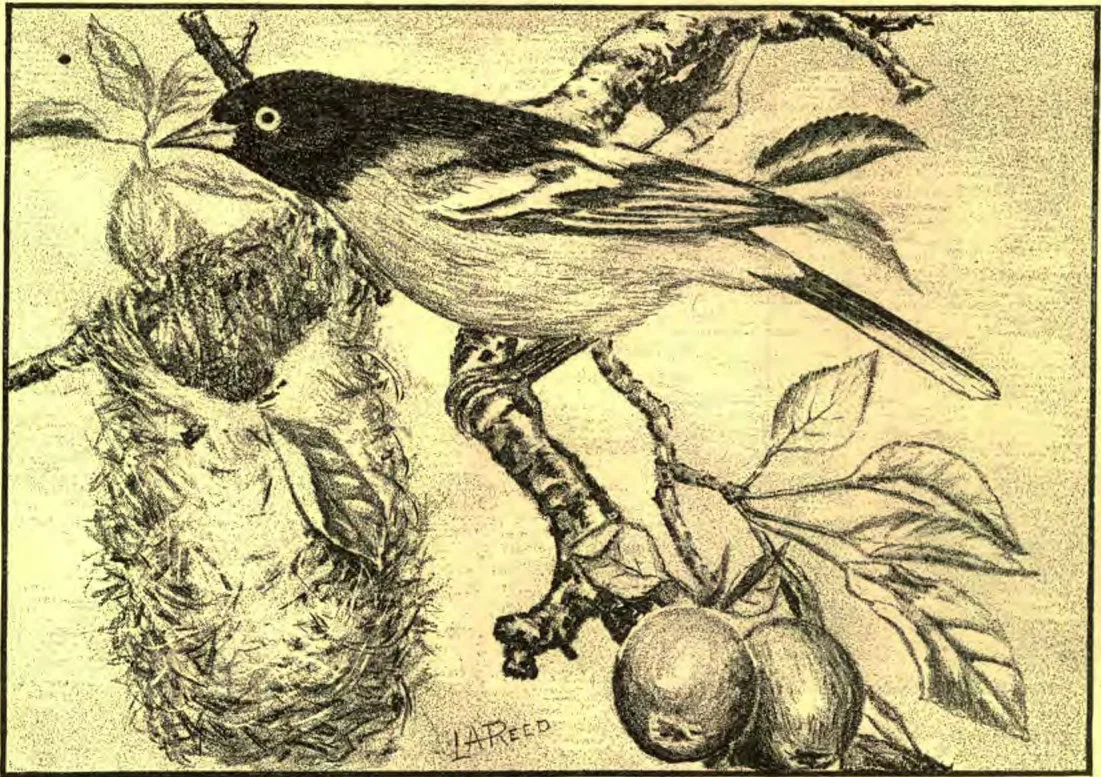
THERE is no more interesting bird in North America than the Baltimore Oriole. His plumage is brilliant, his song sweet and well modulated, he is amiable in disposition, and a master craftsman in the building of nests.
The Baltimore Oriole is so named from Lord Baltimore, whose titular colors were orange and black. He is also called fire-bird, golden robin, and hang-nest.
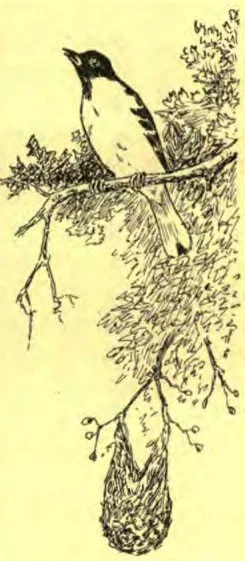
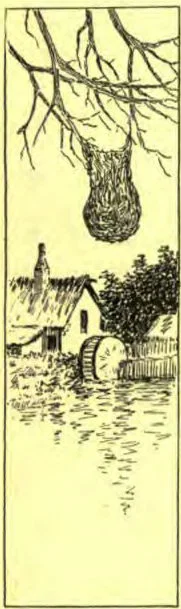
The mother bird is dressed in yellow and brown instead of the orange and black of her mate. Their nest is one of the prettiest you can find. It is a deep bag, skillfully woven of plant fibers, bits of string, and the like, and usually hung at the end of a branch high up in some tall tree, like the elm or willow or some of the maples. When the winds toss the branch, the little nest swings and sways, better than any hammock or cradle that ever was invented.
THE BALTIMORE ORIOLE AND ITS NEST
While the mother bird is sitting on the nest, the mate stays near by and sings to her. But when the little birds hatch out, and have to be fed, he does his part in getting food to stuff into the babies’ hungry mouths. The little birds, as it comes near time for them to fly, move about a great deal, climb up out of their bag-like nest, and often fall to the ground.
This spring I saw a man throwing bits of brick and stone at the nest of an oriole which had been built near my home. One brick struck the nest. The little birds inside screamed at the top of their voices, and the parent birds remonstrated in notes even louder. I promptly stopped the man, but not, I fear, until some damage had been done.
That night we found one of the little birds crying in the grass, took it to the house, and cared for it. When we fed it, it would lift itself up as high as it could stretch, wave its little wings, and seem to say Yum-yum, in a way that delighted us all. Whenever it got hungry, it would cry incessantly until it was fed. I grew used to hearing it, but the morning of the third day, when I awoke, I did not hear its cry. The house was silent. I went where we kept it. It was lying on its back, its feet up in the air, sick unto death. Later in the day it died. We thought it must have been injured when its nest was so rudely struck by the unfeeling man, or that it was hurt in falling to the ground.
Young orioles have been aptly called the crybabies of the bird world; but that day I would have given much could I have brought my little oriole cry-baby to life. L. A. REED.

The Free Kindergarten

I was not a pupil—O, no, not a bit of it; for I would have had to live down a long line of ancestors before they would have trusted me! Did I not belong to that dreadful, unfeathered breed called men? And did they not carry ready for use the most frightful things, which, with a “snap,” “bang,” sent happy feathered people to their graves? And don't you all know that between the crow family and man there is enmity, deep-seated, deadly? So if I had been seen, the kindergarten would have been quickly broken up. And who knows what useful lessons missed?
Word had been passed from one to another of the crow family that the “branch meadow,” as it was called, was quite the finest place to teach baby crows to walk and fly in all the country; and when I hid in the willow thicket, the crows never suspected that I was anything more than a log or a harmless stump, and so I saw the fun.
The first I heard of the kindergarten performances down in the meadow was a loud and rasping noise that sounded so much like “Ma-a” that I looked around quickly to see if a human baby had not slipped into the kindergarten. But they were only crow babies—big, black, ugly. Now I rather respect Papa and Mama Crow. There's a look of wisdom and dignity about them. But the baby—why, he is just big and awkward and lumpy. He hasn't any tail, and you are constantly fearing lest he may lose his balance and tumble over. Mama was evidently trying to teach the youngsters to walk with ease and to fly with grace, and the gawky things seemed to be having a hard time of it. They clung to the rail fence in mortal terror of falling.
“Here, this is the way it is done! Watch me!” And Mrs. Crow tripped along the top of the fence, and stopped at the farthest end of the panel from her unsteady brood. “There, now! Just straighten yourselves out and come to me. I'll give you a nice worm if you will.”
But, although he spread out his wings to balance himself, and started to her on his wabbly legs, the very biggest of the babies stopped right in the middle of the rail, and set up a fearful “Ma-a-ma-a” that I felt sure meant: I can't ever do it! I just know I can't! Please bring the worm to me before I starve.”
Then what do you think the mother did? Give him his wish?—Not a bit of it. She shut her mouth tightly on the tempting morsel, and flew to where her quaking offspring sat. She gave the one in front such a vigorous shove that he nearly tumbled to the ground. “Now, then, I'll see what you'll do there! There are lots of nice things down in that grass, and you youngsters must learn to hustle around and find them, or—”
She did not say what she would do, or what would become of them. On the contrary, she sailed away with such an air! You should have heard the cry that went up then. I thought: “She'll surely come back now.” But no. She flew away, away, and it seemed to me that the louder they cried, the faster she flew. Maybe I was mistaken; for, being a mother myself, I confess my heart went out to the squalling brood clinging to the rail fence.
“I wonder what they'll do now, poor, ugly, helpless things!” I asked the willow bushes.
Directly the baby crow who had seemed to be the bravest looked all about, and gave a most piteous call. Nobody answered. Again he called. Still nobody. Then he looked about, to make sure that no one was peeping, and down he flopped from the fence and struck the ground.
“Why, Jimmy!” cried the others. “Do look at Jimmy. He's flied all by his own self. He's flied off the fence.”
“Come along,” said Jimmy, quite exultantly, just as if he had been flying all his life. “It's as easy! You want to turn all your holds loose, and just hop.”
And they did, every one of them. It wasn't pretty flying, but it got them to the ground. And so pleased they were!
“If we can fly, why can't we walk?” said Blackie, who was the last to get down.
“And why can't we?” they all cried. And they did. They just forgot to be afraid, but put one foot in front of the other, and, to their surprise, the ground didn't jump from under, but stood quite still. Then another foot went out, and the thing was done.
An hour later, when Mama Crow sailed down upon the group, they were walking about in the meadow, hunting for seeds and bugs. Mama Crow chuckled all over inside, but said, quite dryly: “There, now! I knew you could do it, if you'd only try. You'll believe me next time.”
IN BULUWAYO
IN BULUWAYO

The Story of Our Matabele Mission

Choosing a Location
THE feelings of our brethren, now that the object of their search was so soon to be realized, can not be described in cold words. Eager to glorify only the Master, for whom the long journey had been undertaken, they retraced their steps with joyous hearts. Everything seemed overflowing with praise to its Maker. Even the little stream of water was the clearest and coolest and best they had tasted since leaving Cape Town.
Their hopes were soon to be realized. The privilege of planting a mission-station had been granted, and all that now remained was to find the proper location and secure it. Surely there could be no question in their minds but that He who had so tenderly guided them during all these weeks would now lead them into the land which he had prepared for them. With light hearts they gratefully accepted the guides offered them by Dr. Jameson, and started on this last, but most fascinating, part of their journey.
A part of the company were left to care for the mules, horses, and supplies that were to be used in establishing the mission, while the remainder, with the four Kafirs, started on their search. They were obliged to travel very slowly, as now they were not following even the semblance of a road, which had been some help to them before, but were going across country, cutting the brush and making a road as they went. The Kafirs were willing helpers, and did good service. At every kraal the guide would tell the natives who our brethren were, and the object of their visit. Without a single exception, the chief would urge them to locate right there, and teach his people how to live.
One deserted kraal after another was passed. The only sign that there had ever been any life about, was the growing gardens, which the natives had hastily left in their retreat to the mountains.
The Kafirs ate nothing on the journey but meat. At one kraal the poor natives, to do the missionaries honor, gave them a sheep. Brother Druillard helped the Kafirs to dress it, showing them how to do it nicely. They laughed, and seemed to be much interested in seeing a white man kill a sheep. To the utter surprise of the brethren, these natives ate the whole of the insides of the animals, not even stopping to have them cleaned. They threw them onto the coals, and before they were half done, swallowed them. This they would do every time animals were given to the company.
After some search the mission party came to Seluce’s kraal. This chief sent six young men to help them out of the forest, thus making the last part of the journey before reaching the kraal very easy. The village consisted of about one hundred and thirty huts, and was surrounded with kopjes, or little hills.
The chief, who was a very old man, had ten wives. At first he seemed to be afraid of the white men. But when he learned the object of their visit, he urged them to settle near him, and teach his people how to work. These natives had no farming implements, and did not plow their land, only digging up the soil where they wanted to sow the seed. They had no wagons, and raised their cattle for food only.
The company stayed in the vicinity of this kraal two days, but could find no land suitable for their work. The night before leaving, Brother Wessels tried to take pictures of some of the natives with a kodak, but they were afraid; and not until Brethren Harvey and Sparrow stood with them, would they consent. Even then the chief held the guns while the brethren were taking the picture. After this Brother Wessels preached to the natives, and the guide interpreted. Although they were all very quiet, and listened attentively, it seemed scarcely possible that they comprehended much, for in intellect these people are very much like little children.
The next point reached was Gambo’s kraal. He is a half brother of Lobengula, the chief of the Matabeles. The territory in this neighborhood was less satisfactory than at the last kraal, so the workers decided to retrace their steps. The return journey was less difficult, as the road was already cut, and little time was lost.
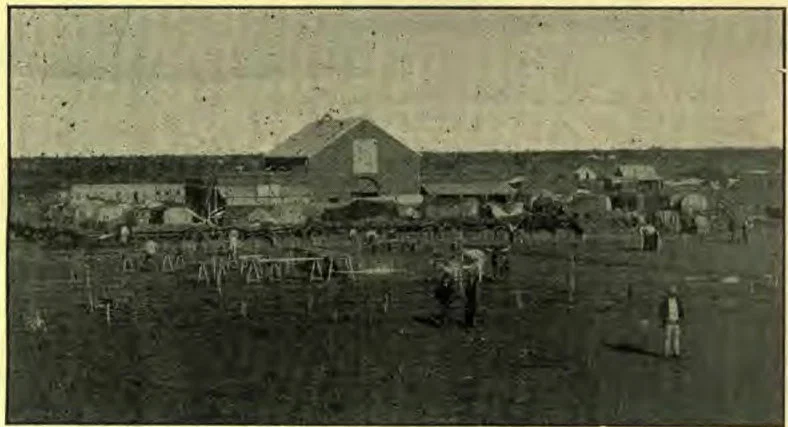
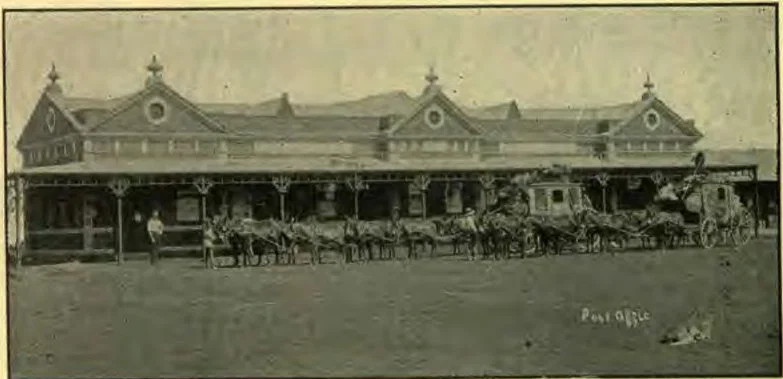
BULUWAYO'S POST OFFICE
Again at Seluce’s kraal, they directed their search toward the Guye River, as that land seemed to be just what they wanted. Soon a location was selected, three miles from the river and three miles from the kraal. The next question was to secure the grant of this land. Perhaps some one had chosen it before them. Eagerly they wended their way to Buluwayo. Dr. Jameson was out of town, so they had to wait for his return before the location could be secured.
ESTELLA HOUSER.

Talking to Little Children Like Crows

And I laughed aloud, for that's the very way I talk to my little people, although they are not crows, but just common boys and girls.—Children's Visitor.

Finding True Peace Through Taking Up the Cross

See, then, how faithfully the Lord is leading thee to true peace, who surroundeth thee with so many crosses. It is called “the peace of God, which passeth all understanding;” that is, which is not known by feeling or perception or thinking. All our thinking can not attain nor understand it; none but those who of free-will take up the cross laid on them—these, tried and troubled in all they feel and think and understand, afterward experience this peace.—Luther.

A Narrow Escape

Dr. John G. Paton, who spent so many years in the New Hebrides, recently narrowly escaped death at the hands of cannibals. In a fight which took place on Tanna between two native tribes warring with spears and knives, fifty-one natives were left on the field dead, and a large number wounded, who were carried off by each party for a feast. Dr. Paton went on the field where the two tribes were fighting, and, at the risk of his life, attended the wounded. While bending over two wounded natives, spears were hurled at him by the attacking tribes; but in God’s providence none struck him. He, however, was forced to leave the field. This account was brought to us from the islands by the steamer “Mambore,” which recently arrived at Victoria, British Columbia. The steamer also reports details of terrible tribal wars and fearful feastings in the islands, together with earthquakes, tidal waves, and other grave happenings.
E. H.

The Little Tub Under the Pump

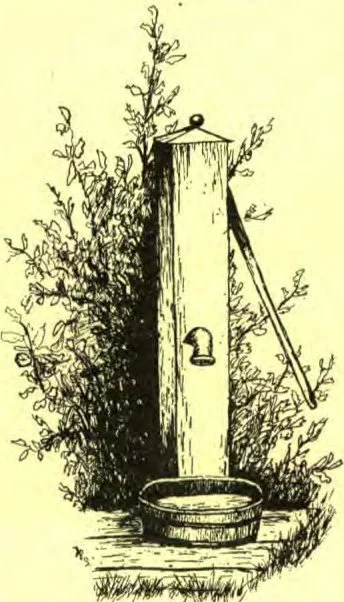
ALL summer the heat was intense; The lily-ponds failed in the sun; The brooks trickled low in the reeds, And died where the arrowheads hung, No rain to replenish them fell, And slowly each watercourse shrunk; But sparkling and fresh, there remains The little tub under the pump.
It catches the drip from the spout, When passers-by pause, with a word, To drink from the dipper that hangs Above on the red wooden curb, While, preening with wet, rosy bills, The pigeons, so shining and plump, To peep in their mirror, descend, And seek the tub under the pump. House-sparrows flit down with a chirp, To perch in a row on the brink; And quick, like a tiny see-saw, They tilt up and downward to drink; Then from the hot sunshine they seek The shade of the barberry clump, And twitter a carol to thank The little tub under the pump.
A vessel, it seems, filled with smiles, When thirsty dogs lap with delight, And bees, with the butterflies, snatch A sip in their honey-bound flight: While even the mud-wasps, at work Near by in an old, mossy stump, To moisten their mandibles seek The little tub under the pump.
And thus from its lowly estate, The deeds of its life ever tell A beautiful lesson of love,— This dear little tub by the well.
MINNIE ROSILLA STEVENS.

The Value of Early Training

IN our garden to-day I came across a chrysanthemum plant that had been overlooked in the general care-taking, and missed that very necessary early training that is necessary to a perfect result in the flowering season.
I stuck in a stake by its side, and made an attempt to bring up the branches, and fasten them to it, hoping in part to repair the damage done by my neglect; but my efforts were in vain. One branch broke off at the root. Another, quartered and twisted by its supine position, split in two near the root, and I had to lay it down again where it was. I was very sorry that all this had happened, for it was a choice plant; but my sorrow avails nothing now. It must grow on as it is, and make the best of it. The result will be that the flowers will grow upon curled-up branches, which can not support the weight of the new growth, so will bend over, and throw the flower to the ground, there to be torn and soiled from frequent sprinklings. If it had been trained early, and tied to a stake, the result would have been straight, clean stems, well set in abundant foliage, and crowned with the beautiful autumn flowers we all admire.
So with us. If we neglect early training, and grow according to our own evil natures, we may make a good growth of something; but the chances are that at the last we shall trail our flowers and our fruit in the dust of remorse and despair.
Every faculty of the mind, every bent of talent, ought to be put early and continuously into such training as will bring the best results. Happy is he who can look back upon a life spent in careful training of his faculties. Not only should the young seek self-training habits of thought, but they should bend every energy toward securing that higher training that comes by putting themselves into the hands of men of cultured and consecrated minds. But first, and most important of all, they should give themselves and all they are and hope to be, into the hand of God.
E. L. PAULDING, M. D.

A Noble Triumph

SOME years ago the visitor of a mission Sunday-school, who was canvassing his neighborhood for prospective pupils, stopped in at a beer-garden, and found an attractive girl, just entering her teens, tending bar. To her father and mother, foreign-born, there was nothing revolting in her occupation; but the visitor viewed it in a different light. A little conversation with the girl revealed a soul as yet uncontaminated by her surroundings, and just beginning to rise above the grossness and vulgarity of her situation.
After a little urging, the parents consented that she should go to the Sunday-school. Her first visit revealed to her a new world of moral and spiritual possibilities, and she went home with a new purpose and outlook.
As the season advanced, and the Sunday trade became better, her parents objected to sparing her from the bar; and there arose in her mind the perplexing question whether she ought, if necessary, to disobey them and continue her attendance. She decided to be so dutiful a daughter in every other relation that she might gain her point in this one, and that with their consent, and she succeeded.
The rapidity with which she learned was almost incredible, save to one who understood her splendid determination. She improved to the utmost the opportunities which the indifferent despised, but which to her were priceless. Her eagerness was not lost upon her teacher, and greater opportunities were made for her. This resulted in her leaving the bar altogether, but happily without any break in her relations with her parents. Such a break was repeatedly threatened, but was averted by her tact, and her unfailing determination to perform every duty devolving upon a daughter. Thus, while she grew above her parents in her tastes and aspirations, she did not grow out of sympathy with them, nor make them hostile to her own new life-purpose.
This was her greatest triumph; for at length they came to accept her point of view, and to take pride in what they learned about her accomplishments.
In due time she passed an examination for teachers, and through the influence of friends secured a position in the ward school. The salary at first was small, but so rapidly did she improve, that within two years it had become fifty dollars a month,—a sum she had long looked forward to as one that would support the family. Then she achieved the object dearest to her heart. She went to her father and mother and offered to support them both if they would give up the business, and let her make a new home for them. They were less opposed to the proposition than she expected. Already they were influenced by what she had accomplished and become. Moreover, her father was getting old, and suffering from an infirmity that made his business hard for him; so they moved to a new neighborhood near her school, and every month she paid the rent and other expenses of the household.
Since then she has been promoted three times, and is still learning. Best of all, she has witnessed a transformation in her father and mother. Respecting, as they do and must, the daughter who has made their home, they are devoting themselves to making that home a worthy place for her to live in, and for her friends to visit. Those who do visit the home find her its soul and center, and the elderly father and mother, full of pride and affection for their only child, adapting themselves, with reasonable success, to the somewhat difficult situation.
The beauty of this girl's achievement lies not more in the place she has made for herself than in consideration for her father and mother. A narrower, poorer nature might have broken with her parents, and lived selfishly, although doing what she considered her duty. This girl did better. Her name can not be recorded here, but her story may encourage some other young person in a similar struggle, and indicate the possibility of triumph over uncongenial and depressing environment.—Youth's Companion.

The Frown’s Companion

Said the Frown to the Smile, “Come, walk with me to-day.” “Very well,” said the Smile, “since you’re going my way.”
They journeyed on slowly for perhaps half a mile, And each person they met said, “Good morning, dear Smile.”
Till at last cried the Frown, “Now, this never will do; There’s no greeting for me, though I’m bigger than you.”
“That’s true,” was the answer; “but remember the while, Even you, as companion, selected the Smile.”
— S. S. Times.

God's Protecting Care

(From an unpublished book manuscript by Mrs. M. N. Crow)
ONE day when I was alone with my two children, three strange Indians came to our house. After looking in at the window, they walked in at the open door. They were highly painted, and had feathers in their hair. Scalping-knives and tomahawks hung from their belts, and they carried guns in their hands. Blankets thrown over their shoulders, and hanging to the floor, made them look so large it seemed to me that they were the tallest, darkest Indians I had ever seen. They took the chairs which I offered them, but not one word did they say, only followed my every move with their piercing black eyes. I was so frightened that I did not dare sit down, but busied myself around the house and with the children. Occasionally they would speak a few words to one another, and give the deep, guttural Indian grunt, Ugh! which frightened me still more.
It must have been two hours before my husband came. Now I thought they would make their wants known, but not a word would they say to him, any more than to me. There they sat till the shadows lengthened, the sun went down, and the stars came out. I begged my husband to leave the house; but he said if they had any evil design, it would be worse for us to go than to stay. At last the one nearest the door rose without a word, and glided out, picking up his gun, as he did so. He was followed by the others, and all were soon lost in the gathering darkness. They never returned. How thankful we were! What did it all mean? Did the Lord have a care for us? Had an unseen power protected us in this hour of seeming peril? I have always believed that this was the case.

Battles Between Truth and Falsehood

Study Prepared for the Young People's Meetings
Lesson XXII—“Read” and “Understand” Daniel
  • (September 28 to October 4)*
HOW TO STUDY THESE LESSONS.—(1) Read the lesson story; (2) try to recall or find scriptures in proof of each statement; (3) study the texts; (4) see how many missing links you can supply; (5) give the lesson to some one else. You will keep only what you give away.
Jesus will not come until the gospel of the kingdom has been preached in all the world. No one can preach the gospel of the kingdom, without an understanding of the book of Daniel.
The book of Daniel was written more than two thousand years ago; but it was sealed up till the “time of the end.” In the time of the end, the gospel will be preached by those who read and understand this wonderful book.
The book of Daniel opens with Babylon ruling the world. This was over six hundred years before Jesus was born in Bethlehem.
Nebuchadnezzar, the young king of Babylon, had a dream. In his dream he saw an immense image, with a head of gold, breast and arms of silver, sides of brass, legs of iron, and feet and toes part of iron and part of clay.
While he was watching this image, he saw a stone strike the feet. Soon the whole image was ground to pieces by the stone. Then the stone filled the earth.
God gave to Daniel the meaning of the king’s dream. Daniel told the king that the head of the image represented his own kingdom; the silver was a kingdom that would follow his; the brass would be a third kingdom to rule the world; there would also be a fourth kingdom, represented by the legs of iron. This fourth kingdom would be divided into ten parts. They would never again be united in one. Men would try to unite them, and when force failed, they would try intermarriage, but none of these plans would succeed.
Iron and clay will not mix, neither would these kingdoms be again united into one. In the days of these intermarried kings, the God of heaven would set up his kingdom. It would break all the kingdoms in pieces, and it would stand forever. We can see how wonderfully all this prophecy has been fulfilled.
The golden head of Babylon was replaced by the silver kingdom of Media and Persia. Next followed Grecia, the brass power.
Then the iron monarchy of Rome ruled the world. This was finally broken into ten parts. Men with great armies have tried to bind the broken pieces together. This failed, then intermarriage was tried. To-day nearly all the monarchs of Europe are relatives, but the kingdoms are not united. Only one thing remains to be fulfilled,—God is to set up his own kingdom, and destroy all others.
The good news that the perfect kingdom of God is now to take the place of all wicked kingdoms, must be told in all the world; then the end will come.

Outline

The gospel of the kingdom must be preached in all the world before the end. Matt. 24:14.
“Therefore” we must “read,” and “understand” the book of Daniel. Matt. 24:15.
This book was sealed till the time of the end. Dan. 12:4.
In these days the wise will understand it. Dan. 12:4, 9, 10.
A history of the kingdom is given in Daniel 2.

Notes

The book of Daniel was written more than two thousand years ago, but it was written for the people who live now.
The book of Daniel is one of the best remedies for infidelity. It is impossible for an honest man to study this book carefully, and remain an infidel. No human being could accurately foretell the rise and fall of nations for so many centuries. The stamp of divinity is here, too plain to be doubted.
Only those who give to others the light they have, will continue to understand the book of Daniel. Study Dan. 12:10 and verse 4, margin.
The prophecy of Daniel 2 is one of the simplest of all the proofs of the nearness of the end. Even a child can grasp it. Let us call the attention of others to it.
You ought to have “Thoughts on Daniel” and “The Story of Daniel” to study. Also sell them to others.
Men have prayed, “Thy kingdom come,” for over eighteen hundred years. This prayer has never yet been answered, but we live in the time when it will be. Let us hasten the answer by telling the good news.
Nebuchadnezzar had his dream six hundred years before Christ was born. Medo-Persia overthrew Babylon, 538 B. C. Grecia conquered Medo-Persia 331 B. C. Rome ruled the world when Jesus was born. In the fifth and sixth centuries Rome was broken up into ten parts. Charlemagne and Napoleon were among those who tried to unite these broken nations. The rulers are intermarried. Now, we wait the falling of the stone. . But it will not fall till the people of all nations are told how they can have a part in the Fifth Great Empire. Let us make haste to tell them.
Continue reading: Sunshine Circles