The Youth’s Instructor, Vol. 33, No. 37.

CARDIFF CASTLE
Earlier text: CARDIFF CASTLE

“CORYLLIS GALGULUS.”

Perhaps our boys and girls would be surprised to come suddenly upon a flock of birds perched upon a tree, with their heads downward. Among the many species of parrots there is one (coryllis galgulus) “peculiar for the remarkable positions it takes, almost invariably sleeping with its head downward, hanging from a limb by one claw. Often several are seen sleeping in this position, looking like richly-colored fruits hanging from the branch. When they awake, they often cling in the same way, talking or murmuring in low notes to one another.”

Longest Word in Eliot's Indian Bible

THE longest word contained in Eliot’s Indian Bible consists of thirty-five letters. It is “Weetappesittukgussunnookwehtunkquoh,” and means “Kneeling down to him.”

A WONDERFUL CLOCK.

THERE is on record a description of a clock made in England, and presented by an English company to the emperor of China. It is in the form of a tiny golden chariot, to which are attached two birds in the act of flying away. A boy standing behind the chariot seems to be pushing it, while in the chariot is seated a lady, who holds upon her finger a bird, whose body, measuring only about the sixteenth part of an inch, contains wheels which give motion to wings that sparkle with precious stones. Below the lady is an eight-day clock, no larger than a shilling. Above the lady’s head is a tiny umbrella of gold, surmounted by flowers, and a flying dragon, both ornamented with precious stones. Inside the umbrella is a golden bell, which, although seeming to have no connection with the clock-work below, regularly strikes the hour, the connection being made through the handle of the umbrella.—Treasure-Trove.

SOME FAMOUS ENGLISH TREES.

The yew tree is an evergreen, related to the pine, valued for its wood or timber. In England it sometimes grows to a great size. The American yew, however, is a low, straggling bush, never forming an ascending trunk. Some remarkable English yews were described in a last year's journal as follows:—
“In the village of Branhurst is an amazing yew tree, said by some historians to be three thousand years old. At five feet from the ground it is twenty-six feet and a half in circumference. The top alone is now green, and even that is much broken off, and battered by the winds; while below all is a melancholy wreck—the trunk shattered and hollow, and crumbling to pieces with age. A part of the trunk is held to the main body of the tree by an iron band.
“In a green lane near Ranmore Common is a curiosity which frequently detains the tree lover. It is a yew tree growing out of an oak, found in a sort of circle formed by smaller trees. Where the branches of the oak begin to spread out from the trunk, the top of the yew tree also sends forth its branches, and pushes its way through the oak in all directions. The trunk of the yew—only a few inches in diameter—grows, to all appearance, out of the very roots of the oak; and at the ground the two trees cannot be distinguished apart, except by the different appearance of the bark. You could not, for instance, put a sheet of paper between them. The yew tree then grows straight up the trunk of the oak, and forces its branches through those of its companion, making substantially one tree. The contrast in color is all the way one notices the difference between the two trees where they begin to branch.
“Not far from Redhill is a yew tree said to be one thousand and two hundred years old. The inside of the tree has been hollowed out, and the traveler may open a door and walk inside the tree. There are wooden benches fixed against the trunk, and a little round table in the middle, and it is said that fourteen or fifteen persons can seat themselves at this table. Picnic parties meet here occasionally for a convivial time. The top of the tree is fresh and green, and in part it has been strengthened with iron plates. The circumference of the trunk is nearly thirty-one feet. Large wens, or ‘bosses,’ have grown upon it; yet in spite of all that time and ill-usage have done, it remains a remarkable tree, worth traveling over many a mile of clay roads to gaze upon.”

TESSIE

“Dunno, miss.”
“But, Tessie, you must know where you got it.”
“Deed, miss, I dunno, no more’n de dead. I nebber tuck it none; it jes’ comed.”
“Just came! O Tessie, Tessie, are you never going to be good?”
“I is good, miss,” said the little girl, who could not seem to learn how very wicked it is to take other people’s property, and who had never been taught that it is wrong to tell an untruth.
“Yes, Tessie, you are good about some things,” I said; “but you are not good when you take things out of my room, as you did last night.”
“Deed, miss, I nebber tuck it none; it jes’ comed.”
“Tessie,” I said solemnly, “what will you do when God asks you about this?”
“I jes’ say I dunno nuffin’ tall ’bout it.”
“But you can’t tell a lie about it to God, for he saw you take it.”
“Reckon ye’ere out dar, ’case it were dark as Egyp’?” said Tessie, grinning at me, and showing a row of white teeth, and a pair of large black eyes.
“But that makes no difference; God sees you all the time, and knows what you do in the dark just as well as what you do when it is light.”
The girl’s expression changed, and she looked about her stealthily, as though in some dark corner she expected to see somebody looking at her. Failing in that, she looked back at me, and said:—
“Tan’t wuth while to vex ’im.”
“No, Tessie,” I said, “it’s not right to vex any one who has been kind to us; and God does more for us than any earthly friend we have. He gives us a home, kind friends, clothes to wear, food to eat, and a great many other blessings. Don’t you think, then, we ought to do all we can to please so kind a Father, and try never to do anything that he has told us not to do?”
“Reckon ef I puts it back in de dark agin, he’ll see it?”
“Yes, Tessie, God will see you, whether you put it back at night, or in the day.”
“Den it’ll be all right?”
“If you make up your mind never to take again what does not belong to you.”
“S’posin’ his head’s turned round de wrong way, and he don’t see me?”
“God’s head is never turned around, Tessie; it is always toward us.”
That evening I watched Tessie, to see the effect of our conversation, and soon after dark I discovered her on her way to my room with the little thermometer she had taken from it the night before.
After that there seemed to be a decided change in Tessie, which pleased me very much; but I was even more pleased when, one day, I found her with a little bottle of cologne in her hand, and heard what she was saying.
“I reckon it smells kind o’ good, and I reckon I’d like ter hab it; but de good God’s a lookin’, an’ he might ax ’bout it some day.”
My little friends, would it not be well if we could take that as a sort of watchword: “He might ask about it some day”? Do we not all do little things quietly, as if they wouldn’t count? And yet we would be ashamed to be asked about them. Remember that everything counts, and that “he might ask about it some day.” Remember that God has a great book, called the “Book of Remembrance,” in which all we say and do is noted down, and that some day the book will be opened, and you and I be judged by the things written in the book.—S. S. Evangelist.

SOMETHING FOR THE LITTLE FOLKS TO THINK ABOUT.

“The harvest is past, the summer is ended,” and the little people who planted gardens have gathered their crops, and found out by this time, in dollars and cents, just what they have made, and perhaps planned what they shall do with it. It may be that some have donated all their profits to missionary purposes; others, a part; and still others may not have given anything; for they were poor, and did not feel able to give.
But has any one a right to keep all his profits? Certainly a tenth of it belongs to God; and if one uses it for himself, does he not rob God? Because one is poor, has he a right to use what belongs to another person? No more has he a right to use that which belongs to the Lord.
The Bible says, “There is that scattereth, and yet increaseth; and there is that withholdeth more than is meet, and it tendeth to poverty.” If one robs God of what belongs to him, he may expect to be poor always; while if he gives liberally, from right motives, the more liberally will God deal with him; for he says, “The liberal soul shall be made fat.”
God asks us to test him on this plan, and see how verily he will fulfill his word. He says, “Bring ye all the tithes into the store-house,” that is, bring the tenths, all that belong to him; “and prove me now,” “if I will not open the windows of heaven, and pour you out a blessing that there shall not be room enough to receive it.”
Dear children, have you ever tried the Lord in this way? If not, will you not do so, and see how faithfully he will keep his promise? We do not want to rob God, nor deal stingily with him, if we want his favor.
Besides testing him on the tithes, make a sacrifice in giving him a freewill offering, that is, give him something that costs you an effort to give up; do it heartily, as to the Lord, and see how truly he will fulfill his words, “There is that scattereth, and yet increaseth.”
An incident is related of a father, who, after giving liberally to some worthy object, asked his sons what they would each donate for it. One said—
“I will give all my pocket will furnish.”
Another said, “I will give half I have in my purse.”
The third said very decidedly, “I will give nothing.”
This illustrates the principle of giving that each acted upon; and a number of years afterward it was found that the one who gave so cheerfully was very wealthy; the one who gave half the contents of his purse, was in comfortable circumstances, while the one who gave nothing was so poor he had to be supported by his brothers.
We hope the little people will deal honestly and confidingly with the Lord, and then they will be his in that day when he makes up his jewels. M. J. C.

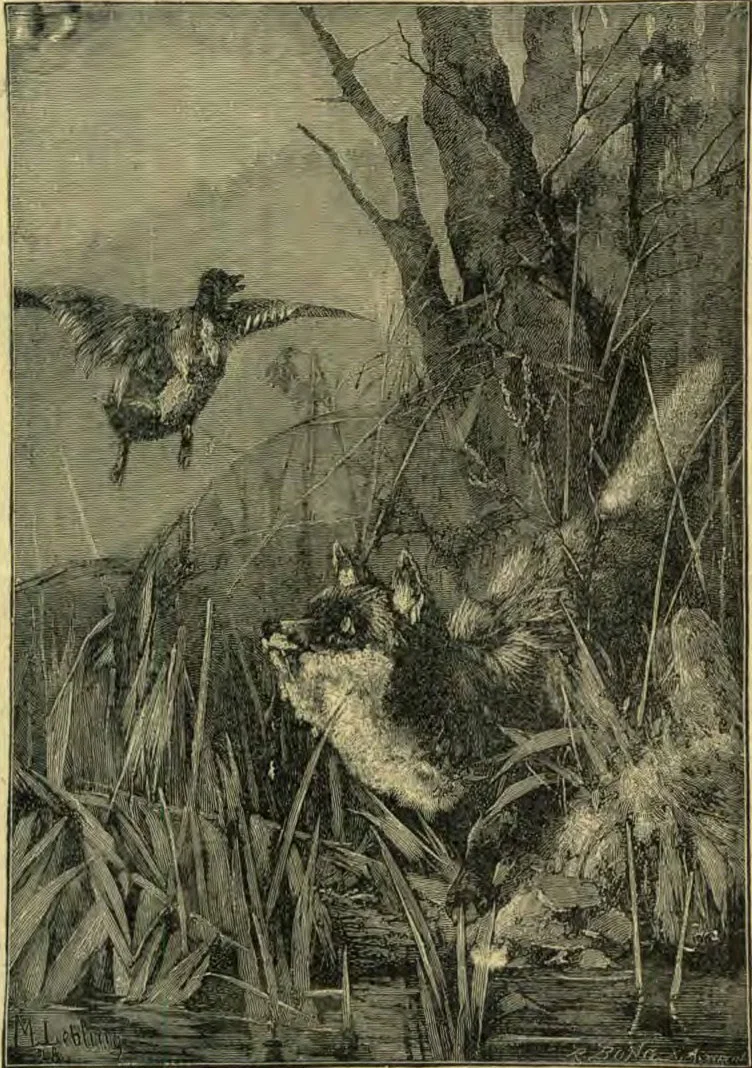
THE LOST DINNER.

The wild duck swam in the sedgy lake, And the red fox crouched in the long, dank brake; A mighty hunter was he. The duck swam circling round and round, Nearer and nearer the enemy’s ground; For never a fear had she.
With gleaming eyes and bristling hair, The red fox crept from his hidden lair; “A good fat dinner,” quoth he; “I’ll eat what I can all alone by myself, And the rest I’ll take home and lay on the shelf, And company have for tea.”
The duck swam close to the enemy’s ground, And the red fox made a terrible bound; But high in the air rose she.
With his mouth full of feathers, his heart full of hate, Poor Reynard slunk home to contemplate,— But not over cold duck for tea.
S. ISADORE MINER.

Do Not Form the Habit of Making Excuses

Do not form the habit of making excuses. Remember what the old proverb says, “A man who is good for making excuses is good for nothing else.” If you have done wrong, be willing to confess it. Do not try to hide it, or to throw the blame on another. You will gain nothing by hiding or excusing a fault; but, while confession is good, there is nothing better than amendment.

Diligence Rewarded: Labor With a Willing Heart

NEVER be idle; as a rule, idle hands are mischievous. Work with a will, and your labor will be blest.

Letter Budget.

Here is letter from New London, N. Y., written by one of our Battle Creek boys. The letter reads: “My name is Elmer Ledingham. I am ten years old. I live in Battle Creek, but at present am staying with my friends here, helping in the store and doing chores. I am a member of the Sabbath-school and missionary society in Battle Creek. I like the Instructor very much. Please print this letter.”
We are glad to hear from Elmer, and that although he is on a visit, he is trying to be useful. He will enjoy his play hours better for having been helpful when there was work he could do.
LILLIE A. STINSON, of Oswego Co., N. Y., writes: “I thought I would write a few lines for the Budget. I am a little girl ten years old. There are seven in our family, and they all keep the Sabbath. We have a nice Sabbath-school of forty members. Three years ago there were no Sabbath-keepers in this place, but Elds. Brown and Swift came here with a tent, and there is now quite a company who meet upon the Sabbath. If my letter is printed, I may write again sometime.”
If the forty members of your school are all faithful and busy workers, how many members ought you to have in three years from this time? There ought to be forty lights in your place, surely; and if all were shining, somebody ought to see; don't you think so? Shall you, Lillie, let your light shine?
TILLIE A. GORRELL, of Fannin Co., Texas, writing in a letter with one of her Sabbath-school mates, says: “I am a little girl eleven years old. I keep the Sabbath, go to Sabbath-school, and learn my lessons well in Book No. 3. I like to go Sabbath-school. I have missed one question this quarter. Mamma and papa are going to camp-meeting. I am trying to be a good girl so I can meet the Instructor family in the new earth. I give my love to you all.”
Tillie's letter reads plainly, “I have missed one question this quarter.” She may have left out the little word not, intending to say, “I have not missed one question this quarter.” She has done well if she has missed but one. How many have done as well as she?
SALLIE R. L. KIVETT, of Cass Co., Mo., writes: “Thinking you would like to hear from our Sabbath-school once more, I thought I would write again. We have a good school, three miles from our place, which consists of all the members, large and small, of four different families, and a part of each of four other families. Our school numbers thirty-six. Twelve members of the school take part in our prayer and social meetings, which I think are good. I love to be where I can hear singing and prayer. Our camp-meeting, which is to be held from October first to the thirteenth, at Pleasant Hill, is only about twelve miles from us. I always love to have camp-meeting time come, for we have such good meetings. I should be more than pleased to see Eld. Van Horn there. We take two copies of the Instructor, and can say that it is the best paper for the youth that we have ever seen. My brother Oscar ordered a copy of the Instructor as a present to a cousin in North Carolina, and they, too, think it is a nice paper; and they appreciate Golden Grains as a premium. Another cousin, to whom I made a present of Child's Poems, says he would not take five dollars for it. I would like canvassing so well for “Sunshine at Home” and Signs of the Times. I would like, if there was space, to tell the little readers of the Instructor about our silk-worms; for we have those that hatch twice and three times a year. We do not feed them anything but Osage orange leaves. I am trying to overcome my sins, and my greatest desire is to be an every-day Christian. May the Instructor family live faithful till Jesus comes.”
When Sallie wrote last January, and signed S. R. L. Kivett, in calling her a boy we did not guess correctly. We beg pardon for not guessing more nearly right. It would be well for our little writers to give in full one Christian name, that a like mistake may not occur.

You have reached the end of this edition.

The Youth’s Instructor · Sep 30, 1885