WHEN a current of electricity flows through a wrapping of wire on an iron bar, it makes a magnet of the bar, giving it power to pull other iron to itself. That pulling power is able to turn machinery, and, in fact, all the electric machinery in the world runs by it.
We work with our hands; electricity works with its hands, too, but they are magnets. They pull and push on the rims of wheels, and turn them, just as our hands do.
Knowing that one simple fact, I am sure no wide-awake “Work-Table” boy will say “I can’t” when it comes to building our little electric engine. It is simplicity itself, can be constructed very cheaply, will run at a great speed, and will give a clear insight into the way electricity does things.
Making the Magnet
Fig. 1. Fig. 2.
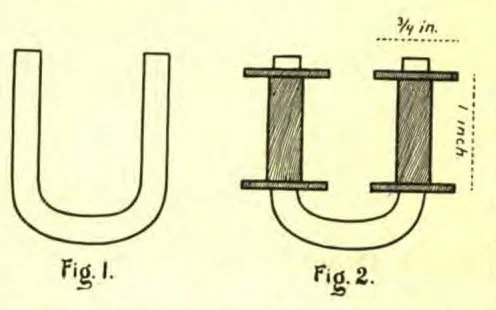
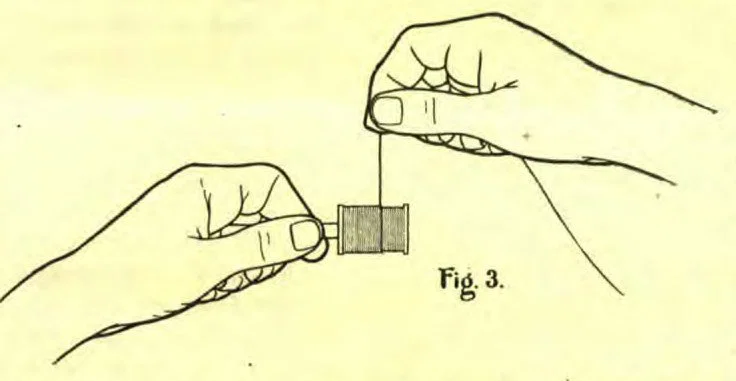
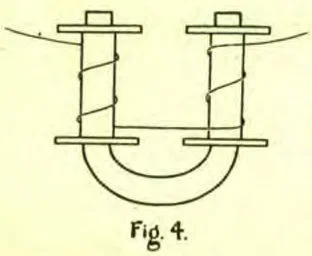
Every electric machine must have a magnet connected with it somewhere. The motor needs one of the little electric-bell magnets, and one can probably get an old one for five or ten cents at an electrical shop. But if he can not buy it, he can certainly make it in the following manner: bend a piece of round iron ¼ x 4½ inches into a horseshoe, like Fig. 1. File the ends off level. With pasteboard, writing paper, and glue or mucilage make two bobbins as shown in Fig. 2. The stems of the bobbins consist of from three to five layers of paper, brought through the cardboard discs, and glued on the ends. The bobbins should fit loosely. Fig. 3 shows the method of wrapping the magnet with wire. One should have from three-quarters to one ounce of cotton-covered copper magnet wire of No. 24 or 26 for each bobbin; it will cost from five to ten cents an ounce. Wrap tight and even and level. When both bobbins are wrapped as smooth as a spool of thread, without having the wire cut between them, they are ready to slip on the horseshoe-magnet. Fig. 4 shows how to put them on. One can see also that the two bobbins are wrapped differently, one one way and one the other. This is very necessary, for the magnet will not work unless it is thus wrapped.
Fig. 3.
The magnet is now ready for use, and when connected with a battery, it should lift large pieces of iron readily. If it does not, some mistake has been made in the wrapping, and the spool will need to be rewrapped.
Building the Machine
Fig. 4.
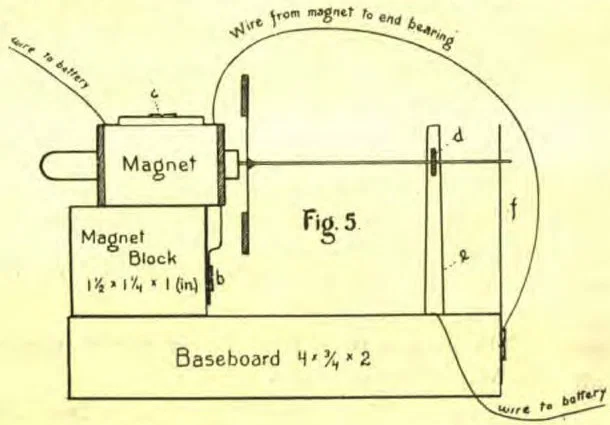
Fig. 5 indicates the best way of mounting the magnet. A small block, c, is screwed upon the top of the magnet, the screw being long, and going down between the bobbins into the “magnet block” below. This holds the “electric hands” solid and steady.
Fig. 5.
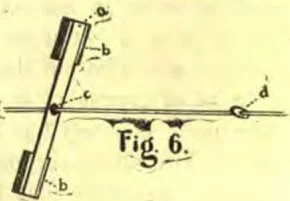
Fig. 6 is the running-gear. The spindle is a piece of hat pin; a is a one-quarter inch strip of heavy tin soldered on the pin at c, one-half inch from the end; b and b are little pieces of iron three-eighths inch square, on which the magnet can pull; d is a little oval of copper or brass soldered near the other end and at right angles to a.
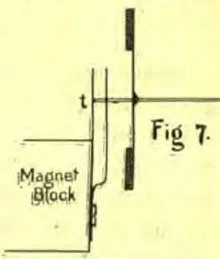
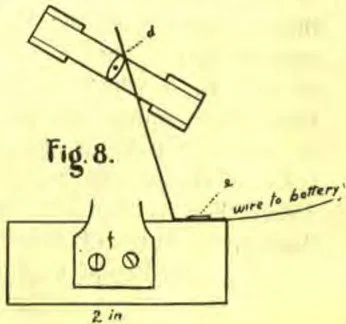
Some little strips of tin or sheet brass are quickly fashioned into bearings. The front bearing, Fig. 7, has an extra strip of brass or tin, against which the magnet pulls the spindle. It is marked t in the diagram, and is bent backward or forward till the running-gear works quite close to the horseshoe, yet without striking it. The end bearing shown in F, Figs. 5 and 8, and also in the photograph, needs no further explanation.
Fig. 6.
Fig. 8 shows a very thin brass strip rubbing against the oval soldered on the spindle. Just how heavily this must touch, and just when it must begin and end its touch, can only be determined by experiment. The strip can, of course, be bent to touch just as may seem necessary.
Connecting with the Battery
Fig. 5 leaves little to be explained as regards the wiring. One wire from the magnet runs directly to the battery. The other magnet wire runs to the end bearing. Another wire goes from the spring shown in Figs. 5 and 8, to the battery.
The Battery Required
Almost any kind of battery that can be named will make this little engine hum. A dry battery, such as is used for door-bell and telephone work, will do very well; one cell is enough.
If one is to make a battery, and do it simply and cheaply, I would recommend him to make the bluestone gravity, or the bichromate tumbler battery described in the INSTRUCTOR dated Dec. 22, 1903.
The value of this little motor is not in the amount of work it can do, for it will do none, but rather in the experience and dexterity one acquires while making it, and in the insight he certainly gets into the workings of this mysterious power—electricity, which is the world’s willing servant to-day.
EDISON DRIVER.
Fig 7.
Fig. 8.
Height of the Polynesian Peoples Compared
The tallest people are the Polynesians, that island race which includes the natives of Samoa, New Zealand, the Marquesas, and Hawaii. Their average full-grown men stand 5 feet 9 1-3 inches, whereas the American averages 5 feet 7 2-3 inches—Selected.
A Message to Our Young People
By Geo. F. Enoch
From the Mission Field
I AM sure that none watch the growth of our Young People's Societies with more interest than the young men and women who have gone out from home and friends to spend their life and strength in carrying the Advent Message in the new fields. We can assure you that as the news of this awakening has reached us, we have been greatly cheered.
As we think of the thousands of young men and women dwelling in ease at home, and then face the great unwarned multitudes before us, with our workers laboring one by one, so far distant from one another as to be almost overwhelmed by the magnitude of the task before them, we are led to our knees in earnest prayer that the Lord will awaken his people to appreciate the situation as it is.
The Bible says that the Lord has chosen the young because they are strong. As we enter upon the last of the final conflict, the brunt of the battle will fall upon our young people. We shall look to our older ones for guidance, wisdom, and counsel, but our young men and women must step forward and bear the heat of the day, the fierceness of the conflict.
And why should it not be so? Why has the Lord endowed the young people of this denomination with strength, if not that they should spend and be spent in his service? There surely has never been a better or nobler cause set before men in which to put their talents out to usury.
It is of course a way of self-denial and self-sacrifice. But self has brought sin into the universe, with all its accompanying pain, misery, and death. Anything that will help in the work of subduing self should be welcomed heartily.
There is a pleasure in sin, but it is only for a season. The sweetness of self-sacrifice far outweighs those transitory pleasures. Self-sacrifice and self-denial should now be carried conscientiously into our daily life. Then whether at home or abroad, the rule is the same. The mind of every one of our young people should be divested of the idea that there is any romance connected with foreign missionary work. There is a pleasure, but it is the pleasure of toil and self-sacrifice for the Master. One can and should enjoy that wherever he is, and under all circumstances.
It means much to toil day after day under the heat of a tropical sun, with no cooler days to look forward to, but rather one unending “hot spell” stretching out in the distance, to be cut short only by the coming of the blessed Jesus; to spend your life near pestilential swamps, which contaminate the surrounding atmosphere with their deadly miasma; to be laid with those that are near and dear to you on beds of pain and suffering, with none to minister to your physical needs; yes, this and more for his dear name's sake.
We pray that each member of our Young People's Society shall volunteer for service. Let that service begin right where you are. In the Sabbath-school and the prayer-meeting there is abundant need of the help you can give. In the selling of the Signs or any of our good missionary papers and books, there lies before our young people, however limited their advantages, an unequaled opportunity to develop their talents. If you have grit, pluck, and perseverance, this, together with the facilities offered by our training-schools, either as a resident student or through the Correspondence Courses, places you in the way of an education that is not surpassed in the world to-day. There are great possibilities in our spare and wasted moments. We wish for young men and women out in the mission field, who are not daunted by the most discouraging outlook, and who are able even under the most forbidding circumstances to wring victory from apparent defeat.
With such a leader as Prince Emmanuel, with the privilege of linking up with the heavenly intelligences, with the opportunity before us of placing ourselves in the channel of all the wisdom and power of the universe, the young people of this denomination are well able to do the work committed to them.
“To the work, to the work!
There is labor for all,
For the kingdom of darkness and error shall fall;
And the name of Jehovah exalted shall be
In the loud-swelling chorus ‘Salvation is free.’”
GEO. F. ENOCH.
Turning Wasted Waters into Blessing
By J. R. Miller
YEARS ago there were in southern California great stretches of burning plains, covered with dry sand, with scarcely a living thing growing anywhere upon them. Meanwhile, up in the mountains, there were streams of water produced by the melting snows, running to waste, oftimes causing damage as they rushed down the gorges. Men saw that if those wasting and destructive streams could only be carried down into the valleys, and made to distribute their waters over the alkaline sands, the desert could be changed into a garden. To-day great orange orchards grow on what, twenty-five years ago, were barren wastes.
This is an illustration of what the forces of human nature, which now in so many lives run riot in dissipation, doing harm to others, and hurt to God’s kingdom, might be trained to do, if all their energies were but turned to noble and beneficent uses. That is what Christ proposes to do with those who come to him. He sets them free, not by unleashing them to live without law or control, but by bringing them under his own yoke, where in true and holy serving and obedience they will not only find rest and peace for themselves, but will also become the means of carrying benediction to others.— J. R. Miller.
People turn upon their spiritual leaders — strife and bloodshed everywhere.
Prophecies fulfilled — wicked destroyed and earth desolated.
Satan’s long period of reflection.
Judgment of the wicked.
Second resurrection.
Note
Make the lesson a real Bible study, fixing in the minds of all the texts relating to the various points.
Good Words
An interesting report comes to us from the Boston Young People’s Society. Their Society is not large, the average attendance being only ten, and a number of the members are children, from eight to twelve years of age.
The first Sabbath in each month is devoted to the study of some special country. The intervening lessons will be spent in Bible studies conducted in the form of readings, but more thorough than is usual in such readings, that the young people may “be ready to give an answer to every man that asketh” them a reason for the hope within. Prayer, social meeting, and recitation of Scripture form part of the regular exercises. It is expected that each one will do some practical work in spreading this message.
The program for the last Sabbath in May is given below; nearly all of those that took part were little people:—
Life of Livingstone, by Miss Leonard.
Poem, by Katie Mooney.
Story (bringing in points on the Sabbath questions), composed and read by Miss Russell.
Four comforting promises of God, repeated by Avis Leonard.
The biggest bear story in the Bible, told by Glen Russell.
Paper — “The Sweetest Love Story in the Word” — by Miss Clough.
Thirty of Solomon’s proverbs, selected and read by Lewis Darouche.
Paper — “The Life of Moses” — by Mildred Hastings.
The most musical psalm — ten verses repeated by May Clough.
Paper — “The Japanese” — Gladys Darouche.
The Palm Tree as a Symbol of Christian Life
The palm tree beaten by the scorching sun and fierce sand-storm, stands green and flourishing and fruitful in the midst of the desert. Its roots are fed by the living springs. Its crown of verdure is seen afar over the parched, desolate plain; and the traveler, ready to die, urges his failing steps to the cool shade and the life-giving water.
The tree of the desert is a symbol of what God means the life of his children in this world to be. They are to guide weary souls, full of unrest, ready to perish in the desert of sin, to the living water. They are to point their fellow men to Him who gives the invitation, “If any man thirst, let him come unto me and drink.”
Flumed Torrent: Harnessing Our Passions for Good
By J. R. Miller
A MAN found a wild torrent in the mountain. It could work only waste and ruin as it rushed, uncontrollable, down the gorge. He built a flume for it, and carried its wild floods in quiet streams down into the valley, where they watered the fields and gardens, gave drink to the thirsty, and turned many a wheel of industry. That was far better than if he had dried up the torrent. It was far better, too, than if it had been left to flow on forever with destructive force. Now it was flumed and made to do good, and make the world richer and more beautiful. That is what God wants to do with the cravings, the desires, the passions, the longings, and all the mighty energies of our nature. They are not to be allowed to work waste and ruin in efforts to find gratification in earthly channels, in unbridled license. That is sin’s way. Rather, these great forces in our nature are to come under the yoke of Christ, and are to be led by him into all holy service for God and man.— J. R. Miller.
Something for the Little People
By Ida Pilquist
I now wish to present to you our children, whose photograph you may see on the first page, for I know that you are interested in looking at pictures. I presume you think they appear rather strange. From their clothing it would be difficult to say whether they are boys or girls, Swedish or Chinese. Therefore I gladly introduce our two little girls to the younger readers of this paper.
Hannah Elizabeth Pilquist is the larger one, a little more than six and one-half years old. She has just recovered from a siege of the typhoid fever, and consequently looks rather thin. Ellen Maria Josefina Pilquist, somewhat smaller than her sister, was four years old last August, and she also has been ill for some time, but is now, as you can tell from the picture, happy and robust, for which we praise the Lord. Now I presume you would like to hear something more about these two Swedish girls.
Hannah was born in Ning-hsafu, which is located in Kansu, a northwestern province of China. Since she was six weeks old, we have almost constantly traveled here and there in China, America, and Europe; but she, of course, does not remember much of what she has seen. Hannah is quite tall and spindling. She has light-blue eyes and brown hair, and a calm, quiet disposition, but is at times playful. She is intelligent for her age, and takes pleasure in making herself useful. She has already read through the first part of her A B C book, and she sews quite well, but the best thing of all is that Hannah loves Jesus, is an obedient girl, and never wearies of listening to what is said about our Saviour. Often she says to me, “Please read to me, read about Jesus.”
On the way to the place where we now live. I was taken ill with malarial fever, and one evening when we stopped at a little country place to rest after the wearisome journey of the day, Hannah said, “To-day, when I saw mama so sick, I prayed to Jesus that she would not die.” After our arrival she came to me one time when the fever was again raging, and asked, “Shall I read the Bible to mama?” I wished to hear read the fourteenth chapter of John, and Hannah tried to find this, but not succeeding, I helped her, and then in her childish voice, she read the beautiful words, “Let not your heart be troubled.”
Little Ellen is quite different from her sister, both in appearance and in disposition. She is more playful and boisterous. She was born in America, in Battle Creek, Michigan, and is consequently neither Swedish nor Chinese, as far as her birthplace is concerned. She has a plump and robust appearance, and is well proportioned. In comparison with Chinese children of her own age, she is quite a little larger. Her hair is light brown, and her eyes are dark. I have nothing very remarkable to write about Ellen, only to say that she is a sweet and lovely girl. Her large and beautiful eyes, her round and rosy cheeks, and her small, pretty mouth, which is continually busy speaking either Swedish or Chinese, makes her very attractive. She is just now engaged in ironing her doll’s clothes after the Chinese fashion, which is done by laying a garment on a stool and pounding it with a piece of flat board. The children usually play in Swedish, but when playing school or store, or carrying a chair as the coolies do, they play in Chinese, which at such times is more natural.
We have a watch-dog named Tref, a few goats, which give us rich, delicious milk, and some lambs. The children are very fond of all of these.
Hannah and Ellen have some playmates of the same age, with whom they associate at times to while away the hours; and thus their childhood days are spent in a quiet and commonplace way.
Now we have made our little readers acquainted with our dear children, and when you pray for the poor heathen children, I hope you will not forget to pray for my two little girls. They send their love with mine to you. IDA PILQUIST.
Candy or Missions
By Mrs. N. C. Alger
“O GRANDMA, please tell me what I shall do, for I have joined the new mission band, and we have to pay a whole quarter of a dollar a year. Where do you suppose I shall get it?”
Grandma Wheatley laid down the stocking she was mending, and looked kindly at Katie, the girl who seemed to think twenty-five cents a large sum to send to the heathen.
By and by she said, slowly, “Long years ago money was not so easily gotten as it is now. Girls and boys in the town where I lived seldom had any. If we wanted something sweet, there was no candy for us, and I never heard of ice-cream. If we wanted dolls, we rolled up old shawls, dressed corn-cobs, or got some older persons to make rag babies.
“In those days I heard of some young ladies who formed a missionary society, agreeing to meet once a month, and pay one dollar a year. Where the money was coming from, not one of them knew, but as Jesus said, ‘Go, teach all nations,’ they were going to obey him as far as they could. One was mourning, when the day came for their third meeting, because she had nothing to give; but when she turned and oiled the great cheeses in the dairy, under the last one lay just the sum she wanted, though how it came there was a mystery to the whole family.
“Another, having tried in vain to secure some money, found a quarter under some chips she was picking up in the yard. One did some writing for her father which he was to have a lawyer do, and, to her surprise, earned her money.
“But children now have more money. If you will try one month, and then can not get anything to help others to find the Saviour, we will talk it over again.”
Katie went out, very slowly, for she knew she often had money to spend, but thought she must have that for candy, and the missionary money she would find somewhere, just as the young ladies did. She could not write well, and did not live on a farm where there were cheeses to turn; but there was the woodshed, and if that failed, the street.
She had heard of people finding money on the sidewalk; so, after filling all the baskets with chips, and kicking around in the shed until there was danger that she would ruin her new boots, vainly trying to strike a silver mine, she began to search the streets.
Day after day she went along with head bent low, and was nearly thrown down several times, by persons who were carrying burdens and did not see her.
At last she went to her grandma, saying, “There, grandma! I have tried hard for a whole month, and not a single quarter can I find.”
“What were you eating as you came in?” asked the dear old lady, with a sorrowful look in her eyes.
“Candy,” said Katie.
“And how much have you spent for candy this week?”
“Oh, I don’t know; three cents to-day, five yesterday, two the day before, and, let me see, ten Monday. Uncle Will gave me fifteen cents, and papa ten this week.”
“Katie,” said Grandma Wheatley, solemnly, “are you sure Jesus is pleased with a little girl who could spend twenty-five cents for candy in one short week, yet could not give as much in a whole year to send the story of his love to the heathen, though she knew there were millions and millions bowing down to wood and stone, knowing nothing of Christ and heaven? If you hunt the Bible through, you can find no promise of beautiful mansions in heaven for those who are too selfish to send others word that there is a heaven, and that Christ wants them there.”
After Katie left grandma, she did a bit of thinking; she saw how very selfish she had been, and we are glad to say she found a way to get her quarter for the missionary work.—Mrs. N. C. Alger.
Half Past
By Jennie Smith
“HALF past what?” asked Connie.
“Three,” guessed Nan.
“No.”
Then came Millie’s turn.
“Nine,” she guessed.
“No,” said Connie. “Ada comes next.”
And so it went on down the long line of girls who were playing the game, and at last it came to Kitty.
“Eight,” she guessed.
“Right!” cried Connie, and then she started toward the corner, running as hard as she could, and Kitty ran after her. But Connie reached the post on the corner before Kitty caught up.
“You didn’t get me!” she said, triumphantly.
“No, I can always guess the number, but I can never catch anybody,” laughed the little girl, and she again took her place in the line.
Then Connie and a girl that she picked out chose a number, and the guessing went on.
“I wish I could catch somebody just once,” sighed Kitty. “I’d like to be chased.”
“Half past?” Nan was asking, and Kitty’s turn had come to answer.
“Four,” she said.
“Right.”
Then Nan started on a run, but what was the matter with Kitty? When she heard the word, “Right,” she had given a jump and a little scream, cried “Half-past four!” and started to run, not after Nan, but in the opposite direction. On and on she went, with the girls watching her in wonder.
When Nan saw that she was not being pursued, she went back to the others.
“Why did Kitty run that way?” she asked.
But nobody knew.
“She just looked up at the sky, hollered, and ran off,” said one of the smaller girls.
“I think she has gone home,” remarked another.
“Suppose we all go after her and find out why she did it,” suggested Nan.6
So off they started, going two by two, and looking very much like a procession of some kind.
When they reached Kitty’s home, they found her sitting on the front stoop. Her face was flushed, and she looked tired, but she smiled when she saw them.
“Why did you run away?” demanded several of the girls.
“I was so afraid that I wouldn’t get here in time,” Kitty told them. “You see, I promised mama that I would be here by half-past four, and when we said that in the game, I just thought of it, and I had to hurry as fast as I could so as to keep my word.”
“Would your mother punish you if you hadn’t come?” questioned Nan.
“O, no, but she would have been sorry!”
“Anyway,” Kitty added, “when I say I’ll do a thing, I want to do it, if possible.”—Jennie Smith.
Little Faults
By George Bancroft Griffith
“Take us the foxes, the little foxes that spoil the vines.”
THE polished shield, so bright and clear,
May dented be with heavy spear:
Its luster still, despite that blow,
Will dazzle the oncoming foe.
But prick it o’er with needles fine,
A million little shafts in line,
And, lo! the polish all is gone,
The knight who bears it limps forlorn.
One sin the conscience may not sear,
Nor make, atoned for, friend less dear;
But petty faults made numberless
Will lose one heaven, as all confess.
George Bancroft Griffith.
“My Faith Looks up to Thee”
By Amos R. Wells
THIS is probably the greatest hymn written by an American. Its author, Ray Palmer, was the son of a judge, Hon. Thomas Palmer, and was born at Little Compton, Rhode Island, on Nov. 12, 1808. He became a clerk in a Boston dry-goods store, a student at Phillips Academy and at Yale, a teacher in New York and New Haven, pastor of several churches, and corresponding secretary of the American Congregational Union.
In 1830, immediately after his graduation from Yale, when Mr. Palmer was teaching in New York, he wrote his great hymn. He was then a young man of twenty-two.
“The words of the hymn,” he afterward said, “were born of my own soul.” He was reading, in the quiet of his own room, a brief German poem of only two stanzas, picturing a suppliant before the cross. Touched by the lines, he translated them, and added four stanzas of his own—the immortal hymn:—
“My faith looks up to Thee,
Thou Lamb of Calvary,
Saviour divine;
Now hear me while I pray,
Take all my guilt away,
O let me from this day
Be wholly thine!
“May thy rich grace impart
Strength to my fainting heart,
My zeal inspire;
As thou hast died for me,
O may my love to thee
Pure, warm, and changeless be,
A living fire!
“While life’s dark maze I tread,
And griefs around me spread,
Be thou my Guide;
Bid darkness turn to day,
Wipe sorrow’s tears away,
Nor let me ever stray
From thee aside.
“When ends life’s transient dream,
When death’s cold, sullen stream
Shall o’er me roll,
Blest Saviour, then, in love,
Fear and distrust remove;
O bear me safe above,
A ransomed soul!”
Dr. Palmer afterward said that when he was writing the last line, “A ransomed soul,” “the thought that the whole work of redemption and salvation was involved in those words, and suggested the theme of eternal praises, moved the writer to a degree of emotion that brought abundant tears.”
The hymn was copied into a little morocco-covered book, which Mr. Palmer carried in his pocket, reading the verses in his hours of communion with the Father. Its use as a hymn is due to a chance meeting of Mr. Palmer on a Boston street with Lowell Mason, the famous musician. He asked Mr. Palmer for a hymn which he might use in “Spiritual Songs for Social Worship,” which he was then preparing, and a copy of “My faith looks up to Thee” was at once made out in a near-by store. Meeting the author on the street a few days later, Mr. Mason exclaimed, “You may live many years and do many good things, but I think you will be best known to posterity as the author of ‘My faith looks up to Thee.’”
Of this incident Prof. Austin Phelps once wrote: “One of those fleeting conjunctions of circumstances and men! The doctor of music and future doctor of theology are thrown together in the roaring thoroughfare of commerce for a brief interview, scarcely more than enough for a morning salutation; and the sequence is the publication of a Christian lyric which is to be sung around the world.” The tune which Mason composed is the well-known and beautiful “Olivet,” to which “My faith looks up to Thee” has always been sung.
The American publication was in 1832. In 1842 the hymn was introduced into Great Britain, and became very popular there. Indeed, it was not till it had received this approval over the sea that it became widely known in America.
This was Mr. Palmer’s first hymn, and he afterward wrote many others, among them “Come, Jesus, Redeemer, abide thou with me” and “Take me, O my Father, take me.” His translations of Latin hymns are especially fine, the best known being “Jesus, thou joy of loving hearts,” and “Come, Holy Ghost, in love.” Mr. Palmer’s own favorite among his hymns was “Jesus, these eyes have never seen.” From this hymn were taken the last words the poet uttered, as, the day before he passed away, he was heard faintly murmuring the stanza:—
“When death these mortal eyes shall seal,
And still this throbbing heart,
The rending veil shall thee reveal
All glorious as thou art.”
Mr. Palmer was a man of gentle, lovable character, a saintly man, but a man of strong feeling and powerful enthusiasm.
The most touching incident connected with this great hymn is perhaps the story of eight young Christian soldiers that met for prayer in a tent just before one of the terrible battles of the Wilderness in the Civil War. They desired to write a statement which should show how they faced death, and go as a comforting message to the relatives of those whom the coming battle might remove from earth. They decided to copy this hymn, and sign it as their sufficient declaration of Christian faith, and they did so. On the morrow seven of these brave Union soldiers died for their country.—Amos R. Wells.