Review and Herald Publishing Assn. · Washington, D.C. · June 21, 1904
Hankow, China
By A. C. Selmon
AFTER a voyage of three and one-half days, traveling six hundred miles, we caught our first glimpse, on October 31, of Hankow. As we drew near the harbor, several small boats came out to meet the steamer, the men jumping upon the boat while it was in motion. Three fell, one of whom was killed by the screw propeller striking him. The officers paid but little attention to the men, for they were only Chinamen; but it touched us, for our sympathies were with this race of people, who have not had the privileges of enlightenment.
Anchoring, we were expecting to see Brother Pilquist from Sin Iang Cheo, and in a short time two well-dressed and intelligent-looking Chinamen, their faces all aglow, came on the boat and sought us out from the rest of the passengers, and motioned to us sufficiently to make us understand that Brother Pilquist was in Hankow, and would soon be there to meet us. These men were two of our converts.
Hankow is to China what Chicago is to the United States. Located centrally in China, it has a railroad which connects it with the northern part of China, and another previously mentioned which connects it with the southern part. It is located on the Yangtse Kiang River at the point where the Han River joins it, these two rivers putting it in connection with western China, as both are navigable for many miles by steam launches and small river steamers.
Hankow is composed of the Chinese city proper, and several foreign settlements, the foreign portion lying east of the Chinese city. Foreigners are rapidly emigrating here, most of them for the purpose of speculating, and they are therefore rapidly building up new industries. The Russians have immense tea factories, and they control the tea industry of China, as Rockefeller does the oil in America.
There are twenty-two river steamers plying back and forth between Hankow and Shanghai each week; two of the small cruisers captured by Dewey at Manila were lying in the harbor at Hankow, subject to call by the American consul in case of trouble arising.
Here we found paved streets, four and five story buildings, and a newly built city after modern pattern.
All the draying and transferring of freight and baggage are accomplished by hand labor, instead of using animals. Our company had their baggage transferred to a hotel, and it required twenty-two coolies to carry it.
Passports to travel in China had to be secured here. Having given evidence to the consul that we were citizens of the United States, he supplied us with a passport issued by the consul at Peking, and sealed by the Chinese imperial government, granting us the privilege of traveling through China, and offering us protection if needed, but we feel much safer under the protection of God, who has brought us here, and will allow nothing to harm us.
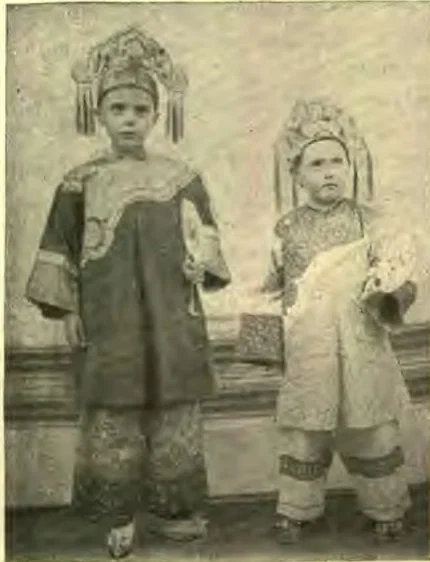
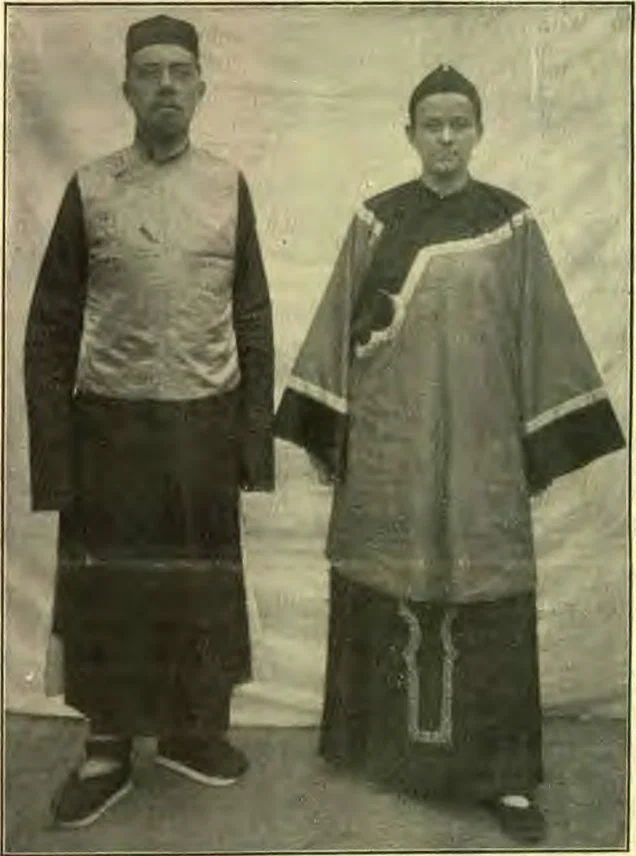
Brother Pilquist, who was clothed in Chinese costume, aided us in securing Chinese apparel, and here we made the change and became Chinamen. This costume has many superior qualities to our own, being lighter, looser, and altogether more comfortable.
Hankow to Sin Iang Cheo
DR. AND MRS. MILLER IN CHINESE COSTUME
From Hankow to Sin Iang Cheo we go by way of the Hankow and Peking Railroad. When we learned that this line of railroad was being built through the central part of China, we felt that it was the Lord's work to serve as an aid in spreading his message to the benighted millions of this land.
Before the construction of this road, the only means of conveyance to the interior was by means of sedan-chairs, wheelbarrows, and donkey carts, methods too slow for an American.
At the present time there is being constructed a railroad running from Canton to Hankow, which will be completed within two years. The line running from Hankow to the north is now completed to within one hundred miles of the Yellow River.
The Hankow and Peking Railroad is being built by a company of French and Belgian capitalists. The operating of the road is under the joint control of this company and the Chinese government.
From Hankow northward, the country through which the road is built is quite level until the Huai Yang Mountains are reached; here the road goes through a tunnel about eighty rods in length.
The road-bed is well constructed, and is probably equal to those made in the States, but as much can not be said for the service the road offers to its many patrons.
Locomotives are of the modern types. The exterior of the first- and second-class passenger coaches presents the appearance of a freight-car with windows in the sides. The interior of the first-class coaches is divided into small compartments holding from two to four persons; all the seats and interior finishings are made of plain boards. The third-class passenger-cars are similar to the open box cars used in the States for hauling coal. No seats are provided in them, and the occupant is exposed to both wind and weather. No baggage cars are provided, and the only allowance made the passenger is hand luggage, which, with the ordinary Chinaman, includes all his possessions.
The fare from Hankow to Sin Iang Cheo, a distance of one hundred thirty miles, is $3.75 for first-class passengers, second-class fare is half of this, and third-class fare is half of the second-class.
The train crew is made up entirely of Chinese, with the exception of one foreigner, who has a general oversight of affairs.
Very few of the stations have any baggage room, and this necessitates one's looking after his baggage very carefully, lest some absent-minded native walk off with a part of it. The road is largely patronized by the Chinese, both for passenger and freight service.
Sin Iang Cheo is one of the most important stations along the line. Our mission station was located here for some time, but it was thought best to move away from this place, because the foreign element coming in with the newly constructed railroad had an evil influence on the natives. The Chinese are very prone to copy the vices of the foreigners, and these ungodly men coming into the country do much to hinder the work of the missionary.
Reaching this place late in the afternoon, we exchanged our box cars for a Chinese inn. The2typical Chinese inn has mud walls and a roof of tile or thatch; some of the inns, however, have partitions between apartments, made of light bamboo work so loosely constructed that one is exposed to the gaze of his neighbor, and also to the smoke from his pipe. The furniture consists of a stool, a table, and a bamboo frame for a bed. In many of the inns one must dispense with this latter article, and be content with spreading his mats on the bare earth floor. The fare served to the guest is tea, a bowl of rice, a bowl of food consisting of a mixture of various vegetables, which, as a rule, is well seasoned with onions or red pepper.
At Sin Iang Cheo one must dispense with all modern traveling conveniences, and have recourse to those methods of travel which were used in the days of Abraham. A. C. SELMON, M. D.
Strength in Weakness
By L. A. Reed
And now to resume our study of the germination of the kernel of corn. We have spoken of the formation of the root, the sprouting of the seed above the soil, and the formation of the foliage.
And foliage is the first thing the plant must secure, after obtaining a hold in the soil; for in the leaves the material of the plant is to be manufactured. The plant, to produce a root, a short stem, and the first leaves, depends upon the material laid up in the seed. But when once this supply in the seed has been exhausted, the plant must die unless the leaves and root work together to continue its life and growth.
Wheat and other grain will make quite a good start in plain, moist, warm sand; but in this soil it can never go farther than its original supply of food in the seed will carry it. The seed will furnish food for the start; but it will not carry the plant through all the round of its growth and life.
And this principle of the natural world holds true in the matter of spiritual birth and life. Every child of God must first be born of a seed, “an incorruptible seed,” even the Word of God. This first experience carries him a certain distance in the spiritual life; but he can not depend upon this first experience solely for the attainments of the later years.
When the root, stem, and foliage have formed, a complete plant has come into existence. At this stage it must begin to be a fully organized plant indeed. No longer can it live upon a supply of energy already stored up by it from the parent plant. It must begin to do a work for itself. If it fails to do this individual work, it ceases to exist. Failure for it in this is death. Surrounded by a food-laden atmosphere, flooded with the energizing light, its root bathed in vivifying moisture, it dies because it does not appropriate these life-giving elements.
But a plant under these perfect conditions lives and does its work. The stones may keep its roots from moisture, the thorns may choke its foliage and keep away its supply of light and air; under such conditions, of course it must die. And so it is with the spiritual plant. Once born of the Spirit, it will continue to grow, unless the cares of this world, the deceitfulness of riches, or other hindering things prevent it from appropriating the life of God.
Yes, there must be a growth of the plant as well as a germinating of the seed. However, do not think you can find this later, maturing growth through effort or labor of your own. You have but to fulfil the conditions of growth, and, naturally and easily, life will do the work. Yet even so growing and maturing, it will be but an instrument, all weak and frail, yet thoroughly adapted to its purpose. In it God's great sufficiency shall be manifested and made perfect, even to the maturing and glorifying of a human soul.
In the following experiment, we have a remarkable example of great power manifested and made perfect in weakness:—
“In the Agricultural College at Amherst, Massachusetts, a squash of the yellow Chile variety was put in harness in 1874 to see how much it would lift by its power of growth.
“It was not an oak or mahogany tree, but a soft, pulpy, squashy squash that one could poke his finger into, nourished through a soft, succulent vine that one could mash between finger and thumb.
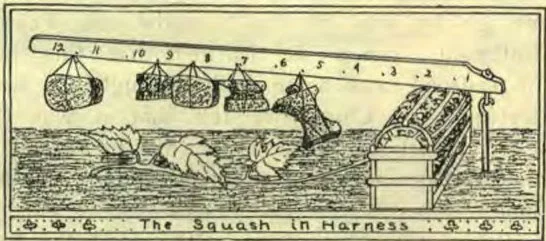
“The squash was confined in an open harness of iron and wood, and the amount lifted was indicated by weights on the lever over the top. There were, including seventy nodal roots, more than eighty thousand feet of roots and rootlets. The roots increased one thousand feet in twenty-four hours. They were afforded every advantage by being grown in a hotbed. On August 21 it lifted sixty pounds. By September 30 it lifted a ton. On October 24 it carried over two tons. The squash grew gnarled like an oak, and its substance was almost as compact as mahogany. Its cavity was very small, but it perfectly elaborated its seeds, as usual.
“The lever to indicate the weight had to be changed for stronger ones from time to time. More weights were sought. They scurried through the town and got an anvil and pieces of railroad iron, and hung them at varying distances, as shown in the cut. By the thirty-first of October it was carrying a weight of five thousand pounds. Then, owing to defects of the new contrivance, the rind was broken through without showing what might have been done under better conditions. Every particle of the squash had to be added and find itself elbow room under this enormous pressure. But life will assert itself.”—“Among the Forces,” pages 139-141.
The Squash in Harness
Such is the work wrought in those watery nothings, called protoplasm. Truly it is God's power that worketh in them: God uses the weak things of this world to confound the mighty.
It matters not if we be unconscious of the working of this mighty power, for the leaf does not feel the might of the power that works within it; its cells could never endure the strain. The glory of the work is that, though mighty, it is performed so easily that a thin, watery protoplasm is a sufficient instrument for the work.
In like manner, we may not sense God's might in us. The perfection of his work lies in the fact that it is performed in instruments as weak as we. And therefore God has purposed to work in weak instruments of clay; for his “strength is made perfect in weakness.”
The work in the leaf is, also, silent. And the work God works in us is no less silent, for the “kingdom of heaven cometh not by observation [or outward display].” Life or growth is always silent. No man ever heard plant or other living creature grow. Your relation with God, if anything, is a life, a growth. True to the law of all growth, it is silent.
God is in the whirlwind and in the storm, but he is also in the silent and beneficent sunshine. His power may be in the thundering artillery of the heavens, but it is also in the silent current from an electric battery or dynamo.
God's voice may be in the wild convulsions of nature, but it may also be the still, small voice,—so still and small that, unless we walk softly and carefully before him, we shall fail to hear it. Our God is the God of thunders, but, too, he is the God of silence; and in that silence his work goes on.
“Be still, and know that I am God.”
“In returning and rest shall ye be saved; in quietness and in confidence shall be your strength.” “Then judgment shall dwell in the wilderness, and righteousness remain in the fruitful field. And the work of righteousness shall be peace; and the effect of righteousness quietness and assurance forever. And my people shall dwell in a peaceable habitation, and in sure dwellings, and in quiet resting places.” Isa. 30: 15; 32: 16-18. L. A. REED.
What Is Done with the Frisky Steer
By Rene Bache
The horns are cut off close to the head, and the pith is removed, to be sent to the glue-pot, while the horns themselves are dried, sorted into various grades, and eventually converted into combs and buttons. Most of the so-called tortoise-shell on the market is a really beautiful and very accurate imitation made from cattle horns, which are reduced to flat sheets with the help of steam, and afterward colored. The tips of the horns are converted into mouthpieces for pipes, and the scraps left over are sold to the florist as a superior kind of fertilizer.
The bones are utilized in a variety of ways, the knuckles from the feet and shanks being transformed into knife handles, toothbrushes, and buttons. The hard bone takes a high polish, and is hardly distinguishable from ivory; the scraps are used by manufacturers of bicycles for case-hardening steel, as well as for poultry food. As for the hoofs, they go to make buttons, glue, and gelatine.
From the blood, albumen is extracted for calico-printing and for finishing leathers. Such portions of the hide as are not utilized for leather, furnish isinglass, and such of the fat as will not saponify is converted into glycerine and nitro-glycerine. From the fat also is obtained oil for oleomargarine and butterine; the feet yield neat's-foot oil, and the tail affords material for curled hair mattresses. The rest of the hair is transformed into felt, cheaper grades of which are used for insulating refrigerator cars and ice-boxes, as well as for under-carpeting, while the better qualities are employed for horse blankets, saddlery, and hats.
Glycerine, which is now so important a by-product of the packing-house, and for which so many valuable uses have been found, was formerly a waste substance evolved incidentally to the manufacture of candles from palm oil. It was thrown away in quantities. But to-day the problem of utilizing every portion of the slaughtered animal has been solved so completely that absolutely nothing is lost. Even the gray brain-stuff of the calf furnishes a substance valuable in the treatment of neurasthenia and other nervous diseases, and the stomach of the pig yields pepsin for the benefit of persons with weak digestion. All parts of the animal that are not utilized for food or manufacture find their way back to the farm as fertilizer.—Rene Bache, in Saturday Evening Post.
Finding Pure Joy in Building Up
“Not in pulling down, but in building up, does man find pure joy.”
Mushroom Poisoning
By Edison Driver
SOME one asks, “Will you kindly tell us through the INSTRUCTOR which of the mushrooms are really good for food? and what is mushroom poison?”
It would be impossible for me to tell you all you wish to know even in a great many pages of the INSTRUCTOR, because there are so very, very many kinds of good and of bad mushrooms. There are few dangerously poison kinds as compared to the good, but these poison ones are so serious in their action that one should be really certain of the harmless nature of any variety he decides to use. There are books printed which give pictures and descriptions of hundreds of kinds, and which enable one to learn the exact quality of most of those he finds.
There are different kinds of poisons contained in mushrooms. Take, for instance, the one called “death cup.” The poisonous principle of this is phallin, one of the toxic albumins, somewhat related to rattlesnake poison. Once in the system, it quickly dissolves the blood corpuscles, allowing them to pass into the alimentary canal, and draining the whole system of its vitality. There is no known antidote. The only chance of saving life is by the stomach-pump and oil purgatives. If only a very small amount of poison has entered the system, it may wear itself out on the blood before death has been produced. The amount of poison necessary to produce death is alarmingly small. Some poisons in other members of the mushroom family exercise a deadening or paralyzing effect on the nerves controlling the action of the heart. EDISON DRIVER.