The time is drawing near when every soul must render account of his stewardship to the great Judge, and his decision in each case is final. There is no other “court of appeal.” His court is the “court of last resort.” Technicalities are barred, and each case goes to him on its merits. Unlike earthly judges, this judge is infallible; he can not err.
That being so, how important that our case be in the hands of the only Advocate who has the right to plead at that bar; and not only so, but who can and does put his righteousness in place of our guilt (if we are his) while he offers his plea in our behalf. “Behold, the Judge standeth before the door.” James 5:9. “Behold, I come quickly; and my reward is with me, to render to each man according as his work is.” Rev. 22:12.
What will the decision be? We may be certain that whatever it is, it will be right. What God is most interested in is righteousness. That is the element essential to the stability of his kingdom. He will not permit the righteous to be destroyed. He can not permit that. The Word declares that “righteousness and justice are the foundation of thy throne.” Ps. 89:14. That being true, the Judge of all the earth will do right. If we are condemned in the final assize, it will be because we have merited condemnation. Righteousness is of the very life and character of the Almighty. The psalmist declares: “God is a righteous judge.”
The unrighteous deeds of the body will surely witness against us when our case comes up unless they are covered by the righteousness of Christ through our repentance and faith. If not so covered, the decision of the Judge is: “He that is unjust, let him be unjust still: and he which is filthy, let him be filthy still: . . . and, behold, I come quickly; and my reward is with me, to give every man according as his work shall be.” The reward goes with the decision of the Judge,—death and darkness forever, or life eternal and all the joys and blessings that go with it.
But the responsibility for that decision rests back upon us. What that decision shall be we have within our own control. But that must be determined before the case is closed. Upon the record of the deeds done here in the body, and our attitude toward the proffered Redeemer, the case is made up. The law of God is the gage by which the deeds are tested. We shall be approved or condemned as we meet or fail to meet the requirements of that test. If they are met, the decision will be, “He that is righteous, let him be righteous still: and he that is holy, let him be holy still.” We may have done work that was imperfect; we may have sinned; but repentance, and acceptance of Christ, with a heart to do his will, bring us pardon. We are covered with the robe of Christ’s righteousness. Our imperfections are made up in the perfections of Christ, and the test of the law is met by the One who has become our substitute and surety.
That door of hope is open to every soul upon the earth, and those deeds are possible to him, whoever he may be, because repentance itself is a deed, and at the same time a gift of God, which he will give to every one who asks in faith. So the eternal destiny of every man is in his own hands; and the decision of the Judge of all the earth depends upon man, each in his own case.
What a fearful responsibility, then, rests upon the man or woman who deliberately turns to the gratification of self, heedless of the decision which he is compelling the Judge to render in his case in the court of last resort! “Turn ye, turn ye from your evil ways; for why will ye die?” This is an appeal from man’s Advocate to man himself, pleading that he do not compel the Supreme Judge to render a decision against him in that final court.11
God’s last warning is now going to the world. He has always given warning before bringing judgment. He warned the antediluvian world; he warned Sodom and Gomorrah; but the warning went unheeded, and the destruction came as the Lord had said it would. As those ancients identified themselves with sin, and refused to forsake their sinful practises, God set them forth “as an example, suffering the punishment of eternal fire.”
That example is for those living in this day when the final judgment of God is hanging over a sin-sodden, crime-polluted world, not merely over a few of its wicked cities. This ought to assure us that God will not temporize with sin. But as he saved Lot and the obedient members of his house out of the midst of the fiery torrent that swept the cities of that sin-loving plain, so will he save his faithful remnant out of the destruction and the fires of the last day. Lot’s wife, with a longing in her heart for the pleasures and associations of the doomed city, heedless of the admonition of the angel not to look back, perished in the destruction that fell upon the things she loved. Her heart was wedded to the sinful city, and she perished with it. Likewise in this day, men and women are permitting the tendrils of the heart to twine lovingly around the pleasures of this world, and are being just as surely captivated by them as were Lot’s wife and his sons and elder daughters; so that when judgment is meted out, they, with the things to which they cling, will go down in the final overthrow of sin.
Many who have come out from the world and joined this remnant people, have done so with reluctance, as Lot’s wife came out of Sodom. Some have already looked back, and are no longer with those who are journeying toward the hills of safety. Others are preparing to follow their example. As the way becomes steeper and narrower, they, too, will look back and be lost. The life of the Christian is a warfare against sin. We can not conduct a warfare against the thing we love. If we love sin, we are not warring against it.
The decision of the great Judge against sin has been rendered. Soon the final execution will be carried into effect, and sin with all that goes with it will be purged from the universe of God. With each separate individual rests the responsibility for the relation which he will sustain to the execution of that decree. Where will we spend eternity — with the redeemed in the eternal abode of righteousness? or in the long sleep of that “second death” from which there is no waking? It is a question that can not be evaded. To live then means that we must range ourselves on the side of righteousness and truth and God now, courageous in every conflict, the face always toward the enemy, always obedient to God’s will, Christ always on the throne of the heart, and self always on the altar of sacrifice.
To such a life and such a service and such a reward God is calling every soul in the world to-day. Strength for that service is provided by the Captain of the Lord’s host, and however hard the service, the reward outweighs it as the finite is outweighed by the infinite, and time by eternity. C. M. S.
General Conference Appropriations for Mission Work
By William T. Knox
EACH year the General Conference Committee makes provision by appropriations for all those portions of the world-wide field not able to meet fully their own necessities. These appropriations are designed to provide for the mission fields in foreign lands, the home mission fields,—as the great cities of the East, with their vast foreign populations, the millions of colored people of the South, the frontier regions beyond the resources of the local conferences of Canada, and on the border toward Mexico,—and the general administrative and departmental expense of the General Conference.
At the autumn council of the General Conference Committee, held in October, the following appropriations were made:—
Brazilian Union Conference...$ 9,000
Bahama Mission ............ 500
China Union Mission ........ 49,000
Hawaiian Mission .......... 450
India Union Mission ........ 33,500
Japan Mission .............. 12,300
Korean Mission ............. 14,000
Malaysian Mission .......... 5,750
Mexican Mission ............ 10,000
Philippine Islands Mission ... 4,500
Singapore Mission .......... 3,000
South African Union Conf..... 25,500
South American Union Conf... 21,750
West African Mission ....... 7,000
Canary Islands ............. 1,500
West Indian Union Conf. .... 13,250
Atlantic Union Conference.... 25,500
Canadian Union Conference ... 9,300
Columbia Union Conference ... 23,000
Southeastern Union Conference 6,700
Southern Union Conference... 6,800
Southwestern Union Conference 7,000
Western Canadian Union Conf. 1,800
Negro Department ........... 31,500
Jewish Work ................ 2,000
North American Foreign Dept. 3,000
Loma Linda College ......... 1,000
Blind Work ................. 6,000
Asiatic Division ........... 2,500
(Gen. Conf. laborers in field .... 25,000
Departmental and executive ex. 42,000
Gen. Conf. Office laborers ..... 2,500
Obligations to Gen. Conf. Assn. 5,000
Obligations to Gen. Conf. Corp. 15,000
Emergency ..................... 50,000
Total .......................$476,600
As a partial offset to the appropriations voted to the Atlantic, Columbia, Southeastern, Southern, and Southwestern Unions, the General Conference will receive approximately $35,000 from the percentage of their tithe voted to the General Conference to assist in meeting its expenses of 1912. Though many of the local conferences are weak in resources, and are carrying heavy burdens, yet they prefer to fully unite with the stronger conferences in the general plan of division of tithe with the Mission Board.
The estimated expenses of all fields were most carefully studied, and every item that could possibly be eliminated was stricken out, so that the amounts above seem to be the smallest that can safely be set apart for the needs of any of the fields.
An important question for every Seventh-day Adventist to consider now is, How can this expense be met? As it totals almost a half-million dollars, it will appear at once that this large sum can not be secured by the General Conference without the most thorough cooperation on the part of every lover of the truth.
It is estimated that the surplus tithe voted to us by the different conferences for 1912 will total about $125,000, leaving $350,000 to be provided for from the offerings of the people. The record of 1910 shows only $300,000 received from these sources, with the probability that the amount of offerings for 1911 will be no greater. It will be seen at once, therefore, that the recommendation of the council at Friedensau, that the amount of donations be raised from ten to fifteen cents per week per member, is very essential.
No one desires to see the work retarded at this time. The only way that we can expect to see our hopes of an aggressive work realized will be by greater liberality on the part of all. Already nearly all the conference organizations of America have by vote signified their acceptance of the Friedensau recommendation to increase the rate of our mission offerings, and some of the conferences by their reports are demonstrating their ability to secure such increase for us. Thorough work in the Harvest Ingathering campaign and increased liberality on the part of our people in their annual offerings will greatly help us in attaining the increased amount desired.
By the time this paper reaches most of the readers of the REVIEW the season of prayer will be upon us. In view of the great needs of the fields and of the depleted condition of our treasury, it behooves all of us to give careful consideration as to what should be the extent of our offerings on this occasion. The remittances sent out to the fields for the month of November leave the treasury with a deficit of over $20,000. This amount should be entirely made up, and a reasonable sum placed in the treasury to begin its operations for 1912.
W. T. KNOX.
Supporting Foreign Missions in India
By J. S. James
INDIA.—There are three important features in a successful military campaign that can never be overlooked: The placing of sufficient men in the field, making provision for them while they fight, and fortifying each position taken from the enemy that it may be held. All three demand an outlay of money. The third is the most expensive, in both labor and means; therefore loss in this feature would prove the most disastrous. The same principle applies in the case of foreign missions. It requires money to put men into the field. Each man and his work must be supported; and when vantage-ground has been gained at such risk of life and means, much depends on holding it.
Few, except those who have battled against the obstacles of a foreign field in the midst of heathen darkness, can appreciate what it means to sacrifice life and health and every earthly comfort to gain a foothold, and then be compelled to abandon it to the enemy. Yet this is the situation forced upon the army in the field if means and men are not increased to meet the growing demands of the work. Can we afford to do it? After having put our hands to the plow, must we turn from our task faint-hearted and helpless? Shall we abandon to the enemy all that God has so graciously given us?—No, never! While we are determined to work on, come what may, joyfully enduring all things for the crown which is held out to us, still we look to you for reenforcements and support, and pray that God will give you a large gift of liberality as you look upon the fields already white for the harvest. J. S. JAMES.
A Glimpse at Heathenism
By Roswell Fenner Cottrell
R. F. COTTRELL
About the middle of May, Mrs. Cottrell and I moved out of the crowded city of Chang-sha, onto the plot of land recently purchased by our mission. It is located on an island in the river, just opposite the business section of the city. While two cottages for workers are being constructed, we are living in a little house, twelve by twenty-four feet. Later this will serve for some of our Chinese helpers.
It has seemed most refreshing to live again in closer communion with nature, where some of the beautiful things that God has created may appeal to and gladden our senses. Here the trees and grass are just as green, the birds chatter just as merrily, the sunset scenes above the western hills are just as beautiful, and the heavens at night tell of our God in grandeur just as marked, as that which pleases eye and ear in other lands.
Then why call this “dark China”? Here, again, the evidences are all about us. We can not forget them, nor shake them off.
Running past one end of our property, is a long, narrow strip of land, once used as a burying-ground, but now as a sort of “city commons.” Near each end of this cemetery is a small shrine, one of which appears to be most popular with the Chang-sha people.
Hither come the ancestral worshippers, or those who have lost some relative by death, bringing paper houses, furniture, servants, sedan-chairs, horses, money, and all other things that the soul of the departed is supposed to need in his spiritual abode. The outfit looks very gay, but it is all a sham, mostly paper pasted over very light strips of bamboo. When all is arranged, the match is applied; the flames devour rapidly, and thus in a few moments the whole outfit is supposed to be transferred into the spirit world.
One of the annual Chinese celebrations is known as the Dragon Boat Festival, which, according to our calendar, usually occurs sometime in May. Aside from the feasting, visiting, and giving of presents, the popular interest centers in the boat-races. Long, very narrow, canoe-shaped boats, with a seating capacity of about twenty-four men each, are especially constructed for the Dragon Boat races. The men are provided with broad paddles, and when well trained in keeping stroke, they send their canoes through the water at a surprising speed.
This year at Chang-sha, three boats participated in the races. By accident, one of them capsized, and when the unfortunates succeeded in reaching shore, it was found that one of their number was missing. Buddhist priests were summoned, and only a little way from us a shed of mats and boards was quickly built.
Here the priests erected a small shrine, brought an image, a large temple bell weighing several hundred pounds, gongs, candles, and other temple paraphernalia. From twelve o’clock noon until twelve o’clock midnight they beat a small gong continuously, struck the large bell about once in every two minutes, and performed various other sacred rites. Their object, as stated, was to cause the body of the deceased to be found if possible; and at any rate to call in the soul of the departed from its dark and wandering state. They purpose to continue this ceremony for several months, or until the body is found.
A few days later in a neighboring house, a mother and her new-born babe both died. This was thought to betoken great ill to the community; the country about must certainly be infected with demons of the worst kind, and therefore another mat shed and shrine were erected in the old burying-ground, and a service quite similar to the above was carried forward for forty-nine days, the object of this being to rid the country of troublesome spirits.
Some weeks afterward, a third tent with its idol and shrine was set up, this one still nearer our place. The Chang-sha commissioner of customs, an Englishman, lost ten dollars, and the guilt seemed to rest on a young Chinese in his employ. The boy protested that he13was innocent, and fearing that he would be turned over to the Chinese officials for a beating, turned to the gods for protection.
Night and day either he or some of his relatives worshiped continually at the shrine. During the day they were fairly quiet; but at night from fifty to one hundred of his friends would come to assist in the demonstration. They paraded the idol up and down the commons, marched it around in short circles, and joggled it up and down to make it reveal, so they said, the guilty person. A goodly number joined in the beating of drums and the shooting of firecrackers. Two receptacles were placed before the shrine, in one of which were several quarts of rice. Every night from sunset to sunrise, the accused devoted himself to bowing before the altar, making a complete prostration each time. His mother knelt beside him and for each prostration, transferred one kernel of rice from one receptacle to the other. This was continued until the first receptacle was empty, two weeks being the time required.
But these are not the only scenes witnessed this year upon the commons. When the weather is fair, each Sabbath afternoon at five o’clock, a little company gathers in the shade of a large mulberry-tree to sing hymns of praise. The music soon attracts a large audience, and to these we tell the story of creation, the fall, the price of redemption, and of our soon-coming Saviour. We exhort them to flee from the dreadful torment and slavery of idol-worship, to the Jesus who loves, and the Lord who delivers. An interest is awakened, and the seed-sowing will be followed by the harvest.
In one hundred thousand other places of China, these same heathen ceremonies are enacted, and to every one of these cities and towns is due the message, “Prepare to meet thy God.”
From the Bible in the World
From the Bible in the World
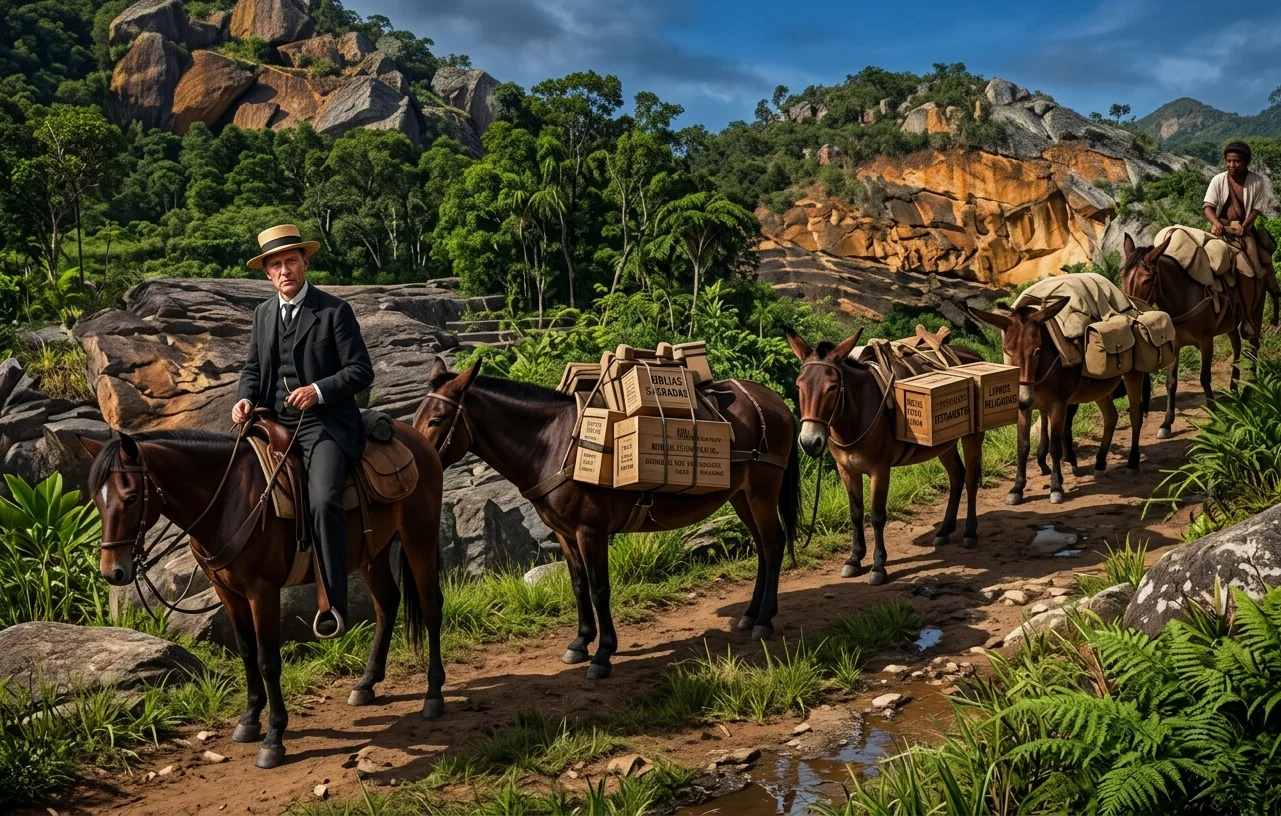
A BIBLE COLPORTEUR TRAVELING IN BRAZIL
My brother, my sister, were you surrounded by such scenes as these, would not your soul be stirred, and your sympathies fully enlisted? Could you at night lie down to rest with a clear conscience if you realized you had in a measure been negligent or indifferent to those about you who have lost their way, and are groping about in superstition and ignorance, and who will certainly perish unless you in the name of Jesus lead them out of darkness?—No; could you visit China, or could you have a true vision of the conditions, I am confident there would be a missionary awakening throughout our churches such as has never been known. But just such an experience must come, if we are to do the work to which God has appointed us.
Those who go to battle and those who abide by the stuff have an equal responsibility; and each, if faithful, will share in the spoils of victory. China’s need means my opportunity, your opportunity.
Chang-sha, Hunan.
Week of Prayer Greetings
By F. W. Spies
BRAZIL.—Again comes the news of the message gaining new victories and planting its standard in the regions of the Amazon. A letter just received brings the following: “The truth is spreading. We now have one or two groups of Sabbath-keepers in Para. One of the believers there, who was formerly a presbyter, writes that he is desirous of attending our next workers’ institute.” Thank the Lord! But this marvelous spread of the message only increases Brazil’s great need of more men and means, and thus swells to a loud cry its calls for reapers to help harvest the grain that is already overripe.
F. W. SPIES.
Greetings from the Ural Field
By J. E. Hinter
SAMARA, RUSSIA.—The peace of God be with you. The message came to us from America as a bright light, and binds us all over the world in the same love under Christ our head. We laborers and brethren and sisters of the Ural field, therefore, feel moved to express to the laborers and brethren and sisters in America, and to all who read this, our most hearty greetings. Although our field has been visited by a general crop failure, all are of good courage, and support the work with gifts and means, so that the message in the cities and regions not yet warned is advancing, and already precious souls are awaiting baptism. J. E. HINTER.
Korean Converts Give Up Tobacco and Liquor
By C. L. Butterfield
SEOUL, KOREA.—Recently I received a letter from one of our native workers, who had been working a month about thirty miles south of Seoul. He says: “Twenty persons have now promised to become Christians, and nine have begun to keep the Sabbath. We have organized a missionary society of sixteen members. These members have decided to give up their tobacco and liquor, and to use the money thereby saved to buy literature for distribution among their friends and the people of this place.” His letter was accompanied by an order for several hundred tracts. The message is to the “highways and hedges.” We find that in all these places God has precious souls waiting for the message of truth. C. L. BUTTERFIELD.
Ten Thousand Miles on the Amazon
By Frank Uttley
(Concluded)
MANAOS is the capital and center of the state of Amazonas, which, along with the state of Para, occupies the whole of the Amazon valley. The only other towns in Amazonas are far apart, up various tributaries, and numerically are very small. The Acre region is the most important district next to Manaos. In this distant field we have circulated quite a large number of books through the efforts of a Brazilian Baptist pastor. Iquitos, a growing and important town, farther up the main stream, lies in Peru, and is of course in Mr. Stark’s field. I talked with a missionary in Para who told me that he himself had sold seven boxes of books in a few days in that place for the American Bible Society.
Next to Para, Manaos is by far the most important city. It is the capital and center of a province covering an area of seven hundred thirty-two thousand square miles; i. e., six times larger than the whole of the British Isles. It is well situated, on the slope of a hill, and ought to be healthful. It is in many ways a modern town, possessing, like Para, a splendid electric-tram service, and the whole town is lighted by electricity. The streets are wide, most of them are well paved, and they present a pleasing appearance on account of the luxuriant vegetation adorning them. Money is made very rapidly, and spent just as quickly. When the rubber trade is good, the whole place is given up to pleasure and gaiety.
One of the most interesting things is its fine modern floating wharf. As the rise and fall of the river is so marked (60 feet), an ordinary wharf would be useless. This is therefore built out in the river, on steel pontoons, and connected with the shore by overhead trolleys, on which is run all the cargo. This floating wharf rises and falls according to the river. The workmen engaged in this movement of cargo are nearly all Portuguese, who are brought from Portugal for this purpose. They work half-naked, and their once-white skin has become so tanned by the sun that they look like Indians. They live on special boats moored out in the middle of the river, and are paid at the rate of 13s. 4d. a day, with board and lodging. As they thus have little or no expense, they are able to send home to Portugal good sums of money.
If the municipal authorities of Manaos would only well drain their city, and take the same steps that Para is taking to destroy the mosquito, it would be a very different place. One of the chief officials, however, said recently: “Why go to this expense? Yellow fever does not trouble us, and if foreigners can not live here, let them die!”
I stayed only a few days in Manaos. I interviewed the three Brazilian Protestant ministers, talked with them and others about the most likely young men for colporteurs, and arranged everything I possibly could for the future. There is certainly room for a further extension of Bible work. At the same time the town has not by any means been neglected. The Presbyterian pastor even went so far as to say that the14town had been well canvassed. But our men can often sell to people who at first are opposed to reading the Bible. If this were not the case, our work in Brazil would be greatly crippled. We are here to persuade the unwilling that at all costs they ought to read God’s Book, and thousands who once never intended to do so, are reading it.
Of the voyage back to Para, there is nothing special to report. Going down the stream, and in the center of the current,—just the opposite to what is done in ascending the river,—we returned to Para in about half the time it took us to reach Manaos. As my trip on this river was made at high water, I saw very little of the great quantity of fresh-water fish and animal life which can be seen at low water. I had hoped to see the Indians shooting turtle, but it was not the right season. I was told by those who had watched the process that when a little of the turtle’s back is seen above the water, the Indian’s arrow is shot up into the air. Were it aimed directly at the turtle, it would glance off at once. Being shot high up, it falls directly with its barbed point onto the back of the shell and pierces it. How this is managed, only an Indian can tell; but it is said he very rarely misses. To the end of the arrow is attached a line, so that he may follow up his success. He paddles off after this line, pulls the turtle to the surface, and despatches it. In some parts of the river, thousands of turtles can be seen together at low water.
Occasionally we caught sight of a huge fish called the pirarucu, an enormous thing, looking at a distance like a porpoise. Specimens of this fish will reach the weight of six hundred pounds. Its flesh is said to be very good, and is dried in the sun and salted for export.
Arriving again in Para, I made my way to the Café de Paz where I was to stay a few days. During these days I resumed my intercourse with the ministers and other Christian workers. I went out with Snr. Lima to the market and the docks. Every visitor to Para ought to see the market, with its innumerable kinds of tropical fruits and its men and women of all shades of color—from the pure Indian and Negro on the one hand, to the European on the other. Here is found an amalgamation of half a dozen races, mixed and remixed. My companion seemed as well known in the market as in the docks, and my presence with him was a good introduction to some who are friendly to us. I became familiar with every part of the city. My visit was full of interest to me, and I believe it will be of great benefit to the society.
On May 2 I embarked again for Rio, where I spent about a week, and arrived in Buenos Aires on May 20, having been away two months. I had traveled ten thousand miles on six different steamers, and reached home feeling very grateful to God for his care, and exceedingly glad that I had been permitted to take the journey.—Frank Uttley in the Bible in the World.
Diet, and Skin Diseases
By G. H. Heald, M. D.
G. H. HEALD, M. D.
In the Journal of the American Medical Association of Aug. 26, 1911, Dr. L. Duncan Bulkley, one of the most noted and most successful skin specialists in the country, who has had marked success in the treatment of certain skin diseases by means of a strictly vegetarian diet, has a paper in which he recounts his experience with psoriasis in an extensive series of cases, extending over a long period of time. In this paper he makes the following remarkable comments:—
“My experience, some of it dating back twenty-five years, shows conclusively that not only does a meat diet increase psoriasis, but that an absolutely vegetarian diet is of the very greatest benefit in this disease, and in certain cases is capable of causing the disappearance of a long-standing eruption, without the use of any internal or external medication whatever.”
Regarding vegetarianism as a general health measure, he says:—
“Vegetarian diet for health is no new proposition, and needs no defense nor explanation; the literature regarding it is extensive, and its positive value has been frequently demonstrated. All are aware that repeatedly vegetarians have far outstripped meat-eaters in athletic contests, while the reverse is almost unknown. The mass of humankind has always subsisted largely or entirely on the products of the ground, and in animal life all work is done on food from the vegetable kingdom.”
“On the other hand, the consumption of much meat is of relatively modern date, with some exceptions, and is particularly common in cities, the mass of workers in rural districts subsisting chiefly on vegetarian products.
“Nor need we dwell long on the injurious effects of a too highly nitrogenized diet on the human system, which have long been recognized and have had able exponents. All are familiar with the necessity of curtailing a meat diet in many conditions of the system, and writers have repeatedly called attention to its influence in the production of cancer. The relative absence of cancer among the natives in rice-eating countries, which I also observed in the Far East, is striking evidence in this direction.”
On the matter of relapses after treatment, he has this to say:—
“Time and again patients who have relapsed into free meat-eating have returned with a fresh outburst of eruption, or great aggravation of any that had remained; and they intelligently recognized the cause, and have willingly taken up the vegetarian diet again, because of the great benefit which they had previously derived from it.
“The question arises as to the length of time it is necessary to continue the vegetarian diet. I am accustomed to tell my patients that this may be indefinite; for if a faulty nitrogenous metabolism and excretion is at the bottom of the eruption, as it seems to be, this may recur whenever the intake of proteids exceeds the power of the system to handle them.
“In some instances a return to a moderate mixed diet has not seemed to increase the tendency to the eruption, but in very many cases it has been recorded that any indulgence in a great amount of nitrogenous food, has caused a return of the skin lesions. So that we must infer that with a certain small proportion of human beings, the organs are not able properly to assimilate much protein substance.”
He finds also that something besides abstinence from meat is required, for he says:—15
“There are some articles from the vegetable kingdom, however, that have to be guarded against. Alcohol in any form, even the lightest beer, is prejudicial, and in some instances I have found better results when I excluded coffee, chocolate, and cocoa.”
Washington, D. C.
Dreams of Heaven
By Mrs. L. D. Avery-Stuttle
MRS. L. D. AVERY-STUTTLE
I AM sitting to-night in the twilight,
In the hush of my silent room,
And sigh as I think of my loved and lost,
Asleep in the quiet tomb.
I long for the same sweet voices,
But I stretch my arms in vain,
And my bosom yearns, and my spirit burns,
Till the tear-drops fall like rain.
For the night is cold and dreary,
And the arms have lost their strength;
But the night, though long, may be cheered with song,
For the clouds will pass at length.
Yes, I think of the sweet hereafter,
When tears will be wiped away,
And hearts now sad will be blest and glad
In the light of eternal day.
Sometime the opening heavens
Will blaze with the glory bright,
While the welkin rings as the King of kings
Descends in a cloud of light.
I shall meet with my loved and dearest,
We shall walk by the crystal sea;
But I long to greet with a song most sweet,
My Shiloh, who died for me.
Lansing, Mich.
Teaching Girls How To Live
By MRS. W. E. A. AUL
MRS. W. E. A. AUL
The most valuable resource of a nation is its children; and there has never been a period in the world’s history when a girl was of more importance than she is just now. It is said that the first seven years of a child’s life are the most important ones. As tropical plants need for development a warm sun, a rich, genial soil, and moisture, so children should be brought up to think home is the happiest, sweetest spot on earth, the place for all kinds of innocent amusement. Whatever qualities are encouraged and brought out in childhood are likely to dominate the after-life.
On the other hand, overpraise and overindulgence are as harmful to a child as is utter neglect. The mental attitude given a child through its early discipline remains throughout life, and either adds to or detracts from its happiness.
By all means, teach your girls to be happy. I do not mean by this an exuberance of spirits, such as overjoyousness and gaiety. True happiness is a calmer frame of mind, more tranquil, more serene, and capable of endurance; for true happiness is not dependent upon circumstances. It is a state of mind that results from a high plane of living. Teach them that the first requisite for happiness is to think happy thoughts, for thoughts are of great importance in the making of character. As the work of the builder is preceded by the plans of the architect, so the deeds we do in life are preceded by the thoughts we think. It follows that an important part of the work and occupation of one’s early years should be to learn to have right thoughts, which later are to become right actions.
Every girl wishes to become accomplished, and every girl can become so if she will. An accomplishment is defined as “an acquirement or attainment that tends to perfect or equip in character, manners, or person.” It means that every girl who can sweep a room, read French, German, or English, bake a loaf of bread, darn a stocking, play the piano, write a neat, well-composed letter, make a bed, or do any of a thousand and one other things well, is accomplished. Housekeeping and home-making are absolutely necessary accomplishments in the life of every girl, whether she marries or not. Every woman wants a home somewhere, somehow, sometime; and she should know how to direct it with system and order.
Of all the accomplishments it is possible for a girl to acquire, that of being gracious and pleasant to those about her is the greatest and most desirable. The heart needs to be educated even more than the mind, for it is the heart that dominates and colors the whole of life, and gives to it character and meaning. Nothing is more restful and refreshing than a friendly glance or a kindly word in the midst of our daily rounds. Wise are they who sprinkle rest, kindness, and heartsease all through their daily tasks. They weave a bright thread of happiness through the warp and woof of life’s pattern.
The pleasant, helpful girl is most likely to become the pleasant, helpful woman. The seed sown in the spring-time of life determines the character of the harvest that must be reaped in the autumn. One’s disposition in childhood and youth is largely what inheritance and parental training make it; but girls should be taught that in after years, when they have awakened to the necessity of training their own dispositions, it is a matter of their own responsibility. A girl is not responsible for the disposition she inherits, but she is responsible for the disposition she acquires.
The girl who has formed the habit of wearing a pleasant face, of smiling honestly and cheerfully, and has the ability to speak a pleasant word to those she meets, has a good equipment for life. Every girl knows that the friends whom she loves best are those who are alive to the world about them, and who feel an enthusiasm in their duties and privileges.
Only they who find joy in their work can live the nobler life, for without work and work done joyously, life must remain dwarfed and undeveloped. They who work with their hearts as well as their hands, do not grow tired. A labor of love is a labor of growing delight.