“Of making many books there is no end.” Eccl. 12: 12. In the time when these words were written by Solomon, books were rolls of parchment, produced by the slow process of copying each letter with pen and ink, not multiplied by the printing-press, many thousands per hour, as at the present day. If one desired to possess the copy of a book, he must either write it himself or employ a scribe to make a copy for him. Doubtless Solomon had in mind, among others, those who were slowly making copies of his own proverbs and other writings.
Of his wise sayings we read: “He spake three thousand proverbs: and his songs were a thousand and five. And he spake of trees, from the cedar that is in Lebanon even unto the hyssop that springeth out of the wall: he spake also of beasts, and of fowl, and of creeping things, and of fishes. And there came of all people to hear the wisdom of Solomon, from all kings of the earth, which had heard of his wisdom.” 1 Kings 4: 32-34. See also Matt. 12: 42. It is no stretch of fancy that on such occasions Solomon saw copyists “making books” — carefully writing down his words of great wisdom.
If Solomon could say in his time that there was “no end” to book-making, what can be said now, when the thousands of printing-presses are multiplying books by the millions, and that upon every conceivable subject? Even the volumes of book catalogues in national libraries and in the British Museum are enough to fill the shelves of quite a library. Many of the books referred to in the catalogues are of great value, but, alas! what a large number are mere romance, fiction, or imagination, with an effort to make the stories appear real. As a sample, I call to mind a circumstance occurring on my passage from Africa to England. Two men were talking about a book from the ship library — fiction — entitled “Why I Was Not Hung.” One had read the book, and was asking the other to read it. He said, “It is a thrilling book. It seems too wonderful to be true; but then the writer gives names or persons, places, and dates, so it must be true.” Yes, that is just the way they have of making fiction appear like reality. As one man said of these novel writers, “They give to airy nothing a local habitation and a name.” As one index to the present demand for such reading, I find in the Literary Digest of October 7, fifteen new novels and books of fiction advertised. These are not ten- and twenty-five-cent pamphlets, but books, the most of them $1.25 each, with postage added. The authors prepare and advertise these books, knowing the kind of reading the masses desire.
Seventh-day Adventists have reason for devout gratitude to God that he has moved upon his servants to prepare so many useful and instructive books. Not only do these deal with the great controversy from the first appearance of evil till its final overthrow, and the establishment of truth and righteousness in the eternal kingdom of God, but they also give counsel adapted to every phase and condition of the present life. And while the mass of mankind are perplexed by the unrest and confusion that prevail more and more upon the earth, these publications show, and that on the authority of the Scriptures, what these things mean, and that they are sure omens that the consummation of all things is right at hand. When we read of the success attending the faithful canvassers in placing these valuable works in the hands of the people, it does not look as if we had yet reached the “end” of “making books” to supply the increasing demand.
Elder James White used to say, “What we want in the reading line is, first, tracts, short and pointed, to create an interest; then, pamphlets for the interested ones; and finally large books for those who wish to make a thorough study.” The literature already prepared by our publishers seems to be on these lines.
Lodi, Cal.
“We Seek Not Yours, but You”
By Percival J. Laird
PERCIVAL J. LAIRD
WE became so deeply interested in reading a bright little incident amid the sorrow of famine among the Chinese, that it was thought the incident would bear retelling:—
“Dr. Samuel Cochran, medical missionary at Huai-yuan, China, in the heart of the famine district, had been distributing food to the starving multitudes of the town—dispensing relief sent from America—for several weeks, when he was suddenly stricken deathly ill with a typhus fever. As soon as the news went out through the town, a pall of despair settled on the people. Quite naturally the missionaries betook themselves at once to prayer for his recovery. The converts, too, prayed. More than that, the resident Catholic priest sent out commands to all the converts of his church to pray unceasingly for Dr. Cochran’s recovery.”
“But this was not all. The rich gentry of Huai-yuan had been, until the famine, supremely indifferent to the missionaries. But the famine had opened their eyes. Long before Dr. Cochran fell sick, they had realized what manner of man they had among them. And when they heard of the beloved physician’s severe illness, they came together,— all the members of the chamber of commerce,—and went in solemn procession to a great temple, and there before their idol each man bowed down and offered enough years out of his own life to make up from the whole company a total of fifty years to add to the life of Dr. Cochran.”
“There were few in the immense audience whose eyes were unwet with tears, as at the conclusion of this recital Mr. Speer gravely repeated the words: ‘Scarcely for a righteous man will one die: yet peradventure for a good man some would even dare to die.’”
“Hark, there comes the sound of crying,
Borne across the restless sea;
And China’s countless millions, dying,
Moan in hopeless agony;
Moan on moan, with none to pity—
So they die eternally!
“Lo, the priests are chanting, chanting
Endless prayers in monotone;
While, like demon-spirits, haunting,
Hired mourners wail and moan;
Incense burns, while souls are dying—
But these ne’er for sins atone!
“See, the shrines are dimly lighted;
Hear the mourners’ measured tread.
Past the chant for souls affrighted;
Now the worship for the dead—
Vain is all that man can offer
For the souls for whom Christ bled.
“So the countless millions, passing,
Go beyond this earthly light;
So the countless millions, massing,
Enter death’s eternal night;
So the days go by, and going,
End our time of doing right.
“Christ is coming; judgment awful
Waits the souls which die in sin;
Christ is coming, judgment lawful
Will with church of Christ begin.
Rouse, ye saints! arise, deliver!
They will shine who souls shall win.”
Madison, Tenn.
The Call
By Edw. J. Urquhart
EDW. J. URQUHART
As Abram lived from year to year
(Though time bent low his form),
He grasped by faith the living Word
Through sunshine and through storm;
And, dying, looked beyond the grave—
He dreaded not its frown,
For by his faith he saw afar
And grasped the victor’s crown.
And that same God whom Abraham
Served with a tenth of all
Bids other sons leave friends and
home—
O listen to the call!—
To dwell in distant lands, as he,
Or die as God sees best;
For, if we do the task he gives,
The sooner is the rest.
And thou, with loved ones thus laid low
While fighting for the Lord,
Seek comfort in God’s promises,
And grasp the living Word.
For he whose word upholdeth worlds
Will let no trials come
But such as help to lead us on
To God, to Christ, and home.
Fernie, British Columbia.
Greater Service in God’s Kingdom
By Lyman Abbott
In the kingdom of God the reward of a great service is the opportunity to render a still greater service.—Lyman Abbott.
The Situation in the Mission Fields
By W. A. S.
WITHIN two weeks we shall be in the midst of the annual season of special prayer and special gifts for missions. No reader of the mission-field reports need be told that the situation does call for united prayer and most earnest planning for the week of prayer offering.
First of all, the work in the mission fields, just as it stands to-day, presents an aspect that cheers and yet solemnizes the heart. In all quarters of the earth the boundaries of our work are being pressed forward by an irresistible power from on high. Beyond all the planning of the Mission Board, the work year by year enters new fields. And in the old missionaries continually at the end of their fields the growing work keeps our misresources. They cry for help; and, under God, their confidence is in this church of the advent people who are now to make the annual offering to missions.
Calls Still Waiting
Here are some of the calls that just now have to be denied, or delayed. In India’s list, presented at the recent General Conference Committee Council, it was decided that immediate response could not be given to the following requests: A man and his wife for the Hindustani work; a man and his wife for South India; a man and his wife for Bengal; and a man and his wife for the work among the Karens of Burma.
Concerning the call for the Hindustani man, Elder J. L. Shaw says:—
The Hindustani work on the plains is in a critical condition. After arousing considerable interest, gathering out several workers, and making some converts among the Hindustani people in the plains, Brother and Sister L. J. Burgess opened their school work in the Garhwal hills, and no man is available to give his time to the Hindustani work. Three or four sisters are working among the women, but a man is urgently needed to open up a mission station on the plains. So necessary is this call that it was voted by the India committee to request the Mission Board to send out such workers at once, so that they could be in the field by the end of the present year.
Concerning this same call Brother L. J. Burgess writes:—
If a new man is sent out at once, it means about two years before he will be able to do much work in the language. We will try to hold the fort, but if there should be much longer delay, it will require a great deal of courage to continue the struggle. If there is any urgent call from this field, this seems to be the one. I am confident that as soon as we get the Hindustani work on a proper basis, we shall see the message going throughout the breadth of this country with a rapidity that will be surprising. We shall be anxiously looking for news of a man to answer this call.
This Hindustani tongue is spoken by about eighty millions in India.
Of the call for the Karen workers for Burma, Elder Shaw says:—
This is the longest-standing unanswered call before the Mission Board from India. Request for a man and his wife to work among the Karens was first made six or eight years ago, and has been approved and sanctioned at every meeting since then.
Workers have, of course, gone to India since then; but in the conditions and needs of the work we have not been able to send sufficient helpers so that the brethren could assign a man and his wife definitely to the Karen work.
Elder H. H. Votaw, of Rangoon, Burma, who has urged the needs of the Karen people, whose traditions place them in an attitude of listening and inquiring for this advent message, writes:—
The burden of the Karen work is becoming such that I can scarcely bear it. I should say the fact that there is no Karen worker is my greatest burden. It is now about six years since I first began to write upon this subject, and still no one is at work among them. I feel sure they offer as good an opening as, if not the best one in, any heathen tribe in all the world. Why Seventh-day Adventists have done nothing for them I can not understand. If the fault has been mine, I mean to cast off the reproach and free myself. I fear that I have not been insistent enough. I have been afraid of adding to your burdens. But I serve notice that I mean to “storm heaven” and the representatives of God’s work in the earth in behalf of this long-neglected people.
“They Call Us”
So the cries come in, brethren and sisters; and from across every sea, in fact, “they call us to deliver.”
At the recent autumn council of the General Conference Committee, appropriations were made to send two English evangelists for the great cities of India, a call which the India brethren have long had listed; also to send a teacher and his wife for school work that can not be delayed; and one city Bible worker and a dispensary Bible worker, the latter needed in village work among the millions of Bengal, to take the place of one of our sisters who must turn aside with broken health to recuperate. These workers, it is hoped, will go in January.
The council felt the conviction that without largely increased gifts no further help for India could safely be planned for at this time. But this coming week of prayer season of giving will tell whether our workers in these needy fields who are “storming heaven” for help shall receive during 1912 some of the longed-for additional assistance. Qualified workers are awaiting the word to go.
Two new missionary couples are just entering China, and a China mission treasurer, and a stenographer and office assistant will soon be in the field. Our missionaries in China point to Sabbath-keepers8springing up beyond their power even to visit them, and ask for just a few more workers; but China’s appropriations are stretched to the limit of the possible until the mission income is increased.
So across in troubled but awakening China companies that are calling for instruction must still be told that we have not the workers to send; and doubtless again, in the language of one such company, they will answer, “What a pity! what a pity!”
Space will not allow even mention of other urgent calls that are listed in the Mission Board from all the four quarters of the earth. It is inspiring to see the stirring up of interest by this message in all the world. It is only with awe that we can watch the onward sweep of the advent movement, for we realize that the very hand of God is leading the way. The Lord is making bare his arm in the eyes of all the nations. And his stewards, or treasurers, are his people on earth. Hundreds of missionaries, battling away among the millions in far countries, will at this time look this way, and pray: “God bless the believers in the home lands, and prosper them in planning large gifts for the missionary cause.”
Every week of prayer finds thousands of new voices in the regions beyond joining us for the first time in thanking God for the third angel’s message, and lifting the advent cry a note higher. We are called to pray and give for a cause that is everywhere triumphing and winning souls from darkness to light. It is a wonderful work and a wonderful time, and we can never view the outlook without being aroused anew to yet more earnest endeavor. From the four quarters of the earth the voice of God’s providence cries:—
“Awake! again the gospel trump is
blown;
From year to year it swells in louder
tone.
From year to year the signs of wrath
Are gathering round the Judge’s path;
New wonders seen, and mighty works
achieved,
And truth in all the world both hated
and believed.”
W. A. S.
The Gathering Call
“AND Jesus came to them and spake unto them, saying, All authority hath been given unto me in heaven and on earth. Go ye therefore, and make disciples of all the nations, baptizing them into the name of the Father and of the Son and of the Holy Spirit: teaching them to observe all things whatsoever I commanded you: and lo, I am with you always, even unto the end of the world.” Matt. 28:18-20, A. R. V.
“THEREFORE, behold, the days come, saith Jehovah, that it shall no more be said, As Jehovah liveth, that brought up the children of Israel out of the land of Egypt; but, As Jehovah liveth, that brought up the children of Israel from the land of the north, and from all the countries whither he had driven them. And I will bring them again into their land that I gave unto their fathers. Behold, I will send for many fishers, saith Jehovah, and they shall fish them up; and afterward I will send for many hunters, and they shall hunt them from every mountain, and from every hill, and out of the clefts of the rocks.” Jer. 16:14-16, A. R. V.
“AND it shall come to pass in that day, that the Lord will set his hand again the second time to recover the remnant of his people, that shall remain, from Assyria, and from Egypt, and from Pathros, and from Cush, and from Elam, and from Shinar, and from Hamath, and from the islands of the sea. And he will set up an ensign for the nations, and will assemble the outcasts of Israel, and gather together the dispersed of Judah from the four corners of the earth.” Isa. 11:11, 12, A. R. V.
“AND this gospel of the kingdom shall be preached in the whole world for a testimony unto all the nations; and then shall the end come.” Matt. 24:14, A. R. V.
The New Cardinals
By William Warren Prescott
The Significance of the Pope's Choice
Much interest has been aroused among both Protestants and Roman Catholics, by the official announcement that Pope Pius X had selected three members of the hierarchy in America to be the recipients of the red hat. Comment upon this action has been wide-spread and of quite a diverse character, varying with the standpoint of the writers and their attitude toward the Roman Church. Of course, the Roman Catholic press has been very jubilant, and columns of the most fulsome eulogy of the three prelates selected have been printed.
Although neither the people nor the clergy have the least voice in the selection of these cardinals who exercise such a controlling voice in the affairs of the church, yet so thoroughly have they been educated in the spirit of subserviency to the absolutely monarchical power in their church that they accept this appointment of Americans to the college of cardinals as a gracious favor on the part of the Pope, which calls forth most humble expressions of gratitude, although they well know that the membership of the curia is still overwhelmingly Italian, and that Italian influence will continue to dominate all branches of their church.
In its comment upon “the new American cardinals,” the Outlook of November 11 analyzes the situation with quite a clear perception of the significance of the selection made by Pope Pius X. There appeared in these columns last week an article which took direct issue with some recent utterances in the Outlook that appeared to us to be altogether unjustifiable commendation of the Roman Catholic Church; and we, therefore, take satisfaction in presenting extracts from an editorial in its very next issue dealing with the Pope’s most recent appointments:—
There has been a growing feeling that a branch of the Roman Catholic Church so powerful as that in America, ought to have more adequate representation in the councils of the church, and it has been the belief of many well-informed people that Cardinal Gibbons would not have been left the only American cardinal so many years if it had not been for the distrust of American influence on the part of many of the Italian cardinals, who have constituted a kind of close corporation.
The appointment of three additional American cardinals is therefore a matter of moment in the history of the Roman Catholic Church in America; but the appointments will hardly give satisfaction to those Americans, either within or without the church, who desire to see it in a position to play a great part in the healthy development of American life. Of the three new cardinals, one, Mgr. Falconio, is an Italian by birth who entered the Franciscan order in 1860, and succeeded Cardinal Martinelli in 1902 as papal delegate to the United States. His relations with our government are unofficial; he is a man of tact and ability; but Mgr. Falconio hardly represents the Catholic Church in this country. Archbishop Farley, of New York, another of the three appointees, is an admirable administrator, a man of kindly nature and benignant spirit, who has the respect of the Protestant community as well as of his own people, but who is not, in a large sense of the word, a leader. Archbishop O’Connell, of Boston, is a younger man of vigor and ability, but is a representative of the reactionary spirit in the church. He is the most prominent American representative of the Spanish influence in the Vatican, the chief exponent of which is Cardinal Merry del Val, whose hatred of all things American is a matter of general knowledge, . . . [and] is an aggressive leader of the narrow school within his own church, an aristocratic ecclesiastic in a democratic community. . . .
Protestants and many Catholics will regret that the Pope has missed a great opportunity of elevating to the college of cardinals those Roman Catholic ecclesiastics in this country upon whom the American people, without regard to religious differences, look as religious statesmen and natural leaders in the movement for the brotherhood of man.
It is evident that the Outlook attempts to deal with the Roman Catholic Church on the basis that certain members of the hierarchy in America whom it regards as of progressive spirit, really represent Roman Catholicism; but any one who is familiar with the history of the Roman Catholic Church ought to know that it has been the uniform policy of the Italian hierarchy, the ruling power in Romanism, either to ignore or to crush every progressive movement in any country, and that when one weighs the question of the growth of Roman Catholic influence in the United States, he must take into consideration, not the utterances of the most liberal-minded representatives of that church who stand for what Pope Leo XIII condemned as “Americanism,” but the official utterances of the Italian rulers, whose well-defined policy is to maintain the medieval views of the Papacy, and to enforce them in every land. The encyclical of Pope Pius X, dated May 24, 1911, condemning the law of separation in Portugal, is a fresh illustration of the papal claim to a divine right to nullify the laws of any nation which appear to be prejudicial to the interests of Rome. In this encyclical Pius X, following the example of the medieval popes, thus asserts his superiority over all civil government:—
While we complain in the strongest manner that a law of this kind should be passed, sanctioned, and brought forward in public, and solemnly expostulate with all who have prepared it or taken part in the work, we proclaim and announce that whatsoever it contains contrary to the inviolable rights of the church is null and void, and is to be so held.
In order to maintain this ultramontane theory of the Papacy which gives to the Pope the place of God on earth, such members of the hierarchy are appointed to the college of cardinals as are in sympathy with the extreme claims of the Papacy, while those who believe that the world has outgrown the papal absolutism of the dark ages, are entirely ignored. There is a significance in these facts which ought not to escape the attention of those who attempt to forecast the influence of the Roman Catholic Church upon the institutions of this country.9
The spirit in which the Outlook’s reference to the selection of candidates for the red hat is received in Roman Catholic circles, may be judged by a brief extract from an editorial in the Catholic Standard and Times (Philadelphia) of Nov. 18, 1911. Referring personally to Dr. Lyman Abbott, the editor-in-chief of the Outlook, this paper editorially declares that—
he allows the magazine of which he is the chief editor to interfere in the Holy Father’s official business, and lecture him upon the men whom he has chosen to be cardinals, and whom he has passed over, in the exercise of his spiritual authority, in the coolest manner possible! The language of the article in which this insult is offered to the Pope is, without exception, the most freezingly cynical that ever was printed. It is the worst example of bad taste that ever emanated from a printing-office, implying a right to criticize the action of a pope in the government of the church, on the part of critics who always emphatically repudiated the right of the Papacy to regulate even its own etiquette in the reception of American visitors [referring to the Fairbanks-Roosevelt-Vatican incident].
It is plain from this extract that the defenders of the Papacy regard any criticism of the Pope in the same light as a devoted Christian would regard a slurring reference to the Ruler of the universe. Perhaps this may suggest to the Outlook how much freedom of the press would remain in this country if the principles of Roman Catholicism should have full sway.
The signs of the times which indicate the policy and purpose of the Roman Catholic hierarchy in America have become so plain that he may run who reads them. No longer are we left to deduce from general principles what would be the probable course of the papal representatives in this country. We have a large number of concrete examples from which to draw our conclusions, and it seems astonishing that so many observers, whose intelligence can not be discredited, should fail to understand the meaning of these things. The only explanation of such a situation is found in the fact that there is an intelligence more than human, and a cunning of the supernatural order displayed, in directing the movements of the Papacy, and in so craftily hiding the real issues involved that black is made to appear white, and the kingdom of Satan is substituted for the kingdom of God. It is in the light of the sure word of prophecy that the working of the “mystery of iniquity” can be clearly seen. W. W. P.
The Divorce Evil
By F. M. W.
The home is the nursery of the church, the safeguard of society, the bulwark of the state. Influences that serve to destroy or weaken this divine institution, will weaken in corresponding ratio every other order of human existence. Satan well knows this, and consequently in these days of mighty working on his part, no institution is so greatly the subject of his attacks as that of the home. Subtly and insidiously, he seeks by every means in his power to create between its members, particularly between the husband and wife, alienation and discord.
From the Independent, New York
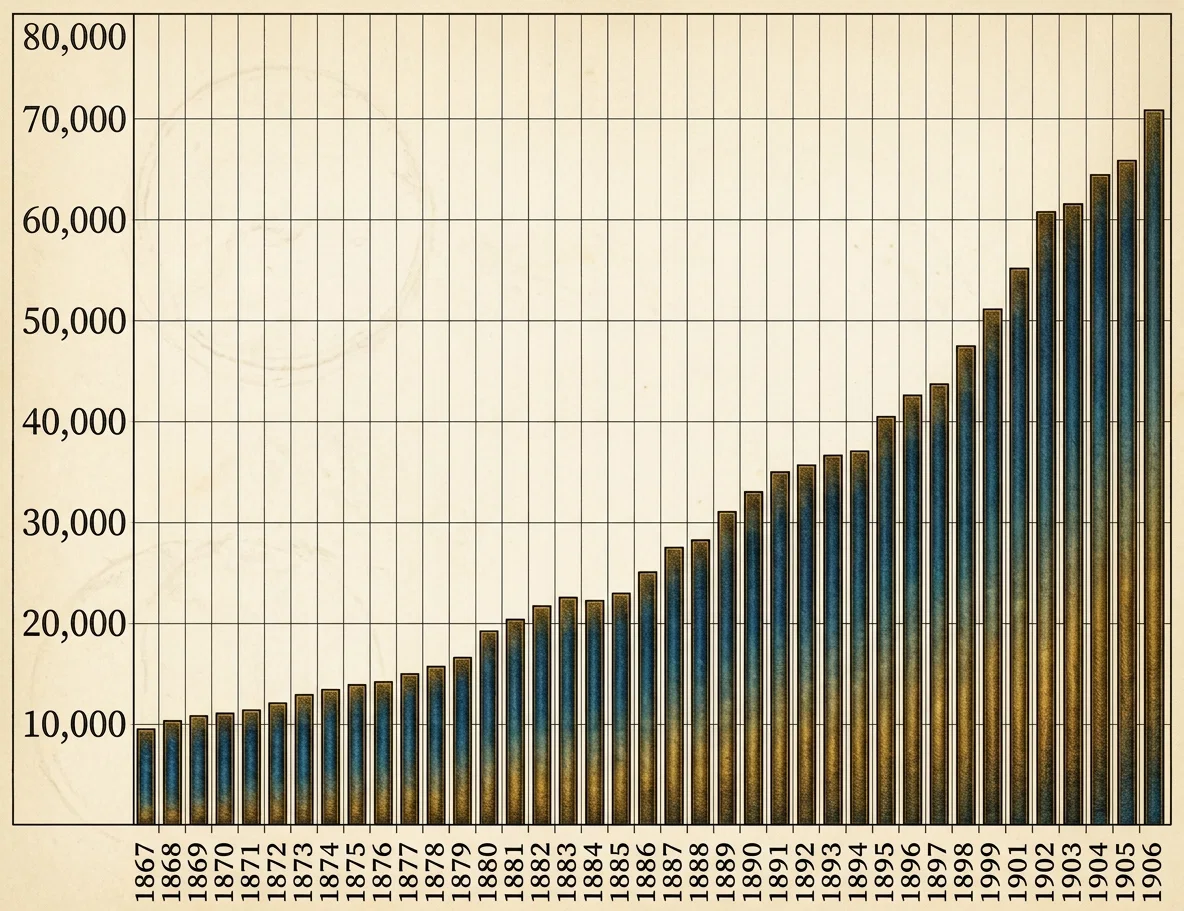
CHART SHOWING INCREASE OF DIVORCES IN THE UNITED STATES FROM 1867 TO 1906
These days are likened to the days of Lot and Noah, when men's minds were so engrossed with the things of earth to the exclusion of God that their thoughts ran riot, their imaginations became vain, and their plans and purposes all sought to minister to selfish ends. In those days they multiplied unto themselves wives. The sacred ordinance of marriage was discounted. Passion and not love prompted the choice, and in revelry and drunkenness they shut the knowledge of God out of their understanding. The world to-day is rapidly reaching the conditions foretold by our Lord. Many are found, even among the professed believers of Christ, “without natural affection, truce-breakers.” We see on every side ruined homes, blasted reputations, tarnished characters.
Among the great evils of the present day that are demanding the serious thought of Christian men and women in every denomination, the divorce evil stands prominent. Every year has marked a rapid increase in the number of separations effected by our civil courts. The Independent for November 16, presents an article by William B. Bailey, Ph. D., assistant professor of political economy in Yale University, that is worthy of serious thought. By graphic representation, which we herewith reproduce, the great increase of divorces is shown from the year 1867 to 1906. This increase is altogether out of proportion to the increase of population. On this point Dr. Bailey says:—
The accompanying chart shows the number of divorces granted in this country per annum from 1867 to 1906. In the first year of the table there were 9,937 divorces and in the last year 72,062. During the forty years covered about 1,250,000 divorces were granted. Although it must be borne in mind that the population of the country has also increased remarkably during this period, the increase in population has not been sufficiently rapid to account for the increase in divorces. In 1870 there were 28 divorces per 1,000 population, while in 1900 there were 73. Perhaps a more accurate unit of measurement could be obtained by substituting married population for total population. On this basis the number of divorces per 100,000 married population in 1870 was 81 and in 1900 was 200.
The sin of Sodom was idleness, wine, and fulness of bread. In days of prosperity men have always forgotten God. Trial, affliction, and destitution tend to keep men's hearts humble. Of the relation of the growth of this evil to such times, we read:—
A careful study of the chart will bring out the fact that in periods of commercial depression the increase in divorces is less than in periods of prosperity. The reduction of the family income seems then to knit the family more closely together.
The great tide of emigration, in sweeping westward, carries with it unsettled conditions, a breaking down of old barriers, and in consequence we naturally10expect an aggravation of the divorce evil in the newer sections of the country. Regarding this the article in question says:—
It can be stated in general terms that the divorce rate in this country increases as one goes westward. The rates in the North Atlantic and South Atlantic divisions in 1906 were respectively 41 and 43, while in the Western division the rate was 168. Bearing in mind that the average annual number of divorces for the five-year period of which 1900 was the median year was for the United States as a whole 200 per 100,000 married population, it may be interesting to know that in Washington the rate was 513; in Montana, 497; in Colorado, 409; while in New Jersey and New York it was 60, and in Delaware, 43.
The causes that have led to these separations have been many and varied. By far the large majority fall outside of the conditions laid down in the Scriptures; namely, the breaking of the seventh commandment, the only Scriptural reason for which a divorce may be granted. Non-support, desertion, incompatibility of temper, and scores of less trivial reasons may be assigned why this solemn ordinance is set aside and the parties released from the obligations that their solemn vows imposed.
It will not avail to protest alone against this great menace to our civilization. Back of the protest there must be a proper education given to those who enter into the marriage relationship if we are to expect better results. This is sadly lacking at the present time. In the average home, and with many professed Christians, the marriage relationship is regarded too lightly, and treated too indifferently. It is discussed as merely a business transaction. This is the education too largely given to the youth. While we may not be able to help these conditions in the great wide world, surely among Seventh-day Adventists they should not exist.
The Word of God declares that marriage is honorable. It was an ordinance sanctioned by the holy presence of the blessed Lord. It comes down from the garden of Eden as a twin institution with the Sabbath of Jehovah. It should not be regarded lightly. It should not be entered into hastily nor unadvisedly. Those contemplating it should realize that they are entering into one of the most solemn relationships of life, a relationship which will largely influence their lives for time and for eternity. When there is given to the young this exalted idea of this holy ordinance, when they are taught to regard it as the solemn, sacred institution that it is, then we need have little concern for their future.
The church of God to-day, the Seventh-day Adventist Church, should seek to hold back, in so far as lies in its power, the growing evil of family separation. We find families represented in the Seventh-day Adventist Church that are divided in religious sentiment, wives living with unbelieving husbands, husbands with wives who care naught for the service of the Lord. Let no word be spoken nor influence exerted that would lead such to disregard the solemn obligations upon which they have entered. They can not lightly regard these and be guiltless before God. Let the believing one seek to abide with the unbeliever in all peace and quietness, endeavoring by a life of meekness and gentleness and of kindly Christian deportment to win the unbeliever to God. This by the grace of his spirit may be indeed experienced.
The Word of God recognizes but one basis for the granting of a divorce. There may be instances of cruelty, accompanied by physical violence, where the wife is forced from home to preserve her life, but even such treatment does not afford grounds for divorce warranting remarriage. Some have made a mistake in marrying outside of the truth of God; but if so, let them not add to that mistake by further complicating the situation. Let them abide in the relationship in which the truth finds them, endeavoring by the grace of God to live an honest, earnest Christian life, and trusting God in his own time and in his own good way to harmonize every difference and every difficulty. Such a purpose will meet the mind of God, and will bring as a result his blessing, which maketh rich, and addeth with it no sorrow.
F. M. W.
One Is Your Father and Master
“And call no man your father upon the earth: for one is your Father, which is in heaven. Neither be ye called masters: for one is your Master, even Christ.”