FOR a number of years I have observed a falling away among our people in Sabbath observance. As this has been going on year after year, I have felt it imperceptibly coming into my own life.
On the morning of Nov. 7, 1916, I awoke with a dream so vividly impressed on my mind that I decided to write it out for the benefit of our dear people.
I seemed to be in my own home, and it was Friday night. I was out preparing kindlings, using the ax vigorously. A man whom I recognized as one of our people came up and said, “Why, Elder States, don’t you know the Sabbath has arrived? and here you are preparing for it.” I awoke at once, feeling very much impressed.
I soon fell asleep again, and seemed to be in my home on Sabbath afternoon with quite a gathering of our people. We were having a good time talking over worldly matters and business in general. The same brother came into our gathering and said, “You must keep the Sabbath differently from this, or you will never go through and have the seal of God placed upon your foreheads.” At this I awoke.
I went to sleep the third time, and seemed to be using the telephone very freely, talking about the election, when the same brother said to me, “Can’t you wait until after the Sabbath to talk over your politics?”
This dream, thrice repeated, made such an impression on me that as soon as I arose I got my Bible and Sister White’s writings and began to study the question. I will quote a few things I found:
“In a view given June 27, 1850, my accompanying angel said, ‘Time is almost finished. Do you reflect the lovely image of Jesus as you should?’ Then I was pointed to the earth, and saw that there would have to be a getting ready among those who have of late embraced the third angel’s message. Said the angel, ‘Get ready, get ready, get ready. Ye will have to die a greater death to the world than ye have ever yet died.’ I saw that there was a great work to do for them, and but little time in which to do it.”
After having had a view of the scenes of the seven last plagues, Sister White describes her feelings thus:
“Terror seized me, and I fell upon my face before the angel, and begged of him to cause the sight to be removed, to hide it from me, for it was too dreadful. Then I realized, as never before, the importance of searching the Word of God carefully, to know how to escape the plagues which that Word declares shall come on all the ungodly who shall worship the beast and his image, and receive his mark in their foreheads or in their hands. It was a great wonder to me that any could transgress the law of God and tread down his holy Sabbath, when such awful threatenings and denunciations were against them. . . .
“I pleaded before the angel for God to save his people who had gone astray, to save them for his mercy’s sake. When the plagues begin to fall, those who continue to break the holy Sabbath will not open their mouths to plead those excuses that they now make to get rid of keeping it. Their mouths will be closed while the plagues are falling, and the great Lawgiver is requiring justice of those who have had his holy law in derision, and have called it a ‘curse to man,’ ‘miserable,’ and ‘rickety.’ When such feel the iron grasp of this law taking hold of them, these expressions will appear before them in living characters, and they will then realize the sin of having that law in derision which the Word of God calls ‘holy, just, and good.’”—“Early Writings,” pp. 65, 66.
As I read this solemn counsel to this people, knowing how we used to keep the Sabbath so many years ago and how it is kept among us now, I felt like pleading, “Spare thy people, O Lord, and give not thine heritage to reproach.”
Thirty-five years ago, when I entered the ministry, our ministers, upon raising up a company of Sabbath keepers, would visit them in their homes to instruct them in the different points of the faith. We told them our people were supposed to have their work done before the Sabbath began, then with the family assembled together, they should be ready to welcome the Sabbath with family worship. We also told them that our people were expected to keep the Sabbath in a very different manner from the way they had kept Sunday.
Sixty or more years ago this people were very careful in their observance of the Sabbath. Their manner of keeping it was very different from our custom now. I see this in my own life. As the Sabbath is God’s seal, I fear that when the angel goes through the land with the writer’s inkhorn, many of us will be passed by, and not be marked.
Has the Lord changed, or is the change in ourselves? Is it not possible that we become so absorbed in the rush of denominational activity that we do not keep the Sabbath holy? Eze. 9:4-6.
Cedaredge, Colo.
THREE MINUTES LATE
By Mrs. Albert Sutton
MRS. ALBERT SUTTON
WHILE reading today an account of the foolish virgins, my mind went back to an incident that happened last spring at the city election. We were anxious to see a temperance mayor elected, as there had been a blind tiger in our city for the past two years, and bootleggers were numerous.
Every woman voter in the city was busy seeking out elderly ladies and invalids and taking them in automobiles to the polls. Just about 4:45 P. M. I remembered an aged friend whom I thought perhaps had not voted. I called her by telephone and found that she had not cast her vote, but would be glad to do so. With great haste I secured an automobile and hurried her to the polls. When I tried the door it was shut. I knocked loudly and rapidly for admission. Then the doorkeeper called to me and said, smiling as he did so, “The polls have been closed just three minutes.”
Just a few minutes late, yet one vote meant so much, because it was going to be close work as to whether the right or the wrong should prevail. Instantly I thought of the foolish virgins, and I am sure I have a better idea now of how they felt when they came and found the door shut.
I was interested in the work, or thought I was; but like the foolish virgins, I certainly had been sleeping part of the time, else I would have taken my voter to the polls in plenty of time for her to vote. I made a resolve that in my Christian experience I would be on time, ever on the alert. I would have oil in my lamp, and the lamp trimmed and burning, lest at last I find the door shut, and hear the solemn words, “Too late.”
Oakland, Ill.
Christianity and the Abolition of War
“NEARLY every means except Christianity has been tried to get rid of war. Some day, it is to be hoped, that will be tried.”
THE MANCHURIAN MISSION
By Arthur G. Daniells
A. G. DANIELLS
LEAVING Soonan, our Korean educational and medical center, the afternoon of February 20, we reached Mukden, the headquarters of our Manchurian Mission, the morning of the twenty-first. The journey was pleasant, the Korean and south Manchurian railways affording fully as many conveniences and comforts for travelers as can be found in most other parts of the world. The changes that have taken place in very recent years in making possible rapid and easy transit from place to place in these far-distant heathen lands, are startling yet convincing evidences that God is marvelously preparing the way for the finishing of his work in this generation.
We were met at the Mukden station by Brethren Bernhard Petersen and J. G. Gjording, and taken to the mission compound, where we met Sisters Petersen and Gjording, and also Brother and Sister O. J. Grundset from the Chang-chun outstation, halfway between Mukden and Harbin. These three couples constitute our force of foreign workers in Manchuria at present. With them are associated six native evangelists, four colporteurs, one Bible woman, and one church school teacher.
It was in October, 1914, that Brethren Petersen and Grundset, with their wives, settled in Manchuria, after having spent a year in language study at Shanghai. The third couple, Brother and Sister Gjording, joined them in November, 1915. These workers entered Manchuria not a day too soon. The field was ripe. Manchuria was entering upon an era of marvelous commercial development. Hundreds of thousands of sturdy colonists were pressing into this rich northern dependency of China, with its vast unoccupied plains capable of yielding two and three crops a year. These immigrants have broken away from the associations of former years, and are more susceptible to the influences of the gospel than are those whose conservatism has kept them in the homes of their ancestors. In some respects, Manchuria is to China what Argentina is to Latin America, what the Northwest is to the United States, and Canada to the British Empire. The population is said to be upwards of twenty million. Mukden, the largest city in the dependency, has a population of nearly three hundred thousand. Out in the country districts the people live in villages, and during the day they go out into the surrounding fields and cultivate the broad tracts available for agricultural purposes. If we can establish good churches among these farmers, the church members should be able to render substantial financial help to the cause.
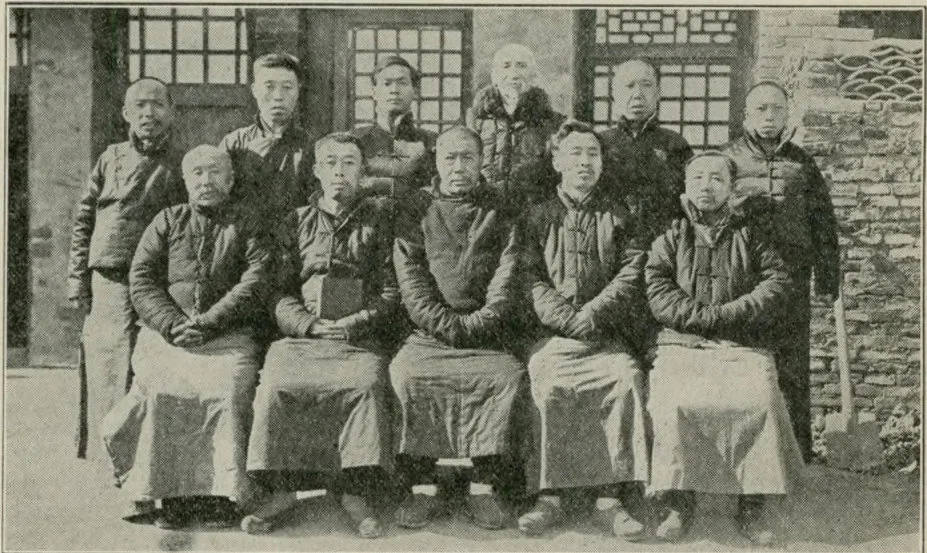
NATIVE WORKERS IN THE MANCHURIAN MISSION
Very encouraging progress has been made in the development of our work in Manchuria since my first visit to this mission, in March, 1915. Then we had only two couples stationed in this field; now we have three. At that time, public meetings were held in a hired hall. We had no mission property in our own name. Our workers were living in unsuitable rented quarters, which were damp, moldy, and altogether insanitary, endangering health and even life. On account of the water-holes and deep mud in the streets around the semiforeign Chinese compound where our Mukden missionaries lived two years ago, the vehicle that took us from the station to their place had to stop three or four blocks from the house, leaving us to pick our way the best we could through the mud. At that time we saw delivery carts sunk in the mudholes up to the axles in different streets around their rented compound. All this made it difficult for people to attend the meetings, even in daylight, and almost impossible to do so at night.
How different our situation today! In a very favorable location, near the legations of the various nations having consuls general at Mukden, and almost midway between the ancient walled portion of Mukden and the modern Japanese section, our brethren have secured an excellent tract of land on one of the great provincial highways, the Hsin Min Fu Road. Here they have established a center from which work can be carried forward to excellent advantage. Around a portion of the five-acre tract they have built a substantial seven-foot brick wall, with a frontage of one hundred and ninety-five feet, and running back about one hundred and fifty feet toward the rear of the lot. Within this secluded compound they have erected two good, substantial brick bungalows.
The outside measurements of these bungalows, which are identical in design, are 29½ x 45½ feet. On the main floor there are six rooms, including two bedrooms and an office or study, besides a small bathroom. At the rear of the house, and forming a portion of the back wall of the compound, are two small brick buildings, each 12 x 25 feet in size, for laundry, storage of fuel, etc.
The walls of the bungalows are solid brick and lime mortar, fifteen inches thick. Storm-doors and -windows have been provided. The thick walls, the extra doors and windows, and the insulated roof insure warmth in winter and coolness in summer,—very desirable features in this far northern land, where the winters are long and severe, and some months of the summer extremely hot, and where terrible dust storms are not infrequent.
The total cost of these homes for our Mukden missionaries, including brick outbuildings at the rear, is about fifteen hundred dollars each. We rejoice in the kind providence that has preserved the health and strength of our workers until we could provide suitable homes for them, apart from the noise and filth and the deadly diseases of the crowded quarters where the Orientals live, and yet within a few minutes' walk of the heart of the city.
Our workers can now continue their self-sacrificing labors with renewed courage, knowing that their13families have sanitary surroundings and the ordinary comforts that make life in a mission field nearly as safe as in more favored lands. The comparatively small investment in these mission homes will be returned to the Mission Board a hundredfold in the preservation of the health and strength of our fellow workers in these difficult fields, and in their increased efficiency in their labors for the lost.
During the fall of 1916 a piece of property inside the small north gate of the walled city of Mukden, was purchased for use as a mission chapel and as general headquarters for our native workers stationed in this center. The lot has a frontage of one hundred and nineteen feet on one of the best and most frequently used streets of the inner city. The lot extends back about sixty feet to a good alley. This property has cost the mission a little more than $2,100. It gives us a serviceable chapel, besides a few old Chinese buildings. There is ample space for the erection of a larger chapel when one becomes necessary later on. There is also room for a medical dispensary and a church school.
Meetings are held every evening in this chapel, and already our work in the city is becoming known among the natives as one that has in it the elements of permanence. The purchase of this mission property in Mukden has placed us decidedly on vantage ground.
The present membership of the Mukden church is thirty-six. This includes our foreign workers, and all other baptized believers in the Manchurian Mission, although if we were to count those whom we hope soon to see identified fully with us, and who even now attend all our meetings faithfully and keep the Sabbath, we could report about fifty believers.
Our general meeting was held in the city chapel at Mukden. All our foreign workers were present, and also our native workers. We had good meetings. While the work in Manchuria is just beginning, we are encouraged to hope for great things within a very short time. The field is a most promising one, and already workers are being developed. Two years ago we had only ten believers in all. Three of these were doing a little colporteur work, two of whom have since developed into evangelists. At the time of my former visit, the faces of these workers still bore decided traces of the debasing influences of heathenism; today I find these same men wholly different.
It is amazing to me, as I go about from one mission field to another, to see the wonderful transformations that have taken place in the countenances of those who have been rescued from the depths of heathenism and caused to know this glorious message, which is preparing the way for the advent of our Saviour. No one can witness these changes that are taking place, even in the countenances of the believers, and doubt that the gospel has in it creative and transforming power. Lines of strength, of firm purpose and noble resolve, take the place of lines of weakness and sin. Thus the glory of God is being revealed in life and character.
During the meeting, plans were laid for enlarging our work in the Manchurian Mission by opening new mission stations as soon as possible in various important centers.
Manchuria is divided into three provinces; namely, Feng-tien, Kirin, and Heilung-chiang. Feng-tien Province embraces the southern and west-central portion, with Mukden as the natural center; and this is the one we occupied first of all. Kirin Province embraces the east-central portion, with the cities of Chang-chun and Kirin and Harbin as natural centers. When our workers had become well established in Mukden, they divided their small forces, because of their eager desire to occupy new territory. Brother and Sister Grundset moved on to Chang-chun, the northern terminus of the South Manchuria Railway, one hundred and eighty-six miles north of Mukden and about two hundred miles south of Harbin, with which latter city it is connected by a railway. Heilung-chiang Province is as yet unentered.
The establishment of our new outstation in Kirin Province required no little self-sacrifice on the part of Brother and Sister Grundset, as that mission was opened just as the new bungalows were getting under way at headquarters. For nearly two years they had occupied Chinese houses, and then, just as we were about to provide the comforts of clean and inviting homes, they with their young child turned their faces northward, and rented a Chinese house in Chang-chun, where they are endeavoring to form a new center of light and blessing. Of course this family must be provided very soon with a mission home, as otherwise they may not be able to keep their present good health and strength. And if with the cottage home we could give them another foreign family to unite with them in labor, it would greatly cheer their hearts.
Some of our native evangelists are conducting chapel services in rented quarters in important towns. Aside from our missions in Mukden and Chang-chun, there are chapels at Liao-yang, forty miles south of Mukden; at Tie-ling, about forty miles north; at Tung-giang-kou, west of Mukden and inland from the railway; and at Kwang-Cheng, about forty miles south of Harbin. These chapels are each manned and operated at a total cost to the mission of about two hundred dollars annually.
One of the most interesting and far-reaching lines of work carried on in Manchuria at the present time, is the placing of our monthly magazine, the Chinese Signs of the Times, in the homes of the people regularly through annual subscriptions. Last summer four colporteurs traveled up and down the highways and byways of the southern and central provinces, and secured a little more than three thousand subscriptions for our Chinese monthly. These papers are even now penetrating into regions we may never be able to reach by means of the living preacher. The work was done on a self-supporting basis, the only cost to the mission being the car fare of the colporteurs to their fields of labor. It is planned this coming spring and summer greatly to extend the circulation of our Chinese paper in Manchuria. This will mean much to our work in this great unentered territory, covering three hundred thousand square miles.
The outlook for our Manchurian Mission is very bright. The encouragements met with early in our work in this field are strong incentives to our faithful fellow laborers to persevere with strong faith and earnest prayer, knowing that the Lord of the harvest is preparing the way before them, and that in his own time and way he will give them abundant success.
A NATIVE FUNERAL
By J. Victor Wilson
J. VICTOR WILSON
A few days ago we all went to see a native funeral, and a short sketch of what we saw may be of interest. We arrived before many natives had gathered, and could see them coming from all directions, dressed for the occasion, each carrying from six to twelve assagais.
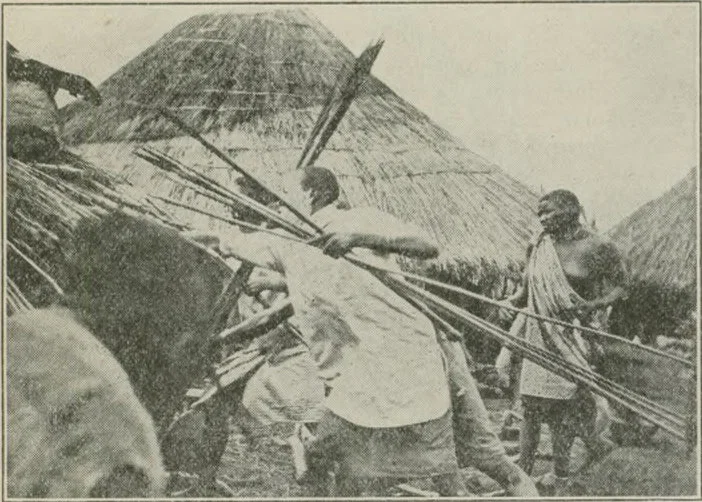
As the women came, they threw themselves on the grave with great force, quite a few times, until taken away by some friend. The men, most of whom had their faces whitened with ashes, came on the hard run, and when near the hut of the deceased, would stab all around with their assagais to frighten off the evil spirits. As we watched the faces of some of the men, they seemed to us to be devils incarnate, and they jumped about more like wild animals than human beings. Two young men began to pull down the house of the dead man (they can be seen doing this in the photograph), but were quickly stopped by one of the old men.
The women and girls marched to and from the grave, wailing as they went, carrying the horns of the cattle that had been killed. Once in a while one of them would run out with the horns, and go through the motions of chasing off evil spirits with them. Another woman walked around the grave, swinging a pot of burning incense.
On all such occasions numbers of cattle are slain, cut up, and boiled and eaten with the hides on; for if14the cattle were skinned, they say, the deceased would have hideless cattle in the next world.
As we watched the proceedings, and compared these heathen with our mission boys, a number of whom were with us but did not join in the ceremony, we could not help thinking what a marvelous change the gospel makes in a native. The funeral took place only two and one-half miles from our mission homes. Knowing this, one can better comprehend what a great work still remains to be done for the poor Africans.
Young African Braves Driving Off the Spirits; Also in Act of Overturning a Dead Man's Hut
Pemba, Rhodesia, Africa.
ARGENTINA
By A. R. Dennis
A. R. DENNIS
The past four months we have had some good experiences here in the city of Rosario de Santa Fé. We have had two baptisms,—one of four believers and the other of eight.
Among the first baptized, and the most interesting, was a native woman who came to us direct from Catholicism. One of our sisters lived in the same house with her for a few months, and shortly after moving in, she went one day to visit the other woman, taking her Bible along. Our sister asked her to read a portion, but she replied that the saints would send a plague in her family if she should read such a book. Again and again she was asked to read a few lines, and finally consented, although she feared some terrible calamity would befall her. Later she came to the meetings, and one morning burned up all her saints, pictures, and images. That evening there was a terrible electric storm, and she feared greatly that the saints were sore displeased. Soon her husband returned, and she told him what she had done. He said, “Thank God all the saints and images are burned up. Now we can live happily.”
She never missed a meeting, and did not rest easy until her husband, who is a brakeman on the railroad, got a pass and went hundreds of miles to one of the northern provinces to bring back their two eldest children, so they also might enter the church.
In the meantime she began selling small books and papers enthusiastically. Wine as well as meat disappeared from the table. She told me her husband was greatly pleased with the wonderful change in her, and he also expects to keep the commandments as soon as he can arrange his work.
She recently bore this testimony in meeting: “It is never too hot or too cold, the wind never blows too hard, it is never too far nor rains too much for me to come to meeting. Many times when it comes time to eat, there is scarcely enough to go round my family of six children; however, now that I know the truth, I am happy.” After the series of meetings just closed, the daughter also was baptized.
We have a good attendance and interest now, so we are hoping the Lord will see fit to add many more to his flock here. We have a membership of about sixty.
At present there seems to be a great awakening of the Italians in this country, and a thirst for the gospel. Two men come to my room at night once or twice a week to study the prophecies; they also attend our meetings when it is possible. We have a nice little meeting place in this large city, the second in the republic. I am hoping the next camp meeting may be held here.
Meanwhile the members are kept busy selling small books and papers, and we hope by that means also to be able to get many more new believers.
ITINERATING IN THE ANDES
In a recent letter, Elder F. A. Stahl, superintendent of the Lake Titicaca Indian Mission, says:
“I am glad to report that the work is ever progressing here, and that the Lord is blessing in many ways. We are preparing to open one of the largest mission stations that has yet been opened, in the district called Moha, but we understand from our opponents beforehand that they are going to do all they can to keep us from entering this district.”
Surely we should all join in prayer for this new mission station, as well as for continued prosperity in this remarkable field, where we have one of the most interesting missions conducted by our denomination.
HOW CHARLIE FOUND THE THIRD ANGEL'S MESSAGE
By M. D. Wood
(Concluded)
M. D. WOOD
We had a bright young schoolmistress teaching the boys’ school, and to the surprise of students and missionaries, Charlie fell in love with his teacher. Soon he confessed, in his frank, open-faced manner, that it was an undeniable fact. And what could we say against it?—Not a word. Charlie had been converted; he loved the name of Jesus Christ, and knew the full value and power of prayer. Charlie was a real Christian, and so was Tarabai, the schoolmistress. Tarabai means “the lady of the stars.” So we consented to his choice, and after due time these two young people were united in holy wedlock. Since then they have been known as Mr. and Mrs. C. V. Kalli. They have always been a happy, prosperous young couple. Frequently while I was at home in America, I received letters filled with news from these young people. They did the best they could, and lived up to the light they had received.
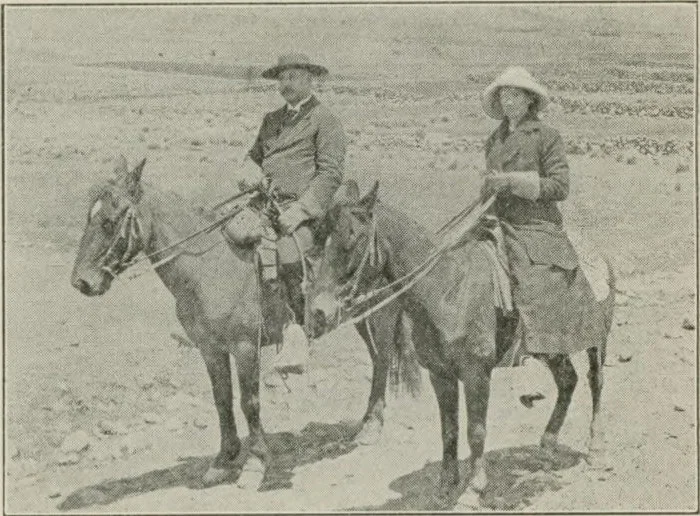
Elder and Mrs. F. A. Stahl on the Way to Visit the Sick and the Church Members
Soon after my return to India I sent them a letter, telling them I should be glad to see them again. It was not long after I arrived at Kalyan before Charlie came to see me. He brought his beautiful, bright little girl Margurette with him. We were very glad to see them. But Margurette could not quite understand why15he called me papa when I was a white man and her papa was a native of India. But Charlie said I was the only papa and Mrs. Wood the only mamma he knew anything about. She was then quite contented with the plan.
When Charlie came, Tarabai sent us a dish of food such as she knew we liked. After we had asked each other many questions about our old friends, I gently told him of the third angel’s message that had come to me while in America. I took my Marathi Bible and read to him the word of God regarding the Sabbath truth. For a while he sat in silence and gazed at me in wonderment. Finally he said, “Well, papa, you have the Bible for what you say.”
Dear friends, I assure you I felt glad he saw I was not teaching him some new fad, but the facts and truths of the dear old Bible. And he believes the Bible to be the oracles of God just as much as we do. I saw that he believed, just as any honest man must believe when he listens to what God says and lays aside all prejudice.
Before Charlie returned to his position, he said, “Well, papa, what about us and our work?” I said, “O Charlie, you have a good position, have you not?” He did not deny that, but I saw he had a taste of the truth such as he had never had before, and that he longed to be better taught. In fact, his heart told him that we had meat to eat that he knew not of, and he was hungry.
It was not long before our mission committee decided we must have a more efficient master for our No. 1 school at Kalyan, and that a mistress was necessary for the school also. This fact was made known to Charlie. He replied that ever since he had been to see me, his associates had given him a great deal of trouble, had made fun of him, and called him a Sabbath keeper, etc. But he had made up his mind that we had the Bible truth, and he wanted to come and learn more and also help in the Master’s work. For some time Charlie endeavored to get leave to come to us, but those in charge would not listen to his request. He sent in a fifteen days’ notice of his resignation, but they doubled the time and insisted on his remaining with them. Higher wages were offered him, and many promises were made, but all of no avail. Finally they began to ridicule him, but his purpose was not changed in the least.
Now Charlie, Tarabai, and Margurette are with us at Kalyan. They will reorganize the school for boys and girls and begin their work with us. We are glad they are here to study the message, and we want all our people to pray God that they may learn to love the truth as we do, so that they, with us, may help finish the closing work on earth, that Jesus may soon come.
SELLING BOOKS AMONG THE MATABELES
By James Mayinza
JAMES MAYINZA
I am glad to tell you my experience in selling books among the Matabeles. I have had a desire to do so for a long time. We were very glad to see “Christ Our Saviour” when it was published, and from that time I began to want to sell the books.
Brother M. C. Sturdevant gave us permits to go and sell the books. There were six of us. Some went in one direction, others in another. Clarence and another boy went toward Bulawayo; but as soon as they got to town, the policeman caught them and put them in prison. They were asked, “Why do you sell the book without permission?” But their friends paid money, and had them released. I and the boy with me got on all right, but we did not sell many books that time. When I came home, I found that the others had been put in prison.
But this did not make me fear to go back. I asked Brother Sturdevant to get me a license from the government. They told him he must pay ten pounds every year. So he said, “We have no money.” Even then I kept going, taking a few books to sell in native kraals.
In September, 1906, I was sent to Barotseland. In 1909 I came back to Solusi Mission again. As I still wanted to sell books, I asked for a license, but was given the same answer as before.
In 1910 Brother Sturdevant went to Umtali, and W. C. Walston took his place. So I asked Brother Walston to get me a license. The government asked the same fee that it asked Brother Sturdevant. But by and by a Mr. Jackson came to Bulawayo to take the place of the other native commissioner. Brother Walston had seen him when he was at Somabula Mission, and had gained his friendship.
He began to tell Mr. Jackson that he wanted the license for me to sell books, and that he had been told he must pay ten pounds for it. The commissioner said, “No, you don’t need a license to sell the books among the natives. You must send a letter to Salisbury and get permission.” Brother Walston said, “I don’t know how.” So Mr. Jackson said, “You go home and write me a letter. I will send for it.” And he did. On Aug. 19, 1914, Brother Walston got the pass for me.
From that time I sold many books and pamphlets, more than eleven hundred. God blessed me in selling the books. I did not sell books only. People asked me to their homes to teach them the Bible in the evening, and many became interested in the truth. Sometimes they kept questioning me nearly all night. I do thank God because he has given us the truth.
They would bring me many inquiries concerning the books of Daniel and the Revelation. I am thankful that Brethren Sturdevant and Willson spent time to teach me those books. They believed the natives could understand the books of Daniel and the Revelation.
Many people now begin to see the true Sabbath. They say, “Why don’t you put your school here in town?” One family has already begun to keep the Sabbath. They came to stay near the mission to learn the truth, so the man can go to tell it to his people.
One day I came to the yard of a bad-tempered white man. The law is, when you come into the yard you must stay just a few minutes, then go. But I stayed a long time, and talked with his native boys. So he came with his heavy boots and said, “What do you want here?”
My reply was, “I am selling the books, sir.”
He said, “What books?”
I showed him the book, and he said, “What is it?”
I answered, “‘Steps to Christ,’ sir.”
He asked, “Where is the step? I see no step here.”
“That book teaches you how to come to Christ.”
“Do you teach people to come to Christ?” he asked.
“Yes,” I said, “I teach my friends to come to my Saviour.”
“What! do you teach your friends only?”
“Yes, all people in the world, they are my friends.” So he went away and said nothing.
But another white man was standing and listening. He saw that I answered the other man well, and said, “You see these boys of mine. They trouble me. They steal my tobacco and many things in the office. I want you to stay and teach them.” So I stayed from 8 A. M. until 1 P. M.
From this time, Clarence also has had his own pass to sell the books. He has been away twice and does very well.
I wish we had more Zulu books, but we have only three,—the Bible, “Christ Our Saviour,” and “Steps to Christ.”
I still want to sell some books and spread the truth among the Matabeles. I wish Uriah Smith’s book, “Daniel and the Revelation,” was translated into our language.
Solusi Mission, Bulawayo
Be What We Are and Speak What We Think
LET us then be what we are, and speak what we think, and in all things keep ourselves loyal to truth. — Longfellow.
Wise Men Make Their Own Opportunities
A WISE man will make more opportunities than he finds.— Bacon.