“Really, I believe I have the worst little boy in the world. He is always into something,” said Mrs. Holcombe to her neighbor.
“He is a busy lad, all right. There is no question about that,” was the reply.
While Mrs. Holcombe was saying farewell to her neighbor, Robert was busy “getting into things” as usual.
By the use of a chair, he managed to climb up on the kitchen cabinet, where he found all kinds of interesting things. Pretty soon mother found him there. In a loud, angry voice she called, “Robert, get out of there!” The command was quickly followed by slaps on hands and face, and more loud talking; and finally Robert was set down, screaming, kicking, and tearful.
Mrs. Holcombe then opened her sewing machine, and Robert as quickly got a chair and began to investigate. It was impossible to sew, with his hands in the wheel; so, after fifteen minutes, during which time Robert received several slaps and shakings, Mrs. Holcombe closed the machine, and looked for something she could do in peace.
So the days passed. Robert’s hands were slapped until they were nearly blistered, but in almost every case he was the victor. Usually he either succeeded in getting what he wanted, or his mother ceased her work, and tried something else. Thus she worried along from day to day, tired and despondent because her baby was so much harder to manage than other babies.
Then came the day when little Robert couldn’t get into mischief any more. He was unable to leave his bed for many weeks, and when he did, he was without the use of his lower limbs. He sat in his little armchair, and watched his mother go about her household work undisturbed; and he still sits there today. Occasionally he asks for a drink, or something to look at. In the quiet and order of that little home, a sorrowful mother has time for painful thoughts and bitter tears. Too late she has learned that she misused her baby. Like a moving picture, there passes before her mind those painful scenes of the days gone by when Robert, so active of body and mind, wanted only something to do to make him happy, but received instead slaps and scoldings.
Why, oh, why had she not made his days and her own full of joy and contentment? Why had she not provided things for him to play with, instead of surrounding him with things he must not touch, and then punishing him for touching them? Why had she been so ready with slaps and angry words? The little wasted body and sad eyes are a constant reproach to that mother, who prays many, many times a day that her little son may regain his health, that she may repay him for his lost babyhood.
Mothers, I wish I could impress upon your hearts the need of proper discipline, with love (not slaps), in the management of your little children. It is not a waste of money to buy plenty of suitable playthings to keep a child busy. A boy, when old enough, should have a well-furnished workshop, while a girl should have17her dolls and sewing basket. Such playthings develop the mind of the child, keep him off the street, and above all, solve many problems of discipline. Where a slap and loud, angry words antagonize the child, and produce a display of stubbornness, tears, and screams, a little love and reasoning will divert his attention, bring instant obedience, and in all probability send him to your arms with a hug and a kiss.
Of course, occasional punishment is necessary, to teach unfailing obedience; but continual slappings and scoldings will lead to more severe corporal punishment in later years, and eventually the average child will become so hardened that he will endure almost any amount of pain before yielding. Are you leading your child to that? Continual punishment in babyhood is the initial step in making a child just what you do not want him to be.
When the tired little body relaxes in sleep at night, and you see the baby features in calm repose, the little hands quiet after a busy day, do you ever stop to ask yourself, “What has this day meant to my little boy? Has it been happy? If not, is it my fault?” He may never again see the morning light. If he should not, would your mother-heart have aught to regret? Would you feel that you had done all that God expected of you in the care of one of his little ones?
Mothers, let us endeavor to be firm, yet kind and considerate, in all our dealings with our children. Then they will grow to noble manhood and womanhood; or if their dear lives should suddenly cease, we should not be henceforth accompanied by an aching remorse. May God keep us faithful, so that when he calls his loved ones home, we may be among those who can say, “Behold, I and the children whom the Lord hath given me.”
St. Cloud, Minn.
GUARD THE CHILDREN
By Mrs. Grace E. Bruce
MRS. GRACE E. BRUCE
One evening while walking through a small village, I noticed three children at play in a field near a house. One was a boy of perhaps thirteen years, and the other two were girls of about the same age. It was midsummer; the sun had dropped from sight, and a gentle breeze was cooling the heated air. The beautiful sunset glow that rested above the western horizon was fading away. Night was drawing dark shadows over the landscape. Lights began to twinkle in the cottage windows.
It was evident that under the cover of approaching night the enemy, with his baleful and poisonous influence, was at work. The most careless observer would have noticed that virtue and modesty were not included in the play in which these three children, alone in the field at nightfall, were indulging.
Many fathers and mothers today are asleep, seemingly oblivious to the great necessity of constant watchfulness; and the enemy, knowing well how to take advantage of the situation, is wide awake and sowing his tares. “He sitteth in the lurking places of the villages: in the secret places doth he murder the innocent.” Ps. 10:8. He lurks in the darkness at our very doors. Too often he finds the way clear, and “murders the innocent” in the very shadow of the home that should be to them a protection against the “outer darkness” and the many temptations that lurk therein.
There is danger that Seventh-day Adventist fathers and mothers will become so burdened with the cares of this life that they will fail to recognize the necessity of constant watchfulness, and by their negligence close the gates of the city of God to their children.
Somewhere in the world today the Lord is preparing a company of children who will dwell in the New Jerusalem. “The streets of the city shall be full of boys and girls playing in the streets thereof.” Zech. 8:5. Dear reader, whoever you are, will your boys and girls be in that company? Are you, by your tender love and watchcare, faithfully guiding their inexperienced feet toward the holy city? Remember that only those who have clean hands and a pure heart “shall ascend into the hill of the Lord” and “stand in his holy place.”
Let us awaken before it is too late. We have no time to lose; already the day is far spent. Thank God, the gates of mercy are still ajar; his ear is still willing to hear, and his arm stretched out to save. Let us work as never before for the salvation of our children.
Gaston, Ore.
ARE ALL THE CHILDREN IN?
By Elizabeth Rosser
ELIZABETH ROSSER
Are all the children in? The night is falling,
And storm clouds gather in the threatening west;
The lowing cattle seek a friendly shelter;
The bird hies to her nest;
The thunder crashes; wilder grows the tempest,
And darkness settles o’er the fearful din;
Come, shut the door, and gather round the hearthstone:
Are all the children in?
Are all the children in? The night is falling,
When gilded sin doth walk about the streets.
Ah, “at the last it biteth like a serpent”!
Poisoned are stolen sweets.
O mothers, guard the feet of inexperience,
Too prone to wander in the paths of sin!
Come, shut the door of love against temptation!
Are all the children in?
Are all the children in? The night is falling,
The night of death is hastening on apace;
The Lord is calling, “Enter thou thy chamber,
And tarry there a space.”
And when he comes, the King in all his glory,
Who died the shameful death our hearts to win,
O, may the gates of heaven shut about us,
With all the children in!
OUR HOMES
By Mrs. I. H. Evans
Conducted by Mrs. I. H. Evans, Takoma Park, Washington, D. C.
Through the columns of this department, hints will be given on all matters pertaining to the home life. Short articles and letters are solicited from home makers, telling of their everyday experiences,—their joys and sorrows, their failures and successes.
POSTURE
By G. H. Heald, M. D.
G. H. HEALD, M. D.
HAVE you ever noticed that the man who goes to sleep over his book does so when he is sitting? When he finds he cannot keep awake sitting, he may stand in order to continue his reading. One who goes to sleep in meeting does so when sitting, not while standing. True, one may be so exhausted as to lose consciousness even while standing; but reference is made to those who seem to be wide awake until they attempt to read or to listen to a sermon.
If one is careful to observe, he will perceive that these drowsy persons habitually sit in a bad position. They are so slouched down that the abdominal wall protrudes, and the abdominal organs are thrown down and forward. The pressure which should aid in forcing the return of the blood to the heart is relaxed; moreover, the kinks formed by the pulling of the prolapsed organs must have some effect in impeding the return of blood through the veins.
At any rate, it is known that with those who habitually sit in a slouched position, in which the normal forward curve of the lower spine is changed for an abnormal backward curve, there is abdominal congestion, a considerable portion of the blood which should be doing duty elsewhere being held in the abdominal vessels. The resulting anemia of the brain may render impossible any mental work requiring concentration. The victim can take part in conversation, provided the other person does not do all the talking, and may not feel drowsy when unoccupied; but when attempting to concentrate his mind on what he reads or hears, he is unable to accomplish anything worth while, because of his drowsiness.
Among other symptoms of stagnation of the abdominal circulation are despondency, “that tired feeling,” mental confusion, cold extremities, and probably constipation.
The use of an abdominal supporter may give some relief; and to lie face down with a pillow or similar body under the abdomen will force the stagnated blood back into the general circulation; but for permanent results, such exercises should be practiced as will develop a correct posture, and strengthen the abdominal muscles.
Particularly advantageous are exercises which strengthen the abdominal muscles. Among these are:
The abdominal compression exercise, alternately compressing the diaphragm and the abdominal muscles, so that the abdominal wall is forcibly and rapidly moved forward and back. This exercise, practiced several times a day, will strengthen the abdominal muscles, and also facilitate the return of the stagnated blood to the general circulation.
Forward and backward bending.
Sidewise bending.
Sidewise twisting.
Lying on back, thigh flexions.
“Nebuchadnezzar exercise” (walking on all fours).
In walking and standing, the victim of abdominal stagnation should acquire a position in which the chest, rather than the abdomen, is the most prominent part of the body. Perhaps if he arranges mirrors so he can gain a sidewise view of himself, he will be surprised, possibly mortified, at his ordinary figure. This will be an incentive for him to form the habit of standing and walking erect. One should remember to keep the chin in, the chest well up, and the hips back. This will ordinarily give a good position. It is comparatively easy to walk and stand erect. The principal difficulty is the correction of the sitting position.
One of sedentary habits who has long been accustomed to a slouching position, will find it extremely difficult to effect a reform, and he will have constantly to guard against sinking back into his old position. If one sits with chest well up, and abdomen in, he is not nearly so likely to suffer from drowsiness. It is true that drowsiness may be in part a result of autointoxication, but this in itself is partly dependent on relaxed abdominal contents, so that the faithful use of the prescribed exercises, and the habitual assumption of a right posture, will eventually relieve the drowsiness, unless some condition which requires medical attention is causing it.
One more word to the unfortunates who were not trained early in life to assume a right position. You have doubtless been led to believe that position is a matter of minor importance. If you can but realize that it is one of the important causes of your early aging, and that proper attention to physical culture will even now add to your efficiency, physical and mental, and lengthen your life, you may be encouraged to test the matter out thoroughly in your own case.
YOUR CHILD AND HIS TOYS
WHEN you buy toys for your children, says Marion F. Lansing in the Ladies' Home Journal for December,
REMEMBER —
That play is the child's business in life, and toys are his tools.
Therefore —
Choose toys to do things with, that make him the actor, not the spectator.
REMEMBER —
That his instinct is to imitate.
Therefore —
Choose toys with which he can reproduce in miniature the life that he sees.
REMEMBER —
That his instinct is to create.
Therefore —
Choose toys which lend themselves to a variety of constructive uses.
REMEMBER —
That his instinct is to be active.
Therefore —
Choose toys that encourage muscular effort and stimulate his powers.
REMEMBER —
That his instinct is to repeat.
Therefore —
Choose toys that will stand hard wear.
REMEMBER —
That his instinct is to admire.
Therefore —
Choose toys that are artistic.
REMEMBER —
That toys are only pegs on which the child hangs the rich mantle of his imagination.
Therefore —
Be more concerned over their adaptability than over their expensiveness; have more regard for their quality than for their quantity.
ANOTHER MEMORIAL CHURCH IN WASHINGTON, D. C.
By T. E. Bowen
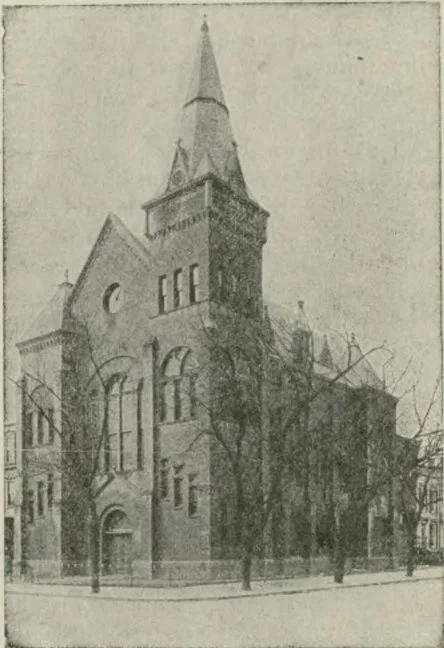
SABBATH, April 14, was a day of rejoicing to our colored brethren in Washington, D. C., as on that day they held their Sabbath services in the church recently purchased from the Lutheran Reformed congregation.
This building is 45 x 65 feet, is of brick, with slate roof, has a good basement above ground, an auditorium with gallery, in which is a pipe organ that cost $2,500 when installed. In the rear of the church is a dwelling built for a parsonage, valued at about $3,000.
This property is on the corner of Sixth and N. Streets, N. W., one block from one of the main street-car lines, and is in good condition. The purchase price, including the parsonage, was $18,750. These buildings were erected in 1892-93, and could not now be duplicated for $35,000.
The North American Division Conference Committee and the Columbia Union Conference Committee, at the last autumn council, united with the local conference committee in the belief that the time had come to take definite steps to provide a place of worship, where school work also might be carried on, for our loyal colored brethren in Washington. Accordingly a resolution was passed at the council, providing for the purchase of such a place. Much careful thought was given to selecting a good site.
At first it was thought best to build, but on account of the cost of labor and materials, this was abandoned. Finally the building shown in the picture was secured, after careful examination by a large and representative committee, in which the North American Division, Columbia Union, and District Committees, as well as members of the General Conference Committee, were represented.
The purchase price was paid at the time the property was deeded to us, but there still remains $6,750 to be raised by the church and the District Conference. It should be mentioned that Mr. Scott, a real estate agent, whose wife is a member of the church, made a very liberal donation of his percentage in arranging for the transfer.
New Church for the Negroes.
Washington, D. C.
We feel sure our loyal colored brethren and sisters throughout the denomination will rejoice with us that this substantial memorial for the truth has been established in so good a location here in Washington, the capital of the nation. Elder U. S. Willis, from Savannah, Ga., who has recently connected with the work in this city, is in charge of this church, and has begun an aggressive effort in behalf of his people, who reside in large numbers in the vicinity of the church. Let all pray that success may attend the efforts put forth to reach others with the message, and that from this new memorial light shall radiate afar to the glory of God. T. E. BOWEN.
"I'M GOING TO TELL MY FRIENDS ABOUT THAT!"
By Orno Follett
I had spent the morning studying the precious promises of God's Word with an educated Navajo Indian and his family. The deeper we went into the study, the more intensely interesting it became. Time slipped by unheeded. The noon hour passed unnoticed. We were feeding upon the bread of life.
I had just finished reading the texts relating to the new earth. How I wish all my brethren and sisters who read these lines could have seen the dark faces of these one-time pagans, as they shone with quiet joy while contemplating the blessings of the Paradise home! And the father exclaimed in the height of his joy, "I'm going to tell my friends about that!"
O, how those words still ring in my ears! And they spur me on day by day, even through mountains of discouragements, to help tell his friends the glad tidings of the Master's soon coming.
ORNO FOLLETT.
Beginning Work in China
By O. B. Kuhn
WE have been studying the language about six months, and are able to give simple Bible talks to the Chinese people. Last Sabbath I spoke to a heathen congregation. The little chapel at West Water Gate was crowded until there was but little standing room left. In the congregation were teachers, shopkeepers, soldiers, and working men and women, and great interest was manifested.
The Bible lesson was illustrated with an idol that had been worshiped many years. Ps. 115: 4-8 was read: “Their idols are . . . the work of men’s hands. They have mouths, but they speak not: eyes have they, but they see not: they have ears, but they hear not: noses have they, but they smell not: they have hands, but they handle not: feet have they, but they walk not: neither speak they through their throat. They that make them are like unto them; so is every one that trusteth in them.”
A few days before the meeting, a temple containing a large number of idols was burned. We used this to illustrate the fact that the idols are not only unable to protect their worshipers, but can protect neither their temple nor themselves. Afterward we told the people about the true and living God, and of the loving care of our heavenly Father. After singing, it was announced that the meeting would close with prayer. But after prayer the people did not leave. They were told three times that the meeting was over, before they left the chapel.
I shall never forget those faces, they were so expressive of soul hunger. I dreamed about them that night, and I think of them every day. As I saw the unwillingness of the people to leave, a great longing came upon me to take them in the arms of faith and present them to God. I felt a great burden to save those men from a Christless grave.
With such a scene before me, I regret that I did not earlier prepare to come to China, and that more of my money did not go to the mission fields. O. B. KUHN.
FIELD NOTES
SEVEN new members have been added to the church at Council Bluffs, Iowa.
ELDER C. M. MCDONALD reports the baptism of eight persons in Porter, Okla.
ON a recent Sabbath eight new members were added to the church in Kansas City, Kans.
ELDER L. B. SCHICK reports seven new members added to the church at Kansas City, Mo.
A NEW Sabbath school has been organized at Herrick, S. Dak. Fifty-six were present the first Sabbath.
A FEW weeks ago the new church building at Selma, in central California, was dedicated to the worship of God.
A NEW church has been organized at Elsinore, in the Southeastern California Conference. Seven members were received by baptism.
ELDER H. E. LYSINGER baptized seven persons at Vallejo, Cal., a few weeks ago. This church has more than doubled in membership during the last nine months.
FIVE new members were received by baptism into the church at Fort Worth, Tex., recently. Others are keeping the Sabbath who have not fully united with us yet.
ELDER J. W. MCCOMAS reports from Toronto, Ontario: “Some thirty-five have accepted the third angel’s message since we came here last June. We are now raising money to erect a new church, which will accommodate about four hundred and fifty.”
THE following note from the Lewiston Tribune shows the good results of the meetings held in Lewiston, Idaho: “Rev. C. J. Cole, of the Seventh-day Adventist Church, finished a series of meetings last Sunday evening in Lewiston. The result was about fifty converts for that faith.”
WITHIN the last few months ten have been baptized and united with the church at Haverhill, Mass. Others are deeply interested in the truth of God. On a recent Sabbath six new believers were baptized at Lowell. The church at South Amherst has been reorganized, and now has thirteen active members.
THE workers at Junction City, Ore., report that as the result of meetings held there, fifteen are keeping the Sabbath, and twelve others are deeply interested. They have just organized a Sabbath school with a membership of thirty-five. Fifteen new believers were recently added to the St. Johns church by baptism.
ELDER F. C. GILBERT reports from the series of meetings he has been holding in Schenectady, N. Y.: “Thus far about twenty-seven persons have taken their stand for the truth of God, and a number are in the valley of decision. Quite a few others are deeply interested in the message we are giving.”
ENCOURAGE THEM TO KEEP ON
By Mrs. I. H. Evans
To every one who works for and loves young people there comes at times a feeling almost of despair as he sees the traps set to ensnare their unwary feet, the carelessness of those who should be examples to guide their wayward steps, and the increasing impact of the world, pushing so many of them out of the narrow way into the broad path that looks so gay and attractive to their eyes.
What can be done to save them? How may we counteract the influences so constantly drawing them down? One whose counsel we value has said:
“The youth who finds joy and happiness in reading the Word of God and in the hour of prayer, is constantly refreshed by drafts from the Fountain of life. He will attain a height of moral excellence and a breadth of thought of which others cannot conceive. Communion with God encourages good thoughts, noble aspirations, clear perceptions of truth, and lofty purposes of action. Those who thus connect their souls with God are acknowledged by him as his sons and daughters.”—“Testimonies for the Church,” Vol. IV, p. 624.
The Bible Year, arranged in daily assignments for completing the reading of the Bible in one year, provides a systematic plan for daily Bible reading. The more our young people read the Bible and the more they lay up its instruction in their hearts, the more will they be safeguarded against the perils of these most perilous times.
This being so, would it not be well for all who have to do with young people—at home, at school, and in the various departments of the church—to encourage them to follow the plan outlined in the Bible Year, and to keep up week by week with the printed assignment?
One Sabbath school division superintendent has fastened up on the wall near the door of her room a large chart. It is neatly ruled, with spaces for names, and fifty-two little squares opposite each. As the children enter the room on Sabbath morning, each one who has completed the weekly assignment stops by the chart, and opposite his name marks an X in the square for that week. The plan has worked well in keeping up the interest.
It is natural for young people to begin the race when a number of others are entering; but after the first enthusiasm wanes, their interest must be fostered and stimulated. If we each use all our influence to encourage those who enrol in the Bible Year to keep on till the course is completed, many more will finish the reading, and receive the benefit that will surely come from it. Mrs. I. H. EVANS.
MINUTES OF MELBOURNE M. V. OFFICERS' MEETING
By E. M. James
Officers from the Melbourne Missionary Volunteer Societies, with other interested members, gathered in Elder Morris Lukens's office until every available seat was occupied, and some stood in the doorway or listened from the next room. After singing and prayer, Elder Lukens talked to us on the responsibilities of our work as officers of the Missionary Volunteer Society, and of his appreciation of the help given in the conference work through this means. He related some experiences showing that the leader can do much to encourage the young people by giving them a part in the work of the society, and getting them to feel that they are necessary to its success. He also told us about some of our missionaries, and the recent changes in their work.
Elder C. H. Parker has been called from the New Hebrides to take the presidency of the first island conference, the Central Polynesian Conference, with headquarters in Fiji. All felt that they did not want to discontinue the support of Elder Parker and his wife because they had changed their field of labor; for we have come to look upon them as our own missionaries, and have been supporting them from the Victorian Conference ever since they began working in our field. Still others felt that they could not consent to discontinue their support of the work in the New Hebrides, which is progressing so favorably; for from its opening this field has been largely supported by the Victorian young people. It was unanimously voted that in view of the fact that Elder Parker, whom we wish to continue to support, is going to Fiji, we discontinue the support of Sister Meyers in that same field, and take as our missionaries for the New Hebrides Brother and Sister A. G. Stewart, who have taken Elder Parker's place there. This would call for more means; but it was thought that we could meet the expenses by keeping well up to our present aims. At least, we would do as much as possible toward the support of the two ministers for these island fields.
A discussion followed on how we can make the most of our Missionary Volunteer meetings. In worldly business, men find it necessary to study their work, and make improvements year by year, changing their methods to suit the times, improving their machinery, sharpening their tools—anything that will help to make the most of the material at their disposal. In proportion to the greater magnitude of our work in dealing with human souls, how much more important that we study to improve our methods, and make the most of the material in our societies!
Suggestions were made as to some of the essentials of a successful meeting, from which we quote the following:
Thorough preparation of self, by prayer and study; of program, by planning ahead; of meeting place, by enlisting the services of Juniors.
Coöperation of the associate officers and the young people themselves in planning for work and meetings, by having a program20committee to plan ahead, thus giving the members time for thorough preparation.
Variety in the programs. It is unwise to have everything read. Some may rewrite the portion given them; others still more advanced may write an essay on a subject suggested by the program; some could tell things in their own words after careful study. Do not attempt too much at first. An example was given from the July Missionary Leader, showing how the program could be divided so that many would have a part, bringing even the younger members into service. It is necessary to read such articles as messages from the Spirit of prophecy, articles by our leading ministers, or stories so well written that they would lose their effect and beauty by being told. In all cases thorough study of these articles is absolutely necessary in order to do them justice in reading them; for we cannot interest others more than we are interested ourselves.
Announcing the meetings.
Good singing, in which all may take part.
Short, definite prayers, sometimes for temperance work, sometimes for the next-door neighbors of those present; for the unbelieving relatives of all present, or for the missionaries in the mission field about which you are studying, etc.
A cheerful leader, one who will get the members to want to do the work, rather than one who will try to make them do it.
Do not despise the day of small things. If your society is small, still give it your best attention.
“Just where you stand in the conflict,
There is your place;
Just where you think you are useless,
Hide not your face.”
If any member makes a beginning in work or study, show your appreciation of the effort; it may lead to greater things. We cannot afford to despise these little attempts any more than the farmer can afford to be contemptuous of his seeds because they are tiny.
Brother H. F. Smith next showed us the new Junior Reading Course book, which gives in an interesting and attractive way the life of John Williams, who labored in the South Seas as a pioneer missionary. The book has thirty-three illustrations, and a number of maps, so the journeys from one island to another can be followed as the book is read. Seventeen copies were ordered by those present who had not already purchased the book. Some took it to read for themselves, so that they would be able to interest the members of their societies in the reading. This Junior course will last for the remaining months of this year, closing in December.
Aggressive plans for the temperance campaign were next presented by Brother J. L. Smith. This gives a splendid method of missionary work for our young people as well as older members. Some are giving their entire time to the work, with excellent results. Names are taken of those who are interested in the temperance cause, with the number who are voting from each home; and after ascertaining if the names are on the electoral roll, their assistance is solicited for the distribution of literature, and a War on Drink magazine is left where sixpence or more is given.
“Give of your best to the Master” was the sentiment of the closing hymn, and this, we believe, is the determination of the officers of our societies.
E. M. JAMES, Sec.
ASA: THE TROUBLE WITH HIS FEET
Like most runners, Asa, king of Judah, ran well at the start. He had a good name, “Healer,” “Physician,” and lived up to it; he set out to heal the sicknesses of his nation. He “did that which was good and right in the eyes of the Lord.” He destroyed the abominable altars of heathenism, and smashed the foul symbols of a still more licentious practice. Because his grandmother was an idolater, he would not have her for queen-mother. He restored the broken-down and disused appurtenances of the temple. He reëstablished the sacred sacrifices of the pure religion, and summoned to them the faithful from the northern kingdom as well as the southern. As a climax, he had the people renew, with shoutings and praise and with all their hearts, the great covenant of the nation with Jehovah,—a covenant so sadly and so frequently broken,—that they would serve the Lord alone, and that any one running after idols should be put to death.
It was not all perfect, says the veracious historian. The people still hankered for their idols, and not all of the idol sanctuaries were wholly abandoned; but though the nation was faulty, the king was not: “The heart of Asa was perfect all his days.” That is a wonderful thing to say of a man.
And as a result, Asa had much peace, peace for many continuous years in those unsteady times. Moreover, when war came, and terrible war at that, Asa was ready for it with the highest and best preparation.
It came from the south, from Egypt. Zerah marched proudly against Judah with an enormous army, and what could the little country do but pray? And so, as Asa set his few soldiers in battle order at Mareshah, he raised one of the most beautiful prayers recorded even in the Bible, that greatest of all prayer books: “Lord, it is nothing with thee to help, whether with many, or with them that have no power: help us, O Lord our God; for we rest on thee, and in thy name we go against this multitude. O Lord, thou art our God; let not man prevail against thee.” And man did not prevail. As the succinct, graphic chronicle has it, “So the Lord smote the Ethiopians before Asa, and before Judah; and the Ethiopians fled.”
Thus Asa ran well at the start; but one might say to him, as Paul said to the Galatians, “Ye did run well; who did hinder you that ye should not obey the truth?” For after all this close walk with God, and after this splendid exhibition and proof of God’s power, it was tremendously disappointing to see Asa, when Baasha, king of Israel, brought his army against Judah, strip the temple of its treasures, and use them to pay the king of Syria for a counterattack in the north, to draw Baasha away. No wonder Asa was rebuked roundly by Hanani the seer, and no wonder also that the angry monarch promptly imprisoned the daring prophet. That is what the erring are wont to do with their consciences.
And so it is most significant to read the next thing about Asa, he “was diseased in his feet, until his disease was exceeding great: yet in his disease he sought not the Lord, but to the physicians.” Is not that a perfect parable of this ancient runner? —Selected.