At the skies' wide gates Earth waited,
Famished and cold,
With eager, outstretched palms
To catch the Sun's bright alms
Of scattered gold.
And the Sun went to his coffers
As a king may do,
And out of his heaps of gold
All that his hands could hold
Broadcast he threw:—
Three yellow-golden guineas,
A rain of them,
Over her pale green gown,
Showering thickly down
From throat to hem.
And, oh, how the little children
Laughed out to see
That with this shining mass
Of dandelions the grass
So bright could be!
I saw them this morning going
Their ways to school,
And of this coin of the Sun
Had every happy one
Both his hands full.
—Clara Doty Bates.
THE HORSE-TIGER.
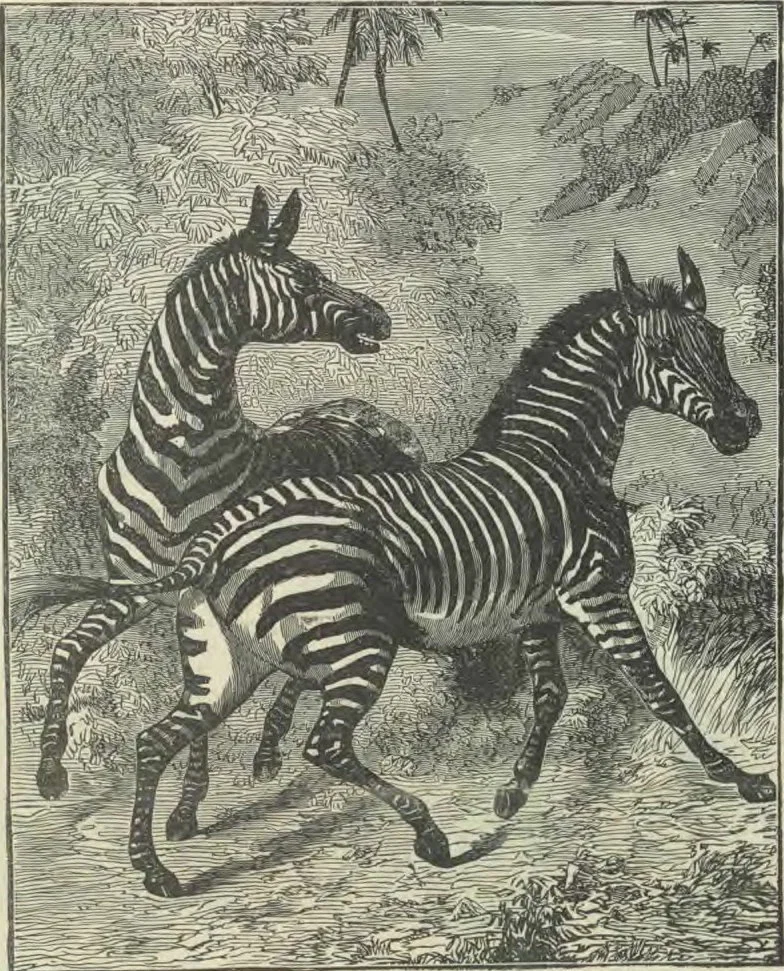
The hippotigris, or horse-tiger, is one name for the strange animals seen in our picture. Do you not think it a very fitting name? The general color of the horse-tiger, or zebra, is creamy white, striped off with velvety black all over the head, body, and legs, down to his very feet.
His home is in the hilly districts and among the high mountain ridges of the southern part of Africa. The zebra is very hard to catch; for he has very keen eyes, and is so timid that when he sees any strange object, he runs away to the mountains. He can run as fast as a swift horse. He is also very hard to tame; for he is fierce and obstinate.
But if caught when very young, he sometimes becomes almost as tame as a horse.
A MOVING NURSERY.
Now, who is this stout lady? And what is this stout lady doing? And what is the matter with her back?
This is Mrs. Toad, of Surinam (her first name is Pipa), and she is taking her family out for a walk. I ought to say for a hop, for Mrs. Toad does not walk, but hops, after the manner of all toads. In most of her manners, however, she flatters herself she does not in the least resemble other toads. In fact she regards all other toads as a set of low, grovelling creatures.
“People who neglect their children!” she says, with a shudder. “No words can express my contempt for them. Only fancy, my dears (she is talking to her children now), those common toads, and the frogs, too, who give themselves such airs, and call themselves opera-singers,—they all neglect their families in the most shocking manner. Why, they just lay their eggs at the bottom of a pond, or river, or any water that happens to be convenient, and then—go off and leave them! Actually leave them, before they are hatched; father and mother both go off whenever they like, and never even see their children. Disgusting! Don’t you speak to any of those people if you meet them. They aren’t fit for you to associate with!” And off hops Mrs. Surinam Toad, with her nose very high in the air.
Well, that is all very fine, certainly. But now let us see how Mrs. Toad herself takes care of her family. She considers herself a model mother, and so she is; but she could not do much without Mr. Toad’s help. She lays her eggs by the margin of the water,—that is the first step. Queer little round eggs they are, and there are a great many of them.
Now, what does Mr. Toad do? He takes the eggs up, and puts them into little round holes in his wife’s broad back. Every cell receives its eggs, and then is shut down with a kind of lid, or flap, which fits quite closely. When the eggs are all put away, Mr. Toad’s task is done, and he goes off to amuse himself; and Mrs. Toad hops slowly about, or sits quietly blinking in a dark corner, waiting for the eggs to hatch.
In due time out of each little egg comes a tadpole, with a round body and a wriggling tail. To tell the truth, they look very much like their vagrant cousins, the tadpoles, who are hatched in the water, and grow up anyhow and everyhow, without any care or attention from anybody. Indeed (though you need not tell Mrs. Toad I said so), if I were a tadpole, I would much rather be a common one.
These little fellows lead the merriest life imaginable, wriggling about in the clear water, or the nice, soft mud, frolicking and chasing each other, and listening to the thrilling tales the big frogs tell each other in the evenings. Whereas Mrs. Surinam Toad’s little fellows have to spend all their tadpolehood in their mamma’s dark little pockets, with no freedom and no society; and they are not allowed to come out at all until their tails are gone, and their legs are come; in fact, until they are no longer tadpoles, but toads. Then they hop out, say good-by to their fond parent, and go off to see the world, and to lay eggs in their turn; and Mrs. Toad watches them as they go, and says, “Ah! Now that is what I call a fine family! Brought up in the most genteel seclusion, with no vulgar associates, and with every advantage that the most refined toad could aspire to. I certainly have done my duty by my children.”
Well, I suppose you have, Mrs. Toad; I suppose you have! But, oh, dear me! To think of having to be a toad all one’s life, and never to have had any fun when one was a tadpole!—Our Little Ones.
Letter Budget.
Our first letter this week is from the Isle of Wight, off from the south coast of England. It is written by Ada Matilda Sargent, who says: “Thinking you would be pleased to have a letter from this part of the world, I will write to you. I have a father and mother, three brothers and five sisters, making eleven in our family. My oldest sister is in America, in Mr. Hilliard’s family. She left England last fall with Eld. Lane and his wife. We were sorry to part with our dear sister; but we hope the Lord will give us the privilege of seeing her again; if not here, we hope to meet her in the earth made new. As far as we know, we are the only Sabbath-keepers on this island. There are some interested ones, and we hope the Lord will help them to keep the truth. The nearest company of believers is at Southampton, which is thirteen miles from here, on the main land; so we have to hold meetings and Sabbath-school in our own home. With so many brothers and sisters, we have quite a nice Sabbath-school. I am trying to be a good girl, by God’s help, and am trying to fill the place of my sister who is in America. I help wash the clothes, iron, mend, and attend to my little baby brothers and sisters, and to set a good example before them. I am fourteen years old. I will try to tell you a little about the island on which I live. It is called the Isle of Wight from the word wight, which means ‘channel,’ it being situated on the south of England in the English Channel. It was formerly called ‘Vectis.’ It is a beautiful island, and by some it is called the ‘Garden of England.’ Its climate is mild and healthful, and its scenery is grand. The population of the island is about 75,000. The principal towns are Cowes, Ryde, Ventnor, Newport, Freshwater, and Yarmouth. Cowes is divided into East and West Cowes, separated by the river Medina, which empties itself at this place into the Solent River. It is the principal port, and near it is the main residence of the queen, called the Osborne House. There are other beautiful residences on the island. Ryde is situated on the eastern side of the island. It has a beautiful pier, nearly half a mile long. It is a pretty town, and is visited by many tourists during the summer months. Ventnor, on the southeast of the island, being much sheltered, is visited by many invalids during the winter months. Newport is the capital of the island. It is a very compact, clean little town, with a beautiful church. Near it are the famous ruins of Carisbrooke Castle, where King Charles was kept prisoner for some time, and where his good daughter Elizabeth died. Freshwater is on the southwest of the island. Near it is the residence of Lord Tennyson, who is the poet-laureate to the queen. Also near it are the Needles, consisting of mighty rocks, jutting out into the sea. Yarmouth is a pretty town, and is also visited by many tourists. If you like, I will sometime tell you more about our island home.”
Maudie Ethel Wright, of Pierce Co., Wash. Ter., wrote a letter for the Budget the 18th of last January; but before it was mailed, she was taken sick and died. She was sick only twenty-four hours. She wanted very much to see her letter in print. This is what she said: “My brother takes the INSTRUCTOR, and I like so much to read the letters, I thought I would like to write one too. I have three brothers and one sister. My sister is married, and lives eight miles from us. She has a dear little baby boy. My parents, Brother Sammie, and myself have kept the Sabbath a year in March; but my sister and two oldest brothers do not keep it. I pray for them every day, and ask God to help them learn the truth. I am going to write my sister and try hard to have her keep the Sabbath; for I love her so well, and want to meet her and my dear brothers in my Saviour’s kingdom. I wish you would pray for them. I am nine years and a half old. I go to day school. We have Sabbath-school at home. We are the only Sabbath-keepers here. There are some across the Bay. We live on the shores of North Bay. I am trying to be a good girl, and hope to meet the INSTRUCTOR family in the new earth.”
Dudlie C. Dortch, of Henry Co., Tenn., writes: “I am a boy ten years old. I have one sweet brother eight months old. I had one brother die about two weeks ago. He died from a relapse of scarlet fever. He was seven years old. His sufferings were great, but he bore them with remarkable patience. We are very lonely without him. We miss him wherever we go, and so much at the family altar; for he always prayed with us twice a day after he could talk plain. He was nearly always bright and cheerful. He loved the Sabbath and the Sabbath-school. I am determined to be good and meet my dear brother Freddie where there will be no more parting. I have been doing some missionary work by sending out papers and tracts. I send my love to the INSTRUCTOR family.”
Ella A. Lobdell writes a letter from Tulare Co., Cal. She says: “I have written three letters to the Budget, and not one has been printed; if you print this, I will write again sometime. I have two brothers and one sister. We all keep the Sabbath. We go seven and a half miles to Sabbath-school. I have missed only two Sabbaths this quarter, and those were when I had the measles. I learn my lessons in the INSTRUCTOR. We live half a mile from town. We have a little bird, a cow, two mules, and about a dozen chickens. I have a hen that has eleven chickens. Five of them are mine, and six belong to my brother. I want to be a good girl, so I can meet the INSTRUCTOR family in the new earth.”