The Youth’s Instructor, Vol. 36, No. 16.

THE SIGNS OF THE SEASONS

The Youth’s Instructor

Apr 18, 1888

S. D. A. Publishing Association · Battle Creek, Mich. · Apr 18, 1888

THE SIGNS OF THE SEASONS.

WHAT does it mean when the bluebird flies Over the hills, singing sweet and clear? When violets peep through the blades of grass? These are the signs that spring is here.
What does it mean when the berries are ripe? When butterflies flit, and honey-bees hum? When cattle stand under the shady trees?— These are the signs that summer has come.
What does it mean when the crickets chirp, And away to the south-land the wild geese steer? When apples are falling, and nuts are brown?— These are the signs that autumn is here.
What does it mean when the days are short? When the leaves are gone, and the brooks are dumb? When the fields are white with the drifting snows?— These are the signs that winter has come.
The old stars set, and the new ones rise, And skies that were stormy grow bright and clear: And so the beautiful, wonderful signs Go round and round with the changing year. —Selected.

A BOY WHO SUCCEEDED.

Some years ago a poor Irish boy left Belfast, hoping to find employment in the New World. While waiting at Liverpool, his little box, containing all he possessed, fell between the steamer and the pier, and was damaged so badly that nothing except one shirt was worth preserving. Although he was accustomed to look on the bright side of things, this loss affected him deeply, for he was utterly friendless, and without means to supply even necessary articles of clothing.
Owing to stormy weather, the voyage was tedious; but at last the vessel sailed proudly into port, and the homesick boy stepped on to American soil, tired, hungry, and homeless. Before him two paths seemed to open up,—one luring him on to evil, and the other directing his weary footsteps in virtue's way. He chose wisely, determining to live a noble, honest, upright life; and in the streets of New York he began his search for employment. He worked hard, lived frugally, and shunned the wine-cup and wicked associates, until, after years of earning, saving, and giving, he rose to eminence, and was loved and respected by all with whom he came in contact.
When the civil war broke out, bringing in its train countless bereavements and an untold amount of suffering and woe, the noble heart of George H. Stuart conceived a plan of helping the soldiers in every possible way. It was at his suggestion that the “Christian Commission” sprang into existence, and all through the long, bloody struggle he remained at his post, not only counseling and directing those he had enlisted in the noble work, but giving freely of his own time, money, and strength to assist in carrying relief to the sick, wounded, and dying.
The purpose of the Commission was to provide for the spiritual wants of the soldiers, as well as to look after their temporal needs; and many of the brave men were first led to the Saviour through the instrumentality of this noble organization. One poor soldier, who yielded up his young life at the battle of Gettysburg, lifted his bleeding head from the ground when dying, and asked if he might kiss George H. Stuart before he died.
Many other incidents, showing the esteem in which he was held by the boys in blue, and the boys in gray as well, might be related, but enough has been told to show what a boy may become if in youth he determines to always be found in the path of duty. Mr. Stuart was more friendless and had fewer advantages than most of boys, yet by his uprightness and honesty he won the esteem and affection of the whole country, and every American boy has an opportunity of doing the same.—Youth's Evangelist.

USEFUL BUTTERFLIES.

If it were not for their beauty, butterflies would be esteemed idle and worthless; but as they are so graceful, we like to study their strange nature. However, it is not about one of these gaudy summer idlers that I wish to tell you, but about one that, while it is not so beautiful, is still very useful. You all, I dare say, owe something to this butterfly; for every bit of ribbon , every silk thread, and every silk kerchief was once the covering of a butterfly; or rather, what would have been a butterfly had we not taken its life in adorning ourselves. You have rightly guessed that the butterfly referred to comes from the silk-worm, or more strictly speaking, is the parent of the silk-worm. But as we are more apt to think of the worm first, I will begin where my experience with them began, and that is just before the worm comes from the egg.
The eggs are very thin, and about the size of a pin head. They are so light that forty thousand of them weigh only one ounce. It was about the first of April when our half ounce of eggs came from the dealer’s; and as it was a cold spring, we waited some time before placing them in a temperature warm enough to hatch them, which should be 70° above zero. While waiting for the weather to grow milder, we fitted up for the worms a room sixteen feet long and eight feet wide, clean and well ventilated, and lined with shelves. As soon as it was warm enough, the eggs were placed on the shelves, and in a day or two the room was alive with these tiny inhabitants. Queer things they were, black and so small that it did not seem as if they could possibly grow into as large worms as crawled around on outdoor plants.
But now our work began in earnest; for the hungry little worms wanted something to eat, and had to have fresh leaves every day. The usual food for silk-worms is the leaves of the mulberry tree; but there is another, the leaves of which are as good as those of the mulberry tree, and in some respects more desirable. This is the osage orange, which is used very extensively in Kansas for hedge fences. We cut off large branches, placing them where the worms could crawl on them. They ate very little at first, but as they grew larger, it was amusing to watch them making large notches in the leaves.
Care must be taken that nothing shall injure the worms; for they have an enemy, which, if allowed an entrance, would make sad havoc, and kill many of them. This enemy is the ant. Silk-worms must also be protected from the heat, by sprinkling the floor with cool water when the room gets too warm.
An interesting stage in silk-worm culture is the molting season. A snake, you know, sheds its skin each year, but perhaps you did not know that worms do this also. The silk-worm sheds its skin three times, at intervals of about two weeks, and after each molt the worm grows much larger than before.
When the worms are first hatched, they are black; but after molting the first time, they become nearly white. While molting, the worms eat very little for two or three days, after which they take a new start and eat all the time. After molting the third time, they become about four inches long. At this stage they are subject to disease, something similar to the “jaundice.” They turn yellow, and stop eating; and as they cannot live without food, they soon die. It was our misfortune to lose several hundred in this way.
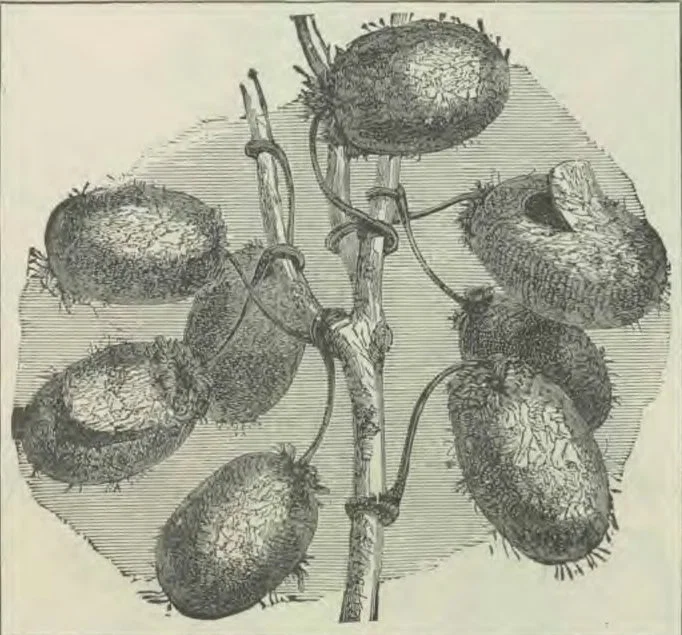
By far the most interesting feature of silk-culture is that of making the cocoons. The worms stop eating, and finding a suitable place, begin the work of house-building. They first fasten silken threads to the leaves and branches about them, forming a network something like a spider’s web. Their heads keep moving all the time, adding more and more to the network until it becomes quite thick. This net-work is called floss silk, and cannot be made into good thread.
Having made a secure fastening with this net-work, the worm begins the real cocoon. This is made in the same manner as the floss silk, only much tighter. At length the cocoon becomes so thick that the worm is hidden from view. It takes about three days to finish the cocoon, which, when completed, is smooth on the inside. Its walls are air-tight, about as thick and stiff as thick brown paper, and so strong that you can hardly tear them apart.
But you will see that the cocoons are not all alike; some are white, some straw-colored, some yellow, and some orange. Some are quite large, while others are very small; but the average are an inch and a quarter long and three-quarters of an inch through.
In preparing the cocoons for sale, we must wait about five days, in order to make sure that the worms are all through spinning their silk; then gathering up the cocoons, we steam them until the worm, or chrysalis as it is now called, is dead. The cocoons are then dried, ready to send off to some silk factory to be converted into thread.
But there will be no butterflies if you steam all the cocoons, did you say? Very true; so a few have been left to come out butterflies. We cannot leave them all to follow the natural course, as they would eat a hole through the cocoon, and thus spoil it for making thread; for in making silk the cocoons must be raveled out, and many of the threads twisted together.
The chrysalides that are not steamed hatch out in about eight days after the cocoons are made, and instead of a worm there comes out a butterfly, but not, however, such beautiful ones as hover over our flowers in the summer. The beauty lies wholly in the cocoon. The body of the silk moth is large, and the wings small, so that it cannot fly well. When the butterfly is about eight days old, it lays its eggs; and when twelve days old, it dies. One butterfly sometimes lays as many as one thousand eggs. If these eggs were placed in a warm temperature, they would soon hatch out; but this would not answer in our country, as the weather would soon grow too cold for them to make cocoons. In China they are hatched four or five times in a year.
W. A. GEORGE.

CHARLES GOODYEAR

Among the inventors who have sacrificed enough for their brain-children to be called indeed “martyrs,” is Charles Goodyear, the man to whom we are indebted for India-rubber. It was in 1820 that a pair of rubber shoes was seen for the first time in the United States, and then they were merely handed about as a curiosity. Goodyear found, in 1834, that for all practical purposes, rubber was a failure. Articles made from it melted in summer, and emitted such an offensive odor that it became necessary to bury them. At the time when his attention was first turned to the subject, he was a bankrupt, and his first experiments with rubber were made in jail.
Like all persevering inventors, he thereafter sacrificed not only his time and money, for the sake of his pet project, but all the funds which he could borrow or beg from his friends. His wife’s jewels and family relics speedily found their way to the pawnbroker’s, and Goodyear moved into the country in order that he might live as economically as possible. At length his invention was patented, and a wealthy partner joined him; but a commercial crisis soon swept away every cent of their joint capital. Then Goodyear found that he had not even enough money to buy food for his family, and the pawnbroker became again his only resource.
He had become an object of general ridicule, and one of his New York friends, having been asked how he was to be recognized in the street, said of him, “If you see a man wearing an India-rubber coat, India-rubber shoes, an India-rubber cap, and in his pocket an India-rubber purse with not a cent in it, that is he.” For he constantly wore the material about, with the two-fold object of testing and advertising it. Sometimes he seemed to be on the road to prosperity. The government once gave him an order for one hundred and fifty rubber mail-bags, but when they were made, the handles dropped off, and the rubber fermented.
But Goodyear was not disheartened. He baked India-rubber in his wife’s oven, boiled it in her saucepans, steamed it at the nose of the tea-kettle, roasted it in ashes, and toasted it before fires quick and slow. And all this time he was regarded by most people as a harmless, but very wearisome, lunatic. His children were often sick, hungry, and cold, and it is said that he once sold their school-books for five dollars, with which he laid in a new stock of gum and sulphur for his experiments.
His darkest hour came when he had in the house a dead child, with no means of burying it, and five living members of the family, with no food for their next meal. But help was at hand. His immediate wants were relieved, and his brothers advanced money for carrying on his experiments. In 1844, he was able to produce vulcanized India-rubber, with absolute economy and success.
But, having attained one object, he adopted another, no less dear,—that of perfecting a life saving apparatus—and after twenty-seven years of labor, having actually founded a new industry, he died insolvent, leaving his family an inheritance of debt.—Youth’s Companion.

A BOY'S VICTORY.

A dozen boys stood on the green by the school-house, careless and jolly, just from a game of ball. A boy came round the corner of the school-house, with an old cloth cap on his head, and wearing a loosely fitting garment of some very coarse cloth. In his hands were an iron stove-shovel and a hod of ashes.
“Here comes old Dust and Ashes,” shouted one of the group, springing forward and giving the coat a twitch.
“Halloo! what's the price of sackcloth?”
The boy's cheeks flushed in an instant. The shovel rang on the gravel walk, and his fingers clutched; but as quickly his cheek paled again, and clenching his teeth, as with a great effort to keep back something, he turned a little, and muttered the word “Mother!”
“Ho, ho!” shouted the other; “the baby's sick, and wants to see his mother.”
The boy in the coarse frock turned away, and rapidly disappeared behind the old barn; then breaking into a run, he fled swiftly down the path to the maple woods, his faithful Hunter bounding and pacing through the grass by his side.
There stood the maples, all russet and crimson and yellow, bathed in the golden haze of the still October afternoon. In among their shadows he sprang, his feet rustling the already falling leaves, and flinging himself into a little hollow, he buried his face in his hands. Poor Hunter stood by, wondering why his young master, any more than himself, could possibly think of anything but birds and squirrels at such a time.
Then the boy, seizing his only playmate in his arms, cried: “Oh, nobody loves me, nobody loves me in the world but you, Hunter! O mother, mother, why did you die?”
And the sobs came fast and thick, and the tears flowed like rain. Long did the motherless boy sob and cry, till from very weariness he could weep no longer. Tears brought relief, and the holy quiet of the grand old woods filled him with solemn and heavenly thoughts.
Only one year ago his mother had died, and as he sat among the leaves, he remembered his agony and loneliness, and the year of toil, as the ward of a cruel uncle. He remembered his eagerness to go to school, his trying to pay his way by working about the school-room, the unfeeling jibes and jeers his humble station and coarse clothing had earned him. Again angry, rebellious thoughts came up, as his eye fell on his coarse frock, and the quivering sobs returned; but then the thought of the weary hours of that mother, and how her poor fingers had toiled to make that frock, the best that she could give him. Though coarse in texture, every thread was hallowed by her love. He took from his vest-pocket the well-worn Bible, her Bible, and read the precious promise to the widow and orphan, again and again. New and strange thoughts came to him, and there, in the grand old forest, with the autumn sunset shimmering the golden maple leaves, a new purpose was born in his soul. He had begun to conquer himself. Henceforth there was no hesitation for him. Body and soul he devoted himself to God. Companions might jeer, but Jesus reigned in his heart, and his mother would meet him in heaven.
The years rolled on, and the boy became a man, but the purpose formed in the old maple grove burned in his bosom yet; and now his feet tread the deck of an Indian steamer, bearing him swiftly to the chosen scenes of his toil, for these words are in his heart: “I must be about my Master's business.”—The Congregationalist.

THE PROPHET ELIJAH.

ELIJAH is perhaps the most mysterious character in the Bible. No account is given of his parentage as is of most of the prophets. We are not even told who he was or whence he came, but like Melchisedec he seems to be “without father, without mother, without descent, having neither beginning of days or end of life.” From the time that he bursts with his fierce malediction upon the astonished Ahab, to the time we see him mounting heavenward in his chariot of fire, his life is one succession of mysterious appearances and disappearances, as if he were some strange visitant from another world. It was this peculiarity of his that perplexed Obadiah when sent to arrest him; when he found the missing prophet, he was afraid to tell Ahab; for, said he, “The Spirit of the Lord shall carry thee whither I know not, and so when I come and tell Ahab, and he cannot find thee, he shall slay me.”
COCOONS OF THE SILK-WORM.
After his first interview with Ahab, when he, as it were, locked the heavens and went off with the key, Elijah is sent by God to the brook Cherith. Whilst the sultry winds dry up every rivulet from its bed, while the plants languish and die, and the lowing herds and bleating sheep search the parched fields for water, the Lord graciously preserves the life of his servant. He is fed by the ravens. There in that dreary wild near the Jordan, the man of God stays in solitude for several months. Dead silence reigns around, broken only by the babble of the purling brook, or the roaring of some distant famished lion, and the cawing of the ravens. But anon the brook dries up, and Elijah moves on at the command of God.
He then visits the widow of Zarephath, and fills her house with plenty. Alone with the widow and her son, the gentler traits of his character appear. The son dies. The widow accuses him of slaying her son. Without a word of reproach, Elijah takes the boy from her, and in secret pleads with his God, and the soul of the child returns.
After many days the Lord tells the prophet to show himself, for at his word he will send rain on the earth again. And then follows the wonderful yet well-known scene that took place on Mount Carmel. He discomforts and slays the false prophets of Baal, and then with wonderful faith he continues in prayer till the rain comes. He tells Ahab to stop feasting and hasten down to his palace; but the Spirit of God comes upon him, and he runs before the king’s chariot to the gates of Jezreel.
We catch a last glimpse of the hoary old prophet as he journeys with Elisha to the scene of his translation. The young prophets knew that their master was to be taken from them, and it seemed that the one who was present at his translation would be greatly blessed. So with dogged perseverance Elisha follows through every difficulty, and is rewarded by seeing the grand old seer carried to heaven in his chariot of fire.
Once more is Elijah seen on this earth, even with Moses on the Mount of Transfiguration; but only for a moment, and then gives place for one even holier than himself, for the frightened disciples “see no man save Jesus only.”
Elijah lived about B. C. 908, and may be called the miracle-worker of the Old Testament. James cites him as an example of what may be accomplished by prayer. At his word the heavens were closed; the dead raised; fire brought from heaven; and the waters made to obey. The Jews have been continually looking for his reappearance, but this will not be a literal coming, for he is only a type of God’s remnant people.
FRANK HOPE.

HOW TO ENLARGE THE CHEST.

A WRITER in Harper’s Young People is of the opinion that our American boys are not taught how to breathe. If this branch of education is not taught the boys, there is danger that the girls, too, lack this knowledge. The same writer gives directions how to become good breathers,—instruction which, if properly heeded, will help to develop a full chest and ward off disease. We hope the readers of the INSTRUCTOR will derive some benefit from what he has written. He begins by saying,—
“City boys, and many from the country, too, have finer chests before they go to school than they ever do afterward. Sitting in a school-room, or shop, or factory, or any other room five or six hours a day, and then sitting most of the rest of the day besides, does much to weaken the chest; for when you sit still, you do not breathe your lungs half full. Take one large, full breath now, and see how your chest rises and expands, and how differently from a minute ago, when breathing only as you generally do. Many boys actually do not breathe their lungs full once in a whole week. Is it any wonder that they have weak chests, and that they easily catch cold? How are you to have strong lungs if you do not use them? Which has strong arms—the invalid leaving a sick-bed, or the blacksmith? he who uses his arms, or he who does not?”
“When walking at the rate of four miles an hour, you breathe nearly five times as much air as when you are sitting still. Now the fuller breaths you take, and the more of them in a day, the stronger and fuller chest you are going to have. If every boy in the United States would take a thousand slow, very deep breaths every day from now on throughout his life, it would almost double our vigor and effectiveness as a nation. For deep breathing not only enlarges the chest itself, and makes it shapely and strong, but it gives power and vigor to the lungs and heart, and makes them do their work far better. And it does the same to the stomach and bowels, the liver and kidneys; indeed, to all the vital organs. It makes the blood richer. It adds directly to the vigor of the brain as well, and so enables it to do more work. In short, it is about the best known way of getting and keeping health. And who would care to hire a sick man to work for him? Or who can do much hard work when he is sick? Not that we can always avoid sickness, but it is less likely to come, and has harder work to enter, when we are robust and in good training than when we are weak and run down.”
“And how shall we get a good chest? In two ways: by building both inside and outside. The deep, thorough breathing does the inside work, inflates the chest as you do a foot-ball when you blow it up; and using certain of the muscles vigorously builds up the outside.”
“And first for the breathing. Do three things. Always hold your neck well back; this straightens your backbone, and so straightens almost the whole of you. Next, breathe not through your mouth, but your nose. ‘God breathed into man’s nostrils the breath of life,’ not into his mouth. Indians think a man who goes around with his mouth open is a coward. Thirdly, get every inch of air into your lungs you can, and as many times each day as you can. At your age you can train your chest and lungs in this way to an extent that will surprise and delight you in your later years. Easy running and plenty of it, breathing just as slowly and deeply as you can all the way, will give your lungs grand work, and right out in the pure, invigorating out-door air. Daniel Boone would never ride when he could walk. Gladstone and Lowell have for many years followed the same rule, and see how fresh they keep in a green and useful old age! Do plenty of walking, and always when walking do the deepest, slowest of breathing you can. Try every now and then and see how many breaths you take in blowing up a foot-ball. It may not be many months till one breath will fill it, and there will be nothing very small or weak about your lungs then. Stand ten feet from a lighted candle, and see if you can blow it out. Practice whispering as loudly as you can, and do as much singing as your neighbors can tolerate, and when singing, as a famous tenor once said, ‘breathe from away down.’ Run a hundred yards in one breath, as the swiftest sprinters do. You are educating your throat and lungs in a most valuable way now; yet how simple!”
Another time we will give his instructions for promoting outside growth of the chest.

QUESTIONS AND LESSON TEXT.

1. WHERE did Jacob dwell?
And Jacob dwelt in the land wherein his father was a stranger, in the land of Canaan. Gen. 37: 1.
2. In what light did the patriarchs consider their residence in the land of Canaan?
These all died in faith, not having received the promises, but having seen them afar off, and were persuaded of them, and embraced them, and confessed that they were strangers and pilgrims on the earth. Heb. 11: 13.
3. To what did they look forward as a permanent residence?
But now they desire a better country, that is, an heavenly: wherefore God is not ashamed to be called their God; for he hath prepared for them a city. Heb. 11: 16.
4. How many sons had Jacob?
Now the sons of Jacob were twelve. Gen. 35: 22, last clause.
5. Which one did Jacob love the most?
Now Israel loved Joseph more than all his children, because he was the son of his old age; and he made him a coat of many colors. Gen. 37: 3.
6. How did Joseph’s brethren regard him?
And when his brethren saw that their father loved him more than all his brethren, they hated him, and could not speak peaceably unto him. Verse 4.
7. What made them hate him still more? Verses 5–11.
8. Upon what errand did Jacob send Joseph?
And Israel said unto Joseph, Do not thy brethren feed the flock in Shechem? come, and I will send thee unto them. And he said to him, Here am I. And he said to him, Go, I pray thee, see whether it be well with thy brethren, and well with the flocks; and bring me word again. So he sent him out of the vale of Hebron, and he came to Shechem. Verses 13, 14.
9. When his brethren saw him coming, what did they propose to do?
And when they saw him afar off, even before he came near unto them, they conspired against him to slay him. And they said one to another, Behold, this dreamer cometh. Come now therefore, and let us slay him, and cast him into some pit, and we will say, Some evil beast hath devoured him; and we shall see what will become of his dreams. Verses 18–20.
10. What did they do with him when he came?
And it came to pass, when Joseph was come unto his brethren, that they stripped Joseph out of his coat, his coat of many colors that was on him; and they took him, and cast him into a pit; and the pit was empty, there was no water in it. Verses 23, 24.
11. How did they afterwards dispose of him?
And they sat down to eat bread; and they lifted up their eyes and looked, and, behold, a company of Ishmaelites came from Gilead with their camels bearing spicery and balm and myrrh, going to carry it down to Egypt. And Judah said unto his brethren, What profit is it if we slay our brother, and conceal his blood? Come, and let us sell him to the Ishmaelites, and let not our hand be upon him; for he is our brother and our flesh: and his brethren were content. Verses 25–27.
12. For how much did they sell him?
Then there passed by Midianites merchantmen; and they drew and lifted up Joseph out of the pit, and sold Joseph to the Ishmaelites for twenty pieces of silver; and they brought Joseph into Egypt. Verse 28.
13. How do the wicked ever regard the just?
The wicked plotteth against the just, and gnasheth upon him with his teeth. Ps. 37: 12.
14. What trait was it that moved Joseph’s brethren to sell him into Egypt?
And the patriarchs, moved with envy, sold Joseph into Egypt; but God was with him. Acts 7: 9.
15. What scripture was verified in their case?
For where envying and strife is, there is confusion and every evil work. James 3: 16.
16. In what class is envy placed?
Now the works of the flesh are manifest, which are these: Adultery, fornication, uncleanness, lasciviousness, idolatry, witchcraft, hatred, variance, emulations, wrath, strife, seditions, heresies, envyings, murders, drunkenness, revellings, and such like: of the which I tell you before, as I have also told you in time past, that they which do such things shall not inherit the kingdom of God. Gal. 5: 19–21.
17. What is said of those who do such things?
18. What course did they take to deceive their father?
And they took Joseph’s coat, and killed a kid of the goats, and dipped the coat in the blood; and they sent the coat of many colors, and they brought it to their father; and said, This have we found: know now whether it be thy son’s coat or no. Gen. 37: 31, 32.
19. When Jacob saw the coat, what did he at once conclude?
And he knew it, and said, It is my son’s coat; an evil beast hath devoured him; Joseph is without doubt rent in pieces. Verse 33.
20. How did this affect Jacob?
And Jacob rent his clothes, and put sackcloth upon his loins, and mourned for his son many days. And all his sons and all his daughters rose up to comfort him; but he refused to be comforted; and he said, For I will go down into the grave unto my son mourning. Thus his father wept for him. Verses 34, 35.
21. Can you recall any of Jacob’s actions that were of a similar character to this wicked deception? Relate them.
22. When had Jacob been forgiven for his wicked deeds?
23. What important lesson may we draw from this?—
That although a sin may be forgiven, the results of it may remain, and the one who committed it will often have it brought before him, and will suffer in consequence.
24. What scripture is fulfilled even in this life?
For with what judgment ye judge, ye shall be judged: and with what measure ye mete, it shall be measured to you again. Matt. 7: 2.

THE MUSTARD TREE.

Prof. Hackett, after long and doubtful search, found on the plains of Akka, on the way to Carmel, a little forest of mustard-trees, which he thus interestingly describes: “It was then in blossom, full grown, in some cases six, seven, and nine feet high, with a stem, or trunk, an inch or more in thickness, throwing out branches on every side. I was not satisfied in part. I felt that such a plant might well be called a tree, and, in comparison with the seed producing it, a great tree. But still the branches, or stems of the branches, were not very large, or, apparently, very strong. Can the birds, I said to myself, rest upon them? Are they not too slight and flexible? Will they not bend or break beneath the superadded weight? At that very instant, as I stood and revolved the thought, lo! one of the fowls of heaven stopped in its flight through the air, alighted down on one of its branches, which hardly moved beneath the shock, and then began, perched there before my eyes, to warble forth a strain of the richest music. All my doubts were now charmed away. I was delighted at the incident. It seemed to me at the moment as if I enjoyed enough to repay me for all the trouble of the whole journey.—Sel.

CLIFF DWELLINGS IN MOROCCO.

RECENT discoveries have shown that cliff dwellings are found in great numbers in Morocco, which are now, and probably have been, inhabited from the time of their first construction. These dwellings in all particulars are like those found in Arizona and New Mexico on this continent. A New York paper speaks of them as follows: It was not until last year that the Moors would permit any examination of the cliff dwellings which have long been known to exist some days' journey southwest of the city of Morocco. The strange city of the cave-dwellers is almost exactly like some of those in New Mexico and other Territories which archæologists have explored. The dwellings were dug out of the solid rock, and many of them are over 200 feet above the bottom of the valley. The face of the cliff is in places perpendicular, and it is believed that the troglodytes could have reached their dwellings only with the aid of rope-ladders. Some of the dwellings contain three rooms, the largest of which is about 17 feet by 9 feet, and the walls of the larger rooms are generally pierced by windows. Nothing is known as to who these cave-dwellers are.—Exchange.

EXPLANATORY NOTES.

“The character of sojourners was common to the patriarchs, and as Jacob dwelt in the same country with his forefathers, he dwelt in the same way, and under the influence of the same motives. This he afterwards confessed to Pharaoh. Though he had bought a small piece of ground in the country, yet he still was, and counted himself, a stranger and a sojourner in the land of Canaan. Heaven was the country which he regarded as his possession, his inheritance, his home.”—Bush.

PRACTICAL NOTES.

“In this, Joseph was a type of Christ, the Beloved of the Father, who was on that account envied and hated by the Jews and by the world; not only notwithstanding his excellency, but for it, as it reproached and exposed their hypocrisy and wickedness; and because he also ‘testified of them that their works were evil.’ John 7: 7. This was the effect of the old enmity, put between ‘the Seed of the woman and the seed of the serpent.’”—Scott.
Joseph “dreamed of his preferment, but not of his imprisonment; as young people are apt to dream of prosperity, but think nothing of affliction.”—Henry.
Regarding the wisdom and propriety of Joseph’s revealing his dreams, Thomas Scott, the commentator, remarks as follows: “It was on many accounts proper they should be known, though otherwise it would have been impolitic for him to declare them. His brethren rightly interpreted the dream, though they abhorred the interpretation; and while in endeavoring to defeat it, they spared no pains, and ventured upon the most atrocious crimes, they were themselves the instruments of its accomplishment.
“Thus the Jews understood Christ’s parables, and the intimations he gave of his kingdom; but determining that he should not reign over them, they consulted to put him to death, and by his crucifixion they actually made way for that exaltation which they intended to prevent.”
In the deceit practiced by Joseph’s brethren towards their father, in the matter of the disposal of Joseph, is exemplified the same trait that Jacob exhibited toward his father in the methods he employed to obtain the patriarchal blessing. Herein will be found a most valuable suggestion to parents, applicable in bringing up their children.

OLD TESTAMENT HISTORY

NOTE.—Do not consider the lesson learned until you can state the substance of the “Introduction,” give the “Analysis,” and correctly answer the questions, without referring to the paper. A complete understanding of the lesson will enable one to answer questions upon the “Explanatory” and “Practical Notes,” in addition to the questions herewith given. Pupils should not refer to the paper during the recitation hour unless asked to do so by the teacher. Teachers should be so thoroughly prepared as to need only the questions before them in conducting the recitation.

OLD TESTAMENT HISTORY.

LESSON 18.—PLOTTING AGAINST THE JUST.

INTRODUCTION.—Last week’s lesson left Jacob in Peniel, where he had his wonderful wrestling with the Lord, and where he met his brother Esau, and was reconciled to him. From here he journeyed to Succoth, only a short distance west from Peniel, and here built a house for himself and booths for his cattle. His next place of residence was Shalem, probably Shechem, a city situated in a narrow valley between Mt. Ebal on the north and Mt. Gerizim on the south, 30 miles directly north from Jerusalem. Here he seems to have remained for some years; but the slaughter of the Shechemites by Simeon and Levi, caused Jacob to move his increasing clan farther south. At Bethel he renewed his covenant with God. Near Ephrath, or Bethlehem, his beloved wife Rachel died and was buried. At Hebron he met once more his aged father, and remained there during the most of his after-life. It was during his residence here that Joseph was sold by his brethren at Dothan on the southern slopes of Mt. Gilboa, about 70 miles north of Hebron—the incident which constitutes the main topic of the present lesson. This event occurred ten years after the incidents recorded in the lesson of last week.

ANALYSIS.

I. Historical.
1. Patriarch’s place of residence. a. Temporary. b. Permanent. 2. Jacob’s sons. a. Number. b. His favorite. 3. Plot against Joseph by his brethren. a. Causes of. b. Consisted in what. c. When and how executed. d. Trait of character manifested thereby. e. Course pursued to deceive Jacob.
II. Practical.
  1. Purpose of the wicked concerning the just.
  2. Envy.
a. A work of the flesh. b. Its results, present and final. 3. The forgiveness of sin does not always secure immunity from its results.
Continue reading: DANDELIONS