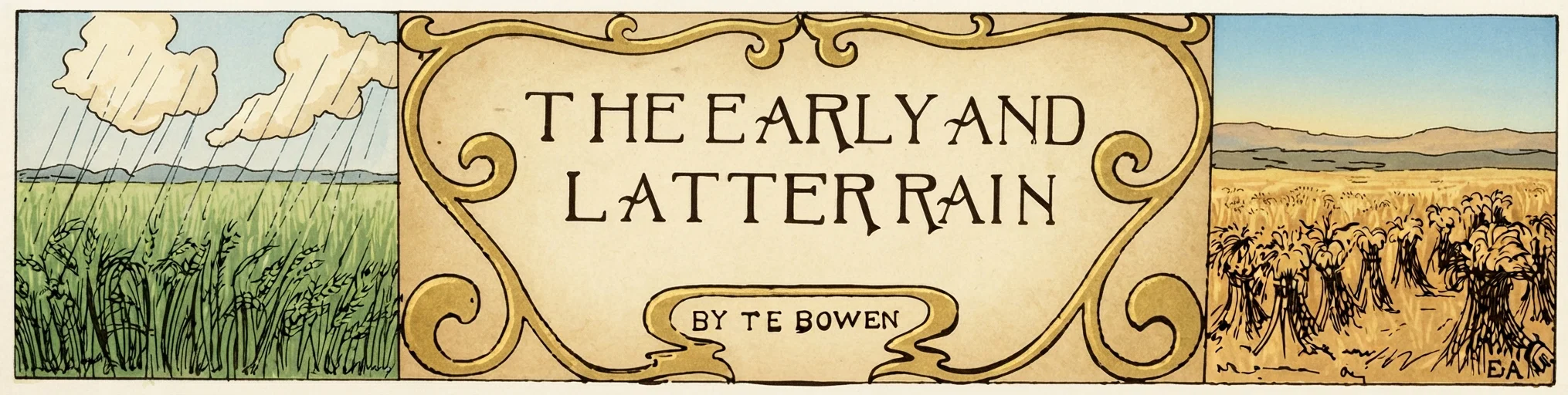
THAT which to-day is of the most importance to the Christian, to the church, and really to every soul on earth, is not what men do and say, but what Christ, the great Redeemer, is doing and saying.
The Father sent John the Baptist to prepare the way for Christ's earth work. Gabriel, the mightiest angel on high, was sent to announce both John's birth and work, and that of Christ. The great outpouring of the Spirit on the day of Pentecost was to make known to men that our great Redeemer—man's Friend—had entered upon His work of ministration in the heavenly sanctuary on high. This was the important truth for the church at that hour to know. Knowing it, they could intelligently worship God in spirit and in truth. Ignorant of it, they would miss the object of worship entirely, and worship they knew not what—resulting at once in lowering their worship into accepting for doctrine man-made traditions, containing no salvation. And this mistake the Jewish people literally made.
The close of Christ's service in the first apartment of the heavenly temple, and His entry upon His service in the second, the most holy, was another very important epoch in the history of the church on earth. That they might know concerning this important event, the great judgment message of 1844 was given.
Now, near the close of our Saviour's work in heaven, how appropriate indeed that the church—and through the believers the world—should be warned of its solemn approach. That service in the second apartment over, the voice of mercy will be silenced forever. With the ceasing of Jesus' mediatorial work before His Father's throne, man's opportunity to have his sinful, spotted garments washed in the blood of Christ is forever at an end. When His work of forgiving sin ceases, the solemn announcement is made: "He that is unrighteous, let him do unrighteousness still; and he that is filthy, let him be made filthy still; and he that is righteous, let him do righteousness still; and He that is holy, let him be made holy still." Rev. 22:11.
Just prior to this awful hour is due the great promised blessing of the descent of the Holy Spirit upon those everywhere who have accepted and obeyed all the light given them. From all denominations, from all classes, these faithful ones are to come out to unite firmly upon the platform of eternal truth, as found in the faith of Jesus and the keeping of all the commandments of God. "And I heard another voice from heaven, saying, Come forth, My people, out of her, that ye have no fellowship with her sins, and that ye receive not of her plagues; for her sins have reached unto heaven, and God hath remembered her iniquities." Rev. 18:4, 5.
It was only by fleeing from Jerusalem at the appointed hour that Christians saved their lives when that city was destroyed by the Roman army. So now all must obey the call promptly, and come forth from Babylon (the fallen churches) when the call from heaven is heard.
Conclusion.
May we not safely conclude that the church or people which shall be so greatly honored of Heaven as to receive the promised "latter rain" of the Spirit will be, and necessarily must be, keeping all of God's commandments? Could it be expected that God would deny Himself by pouring His Spirit upon any one who was knowingly committing sin—who was lying, and cheating, and swearing, or breaking the Sabbath of the Fourth Commandment?—Certainly no candid mind would for a moment admit that God, who can not lie, would thus deny Himself. Then it must be admitted that somewhere, now and soon, a people must be found who are keeping all the commandments of God, in fact (see Rev. 14:12), a people who are of one accord, who love God and one another, upon whom this great gift will be bestowed.
The early rain was not manifested in secret. It was at Jerusalem, where dwelt men out of every nation, and they all heard the words of life preached to them in their own tongue. So may we not conclude that the latter rain will be bestowed upon believers, when, with them, those scattered among "all flesh," in every nation and language, shall hear in their own tongue the heavenly call to the great marriage feast of Christ—the last call to supper? It is promised to "all flesh," hence will not be done in secret or in a corner. The world will know about it, all will have opportunity to receive or reject it, but those who receive it will be those not rejecting the heavenly-sent preparatory message of truth contained in the great advent and Sabbath reform messages, and will be made ripe by it for the heavenly garner, and thus become prepared to enter with Christ upon their "eternal great reward" in the kingdom prepared for them from the foundation of the world.
Thus the latter rain will ripen both the wheat and the tares, and the angels will be sent forth with a great sound of a trumpet to reap the harvest of the earth, to gather the tares into bundles to be burned, and the wheat into the garner of God.
Reader, there is no escaping the issue. There is no neutral ground upon which to stand to avoid being counted upon either the one side or the other. Every soul will be marshalled under the banner of Christ, or counted among the legions arrayed against Him. No man can serve the two masters. We shall hold either with the one or the other.
We appeal to you to count well the cost. Can you afford, for a little applause of men, a few fleeting pleasures of earth, to cast aside the great eternal reward in the kingdom of God, where will be pleasures forevermore? Christ gave Himself for you. He endured insult on earth that you might receive honor in heaven. He has made a way of escape possible for you. Why not use it? Why not become a friend of Jesus now, that when the great refreshing shall come from the presence of our God, thy10soul shall receive also of this heavenly anointing, and all thy sins be forever blotted from the heavenly records?
"Be patient therefore, brethren, until the coming of the Lord. Behold, the husbandman waiteth for the precious fruit of the earth, being patient over it, until it receive the early and latter rain." "Behold, we call them blessed that endure; ye have heard of the patience of Job, and have seen the end of the Lord, how that the Lord is full of pity, and merciful." "Be ye also patient; establish your hearts; for the coming of the Lord is at hand." "Even so, come, Lord Jesus."
THE WATCHTOWER.
By N. P. Neilsen
IT is night. In a railroad tower on the great Northwestern line is a man all alert, with hands on levers, peering into the darkness. The noisy telegraph instruments are chattering their messages, and we see a score of levers controlling interlocking switches. The shrill whistle of an approaching train is heard. The man throws back a lever, a semaphore drops, a glare of light tunnels the darkness, and then with a roar the limited express rushes past with its freight of sleeping passengers, and soon disappears in the darkness.
Again a shrill whistle pierces the midnight air. Other levers are flung back, other semaphores drop, and a belated train from the opposite point plunges past with a deafening roar. The tower-man must be alert. Tho the night may be dark and the hours seem long he must not fall asleep, for upon his faithfulness depends the safety of scores of lives. Should the wrong signal be given or the wrong lever operated, the sleeping passengers might be hurled into eternity without a moment's warning.
Even thus it is with the watchman on the walls of Zion. He also must be alert. The earth is wrapped in midnight darkness, and men are rushing on in a maddening race. They must be warned. The true signals of God's last great threefold message (Rev. 14:6-14) must be given. A fa'se signal may mean the destruction of many souls. Nor must the watchman fall asleep or the blood of souls may be on his garments. He must be faithful to his calling.
A CHRISTIAN mother in speaking of her dead son who had not quite reached the age of twenty, said: "I thank God that I found nothing in his trunk or in his pockets which I was not glad to find." It is an excellent testimony, presumptive of the purity of the inner life of the young man. What a blessing it would be to the world if every young man could so live that no evidence of anything that would make the world worse could be found behind him! But how much better than this to be able to stand "without fault before the throne of God"!—Selected.
"NOTHING brings people closer than the touch of tears."
MICAH.
By F. D. Starr
BY F. D. STARR.
SOMEWHAT over a century after Jonah preached to the Ninevites, Micah warned the people of Israel that, on account of their wickedness, their city would be destroyed, and Zion be plowed as a field. But the men of Judah and the inhabitants of Jerusalem did not repent, and thus avert the coming judgment, as the inhabitants of Nineveh had done. Of the seven chapters into which this book is divided, each contains matters of deep interest.
Chapter one brings to our attention the soon-coming day of final retribution, in the following words: “Behold, the Lord cometh forth out of His place, and will come down, and tread upon the high places of the earth. And the mountains shall be molten under Him, and the valleys shall be cleft, as wax before the fire, and as the waters that are poured down a steep place.” This harmonizes with the predictions of other prophets of both the Old and New Testaments in regard to that great day, when every island and mountain are moved out of their places. The coming of the Lord is the sublime climax of the ages.
In chapter two, we have a very plain refutation of the somewhat popular assertion that every man is trying to do the best he can, that his intentions are good. The truth is, that many men study to do wrong; instead of doing the best they know how, they deliberately plan to do that which they know is a great perversion of right. The prophet declares: “Wo unto them that devise iniquity, and work evil upon their beds! when the morning is light they practise it, because it is in the power of their hand.” As Jeremiah says: “They have taught their tongue to speak lies, and weary themselves to commit iniquity.” Jer. 9:5.
The third chapter tells us the reason why Zion was to be plowed as a field: “They build up Zion with blood, and Jerusalem with iniquity. The heads thereof judge for reward, and the priests thereof teach for hire, and the prophets thereof divine for money; yet will they lean upon the Lord, and say, Is not the Lord among us? none evil can come upon us. Therefore shall Zion for your sake be plowed as a field,” etc. The destruction of Jerusalem did not come as an arbitrary judgment of the Lord, but as a logical consequence of a wrong course. Zion that was built up with blood must be plowed as a field.
Chapter four is a reiteration of Isaiah 2. The siren song of peace and safety, the declaration of the people that the art of war is to give way to the peaceful pursuits of agriculture, is here shown to be a feature of the age that shall just precede the time when the first dominion shall return to Him whose right it is. As Paul informs us, “When they shall say, Peace and safety; then sudden destruction cometh upon them.” 1 Thess. 5:3.
In chapter five, we have the very important and interesting prediction concerning the birthplace of our Saviour. Bethlehem is pointed out as the honored spot of the nativity. And there is probably no other place in the Bible where the pre-existence of Christ is more clearly indicated than in this chapter. His “goings forth have been from of old, from everlasting.”
“Shall I give my first-born for my transgression, the fruit of my body for the sin of my soul?” is the leading question of chapter six. What a volume is contained in the query here introduced! Heathen systems of religion will reply, Yes, Deity will be pleased with human sacrifices. The sacrifice of a first-born was indeed necessary, but whose first-born? that of the transgressor?—No, but that of Him against whom man has transgressed. Abraham even was told to spare his own son, but God “spared not His own Son, but delivered Him up for us all.” Rom. 8:32. The Sacrifice has been provided, and now here is man’s part in the matter: “He hath showed thee, O man, what is good; and what doth the Lord require of thee, but to do justly, and to love mercy, and to walk humbly with thy God.” Micah 6:8.
Chapter seven of Micah’s prophecy is of universal interest. It seems to be an outline of the history of the church down through the Christian age. Verse 1 would seem to find its fulfilment in our Lord’s experience as recorded in Matt. 21:18, 19. The application of the illustration in either case, is the decay of virtue among men. The conspiracy among the various leaders of the people is shown in verse 3: “The prince asketh, and the judge asketh for a reward; and the great man, he uttereth his mischievous desire; so they wrap it up.” The great men are defined in Jer. 5:5 to be those who know the way of the Lord, the religious teachers of the people. Thus, according to Micah’s prophecy, the executive and judicial departments of the government are combined with the ecclesiastical leaders of the people, to work mischief and oppression to the humble people of God. Micah 7:5, 6, finds its fulfilment, as explained by our Lord, in Matt. 10:35, 36; Matt. 12:52, 53, to the persecutions entailed upon the church, especially during the Dark Ages. “She that is mine enemy,” of verse 10, is no doubt the great enemy of the church described in Revelation 17, 18.
The gathering of God’s people, just before the close of human probation, is shown in verse 12. The desolation of the earth for one thousand years that immediately follows, is brought to view in verse 13. We see by verse 15, that the wonders and miracles wrought in Egypt at the deliverance of Israel, are to be equaled or exceeded in the wonders performed in the final deliverance of God’s people just before the coming of the Lord. The consternation of the nations, as depicted in verses 16, 17, is parallel with the description given in Rev. 6:15-17, as they call for the mountains and rocks to fall upon them. “Who is a God like unto Thee, that pardoneth iniquity, and passeth by the transgression of the remnant of His heritage?” Verse 18. God it is that passeth by the transgressions of the remnant of His people. His words to Israel on that fearful night when the death angel passed over the land, were:
“When I see the blood, I will pass over you.” Ex. 12:13. He passes over, or passes by, transgression. This will be completely fulfilled in connection with the closing work of our Lord in the heavenly sanctuary, when the sins of His people are finally and completely blotted from the books of record. “He delighteth in mercy.” What a glorious truth! Surely His true character is revealed to us through the scriptures of the prophets in a most vivid manner.
“He will subdue our iniquities.” Are you troubled at the thought that you can not subdue or conquer sin? He has triumphed over sin and death, and by His grace your sins may also be subdued. “This is the victory that overcometh the world, even our faith.” 1 John 5:4. The fulfilment of the glorious promise of redemption is found in the closing verse of this book: “Thou wilt perform the truth to Jacob, and the mercy to Abraham, which Thou hast sworn unto our fathers from the days of old.” Rapturous thought! Let us give more attention to the words of Micah, the Morasthite, than did ancient Israel.
FIFTY REASONS FOR SABBATH OBSERVANCE.
By D. T. Bourdeau
BY D. T. BOURDEAU.
THIRTY-FOURTH. By faith in Jesus Christ, we observe it, not with the view of meriting salvation, but because we believe the Biblical doctrine that Jesus Christ came to save us “from” our sins and not in our sins, and that the grace or unmerited favor by which He saves us reigns “through righteousness” (Rom. 5:21), and not through sin, and is seen in our works, without which our faith would be a dead faith and could not save us. James 2:20. And such would be the character of our faith, if, knowing our duty with regard to the Sabbath, we refused to fulfil it. If we voluntarily transgressed even one of the precepts of the divine law, without showing a disposition to reform, none of our works would be acceptable unto God. In that case it would be in vain to count on the grace and mercy of God and lean on faith in Christ, and we would have no scriptural grounds to expect that the sacrifice of Christ would expiate our sins. Heb. 10:26. We would then be regarded by God as transgressors of the whole law (James 2:8-12); for none of our works would be the fruit of love to God and love to our neighbor; on the contrary all our works would be considered by Him “who searcheth the reins and the heart” as marred with selfishness and as infractions of the divine law. In such a case we would certainly be without one work that would be approved by the law of God or by the Gospel, and would have a faith without works—a dead faith that would have no salutary power in it.
Thirty-fifth. We observe it because God wants the only law that existed in the time of Jeremiah that was to exist under the new covenant—the law of which the Sabbath forms a part—to be written in our hearts; and that signifies that He would have us observe that law, for one can not have a law written in his heart without loving and obeying it. In Jer. 31:33, God thus expresses the first promise of the new covenant, “I will put My law in their inward parts, and write it in their hearts.”
Thirty-sixth. We observe it, because the sons of the stranger (the Gentiles), and the eunuchs or servants, to whom the duty of observing the Sabbath would seem more difficult11than to others, are encouraged to keep the Sabbath when “salvation is near to come” (Isa. 56:1), or when our Lord is soon to return to our earth to raise the righteous dead (Isa. 25:9, 8; 1 Cor. 15:34). “Neither let the son of the stranger, that hath joined himself to the Lord, speak, saying, The Lord hath utterly separated me from His people; neither let the eunuch say, Behold, I am a dry tree. For thus saith the Lord unto the eunuchs that keep My Sabbaths, and choose the things that please Me, and take hold of My covenant; even unto them will I give in Mine house and within My walls a place and a name better than of sons and of daughters; I will give them an everlasting name, that shall not be cut off.” Isa. 56:3-5.
And the fact that, in the verses which follow, the Lord promises to accept the “burnt-offerings and sacrifices” of the sons of the stranger that keep the Sabbath is not against the application we make of this prophecy. Often terms are employed in the Bible which, tho’ of a character justifying their application to those who lived under the old, can, nevertheless, be taken in their original sense. Certainly the word “sacrifice” has a spiritual sense under the former dispensation as it has under the present. Proof: “So will we render the calves of our lips.” “That ye present your bodies a living sacrifice, holy, acceptable unto God, which is your reasonable service.” Rom. 12:1. “Ye also, as lively stones, are built up a spiritual house, an holy priesthood, to offer up spiritual sacrifices, acceptable to God by Jesus Christ.” 1 Peter 2:5.
Thirty-seventh. We observe it, because, having been made before sin entered into our world and when man was in his state of innocency, and there being ample evidence that it will exist in the new earth, where holiness shall reign (Isa. 66:22, 23), it is not one of those ordinances that were a shadow of a Saviour to come, and were abolished at the death of our Lord. Col. 2:14-17. Those ordinances said continually to man, Thou art a sinner, needing a Saviour who is to come. If the Sabbath had said this to our first parents, when they were in their state of innocency, it would have said that which was false, and its Author would have been guilty of falsehood. And this would be equally true of the Sabbath and its Author in the new earth. There will be no sinners in that beautiful world; no expectation of a coming Saviour.
Thirty-eighth. We observe it, because it is honored and sanctioned by the plan of redemption. Redemption restores to holiness those who accept its plan; and holiness is conformity to the law of which sin is the transgression, and of which the Sabbath forms a part. 1 John 3:4; Ex. 19:5, 6; Deut. 4:12, 13, etc. One essential part of the work of redemption will be the restoration of our earth to its primitive state of glory; and by this very fact the sign of the first creation, the holy Sabbath, is honored and sanctioned. Therefore the Sabbath exists, and is obligatory during the entire period of redemption, and it will be thus during the endless period of the world to come,—when the work of redemption will have been accomplished, and every day—but especially each Sabbath—the redeemed will contemplate the character of God in His works, rendering homage and adoration to God and the Lamb. Isa. 66:22, 23; Rev. 5:13.
TESTED AND TRIED.
A BLACKSMITH who, some eight years after he had given his heart to God, was approached by an intelligent unbeliever with the question: “Why is it that you have so much trouble? I have been watching. Since you joined the church and began to ‘walk square,’ and seem to love everybody, you have twice as many trials and accidents as you had before. I thought when a man gave himself to God, his troubles were over. Isn’t that what the parson tells us?”
With a thoughtful but glowing face the blacksmith replied:
“Do you see this piece of iron? It is for the springs of a carriage. I have been ‘tempering’ it for some time. To do this I heat it red hot and then plunge it in a tub of ice-cold water. This I do many times. If I find it is taking ‘temper,’ I beat it and hammer it unmercifully. In getting the right piece of iron, I found several that were too brittle to take ‘temper.’ They cracked the first blow I struck. So I threw them into the scrap-pile. Those scraps are worth about a cent a pound. This carriage spring is very valuable.”
He paused; his listener nodded. The blacksmith continued:
“God saves us for something more than to have a good time. That’s the way I see it. We have the good time all right, for God’s smile means heaven. But He wants us for service, just as I want that piece of iron. And He has to put the ‘temper’ of Christ in us by testing us with trials. Ever since I saw this truth, I have been saying to Him: ‘Test me in any way You choose, Lord, only don’t throw me into the scrap-pile.’” —Selected.
POWER FROM OUTSIDE.
MEN seem to be the only created things that utilize power outside themselves. Our civilization grows by the outside forces that we summon to our aid. Steam transports us, electricity carries our thoughts afar, steel bears the lashing of wind and water, in war we are helpless except with equipment. Hearts and morals are just as dependent on outside forces as bodies, but the power by which they are civilized is as much higher than steam or electricity as our hearts—it is God Himself. There is as much likelihood that a man will make an increasingly good life by himself as that he could swim the Atlantic by himself. Failures often keep us away from achievement, sins separate us from good, when God is just the outside force we need to turn weak resolves into stalwart deeds, and replace sins with purity. We need a Saviour more than we need houses, guns, and transportation.—S. S. Times.
LOST AND REDEEMED.
1. For what purpose was the earth created?
“For thus saith the Lord that created the heavens; God Himself that formed the earth and made it; He hath established it, He created it not in vain, He formed it to be inhabited.” Isa. 45:18.
2. To whom was given dominion over the earth?
“Thou madest him [man] to have dominion over the works of Thy hands; Thou hast put all things under His feet.” Ps. 8:6. See, also, Ps. 115:16.
3. What provision did God make that His purpose concerning man should not fail?
“Who saved us, and called us with a holy calling, not according to our works, but according to His own purpose and grace, which was given us in Christ Jesus before times eternal.” 2 Tim. 1:9.
4. Through what did man lose his dominion, and become a bondservant?
“Know ye not, that to whom ye present yourselves as servants unto obedience, his servants ye are whom ye obey; whether of sin unto death, or of obedience unto righteousness.” Rom. 6:16. See, also, 2 Peter 2:19 and John 8:34.
5. By heeding Satan, in open disobedience to God, whose bondservant did man become?
6. What promise have we of a restoration of that first dominion?
“And Thou, O Tower of the flock, the hill of the daughter of Zion, unto Thee shall it come, yea, the former dominion shall come, the kingdom of the daughter of Jerusalem.” Micah 4:8.
7. How is this redemption accomplished?
“Since then the children are sharers in flesh and blood, He also Himself in like manner partook of the same; that through death He might bring to naught him that had the power of death, that is, the devil; and might deliver all them who through fear of death were all their lifetime subject to bondage.” Heb. 2:14, 15.
“If therefore the Son shall make you free, ye shall be free indeed.” John 8:36.
8. How much will be included in what the blood of Christ redeems?
“For the Son of Man came to seek and to save that which was lost.” Luke 19:10.
9. How much of man does Christ’s purchase include?
“For ye are bought with a price; therefore glorify God in your body, and in your spirit, which are God’s.” 1 Cor. 6:20.
10. What will be the nature of the dominion when finally restored to man?
“The kingdom and the dominion, and the greatness of the kingdom under the whole heaven, shall be given to the people of the saints of the Most High; His kingdom is an everlasting kingdom, and all dominions shall serve and obey Him.” Dan. 7:27.
Failure and Success
“WELL-DIGESTED failure is the father of success.”
A Perfect Heart with God
“HAVE I given myself up to say that there must be nothing, nothing whatever, to share my heart with God and His will? Is my heart perfect with the Lord my God, the object of my desire, my prayer, my faith, my hope? Whether it has been so or not, let it be so to-day. Make the promise of God’s Word your own: ‘The God of peace . . . make you perfect.’ The God who is of power to do above all we ask or think, will open up to you the blessed prospects of a life of which He shall say: ‘His heart was . . . perfect with the Lord his God.’” —Sel.
PROVE FAITH BY WORKS.
THE prayer that has weight with God must be prepaid prayer, says the venerable Dr. Cuyler. If we expect a letter to reach its destination, we put a stamp on it; otherwise it goes to the dead-letter office. There is what may be called a dead-prayer office, and thousands of well-worded petitions get buried up there. All of God’s promises have their conditions. No farmer is such an idiot as to look for a crop of wheat unless he has plowed and sowed his fields. In prayer we must first be sure that we are doing our part if we expect God to do His part. When a minister was called on to pray in a missionary convention, he first tossed a coin into the plate, and said, "I can not pray until I have given something." He prepaid his prayer. For the churches in these days to pray, "Thy kingdom come," and then spend more money on jewelry and cigars than in the enterprise of foreign missions, looks almost like a solemn farce. God never defaults, but He requires that we prove our faith by our works, and that we never ask for a blessing we are not ready to labor for.
AN INTERESTING LETTER.
In a letter received from our friend, Pastor G. Irwin, who is visiting the islands of the Pacific in the interest of future missionary efforts in behalf of these people, he says:
"I have had a very interesting and profitable trip thus far. I have embraced every opportunity to go ashore, and visit the different tribes of natives, that I might form some just conception of their needs. I am decidedly of the opinion that here, as elsewhere, the health reform and evangelical work should go hand in hand. While people live in such filthy homes, not much can be expected in the way of spirituality.
"The natives and their many dogs lie together on mats in these dark, vermin-infected dens. Many of the children are covered with horrible sores. The stench from these so-called homes is simply awful.
"One of two things is certain—either these people are beyond all hope, or the missionaries already here have neglected a very important part of their work. I am more inclined to the latter opinion, when I see such a condition of things under the very eaves of a mission that has been in existence for thirty years. What can be expected from missionaries who drink beer and wine, and smoke black plug tobacco? All do not do this, but as far as I have gone, those who do not are the exception. I believe we are training our missionaries in right lines, when we teach them how to care for the bodies as well as the souls of men.
"I have had some interesting experiences on the boat. It was known by all the first day, it seems, that I was a vegetarian, as I brought to the table my granose biscuits, protose, and malted nuts. They watched me closely, as tho they expected I would collapse in a few days, but as they saw I got along well, and could stand more tramping on shore without the customary after-aches, they began to make remarks about my way of living. A young doctor in our company publicly avowed his intention of practising vegetarianism in the future. He said to me one day, "How is it you always seem so happy, while I have such terrible blue spells, and feelings of depression?" I told him it was because I endeavored to live in harmony with the laws of my being. I gave him quite a lecture on dietetics, etc. He admitted all I said was true."
Preparing for a Coronation in Fiji.
—Australasian Good Health.
FROM JAPAN.
PROF. F. W. FIELD, who has spent about three years as a missionary in Japan, gave a short talk recently at a missionary meeting in Academia, Ohio. From a report in the Welcome Visitor we take this extract:
Home Scene in Japan.
"He told us of the many trials the young have to endure who accept present truth in the land of the rising sun. From early childhood the three following principles are forcibly impressed on the young mind: First, obligation to the emperor; second, to parents; and, third, to the oldest son of the family, leaving their obligation to God out of the question.
"The prevailing religion is Buddhism. They have no knowledge of the Gospel, nor do they desire 'that light that lighteth every man that cometh into the world.' When one gives up this belief, and accepts the message, all opposition possible is brought against him.
"Professor Field told us of a young man who took his stand for the truth in the face of much opposition. His parents firmly believed that his mind was deranged, and threatened to shoot the13foreigner who drew him from his former belief. The young man was at this time attending school some distance from his mountain village home. He was an earnest student of the Bible. Later his father suffered heavy financial losses. The parent's pride was humbled, and he, with the rest of the family, was ready to hear this message which the son so gladly carried to them. The mother and grandmother have recently been baptized, and the father is at the door of the church. In March, the young man was sent to prison, because he could not conscientiously enter the military service. His sentence was for two months. He is of good courage, and sent by Elder Field the message found in 2 Cor. 4: 17, 18 to the students of Mount Vernon College."