The Youth’s Instructor, Vol. 49, No. 8.

THE MELODY OF NATURE
Earlier text: THE MELODY OF NATURE

NUNKIE'S DOG STORY

“Hallo, Nunkie!”
Nunkie looked up from the piece of carpenter work that he was doing, and smiled at the boy, who, entering the shop, had greeted him in this way.
Nunkie was Uncle John; but the boy in his babyhood had said Nunkie, and had kept on using the name ever since.
“Well, Charlie?”
“I saw Mr. Brown to-day.”
“What about him?”
“He’s been drinking again.”
Nunkie sighed. Only the week before, Mr. Brown had promised that he would never touch another drop.
“Isn’t he foolish to touch the stuff when he knows it will make him drunk?” Charlie went on.
“How can he? I should think he would hate to be like that. I’d keep away from a saloon, I would.”
Nunkie looked serious, then he said: “Charlie, I once knew a dog that was wiser than many a person that I know to-day.”
“A real dog, Nunkie?”
“Yes; a real, live dog.”
“Then it isn’t just a story?”
“No; it is all true. This dog lived out in the country, with a man who kept sheep, and one day he attacked and killed one of the sheep. He was caught doing it, and, ‘Now that he has begun it, he will go on killing more,’ said his master; ‘he must die.’ So he put the dog into a bag with some heavy stones, sewed it up, and drove to a river. Into this river he threw the poor prisoner.”
“Oh-h-h!” came pityingly from Charlie.
But Nunkie was smiling, and went on: “When the man went home again, he found, to his astonishment, that the dog was there ahead of him, calmly resting on the hearth.”
“Why—why!” exclaimed the boy, with wide-open eyes and excited manner, “how could he be, when he’d been thrown into the river?”
“That’s what the man wondered; but there the dog was, surely enough, and he came to the conclusion that the bag must have been rotten, so that the heavy stones had burst it open.”
“What did the man do with him then?” Charlie asked, eagerly. “I hope he let him live.”
“While he was wondering what to do with him,” Nunkie continued, “he discovered that the dog had learned such a lesson that he wouldn’t be likely to touch the sheep again. No one could induce that dog to go anywhere near the sheep. He seemed to understand that it was the sheep that had got him into trouble, and he was determined to give them plenty of room. Do you not think he was a very wise dog?”
“Yes, indeed, wiser than Mr. Brown.”
“Yes, or—”
Here Nunkie paused, waiting for Charlie to finish.
“Or,” repeated the boy,—“or any one who keeps on using tobacco when he knows it is hurting him.”
“Or—” began Nunkie again, but Charlie could not think just then of any more, so his uncle said: “Or a boy who again and again lets anger get such control of him that he says and does many things that get him into trouble, and cause him to feel very sorry afterward.”
“Oh-h-h!”
This time the word came slowly and thoughtfully, and there was a different expression on Charlie’s face. Somehow there was less of self-satisfaction there.
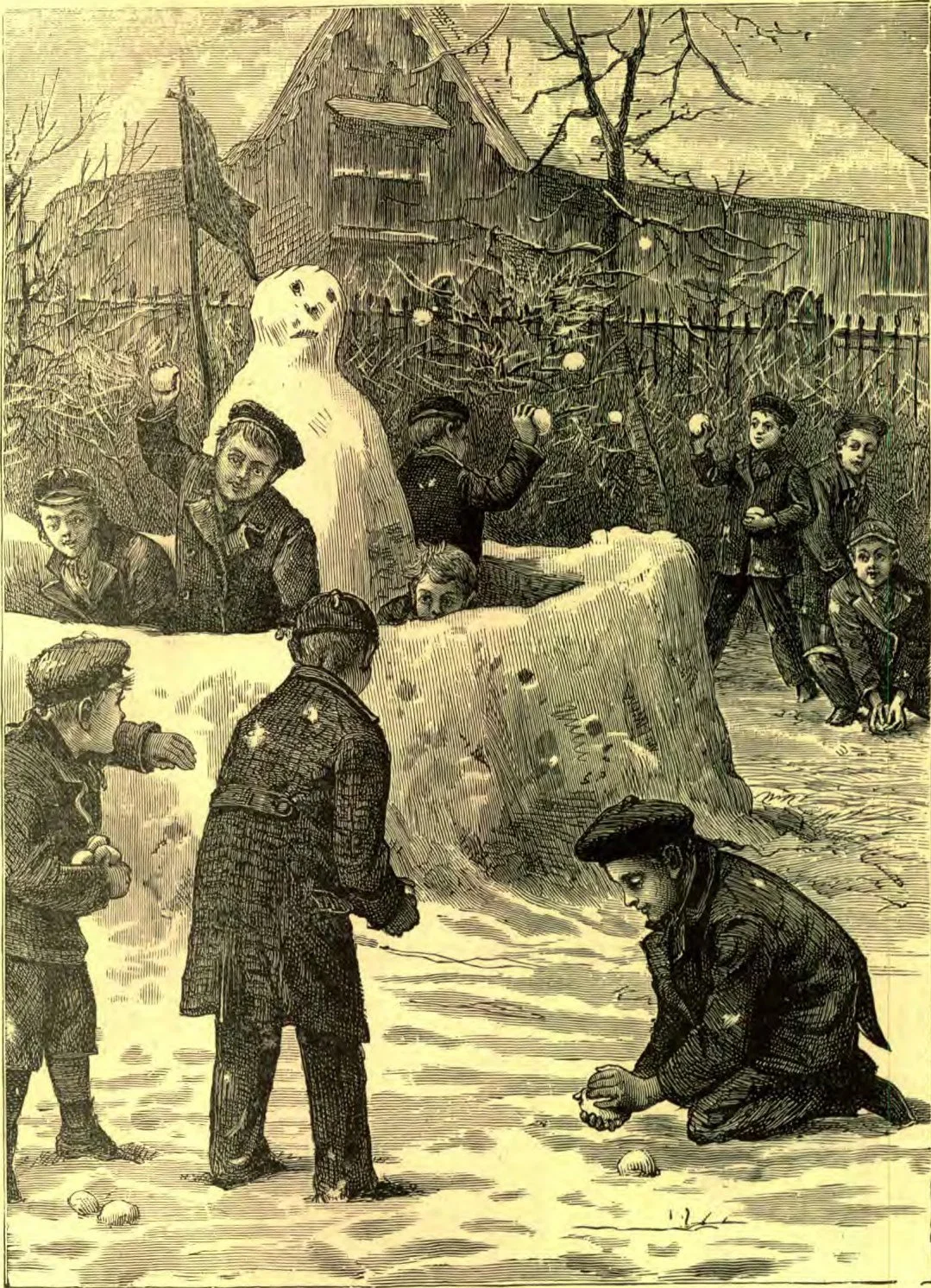
THE SNOW FORT
THE SNOW FORT
“We should all do well to take pattern after the dog in some ways,—shouldn’t we, my lad?”
“Yes, I think so.” And Charlie meant it, too.—S. Jennie Smith, in the Sunday School Times.

DOING AND NOT DOING

“Sir,” said a lad, coming down to one of the wharves in Boston, and addressing a well-known merchant, “have you any berth on your ship? I want to earn something?”
“What can you do?” asked the gentleman.
“I can try my best to do whatever I am put to do,” answered the boy.
“What have you done?”
“I have sawed and split all mother’s wood for nigh on two years.”
“What have you not done?” asked the gentleman, who was a queer sort of questioner.
“Well, sir,” answered the boy, after a moment’s pause, “I have not whispered in school once for a whole year.”
“That’s enough,” said the gentleman, “you may ship aboard this vessel; and I hope to see you the master of her some day. A boy who can master a wood-pile and bridle his tongue, must be made of good stuff.—Selected.

THE ENGLISH ALPHABET

The a in all written languages stands at the head of the alphabet, with the sound of a in “father.” It is asserted that this letter is of Semitic origin; that is, that it originated among the nations who were the direct descendants of Shem, the son of Noah. It may have been given the first position in the alphabet because, also, in uttering this primary sound the air-passage between the glottis, the narrow opening between the vocal cords and the lips, is wide open; while in sounding any other the tongue and uvula take part, contracting and changing the shape of the air-passage; the lips also are kept wide apart and motionless in giving the sounds of a.
The symbol b came from the Phenicians. With them it had only the upper loop. In borrowing the sign from the Phenicians, the Greeks closed the lower end, so forming the b now in general use. It is the second letter of all European alphabets, except in those languages that follow the so-called “Cyrillic alphabet,” which was originated by a monk named Cyril, who lived in the ninth century. The Russian language is an example. The letter c was adopted from those alphabets derived from the Latin. It owes its origin to the effort to distinguish in letters the difference between the sounds of g and k. Originally it was written as the Greek gamma, or g, the top being slanted gradually more and more to the right, until it became rounded into our modern c.
D is the fourth letter in the Hebrew, Chaldaic, Samaritan, Syriac, Greek, and Latin alphabets. The Greek delta is borrowed from the alphabet of the Phenicians, and the modern d is only the Greek delta, with the corners rounded.
E also comes from the Phenicians, and stands among the vowels as the antipode of a, so far as the original sounds are concerned. As a represented the smooth breathing (as a in “father”), so e denoted the rough breathing—our h. The Greeks distinguished the long sound of e by a separate sign, after which the e was restricted to denoting the short e-sound, as in “met.” But in the Latin and Italian alphabets the same sign stands for both the long and the short sound of e. Its present typical sound, in almost all languages, is found in “men.”
While f was a part of the primitive Greek alphabet, it soon fell into disuse, not being agreeable to the Greeks. In the Latin, when it became necessary to express the hard sound of v, the f was revived, and has the same significance still.
G in all alphabets derived from the Latin, holds the same place that z did in ancient Greek. In the fifth century B. C. the distinction between the k- and g-sounds was lost; in the third century the distinction was revived; and as the c, which formerly represented the g-sound, had already its place as third letter of the alphabet, its form was modified to represent the g-sound.
H as it is now presented is simply the form of the old Hebrew character cheth, with the top and bottom cross-lines omitted, retaining only the center one. The Phenicians wrote it as a square, with a cross-line through the middle. Like a, b, etc., h comes from the Phenician through the Greek and Latin. It had the same place in the Phenician and Latin alphabets as in the English, being made the seventh in order in the Greek by the later omission of the f-sign.
In Phenicia i represented the semi-vowel y, and the Greeks took the symbol to represent the vowel i, but only in modern times did it have its present simple form. It became a diphthong in the sixteenth century. J is merely i modified, the same as w and u are modifications of v. It was a fancy of the writers; as, for instance, in writing VII it was customary to denote it thus—uij. The origin of k has already been explained under c.
The form of n has never varied materially, being two straight lines at an angle,—an inverted v,—and in all languages has the same liquid sound. So of the letter m; it has the same labio-nasal sound in all languages, the lips being closed in its pronunciation. While m represents the labio-nasal sound in all languages where our alphabet is used, the n represents the denti-nasal sounds.
O has always been used in its present form, except sometimes it was written in Latin in a square shape, and in the Greek a distinction is made between the short and long sounds of o.
P originated with the Phenicians, and in its primitive shape resembled a shepherd’s crook. Later, in Greece, it was expressed as two ii’s. Among the Latins it assumed its present form. The sound it expresses is a closed labial, the antipode of b.
Q in the Phenician and Greek was written at first as a circle with a straight line hanging from it, and was called kappa. The alteration to its present form was made by the monks at Rome; its use has always been to express the velar k, as in sequor. Q occurs in English, as in Latin, only before a u that is followed by another vowel.
The Greeks, who borrowed the r from the Phenicians, at first expressed it as p. The symbol is used to denote three distinct forms of sound,—the consonantal, as in “reed;” the vowel, as in “father;” and the trill, as in “theater.”
S is simply a rounded form of the Greek sigma, for convenience in writing. Until z was introduced, it carried that sound also, and in many words does so still, as in “curs,” “lose,” “hers.” It is used also to denote the sound of sh, as in “sugar,” “sure,” etc., sh, in spite of its spelling, being a single sound.
T has changed but little in form since originally introduced in Greece. It is, and always has been, a voiceless dental, the opposite of d, which is voiced. Exceptions occur where the symbol is followed by i or y, when it assumes the sound of s, as in “nation;” and where followed by u, when the sound changes to tsh, as in “nature.” When h is added, the t is used to denote two sounds, as in “thin” and “then.” With t the original Phenician alphabet ended.
The u and the following five letters in the English alphabet came in from time to time as the necessities of expression demanded. The symbol follows the Greek symbol for the twentieth letter of the alphabet, upsilon, and is rounded into u for convenience in writing. It has two sounds,—the narrow, as in “rule;” and the wide, as in “full.” The sound of u as in “muse,” “duke,” “mute,” “pure,” came into use in the seventeenth century.
As f is the voiceless labio-dental sound, so v is the opposite, or voiced. U and v were formerly one, their separation being merely for convenience in writing. In old texts v does not appear, being represented by f as in “ofer.”
The next letter in the English alphabet, w, is simply double v. Anciently the letter was written uu, or simply u; as early as the eleventh century, writers used wv, and later the present w.
X in English has nothing particularly interesting attached to it, as a matter of history. It is a more useful symbol to the French than to the English. It represents the old Phenician letter samekh.
The three symbols, u, v, and y, are only different modifications of one original form. In the old Phenician alphabet z stood as the seventh letter, and as sixth in the Greek; it came into use in its present form in the first century B. C., but in old English the z hardly ever appears.
W. S. CHAPMAN.

BEREAN LIBRARY STUDY

Revelation 14:9-20; “Thoughts on the Revelation,” Pages 626-637
(February 24 to March 2)
Mark in Forehead or Hand.—The seal of the living God will be placed only in the foreheads of God’s people. The forehead represents the seat of the intellect. The whole mind and heart must be surrendered to the Spirit of God. God does not accept half-hearted worship. Satan is willing to count as subjects only those who receive his mark in their right hand. In their hearts they may be fully persuaded that the seventh day is the Sabbath of the Lord, and expect some day to observe it; but as long as, through fear of man, they work on the Sabbath, Satan is content. He well knows that “the way to hell is paved with good resolutions,” and that as long as they allow their hands to obey, they will never receive the seal of the living God.
What Is the Mark of the Beast?—The beast of Revelation 14 is the same as the “first beast” of Revelation 13. The beast of Revelation 13 receives power and authority from the dragon of Revelation 12. In other words, paganism transmitted to the papacy certain emblems of power and authority. In Rev. 13:8 we find the beast enforcing a world-wide worship. The highest type of worship is obedience. 1 Sam. 15:22. The beast requires obedience. This obedience is in opposition to the commandments of God; for in Rev. 14:12 those who refuse to worship the beast, or receive his mark, are spoken of as keeping the commandments of God. For many centuries the beast, or papal power, required the world to observe Sunday, the first day of the week, in place of the seventh day of the week, as commanded in the fourth commandment. Sunday was bequeathed to the papacy from paganism, and later was adopted by Protestantism. In obeying the Sabbath commandment as handed down from paganism, instead of the fourth commandment of the law of God, one worships the power that changed the law, and by so doing he also worships “the dragon which gave power unto the beast.” It is a threefold worship,—a counterfeit of the worship of the Father, the Son, and the Holy Ghost. The dragon (paganism) is the father of it; the beast (papacy) has given it to the world; while the image (apostate Protestantism) is the power whose world-wide influence helps to induce every one to worship this man-made institution. Those whose names are in the book of life are the only ones who will refuse this worship, and will receive the seal of the living God.
The Cup of His Indignation.—Each person is represented as possessing a cup. If one’s cup is filled with iniquity, God will pour upon him the contents of the cup of his indignation. No one is cast off until he has filled his cup full of iniquity. The Lord waited four generations for the Amorites to fill up their cup of iniquity (Gen. 15:16) before he punished them. He is now holding out the cup of salvation to every one; it is “full of mixture;” all are invited to drink of it, and share in his mercy. Ps. 75:8; 116:13. Soon the door of mercy will close, and upon the shelterless heads of the wicked will be poured out the cup of the unmixed wrath of God.

TWO SIDES TO THE THIRD ANGEL’S MESSAGE

THE WICKED THE RIGHTEOUS
Worship the beast and his image. Worship the Father, and the Son, the express image of the Father.
Receive the mark of the beast in their forehead or right hand. Receive the seal of the living God in their foreheads.
Drink of the wine of the wrath of God, which is poured out without mixture into the cup of his indignation. Drink of the river of God’s pleasure, and “take the cup of salvation, and call upon the name of the Lord.”
Shall be tormented with fire and brimstone in the presence of the holy angels and in the presence of the Lamb. “God shall wipe away all tears from their eyes; and there shall be no more death, neither sorrow, nor crying, neither shall there be any more pain.”
The Two Vines.—The vine of the earth, of which Satan is the root, and the wicked are the branches, bears “grapes of gall, their clusters are bitter.” Deut. 32:31-33. This vine will be cast into the great wine-press of the wrath of God. The vine of heaven is the “True Vine,” and the righteous are the branches. The Father is the husbandman, who watches anxiously to see the fruit of peace and love ripening upon each branch.

BALAAM

(March 2)
MEMORY VERSE: 2 Peter 2:15.
1. In what country did the Israelites finally pitch their camp? Num. 22:1.
2. How did the Moabites feel toward Israel? V. 3; note 1.
3. Who was king of Moab at this time? V. 4 (last part).
4. To whom did he send for help? What was his message? Vs. 5, 6; note 2.
5. What did Balak’s messengers carry with them? V. 7; note 3.
6. As they made known their errand, what did Balaam say? V. 8.
7. What question did the Lord ask of Balaam? V. 9.
8. What answer did he give? Vs. 10, 11.
9. What positive command did the Lord then give? V. 12; note 4.
10. What answer did Balaam return to the messengers? V. 13.
11. When the servants returned without Balaam, what did the king do? What was the second message? Vs. 15-17; note 5.
12. What did Balaam then say? V. 18.
13. What did he then ask them to do? Why? V. 19.
14. What did the Lord at this time say to Balaam? What did Balaam do? Vs. 20, 21; note 6.
15. To what different places did Balak take Balaam, that he might curse Israel? V. 41; Num. 23:14, 28.
16. When Balak saw that Balaam could not curse, how did he feel? What did he say? Num. 24:10, 11.
17. Of what did Balaam remind him? Vs. 12, 13.
18. What did Balaam say he wished to do before returning home? V. 14.
19. After prophesying of the coming of Christ, what did Balaam do? V. 25; note 7.

NOTES

1. The people of Israel were nearing the end of their long wilderness march. Those who had murmured, and complained, and hindered the work had nearly all died, and God could once more bless the efforts of his people. Therefore he went before them in power, and they were victorious over all their enemies. The nations all around were again hearing of the wonderful things God was doing, and they were afraid. It is a blessed thing to walk with God in obedience, for then we may have one continual victory over sin. Every day we shall make advancement.
2. The Moabites were idolaters, and therefore did not know God. They had heard that Balaam was one who had wonderful power, and they sent for him. They thought that he could in some way curse Israel, and thus do what they could not do in battle. Balaam had once been a prophet of the Lord; but he had allowed a selfish, greedy, money-loving spirit to overcome him, and he was now a servant of the evil one.
3. Satan works through the world to tempt us. He knows all our weak points, and arranges his temptations so that we shall be overcome easily. He knew Balaam’s greed for money, and so he led Balak to send the rewards of divination by the messengers. The sight of the treasures filled Balaam with a longing to go, though he knew that it was wrong to do so. He was conscious that the Lord was blessing Israel, and yet he asked the Lord if he might go and curse them. How foolish to ask God to let him do what he knew was forbidden! He was trying to get the Lord to act like a man, and change his mind.
4. God said, “Thou shalt not go.” That was God’s will. He did not want Balaam to go. And Balaam understood just what God meant. He needed not to ask any more questions.
5. The people of the world never stop with one invitation to join them in their evil work. If they do not succeed at first, they will try other ways, seeking to make their course as attractive as possible. They will promise all kinds of blessings and honors to the child of God if he will only go with them. The only safe course is to let them know at the very first that we have no use for worldly honor or pleasure, and that they need not come again. But Balaam dallied and questioned, and tried to coax the Lord, and by so doing encouraged Satan to tempt. It is in this way that many young people are lost. Let us heed the word which says, “Love not the world, neither the things that are in the world,” and never for a moment even think of doing anything else.
6. It may seem strange that God would now tell Balaam to go, after he had so plainly said not to go. But even the Lord will let us do wrong things if we are determined to do them. God had not changed his mind, but he simply permitted the prophet to follow his own selfish ways. We should learn from this that it is unsafe to pray for anything that is out of harmony with God’s will. He might let us have it, and we, like Balaam, be lost.
7. Balaam did not at this time secure the reward, and he went home angry and disappointed. A little later he returned, and succeeded in bringing a curse upon Israel by leading them into idolatry and other forms of wickedness.

Baby’s First Wardrobe

HYGIENIC PATTERNS

Complete outfit, based on healthful principles—22 PATTERNS, together with a beautiful booklet on the proper care of infants, sent postpaid for 50 cts. Full directions for making, showing necessary material, etc. Address—
MRS. F. M. KELLOGG,
36 Washington Ave., Battle Creek, Mich.

GRAND TRUNK R'Y. SYSTEM.

Taking Effect Dec. 16, 1900.
Trains leave Battle Creek.

WEST-BOUND.

No. 2, Mail and Express, to Chicago — 12.15 P. M.
No. 1, Chicago Express, to Chicago — 8.30 A. M.
No. 3, Lehigh Valley Express, to Chicago — 3.50 P. M.
No. 5, International Express — 2.17 A. M.
No. 75, Mixed, to South Bend — 8.30 A. M.
Nos. 9 and 75, daily, except Sunday.
Nos. 1, 3, and 5, daily.

EAST-BOUND.

No. 8, Mail and Express, East and Detroit — 3.45 P. M.
No. 4, Lehigh Express, East and Canada — 8.22 P. M.
No. 6, Atlantic Express, East and Detroit — 2.10 A. M.
No. 2, Express, East and Detroit — 6.50 A. M.
No. 74, Mixed (starts from Nichols yard) — 7.15 A. M.
Nos. 8 and 74, daily, except Sunday.
Nos. 4, 6 and 2, daily.
W. C. CUNLIFFE, Agent,
BATTLE CREEK.

Best Stories from the Best Book

Since its publication, [the book] has met with a most gratifying reception. It grows in favor day by day. Everyone is delighted with the book upon first sight, but the more thoroughly they become acquainted with it, the more they realize its inestimable value. We know it is appreciated from the many kind words our friends have to say concerning it.

AN EXCELLENT HELP FOR CANVASSERS

PAW PAW, MICH.
The truths presented in “Best Stories” certainly make it a work that cannot fail to bring much-needed light to many who have been reading the Bible for years. It is an excellent help for our canvassers.
GEO. MATTESON.

A READY SELLER

ELLIOTT, PENN.
I like “Best Stories” very much. It is a ready seller, and an excellent book for young persons to sell.
F. E. PAINTER. Pennsylvania State Agent.

AN INSPIRATION TO THE CHILDREN

SOUTH LANCASTER ACADEMY, SOUTH LANCASTER, MASS.
I find “Best Stories” very attractive to the children, as the illustrations are so beautiful, and the story so simply and impressively told. We are using it as a reader for beginners, with much enthusiasm and inspiration on their part. SUSIE SISLEY.
This is just the book for children and young people to sell. It is a beautiful book, pleasing to the eye, and contains many fine illustrations. The fifty pages of “Easy Lessons” are a drawing feature of the work. It is a volume of which the children never tire.
Heavy paper, cloth back covers .......... 75c Heavy paper, board covers .......... 50c Thin paper, edition, limp paper covers .......... 25c
For particulars, address your—
Tract Society; the Review and Herald Pub. Co., Battle Creek, Mich.; or the Pacific Press Pub. Co., Oakland, Cal.

Cultivating the Memory and Storing Beautiful Thoughts

WHILE our attention is directed to the importance of cultivating the memory (page 60), we would like to suggest that while trying to improve this gift, and make it give you the best possible service in your work and study, you do not neglect to store away in the mind many a precious treasure of beautiful thought, expressed in prose and poetry. The empty mind is the swept and garnished room waiting for the spirits of evil; but the mind filled with the truths of God's word, and other helpful and beautiful thoughts, is in large measure fortified to resist temptation. It is our intention that every week the INSTRUCTOR shall contain one or more little poems that will be adapted to the different ages of its readers, and of sufficient literary merit to make them worthy of being committed to memory.
Continue reading: A SWEEPING EXAMINATION