The Youth’s Instructor, Vol. 49, No. 8.

THE MELODY OF NATURE

The Youth’s Instructor

Feb 21, 1901

Review and Herald Publishing Company · Battle Creek, Mich. · Feb 21, 1901

THE MELODY OF NATURE
It is almost as true of the earth as it is of the firmament that “there is no speech, there are no words, their voice is not heard, but their melody extends throughout all the earth.” Ps. 19:4, 5, Jewish translation. The striking contrasts that various portions of the surface of the earth furnish us can not but leave imperishable impressions upon the mind. To travel for several days over the great American Desert, which has such a sameness about it that it becomes painful to the eyes and tiresome to the mind, and then to emerge from this dreary waste into the wonderful scenery that lines the Columbia River, is an experience never to be forgotten. It seems as if nature has here outdone herself to please the mind of the weary traveler. On one side is the beautiful river with its little islands and projecting rocks, while nestling near the water on either side are flowers of various varieties; and on the opposite side are the steep sides of the mountains, which in some places almost overhang the train.
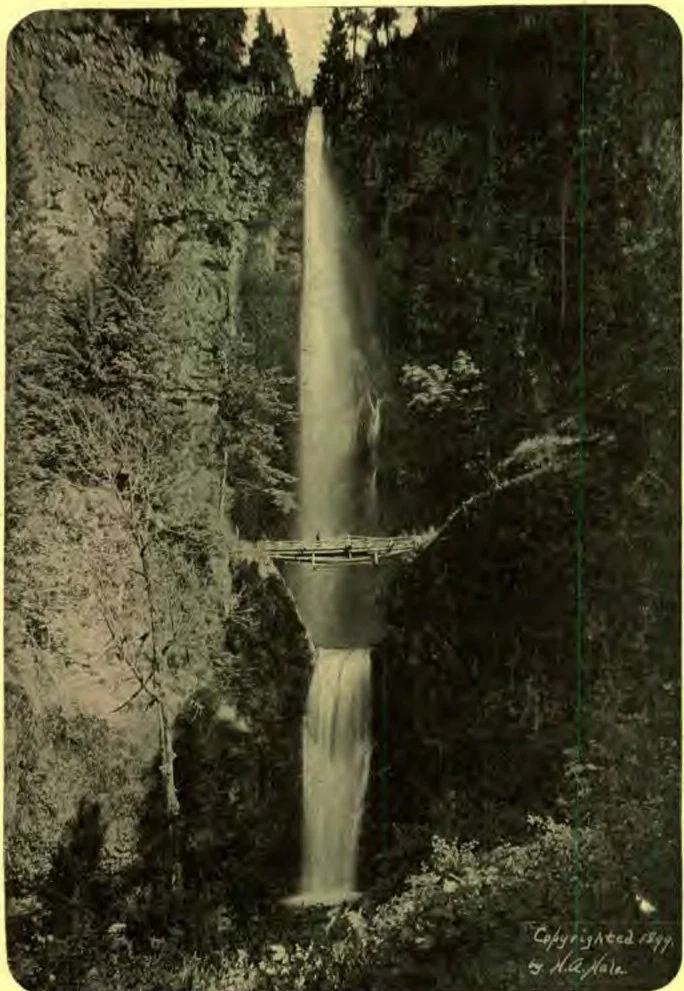
Here and there are dainty little waterfalls, practically changing into mist before they strike the bottom. One of the most beautiful of these is well shown in the accompanying illustration—Multnomah Falls. Here the small sheet of water falls nearly a sixth of a mile, the magnificent spray bathing the luxuriant foliage that grows at the bottom, and even up to the very rocks on either side.
Niagara Falls impresses one with the massiveness and strength that can be manifested in nature. Minnehaha Falls, with its beautiful fan-like sheet of water, which at certain seasons is all beaten into a spray before it reaches the rocks below, suggests the fanciful in nature; the Rainbow Falls in Williams Cañon, Colorado, suggests the distinctly picturesque; but to those who have stood on the little rustic bridge in Multnomah Falls, and watched this stream of water coming down as if it were poured over the very edge of a cloud, there is left an impression that can not be easily expressed in words. The beholder feels that he has come nearer to hearing the melody of nature mentioned by the psalmist than at any previous time in his experience.
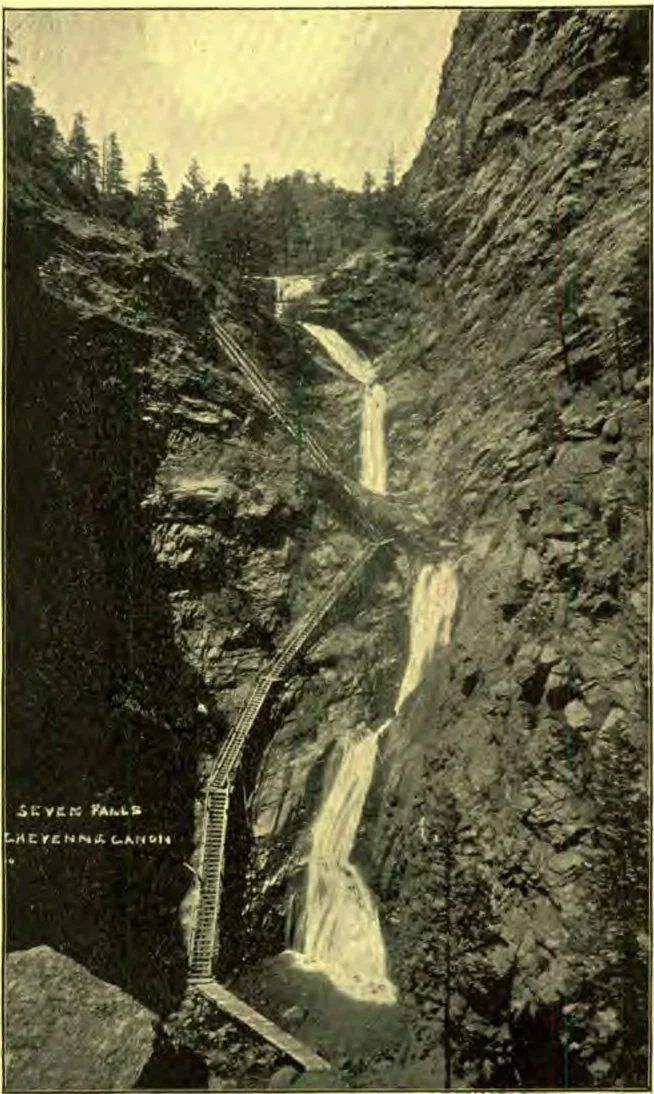
SEVEN FALLS
SEVEN FALLS
Cheyenne Cañon, Colorado, has acquired a world-wide reputation for possessing another remarkable falls—the Seven Falls. This sheet of falling water is altogether different from those that have been mentioned, it being so broken that it really forms seven distinct falls, each of which averages about one hundred feet in height. For the convenience of tourists and sightseers, a wooden stairway has been constructed up the rocky sides of the mountain, so that if the enthusiastic traveler possesses sufficient muscle, and does not become dizzy, he can have the satisfaction of climbing to the very top, and walking over on the opposite side. From that rocky elevation he can secure a view of the entire series of falls. If he is not entirely fatigued, he may recross this stream, and by carefully working his way up the steep sides of the mountain, he will, in a few moments, find himself near the heap of mountain boulders marking the grave of Helen Hunt Jackson, who spent much her time among these rocky fastnesses. It was her dying wish that she might be buried here.
DAVID PAULSON, M. D.

THE CAREER OF AN ISLAND

Copyright, 1899, by H. A. Hale, Portland, Ore.
MULTNOMAH FALLS
Copyright, 1899, by H. A. Hale, Portland, Ore. MULTNOMAH FALLS
ISLANDS are formed in several ways, and if large, are generally looked upon as fairly permanent features of the earth’s surface; but occasionally they disappear, and we are surprised at the history their destruction reveals. One such island, upon which I played when a boy, had no appearance of being otherwise than a part of the mainland around which the water had worked its way; but the truth was revealed when the soil was removed, and the core of the island proved to be a stranded tree. It was clear that a very long time ago some great freshet had uprooted and carried down-stream a large tree, and that it had lodged at some shallow spot. No sooner was it an obstruction to the free flowing of the water, than it began catching drifting material; and this, securely lodged, was an additional check to the progress of anything floating. Such a barrier soon begins to collect sand about it, and the growth of an island is then begun. In the sand lodge seeds of water-plants, and these rank growths, if submerged species, check the current, and cause floating particles to sink; and later, taller plants, like wild rice, spatterdock, and arrow-head, take root and flourish. Thus, in various ways, the soil is accumulated, or, as I have said, the island grows. Then the seed of some tree lodges, and a maple, a willow, or a water-birch takes root. Dry land is made at last; grass starts, and the birds frequent the spot. It may be the work of a few years, or of many, for this is the history of some of the islands in our rivers and creeks. Perhaps we never think of this when walking about, and that is where we make a grave mistake. No matter what the character of the locality, it is always well to keep our eyes open, that we may the better understand its present condition. The island of which I have told gave no clue as to why it was an island and not a bit of the surrounding meadow; but this is no reason for wondering why it was here at all.
That my play-day island, now no more, was very old, as we count years, was shown by the fact that close to the level of the water were found pretty flint arrow-heads and pieces of Indian pottery. Here was a pretty chapter of the island’s history. When but a sand-bar, bare perhaps at low tide only, Indians came here, perhaps to fish, or to lie in wait for passing water-fowl; but here they came, and what they left behind clearly proves that the old tree was the foundation of the new land long before the white man came to this country.
Wherever there is a little brook, the story of the making and unmaking of islands is told. It is never necessary to travel to the ends of the earth to learn about a great many interesting things that are going on outdoors. The familiar incidents about our doorsteps are never to be despised. A cat in the grass can tell as much as a tiger in the jungle.—Charles C. Abbott, M. D., in St. Nicholas.

FIRST STEPS IN INTEMPERANCE

A young man twenty years of age, belonging to a “good family,”—one that has not heretofore produced either drunkards or criminals,—has brought disgrace and dishonor upon both friends and relatives by the crime of forgery, for which he has been arrested, and to which he has pleaded guilty. He forged his uncle’s name to a check, in order to secure money to bet upon horse-races, having in this same manner previously lost all the money he had, together with all he could borrow from his friends. I asked him how he started to gamble. He answered, “Bad company.” Then I asked what led him into bad company, and to this he replied: “It was my love of drink that brought me into evil associations.” With a desire to get to the bottom of his trouble, I inquired still further, “How did you come to be addicted to drink?”
The intelligent face of the young man was turned toward the floor, and for several moments his mind was engaged in deep thought. I did not break the silence. Finally he answered thus: “My friend, it is a long story. It began, I believe, when I was only a boy. At least, if it did not begin then, I know not when nor where. I know that now I am a drunkard,—a helpless, hopeless victim of alcohol. I might have been helped earlier in my experience; but now I am in despair of ever gaining the victory over the evils that have mastered me, soul and body.”
The answer to my question proved to be indeed a long one, but in substance it was as follows: His parents were well-to-do, and set what the world calls a “good table.” Of course this meant plenty of meats, spices, pastry, tea, and coffee, although liquors were never brought into the house. At an early age these unwholesome and illy prepared foods began to sour on the boy’s stomach; and one day, he learned, in the home of a youthful comrade, that vinegar and soda stirred together in water was an antidote for sour stomach. This he tried, and it would seem from his story that he experienced some relief by using this concoction; after this, whenever his stomach became sour, he would take some vinegar diluted with water, into which he had stirred a little soda. Before long he developed a liking for this preparation, and began to take it when his stomach was not sour. Soon he was in the habit of taking from one to three glasses of this mixture every day.
About this time, having grown old enough to be out evenings with his young associates, he began to drink ginger ale and other drug-store and soda-fountain preparations. He says he can well remember that, when thirsty, water did not seem to quench his thirst. At first he would drink sweet cider, but soon hard cider satisfied his craving better. About this time he was induced to take his first glass of beer, and before long his first glass of wine. This was soon followed by the first drink of whisky. These preparations, he discovered, perfectly quenched his thirst.
The story is almost told. Every cent he could obtain was spent for drink. His evenings were passed in saloons, and in the dens of iniquity connected with them. His relatives spoke of him as the “black sheep” of the family, little knowing that it was their illy seasoned, rich, and unseasonable food that had accomplished the work of making the boy a drunkard. The mother, a temperance woman, never dreamed that she was conspiring with the cook to make a drunkard of her own son.
If we would reap temperance, we must sow for it; and, too, we must realize that even drunkenness does not come without having the way first prepared for it. “Blessed art thou, O land, when thy king is the son of nobles, and thy princes eat in due season, for strength, and not for drunkenness!” Young men and women (for the beer halls of a great city like Chicago are nightly thronged by thousands and thousands of young women, who have been led into the clutches of the drink habit in ways similar to those which entrapped this young man) must realize that when they sit down at the table, they are to eat for temperance instead of drunkenness. If they do this, they will eat plain, simple, wholesome, and nutritious foods,—foods that will not pervert the appetite.
Drunkards, criminals, and other vicious characters are not, as a rule, made in a moment. The way is prepared by a long series of small transgressions. “Little foxes,” nibbling daily at the vine of temperance, erelong effect its complete destruction. The Bible warns us to be careful in these last days lest we be found eating and drinking “with the drunken;” that is, eating and drinking those things that have a tendency to produce drunkenness.
In closing, let us briefly summarize the quick downward career of this soul, from youthful innocence to the crime of forgery:—
  1. Rich, highly seasoned, and stimulating foods.
  2. A sour stomach. (A sour stomach indicates that more or less alcohol is being manufactured in the stomach by the process of fermentation,—a condition ordinarily known as “sour stomach.”)
  3. The occasional, and subsequently habitual, use of the vinegar-and-soda preparation. (Both of these substances are extremely irritating to the stomach.)
  4. Cider, first sweet, afterward hard.
  5. First taste of beer.
  6. First taste of wine.
  7. First drink of whisky.
  8. By this time the hands of intemperance have been securely forged about this helpless victim. Evil associates, vice, gambling, and other attendant evils have conspired together quickly and effectually to destroy the prospects of this bright life, both for this world and for the world to come. What a warning every human wreck of this sort should be to the youth of the rising generation! What a lesson we should learn from a bright light so soon extinguished! Let us make sure that we are sowing for temperance and not for drunkenness.
(The growing tendency to drink in public places is a custom that every Christian should discourage. The line between what are known as harmless drinks and harmful ones, is indeed difficult to distinguish; and the habit of paying for and drinking liquids in public places is a dangerous practice. We believe that Christian youth, who would sow for temperance and not for drunkenness, would do well to avoid becoming habituated to such a practice.)
W. S. SADLER.
1926 Wabash Ave., Chicago.

Reflections on Temptation and Fallen Brethren

Oh, how shall I, who have not seen Temptation’s sweet, alluring face, Condemn my brother’s fall from grace, And say I had more steadfast been? Put to the test, might it not be That I would fail as fast as he? — Susie M. Best.

A GOOD REPUTATION HELPS OTHERS

OCCASIONALLY I hear some one say, with a pious air: “It doesn’t matter what people think of me, I know my heart is right.” Ah, my friend, but it does matter.
Let me give you an illustration: In sight of my office window is a church tower; on each of the three sides there is a clock face. On one of these one of the hands has been broken, making the clock tell strange tales. Of course there are people who do not understand the circumstances, and are, therefore, misled. At heart the old clock is all right; but that doesn’t alter the seriousness of the fact that people have been late in meeting their engagements, and have missed their trains, because the face is not an index to that which it covers.—Selected.

FIRST BUTTERFLY OF THE YEAR

PROBABLY no other butterfly attracts so much attention as the mourning-cloak (Vanessa antiopa), which appears in the sunny days of February. It is the first of those that hibernate in the winged form to venture forth from its winter quarters. Last year, February 19, a lawyer became quite excited, and later much interested in butterflies, from having caught one flying near his barn when the ground was deeply covered with snow. A live butterfly, flitting over the snowbanks, apparently as happy as if hovering in July from flower to flower, seemed to him almost incredible.
For many years past I have received several letters, especially in the spring, inquiring about this “freak of nature,” as some express it. Some persons, knowing nothing of the habits of the butterfly, and apparently having no desire to learn, have foolishly claimed that its appearance portends a great calamity, or predicts unusual summer weather.
Many of our young folks know well this beautiful butterfly, with its yellow-edged dark wings. It is easily found in open groves in February or March on warm, sunny days, and flits here and there, apparently as joyous as if spring had come. Its characteristic flight is two or three flutters of the wing in quick succession, then a sailing away as if floating on air in an irregular course for a short distance; then beating its wings again, it thus pursues its way. It lives among rocks, in hollow places in trees, in old buildings, and in similar places, venturing out in pleasant weather even in the midwinter months, but being very rarely seen before the middle of February. In the leafless woods it finds its chief food in the exuding sap of some injured place on a tree. The eggs are laid in early spring, and the caterpillars feed on the leaves of elms, willows, poplars, and some other trees.—Selected.

ANNALS OF A BIRD-BOX

I am delighted to notice that many of our boys and girls have begun to study the birds. Some have written me to know whether anything interesting can be done in winter. I say, emphatically, Yes, indeed! especially as I notice that some say they have a good location, with pine and spruce woods near, and many sunny nooks and sheltered valleys. In regard to attracting the birds that come near the house, instead of giving you any directions I think I will tell you the story of the bird-box which we had last winter. Our piazza runs along beside the dining-room and kitchen, and then the barn makes an L with it, facing the orchard and maples. Our Bert put up the box on the corner of the barn opposite the piazza, where we could see it all the time. It was an empty grape-basket, with the handle cut off. Bert drove the nails through the bottom of the basket, leaving the top open toward us, so that we could see at any time if there were any birds in it. He left the heads of the nails sticking out, so that we could tie in the pieces of meat and suet; this proved a wise precaution.
It was the fifteenth of December, and the ground was well covered with snow. I scattered a handful of sunflower seeds in the box, mixed with some butternut and walnut meats, and tied two pieces of suet to the nails in the bottom of the box. I thought I had provided a very good banquet for the birds, but I did not think my invitation would be accepted quite as quickly as it was. But it must be that I was watched, for I had hardly got into the house before two Blue Jays shot into the box with a tremendous ki-yi-ing, and began to tear away the suet. They acted half starved. Perhaps they were; at any rate they gorged themselves, and left for the next comers little but a greasy string.
But, as it happened, the next visitors were not fond of suet anyway. They were a couple of Chickadees. They picked the nuts up daintily, sang their jolly chickadee-dee-dee, and nodded their tiny black caps toward us prettily. I took it that this was their way of expressing thanks.
It is not to be supposed that a newspaper circulates in the kingdom of the birds, but they all seemed to hear about our bird-box, and make it a visit. The Woodpeckers came, and they were suet-eaters, too. I could hardly get enough to keep the birds fed, they ate so ravenously. The Woodpeckers were noisy fellows, and no other bird would come to the box when they were there. If the Blue Jay came around when the Woodpecker was eating, he would sit on the tree, and talk very loud about what he was going to do, and make blood-curdling threats; but he kept away from the box.
Two little visitors who came to the box when the way was clear, gave us great delight. They were the white-breasted and the red-breasted Nuthatch. These little birds like to run about the trees, and it makes no more difference to them which side up they are than it does to a fly. The white-breasted Nuthatch has a good deal of curiosity in his make-up. If you come along quietly, he seems to be as anxious to see you as you are to see him; and it is very funny to see him stop, back downward, on the under side of a limb, and tilt his head toward you, as if he would say, “Can you do this?” The Nuthatches did not eat in the box, but took the pieces of nuts in their bills, flew to a tree, wedged the nuts into crevices in the bark, and then picked away at them. The red-breasted Nuthatch is tamer than the other species. Sometimes I would put a bit of nut in a chair on the piazza, and he would come and get it, and wedge it into a crack in the floor of the piazza and eat it there, to the great delight of the whole family.
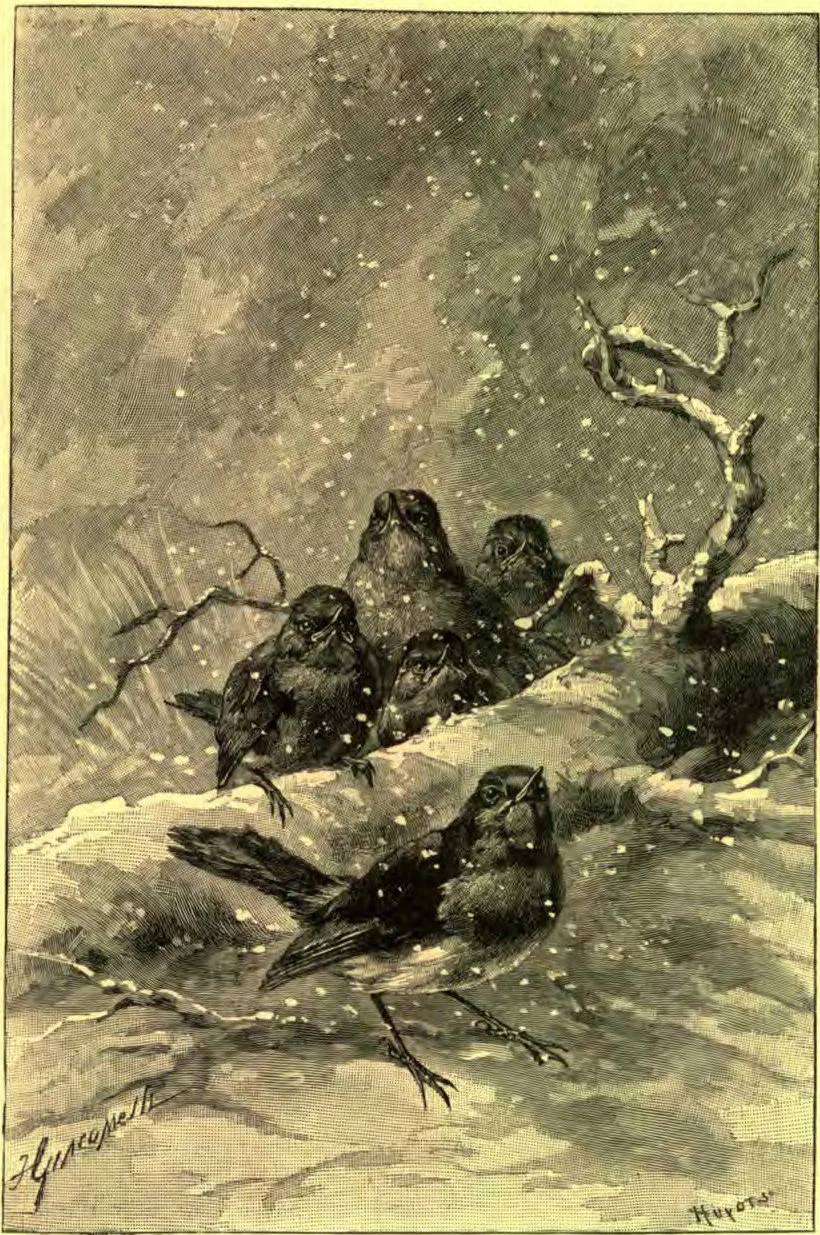
OUT IN THE COLD
OUT IN THE COLD
So the birds came to see us all through the winter, and on Christmas day we paid them a family visit. It was cold, but calm and bright, and we started out about nine o’clock through the orchard. We found eight of the birds ready to receive us, although the ungrateful Blue Jay sat in the top of a tall elm tree, and cried at the top of his voice, “Clear out, there! Skip, now!” But the Tree Sparrows and Nuthatches were glad to see us, and so were the Goldfinches—though it didn’t seem as if these yellowish-brown birds could be the same as the black-capped sprites of gold that undulated through the air in the summer, singing, “Per-chic-o-ree, per-chic-o-ree.” There was a small flock of Chickadees, too, and with them a solitary Junco, having his neat, slate-blue cape drawn closely across his shoulders above his white vest. Further up the mountain we found a flock of pine Grosbeaks feeding on the mountain-ash berries; and as they rarely come south of the Canada line, this was the most interesting experience of the day. Some of the Grosbeaks afterward came to the house. They would not go to the bird-box, but they ate pieces of apple from the piazza. They are very pretty when the sun brings out the rosy tints of their heads and necks.
But, after all, I think those who took the greatest pleasure in the bird-box were father and poor old Aunt Maria. Grandpa, who can imitate any sound there is in nature, from the peep of a chicken to the bray of a donkey, talked with all the birds that came, and I think they liked it. We would roll Aunt Maria up to the window in her wheel-chair, and she would sit there hour after hour watching the birds. Early in March, while the snow was yet deep, there came up from the south a warm, odorous day, to tell us that spring was coming. The window was open, and there was a Chickadee about, and we put nuts on the window-sill for him, as we had often done before, so that Aunt Maria could see him eat.
“Chickadee-dee-dee!” called grandpa.
“Chickadee-dee-dee!” answered the merry little fellow, and came to see what friend was calling him, and so found the nuts on the window-sill and began to eat them.
It was Ned who thought of it. He put some bits of nut in Aunt Maria’s hand as it lay on the arm of her chair. Pretty soon the Chickadee began to look around for more nuts, and saw those in Aunt Maria’s hand. He was a long time about it. He fluttered in and fluttered out, bowed and scraped and hopped about, but at last he alighted on the arm of Aunt Maria’s chair, and in a minute he began to pick at the nuts in her hand. Ned squirmed and swelled up almost to the bursting-point in his efforts to keep quiet, but dear old Aunt Maria’s face shone with joy.
So you see that the bird-box was a blessing to us as well as to the birds. Of course this isn’t the scientific side of bird study, but that will come later, as you get more acquainted with the birds themselves in their own haunts and homes.—John Melvin Hull, in Young People’s Weekly.

HOW TO MAKE THE MOST OF YOUR MEMORY

Of all the faculties of the human mind, memory is certainly one of the most desirable. Yet it is true that a really excellent memory is not so common as might be wished. The average person does not have a first-class memory, and often has occasion to regret the lack of it. That the memory may be cultivated and developed to a surprising and gratifying degree, is not so plain to such as to induce them to strive to improve it. This article is written to suggest a few practical and reliable methods of strengthening a weak memory. The writer knows from experience that the memory can be made a good servant; and that notwithstanding the apparently Herculean task of making one’s memory what it should be, and was intended to be, it is possible so to train this gift that one can do almost anything with it.
There is a good reason why we can remember — without any effort, too — the things we would gladly forget; and this reason affords a clew to the secret of shaping the memory in the way it should grow. Every one knows what a deep impression is made on the mind by some striking incident, forcible statement, or unique event. Why should we not regulate the events of life so that the things we desire to remember shall have the quality of making a strong impression on the mind? The things that create a lasting impression are those in which a keen interest is taken. That a striking quality shall be possessed by a thing, it is essential that we in a measure impart that quality to it.
For example, I have for years been a student and great lover of language. One day I picked up a book containing a mass of miscellaneous information. Glancing through it, I saw, on the first line of one page, the statement that there are two thousand seven hundred and fifty-four distinct languages in existence. That was about the only thing in the book that especially arrested my attention, and the reason for it is clear. Everything appertaining to the spoken or written tongues of the globe has a peculiar interest for me; therefore, without any conscious effort, my mind seized upon this assertion. I put the book down without giving the matter further thought. Next day the instructor of a class which I attended chose as his Scripture lesson the building of the tower of Babel. Toward the close he asked if any one present could tell how many different languages there are. Instantly the number I had read the previous day flashed into my mind, and I shall not soon forget my pleasure at being able to give the exact figures. I never could have done this if my memory had not been trained to retain what I thought worth remembering.
A second factor in the cultivation of the memory is that the attention shall be riveted upon the matter in hand. If the mind is allowed to wander when we study, it will wander at other times. If the reader desires to remember a fact, let him grasp that truth as if his life depended on his knowing and retaining it. A great help in fixing a thing in mind is to write it out. One can not very well transfer a statement to paper without giving it his entire attention; thus the resulting impression is more intense than it otherwise would be.
A third element in the cultivation of the memory is to abstain from trying to make the mind do more than can reasonably be expected of it. If you are capable of thoroughly learning only twenty lines of a poem, don’t spend your time trying in vain to fix thirty lines on your mental tablets. If you do, you will be discouraged and disheartened. After you have trained your mind to remember twenty lines without mental strain, you can safely enlarge your grasp, and take in thirty lines, gradually increasing the task. If this plan is persisted in, the scope and strength of your memory will develop so rapidly as to surprise you.
An important thing in this connection is the ability to recall, instantly, anything that has once been memorized. The writer has done considerable reciting in public; and his memory never fails him, although he never goes through the pieces in his repertoire except when called upon in public to deliver them. A memory that is not sufficiently reliable to answer any demand at any hour, needs to be repaired and overhauled.
Rules for memory-training are usually burdensome, and are not to be recommended. Look well to your memory; subject it to discipline; and in a short time you will surprise and please yourself and others. HENRY WILLIAM ROSE.

*CHRIST’S ENTRY INTO JERUSALEM

I

THE time of Christ’s entry into Jerusalem was the most lovely season of the year. The mount of Olives was carpeted with green, and the groves were beautiful with varied foliage. From the regions round about Jerusalem many people had come to the feast with an earnest desire to see Jesus. The crowning miracle of the Saviour, in raising Lazarus from the dead, had had a wonderful effect upon the people, and a large and enthusiastic multitude was drawn to the place where Jesus was tarrying.
The afternoon was half spent when Jesus sent his disciples to the village of Bethphage, saying: “Go into the village over against you, and straightway ye shall find an ass tied, and a colt with her: loose them, and bring them unto me. And if any man say ought unto you, ye shall say, The Lord hath need of them; and straightway he will send them.”
This was the first time during his life of ministry that Christ had consented to ride, and the disciples interpreted this move to be an indication that he was about to assert his kingly power and authority, and take his position on David’s throne.
Joyfully they executed the commission. They found the colt, and loosed him. “And certain of them that stood there said unto them, What do ye, loosing the colt? And they said unto them even as Jesus had commanded: and they let them go. And they brought the colt to Jesus, . . . and he sat upon him.”
As Jesus takes his seat upon the animal, the air becomes vocal with acclamations of praise and triumph. He is the object of universal homage. He bears no outward sign of royalty. He wears no dress of state, nor is he followed by a train of soldiers. But he is surrounded by a company wrought up to the highest pitch of excitement. They can not restrain the joyous feelings of expectancy that animate their hearts.
Many flatter themselves that the hour of Israel’s emancipation is at hand. In imagination they see the Roman army dispersed, and driven from Jerusalem, and the Jewish nation once more free from the yoke of the oppressor. From lip to lip the question passes, “Will he at this time restore again the kingdom to Israel?” Many in the throng recall the word of the prophet: “Rejoice greatly, O daughter of Zion; shout, O daughter of Jerusalem: behold, thy king cometh unto thee: he is just, and having salvation; lowly, and riding upon an ass.” Each strives to excel the other in responding to the prophetic past. The shout echoes from mountain and valley, “Hosanna to the Son of David: Blessed is he that cometh in the name of the Lord; hosanna in the highest.”
No mourning nor wailing is heard in that wonderful procession. No captives are to be seen in chains of humiliation. Those who have once been blind, but whose eyes have felt the healing touch of the Son of God, lead the way. They press close to the side of Jesus, while one whom he has raised from the dead leads the animal upon which he is seated. Those once deaf and dumb, with ears opened and tongues unloosed, help to swell the glad hosannas. Cripples, now with buoyant steps and grateful hearts, are most active in breaking down palm branches, and strewing them in his path, as their tribute of homage to the mighty healer.
The leper, who has listened to the dread words of the priest, “Unclean!” which shut him out from intercourse with his fellow men, is there. But the curse of the loathsome disease no longer contaminates those within touch of him. He has felt the compassionate touch of the Saviour, and has been cleansed by his power. Now he lays his untainted garment in the path of the Saviour, exclaiming, “O give thanks unto the Lord; for he is good: for his mercy endureth forever.”
The healed demoniac is there, not now to have the words wrenched from his lips by satanic power, “Let us alone;” but “clothed, and in his right mind.” He adds his testimony to that of others: “The Lord hath done great things for me, whereof I am glad.”
The restored dead are there. Their tongues, once palsied by the power of Satan, take up the song of rejoicing, He hath brought the dead from their graves; I will open my lips in praise to him.
The widow and the orphan are there to tell of his wonderful works. Little children are inspired by the scene. There are present those who have been healed of their diseases, and brought back from the grave by the word of the Life-giver; and with palm branches and flowers these bestrew the path of the Redeemer.
MRS. E. G. WHITE.

THREE OLD SAWS

If the world seems cold to you, Kindle fires to warm it! Let their comfort hide from view Winters that deform it. Hearts as frozen as your own To that radiance gather; You will soon forget to moan, “Ah! the cheerless weather!”
If the world’s a wilderness, Go build houses in it! Will it help your loneliness On the winds to din it? Raise a hut, however slight; Weeds and brambles smother: And to roof and meal invite Some forlorner brother.
If the world’s a vale of tears, Smile till rainbows span it! Breathe the love that life endears, Clear from clouds to fan it. Of your gladness lend a gleam Unto souls that shiver; Show them how dark Sorrow’s stream Blends with Hope’s bright river!
—Lucy Larcom.

HOPE

Hope is a guide to weary feet, As they plod along on a toilsome way; It smooths the rocks from the rugged hill, And lights the path through the forest gray. The dreary swamp, with its tangled thorns; The desert sands, where the steps may tend, Are oft forgot in a vision sweet Of the joy that lies at the journey’s end.
Hope is a balm to aching hearts, As they brood alone in the sunset light; From the drooping lashes it wipes the tears, And comfort brings with the hours of night. With dreams of joy that banish pain, Hope soothes the heart to a sweet repose; And leaves, instead of a tear, a smile, And instead of thorns, but a velvet rose.
MINNIE ROSILLA STEVENS.

MY NEIGHBORS

My neighbor, who lives ’cross the way, Is wondrously happy and gay; She moves here and there with housewifely care, And sings soft and low as she flits to and fro— My neighbor just over the way.
There’s a lassie so winsome and fair, Who follows her close everywhere, And smiles up in her face with a sweet baby grace, While the sound of her voice makes her mother rejoice,— This wee, winsome lassie so fair.
And often at evening I see A table set neatly for three; While, the day’s work all o’er, at the wide-open door, They hasten to greet, with a welcome so sweet, The loved one they’re longing to see.
Then they quietly shut to the door, And I see them for that day no more; But I miss the sweet sight of their faces so bright, And it really is queer that the street seems so drear When my neighbors have shut to the door.
VIOLA E. SMITH.
Continue reading: NUNKIE'S DOG STORY