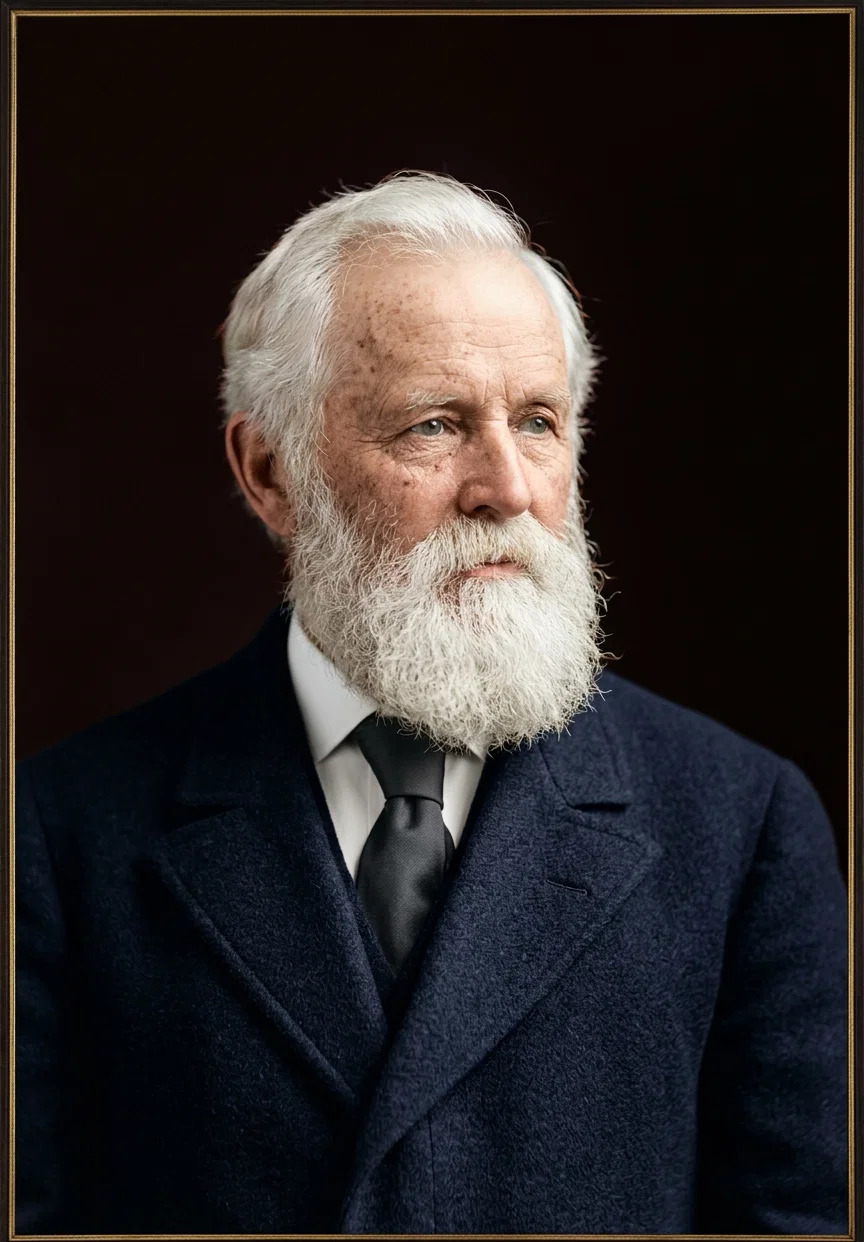
At his home in West Monroe, N. Y., on the evening of Oct. 11, 1910, occurred the death of Elder Frederick Wheeler, in the one hundredth year of his age. He was born at Acton, Mass., March 12, 1811; therefore he lacked only a few hours of being ninety-nine years and seven months old.
Elder Wheeler was married to Lydia Proctor, March 25, 1832, at Washington, N. H. Her death occurred March 12, 1886. To them were born six children, five of whom are still living,—George, Theodore, and Mrs. Mary Halliday, in New York; Nathan, in California; and Mrs. Lucy Spaulding, in New Hampshire. In addition to these he had an adopted son, Wm. Henry Anderson, with whom he spent the last years of his life. From these sprang a numerous family, consisting of twenty-five grandchildren, including the son of Brother Anderson, thirty-nine great-grandchildren, and at least four great-great-grandchildren.
Brother Wheeler's religious experience began in the Methodist Episcopal Church, and about 1840 he was ordained as a minister of that denomination. By rather a peculiar providence, in 1842, he became interested in the advent movement, under William Miller, and soon began advocating the doctrine of the immediate return of the Lord to this earth. At this time he was residing near Washington, N. H., and was among those who received the light on the Sabbath from the Seventh-day Baptists, and is supposed to have preached the first sermon in favor of the seventh-day Sabbath ever given by an Adventist minister before the passing of the time in 1844.
ELDER FREDERICK WHEELER
In the spring of 1857, he removed to the State of New York, locating first in Brookfield, Madison County; but in the fall of 1861, he went to West Monroe, settling on a farm, which has since been his home.
In his earlier Adventist experience he was evidently a man of strong faith, being frequently called to pray for the sick. He related some remarkable answers to prayer. He was a charter member of the New York Conference of Seventh-day Adventists, and sustained the relation of minister in the conference until his death.
After his advanced age prevented him from engaging in active evangelistic labor, he continued to serve his home church with acceptance, his influence and instruction being of great assistance and encouragement.
After his eyesight and his power of locomotion had become greatly impaired, he still retained the use of his mental faculties to a wonderful degree; and in the last decade of his life, some of his exhortations had the force and power of his younger days. In his ninety-fifth year he dictated a message to the conference in its annual session, which was as straightforward, clean-cut, and pointed as any he ever gave. His mind remained active and clear to the last. For some years it has been my privilege to make him frequent visits, one being less than a month before his death. These occasions were always very profitable. On one of them he expressed himself as being especially grateful for the preservation of his mental powers. As failing eyesight deprived him of the opportunity of reading, these visits seemed to afford him much comfort and enjoyment.
His strong constitution and great vitality, combined with adherence to strict temperance principles, gave him a tenacious hold on life. He literally died of old age, and breathed his last as peacefully as a child falling asleep.
A large company attended the funeral services, which were held in the M. E. church. The discourse was based on Job 5:26. S. B. WHITNEY.
Colorado Camp-Meeting
By H. M. J. Richards
THE twenty-eighth session of the Colorado Conference of Seventh-day Adventists was held in connection with the annual camp-meeting at Denver, Aug. 18-28, 1910. The attendance was large, and the weather fine. Workers were present from the General Conference and the Central Union Conference.
In spiritual interest and actual benefit this was one of the best camp-meetings I have ever attended. The Spirit of the Lord was present from the first. Truly this is as it ought to be. As we near the end, our annual gatherings may be expected to increase in spiritual interest and blessing.
Elder C. R. Kite was again elected president of the conference. Elders A. T. Robinson, H. A. Aufderhar, Geo. M. Alway, and W. D. Emery are the other members of the committee. This arrangement is very satisfactory, in that it gives a new experience to men who are younger in the work, and prepares them to carry greater responsibilities. Brother W. D. Emery, who was ordained at this meeting, was chosen to act as secretary of the conference.
The president's report showed an increase of over two thousand dollars in the tithe for the year. The churches16have given over twelve thousand dollars in offerings, and five thousand dollars of surplus tithe was sent to the Mission Board. This conference, which is ninth in membership, now ranks seventh of all conferences in the world in the amount of gifts to foreign missions. One hundred forty-two persons were baptized and received into the various churches in the conference during the past year, and twenty-five more were baptized at this meeting.
This conference has been sending to the Foreign Mission Board one fourth of its tithe. It was voted to continue this appropriation. We feel that this not only gives the Mission Board something definite to depend on, but also brings the blessing of God upon our home conference.
The various branches of the work were found to be in a prosperous condition, and plans were laid for advancement. The Southern work among the Negro people was presented by Elder A. J. Haysmer, and subscriptions were raised to help it forward. Other interests were given due consideration.
Altogether, this was a most successful and blessed camp-meeting, and one to be long remembered with gratitude to the Lord for his manifold mercies and blessings.
H. M. J. RICHARDS.
E. L. ILES
By E. L. Iles
Alabama
ALABAMA CITY.—The writer and Brother Ross S. Lindsay began meetings in this place on June 30. Our tents were pitched in a beautiful grove within reach of all parts of the city. From the very first meeting the interest was excellent, sometimes the tent being crowded, and many standing outside. Although it rained nearly every day for three weeks, we did not miss a meeting with a good congregation. One remarkable feature of the meetings was the fact that when we began to present the Sabbath truth, the congregation increased.
As the result of the effort, twenty-two signed the covenant before camp-meeting, and a few more have taken their stand since, although some are not yet ready for church fellowship. The last Sabbath in September we were favored with the presence and help of Elders J. R. Bagby and E. G. Hayes. At this time a church was organized, officers were elected, and Brother Ross Lindsay was ordained as elder of the church. Eleven have already been baptized, some are satisfied with their former baptism, and a few more will probably be baptized soon.
We closed our public effort October 23, and are holding Sabbath-school and meetings in private houses. We expect soon to erect a neat little church in which to worship. Part of the money for this purpose is already raised.
E. L. ILES
West Pennsylvania
By J. W. Watt
JUST before our camp-meeting at Ford City, the writer held meetings for ten days at Mt. Union, a country place, and the interest was good. A brother and his family who have been reading our books for years have taken a stand for the truth. Others are interested. At present we hold services in a private house, as no public place can be secured. We hope others will yet take a stand for the truth at this place.
Since we began work in the vicinity of Kittanning last spring, which was followed by tent-meetings during the summer, seven persons have accepted the Sabbath, among them an evangelical preacher. Others are interested, and we hope so to follow up the interest during the fall and winter that others may be added to the number.
On a recent Sabbath we had the privilege of baptizing one sister and receiving her into the Indiana church. Our church-school at Indiana is starting off well this fall, and we hope by the blessing of God to have a prosperous school year. Brethren, pray for the work in West Pennsylvania.
J. W. WATT.
Work of the Foreign Mission Seminary
By M. E. Kern
THIS autumn, for the first time in the history of the third angel's message, there assembled together for special training a group of individuals under appointment as foreign missionaries. The new plans for the special training of missionaries, adopted after much prayer and careful consideration, have, we believe, marked a new era in our foreign missionary enterprise.
A Missionary People
This denomination, young and old, has taken for its motto, “The advent message to all the world in this generation,”—and the truth of the message itself depends upon the accomplishment of this thing. With what untiring zeal, then, should every believer in the soon coming of Christ work and pray for the finishing of the gospel work! Every individual a devoted missionary, every church a center of missionary activity and a base of supplies, and every school a recruiting and missionary-training station,—this is the ideal toward which we strive.
Value of the Foreign Mission Seminary
Being directly responsible for this work, and constantly under the necessity of selecting and sending out missionaries to answer the calls and push forward the work in new fields, the General Conference has done well to found this Seminary in connection with the denominational headquarters, where a body of missionaries may be constantly in training. Coming to this institution from many schools and different localities, from fields of activity and from the common walks of life, students can here “be tested and proved, that it may be seen what their adaptability is, and whether they have the right hold from above.”
Every day is demonstrating the wisdom of the establishment of this school, and of the plans adopted by the General Conference with reference to its work. Students are received under provisional appointment only after the same thorough investigation that would be made if they were going directly to the field. Then they are asked to spend a short time at the Seminary in final preparation.
All these appointees need missionary information, and an acquaintance with the practical missionary problems to be met in their fields. Much depends on a good beginning, and nothing is more helpful in starting right than a thorough acquaintance with the field to be worked, a knowledge of what has been done and what remains to be accomplished, and the problems to be met.
The constant contact with members of the Mission Board, men whose experience at home and abroad has fitted them for leadership, is a great blessing to these missionaries, and a valuable aid to the board in knowing where to place them.
The Call for Workers
Our enrolment is about eighty-five, including academic students. Yet there is room. The number of missionaries that will be required soon in the future, if urgent calls are to be filled, is not made up. Are there not others whose hearts respond to the needs of those who sit in darkness and the shadow of death, and can enter training this winter?
Doubtless there are many mature persons with some education and considerable practical experience who could be fitted for good service by one or two years of special training. The Seminary is open to such.
Are there not scores of graduate nurses who will respond to the call of the Great Physician to come over and help in less favored lands? The nurses who are with us are finding just what they need to make them all-round workers.
We have made special arrangements to meet the increasing demand for Bible workers in the large cities. An experienced Bible worker has been engaged to instruct the young women who wish to engage in this work. This class is just now beginning practical work, and a more interested and enthusiastic class would be hard to find. Students could easily enter this work yet. Another class will be started in a few weeks, if there is a sufficient number of new students to warrant it.
A very helpful class is the one in pastoral training. The work in public speaking and sermon building, the study of all that pertains to a minister's duties, and the practical experience gained, are just the things needed by young men who are called to this sacred work. Many young ministers and others who hope to enter this work ought to be taking such a class this winter.
The Seminary is organized this year with special reference to giving the students practical missionary experience, Sunday and Monday being given to field work.
The series of lectures on “Denominational Organization and Work” and “The Bible Versus Human Philosophy” are proving very helpful. The series on “Comparative Religions” is now being given, and Elder A. G. Daniells’s lectures on “General Organization” will probably begin soon after the General Conference Council.
Expenses, and Opportunity to Work
The regular expenses at the Seminary are about $17.50 a month, and one hour's work each day. Just now the school is prepared to offer several young men a good opportunity to earn a part or all of their expenses. We have clearing, farm and dairy work, firing, electrical and plumbing repair work, and general work about the premises to offer. We have also some sewing, laundry, and general housework for young women. Some may work for half their expenses in school, and others may spend their entire time in work this winter and next summer, placing the amount above necessary expenses to their credit for next year's schooling. Academic students, who can not get this opportunity elsewhere, will be received here. We carry regular academic work, aside from the special course for missionaries. No one should come expecting work without first making arrangements.
Our schools exist for the one purpose of helping our youth and training workers for the cause. Let all who read this article pause, and ask, “Lord, what wilt thou have me to do?”
Let all who think of taking work in the Foreign Mission Seminary address the undersigned at Takoma Park, Washington, D. C., care of Seminary.
M. E. KERN.
Fireside Correspondence School
By W. E. Howell
The Favorable Season
The most favorable season for vigorous mental work is winter. The evenings are long, the nerves are in tone, the faculties are wide-awake. Those students did wisely who enrolled at our autumn opening, October 3; but the good part of it is that it is not yet too late to enroll; for winter is just fairly beginning, and our book of registry is —
Always Open
We are still enrolling students. Our new students are starting out very encouragingly. Some are making more than the standard requirement of one lesson a week. A few will soon have one fourth of their course done, and will doubtless be half through before some others get started. It is only fair to say, too, that some who are in the lead are among the very busiest of our students. There are many young people and laborers over the country, who “haven’t the time” to take a study by correspondence; but if we wait for more time, the probabilities are that it will never come, and we shall lose many of the sweets of life because we never could find time to partake of them.
Is there a better season of the year to break away from the habit of making a scapegoat of time? If we do not make the decision now, we may have to content ourselves next summer with the lament, “The winter is past, the opportunity is gone, and I am a year behind where I might have been if my good intentions had not been thwarted.”
Ask for our latest calendar; it may be a help to you. Address us at Takoma Park, D. C. W. E. HOWELL,
Principal.
Religious Liberty Notes
By F. Frederick Bliss
THE religious liberty cause in California is being aided by an anti-blue-law organization called the Religio-Civic Liberty League. This body did some heroic work in the last legislature, rolling up a petition of forty thousand names in opposition to the Sunday-law efforts then. TENNESSEE has a State-wide prohibition law; but notwithstanding this, seven hundred saloons have been operating in Memphis ever since the law went into effect. Last Sunday, however, they were closed all day; and this is said to have come about through the representations of real-estate dealers and property owners that these crime-breeding places were depreciating the value of adjacent property.18
THE president of the Chesapeake Conference, Elder R. T. Baer, writes that they are planning to have the religious liberty secretary visit the churches of that conference in the interests of the literature campaign for which the general department has arranged. Liberty, the Protestant, and other religious liberty literature will in this way be placed in the hands of the people.
GENERAL SECRETARY SHAW, of the United States Christian Endeavor societies, struck a hard blow to religious-by-law in the following sentence, which occurs in a reply to the accusation of some none-too-friendly observer of the workings of the Endeavor societies, that Endeavorers do not seem to get “the man on the street” to become a church attendant. He said: “In free America we can not compel people to go to church services or to love the church, any more than we can compel people to love each other.”
RELIGION in the public schools is to the front just a little, as is indicated by the following clipping from the Chicago Israelite of October 8: “Jewish teachers in the public schools are to receive no pay for the two religious holidays of October 4 and 13, according to action by the board of education yesterday, in refusing a petition for such pay. Frank Hamlin, attorney for the board, ruled that the payment would be illegal. Rabbi Joseph Stolz, a former member of the board, saw injustice in the decision, provided Christian teachers are allowed pay for their holidays, such as Good Friday.”
F. FREDERICK BLISS.
Eastern Pennsylvania
By W. H. Heckman
ONE sister who had done excellent work in the two previous campaigns, was loath to take any copies of the special REVIEW this year. She relented, however, sent for twenty-five copies, and was the first person to make returns of money solicited during this campaign—a money-order for $12. Since then she has sent for more papers with which to continue soliciting.
One of the deacons of the Scranton Seventh-day Adventist church, a railroad engineer, last week secured leave of absence for a few days in order to solicit funds for missions with the special REVIEW. He went over practically the same territory this year, and solicited from the same persons whom he visited during the two previous campaigns. He says he found them even more willing to give of their means this year than before. For thirty-five papers distributed, he received $37.
The elder of the Stroudsburg church says: “We are doing finely with the Harvest Ingathering REVIEW. Those who at first were the most reluctant in taking hold, were the first to report with money. Kindly send us one hundred fifty more copies at once.”
The First Philadelphia Seventh-day Adventist church last year received $199.66. This year they are aiming for $250. The pastor, Elder R. E. Harter, is doing all in his power to realize this amount.
One of our workers visited a prominent business man, and in the course of conversation, remarked: “You remember you gave us $5 last year, and we appreciated it very much.” He replied: “My! was I as liberal as all that?” She assured him that he was, and that she would like to have him duplicate it this year. “Well,” he said, “I guess I will have to,” and wrote out his check for another $5.
A laborer who had been sent to one of our churches to assist in this campaign, reported that in a few days she had collected $12.
One of our Bible workers, who was very successful soliciting last year, writes: “So far, I am going over the same route this year that I had last year, and I tell the people this paper shows what their contributions helped to do last year in sending abroad one hundred forty-two missionaries, and then ask them to double what they gave last year.” She is meeting with success.
Two sisters went out one day last week in the business section of one of our large cities, and the day’s work netted them $22.50.
The Scranton church collected $194.50 last year. This year they have set their mark for $300. A letter from Sister J. M. Weiss, who is assisting them, states that in two days she, with the aid of four sisters of that church, received $42.50. At that rate, they will soon realize the amount aimed for.
The Reading church did a splendid work last year in soliciting for missions, going $20 ahead of the year previous. This year bids fair to exceed what was done during 1909.
Brother J. W. Hirlinger, our field and missionary agent, writes very encouragingly from the church he has been asked to visit in the interests of the Ingathering campaign. In behalf of the Lancaster church, where he is elder, and which made a splendid gain last year over the previous year, he writes: “Sister —— has secured over $17. Some of our most active members are at present on the sick list; but while we may be behind at the present time, we expect to get $100 or more before the campaign is over, and I believe the Lord will reward us with this amount.”
In the first Harvest Ingathering campaign the Allentown church made a splendid record, collecting $119.38. In communications from Brother C. S. Baum, who has been conducting a tent effort in that city this past summer, and from Brother Baumgartner, the local elder, we learn that they are aiming for $125 or more this year. We confidently believe that they will more than make it.
W. H. HECKMAN.
The Harvest Ingathering for Missions
“Thy people offer themselves willingly in the day of thy power, in holy array.” Ps. 110: 3, A. R. V.
“For that the leaders took the lead in Israel, for that the people offered themselves willingly, bless ye Jehovah. . . . My heart is toward the governors in Israel, that offered themselves willingly among the people.” Judges 5: 2, 9, A. R. V.
Harvest Ingathering Work in Colorado
Colorado
The following letter, forwarded to us by Elder C. R. Kite, from a sister who has been doing earnest work in Colorado in the Harvest Ingathering campaign, illustrates how the work may be carried on successfully, and what a power this work may become in getting the truth before the people, and in soliciting funds for our foreign missions:—
“I know you will appreciate the fact that we have entered upon the Harvest Ingathering work. I myself put out ninety-eight papers, and have not missed getting something at every house, having taken in $14.18. Sister —— took in $1.75 in one day, and Sister ——, sixty cents. Not a paper has been wasted. We are of good courage. I have counted thirteen who have asked personally for meetings. I found one lady and two children on this trip who promised they would come to our Sabbath-school. On Tuesday after one family had given me fifty cents, I went back in the evening, and gave treatment to one who was sick. Then they gave me $1. This day's work being devoted to the Lord, I added that to “my missionary money.””
Sabbathkeepers Added in Pennsylvania
FOLLOWING a tent-meeting at Altoona, Pa., six adults have begun to keep the Sabbath. October 8, six persons were added to Church No. 1 at Pittsburg. As a result of work done at Kittanning and Ford City, seven persons are keeping the Sabbath. After reading several of our denominational books for years, and attending a ten days’ tent effort at Mt. Union, Pa., five persons, all of one family, are keeping the Sabbath. The books had been placed in their home by a canvasser; and as a result, after hearing a few sermons on present truth, they accepted the faith.
Christian Liberty
Reports, Notes, and Comments Pertaining to the Current History of the Rights of Conscience
Conducted by the Religious Liberty Bureau
K. C. RUSSELL . . . . . . . . . Secretary
C. M. SNOW . . . . . . . . . Corresponding Secretary
How You Can Help
IN your reading of newspapers and magazines, watch for any item relating to the question of religious liberty, and then send on to us marked copies of such publications, or clippings from them. We especially wish the names and addresses of the persons who are mentioned in the reports of these events, in order that we may correspond with them, and supply them with appropriate literature. The minds of people who are thinking on the subject of religious legislation can be impressed more easily than those of people who are not concerned either way.
The items, which we wish you to be on the outlook for are such as these: Reports of Sunday-closing crusades, reports of arrests for Sunday work, reports of conventions or other meetings where Sunday legislation is touched upon, court decisions affecting liberty of conscience and the Bible in the public schools, freedom of speech and of the press, the movement for the federation of the churches, indications of a purpose on the part of Protestants and Catholics to join hands in bringing about religious legislation, religious bills introduced in State legislatures, striking statements of clergymen or statesmen for or against freedom of conscience, etc.
If you will take up this work, you will greatly facilitate the work which the Religious Liberty Department was organized to carry on, and every effort put forth in this direction will be deeply appreciated by us. For us to patronize a regular clipping bureau is quite expensive; but if our brethren and sisters throughout the field will help us in the manner suggested, we shall have a valuable clipping bureau of our own, at very little expense to the cause.
In sending clippings, be sure to write the name and date of the paper on the margin of the clipping.
Address Religious Liberty Association, Takoma Park, Washington, D. C.
Mission Schools
By H. R. S.
ALL who have had to do in any way with work in foreign fields understand the value of a mission school. In fact, there are countries in which the school has not only been the entering wedge, but in many ways the backbone of the missionary work. In the mission school, “line upon line,” and “precept upon precept,” can be imparted as in no other place. It is through these schools that the missionary is often able to multiply his work manyfold, by means of the native evangelists. Especially in countries like Africa, our greatest success lies in getting the natives into our schools, and there carefully training them. It is always of great interest to hear of these mission schools in these different countries. The following extracts from a letter received from Brother B. L. Morse, one of our missionaries in British East Africa, will be of interest. With one exception, the eight workers in our British East Africa missions are from our British training school. Considering the fact that these missions are located under the equator, it is a satisfaction to note the good health that has been enjoyed by the laborers since the founding of the mission station six years ago. Brother Morse says:—
“I am glad to write that every worker is in good health. Brother and Sister A. A. Carscallen have occasional attacks of the fever. Brother H. H. Brooks had several some time ago, and also Sister Brooks has had one; however, of late they have not returned. The children of Brother and Sister Carscallen and of Brother and Sister J. D. Baker are as bonny as you could find anywhere in the world.”
“At present we have two stations established—Gendia, by the lake, where Brother and Sister Baker are located, and Wire Hill, about fifteen miles from Gendia. They have about twenty boys living at their station, besides a hundred children coming in from the surrounding villages to school each day. In addition to looking after these children, Brother Baker is also getting out material for a permanent house. At the Gendia school we have two sessions daily—in the morning from eight to ten, and in the afternoon from one to three. The afternoon session is for the thirty-five boys who live with us. I feel quite proud of these boys, for most of them are beginning to read nicely, all of them being able to manage easy sentences. Fifteen months ago none of them could read, and few of them had even seen an alphabet.”
“It must be borne in mind that the Kavirondos do not care at all for school; so that when we opened a school for the children from the villages, we had to go to them, and urge them to send the children to us. Often one must go several times before they come regularly. At our school to-day there are ninety-two from the villages. Had all been present, there would have been one hundred twenty-five. Often after the afternoon session I take two of the older boys for a five- or six-mile tramp to the villages to look after the truants. When I have had time to get to all the villages, I hope to have about two hundred boys attending our school here.”
“LATER.—I have been visiting villages during the past ten days, and we now have an average of one hundred twenty-five present. I have half the villages within a radius of three miles yet to visit. From those already visited, I have over two hundred names of children of school age. The mission boys who go with me say that there are many more whom I have not seen, who are hidden away by their parents when they know that I am coming. The village head man will not tell me the truth when asked about the children. Often by staying around, talking with him about other things, and keeping my eyes open, I see a goodly number of black heads poking out of the hut doors. Then I get hold of the boys for students. There are hundreds of children in this section; and I am sure, could they be found and brought in, we would have nearly five hundred in our school, all of whom would be over seven years of age.”
“As yet we have no printed books. Brother Carscallen has gathered a dictionary of three thousand words, and worked out a rough grammar, to help new workers in the language. At present he is working on the translation of Matthew, the first chapter of which is completed. Brother and Sister Baker have translated ‘The Story of Joseph.’ This I am giving the boys for reading lessons. I write out two or three paragraphs on the blackboard for them to copy in exercise books. I shall be able to get them on much faster when we have the printed page from which to read.”
H. R. S.
The Value of the Morning Watch
By G. B. THOMPSON
THERE is nothing so important to Christians as to learn to pray. Jesus prayed. The stillness and darkness of the night found him, though weary with the cares and burdens of the day, amid the solitude of the mountains praying. “And in the morning, rising up a great while before day, he went out, and departed into a solitary place, and there prayed.”
Morning is the golden time for prayer and for study of the Bible. “Satan well knows that one whom he can lead to neglect prayer and the searching of the Scriptures will be overcome by his attacks. Therefore he invents every plausible device to engross the mind.”
In the life of every true Christian there should be times of silent meditation on the things of God. How fitting that in the morning hour, before the busy scenes and conflicts of other hours begin, we take a little time when the heart, in holy, quiet devotion, can, in the hush of the opening day, commune with its Maker! How fitting to sit, ere the toil of the day begins, at the feet of the Master, and receive from him such instruction as pilgrims journeying through an alien country need to guide them aright, and to save them from falling into the pitfalls of sin, or becoming entangled in the subtle webs woven by the enemy! True, we can not always sit in the quietude of silent meditation. Peter desired this when on the mount of transfiguration. But now, as then, human suffering and sorrow await us at the mountain’s base. Before we are fitted to minister to the needs of others, or cope successfully with the temptations which19beset us, we must take time to drink at the fountain, to receive from God the water of life.
Truly that day is not wholly well spent that is spent without a quiet hour. Prayer is the breath of the soul. We may not be able to pray eloquently, but the Lord is our Father; and we should remember that parents take more pleasure in the stammering of their children than in the words of the most gifted orator. Jesus has bidden us to watch. “And what I say unto you, I say unto all, Watch.” We are to watch against the spirit of the world; watch against temptation; watch against Satan; watch against sin. We are also to watch for opportunities to do good, and be useful. We must constantly “watch and pray.”
G. B. THOMPSON.
Christian Education
By H. R. Salisbury
Conducted by the Department of Education of the General Conference
H. R. SALISBURY . . . . . Secretary
The Morning Watch Calendar
By M. E.
ABRAHAM LINCOLN’S mother said, “I would rather my son would be able to read his Bible than to own a farm, if he can have but one.”
To all parents who, like Lincoln’s mother, are anxious to have their sons and daughters study the Bible prayerfully, we recommend the little Morning Watch Calendar. It has been prepared especially to help our young people to form the habit of regular secret prayer and personal Bible study.
Last year Australia circulated 1,200 copies of the calendar. This fall 2,150 have been sent to that distant field. The orders from this country for two days last week amounted to 1,700. This will suffice to show that the calendar is fast making friends; but there are young people here and there who have failed to make its acquaintance. Let not yours be among that number.
The little calendar will each morning give a thought on the Sabbath-school lesson. It will suggest a subject for prayer. From the sunset table on the last page, the time of sunset for Fridays during 1911 can be computed for any place in the United States and Southern Canada. Order the calendar from your tract society. Price, five cents. M. E.
Young People's Work
Conducted by the Young People's Missionary Volunteer Department of the General Conference
M. E. KERN . . . . . Secretary
MATILDA ERICKSON . . . Corresponding Secretary
The Summary
By A. J. S. B.
Question: “To what extent am I responsible for the loss or gain in my union conference?”
The comparative summary shows that during the first ten months of 1910, 234,200 more magazines were sold than during the corresponding months of 1909.
The figures credited to each conference represent the number of magazines sold by agents. They do not include the copies received by subscribers residing in those territories.
The average monthly sale of magazines during the first ten months of this year has been 150,126, as compared with 126,706 a month during the corresponding period of 1909; that is to say, a monthly gain of 23,420 copies over last year.
Our agents sold 85,897 of the 120,020 magazines circulated during September, and 79,940 of the 116,157 copies sold during October. Thus 5,957 less magazines were handled by the agents than during September. As a partial compensation for this, a gain of 2,094 is shown over September in the number of copies mailed to subscribers at home and abroad.
Although our four publishing houses shared about equally the loss represented by 3,863 less sales than during September, a renewed interest is apparent in this work throughout the field. Brother D. W. Reavis, manager of the Review and Herald Periodical Department, accompanies his October report of magazine sales with the following cheering words: “While our sales during October were not so large as during the summer months, when the students were largely engaged in this work, we appreciate the visible evidences of continued interest on the part of our regular workers, and also the increase of new workers. About one third of the orders for the November number that have come to us are from new workers, and over one half of the orders from our regular agents show an increase over their October orders. This is a very encouraging feature of our work at the present time.”20
Following is a list of the union conferences showing gains: (1) Columbia Union, 3,056; (2) Northern Union, 1,860; (3) Southeastern Union, 1,669; (4) Southwestern Union, 1,258; (5) Western Canadian Union, 681; (6) Canadian Union, 580. The following union conferences show losses: (7) Southern Union, 541; (8) Pacific Union, 846; (9) North Pacific Union, 1,195; (10) Lake Union, 3,272; (11) Central Union, 3,590; (12) Atlantic Union, 5,627.
Thus far during the year 881,367 copies of the five ten-cent magazines issued by the Review and Herald Publishing Association have been sold,—an average of 88,136 copies a month. According to figures submitted by the manager of the periodical department, the association’s total magazine sales for six years have amounted to 3,371,500 copies, representing a value of $337,150. If to these be added the other periodicals issued, we have a grand total of over 15,500,000 copies of periodicals sold by this firm during the past six years. These represent a valuation of nearly $950,000. This year-by-year report will be published in a future issue. It is most interesting and profitable.