Review and Herald, Vol. 11, No. 6.

NEW AND ENOURMOUS ARGUMENTS FOR SUNDAY-KEEPING
Earlier text: THE FEET OF IRON AND CLAY

H. W. DODGE

From Bro. Dodge.

BRO. SMITH : When I take the Review into my hands to read, I can scarcely lay it down until I have read it through. How cheering it is to me and my family to read the soul-stirring truths it contains, and the comforting letters from brethren and sisters, and hear them by letter testify to the goodness of God to them even in their loneliness. It give us new courage, and we all feel to acknowledge the goodness of God to us; for he has done great things for us.
Our troubles and trials here are nothing to be compared to the never-ending joy that awaits us, and I feel that come what will, I will press my way through and hold out to the end, by the grace of God. I can truly say and sing, "Farwell all earthly treasure." Jesus is my treasure, heaven is my home. I long for the day when Jesus will come to redeem his people. I often feel as though I could truly say, Come Lord Jesus, come and reign. I know we read, "It is a fearful thing to fall into the hands of the living God;" it must be to the unprepared; but to those that look up and see Jesus when he comes, and can say with a pure heart, Lo, this is our God, we have waited for him, to such it will be a pleasure to be in the hands of God, for he is our heavenly Father.
I sincerely believe that we do not let our light shine as we ought; we are too apt to keep back part of the price. I feel that if I do not let my light shine it will grow dim; and I am resolved by God's grace assisting me, to work as a day-laborer in the vineyard of the Lord. I want to be made free from sin. I must have the wedding garment on. I hope to meet all the dear saints on the new earth, and for this I will strive. We must avoid pride and selfishness.
Yours in Christian love.

H. W. DODGE

Stodard, N. H., Nov. 30th, 1857.

Preparing for the Holy City

From Sister Woodruff.

Bro Smith: I have been thinking much about the holy City. O how holy, how beautiful, and how wonderful. Far more glorious than man can realize. What manner of persons then ought we to be in all holy conversation and godliness, in order to be prepared to dwell with a holy God in the holy city! Who does not want to overcome, to do his commandments, that they may have right to the tree of life, and may enter in through its pearly gates. I for one have much to overcome. The way is a strait way, and I see it is narrowing up, it is cast up high above this world, but I mean to be one, the Lord helping me, to walk in this way, though strait and narrow. The way is not too strait; we cannot be conformed to this world, and be transformed. Rom. xii, 2. We cannot serve God and mammon, we cannot come out of Babylon and be in Babylon, be separate from the world and still unite with the world, go hand in hand with them, talk, act and dress like the world, all at the same time. Wherefore come out from among them, and be ye separate, saith the Lord. 2 Cor. vi, 17, 18. What a blessed promise in verse 18. We must crucify self, lay aside all pride. We need to examine our lives very closely. Are not many changes of apparel, and extra trimmings, pride? Is it not like Babylon? Is it not a sign of the last days? Read Isa. iii, 22. It is not a small thing to know our own hearts. The enemy is trying many ways to deceive the people of God. It is very necessary that we watch, and keep our eye fixed upon the work, lest the enemy overcome us, or divert our minds, and ere we are aware we find ourselves far from the strait and narrow path. The Lord has said it will take all to buy the field. I think there is more implied in these words than we have, perhaps, realized. We are living in a solemn time, the period of Judgment. I want to confess all my sins that they may be blotted out, and that I may be found of him in peace, without spot and blameless.
Yours striving to overcome. HARRIET WOODRUFF. Palermo, N. Y., Dec. 4th, 1857.

Men do not Reason on Religion.

The great mass of the world do not reason on religion. They are governed more by feeling and prejudice than they are by arguments and convictions of truth. You may prove a doctrine logically and sustain it by an appeal to the word of God, but if it is not in accordance with the pre-conceived opinions and prejudices of those who hear your argument and proof, little or no impression is made. Men will not be convinced against their feelings and prejudices. And this is one reason why there is so much error in the world, on the subject of religion. As Christ said of men in his day, "that they would not come to him that they might have life," so it may be said now, that they will not receive his instructions that they may know the truth.
There is not that obscurity about the teachings of the Scriptures, and difficulty in understanding the doctrines of Christianity, that men imagine. The great difficulty lies in the depravity of the human heart, and in the power of that prejudice which governs human belief. If men would reason on the subject of religion, infallible as human reason is, and receive the plain and honest teaching of God's word, there would not be that diversity of opinions and creeds that are now to be found in the world. We have no very exalted opinion of the infallibility of human reason, but there is a clearness in Revelation in reference to the great doctrines of salvation that all may see. Yet men who are governed by their prejudices will not see, and if they do, they will not believe what is plainly revealed. We have heard them assert that they would not believe certain doctrines which they would not deny were taught in the Bible. And this is a species of infidelity which is wide spread in our day. It is the result of following human prejudices. They become so strong that they refuse to yield to the authority of Divine truth.—Sel.

Golden Thoughts.

I NEVER yet found pride in a noble nature, nor humility in an unworthy mind. Of all trees, I observe that God has chosen the vine—a low plant that creeps upon the helpful wall: of all beasts the soft and patient lamb: of all fowls the mild and guiltless dove. When God appeared to Moses it was not in the lofty cedar, nor the spreading palm, but in a bush, an humble, slender, abject bush. As if he would by these selections check the arrogance of man. Nothing produceth love like humility; nothing hate, like pride.—Feltham.

THE WORD WITHIN

Let it be your care to hide the Word in your hearts, and get the teachings of the Spirit; that, whatever changes of Providence be upon the world, you may have the light and comfort of the Scriptures to direct and cheer your souls. Sanctification is the writing of God's law in your hearts; and what is written there is secure and safe. The word within you is more secure, sweet and effectual, than the word without you. Jerome saith of Nepotianus, that by long and assiduous meditation of the Scriptures, his breast has at last become the library of Christ. O, that the breast of every Christian were so too!—Quarles.

Let your Light Shine.

A correspondent says, “The church in this place have been invited by other denominations to join with them in prayer and conference meeting; but they are opposed to having present truth advocated. They say that there is not interest enough among their own members to keep up the weekly prayer-meetings, so they want our church to come over and help wake up an interest among them. Some have been from our church; but my mind is not settled as to its being right. Will some one tell me through the Review what is right.”
Said the Saviour, “Let your light so shine before men, that they may see your good works, and glorify your Father which is in heaven” Matt. v, 16. This is the duty of all Christians, as far as circumstances will admit, and they have ability. When people shut their ears and their hearts to the truth, it is better to leave them than to disturb and to pain them with the sound of truth. “Let them alone.” For brethren to meet with, and try to worship God with such, and keep silent on the present truth, we think would be wronging their own souls and dishonoring the God of truth. Would it not be like putting a light under a bushel, or under a bed? True, it may not be duty in all places and at all times to introduce unpopular Bible truth; but, certainly, brethren should not engage in the worship of God with those who hold popular errors, and bind them so that they cannot give a free expression of plain Bible truths. J. W.

The Faith of Jesus.

A BROTHER in Vermont inquires as follows: “Can the definition that Paul gives to the word faith in Heb. xi, 1, be given to “the faith of Jesus,” in Rev. xiv, 12, and be correct.”
We are confident that the word faith in these two passages does not have the same signification. In Rev. xiv, 12, we read, “Here are they that keep the Commandments of God and the Faith of Jesus.” Both Commandments and Faith are to be kept, observed, obeyed. But Paul in Heb. xi, 1, says, “Now faith is the substance of things hoped for, the evidence of things not seen.” If faith, in both texts, means the same, then we may understand Rev. xiv, 12, as follows: Here are they that keep the Commandments of God, and the substance of things hoped for, and the evidence of things not seen. J. W.

Our Conversation.

On this subject, repeated admonitions are found in the Bible. At times we feel in some degree the force of them, and the necessity of having our conversation in heaven, from whence we look for the Saviour. But at other times we neglect to watch our words, we indulge in light and trifling conversation, and as the result of so doing we find ourselves destitute of the Spirit of God, in a very great measure. We resolve, and re-resolve, but do not gain the desired victory.
But why not? Certainly not because the Lord is not ready to impart his grace to assist us in this effort. Certainly not because it is not pleasing to him that we obtain a complete and lasting victory over wrong words. But if we examine our efforts in this work, we shall undoubtedly find they have been too weak. We shall discover a lack of perseverance. David asks at one time, “What shall be given unto thee? or what shall be done unto thee, thou false tongue?” Ps. cxx, 3. In Psalm xxxix, he says, “I said, I will take heed to my ways, that I sin not with my tongue: I will keep my mouth with a bridle, while the wicked is before me.”
Again says David, “I am purposed that my mouth shall not transgress.” This strikes me as a purpose worthy to be adopted by all the remnant.
Says James, “If any man among you seem to be religious, and bridleth not his tongue, but deceiveth his own heart, this man’s religion is vain.” Now as we all desire to be found, not with a vain, but a pure, religion, when the Saviour appeareth, let us each bridle our tongue, ever bearing in mind the blessed promise, “To him that ordereth his conversation aright will I shew the salvation of God.” A. S. HUTCHINS. Parma, Mich.

Maine Conference.

THERE was a good gathering of the friends of the cause of truth, while many were absent that we should have been glad to see at this conference. A lack of strait forward, gospel discipline in cases of wrongs, has produced a withering effect upon the cause, which suffers much in this part of the State. It was distressing to witness the interest manifested to hear by those not in the truth, while the way seemed to be hedged up by the sad state of things in the church. We have sorrowed much because these things were so, and because that our efforts at this meeting did not have that salutary effect upon the church here as in other States; yet we hope the effort is not lost, and believe the honest ones will now show themselves by faithfully confessing their own faults, and cutting loose from every ungodly connection with the world, that has always proved a curse to vital godliness. O that all might realize the awful threatening that is out against the lukewarm, and zealously repent. The cause is destined to rise in Maine, and when it does, those that rise with it will not rise with those dead weights that have so long been a hindrance to the cause. We feel
deeply for those that love the truth, and pity those that do not. O for grace, wisdom and courage to live out the truth acceptably to God in this trying hour.
There was a hearty concurrence in the decision of the other conferences to make the tent operation one in New England, and not sectional. It was also decided to hold another conference at Topsham in two weeks.
This conference is now past, and we feel glad of the privilege of saying to the dear suffering saints in Maine that God’s hand is evidently set to the work to bring up his people here. His arm is not shortened that it cannot save, neither is his ear heavy that it cannot hear. The searching Spirit of truth brought out those deep, heartfelt confessions of faults that we have heard elsewhere. The backslidden were reclaimed, the weak were strengthened, and the strong grew stronger, while two daughters of Bro. Brown of Litchfield made up their minds to keep the commandments and go with the saints to the kingdom. May God bless and keep them and all of his dear saints from all evil.
From the interest manifested to hear on the subject of present truth at Canaan, Phippsburgh, (a new place,) and at Topsham, we are shut up to the conclusion that the gathering Spirit of the Lord is out after honest souls in Maine, and only waits for the church to rid itself of the rubbish, when it will bring to the knowledge of the truth all such as can be reached and benefitted by the same. O brethren, arise and improve this last solemn moment, and secure for yourselves the great gift of eternal life.
E. L. BARR. Portland, Me., Nov. 25th, 1857.

APPOINTMENTS.

Providence permitting, we will meet with the Brethren at Otsego, Sabbath and First-day, Dec. 19th, 20th; at Hillsdale the 26th, 27th; at Monterey, Jan. 2d, 3d.
The appointment at Monterey is put one week later in consequence of the Conference at Hillsdale.
James White. J. N. Loughborough.

Conference in Hillsdale.

Lord willing, there will be a Conference in Hillsdale in the house of worship, commencing sixth day, Dec. 25th, at 2 o’clock P. M., and holding over First-day.
Several brethren in the ministry may be expected at this meeting. J. H. Waggoner.

Business Items.

Ruth Judd.—The books are now sent to your brother as you ordered, Oct. 4th. Please excuse the delay.
Harriet Town.—When did you send to this Office the money from which you have not heard?
S. A. Hastings.—The paper is sent as you desired.
J. F. Hammond.—The paper has been regularly sent to Harriet G. Dana, (the name given us,) since the commencement of the present Vol. Have we the correct name?
Saml. Treat.—We send books again.
E. L. Derby.—We send you the first five Nos. of Vol. X. There was no paper published Nov. 5th, on account of Conference as noticed in the last No. of Vol. X. The books we send as you direct.

Receipts.

Annexed to each receipt in the following list, is the Volume and Number of the 'Review and Herald' to which the money receipted pays. If money for the paper is not in due time acknowledged, immediate notice of the omission should then be given.

FOR REVIEW AND HERALD.

J. Taber 1,00,xi,23. F. Whitney 1,00,xii,1. D. Carpenter 1,00,xii,6. S. W. Willey 2,00,xiii,1. M. Everts 1,00,xii,14. J. L. Palfrey 1,00,xii,1. A. Dunbar 0,50,xii,6. Wm. W Lockwood 1,52,xii,14. W. Morse 0,20,xi,5. N. J. Cleland 1,00,xii,1. W. W. Miller (for R. Rhodes) 0,50,xi,1. B. Stiles 1,00,xi,23. D. Stowe 1,00,xi,1. Wm. Bixby 3,00,xii,1. S. Pierce 1,00,xii,1. E. Churchill 1,00,xii,1. L. Harlow 1,00,xii,1. E. T. Hodge 1,00,xi,1. J. McConnell 1,00,xii,1. B. Thomas 1,00,xii,1. S. Slayton 1,00,xii,1. H. Town 2,00,xi,1. L. M. Freeto 1,00,xii,1. S. Bunnel 1,00,xiv,1. H. P. Wakefield (for S. Borden) 0,50,xii,6. M. Lathrop 1,00,xii,6. S. A. Street 1,00,xii,1. R. S. Durfee 1,00,xii,1. L. Hastings 1,00,xii,14. N. Chase 1,00,xi,1. J. P. Munsell 2,50,xi,14. J. M. Ballou 1,00,xii,1. E. O. Fish 2,00,xii,1. R. Torrey 1,00,xii,1. M. P. Chaplin 1,00,xi,14. N. Powers 0,50,xii,1. Wm. Rhodes 0,50,xii,1. J. P. Hunt 1,00,xii,1. J. H. W. (for Betsey Moore) 1,00,x,18. J. Wilson 1,00,xii,1. H. H. Mapes 0,25,xi,18. R. Barnes 1,00,xi,1. J. Thomas 1,00,xii,1. A. Barnes 1,00,xi,1. S. W. Flanders 1,00,x,14. R. Hopkins 1,00,x,14. L. Martin 1,00,xii,1. S. Martin 1,00,xii,1. Thos. Hale 1,50,xiv,1. D. Cole 2,00,xii,1. J. F. Hammond 1,00,xii,1. A. Miller 2,00,xii,14. Mary Foster 1,00,xii,1. L. Mann 1,00,xii,1. L. Mann (for Mrs. P. Smith 1,00,xiii,1, for D. Fisk 1,00,xiii,1, for C. Coburn 1,00,xi,21.) C. Smith 1,00,xi,1. C. Smith (for Thomas Smith) 0,50,xii,6.

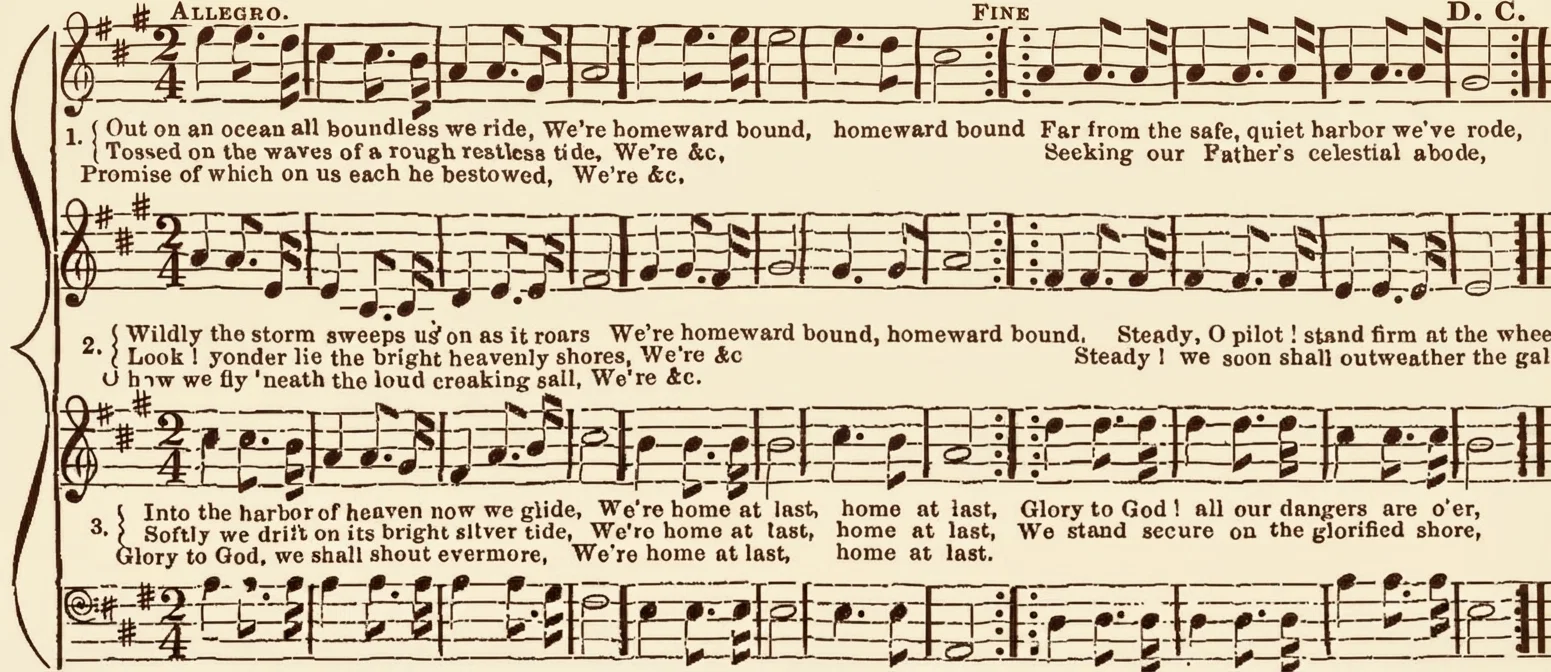
HOMEWARD BOUND. 10s & 7s.

HOMEWARD BOUND. 10s & 7s.

Homeward Bound

Homeward Bound.—This beautiful piece of music was sent us by Bro. J. G. Whipple. Who can sing it without reviving his hope or renewing his courage? We trust that we are indeed homeward bound, and that the time will soon come when “Glory to God! we shall shout evermore, We’re home at last, home at last.”

Encouragement from Battle Creek

To those who love to hear of the prosperity of their fellow-travelers to Mount Zion, we can say that the indications of a few meetings past, in this church have been especially encouraging. We hope to be able to correct our “dead reckoning,” and report progress from time to time. Remember the church and the work in Battle Creek.

Maintaining Our First Love

It has been the observation of the world hitherto that every church that has arisen by coming out and taking a stand upon new truth, has manifested more holiness in life and more zeal and energy in their cause in their early days than at later periods. The standard, high in the beginning, has been gradually lowered, till a dead formality has succeeded to the life and power with which they commenced. This must not be so with us. But more life, more zeal, more consecration, more holiness of heart, a higher stand, a closer walk with God, must be our motto henceforth, till we sit down with our conquering king upon the throne of victory.

The Heavenly Sanctuary

We recently saw a question addressed to E. Burnham through the Crisis, asking him if he believed the true Sanctuary, of which Christ is minister, is the land of Canaan. The view of a Sanctuary and priesthood in heaven he not long since stigmatized through the same paper, as “too silly” to be noticed; “tom-foolery:” &c., &c. We feel somewhat interested in his answer to the above question. Where is it?

You have reached the end of this edition.

Review and Herald · Dec 17, 1857