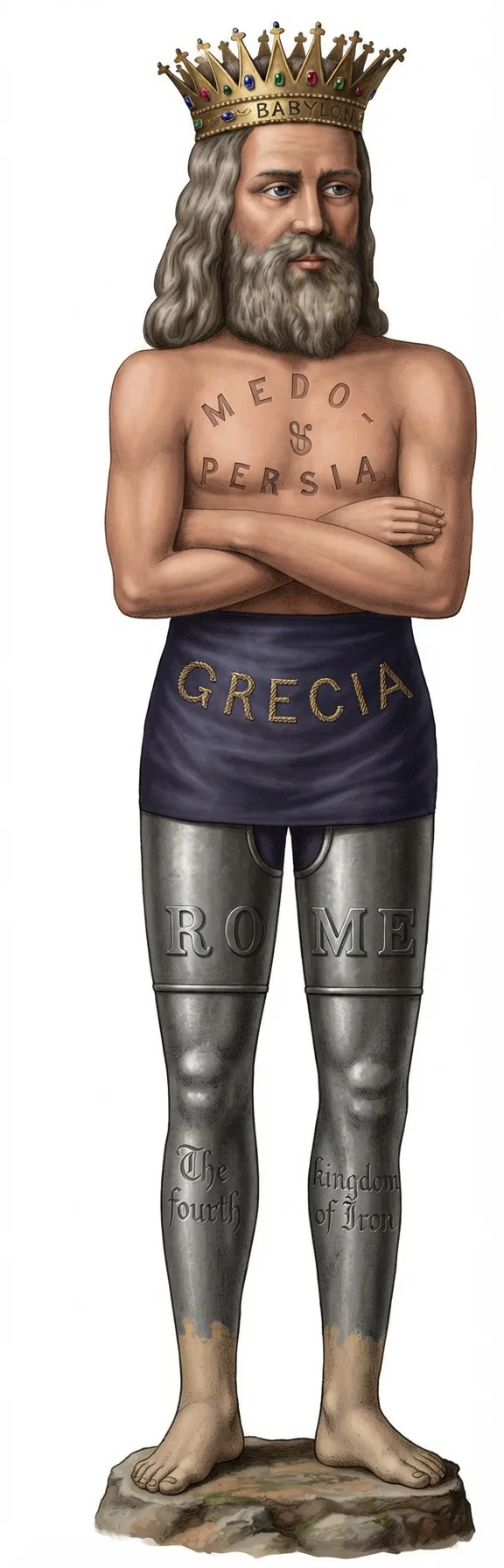
HAVING shown that the legs of iron of Dan. ii, and the little horn of chap. viii, symbolized Rome, the fourth great empire of the world; and having traced that power down to the commencement of the christian era, it only remains that we notice some further specifications of the prophecy which have their application since that time.
Said the Prophet, [Dan. ii 40,] "And the fourth kingdom shall be strong as iron . . . and as iron that breaketh in pieces and subdueth all these, shall it break in pieces and bruise." This is a fit emblem only of the Roman power, "the invincible fortitude, hardiness, and force of which," says Scott, "perhaps were never equalled. By wars and conquests the Romans bore down all opposition, and reduced almost every kingdom or state in the known world into some kind or degree of dependence."
But the Prophet continues: "And whereas thou sawest the feet and toes part of potter's clay, and part of iron, the kingdom shall be divided: but there shall be in it of the strength of iron, forasmuch as thou sawest the iron mixed with miry clay. And as the toes of the feet were part of iron, and part of clay, so the kingdom shall be partly strong and partly broken."
"The kingdom shall be divided." In considering this item of the prophecy, we are brought once more to the symbols of the seventh chapter, in which the fourth kingdom is set forth by a great and nameless beast dreadful and terrible, and strong exceedingly, which had great iron teeth, which devoured and brake in pieces, and stamped the residue with its feet; and it had ten horns. Verse 7. The ten horns are declared plainly in verse 24, to be ten kings which should arise out of this kingdom. Here we have the same divided state of the empire as is signified by the ten toes of the image. This is now the subject of our consideration: Did ten kingdoms arise out of the Roman empire, as contemplated by the prophecy? We answer, There did; and cite the reader for proof to the records of history:
It is well known that Rome fell beneath an overwhelming irruption of Barbarians from the north. They were fierce and warlike tribes, given to rapine and plunder. The wealth of the provinces of the south presented an alluring bait for their avarice; and the effeminacy of the people brought on by a long course of corruption and luxury, rendered them an easy prey to their unimpaired valor. Being given to pillage, and led on from place to place, by the hope of spoil and the love of plunder, and warring frequently upon each other, it is difficult to assign them at first for any considerable period, a fixed location. Suffice it to say that between the years 350 which is marked by the establishment of the great Gothic Kingdom, and 483, when the Roman empire was in its last stages of decline, they had appropriated to themselves the territory of Europe; and from them have descended the people that at present inhabit it. But the nations engaged in this work of invasion and subversion, were ten, according to the prophecy, and are enumerated by Marchiaval, Bishop Lloyd, and Dr. Hales, as follows:
1. The Huns. 2. The Ostrogoths. 3. The Visigoths. 4. The Franks. 5. The Vandals. 6. The Suevi. 7. The Burgundians. 8. The Heruli and Rugii, or Thuringi. 9. The Anglo-Saxons, and 10. The Lombards.
Concerning these kingdoms, Scott remarks, "They are indeed reckoned up in different ways by different writers, according to the date assigned to their enumeration; but in general it is clear that they were nearly the same with the principal kingdoms in Europe at this day; excepting some of the more northern regions, and those possessed by the Turks. It is however certain that the Roman empire was divided into ten kingdoms: and though they might be sometimes more and sometimes fewer, yet they were still known by the name of the ten kingdoms of the western empire."
The question may here arise in some mind, how it happens, since Rome conquered the world, that the ten horns are confined to Europe, and embrace none of their conquests in Africa or Asia. The following from Dr. Nelson, will clear this part of the subject of all difficulty:
"The learned of the earth have praised one of their own number, for one particular trait of character belonging to him in full measure. They have said that Sir Isaac Newton would not indulge in wild speculations and vain conjecture. It is stated that in all his astronomical and philosophical researches, every doctrine which he advanced was built on fact, and that further than this he would not proceed. He seems to have preserved this feature of his mind while writing on prophecy. I never understood one fact concerning the ten horns of the fourth beast, until I read and closely noticed a passage of this philosopher's writing, concerning that beast. I knew that the Roman empire was divided, and that ten kingdoms had existed in Europe as fragments, or horns of that beast; but I did not know why eastern countries, over which the Roman empire had extended, were not included. I knew that in Europe, for twelve hundred years, ten horns had been visible, but if Asia should be taken into the reckoning, the number of horns must be extended. The astronomer saw clearly enough why the kingdoms of Europe alone were to constitute the body and the horns of the beast. His words we will transcribe, for the sake of those who may wish to understand plainly this interesting part of history.
"All the four beasts are still alive, though the dominion of the three first be taken away. This corresponds with the declaration of the twelfth verse that although their dominion was gone, they had their lives prolonged for a season and a time. The nations of Chaldea and Assyria are still the first beast; those of Media and Persia are still the second beast; those of Macedonia, Greece, Thrace, Asia Minor, Syria, and Egypt, are still the third; and those of Europe on this side are still the fourth. Seeing therefore the body of the third beast is confined to the nations on this side of the river Euphrates and the body of the fourth beast to the nations on this side Greece, we are to look for all the four heads of the third beast among the nations on this side the Euphrates, and for all the eleven horns of the fourth beast among the nations on this side of Greece, and therefore, at the breaking of the Greek empire into four kingdoms, we include no part of the Chaldeans, Medes, and Persians, in those kingdoms, because they belonged to the bodies of the two first beasts. Nor do we reckon the Greek empire seated at Constantinople among the horns of the fourth beast, because it belonged to the body of the third." — Sir Isaac Newton.
"This is plain as the astronomer's doctrine of gravitation. I pity the man who does not read; and I pity the man who hastily reads his Bible, but is too ignorant to enjoy the wonderful picture so plainly delineated in these few verses."
This part of the prophecy completes the image. From the starting point given us by the Prophet, we have come down past the head of gold, the breast and arms of silver, the belly and sides of brass, the legs of iron, until by these last revolutions the weakened state of the empire as set forth by the clay of the feet, and its division as signified by the toes, were fully accomplished; and the image stands complete before us. The words of the Prophet now come home with stirring power. "In the days of these kings shall the God of heaven set up a kingdom." The next event in this chain of prophecy, is the crushing blow of the Stone cut out without hand, which descends upon the feet of this great image of earthly kingdoms, and dashes it in pieces. Like a statue in solemn anticipation of its doom, it has been for long years awaiting this event. We are persuaded that it is not far in the future.
Another question may here arise which perhaps demands a passing notice. In the days of these kings, the God of heaven was to set up a kingdom. We turn our eyes to Europe at the present day, and behold a variety of kingdoms, petty sovereignties, and dependencies. The question has been asked, Where are the ten kingdoms? Have they passed away? or has the time passed in which the fifth kingdom should have been set up? In reply to this we quote again from Nelson:45
"Some have asked how it could be said that ten kingdoms have existed to represent ten horns, in a part of the earth once under the dominion of Rome when so many changes have been constantly going on in Europe, and when so many of them have been at times, as it were, consolidated into one. We may reply at any time to such an inquiry very fairly, that the ten horns have been there; that making a kingdom tributary does not take away its existence. If there should have been at times, eleven, twelve or more horns there for half a century or longer, this does not make it untrue that ten were there. Such inquiries as have been made, and such objections as have been urged, seem to many, unworthy of an answer; but if a puerile cavil should appear weighty and important in the view of the unthinking, or the uninformed, for his sake it needs an answer. Let us then pass briefly through an illustration which may aid us in understanding each other.
"Suppose some feeble people should be suffering from the almost constant invasions of numerous and ferocious enemies. Suppose a powerful and benevolent prince sends them word that he will, for a number of years—say thirty—maintain for their safety, along their frontier, ten garrisons, each to contain one hundred well armed men. Or suppose he is actuated by different designs and moved by other motives; no matter how this is, so that his word is out for the support of a given number of fortifications containing a thousand soldiers. Suppose the forts are built and remain a few years, when two of them are buried to the ground and rebuilt without delay; has there been any violation of the sovereign's word? No, there was no material interruption in the continuance of the walls of strength; furthermore, the troops, the most important part of the safeguard, are still there. Again, suppose the monarch sends and has two posts of strength demolished, but adjoining the spot where these stood, and immediately, he has other two buildings erected, more capacious and more desirable; does the promise still stand good? We answer in the affirmative, and we believe no one would differ with us. Finally, suppose in addition to the ten garrisons, it could be shown that for several months during the thirty years, one more had been maintained there; that for one or two years out of the thirty, there had been there eleven instead of ten fortifications; shall we call it a defect or a failure in the original undertaking? Or shall any seeming interruption, such as has been stated, destroy the propriety of our calling these the ten garrisons of the frontier? The answer is, No, without dispute."
"So it is, and so it has been, respecting the ten horns which were to represent ten kingdoms of Europe, once under the Roman sceptre. They have been there for twelve hundred and sixty years. If several have had their names changed according to the caprice of him who conquered, this change of name did not destroy existence. If others have had their territorial limits changed, the nation was still there. If others have fallen while successors were forming in their room, the ten horns were still there. If during a few years out of a thousand, there were more than ten—if some temporary power reared its head, seeming to claim a place with the rest, and soon disappeared, it has not caused the beast to have less than ten horns."
This quotation removes at once every chance for cavil, and all ground for objection. For over thirteen hundred years those kingdoms have been in Europe. In the days of these kings shall the God of heaven set up a kingdom. There are other prophecies to be noticed hereafter, which, through the development of further particulars, bring us down more definitely to our own time. But on the present point we wish to enquire, Would the Prophet thus accurately predict the existence of four great kingdoms, and be mistaken in regard to the fifth? The better judgment of every man will answer, No! As surely as four great kingdoms have successively borne rule over the earth, so surely will the God of heaven set up a fifth, which will never pass away. It will not be left to other people as these have been, but the saints shall possess it forever and ever. As surely as the image has been developed before us, so surely will it be smitten and dashed to shivers.
With one more question, which each must answer for himself and upon his own responsibility, we leave with you, reader, this part of the subject: Are you ready for this destruction of all earthly governments? Have you an interest in the kingdom that is to be set up? Is your name enrolled among those highly privileged ones, who are to be its immortal subjects? Is your citizenship in heaven, from whence we look for the Lord and Saviour? Are you Christ's, and therefore an heir, according to the promise? Or are you, on the other hand, in that condition, that if the King should appear, to raise his people to their glorious and imperishable inheritance, you would covet, as the greatest blessing to be buried from his presence by rocks and mountains? Woful condition! Watch! lest coming suddenly he find you sleeping.
(To be Continued.)
"THE WISE SHALL UNDERSTAND."
By R. F. C.
I. WHAT SHALL THE WISE UNDERSTAND?
1. They will understand the prophecy of Daniel, especially those portions which were shut up and sealed till the time of the end.
2. They will understand other prophecies that mark the events of the same period. So that when certain signs appear, they will know that the coming of the Lord is near, even at the door.
II. WHEN SHALL THE WISE UNDERSTAND?
At the time of the end. "And he said, Go thy way, Daniel; for the words are closed up and sealed till the time of the end." What shall take place then? "Many shall be purified, made white and tried; but the wicked shall do wickedly; and none of the wicked shall understand; but the wise shall understand." We are now in the time of the end. For that king that was to exalt himself, and magnify himself above every god, and speak marvelous things against the God of gods, was to persecute the saints till the time of the end. "And some of them of understanding shall fall, to try them, and to purge, and to make them white even to the time of the end." That persecution having passed, we are certainly living in the time of the end—the time when it is positively declared, "The wise shall understand." This fact will aid in answering our next question.
III. WHO ARE THE WISE?
1. They are not those who, living in the time of the end, acknowledge that they do not understand, and claim that nobody can—those who say, Christ may come to-morrow, or next year, and perhaps not in hundreds, or even thousands of years—those who reject the Advent doctrine on the ground that the prophecies cannot be understood, and claim that it is wrong to try to understand them. As certain as we are in the time of the end, the time when the wise should understand, these are not the wise. Those who understand prophecy in the time of the end must be Advent believers.
But professed Advent believers are divided into a number of large parties and little factions, and individuals who stand almost entirely alone, each claiming to understand, and yet understanding scarcely anything alike. Now those that really do understand prophecy will understand it alike; and, of course, they will be gathered to unity of faith. But the different views of those who profess the Advent faith form a perfect Babel. To suppose that the Lord will come and claim all these as the wise, is preposterously absurd. He might as well have gathered the nominal churches, without sending forth the Advent messages. The history of Advent believers might be compared to a flock of wild geese, which having started for a warmer climate, all agreed upon the course, have become divided and scattered, and are flying in every possible direction. Up to 1844 they were all united in their course. Since then a large portion have been dividing, and scattering, and though all profess to be bound to their proper destination, yet they disagree in the points of compass; mostly agreeing, however, that they were altogether mistaken in the waymarks by which, on setting out, they laid their course. But blessed be the Lord! a few kept on their original course, and have not denied their faith, and to them many of the bewildered, suspecting the sagacity of their leaders who were turning their backs to the Sun of righteousness, have been, and are gathering. But who are the wise?
2. They are not those individuals and small factions that stand by themselves, understanding the prophecies differently from everybody else. It is reasonable to look for more than one, or one hundred persons that God will account wise. It is time that the wise were being gathered to unity of faith. Consequently these isolated individuals and factions, that say the Lord is at hand, even at the door, and yet they alone have the truth, are not so wise as they imagine. They may be, and perhaps are, wise in their own conceit, but there is more hope of a fool than of such. The wise will understand, and understand alike, and, since the Lord is at hand, they must be gathering together.
3. They are not the wise who aid in sending two messages of a chain of prophecy, and then, rather than receive and proclaim the third message in the same chain, turn and give up all they had done as a mistake, still claiming to be in the Advent faith, but giving up and denying the fulfillment of every prophecy or sign that made them such. They are the wise that follow down the line of prophecy, and when the first and second of the Advent messages are fulfilled, proceed to the third. Such a company there is; and in that storm where others lost their compass and got bewildered, they pursued their original course, still acknowledging and steering by the land-marks in the past.
"They've looked astern, and many a toil
The Lord has brought them through;
They're looking now ahead, and Lo!
The land appears in view."
4. The wicked are not the wise; for the two classes are put in contrast in the text. "None of the wicked shall understand; but the wise shall understand." The wicked are transgressors of the Commandments of God; the wise must be commandment-keepers. The Scriptures testify to this. The fear of the Lord is the beginning of wisdom; a good understanding have all they that do his Commandments. The fulfillment of the third Advent message is developing a people of whom it will be said, "Here are they that keep the commandments of God." They hold to the ten Commandments of God, as originally given, without the abolition or change of any one of them. Not many wise men after the flesh will join this company; not many mighty, not many noble. But true wisdom consists in obeying God; and such as obey him will have an understanding of the truth. The pathway of the just is as the shining light, that shineth more and more unto the perfect day. But the way of the wicked is as darkness; they know not at what they stumble.
Perhaps some will say, this writer is wise in his own esteem. I hope it is not so. I have nothing whereof to boast. But through the grace of God I have been enabled to learn that we are in the time of the end, and that at this time, the wise are to understand. And by the light of prophecy I have found the company that have not lost their compass; and I want to go with them. And the object of this writing is to assist others to find where the company of the wise are gathering. For just so certain as it is that the wise will understand the truth concerning the present time, so surely will they come together into unity of faith. And since the righteous are the only ones that God esteems wise, I would humbly endeavor to turn some to righteousness; for in the resurrection, "they that be wise shall shine as the brightness of the firmament; and they that turn many to righteousness, as the stars for ever and ever."
R. F. C.
Learning Our Ignorance
Have you learned to know you are ignorant? This is God's way of making wise; he bids you ask wisdom, and promises to give.
LETTERS.
By Jane Ginley
"Then they that feared the Lord spake often one to another."
From Sister Ginley.
DEAR BRETHREN AND SISTERS: Realizing in some little degree the benefit derived from hearing through the Review from fellow-travelers to Mount Zion, of the trials and difficulties they meet with in the way, of their present prospects, of what our Lord has done for them, and of the blessed hope that buoys their spirits up, I desire to throw in my testimony on the Lord's side, knowing that it is through the blood of the Lamb and the word of our testimony that we are to overcome.
The path we are striving to travel is rugged and thorny, as well as strait and narrow, and there are difficulties all along the way; and were it not for the47glorious prospect before us, and the blessed promises we should faint by the way. Some have to wade through affliction's fiery furnace, it is true; but all these light afflictions work out for us a far more exceeding and eternal weight of glory, and are not worthy to be compared with the joys that await the faithful. I think, on the whole, that we ought not to stop to think and talk of trials, but thank God and take courage that things are as well with us as they are, that we have any disposition to keep the Commandments of God and the Faith of Jesus, and to suffer affliction with the people of God rather than enjoy the pleasures of sin for a season. There is every inducement for us to strive to be faithful, that a kind Saviour can give, and nothing but death, eternal death, if we turn back, and all we have to fear is our own sinful hearts. At least this is the case with me, and often am I led to exclaim, "the heart is deceitful above all things, and desperately wicked; who can know it?" But my prayer is that I may see my heart as Jesus sees it, and that he will purify and make it a fit place for the indwelling of his Holy Spirit.
I know that Jesus is soon coming, but I must have a realizing sense of this fact; for I feel that every act of mine ought to be in reference to this one thing, and it seems strange how any one that believes in the soon coming of Christ, can hold on to their possessions, be so careful about a little of this world's goods, and so fearful they shall do more than their part. If we could realize that the earth is the Lord's and the fullness thereof, and we his stewards, some of us would act very differently. If I know my heart, I desire to save all that I have and am consecrated to the Lord, and give myself a living and willing sacrifice holy and acceptable, which is my most reasonable service.
Your unworthy sister striving to overcome.
JANE GINLEY.
Bowne, Mich., Nov. 28th, 1857.
A Conversation.
By J. Clarke
Modern Spiritualist. Do you believe that God is a jealous being ?
Lover of Truth. Yes, I do.
M. S. I cannot believe so. I think too highly of God for that.
L. T. Your mistake lies in the meaning you attach to the word "jealous." This word is now commonly used in a bad sense; but it was not always so used; it implied watchful care. To illustrate: F. has a choice field of grain, exposed to the inroads of unruly cattle; his mind is exercised with an emotion of jealousy, lest his labor should be lost, and he keeps a constant guard while danger is at hand; but when danger is removed he is at ease: so God is jealous for his name and law, in a good, not in a bad sense, and his readiness to pardon the rebel is full proof that he is not subject to any bad passion.
M. S. But do you hold that God would be so cruel as to punish man to all eternity for sins committed in this short life ?
L. T. God has no pleasure in the death of the sinner; it is the sin he hates. Sin brings its own penalty. The laws of God are immutable, and wo to the man or angel who breaks them; for the penalty is sure as the offense. The wicked rebel falls under the penalty in accordance with natural laws, just as he who throws himself into the water, will drown unless succor is at hand. God beholds all pain with sorrow, and his warnings, and expostulations, entreaties and threatenings, his invitations and offers of reward, all proclaim his benevolence. He could not be capable of giving or receiving happiness, without order, and order cannot exist where there is no law, and law would be null without a penalty.
M. S. Do you think there is such a place as hell?
L. T. What God has said I believe. "The wicked shall be turned into hell;" also a "lake of fire" is spoken of. As to the locality, the universe is not wanting a place; the earth we tread is supposed to be a mass of liquid fire, covered with a crust a few miles in thickness. Volcanoes are but the chimneys, and earthquakes the heavings of the mighty mass; and a word from Jehovah would ignite the whole. Christ compares the wicked to chaff of the threshing-floor, also to fuel which is burned up; they are said to be like wax before the flame, and as the fat of lambs to consume away, as ashes, &c. I think, however, that efforts to avoid punishment, are more profitable to us now, than vain speculations as to the mode, duration, place, &c. If a family of children were threatened with punishment for disobedience, it would be lamentable truly, to see them taking counsel together in regard to what kind of penalty they should suffer; better obey at once, and thus end the matter. God is just, not cruel.
M. S. I can't believe the Bible wholly inspired truth.
L. T. Will you please to show me the sieve you use, and where you draw the line?
M. S. That would be difficult; still I assure you that Spiritualists accept what truth there is in the Bible.
L. T. I see you have taken the first steps, and as you advance you will become more and more bold, until with most of like faith, you will class the Bible with the fabulous myths of the ancients.
M. S. But the spirits do good works, heal the sick, the lame, the deaf, &c., and I am under great obligations to them for aid and comfort rendered when in want, and distress, even when my kindred, members of the Methodist church, too, turned their backs upon me. Then in my need, these Spiritualists, though strangers, acted as brethren; this is proof enough for me.
L. T. You look to men for a test of truth, and while you do so, you will ever run into error. "Cursed be he that trusteth in man." Should not a people seek unto their God? You have partly lost your faith in God, and have recourse to men, and familiar spirits. The word of God points out these errors, and gives us a way of escape, but if you reject a part, and put a part on a false foundation, you may be sure God will frown upon you.
M. S. You have not met my question. Can such kind people as these be in the wrong?
L. T. Satan, to gain his ends, assumes the garb of an angel of light, and this is his last effort to counterfeit the works and attributes of God, even to "show that he is God;" and it seems that greater manifestations will yet appear. Satan's masterpiece is yet to come. "Wo to the inhabiters of the earth and of the sea, for the devil is come down unto you having great wrath, because he knoweth that he hath but a short time." Trust not to appearances, try the spirits by the word of God.
M. S. I do not wish to be deceived. I have nothing here to live for. If I lose eternal life, all is lost.
L. T. Look to God alone, through Christ. Men are fallible, blind leaders of the blind. You have been looking too low. Read the Word with prayer to escape Satan's snares. Fashionable error, and customary crime, are a gilded pill, while truth, though homely and rough in garb, is truth still.
M. S. I will investigate the matter, and would like to converse with you again at the first opportunity.
J. CLARKE.
Lay up Treasure in Heaven.
By Francis Gould
THE present hard times for money, and the failing of banks, and their connecting circumstances are causing men's hearts to fail for fear, and for looking after those things which are coming on the earth; and it is a solemn thought; for it may be a precursor to the time of trouble spoken of by Daniel the prophet, "And there shall be a time of trouble such as never was since there was a nation, even to that same time." The present condition of affairs is a striking fulfillment of the prediction of the apostle James. "Go to now, ye rich men, weep and howl for your miseries that shall come upon you. Your riches are corrupted, your garments are moth-eaten, your gold and silver is cankered; and the rust of them shall be a witness against you, and shall eat your flesh as it were fire. Ye have heaped treasure together for the last days."
While I have witnessed of late the howling of rich men, and the miseries that have already come upon them, and the fear, which like an incubus, has stolen over them, I am admonished that the Judge standeth before the door, and of the importance of laying up a treasure in heaven. Says the word of God, Sell that ye have, and give alms: provide yourselves bags that wax not old, a treasure in the heavens that faileth not, where no thief approacheth, neither moth corrupteth. Luke xii. 33. From this scripture there may be several reasons deduced why we should lay up treasure in heaven.
1. Because it faileth not. The treasures of earth often fail, and through a sudden change of the times become good for nothing; but there is a bank in heaven that will never fail; whether the winds blow high or low, in the midst of prosperity or adversity, it fails not.
2. We should lay up a treasure in heaven because no thief approacheth. It is very evident for the last few years, that crime in all its various forms, has greatly increased, and it can be said with propriety, that there is no place in which earthly treasure can be deposited but what thieves will break through and steal. No thief will ever gain the treasure which is laid up in heaven, or that which God has prepared for them that love him. Blessed are they that do his commandments, that they may have right to the tree of life, and may enter in through the gates into the city. For without are dogs, and sorcerers, and whore-mongers, and murderers, and idolaters, and whosoever loveth and maketh a lie. Rev. xxii. 14, 15.
3. Another reason why we should lay up treasure in heaven, is, because it is the only way to secure eternal life. That way is made plain by the apostle Paul in speaking of the righteous judgment of God, who will render to every man according to his deeds. To them who by patient continuance in well-doing, seek for glory, and honor, and immortality; eternal life. There are two distinct classes of thieves, and robbers, that have rendered themselves very conspicuous in these last days: one class steals and robs a man of his earthly possessions, the other class are those who teach that the righteous receive their reward at death, thus virtually robbing God of his power, and the Son of God of the crowning glory of redemption. Says the prophet, Will a man rob God? yet ye have robbed me. Ye are cursed with a curse, for ye have robbed me, even this whole nation. Mal. iii. 8, 9. Says Christ, Verily, verily, I say unto you, he that entereth not by the door, into the sheep-fold, but climbeth up some other way, the same is a thief and a robber. John x. 1.
I would say to the scattered remnant, who keep the Commandments of God and the Faith of Jesus, double your diligence in well-doing, lay up a treasure in heaven, and may it be an individual work. The great day of the Lord is near, it is near, and hasteth greatly, even the voice of the day of the Lord: the mighty man shall cry there bitterly. Zeph. i. 14. Neither their silver nor their gold shall be able to deliver them in the day of the Lord's wrath. Let us take heed to the counsel of the faithful and true Witness. I counsel thee to buy of me gold tried in the fire, that thou mayest be rich; and white raiment, that thou mayest be clothed. That we may on the examination of the guests be found having on the wedding garment, is my prayer.
FRANCIS GOULD.
Randolph, Vt., Nov. 22d, 1857.
CHASTISEMENT.
By S. M. Swan
"Whom the Lord loveth he chasteneth, and scourgeth every son whom he receiveth."
I saw a tender parent, kind and true,
Chastise his child, the idol of his heart;
I saw the tear of sorrow in his eye,
'Twas not his pleasure thus to cause the smart;
The child he loved, transgressed his just commands,
Parental kindness drew the chastening rod;
'Tis love that prompts the father thus to strive
To lead his child to virtue and to God.
I saw a poor, afflicted child of God,
Through devious wilds he sped his lonely way,
Affliction's cup full oft his lips had pressed,
And bitter grief had long beset his way;
His heart began to sink beneath the load,
Too heavy seemed to him the chastening rod,
And as his faith began to fail, he cried,
Alas! I am forsaken of my God.
Thy Father ne'er doth willingly afflict,
Look up, desponding, tried and tempted one,
'Tis for thy profit that he doth chastise,
O trust, and humbly say, thy will be done.
Remember that the hottest fire will make
The gold more pure, sooner consume the dross;
'Tis that thou may'st his holiness partake,
That thou must suffer here, must bear the cross.
Forsake thee! no, he never can forsake
Those who with humble faith on him rely;
For thee, poor soul, his precious blood was spilt,
And thou art as the apple of his eye;
O trust, thy name is graven on his hands,
Thou art the object of his special care;
When thou art purified, made white and tried,
Thou shalt with him abide in mansions fair.
S. M. SWAN.
Orwell, O., Nov. 14th, 1857.
Extracts from Letters.
Bro. I. Gardner writes from Vergennes, Mich., Dec. 5th, 1857: "Bro. Smith: I am still striving for the kingdom, still trying to hold fast that no man take my crown. Truly it is a trying time, a day of deception, a day of darkness. The love of many is waxed cold, darkness is covering the earth and gross darkness the people. The devil is come down in great wrath because he knows that he has but a short time; but in the midst of all this I am not discouraged. Why? for Jesus says, 'Look up.' Why look up?
Because our redemption is near. Glory be to God for his word, and for the light of present truth that shines upon my pathway. I feel more than ever to press my way on towards the mark for the prize of the high calling of God in Christ Jesus. We have come out before the world, and profess to keep all the Commandments of God and the Testimony of Jesus; the law and the gospel. It is a perfect work, and will prepare a people to enter in through the gates into the city of God."
Bro. J. Dorcas writes, Dec. 3d, 1857: "Bro. Smith: I am at this time at work, doing what I can for the spread of present truth. I find that it is up hill to the Mt. Zion, but I have no disposition to turn back. Sometimes my heart burns within me when I contemplate the greatness and glory of the soon coming kingdom of our God and of his Christ. I long to see the signs of this glorious event accumulate, and do not feel that we have anything to fear."
Looking for Christ’s Appearing
By A. & H. Lanphear
From Bro. & Sr. Lanphear.
BRO. SMITH: We are glad to hear of the prosperity of the Review and Herald, and it is with pleasure, and we trust with profit, that we peruse its pages of truth from week to week. May the Lord prosper the cause in which you are engaged, in sending forth light on the subject of the Sabbath, and the near approach of the blessed Saviour, our Redeemer, who died to redeem us from sin, rose again for our justification, ascended to heaven to prepare a place for his redeemed ones; and who now is in the heavenly Sanctuary, making intercession for sinners, and finishing up his last work of mercy for dying men. Soon he will leave the Sanctuary, and no longer plead the sinner's cause; probation will cease, and he that is filthy will be filthy still. The wicked will call for the rocks and mountains to fall on them and hide them from the presence of the Lord; but they must receive their final doom and be punished with an everlasting destruction from his presence, and from the glory of his power. But to those who are looking for and loving his appearing, will he appear the second time without sin unto salvation. May the glad day hasten on when we shall see Jesus coming in the clouds of heaven to gather his ransomed ones home. Then we shall behold his face, rise to meet him in the air, and so ever be with the Lord. Holy and blessed thought!
Yours hoping for immortality.
A. & H. LANPHEAR.
Nile, N. Y., Nov., 1857.