Review and Herald, Vol. 16, Nos. 1 & 2.

PROPHECY
Earlier text: THE TWO LAWS:

DEATH AND BURIAL,

OR SCRIPTURAL CONVERSION.
"For I was alive without the law once, but when the commandment came, sin revived, and I died." Rom. vii, 9.
The word alive in the text does not refer to natural life, neither does died refer to the cessation of natural life; but the words are here used to represent opposite states of mind and feelings.
The Apostle in this chapter is giving his own experience, hence those who seek for apostolic religion, should mark well the means employed in his case, of which he here speaks.
Verse 7. "What shall we say then? Is the law sin? God forbid. Nay, I had not known sin, but by the law; for I had not known lust except the law had said, Thou shalt not covet." It is evident that Paul means the moral code of ten commandments, when he speaks of the law, from the following facts:
1. He quotes from the tenth commandment—"Thou shalt not covet."
2. The epistle to the Romans was written A. D. 60, about twenty-nine years after "the hand-writing of ordinances" was nailed to the cross. And even Paul's conversion was several years after the abolition of the Jewish system of worship; therefore the law, which was an important agent in his conversion, must refer to the moral code of which Christ says, "Till heaven and earth pass, one jot or one tittle shall in no wise pass from the law." Matt. v, 18.
"I had not known sin, but by the law." What the Apostle here affirms of himself, is most certainly true in the case of every sinner. "By the law is the knowledge of sin." Chap. iii, 20. Here we see that one use of the law of God, in the Christian dispensation, is to show sinners the nature and extent of their sins.
Verse 8. "But sin taking occasion by the commandment, wrought in me all manner of concupiscence. For without the law sin was dead." The moral law is God's great mirror, into which the sinner may look and see the imperfections of his moral character. Without it, sin is dead, or undiscovered. The apostle James illustrates the use of the royal law by a looking-glass. "But be ye doers of the word, and not hearers only, deceiving your own selves. For if any be a hearer of the word, and not a doer, he is like unto a man beholding his natural face in a glass; for he beholdeth himself, and goeth his way, and straightway forgeteth what manner of man he was. But whoso looketh into the perfect law of liberty, and continueth therein, he being not a forgetful hearer, but a doer of the work, this man shall be blessed in his deed." Chap. ii, 22–25. The first great work, then, of the gospel minister, as he labors for the genuine conversion of sinners, is to raise before them God's great mirror, that they may see what sin is, and know its exceeding sinfulness.
Verse 9. "For I was alive without the law once; but when the commandment came, sin revived, and I died." By the word alive, the Apostle designs to express his condition before he discovered his sinful state by the light of God's law. "The commandment came." He saw by the help of God's great looking-glass his true condition. "Sin revived," and he adds, "I died." The word died denotes the change wrought by intelligent conviction. The law of God is the instrument to convict the sinner. As he looks into it, he sees himself condemned in the sight of heaven. Thus the law slays him. The gospel then points him to Christ as the only remedy for sin.
The reason why many who profess religion were never converted, is because they were never convicted, and the reason why they never had genuine conviction, is because they have never seen themselves in God's mirror, the ten commandments. A popular gospel keeps that more or less out of sight, and moves upon the sinner's sympathies and fears, producing a conviction more nervous than intelligent. Such conviction does not result in a change of life, as required in the sacred Scriptures; while intelligent conviction produced by the claims of God's law, changes the mind, the heart, and the life. This change is illustrated in the text by the change from life to death. A man walks to-day in the strength of manhood, to-morrow he is a corpse. What a change! Yet inspiration has chosen it to illustrate the first great work in true conversion.
Verses 10–12. "And the commandment which was ordained unto life, I found to be unto death. For sin, taking occasion by the commandment, deceived me, and by it slew me. Wherefore the law is holy, and the commandment holy, and just, and good." This was the character of the divine law A. D. 60, which is the same in 1860. The great Apostle extols it to the very heavens, and shows its work in conversion twenty-nine years after the change from the Jewish to the Christian dispensation. This is the strongest proof of its perpetuity.
Thus far we have followed the Apostle in his experience, and have learned from him the character and use of the law of God in the present dispensation. He saw its excellence, its holiness, its justice and goodness, and felt its searching, slaying power, and says, "I died." But he does not leave us here. Burial follows death. Chap. vi, 3, 4. "Know ye not, that so many of us as were baptized into Jesus Christ were baptized into his death. Therefore we are buried with him by baptism into death; that like as Christ was raised up from the dead by the glory of the Father, even so we also should walk in newness of life."
We now see that the Apostle uses death and burial to illustrate the two great steps connected with true conversion. Death well illustrates the preparatory work, and burial, baptism. Christian baptism is designed to show, first, that the candidate is dead; and, second, that he believes in the death, burial, and resurrection of Jesus Christ." Verse 5. "For if we have been planted together in the likeness of his death, we shall be also in the likeness of his resurrection." The words buried and planted, as used in this connection, can give no other idea of baptism than immersion. We have not only the word planted, but are taught how the candidate should be planted. How? "In the likeness of his death." Let us for a moment go away to Joseph's new sepulchre, and see "how his body was laid." We there see Jesus laid out in death, as we lay out our friends who die, upon the back. How planted? Be sprinkled? poured? or be plunged into the water face down? No. "Planted in the likeness of his death." The administrator leads the candidate down into the water to a suitable depth, then plunges the candidate backwards down into the water until buried in a similar position to that in which Christ was laid out in death.
The Apostle uses the important events of Christ's first advent to illustrate the steps connected with conversion.
1. The crucifixion. "Knowing this that our old man is crucified with him, that the body of sin might be destroyed, that henceforth we should not serve sin." Chap. vi, 6. Jesus died upon a cross of wood; but where is the cross upon which the sinner must die? We know of no other than that on which Paul died, as he declares in the text, "I was alive without the law once; but when the commandment came, sin revived, and I died." In the unconverted man, I lives and reigns; but let the divine law enter and slay I, then there is room for Christ.
2. Christ's burial. "Therefore we are buried with him by baptism." Verse 4.
3. His resurrection. "If ye then be risen with Christ, seek those things which are above, where Christ sitteth on the right hand of God. Set your affections on things above, not on things on the earth; for ye are dead, and your life is hid with Christ in God." Col. iii, 1–3. See also Chap. ii, 12.
Here, then, at baptism, commences the new life. "Like as Christ was raised from the dead by the glory of the Father, even so we also should walk in newness of life." Rom. vi, 4. If the reader inquires for those who have died in hope without being immersed, we reply, that the Bible, and not the doctrines of even honest and pious men, should be our rule of faith. And instead of laboring to bring the Bible to long-cherished customs, we should bring our faith to the Bible. Men are accountable for all the light they have, and no more. Thank Heaven that it is possible, through the mediation of Jesus Christ, for men who are in error on some points, yet live up to all the light God sees fit to open before them, to live holy lives, and rest in hope of a glorious resurrection. But our only safety is in walking in the light which God in his opening providence brings before our minds. Therefore we should not be so anxious to inquire, What has been the faith of our fathers? but, What saith the word of God?
While some have removed baptism from its close relation to conversion, and regard it of little consequence, others may err on the other hand. We briefly notice the two extremes.
1. It is the custom of some to wait several months to see if the converts will remain firm, before baptizing them. To this we object, first, because the figures of death and burial, as used by the Apostle, give the idea that baptism is closely connected with true conviction of sin; and, second, this practice does not agree with apostolic example. Said Ananias to Saul, "And now, why tarriest thou? Arise, and be baptized." Acts xxii, 16. The jailer and his family were immediately baptized, even in the night. Chap. xvi, 25–36. Philip did not have the eunuch wait six months to see if he would live a faithful Christian, before receiving baptism, but they immediately "went down into the water, both Philip and the eunuch, and he baptized him." Chap. viii, 26–40.
Those who regard baptism of little importance, sometimes cite 1 Pet. iii, 21, as sustaining their lax position. "The like figure, whereunto even baptism, doth also now save us (not the putting away of the filth of the flesh, but the answer of a good conscience toward God), by the resurrection of Jesus Christ." "I was sprinkled," says one, "and that answered my conscience." "And my conscience was answered by being poured," says another. This may all be true; but are our friends, who differ with us on baptism, sure that they have a good conscience on this subject. Peter says, "But the answer of a good conscience." Pagans and Papists may be very conscientious, and their blinded consciences not be good. Protestants may be in a like condition on some points. But it is a fact of much interest that the Apostle in the last clause of the passage—"by the resurrection of Jesus Christ from the dead"—raises a standard to which we may bring our consciences, and know that they are right. Baptism commemorates the burial and resurrection of Christ. Such expressions of holy Scripture as "buried with him by baptism," and "planted together in the likeness of his death," contain light for those consciences blinded by the Papal error of sprinkling infants or adults for baptism.
2. On the other hand, some evidently overlook the necessary work to be wrought upon the mind and heart before baptism. They do not see the use of the divine law, that it must slay the sinner, that he be dead before he is buried, hence it is to be feared that some at least are buried alive! Some teach that Christ is put on in the simple act of baptism, which teaching has a strong tendency to set aside not only the work of the law of God in conversion, but that also of the Holy Spirit.
But Gal. iii, 27 may be urged—"For as many of you as have been baptized into Jesus Christ have put on Christ." It should here be noticed that the text does not say that the Galatian brethren had put on Christ in the sole act of baptism. They had put on Christ by faith, baptism being the corresponding work, an act by which they manifested their faith in Christ.
It is also asserted that baptism is for the remission of sins. Very true; but there are also other means for the remission of sins. Christ's blood was shed for the remission of sins. Matt. xxvi, 28. Christ was to give knowledge of salvation unto the people for the remission of their sins. Luke i, 77. It became Christ to suffer, and to rise from the dead the third day, that repentance and remission of sins might be preached in his name. Chap. xxiv, 46, 47. Repentance and baptism are for the remission of sins. Acts ii, 38. Faith is for the remission of sins. "Whosoever believeth in him shall receive remission of sins." Chap. x, 43; also Rom. iii, 25. In the arrangement for the remission of sins, baptism holds its place in the divine whole.
In the investigation of the subject of scriptural conversion thus far, we see that it is by the divine law that the sinner obtains a knowledge of his sins. He cannot understandingly repent of his sins until he sees them; therefore the gospel minister, who labors to convert the sinner, is under the most solemn obligation to hold before him God's great mirror. His first work is to show the character, perpetuity and claims of the moral code. And in so doing he follows the example of his divine Master. In Christ's first recorded sermon he said, "Think not that I am come to destroy the law, or the prophets; I am not come to destroy, but to fulfill. For verily I say unto you, Till heaven and earth pass, one jot or one tittle shall in no wise pass from the law, till all be fulfilled." Matt. v, 17, 18.
The sinner sees the holiness and justness of the divine law, that he is exposed to the wrath of God, and feels its slaying power. He yields to the requirements of all its precepts, and is dead. The gospel then points him to Jesus. He hears the story of the cross, the burial in Joseph's sepulchre, the glory of the resurrection, and the ascension of Jesus to the Father's right hand where he ever lives to intercede for poor sinners. He raises his head and ventures to believe that Jesus will pity and save him. And as he believes, let him immediately show his faith in the burial and resurrection of Christ by being baptized.
He has now put off the "old man," and has put on the "new man." The Christian warfare and race is begun. He now has the faith of the gospel, and the exhortation of Peter is especially applicable. "Giving all diligence, add to your faith virtue; and to virtue knowledge; and to knowledge temperance; and to temperance patience; and to patience godliness; and to godliness brotherly kindness; and to brotherly kindness charity. For if these things be in you and abound, they make you that ye shall neither be barren nor unfruitful in the knowledge of our Lord Jesus Christ." 2 Pet. i, 5–8.
In Chap. vii, the Apostle first makes an important declaration; second, gives an illustration; and, third, states his conclusion. These we will notice in their order.
1. His declaration. "Know ye not, brethren, (for I speak to them that know the law), how that the law hath dominion over a man as long as he liveth." Verse 1. The words, he liveth, do not refer to natural life. This is not the subject upon which the Apostle is treating. In harmony with his discourse in these chapters, the phrase must have reference to what he calls the old man, or the carnal mind. Then we understand Paul to declare that the law has dominion over a man as long as he lives in transgression of it. We will give an illustration.
Passing a bridge in the State of New York, we met three men, each carrying a large leaden ball. Each man was chained to the ball he carried, and an officer followed them. These men had been breaking the law, and it had dominion over them, because they had not kept it. We walked with freedom where our business led us, for we had kept the law. Our feelings were in perfect harmony with every good law in the State. To say that those who keep the law of God are in bondage under the dominion of the law, is a stupid blunder. They are not the men.
2. His illustration. "For the woman which hath an husband is bound by the law to her husband so long as he liveth; but if the husband be dead, she is loosed from the law of her husband. So then if, while her husband liveth, she be married to another man, she shall be called an adulteress; but if her husband be dead, she is free from that law so that she is no adulteress, though she be married to another man." Verses 2–3.
In this illustration there are mentioned the woman, the law of marriage, the first husband, and her second husband. We now look for an application, consistent with the subject upon which the apostle is here treating.
The woman represents candidates for everlasting life to whom the gospel call is given. The law of marriage represents the law of God. The first husband represents the old man, and the second husband represents the new man, which is the Lord Jesus Christ. We will here give a few direct texts which speak of the old and new man. "That ye put off concerning the former conversation the old man, which is corrupt according to the deceitful lusts; and be renewed in the spirit of your mind; and that ye put on the new man, which after God is created in righteousness and true holiness." Eph. iv, 22–24. "Lie not one to another, seeing that ye have put off the old man with his deeds, and have put on the new man, which is renewed in knowledge after the image of him that created him." Col. iii, 9, 10. See also Gal. ii, 20; Rom. vi, 6.
Now mark. Before the woman could be legally married to the second husband, her first husband must die. Did his death affect the law of marriage? Certainly not. The same law that bound her to her first husband, bound her to the second. And before the sinner can be united to Christ the new man, the old man must die. Does this death affect the divine law? Not in the least. The same moral code that held the sinner in condemnation, is now his rule of obedience, and binds him to Christ. The apostle's conclusion shows that we have correctly applied his illustration.
3. His conclusion. "Wherefore, my brethren, ye also are become dead to the law by the body of Christ; that ye should be married to another, even to him who is raised from the dead, that we should bring forth fruit unto God." Verse 4.
Verses 5, 6. "For when we were in the flesh, the motions of sins, which were by the law, did work in our members to bring forth fruit unto death. But now we are delivered from the law [its condemnation], that being dead [the carnal mind—margin, being dead to that] wherein we were held; that we should serve in newness of spirit, and not in the oldness of the letter."
Says Paul, "The carnal mind is enmity against God, for it is not subject to the law of God, neither indeed can be." Rom. viii, 7. This carnal mind, which is represented by the first husband, must be slain before the person can be united to Christ; then the enmity against God and his holy law is gone, and he is subject to the divine law, and keeps all its precepts with delight. But to set the ten commandments aside, and teach that sinners may be married to Christ without being first slain by the moral law, is to teach spiritual adultery.
Turn to Acts xx, 20, 21, dear reader, and you will there learn that the gospel preached by Paul is in harmony with his own experience and his teachings in his epistle to the Romans. He says, "I kept back nothing that was profitable unto you, but have showed you, and have taught you publicly, and from house to house, testifying both to the Jews, and also to the Greeks, repentance toward God, and faith toward our Lord Jesus Christ." Here are the two great foundation timbers of the gospel as preached by Paul; first, repentance toward God, and, second, faith toward our Lord Jesus Christ. He taught that sinners must first manifest repentance toward God for the transgression of his holy law, before believing in Jesus Christ. He kept back nothing that was profitable. He did not keep back the law; for by it is the knowledge of sin. He first presented the claims of the divine law, and showed the sinner that his first work was to exercise repentance towards its Author; then he taught the sinner that faith in Christ was the only remedy for sin.
Therefore, in the present dispensation, God the Father is our law-giver, and Christ is our advocate. And before sinners can be benefitted by the mediation of Christ, they must manifest repentance toward the Law-giver for the transgression of his holy law. To this the words of the beloved disciple agree: "Sin is the transgression of the law." 1 John iii, 4. "And if any man sin, we have an advocate with the Father, Jesus Christ the righteous." Chap. ii, 1.
But if Christ is our law-giver, as some teach, who is our advocate? We have none. But as Jesus Christ is the sinner's advocate with the Father in this dispensation, it follows that the Father's law of ten commandments is in full force.
"Do we then make void the law through faith? God forbid; yea, we establish the law." Rom. iii, 31. Faith in Jesus Christ as a sacrifice for sin, and now an advocate with the Father, for our sins—"transgression of the law"—is the strongest proof of the perpetuity of the law of ten commandments.
Hence the closing testimony of the third angel. "Here is the patience of the saints, here are they that keep the commandments of God and the faith of Jesus." Rev. xiv, 12. Also the dragon is to make war with the remnant, the Christians in the closing generations of time, "which keep the commandments of God, and have the testimony of Jesus Christ." Chap. xii, 17.
Dear reader, these are Christian commandment-keepers. Their observance of the Sabbath of the fourth commandment, stirs the ire of the dragon host.
But those who endure his wrath, and stand faithful in the closing conflict, will soon receive the great reward promised by Him who says [Rev. xxii], "Behold, I come quickly, and my reward is with me." "Blessed are they that do his commandments, that they may have right to the tree of life, and may enter in through the gates into the city."
J. W.

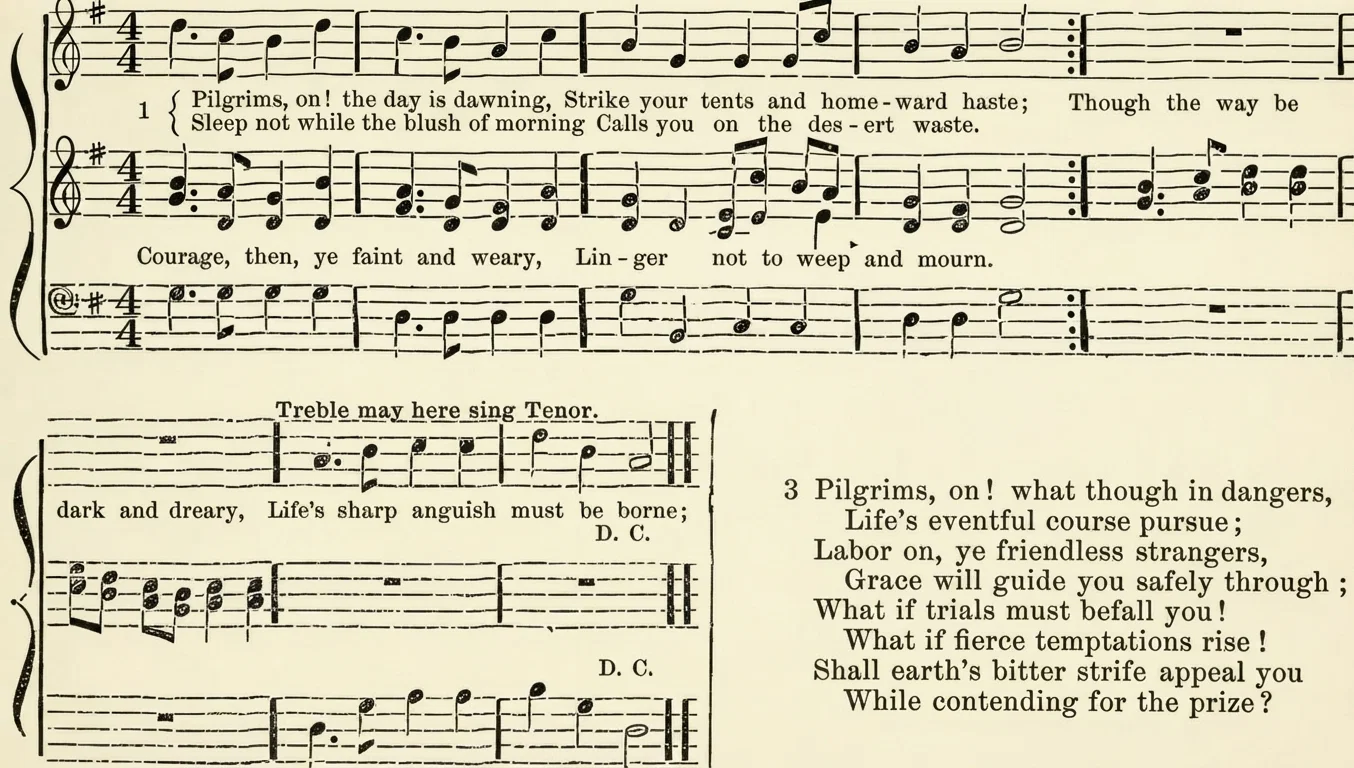
Pilgrims, On!

Pilgrims, On! 8s & 7s, Double.
2 Pilgrims, on! the storm is beating, Beating wildly on your way: Tarry not, the time is fleeting, Shall the storms your footsteps stay? Hasten on, through joy and sorrow, Let whatever may betide, Wait not for the calm to-morrow, Faithful at thy work abide.
3 Pilgrims, on! what though in dangers, Life's eventful course pursue; Labor on, ye friendless strangers, Grace will guide you safely through; What if trials must befall you! What if fierce temptations rise! Shall earth's bitter strife appeal you While contending for the prize?
4 Pilgrims, on! there's rest in heaven, Rest from every anxious care, Rest in Jesus' smiles, forgiven, Peaceful and eternal there. O! 'twere sweet to toil in sadness, O! 'twere well the cross to bear, If, at last, in joy and gladness, We may rest forever there.

Receipts.

Annexed to each receipt in the following list, is the Volume and Number of the REVIEW AND HERALD to which the money receipted pays. If money for the paper is not in due time acknowledged, immediate notice of the omission should then be given.

FOR REVIEW AND HERALD.

D L Welch 1,00,xv,2. L Schellhous 1,00,xviii,9. L Schellhous (for Mrs E Adams) 1,00,xviii,1. Geo Strickland (for D Strickland) 1,00,xviii,1. W Carpenter (for E Stillwell) 1,00,xviii,1. R Hoag 1,00,xvii,1. O Well 2,00,xiii,14. Wm Hafer 1,00,xvi,1. J M Brown 2,00,xvi,14. M J Chapman 2,00,xviii,1. Jno Byington 1,00,xviii,1. Mrs C Byington (for a friend) 1,00,xvii,10. Mrs E Bracket 0,75,xvii,1. Sr Bracket (for H Harrington) 0,50,xvii,1. Mrs Wm Smith 1,00,xvii,1. Mrs Jas Lane 1,00,xviii,1. Sr Lane (for Mrs M Monk) 0,50,xvii,9. H H Pierce 1,50,xvii,1. S I Twing 1,50,xviii,1. S I Twing (for H A Brooks) 0,50,xvii,1. A S King 1,00,xvii,1. M Foster 1,00,xvii,1. L Fogg 1,00,xvii,1. S Osgood 1,00,xvii,1. L A Sargent 0,50,xvii,1. S Peckham 1,00,xvii,1. A Woodruff 1,00,xvii,1. J Ralston 2,00,xvii,1. J J Emans 2,00,xvii,1. S E Edwards (50c each for Wm Edwards and D Edwards) 1,00, each to xvii,1. W Carpenter jr. 2,00,xviii,1. B Moore 1,00,xvi,1. H Decker 1,00,xv,25. Wm Weaver 2,00,xviii,1. J H Grandy 2,00,xv,8. G L Barber 2,00,xvi,20. S Coy 0,90,xvii,9. Wm E Pierce 1,00,xvii,1. J Althouse 4,00,xvi,1. H D Corey 1,00,xvii,1. E M L Corey 1,00,xvii,1. F F Lamoreaux 1,00,xvii,1. J Webb 2,00,xix,1. J Hull 1,00,xv,1. P Lightner 1,00,xvii,1. E Loveless 1,00,xiii,10. Wm D Mills 3,00,xvi,1. Geo P Lull 1,00,xvii,1. T Porter 0,50,xvi,14. S Bond 2,00,xviii,1. L W Murphy 0,50,xvii,1. W H Smith 0,50,xvii,1. Wm T Hinton 1,00,xvii,1. Wm E Newcomb 1,00,xvii,1. A A Thomson 1,00,xvii,1. E C Stiles 1,00,xvii,1. W G Kendall 1,00,xvii,1. J B Sweet 2,00,xvi,1. L L Glover 1,00,xvii,7. E Stone 1,00,xv,20. J M Ferguson 1,00,xvii,8. D B Dunham 2,00,xvi,9. S W Flanders 1,00,xvii,1. M Courter 1,00,xvii,10. Mrs P D Lawrence 1,00,xvii,1. T Bryant jr. 1,00,xvii,1. E W Waters 1,00,xix,1. C B Preston 1,00,xvii,1. D R Wood 2,00,xvii,1. N C Preston 0,90,xvii,7. Mary Mills 3,00,xvii,1. C L Palmer 2,00,xviii,1. A H Adams 1,00,xvi,18. Wm R Loughborough 1,00,xvii,1. Wm K Loughborough (for E Root) 1,00,xvii,19. A E Buckland (for R L Wright) 1,00,xvi,1. Ann 2,00,xviii,1. P S Thurston 2,07,xv,5. P E Ferrin 0,80,xviii,14. M Fairbanks 1,00,xvii,1. B Reed 1,25,xvii,8. R Morse 0,75,xv,21. E A Davis 1,00,xv,2. C Potter 1,00,xvi,1. I D Cramer 1,00,xvii,1. O B Sevey 2,00,xvi,8. J L Locke 1,00,xvii,1. N Lesley 1,00,xvii,1. A friend (0,50, each for H Hudson, A Mills, Mrs J Askins, Dr W N Hudson, and E Hartwell) 2,50, each to xvii,1. S Rider 2,00,xvii,1. R Godsmark 1,00,xviii,1. A Whitney 2,00,xviii,1. E M Freeto 1,00,xvii,1. H Barr 1,00,xvii,1. R M Pierce 1,00,xix,1. J Y Wilcox 1,00,xvii,1. M S North 1,00, 1,64, (2 copies) xvii,1. Ch in Conn (s. b.) (for C Lyman) 1,00,xviii,19. J M Aldrich 1,00,xvii,1. T Ramsey (for J McClure) 0,25,xv,23. J E Brown 4,00,xvi,1. B M Osgood 2,00,xviii,1. A O Thompson 1,00,xvii,1. H Miller 1,00,xvii,1. J A Loughhead 1,00,xvii,1. J Luddington 2,00,xvii,1. Geo H Heacox 2,00,xviii,3. R E Graves 3,00,xvi,5. L Morrison 1,00,xvi,1. E Wick 1,00,xvii,4. D Hildreth 1,00,xvii,1. Mrs L M Gates 1,00,xvii,1. A D Love 1,00,xvii,1. D Robbins 1,00,xvii,1. J Butler 1,00,xvii,1. Wm Gould 1,00,xvii,1. E Scribner 5,00,xix,1. Mrs S Benson 1,00,xvii,1. C K Farnsworth 1,00,xvii,1. D Litchfield 1,00,xv,1. E Bartlett 2,00,xvii,1. L Wiswell 1,00,xvii,1. L McClaflin 1,00,xviii,1. G Kellogg (for J Lord) 0,50,xvii,1. A G Long 1,00,xvii,1. B E Place 1,00,xvii,1. Jno Place 1,00,xvii,1. B E Place (1,00 each for J R Weaver and L Brown) 2,00, each to xviii,1. P Mott 1,00,xvii,1. A J Richmond 1,00,xvii,1. C L Palmer (for C L Miller 0,50,xvi,12; for R E Copeland 1,00,xviii,1; for N Sexton 0,50,xvi,1; for Mrs J B Hare 0,50,xvii,1). J G Cheal 1,00,xvii,1. A W Hartson 1,00,xvii,1. Z Nicola 0,50,xvii,1. Eld P T Russet 0,50,xvii,1. W Downing 0,50,xvii,1. J W Landes 0,50,xvii,1. G W Riddle 0,50,xvii,1. Jas Thomas 1,00,xvii,1. T Ramsey 0,75,xvi,19. H Lyon 1,00,xvii,1.

FOR MISSIONARY PURPOSES.

Church at Cranes' Grave, Ills., (s. b.) $25,00. C K Farnsworth $1,00. Ch. in Colon, (s. b.) $3,25. Mary M. B., (s. b.) $2. J. F. Carman (s. b.) $3,00. Ch. in Jackson, Mich. (s. b.) $25,00.

FOR MICH. TENT.

Mrs. E. Aldrich $10,00.

FOR REVIEW TO POOR.

A. S. King 0,82.

FOR BRO. CZECHOWSKI.

D. Hildreth 65 cts. Mrs. S. Benson $3,00. Ch. in Convis, Mich. (s. b.) $5,00.

Directions for Greenfield Meeting

Brethren coming on the cars to the meeting in Greenfield, near Chatfield's Corners, Saratoga Co., N. Y., to be held June 8-10, will stop at Ballston Spa. If they can let us know, we will send conveyance to bring them to the meeting. Brethren will endeavor to be at the depot on fifth-day. In behalf of the brethren. P. TABER.

Appointment at Hundred Mile Grove

PROVIDENCE permitting, I will meet with the church in Hundred Mile Grove, Wis., June 30, 1860. ISAAC SANBORN.

Business Department.

Business Notes.

H Keeney : The balance due for Bible Class and INSTRUCTOR is 40 cts.
A Woodruff : The remittance for H Woodruff pays up.
J J Emans : Your former remittance was accidentally omitted in the paper. We receipt in this number.
M C Trembly : There are 75c due on the INSTRUCTOR.
T Draper : Your receipt is all right. Your former remittance paid you to xvi,1. The $2,00 you last sent paid xvi, and xvii, carrying you to xviii,1 as receipted.
H Hiestand : Your paper has been regularly sent. We know not why you have not received it. We send again.
O P of Reedsburgh, Wis. : Your former communication was returned as per request. If you have not received it, it has been lost on the way. We would return your present one if you had given your full name.
F Wheeler : C B Preston's INSTRUCTORS are paid volume viii, or till Jan. 1861. How far does he understand that his remittance paid.
L D Newton : Yes.
Bro. I D Cramer formerly of West Milton, N. Y., wishes us to state that his P. O. Address is changed to Lake Pleasant, Hamilton Co., N. Y.
J Luddington : The paper still goes to H Hatch but not to A Day.
L Schellhous : R Schellhous' paper is paid to present volume.

Books Published at this Office.

Hymns for those who keep the Commandments of God and the Faith of Jesus. This Book contains 352 pp., 430 Hymns, and 76 pieces of Music. Price, 60 cents.—In Morocco 65 cents.
Supplement to the Advent and Sabbath Hymn Book, 100 pp. Price 35 cents.—In Muslin 35 cents.
Spiritual Gifts, or The Great Controversy between Christ and his angels, and Satan and his angels, containing 224 pp neatly bound in Morocco or Muslin. Price 50 cents.
Bible Tracts, Two Vols. 400 pp. each. Price 50 cts. each Sabbath Tracts, Nos. 1, 2, 3 & 4. This work presents a condensed view of the entire Sabbath question.—184 pp Price 15 cents.
The Three Angels of Rev. xiv, 6–12, particularly the Third Angel's Message, and the Two-horned Beast. 148 pp. Price 15 cents
The Atonement.—196 pp. Price 15 cents.
The Bible Class. This work contains 52 Lessons on the law of God and Faith of Jesus.—Price 15 cents.
A Book for Everybody—The Kingdom of God. Price 15c. The Prophecy of Daniel—the Four Kingdoms—the Sanctuary and 2300 days. Price 10 cents.
The History of the Sabbath, and first day of the week, showing the manner in which the Sabbath has been supplanted by the heathen festival of the sun. pp. 100, price 10c.
Which? Mortal or Immortal? or an inquiry into the present constitution and future condition of man. pp. 128, price 10c.
The Saints' Inheritance. Price 10 cents.
Modern Spiritualism; its Nature and Tendency—an able exposure of the heresy.—Price 10 cents.
The Law of God. Testimony of both Testaments relative to the law of God—its knowledge from Creation, its nature and perpetuity—is presented. Price 10 cents.
Miscellany. Seven Tracts on the Sabbath, Second Advent &c. Price 10 cents.
Facts for the Times. Extracts from the writings of Eminent authors, ancient and modern. Price 10 cents.
The Signs of the Times. Price 10 cents.
The Seven Trumpets. Price 10 cents.
The Sinners' Fate. pp. 32, price 5c.
The Nature and Obligation of the Sabbath of the Fourth Commandment, with remarks on the Great Apostasy and Perils of the Last Days. Price 5 cents.
Bible Student's Assistant. A collection of proof-texts on important subjects. 36 pp. Price 5 cents.
The Celestial Railroad. Price 5 cents.
Perpetuity of the Royal Law. Price 5 cents.
Review of Crozier. This work is a faithful review of the No-Sabbath heresy. Price 5 cents.
Brief exposition of Matt. xxiv. Price 5 cents.
Review of Fillio on the Sabbath Question. Price 5 cents.
Brown's Experience. Price 5 cents.
The Truth Found—A short argument for the Sabbath. Price 5 cents.
SIXTEEN PAGE TRACTS. Who Changed the Sabbath? Unity of the Church—Both Sides—Spiritual Gifts—Judson's Letter on Dress—Mark of the Beast.—Price $1 per 100.
EIGHT PAGE TRACTS. Wesley on the Law—Appeal to Men of Reason, on Immortality. Price 50 cents per 100.
These small Tracts can be sent at the above prices, post-paid, in packages of not less than eight ounces.
Home Here and Home in Heaven, with other poems This work embraces all those sweet and Scriptural poems written by Annie B. Smith, from the time she embraced the third message till she fell asleep in Jesus. Price 25 cents In paper covers, 20 cents.
Time and Prophecy. This work is a poetic comparison of the events of time with the sure word of Prophecy. Price 20 cents. In paper covers, 15 cents
Word for the Sabbath. Price 5 cents.
The Chart.—A Pictorial Illustration of the Visions of Daniel and John. 20 by 25 inches Price 25 cts On rollers, post-paid, 75 cts.

Tracts in other Languages.

GERMAN. Das Wesen des Sabbaths und unsere Verpflichtung auf ihn nach dem Vierten Gebote.
A Tract of 90 pp., a Translation of Nature and Obligation of the Sabbath of the Fourth Commandment. Price 10 cents.
HOLLAND. De Natuur en Verbinding van den Sabbath volgens het vierde Gebode. Translated from the same as the German Price 10 cents.
FRENCH. Le Sabbat de la Bible. A Tract on the Sabbath of 32 pp. Price 5 cents.
La Grande Statue de Daniel II, et les Quatre Betes Symboliques et quelques remarques sur la Seconde Venue de Christ, et sur le Cinquieme Royaume Universel A Tract of 32 pp. on the Prophecies. Price 5 cents.

Books from other Publishers.

Debt and Grace as related to the Doctrine of a Future Life, by C. F. Hudson. Published by J. P. Jewett & Co., Boston. 480 pp. 12 mo. Price $1.25.
Works published by H. L. Hastings, for sale at this Office.
The Voice of the Church on the Coming and Kingdom of the Redeemer, by D. T. Taylor. Price $1.00.
The Great Controversy between God and Man, by H. L. Hastings. 167 pp., bound in cloth, price 60 cents.
The Fate of Infidelity, 175 pp., cloth gilt. Price 25 cent
Future Punishment. By H. H. Dobney. Price 75.
Pauline Theology. An argument for Future Punishment in Paul's fourteen epistles. Price 15 cents.
Tracts of 24 pages. Church not in Darkness; The Three Worlds; The Last Days; Plain Truths; New Heavens and Earth; Ancient Landmarks. Price 5 cents.
These Publications will be sent by Mail, post-paid at their respective prices One-third discount by the quantity of not less than $3 worth. In this case, postage added when sent by Mail. All orders to insure attention, must be accompanied with the cash, unless special arrangements be made. Give your Name, Post Office, County, and State, distinctly. Address REVIEW & HERALD, Battle Creek, Mich.
PROTESTANT AMERICA.
PROTESTANT AMERICA.

You have reached the end of this edition.

Review and Herald · May 29, 1860