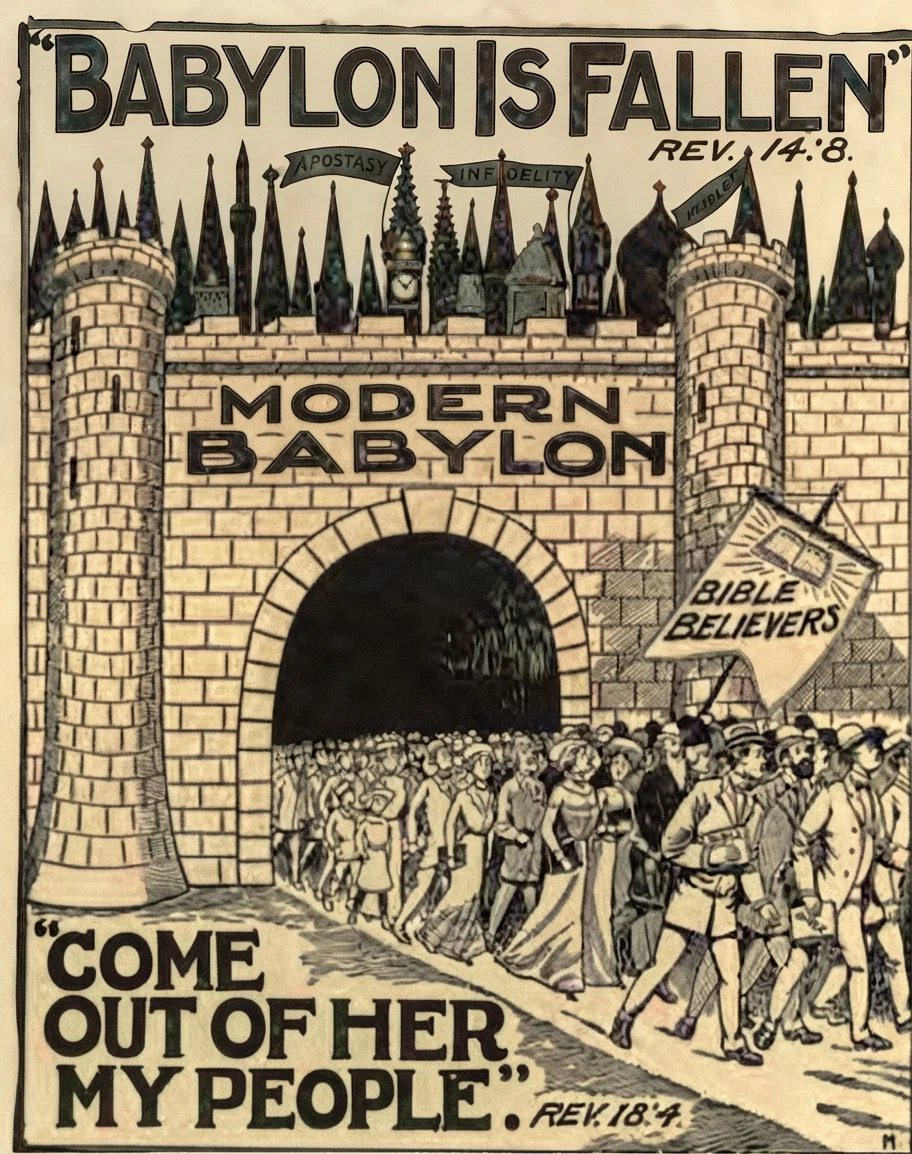
IN the very heart of a great prophecy setting forth the final judgments of God against the kingdom of Babylon, are found these words of loving sorrow and sympathy. With the awful picture of retribution and desolation before him, the prophet's mind was turned to what might have been had the nation to which his people had been subject turned with willing heart to God, and having seen the purpose of Heaven in sending Israel and Israel's truth into that darkened land, he exclaimed, "We would have healed Babylon."
Yes, God had a great healing remedy for Babylon's spiritual ills. However far from Him those people were, they were still within reach of His power, and through the people of Israel, whom Babylon for a time was allowed to scourge, the opportunity was given them to become acquainted with Israel's Redeemer and come into possession of His "plenteous redemption."
"We would have healed Babylon." In the light of these beautiful, sweet words, we may, perhaps, see more fully the tremendous import of the story of Daniel and his work in Babylon. That story is a picture of divine effort to bring home to Nebuchadnezzar and his people the great truths of God's name and nature, God's life and power, God's kingdom, God's authority. Daniel and his people were God's messengers of healing, bearing, in sorrow and reproach, the blessed gospel of creative power, the revelation of Him whose rightful place is the inner sanctuary of man's truest being.
Study again the story of the king's dream, and the prophet's interpretation, which, step by step, led the king forward to the final triumphs of God's grace in the establishment of the everlasting kingdom upon earth. How marvelously complete was the presentation, which showed the utter fallacy of all that Babylon believed and taught, and which brought home to the hearts of men God's blessed willingness to transform their lives and make them fit for an eternal hereafter! It was a splendid manifestation of omnipotence and wisdom and love, designed to countervail the fundamental error of the Babylonian system, namely, that man was himself a part of the divine, and as such was capable of saving himself and of perpetuating himself indefinitely.
Had Babylon received that first message, she might, indeed, have been healed, and have been used of God for declaring His name throughout all the earth.
The experience of King Nebuchadnezzar in seeking to set aside the truth of the dream by erecting an idolatrous image and compelling all to bow before it, again published to his entire kingdom the exalted message of superhuman power and love, and was made the occasion of a direct appeal to every individual in the vast multitude of worshipers to submit himself to that God whose creative power reached beyond and above the elements of nature, and wrought deliverance for those who served Him. He who had brought salvation and healing to the Hebrews, was now offering the same to the entire Babylonian empire.
Later, through the dream of the tree and the visitation of the affliction which the dream had foretold, the king actually did find the knowledge of God and His righteousness, and to all the world bore a touching testimony to the goodness and wisdom of the Almighty. The healing message given again and again to him and his people was at last received, and in the king's life demonstrated what God intended for all. Nebuchadnezzar was healed; his sins were broken off by righteousness; he exchanged his Babylonian confusion and despair for the certainty of truth and the light of everlasting, bright hope.
Well had it been had the people followed the example of their king. But they did not. The message fell apparently upon unwilling ears, and with the passing of the king, the nation rapidly filled up the cup of its iniquity. Instead of giving heed to the prophetic announcements, as may be found recorded in chapters 7 to 9 of Daniel's book, Belshazzar and his wanton subjects sought to heap reproach upon all that pertained to the worship of the King of Heaven, and flagrantly and presumptuously insulted Him in national festival and by official decree. (See Daniel 5.)
Great Mystical Babylon
Babylon refused to be healed, and when her sins had mounted up to heaven, inviting the stroke of wrath which had been so plainly foretold, then God's judgments were visited upon her, and she fell to rise no more.
Babylon was a great world kingdom, and in a most peculiar and wonderful way she was the type of the religious world of these last days. The Apocalypse repeatedly refers to Babylon, and locates her at the time and connects her with events immediately preceding and in connection with the day of Christ and the end of the world. See Rev. 16:19; 18:2, 10, 21, etc. The prophecies of Jeremiah, setting forth the final destruction of ancient Babylon (Jeremiah 50, 51), are a vivid portrayal of the destruction which is to be visited upon modern Babylon in the day when God shall finally and forever close up all earthly accounts.
What Jehovah did, therefore, to bring healing to the world—to Babylon of long ago—is a blessed truth for to-day, and is well worth our study. What is the healing message at this time, and how may we know it and receive it?
In a previous article, it was shown that the Babylon of to-day is the great confused religious world, rent into hundreds of factions, its different parts all at variance, all weak, all inconsistent, all hopelessly worldly, yet seeking by federation and compromise to bring about unity and thus gain earthly power for the accomplishment of its mistaken purposes. "Babylon" signifies confusion, and God made no mistake when He applied the title to these last-day conditions.
To this Babylon—to this broken, bruised, bleeding, dying Christendom—there should come some special message from God, as special as ever came to Babylon of old, one that will constitute a foundation for true Spirit union, Spirit fellowship, Spirit guiding. There is due a message which shall be at once so plain, so positive, so pure, so powerful, so far-reaching and all-comprehensive, that its very presence shall compel world-wide attention, and giving to all who hear in faith, absolute knowledge of its divine origin. And as it flies in mercy to all the world, men will be conscious that its beams of light are but rays from the Sun of Righteousness, which brings healing in its wings. Mal. 4:2.
Surely the time is ripe. Not only do conditions in themselves make silent but eloquent appeal for healing, but all through the great world honest hearts are crying to God for such a revelation of Himself as shall make them know the certainties of hope, the infallible assurances of faith. Even the great heathen world is looking for the coming of a great Teacher, "who shall put an end to the present state of things, and establish a reign of universal peace and righteousness."
But will there ever come a universal healing, a unifying of all beliefs, an amalgamation of the multitude of present-day teachings? Is it possible? Can God bring it about? Is it His plan to do so? Ah, no, dear reader! And yet to this great world of distraction, uncertainty, confusion, and discord, He does send a message which has in it every needed element of life, a message which will quickly and positively remedy every wounded soul, and which develops a great and united and Spirit-filled company for the glorious day of the Master's coming. It is a message of reform which calls out of Babylon and away from her sins.
The Healing Remedy
Here is the message:
"And I saw another angel fly in the midst of heaven, having the everlasting gospel to preach unto them that dwell on the earth, and to every nation, and kindred, and tongue, and people, saying with a loud voice, Fear God, and give glory to Him; for the hour of His judgment is come: and worship Him that made heaven, and earth, and the sea, and the fountains of waters." Rev. 14:6, 7. (Continued on page 8)7## God's Message for To-Day (Continued from page 6)
There is no question as to the time of this remarkable pronouncement, for the prophet is soon made to behold the terrible glory of the day of all days,—the day of the coming of the Christ. The opening heavens reveal the unveiled brightness and splendor of the Son of God. Rev. 14:14. This message, then, which goes to all the world, is one of the last to which men shall ever give ear.
That it is God's final word of mercy to perishing humanity is further shown from the fact that it announces the hour of judgment,—"for the hour of His judgment is come." He is about to close up His accounts with all men, and in view of this He makes special appeal to them to break away from Babylon's sins and accept His righteousness. "Come out of her," is His word of warning. Rev. 18:4. This was His message to ancient Babylon, when the armies of the Medes and Persians were about to destroy (Jer. 50:8); it is His message to modern Babylon when the armies of heaven are about to accomplish the final work of destruction. Rev. 16:19.
In close connection with this word of invitation to turn to God and worship only Him, is another which declares, "Babylon is fallen." It is this that calls loudly for just such invitation. The Babylon of churches, the Babylon of teachings, the Babylon of spiritual degeneracy, prompts Heaven to make this grand and final effort to ward off impending doom. And only this message can avert the threatened disaster.
The message is one that actually meets the great world's needs, for it is sent "to every nation, and kindred, and tongue, and people." It goes to every land, wherever the darkness and uncertainty of sin have gone. It heals the wounds of the heathen as well as those of the misled churchman or8the disappointed, unconverted man of civilization. It bears within itself the life and love of the universal Man, Christ Jesus. He who is "the Desire of all nations" (Haggai 2:7) finds His way to all nations in this last, blessed message; and He does so that He may truly satisfy the desire which He has created.
The Results of the Message
And note the results of the message. The prophet is directed to a glorious company of called out ones, of whom the angel attendant said, "Here is the patience of the saints: here are they that keep the commandments of God, and the faith of Jesus." Rev. 14:12. The message, therefore, is one that specifically calls men away from all false isms, from every delusive teaching of Babylonian confusion, to the faith of Jesus and to the commandments of God. It is one which in a most special way introduces men to "the Lamb of God, which taketh away the sin of the world;" and having taken away sin, brings them into that wonderful covenant relationship in which God's complete Spirit-filled law is written in the heart. Heb. 8:10. It causes all who receive it to know the very life power of Jehovah, a power which expresses itself in full obedience. It emphasizes the merits of the blood of Christ, and preaches a salvation of faith and faith alone. Babylon has never known nor taught this. Every false religion and even the professedly true teach salvation apart from the blood of Christ, and surely none to-day give God's law its proper place.
The one great reason why there is a Babylon in the experience and teachings of world and church just now is that the two great principles of faith in Christ and obedience to all God's commandments are both neglected and rejected. Men are seeking to climb into the fold another way. They are rearing spiritual towers in opposition to God's plain truth. The good Word of God is made to give place to the commandments and ordinances of men. Man has put himself into God's place.
"Fear God, and give glory to Him." This is a call to old-time conversion, old-time love, old-time faith and obedience. It calls for absolute consecration. It means the destruction of all spiritual pride, and when heeded, enables man to give the Lord first and only place. It brings power to do right because it brings power to be right. It is the one universal truth, the summing up of all truth, and therefore is the foundation for spiritual unity and everlasting peace.
Dear reader, for the sake of the Giver of the message, make sure that in this auspicious hour you fully receive the message of healing and rejoice in its salvation.
["The Gospel for To-Day" is the next article in this series.]
The Altar of Incense and Its Service
By Mrs. S. N. Haskell
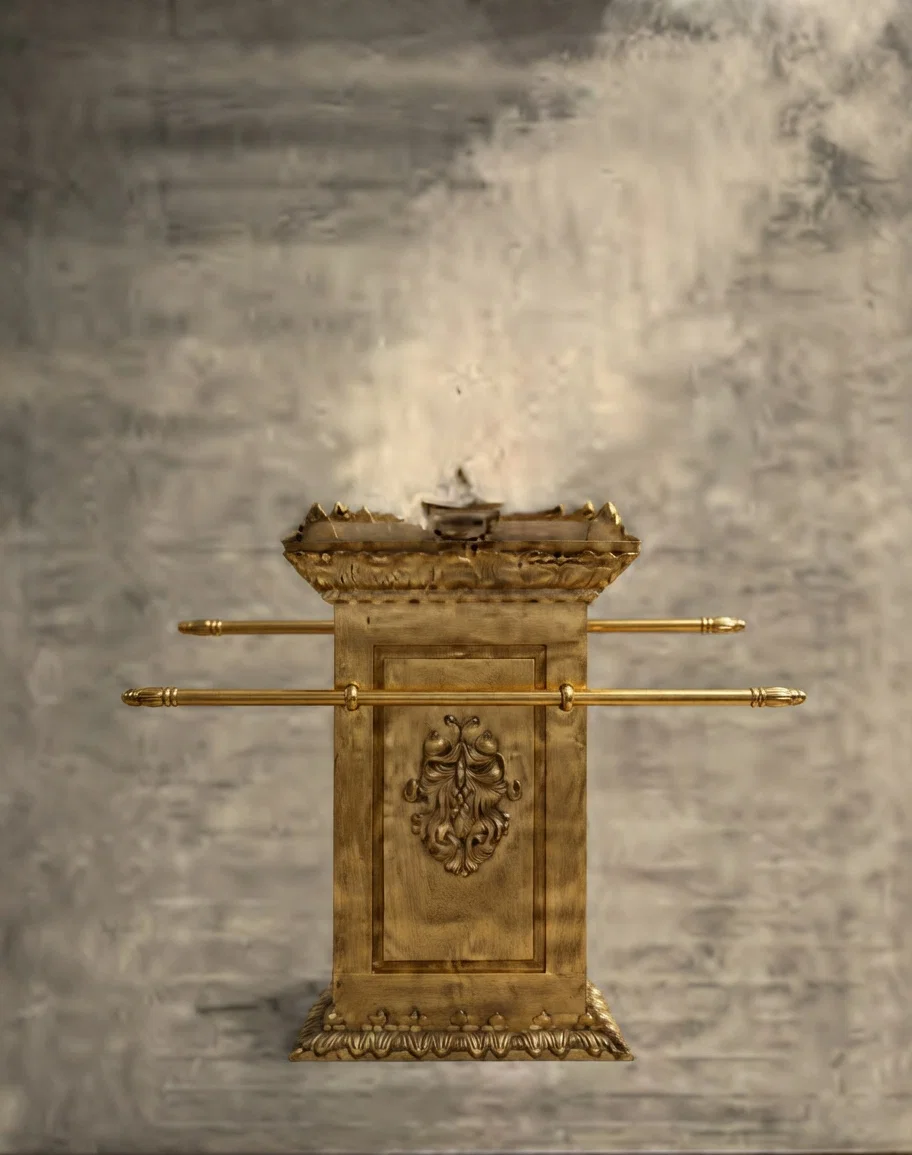
HE golden altar, or altar of incense, was before the veil in the first apartment of the sanctuary. It was a cubit square, and two cubits high, with horns upon each corner. The altar was made of the shittim or acacia wood, and all overlaid with pure gold. Around the top was a beautiful crown of gold; and beneath the crown, rings and staves, all overlaid with pure gold, for carrying the altar.
Within the crown of gold which encircled the top of the altar, holy fire was kept constantly burning (Ex. 30:8), from which ascended the fragrant smoke of the incense. The perfume of the incense pervaded the entire sanctuary, and was carried by the breeze far beyond the precincts of the court.
The incense, composed of equal weight of four fragrant gums and resins, was made by divine direction. It was very sacred; and the individual making any like it, even for perfume, was cut off from among the people. Ex. 30:34-38.
Incense was kept constantly burning upon the golden altar, and was renewed every morning and evening by the high priest. The high priest alone was to perform the sacred duty of putting incense before the Lord on the golden altar. Ex. 30:7, 8. The altar and the fragrant incense in the earthly sanctuary were but a shadow of heavenly things, an example of the work our great High Priest is performing for us. Heb. 8:5. Our minds should often dwell upon the work of Christ in the heavenly sanctuary. Heb. 3:1. Moses, when directed to build the sanctuary, was "caused to see" the heavenly model of which he was to make a "shadow." Ex. 25:40, margin. John the beloved disciple was permitted several times in vision to behold the Saviour officiating in the heavenly sanctuary. He saw a heavenly being standing at the glorious golden altar in the heavenly sanctuary. He beheld the incense offered upon that wondrous altar. How it must have thrilled his soul, when he saw that precious incense added to the poor, faltering prayers of the struggling saints here on the earth! He saw those prayers, after the incense was added, ascend up before God, and they were accepted because they were made fragrant with the incense. Rev. 8:3, 4, margin. "We know not what we should pray for as we ought: but the Spirit itself maketh intercession for us with groanings which can not be uttered. And He that searcheth the hearts knoweth what is the mind of the Spirit, because He maketh intercession for the saints according to the will of God." Rom. 8:26, 27.
But even the Spirit could not present the prayers of sinful mortals before a pure and holy God without adding the fragrant incense. When Jesus was preparing His disciples for His separation in person from them, He assured them that "whatsoever ye shall ask the Father in My name, He will give it you." John 16:23. The strength of a name is the character of the individual that bears the name. The name of the precious Redeemer is honored, and every petition presented in that name is granted in the courts of heaven, because Jesus lived a sinless life. He "knew no sin." The prince of this world had nothing in Jesus. John 14:30. He had nothing in Him, for He was pure and holy, without one stain of sin. It is Christ's righteousness that makes our prayers accepted before the Father. John saw the smoke of the incense, with the prayers of the saints, ascend up before God. Our prayers, made fragrant by the righteousness of Christ our Saviour, are presented by the Holy Spirit before the Father. To John in vision it appeared like a cloud of smoke bearing the prayers and fragrant incense up before the throne of the Infinite One. The weakest saint that knows how to press his petitions to the throne of grace "in the name of Jesus" the Sinless One, has all the treasures of heaven at his command. Having the richest multimillionaire of earth sign his checks at earthly banks would in no way compare with the privilege of the Christian.
The Altar of Incense
The name of Jesus is often added to prayers in a meaningless way. Many prayers are spoken for a mere form of worship, and go no higher than the head of the one that offers them; but every prayer of faith reaches the ear of the God of the universe. David understood what was typified by the incense, and prayed, "Let my prayer be set forth before Thee as incense; and the lifting up of my hands as the evening sacrifice." Ps. 141:2.
There was no other part of the daily ministration that brought the priest as directly into the presence of God, as the offering of incense; so there is no part of our religious service that brings us as close to the Master as when we pour out our souls before Him in earnest prayer. Anciently, as in the antitype, the prayer of faith entered the "holy dwelling-place" of God in heaven. 2 Chron. 30:27.
A lamb was burned upon the brazen altar in the court each morning and evening at the time the incense was renewed upon the altar. The golden altar was an "altar of continual intercession," representing the prayers of God's people coming up before Him continually; while the brazen altar was an "altar of continual atonement," representing the putting away and destruction of sin, the only thing that separates from God and prevents any prayers from being answered. The morning and evening lamb was offered as a whole burnt offering for the entire congregation, showing their desire to put away sin and consecrate themselves to the Lord so that their prayers could ascend from off the altar with the fragrant incense. In ancient Israel, the people living near the temple gathered at that hour. Often "the whole multitude of the people were praying without at the time of incense." Luke 1:10, 11. The habit of morning and evening prayer in the homes came from this typical worship. The faithful Israelite who was far from the temple would pray with his face toward the temple where the incense was ascending each morning and evening. Josephus says the incense was offered as the sun was setting in the evening, and in the morning as it was rising. This service was ordered by the Lord as an "example and shadow of heavenly things." Heb. 8:5.
The type was beautiful, but the antitype far surpasses the type. In the heavenly sanctuary, there is an inexhaustible supply of Christ's righteousness. In the type, the incense was always ascending, typifying that any time, day or night, a struggling soul cries out for help or gives thanks and praise for help received, his prayers are heard. In the morning, as the duties and burdens of the day seem more than human strength can bear, the burdened soul can remember that in the type a fresh supply of incense was always placed on the altar each morning, and from out of the antitypical heavenly sanctuary help will come for the day to the one that claims divine help in the name of Jesus. In the evening, as we review the work of the day, and find it marred by sin, there is blessed comfort, as we kneel confessing our sins, to know that in heaven the fragrant incense of Christ's righteousness will be added to our prayers; and as in the type the cloud of incense shielded the priest (Lev. 16:13), so Christ's righteousness will cover the mistakes of the day, and the Father looking upon us will behold the spotless robe of Christ's righteousness. If we realized more fully the privilege of prayer, we would often say with the prophet, "I will greatly rejoice in the Lord; . . . for He hath clothed me with the garments of salvation. He hath covered me with the robe of righteousness." Isa. 61:10.
Not all prayers that are accepted before God are answered immediately, as it would not always be best for us; but every prayer to which the fragrance of Christ's righteousness has been added, is lodged on heaven's altar, and in God's good time will be answered. John saw those officiating before the throne of God, holding in their hands "vials full of incense," which he said were "prayers of saints." Rev. 5:8, margin. These prayers had been accepted, for the added incense was so fragrant that John said the vials were full of incense.
In the typical work, the one that attempted to use the fragrant perfume of the incense for his own selfish use was cut off from among the people of God. There was8(Continued on page 9)
The Altar of Incense
(Continued from page 7) to be no imitation of the incense. No fire was to be used for burning the incense except that taken from the altar before the Lord. Nadab and Abihu, while under the influence of strong drink, offered "strange fire" before the Lord, and were slain. Lev. 10:1-10. Their fate is an object-lesson of all who fail to appreciate the perfect righteousness of Christ, and appear before the Lord clothed in the filthy rags of their own righteousness. Isa. 64:6. When the plague was smiting the hosts of Israel, Aaron the high priest put incense on the censer and ran among the people, and God stayed the plague. Num. 16:46, 47. The incense was only burned on the golden altar and in the censer of the priests. Levites were not allowed to burn the sacred incense. Num. 16:3-35. The priests, who performed the work which typified Christ's work in an especial sense, were the only ones who could burn incense before the Lord.
The horns of the golden altar were often touched with the blood of the sin-offering, thus typifying that it was Christ's death that made it possible for our prayers to be answered and for us to be clothed in His righteousness. The fragrance of the incense was not confined to the sanctuary, but carried in the air to the surrounding neighborhood. In like manner, when one is clothed with Christ's righteousness, others will detect it. An influence will go out from them which those who come in contact with them will recognize and by its fragrance detect its heavenly origin.
Ex. 30:7, 8. Incense burned on the golden altar by the high priest every morning and evening.
Ex. 30:9; Lev. 10:1-7. The one burning incense with strange fire was destroyed.
ANTITYPE
Rev. 8:3. There is a golden altar in heaven before the throne.
Rev. 8:3, 4. Much incense is added to the prayers of all saints, and they then ascend before God.
Isa. 64:6. One clothed with his own righteousness will be destroyed.
A Perpetual Memorial—II
By Mrs. E. G. White
By Mrs. E. G. White
SATAN's chief agent in bringing about the rejection of the fourth commandment, and the institution of the first day of the week as a day of rest, has been the Roman Catholic Church. The Roman Catholic Church does not deny the part she has acted in this change, but makes a boast of her power, as shown in the change which she has brought about in the world. Papists acknowledge that the Bible gives no sanction to this change, and that Protestants have no Scriptural authority for Sunday worship. The Catholic Church changed the day of rest from the seventh to the first day, and without the shadow of divine sanction, it has been accepted by almost all the Protestant churches; and Rome, pointing to the adherents of her doctrines, claims the supremacy. In changing the fourth precept of God's law, the papal power has thought itself able to exalt itself above all that is called God, or that is worshiped. This was the very work that the prophecy foretold would be done by this power. In trampling upon the fourth commandment, the first commandment is broken. Their idolatry is similar to that of Israel's when she substituted a god which her own hands had made, for the living and true God, and followed after the example of Egypt; for when the Catholics substitute a sabbath of their own making, for that which God commanded, they too worship that which their own hands have made, and follow the example of the heathen who worshiped the sun on the first day of the week.
Through the pope of Rome, the same work has been carried on here on earth as was carried on in the courts of heaven before the expulsion of the prince of darkness. Satan sought to correct the law of God in heaven, and to supply an amendment of his own. He exalted his own judgment above that of his Creator, and placed his will above the will of Jehovah, and in this way virtually declared God to be fallible. The pope also takes the same course, and, claiming infallibility for himself, seeks to adjust the law of God to meet his own ideas, thinking himself able to correct the mistakes he thinks he sees in the statutes and commands of the Lord of heaven and earth. He virtually says to the world, I will give you better laws than those of Jehovah. What an insult is this to the God of heaven!
Many thousands who have accepted the change made in the day of rest, have done so ignorantly, and unwittingly have placed themselves under the banner of the prince of darkness. The Christian church has accepted the false sabbath, but the day of light has now dawned. The times of their ignorance God winked at, but now He commandeth men everywhere to repent. It is demonstrated that no change is necessary in the law of God. Were there a change needed in the law of God, and could such a change be made, the rebellion of Satan would be justified, and the universe would have to concede that Satan was wiser than God, and had a right to supreme authority. But Jesus came to magnify the law and to make it honorable; and His death on Calvary in the sinner's behalf, proves the immutability of the law of heaven.
The work of the papal church was to be of an exactly opposite character to that of Christ. Daniel, in holy vision, saw that she would "think to change times and laws." The laws of God and the time of God were to be changed by this antichristian power. The laws of God are the only laws which men are prohibited from changing, for secular powers may change as they see fit the laws of secular governments. In the prophecy, it is plainly shown that this papal power would with deliberate intention change the law of God. In the Catholic catechisms, the second commandment is not taught as obligatory; but for this change, they do not hold themselves responsible of intention to change the law, as they declare that the whole significance of the precept is contained in the first commandment. But the change of the fourth commandment, the institution of the first day of the week as the Sabbath instead of the seventh day, is a change for which she holds herself responsible of intention to change, and makes a boast of her power, because the whole professed Christian world acknowledges her mandate in this particular. It is by thus trampling upon God's commandments (sin is the transgression of the law) that the Roman Church has proved its right to the title given in prophecy to one who shall be the "mystery of lawlessness."
FOR IN SIX DAYS THE LORD MADE HEAVEN AND EARTH, THE SEA AND ALL THAT IN THEM IS AND RESTED THE SEVENTH DAY; WHEREFORE THE LORD BLESSED THE SABBATH DAY AND HALLOWED IT. EXODUS 20:11.
The Papacy, claiming to be the vicegerent of the Son of God, is in truth the vicegerent of another power. She points to the Sunday institution as the sign of her authority; but in the change of the law and time of God, she is only doing that which Satan tried to do in heaven,—prove the law of God faulty, and the Lawgiver fallible. In boasting of her power above the law of God, she is but echoing the sentiments of the great deceiver. God instituted the Sabbath as a sign of His authority and power; and the Papacy, acting for the prince of evil, points to the Sunday as a sign of her power and jurisdiction. The day of the sun, Sunday, was a day devoted to the most vile of the heathen worship, for it was celebrated in connection with sun-worship. This Sunday-sabbath has been accepted by many who know it to be the foundling of heathenism, which has been cherished and nourished by the Church of Rome, and by her clothed in the garments of sanctity. But while many are now aware of its origin, there are true Christians in every church who do not know the origin of the Sunday-sabbath, and believe that they are keeping the day which God sanctified and blessed. This is true of worshipers even in the Catholic Church; and while this ignorance and integrity remain, God accepts of their sincerity; but when light shall fall upon their pathway, God requires them to come into harmony with His law, and to observe the Sabbath of His appointing. The time has come when the glory of the Lord is to fill the earth, and when the whole earth shall be lightened with His glory. The cry is sounding to the honest in heart to "come out from among them, and be ye separate, saith the Lord, and touch not the unclean thing; and I will receive you, and will be a Father unto you, and ye shall be My sons and daughters, saith the Lord Almighty." "And I heard another voice from heaven, saying, Come out of her, My people, that ye be not partakers of her sins, and that ye receive not of her plagues. For her sins have reached unto heaven, and God hath remembered her iniquities." "Here is the patience of the saints: here are they that keep the commandments of God, and the faith of Jesus."
We Do Not Pray Enough
FELIX NEFF once made the following comparison: "When a pump is frequently used, but little pains are necessary to get water. The water pours out at the first stroke, because it is high. But if the pump has not been used for a long time, the water gets low; and when you want it, you must pump it a long while, and the water comes only after great efforts. It is so with prayer. If we are instant in prayer, every little circumstance awakens the disposition to pray, and desires and words are always ready. But if we neglect prayer, it is difficult for us to pray; for the water in the well gets low."
—Selected.
Starved Christians
By Theodore L. Cuyler
Starved Christians.—There is a sufficient reason why so many members of our churches are so pitiably weak, either to work or to resist temptation. Starvation has reduced them to living skeletons. A Christian soul can not keep fat and strong on daily newspapers, or on the best of secular literature. Such self-weakening is wickedness. Food is fuel to the body, repairing what is burned away by various vital processes. How can a soul be either fed or warmed that seldom touches the Bread of Life? All the most growing Christians are large feeders on the Word of God.—T. L. Cuyler.
Evangelizing South America
“We could easily evangelize South America if we had the heart.”
Thanksgiving
By Zion's Herald
It was years and years ago,
Mid the winter's ice and snow,
That our sturdy old forefathers kept the
first Thanksgiving Day;
What tho hearts were sorely tried!
What tho half of them had died!
"Let us make a feast together, and give
thanks to God," said they.
How the wilderness stretched round,
Without limit, without bound,
Filled with beasts of prey, and savages who
lurked to do them harm!
How the gray waves, lashed with foam,
Tossed between them and their home!
Stout of heart, they never faltered, safe in
God's protecting arm.
And they labored and contested,
Till from forest gloom they wrested
Game and fowl in great abundance, fit to
grace the festive board.
And the snarling sea they plundered,
While its breakers roared and thundered,
For the fish to flank the wild fowl and the
harvest's gathered hoard.
Then they sang, with souls uplifted,
Till the gloomy skies seemed rifted,
And heaven's glory shone upon them, filling
all their hearts with cheer.
Let us read Time's yellow pages
For this story of the ages,
And like them, in grateful praises sing the
harvest of the year.
—Zion's Herald.
Thankfulness
By Ellen Isabella Tupper
For all that God in mercy sends,—
For health and children, home and friends,
For comfort in the time of need,
For every kindly word and deed,
For happy thoughts and holy talk,
For guidance in our daily walk,—
For everything give thanks!
For beauty in this world of ours,—
For verdant grass and lovely flowers,
For song of birds, for hum of bees,
For the refreshing summer breeze,
For hill and plain, for streams and wood,
For the great ocean's mighty flood,—
In everything give thanks!
For the sweet sleep which comes with night,
For the returning morning's light,
For the bright sun that shines on high,
For the stars glittering in the sky,—
For these, and everything we see,
O Lord, our hearts we lift to Thee,
For everything give thanks!
—Ellen Isabella Tupper.
Cry of the Poor
By Andrew Young
God hear their voice! It is the cry
Of wo and want in accents wild.
Is there no power in Thine own name
To cease the reign of greed and shame?
Shall wealth, still mocking, pass them by?
O God of Hosts, list to their cry!
They ask a share of blessings lent
To all mankind. O, hear their prayer
For bread and roof! May it be sent!
Their children cry in tears, and moan,
With face uplifted to Thy throne.
Shall greed still, mocking, pass them by?
O God of Hosts, list to their cry!
Thy kingdom here can ne'er fill grateful hearts,
Till of its blessings they shall have a part;
Till Christians shall Thy golden precepts preach
With heart and hand, and not with empty speech;
Wealth, with proud head, no longer pass us by.
Thy kingdom then shall reign, great God on high.
—Col. Andrew Young.
Our Bountiful Giver
"Thank God for rest, where none molest,
And none can make afraid;
For Peace that sits as Plenty's guest
Beneath the homestead's shade.
O, favors, every year made new!
O, gifts, with rain and sunshine sent!
The bounty overruns our due,
The fulness shames our discontent."