Your ShelfYour Projects

Signs of the Times, Vol. 39, No. 46.

Signs of the Times
Earlier text: God's Message for To-Day

The Balkan Situation

It is still uncertain, but we may briefly summarize, as follows:
1. The uncertainty of reports. Many of these have been rumors, corrected afterward. This is especially true regarding the outcome of the struggle. Our readers may take with considerable allowance all the prophecies of the dividing up of Turkey and the results of the war. These will all doubtless be determined by a general European conference. There will be many demands now, but these demands must be harmonized, and there will of necessity have to be compromises and concessions.
2. Uncertainty of maps. The one printed by us last week was not accurate. Even such works as the Century Dictionary give us a map more than thirty years old, with all of Bulgaria north of the Balkans, and Rumelia a province by itself, when in 1881 Rumelia revolted from the Turk and joined Bulgaria. Rand & McNally's latest we believe are correct, and so also is the Standard Dictionary and atlas. Still, about this we need not worry; the map of Europe will soon be remade with new boundaries.
3. There has been cruelty unspeakable, without any question, and notoriously on the part of the Turks, and yet there is no doubt much sympathy for the Young Turks and their attempt to establish a stable government. Many feel that they have not had a fair chance, during the last four years, to do what they wished to do; and one noted journal remarks that the Turks have been somewhat indulgent to missionaries, as long as they do not attempt to pervert Mohammedans; but the Orthodox Church, to which the invading Slavs belong, is not so tolerant. That is, there is even more intolerance in Russia under the Orthodox Church at the present time, than in Turkey, if the missionary will let politics alone.
Of course there are the massacres ascribed to the Turk; and yet there are those well-informed who tell us that they have quite as often been perpetrated by Kurds, Albanians, Greeks, and Bulgars, and the Turk as an individual is not so much different from other men, after all. As the English "Spectator" remarks, "the Turk makes a good peasant, but a bad prince."
With his disposition he is no match for the tremendous dash and power with which Bulgaria has hurled against him. He has cut a very poor figure in this struggle, and is also at a great disadvantage in fighting with modern weapons. He is inefficient, not cowardly; and as to cruelty, the "Spectator" remarks that one can not tell whether he would behave like a fiend or a friend to a vanquished enemy. And the Springfield "Republican" remarks: "It is not necessary for Americans to give their unreserved sympathy to either side. It is not a holy war; it is a crisis and an age-long struggle, in which religion has a part, but also racial, economic, and political rivalry. We need not assume that all the right is on one side, and all the wrong on the other." It is really two great civilizations which can not, in the nature of the case, exist together, striving for the mastery.
4. The conflict would long since have ceased if the "powers" had not been divided. Knowing this division, the Balkan allies struck at the right time. One of the real features of the division has been Austria. Austria is Roman Catholic. The Slavs, of which the Balkan States are largely composed, are Greek Catholics; and Austria does not want a strong Slav state on her southeastern frontier. It is for this reason that she has done all in her power to keep Turkey just where she is, and the Balkan States weak. She has fomented jealousy and rivalry during the past for this purpose. While united in alliance with Italy, she still holds some territory that is Italian in population, and which under certain provocation would rebel. On her eastern and southern borders she has the Slav population, so that she really is surrounded in a way by hostile zones, and it is her purpose to keep the Balkan States as weak as possible.
5. The demands of the allies are not wholly known. There have been all sorts of rumors. Doubtless, as has been stated, the allies have not wanted to drive the Turk out of Europe, but they have certainly had the purpose of confining her to a very small territory. It has been stated repeatedly that she would be left with what is called the "Golden Horn," the little peninsula on which Constantinople is located. That would give Bulgaria and Servia each an outlet on the Aegean Sea, and Servia one also on the Adriatic Sea. It would give the northern part of Albania to Montenegro, the central part to Servia, and some of the southern part, perhaps, or at least some of the Greek populated territory, including Saloniki, to Greece. Another rumor is that the Balkan allies would be willing to organize two states out of Turkey,—Albania in the west, and the Slav state in the East, giving them autonomous government, but united in the federation, with one emperor over the federation, but each state having its own government. This the powers would hardly allow. It has been rumored that Servia had already taken possession of Durazzo on the Adriatic. This Italy and Austria forbid. They hold that the Adriatic Sea should be controlled by them, and it has been positively stated in news despatches that an ultimatum has been laid before Servia by both Italy and Austria. This, however, is denied.
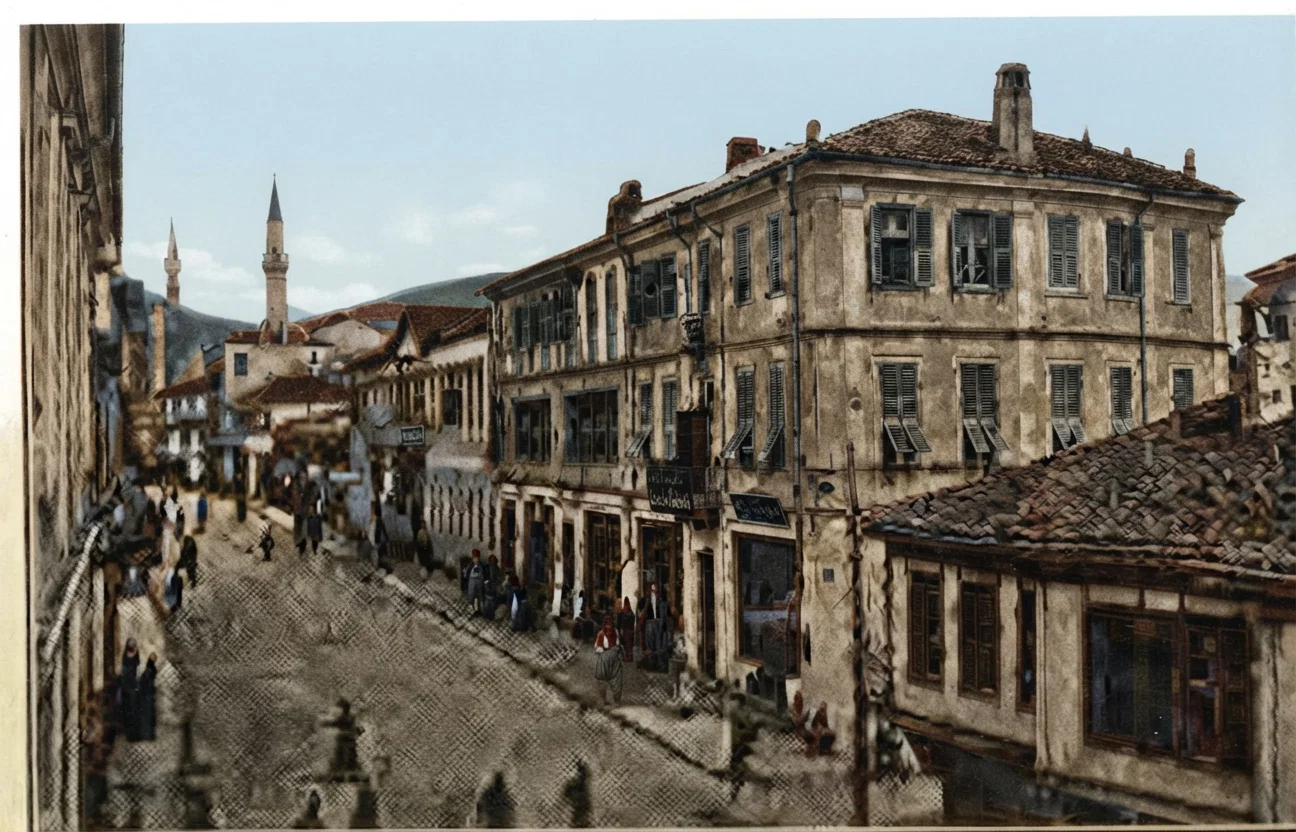
A street scene in Monastir, where heavy fighting is going on
Another rumor is that Saloniki will be made an international port, held by no one power. There are a half dozen ideal divisions suggested. Statesmen, newspaper correspondents, journalists, and editors have drawn ideal boundary-lines of the Balkan territory galore, but it is well to wait.
6. The powers will doubtless bring enough pressure to bear upon Austria to wait until the war is over. Then a European conference will be held, all the past conferences set aside, and a new division will be made with the Balkan allies as parties to the conference. That seems to be the most reasonable rumor in the air at the present time.
7. The present situation. The Turk is willing now to surrender everything but Constantinople and Macedonia, and she has bowed to the state which formerly has been subject to her, Bulgaria, and pleads for an armistice until peace conditions can be arranged. It was thought yesterday that this would be granted; but at this writing, November 17, it is not.
The allies demand the surrender of the Tchatalja army, the evacuation of Adrianople, Scutari, Monastir, and Janina, the surrender of all conquered territory, a war indemnity, and the internationalizing of Constantinople. This at present the Turks refuse to grant with the Bulgarian army within twelve miles of Constantinople, the subjection and capture of which is but a question of hours if the Turk remains obdurate.
Another foe as potent as the Bulgarians is within the Turkish camp, and that is cholera. There were 400 deaths from the disease in one army camp at Tchatalja in one day, November 14. There are nearly 3,000 cases within the Turkish lines, it is stated, and mutiny is feared among the troops. The number of sick and wounded in Constantinople is placed at 15,000. Turkey's condition is pitiable; unless the powers intervene—and it seems too late now—she will agree to any terms whatsoever.
It is well in the human uncertainty for us to wait fuller developments. We believe this, however,—that after this war, there will be greater freedom in the giving of God's last message to the world. That is what we saw in the war between Russia and Japan, and that followed, altho Russia has withdrawn much of that freedom which she permitted. And so in this present conflict there would be greater freedom in the preaching of the gospel. Let our readers be glad of this, and thank God.

The Spirit of World-Wide War

THE following from the London Daily Mail of October 26, 1912, from England's highest military authority, certainly does not portend peace:

'GERMANY WILL MAKE WAR'

'Lord Roberts, in an impressive speech at Manchester on Tuesday affirmed once more that the 'Nation in Arms' was the only sure bulwark of this empire and these islands, and gave this message as his ultimate counsel to the nation: 'Arm and prepare to quit yourselves like men, for the time of your ordeal is at hand.'
'Now,' he said, 'just as in 1866 and in 1870, war will take place the instant the German forces by land and sea are, by their superiority at every point, as certain of victory as anything in human calculation can be made certain. Germany strikes when Germany's hour has struck. That is the time-honored policy of her foreign office. It is her policy at the present hour. It is, or should be, the policy of every nation prepared to play a great part in history.
'There is one way in which Britain can have peace not only with Germany, but with every other power, and that is to present such a battle front by sea and land that no power or probable combination of powers shall dare to attack her without the certainty of disaster. But there is a way in which Britain is certain to have war and its horrors and calamities: it is by persisting in her present course of unpreparedness, her apathy, unintelligence, and blindness, and in her disregard of the warnings of the most ordinary political insight, as well as of the example of history.
'What, then, is my plan, and what is my ultimate counsel to the nation and the message to my countrymen at this solemn hour? It is—"Arm and prepare to quit yourselves like men, for the time of your ordeal is at hand." '

War Talk

EUROPE has been facing a crisis, but the crisis has not deterred men of authority and position in England from saying that England stands ready. The very time that President David Starr Jordan was making his peace speech in Kansas City, Premier Asquith of England was saying at another banquet, that the map of Europe must be remade, and that England was facing a crisis; and he was followed by Winston Churchill, the First Lord of the Admiralty, declaring that Great Britain was ready. A strong British fleet, he told us, was cruising in the Eastern Mediterranean. "More than twenty battle-ships and cruisers are to be found where they are wanted, and when they are wanted, in those classic waters." "We have no reason to apprehend trouble of any kind, but my advisers of the admiralty are satisfied that our fleet and flotillas in home waters are by no means unequal to any task that might devolve upon them."
Referring to the British navy, he declared that "that power has seldom stood on a firmer basis than it does now;" and concerning relations with Germany he said: "No harm can be done by plain speaking. The Germans are a people with robust mind, and a high sense of honor and fair play. . . . The relations of the two countries have improved steadily, with every evidence of our determination to maintain supremacy. The best way to end the rivalry is to go right on and prove that we can not be overtaken."
And of course such utterances as these will stimulate Germany to go right on, and their actions will stimulate their allies, as well as the United States and other nations, to do the same.

A New Secretary in the Federal Cabinet

ACCORDING to an article in the "American Citizen" of October 12, which they publish from the Newark (New Jersey) "Evening News" of October 5, there is a demand made by Roman Catholics for a new "secretary of peace" in the cabinet of the President of the United States. The news item says:
"A movement is under way to secure an addition to the cabinet of the President of the United States, of a secretary of peace. It is also proposed to have this question presented to the representatives of every world power now in session at the International Peace Congress at Geneva, Switzerland, with a view to establishing this office generally in national councils. It is reported that President Taft, Roosevelt, and Governor Woodrow Wilson are to be approached and their views on the proposition ascertained."
A special committee, representing most of the peace organizations, a number of religious denominations, with no idea of sectarianism, is to present the subject to presidential candidates, it is said.
"The first suggested choice for this office, it is understood, is James Cardinal Gibbons. It is urged that 'his influence would be powerful in preventing future conflicts between the United States and Catholic nations.' He has been a prominent speaker on occasions when world peace has been the subject, the dedication of the Pan-American Union building at Washington in 1910, the third National Peace Congress at Baltimore in 1911, and other occasions. The proposed office is to be advisory in character and to carry no special authority. The exact draft of this plan is not to be made public until after they have received the question."
It would be well, certainly, to watch developments.

Hardly in Harmony

It has been stated that "Harper's Weekly" was a Catholic paper, or in sympathy with the Catholics, or that the editor himself was a Catholic; but the following from the issue of August 10, in an editorial entitled "The Pope and the Marriers," hardly indicates it. Referring to the decree called "Ne Temere," which provides that in the estimation of the Roman Catholic Church a marriage between two Roman Catholics, or a Roman Catholic and a Protestant, without the sanction of the Catholic priest, is null, the editor says:
"If this papal decree about mixed marriages was worth attacking by legislation, the way to go about it would be, we suppose, to provide that no marriage by a Roman Catholic priest should be valid at law. How would that do? The pope announces that certain marriages, accepted as valid, say, by the state of New York, shall be null to all members of the Roman Catholic Church. Would it be more than a measure of gentle protest if the state of New York should announce that certain marriages accepted as valid by the pope should be held to be null by the courts of New York? That would seem to be no more than turn about, and something like it has been done in France. But here it would not pay. It would make the pope and his decrees of too much consequence in the state of New York. The state at present does not know the pope, and they are best off unacquainted."
The latter part of which is a very just observation indeed.

The Catholic View

Not long ago, in a sermon in San Francisco, the noted Catholic priest, Bernard Vaughan, S. J., spoke on the subject, "Our Homes the Pillars of the State." Referring to Ireland, he says, "The people believe there, with the Catholic Church, that the material basis of the state is private property, that the natural basis of the state is the home,—family life,—and that the spiritual basis of the state is religion; and I may fearlessly say, no people on God's earth realize more fully than the Irish that their country claims for its triple foundation those three great institutions."
Now certainly private ownership is a help to a state, good homes are a help to the state, religion is always helpful to a state if it is separated from the state; but this is not the Catholic view. The Catholic view is that that religion must be connected with the state, and that that religion must dominate the state. The Catholic view is always that religion must control the state, and that religion must be the Roman Catholic religion. We never hear it said by the Roman Catholic that the Bible is the foundation of good government, or of liberty. It is ever and always religion, and that religion is the Roman Catholic religion. And believing this, they must of necessity work for the union of the Roman Catholic Church with the state, and control of the state by that church.

Catholic Influence and the Panama Canal

"The American Citizen" of November 2 declares that the first man Mr. Roosevelt saw after his operation was the Roman Catholic priest, Father Vattman; that on Friday, October 25, altho other visitors were denied him, three prominent Roman Catholics, Robert Collier, Peter Dunn, and Mark Sullivan, were admitted. Of course it has been known for a long time that one of Mr. Roosevelt's special friends is Father Curran, of Wilkesbarre, Pennsylvania. The American Citizen declares that eighty per cent of the Catholic vote went for Mr. Taft.
Even a paper that is demanding more and more battle-ships thinks that it is an incongruous thing that the first ship to pass through the Panama Canal is to be a man-of-war, that the canal itself ought to stand for commerce instead of for destruction. But everything is turned to war these days.

Suicides in France

Suicides in France.—According to the Journal of the American Medical Association, these are constantly increasing. In 1901 the number was 8,818,—6,809 men and 2,009 women. In 1910 the total number was 9,819, and this the journal tells us is evidently less than the total number, for there are many suicides never noted by the authorities. The suicide rate is 25 per 100,000, three times what it was seventy years ago. The rate is increasing among children less than sixteen.
At a meeting of surgeons in New York City, one of the new methods of surgical work was the nailing of a hip together with spikes and a hammer. Sterilized steel spikes were used, and when the bone knits together the spikes will be withdrawn.
A race war is reported from Fort Stockton, Texas, under date of November 9, between Mexicans and Americans. The cause was a week's drinking and gambling debauch. The center of it was a saloon, the only saloon for miles around.

Felix Diaz Escapes Mexican Prison

Felix Diaz, who was sentenced to death by the Mexican government, has escaped from his prison, and is now at liberty in the United States.

The Importance of Family Prayer

By Mrs. L. D. Avery-Stuttle
IT has well been said that prayer is the mighty lever with which it is possible for the puny arm of man "to move the world"—because connected with infinite power. When I pause a moment to consider this subject, I am overwhelmed with the magnitude of it. My pen seems weak and inefficient. I find no words with which to convey a correct appreciation of the importance, fitness, and necessity for prayer.
There are few holier memories which ever come to us after the hair is white and the brow furrowed, than those which cluster about the sacred hour of family prayer.
But some one says: "I can not pray in public. I never did. I am not learned or eloquent; and no one, not even my children, has ever heard me pray. I do not believe they would be benefited or encouraged by anything which I could say in prayer."
You need not be eloquent. The Lord God is no respecter of persons. But I tell you, there is nothing which produces so wonderful and so lasting an effect for good, as the bringing of all the loved ones by name before the Lord, at the family altar. No matter if the voice be weak and faltering and the words homely and simple. Remember, God looks at the heart—at the motive. "The Lord seeth not as man seeth."
O, I am so glad of this! If it were not for this blessed truth, the most of us would sink in discouragement. Our prayers at best are so weak and stammering! But the loving, tender heart of the Father knows and feels for us. There is never a heart-throb that He does not count, never a tear that He does not number, never a sigh that He fails to hear.
Some of us have the mistaken idea that the Father is hard and unloving and unpitying. O, why do we such injustice to Him who loved us so tenderly that He gave up His dearly beloved Son for us?
"Yes," you say; "Christ pleads for us, and the Father will hear Him," and that is indeed a blessed truth. But this is not all there is for our comfort. Listen:
As if the blessed Master knew that we poor mortals failed to appreciate the loving, tender, compassionate heart of the Most High, He has explicitly assured us of the Father's love: "And I say not unto you, that I will pray the Father for you: for the Father Himself loveth you."
Blessed assurance! He loves us—you and me—and with a love which can not be measured. No wonder that even the pen of inspiration is powerless to express it in words which we poor, weak creatures can comprehend! And so the Spirit-filled penman simply exclaims, "Behold, what manner of love the Father hath bestowed upon us!"
"Why, then," you ask, "is prayer necessary, since God knows all about us anyway?"
Well, how would we feel if our children refused to come to us with all their little joys and sorrows and troubles,—if John never mentioned a word about his disappointment in failing to pass examination; suppose we found out in some roundabout way the fact that our little Mary or Jane or Bertha had taken the prize for the best composition at school? Would we not feel greatly aggrieved, and justly so?
But it is for our own sake that the Father asks us, His children, to confide in Him. He knows that prayer is the life of the soul, and that is why we are instructed to "pray without ceasing."
But O, the blessedness of gathering the little family together in the morning and at evening, for a song of praise and sweet communion with Heaven!
Even as I write, the days of my childhood come trooping back to me. The red sun is sinking behind the old barn. The crickets are chirping in the dewy fields. The somber twilight is spreading a dusky robe over the world. The wide-topped trees in the orchard cast long, deep shadows. An occasional tap of the cow-bell in the barn-yard, and the cheery call of the whippoorwill in the wood near, emphasize the fact that it is time for evening prayers.
"Well, children, what shall we sing tonight?" asks father.
"What shall we sing, mother?" question the children.
Before any can reply, a sweet, vibrant voice like a silvery bell rings out—it seemed to my childish ear that there was never another such a voice this side of heaven as my mother's:
"O'er the hill the sun is setting, And the eve is drawing on;"
and then we all joined in the sweet old song of praise.
O, these are memories that I would not have effaced from my heart for any consideration! I would not exchange them for the memory of all the shows and vaudevilles and theaters and pleasure parties in the world.
Sometime those who have worshiped blindly at the shrine of vanity and pleasure, will pray earnestly to the God of heaven—for "every knee" shall bow to Him.
But then it will be forever and ever too late.
Is it not the part of wisdom to become acquainted with Him now?

True Courtesy

GENUINE politeness is not any too common, for this quality is not a matter of mere form or ceremony, but comes from that sincere kindness of heart that tenderly regards the rights and the comfort of others. There is a class of people who are very scrupulous as to certain forms, and would rather violate one of the Ten Commandments than disregard a rule or practise of table etiquette. Such persons regard it as a grave impropriety to raise the knife to the lips in eating, instead of the fork. A beautiful fact on this subject is related of Prince Albert, the excellent husband of Queen Victoria. On one occasion a humble, worthy man, who had befriended the prince in early life, called to see him, and was invited to come to the family table. He began to eat with his knife, as he had been accustomed, and the young people smiled. Prince Albert looked around upon them as if to say, “Stop that,” and at once he himself began to eat with his knife, and did so to the end of the meal. After dinner one of the children asked him why he did so.
Prince Albert replied: “It is well enough for us to observe the etiquette of the day, but it is far more important to avoid insulting people. I wanted my old friend to enjoy his dinner, which he could not if he had seen you laughing at him. He is accustomed to use his knife, and it would be quite difficult for him to use the fork instead.”
This was genuine politeness. The world would be happier and better if there were more of it. There may be the most scrupulous following out of forms where the very essence of politeness is lacking. And parents make a great mistake who insist upon their children’s observing the forms of etiquette, while they neglect to inculcate that kindness of heart, that unselfish regard for the welfare of others, which is the only source from which genuine courtesy can come.—Christian at Work.

Leverage

By T. R. Williamson
Archimedes the sage found, long ago, That all things earthly yield to upward pressure. He poised a bar upon a fulcrum so That power applied gave power in tenfold measure.
“Ah,” said the old philosopher, “could I A planet find on which to rest my lever, Then swing some beam of strength into the sky, Its length extending out almost forever,
“Under this world I’d place its shortest end, And, fearless, seat myself upon the other; My puny weight should through its fibers send A force that giant nature could not smother.”
Since the great thinker hailed the new-found law, That men plus handspikes can upset creation, O’er all the earth, by dint of tooth and claw, Each pries and turns as suits his inclination.
For every man may lift his share of weight, And force the big world nearer to the heavens. Life is the fulcrum, mind the power great, Love, hate, ambition, greed, the levers given.
Painted with lies, ambition lifts in vain; Greed’s lever short can only curses raise; Hate of its bar a bludgeon makes to rain Black, murderous blows on all who merit praise.
Love, lightning-winged, with helmet of the sun, With face that like the dawn bids shadows flee, With mightful, piteous hands, pries down upon A shaft plucked up from holy Calvary.
Forever out its glorious length extends, And error’s drag-chains snap beneath its power. Back to its home with God the world ascends, Linked to His throne with stars forevermore.

STANDARD HOUSEHOLD LUBRICANT

For bicycles, lawn-mowers, go-carts—anything you want to run smoothly and easily—the best oil you can find is Standard Household Lubricant.

In the Handy Oiling Can

Standard Household Lubricant is guaranteed not to gum or corrode.
This makes it splendid for every kind of household use, and the can in which it comes, with patented nozzle attached, prevents leakage and loss by breaking.
Dealers Everywhere STANDARD OIL COMPANY (Incorporated) 461 Market Street                      San Francisco

Success with the Small Books

SEVERAL hundred copies of the new prospectus, containing samples of a list of beautiful character-building books for the home, are now in use, and the reports indicate excellent success on the part of those who are thus introducing these books to the people at this book-buying season of the year.
"Satan has two plans with reference to the rising generation," writes one of our general agents. "The first is to prohibit them from reading anything; and if that does not succeed, to fill their minds and hearts with impure literature. We can not prevent such literature from being written or circulated or read, but we may counteract its influence by placing good literature in the homes of the people." This is what an army of workers are now doing with the handy new prospectus. Some recent reports are as follows:
7 days, 83 orders, value $55.75. 7 hours, 18 orders, value $8.00—"I like my prospectus very much." 4 days, 49 orders, value $38.75—"I took an order in every home I visited except three." 12 hours, 21 orders—"The Lord has blessed me in my work."
This last report is for the following books: 3 "New Testament Primer," cloth; 2 "New Testament Primer," board; 1 "Best Stories," board; 1 "Bible Child Life;" 1 "Making Home Happy;" 3 "His Glorious Appearing," cloth; 2 "Paradise Home," cloth; 5 "Paradise Home," board; 3 "Steps to Christ," cloth. 21
In addition to the books here listed, the prospectus has samples for— House We Live In Uncle Ben's Cobblestones Elo the Eagle Story of Pitcairn Advance Guard of Missions Making Home Peaceful Mount of Blessing Christ Our Saviour
The prospectus is so arranged that you can select samples for the books you wish to handle, taking out the others.
A new home workers' booklet describing this handy prospectus (the price of which is $1.00), and explaining in detail just how to sell these books successfully, will gladly be sent you by your tract society. It gives full list, prices, discounts, suggestive introduction, and just the help you will need to have a part in placing these books in the homes of your neighbors. Write for a copy.
Pacific Press Publishing Association, Mountain View, Cal. Kansas City, Missouri Portland, Oregon Calgary, Alberta, Canada

A New Bible

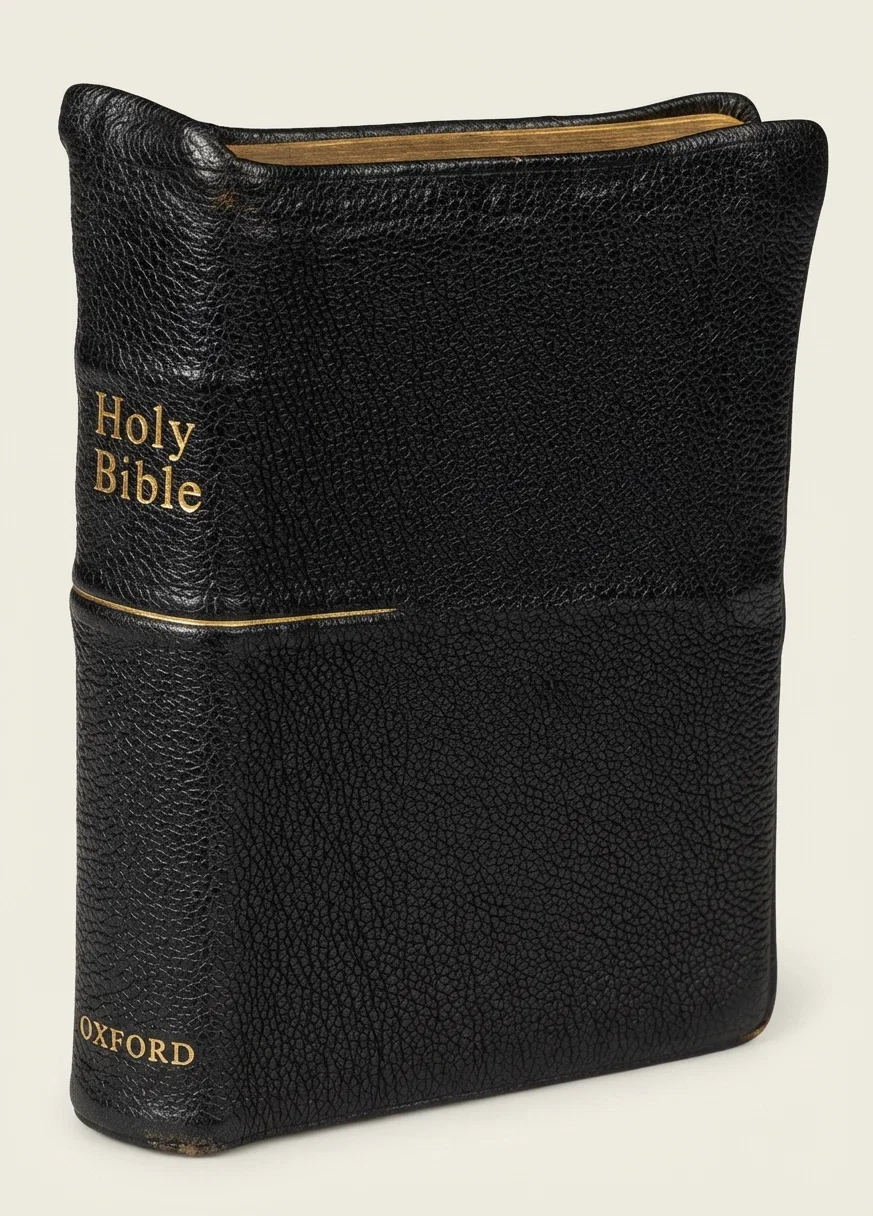
YOU may be planning to have a new Bible for yourself, or to make a present of one to a member of your family, or to a friend. Our carefully selected stock of Bibles, the result of more than twenty-five years of supplying good Bibles by wholesale and retail, is almost ideally described in our "Good Service Bibles" catalog. It so clearly explains the bindings, illustrates the types, and groups the classes of Bibles, that you can feel safe in making selection without seeing the Bible itself. It describes that most popular Bible, "The Sealskin," No. 03248x. You will want to see this, and also descriptions of its many others. Send card for Bible catalog, and if you are unable to make selection from it, write description to us, and we will gladly assist you.
Pacific Press Publishing Association Mountain View, California Kansas City, Mo. Calgary, Alberta, Canada Portland, Ore.

Spending on Unnecessary Dress

“HAVE you not robbed the heathen by spending money for articles of dress which are not strictly necessary for Bible neatness and comfort?”

Would Hold Fathers' Meetings

"Countless sons and daughters go wrong to-day because of the fathers' too great absorption in business and too little attention to their children. Present-day fathers are too often merely their children's pocketbooks and bogy men, instead of being their law book, monitor, teacher, guide, and closest friend. Were modern fathers punished for the wrongs done by their children, but for which they themselves, because of their neglect, are responsible, we would have to free half the prisoners in our public prisons in order to make room for their fathers," said Rabbi Joseph Krauskopf, D.D., of Philadelphia, in a recent sermon.
To the modern father's neglect of his parental responsibilities, Dr. Krauskopf ascribed such present-day evils as skepticism, divorce, race suicide, the exchange of self-respecting homes for shoddy apartments, and "bachelordom, with all which that term generally implies." He said that the irresponsibility of modern fathers had made it necessary for the conscientious and unassisted mothers often to become saints and martyrs. To raise children properly in the present social atmosphere is becoming more and more difficult every day, he said. He recommended the formation of "fathers' meetings" and "fathers' colleges."—Exchange.
Continue reading: Abyssinia