The Youth’s Instructor, Vol. 43, No. 31.

RESCUE THE PERISHING
Earlier text: RESCUE THE PERISHING

LESSON 7.—THE APOSTASY AND THE SABBATH.

(August 17, 1895.)
PLEASE review principal points in previous lesson.
1. What was the only basis of faith in the apostolic church? 2 Tim. 3 : 16, 17; John 17 : 17.
2. When received as the word of God indeed, what did the word accomplish? 1 Thess. 2 : 13.
3. What is the nature of the word? John 6 : 63.
4. When received by faith, whose presence did the word bring into the heart? Eph. 3 : 17.
5. What did this make the believer? 1 Cor. 6 : 19.
6. What did a church composed of such persons become? Eph. 2 : 19, 22.
7. What is the mystery of godliness? 1 Tim. 3 : 16; Col. 1 : 27.
8. What, then, would be the right name for anything which would take the place of Jesus in the heart? 1 John 4 : 3; 2 Thess. 2 : 7.
9. Why did not this “man of sin” exercise full power in the apostles’ times? 2 Thess. 2 : 6, 7. (See note .)
10. Did Paul warn elders and preachers about this? Acts 20 : 28–30; 2 Tim. 4 : 1–4.
11. What has always been the principal god of all heathen nations?—The sun.
12. What has been honored for, and named after, that god?—Sunday. Study on this point the new pamphlet entitled “The Lord’s Day.”
13. Before conversion, what were the Galatian Christians? Gal. 4 : 8.
14. What did they do after turning away from the gospel? Verses 9, 10.
15. Have the heathen in general observed times and days? Deut. 18 : 9–14.
16. From what class of people did the gospel draw the greatest numbers in the apostles’ times?—Gentiles, or heathen.
17. Then if there should be a general apostasy, whose manner of worship would come into the church?
18. Was such a falling away (apostasy) foretold? 2 Thess. 2 : 3, 4.
19. What is written in Dan. 7 : 25 about that which would develop from such apostasy? (See note .)
20. By what name is that wicked system known, which grew out of the “falling away” and exalting of self, mentioned in 2 Thess. 2 : 3, 4?—The papacy, or Roman Catholic Church.
21. Do they claim to have done what Dan. 7 : 25 states, concerning a change in God’s times and laws? (See note , also “The Lord’s Day.”)
22. How did this change times?—By changing the day of the Sabbath and the time of beginning and ending of all days from sunset to midnight.
23. For how long were saints, times, and law to be given into the hands of the papacy? Compare Rev. 12 : 14, 6 with Dan. 7 : 25.

NOTES.

ADDITIONAL NOTES.

That there was to be an apostasy in the church and a great departure from the faith, is clearly evident. By the texts quoted in this lesson it may be seen that Paul fully foretold the rise of this apostasy. It was beginning to work in his days. It is a remarkable fact that the errors of the Romish system may, in many cases, be traced almost to the time of the apostles. Veneration for the martyrs led to the respect for their relics; and from respect, it is but a short step to adoration.
The great successes of the gospel were in heathen lands. Affected by the story of the cross, a vast host of pagans nominally became Christians. In some instances rewards were given to those who would accept Christianity. When Christianity became the state religion under Constantine, a profession of Christianity was the only road to royal favor. Human nature is the same in every age, and selfishness will lead men to profess anything by which their material prosperity in this world is enhanced. Christianity soon became the name of a profession, rather than an exemplification of the life of Jesus Christ. When the kernel of true piety is gone, and only the barren husk of a profession is left, there is nothing to prevent a rapid change in the doctrines of the church.
The change of the day of worship from the seventh to the first day of the week was gradually accomplished during this period of the rise of the papacy. Sunday was the chief holiday of paganism. The early church made it a holiday in honor of the resurrection of Christ. It did not at once usurp the place of the Sabbath; it grew into that position as the apostasy grew. Those who planted this seed of error probably never realized that it would grow into a spreading tree, overshadowing the Sabbath of the Bible, and usurping its place. This unwarranted change of the Sabbath is a striking illustration of the way that errors grow. The responsibility for the beginning of this change undoubtedly rests upon men who had no intention to degrade the Sabbath so that it would become a common working day.
Some may think that so great a change could not come gradually, that it would have to be done at once, and then we could tell just when it all took place. There were at times great steps taken, such as the decree of Constantine and the decision of the Council of Laodicea, but the change was gradual all the way through. As an illustration of how a change of time in the observance of a day can be gradually made, we may look at the observance of Sunday as practised by the Puritans one hundred years ago, and compare it with their observance now. Then the Congregational churches of New England kept Sunday from Saturday night till Sunday night. With them Sunday began and ended at sunset. They regarded it as sin to work on Saturday evening, and not as sin to work on the evening following Sunday. Now this custom is abandoned, and the Congregationalists keep Sunday from midnight to midnight. Here is a great change in the actual time of the observance of Sunday; but no man can tell just when this change took place. It was a gradual change, the same as the observance of Sunday gradually took the place of the Sabbath.
It may be urged that if the causes which led to the change of the Sabbath began at such an early date, it cannot be said that the Church of Rome changed the Sabbath, as Rome did not arise until a later period. It is true that Rome was not fully developed until A. D. 538; but the apostasy from which Rome grew, and which was Rome in embryo, began very early. The germ of Romanism started to grow in the days of the apostles. The change of the Sabbath was accomplished by the apostasy, and that apostasy culminated in Rome.
M. E. K.

HIS TALENT.

A MAN was once asked why he took so much pains to oblige others in trifles. His answer was in substance: I have neither the wealth, nor the intellect, nor the learning, nor the position, to do big things for God or man, and so I take delight in doing any little thing to promote another’s interest or enjoyment. In this way I may add to the sum of human happiness, and also recommend my Saviour to those who know him not.—Christian Intelligencer.

PRAYER

WHEN I feel that I am become cold and indisposed to prayer, by reason of other business and thought, I take my psalter and run into my chamber; or, if day and season serve, into the church to the multitude, and begin to repeat to myself—just as children use—the ten commandments, the creed, and, according as I have time, some sayings of Christ or Paul, or some psalms. Therefore it is well to let prayer be the first employment in the morning, and the last in the evening. Avoid diligently those deceptive thoughts which say: “Wait a little, and I will pray an hour hence; I must perform this or that.” For with such thoughts a man quits prayer for business which lays hold of and entangles him, so that he comes not to pray the whole day long.—Martin Luther.

SUMMER

SUMMER is upon us With its torrid heat, And the mass of people Seek a cool retreat; Some prefer the sea-shore, In bathing-suits arrayed; Some the Adirondacks, Resting in the shade.
Others think it pleasant Now to go abroad, Crossing the Atlantic— Nothing very odd— Taking a small fortune With them there to spend, Ere the present summer Cometh to an end.
Viewing all the wonders Of that ancient land, Asking guides queer questions, Hard to understand; But they are obliging, As all guides can be, Waiting for the giving Of expected fee.
HAVING.
HAVING.
Some prefer the country. O, what lots of fun! Going out a-hunting With your dog and gun, Fishing in the mill-pond Or some little brook, Taking game and fishes Back with you to cook.
Where is rest so peaceful As upon the farm? Where such perfect freedom, With its potent charm? Where are breezes purer, Skies more fair and bright? Where the moon more lovely On a summer's night?
Moon and stars and twilight, Sunlight, shade, and showers, Fields of grain and clover, Honeysuckle bowers; Lovely drives, where landscapes Burst upon the view, Beautiful as Eden, Not in numbers few.
Summer in the city, With its dust and heat, Where the walks are burning Tired people's feet, Where the air is teeming With its odors foul, Faces once so beaming, Wear a settled scowl.
Summer in the country In the olden times,— Tinkling cow-bells ringing Out their merry chimes,— Long before inventions Had been brought to light, Making labor easy, Putting time to flight;
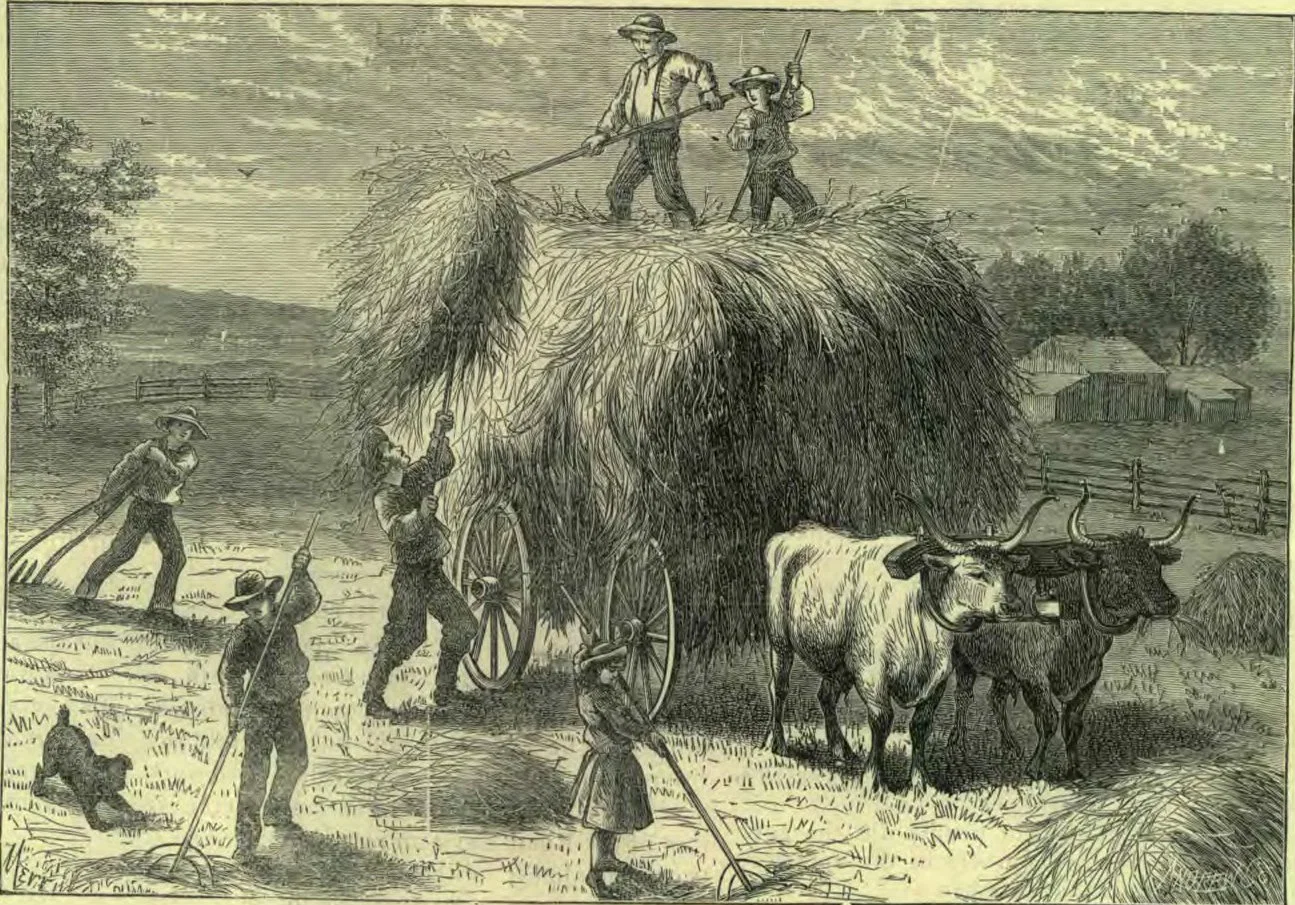
Many still remember How they made the hay In the old-time manner— Now all done away— When a yoke of oxen Slowly drew the load, How the farmers urged them With sharp-pointed goad;
When the wife and daughters Knit and wove and spun, Churned and baked and mended Till the day was done; Or, if showers were coming Helped to rake the hay, Milked the cows at evening, Never saying nay.
Summer on the mountain, Summer on the seas, Summer in the country, Summer where you please; Here or there or elsewhere, Anywhere you will, Summer is delightful, And we love her still.
Summer, blooming summer, Coming once a year, Thine it is to give us Much that's truly dear; Thou art ever welcome, Dear to every heart; Take our fondest blessing Ere thou dost depart.
ELIZABETH KELLOGG EDMONDS.

“I FORGOT,” AND “I’LL DO BETTER.”

The two sentences which are most frequently in the mouth of a certain lassie, who shall be nameless, are:—
“Mama, I forgot,” and, “I’ll do b-e-t-t-e-r, mama.”
Now when I was a little girl, and given to making excuses for my shortcomings, my dear, wise mother used to say, very gravely:—
“Helen, that may be the reason you did it; but it is no excuse for your having done it. ‘I forgot’ never can excuse your doing or not doing a thing; it is simply telling of another fault committed. Only old people whose memories are failing are excusable for forgetting.”
This made a very deep impression on my mind, and I think of it to this day whenever I find myself forgetting, and wonder if I have reached the age when I am excusable for those lapses of memory.
I wish the girlie who says “I forgot” so frequently could manage to remember “Grand-mama Steinhauer’s” reply, and lay it sufficiently to heart to profit by it. She is always ready to supplement it with:—
“I will do b-e-t-t-e-r, mama!”
Now at the first glance this seems to be, what she intends it to be, a very nice thing to promise. But—did you ever see a person who had no backbone? I mean the real spinal vertebrae.
I once knew a boy whose backbone at twelve years old was nothing but soft gristle. Although he was large and well-grown of his age, he could neither sit, walk, nor stand; but had to lie all the time.
Now, every man, woman, or child who says “I will do better” in his own strength, will find that he lacks backbone, and can neither sit, walk, nor stand in the line of right, but lies every time. His intentions are, doubtless, good; he means to do right. But at least nine tenths of the people who will be lost at the last mean to do better (some day), and to get to heaven by and by.
Therefore, my dear young readers, don’t content yourselves with saying, “I will do better,” but first give yourselves to God, and then say,—
“God helping me, I will do better.”
“Notice it is not ‘shall,’ but ‘God’ and ‘will.’ He must put his strength inside of our earnest desire, and then his will becomes our will; and what he wills always comes to pass. And this is what is meant when we are told that he works in us, according to his good pleasure, ‘both to will and to do.’”
But God will do absolutely nothing for those who are too lazy to seek and avail themselves of his almighty aid. To make use of a homely illustration: Imagine a poor cripple who cannot walk a step without his crutches. With them he can get about quite nimbly, but without them he cannot even stand. Now they may lie on either side of him, within easy reach of his hands; but if he is too lazy to stretch his hands out and take them, he will remain right in that spot, although he may talk all day about where he intends to walk.
“Trust ye in the Lord forever: for in the Lord Jehovah is everlasting strength” (Isa. 26:4), but in ourselves only weakness. Let us, therefore, both old and young, lay hold upon it, for he has said: “My grace is sufficient for thee; for my strength is made perfect in weakness.” 2 Cor. 12:9. Then we need not even lament over hereditary tendencies to evil, but with Paul can say: I glory in my infirmities that the power of Christ may rest upon me; and daily and hourly we will prove that we can do all things through Him who strengthens us. Phil. 4:13.
HELEN A. STEINHAUER.

Nurture Your Mind With Great Thoughts

NURTURE your mind with great thoughts, for to believe in the heroic makes heroes. — Lord Beaconsfield.

Ministers Must Aim at Converting Sinners

MINISTERS are seldom honored with success unless they are continually aiming at the conversion of sinners. — Owen.

ABELARD

The name of Abelard is among those indelibly stamped upon the intellectual history of Europe, where it stands for the rise of the universities. Abelard was the father of the University of Paris, one of the first and for a long time the greatest of universities. The story of his life would interest us for this reason alone, even if its course were not disturbed by the sad and romantic incidents which have made it so famous. It is the story of a great genius ruined, a genius profoundly affecting the world, yet producing nothing which could be called its own, and leaving to posterity no legacy but its influence.
Abelard’s birthplace was Pallet, near Nantes, in Brittany, where he was born, it is thought, about 1079. His father was Berenger, a gentleman of noble family, educated according to the highest standards of that day, and devoted to his profession of arms. Peter, surnamed Abelard, the eldest of his children, was early put under tutorage, as were his brothers, that he might receive culture due to learning before taking up the study and practise of the art of war. Such, however, was the love of study which the child developed, that he determined, in spite of all persuasion, to give his life to the pursuit of knowledge.
The instruction of that day was almost entirely elementary. Three centuries before, Charlemagne had found himself at the head of an empire composed of barbarous and disunited tribes, with no common system of law or government, and either wholly untouched by civilization, or touched only by its vices. In this soil he sought to plant such seeds of Roman learning and Roman civilization as could be gathered up after the storms of the barbarian invasions. To his court he assembled, from the monasteries where alone the lamp of science was still kept burning, a few scholars, chief among whom was Alcuin, an Englishman. To Alcuin the emperor intrusted his task of reviving the classical learning. We may stretch terms sufficiently, perhaps, to say that Alcuin was Charlemagne’s minister of education. Since even the emperor could not write his own name, Alcuin suggested that the study of orthography should be made first in the program, to be followed by the trivium,—grammar, rhetoric, and logic,—the language studies; and that upon the trivium should follow the quadrivium of sciences,—arithmetic, geometry, astronomy, and music. But the fate of the arts and sciences might have remained very uncertain if it had rested in the hands of soldiers, kings, and turbulent courts. Fortunately for posterity, the church had an interest in keeping alive the knowledge of Latin. The Fathers had written in Latin, and it had come to be considered as the only tongue fit for the expression of sacred truth. Therefore all lights in the church were expected to use the language with ease and grace; and to use it with ease and grace it was necessary to study the writings of its greatest masters. So, though the church was for a long time opposed to learning as dangerous to faith, it still kept intact, from a sort of necessity, the body of science which it had received from Rome.
As a result of this interest of the church in learning, there arose schools in connection with many bishoprics and in many monasteries. These schools confined their teaching in the main to the trivium and the quadrivium. The papacy had indeed declared against learning; but there was not at that time the unity which now exists in the Catholic Church, and the overlordship of the pope was mainly a theory which men talked about, but which they acknowledged in fact only when it suited their interests to do so. Some of the leading episcopal schools added to the elementary studies the study of dialectics, or the art of reasoning and disputing; and to the study of dialectics was united in time the study of philosophy and of theology. The schools became firmly established in the face of the dislike of the early popes for knowledge; and, once established, the papacy saw in the schools a source of great power, and at once grasped for it. Study and schools were encouraged at all opportunities. The popes themselves were, at this period, men of learning and great keenness of mind, the men who did most to elevate the papacy to supremacy, and they could see what advantage the monopoly of intellectual training would give them.
These were the conditions which prevailed when, in his twentieth year, young Peter—he was not yet called Abelard—came to Paris. He had already seen something of the intellectual world of that day, having traveled about considerably among the schools of France. He called himself a “knight errant of philosophy,” a name which is still applied by historians to that large tribe of wandering scholars, scholares vagantes, which were a feature of medieval life. There was in Paris a professor of philosophy, of considerable note, William of Champeaux, by whose fame Abelard was attracted. He became a hearer. It was the fashion then for professors to debate with any opponent who might present himself. William of Champeaux was the champion of the realistic philosophy. Abelard had been the pupil of Roscellinus, one of the leading voices of the nominalist school. One day not very long after his arrival, the young “knight errant” disputed with his professor. The dialectician was pleased with the young debater, and took him to board. The nearer view which the pupil thus obtained was not to the advantage of the teacher. Abelard found out the extent of his master’s resources, and the reverence in which he had held him fell away. What had at first been a trial of the pupil’s skill became an open warfare, with the younger man in the advantage. Abelard opened a school at Melun, a few leagues from Paris. This school grew so rapidly that he moved to Corbeil, about nine miles from the city, and at last “pitched his camp,” as he said, “on the heights of Ste. Geneviève,” just outside the walls.
From his position upon Ste. Geneviève, Abelard began to bombard the camp of William of Champeaux at the school of Notre Dame. The audience of the master began to melt away like the snow, while that of his pupil grew in proportion to the growth of his reputation. As for his reputation, it traveled to the farthest parts of France, and from all sides pupils gathered to the school of Ste. Geneviève. To the power of his logic was added the charm of his delivery and the spell of his personal presence. Of the first, Roscellinus testified that Abelard was the acutest logician of his age; and there are witnesses who say that his voice had a wonderful sweetness, that his words were like honey, and that his face and figure were proud, handsome, bold, and commanding. These gifts of nature were irresistible in that age; Abelard became the hero and the idol of his pupils.
In the midst of these successes and arduous labors, the health of Abelard gave way, and he retired to his native Brittany. There he lived, chafing, in forced seclusion from the conflict he loved, till such time as his physicians would permit his return to Paris. When he returned, he found William of Champeaux in the enjoyment of his early popularity; but, instead of renewing the warfare, Abelard became once more his pupil.
Not for long, however. His appearance in Paris awakened all the old enthusiasm. His former pupils begged him to lecture. Relations between him and his master became again hostile. He began to lecture again. At once his hall was crowded with eager listeners. He had refuted Anselm of Laon, one of the leading theologians of the day, to whose school he had been attracted. In the self-confidence thus gained, he added lectures on theology to those on philosophy. His success in theology proved to be equal to, if not greater than, his success in philosophy had been. His popularity rose higher than ever, and his pupils were numbered by thousands.
Of Anselm, Abelard has left us a description which might characterize many teachers of the middle ages. He had gone to Anselm’s school because of his reputation; but he was disappointed in him. “From afar,” said Abelard, “he was a fine tree thick with leaves; on a nearer view, he was without fruit, or bore only the dry figs of the tree that Christ cursed. When he lit his fire, there was much smoke, but no light.”
William of Champeaux was at length driven out of Paris. Abelard refuted his sophistries so completely that he was obliged to retire from some of his positions, and even signed, voluntarily, the retraction of some of his propositions. This step was fatal to his influence. His followers deserted him. He was forced to retire to the monastery of St. Victor, outside of the city, to hide his chagrin. He left his professorship to a disciple of small abilities, who of his own will resigned it to Abelard, and took a place among the followers of that prince of reasoners. Thus Abelard’s victory was complete, and he marched triumphant into the episcopal school of Notre Dame.
C. B. MORRILL.

TALKING BACK.

ONE of the surest ways to pick a quarrel is to talk back. If this were always done in the right spirit, and in the right kind of words, there would be no trouble. Solomon says that “a soft answer turneth away wrath.” He also tells us that “grievous words stir up anger.” It is the “grievous words” that make the trouble.
Here is what Mr. M. C. Wilkinson has to say about the habit of talking back:—
“‘Contradicting’ is the Latin of it. Some boys and girls have a bad habit of doing this. The habit grows upon them till they become quite unconscious of it. Whatever is said to them by parent or teacher in the way of requirement, advice, expostulation, or reproof, these boys or girls have some defense or objection to make. What they ought to do is to receive admonition in silence, or else with a thoughtfully spoken assent.
“There are children that never seem to regard a direction from father or mother as binding on them if they can only think of something to say against it; and generally they can. The direction must be repeated, or they consider themselves free because they have talked back.
“Boys and girls, don’t talk back. It is a miserable habit. Ask your friends if you do it; for if you do, it is probable that you are not aware of it. So ask to be reminded when you talk back. Then stoutly say nothing in reply to the reminder except, ‘Thank you,’ and bite your lips in silence. Make your lips bleed rather than talk back.”—Selected.

LIVE IT DOWN.

Has your life a bitter sorrow? Live it down. Think about a bright to-morrow; Live it down. You will find it never pays Just to sit, wet-eyed, and gaze On the grave of vanished days: Live it down.
Is disgrace your galling burden? Live it down. You can win a brave heart's guerdon; Live it down. Make your life so free from blame That the luster of your fame Shall hide all the olden shame; Live it down.
Has your heart a secret trouble? Live it down. Useless grief will make it double; Live it down. Do not water it with tears: Do not feed it with your fears; Do not nurse it through the years; Live it down.
Have you made some awful error? Live it down. Do not hide your face in terror; Live it down. Look the world square in the eyes; Go ahead as one who tries To be honored ere he dies; Live it down.
— Ella Wheeler Wilcox.

THE PREPARATION OF PRAYER.

THE past century produced a race of mighty preachers in the principality of Wales. Talent and style were completely forgotten. The cross filled their vision. Their souls were ushered immediately into the presence of eternal realities, and were filled with an agony of desire for the salvation of their hearers. They were mighty in prayer. To gain power with men they sought first to gain power with God. The sermons of Daniel Rowlands were the outcome of protracted wrestlings with the angel of the covenant. He would often spend the whole of Saturday night in his study. One Sunday morning a large congregation was assembled, and the hour of service had arrived; but Rowlands was not forthcoming for a long time. Two men went to seek him. They found him upon his knees struggling in prayer. He accompanied them; he fell down again on his way, and besought the Lord to forgive him for his reluctance to preach. The word came with extraordinary power, and resulted in the ingathering of eight hundred souls. A ministerial friend once said to Robert Roberts: “Tell me, where did you get that wonderful sermon that is working such havoc in the land?” The answer came: “Come here, John;” and he took him to a small parlor and said to him: “I found that sermon on the floor here, all night long turning backward and forward with my face sometimes on the earth.” Paul could say: “For this cause I bow my knees unto the Father of our Lord Jesus Christ.”—Rev. James Harris, in Guide to Holiness.

A STORM SIGNAL.

THE United States Weather Bureau and Signal Service has already done incalculable good in the preservation of life and property by its foreknowledge of storms and warnings to mariners. But in the onward march of science new appliances are continually being invented and adapted for use, which increases the value of the Service. At Chicago for some time the Signal Service has been able to warn ships out on the lake at night, at a distance of twenty miles, of the coming of storms, by means of electric lights from the top of the Auditorium. This proved very valuable, but Professor Moore, chief of the Signal Service, was not satisfied with this. He wanted a search-light with a wider range than anything he had, and after several experiments, he has perfected a plan for a light which will enable the Signal Service to signal from Chicago across the lake to St. Joseph, in Michigan, and as far in any other direction. By this means ships over a large area of the lake can be notified of approaching danger in the darkest night, by electric flashes of various colored lights. Perhaps by means of similar appliances at other points the whole surface of the great lakes may be put into communication in the night with the Signal Service. This would be a great achievement, and would entitle the inventor to be called a benefactor of the human race.

MEMORIES OF BOYHOOD.

MR. WHITTIER could not remember incidents that happened before he was six years old. His first recollection was of the auction sale of a farm in the neighborhood, and he was surprised to find, the next morning, that the farm had not been taken away by the purchaser, and a large hole left in its place!
When he was nine years of age, President Monroe visited New England, and happened to be at Haverhill on the same day that a menagerie, with a circus attachment, was exhibited in that village. The Quaker boy was not allowed the privilege of seeing either the collection of wild beasts or the chief magistrate of the nation. He did not care much for the former, but he was anxious to see a president of the United States. The next day he trudged all the way to Haverhill, determined to see at least some footsteps in the street that the great man had left behind him. He found at last an impression of an elephant’s foot in the road, and, supposing this to be Monroe’s track, he followed it as far as he could distinguish it. Then he went home, satisfied he had seen the footsteps of the greatest man in the country. When he was an old man, a little girl in Pennsylvania wrote to him inquiring about his childhood on the farm. These passages are from his reply:—
“I think, at the age of which thy note inquires, I found about equal satisfaction in an old rural home, with the shifting panorama of the seasons, in reading the few books within my reach, and dreaming of something wonderful and grand somewhere in the future. Neither change nor loss had then made me realize the uncertainty of all earthly things. I felt secure of my mother’s love, and dreamed of losing nothing and gaining much. . . . I had at that time a great thirst for knowledge, and little means to gratify it. The beauty of outward nature early impressed me, and the moral and spiritual beauty of the holy lives I read of in the Bible and other good books also affected me with a sense of my falling short and longing for a better state.”—From “Life and Letters of John Greenleaf Whittier.”

OUR HANDWRITING.

One of the most important things for boys and girls to learn to do is to write plainly, so that those who have to read what they write are left in no doubt as to their meaning. Several amusing stories of the embarrassment which has followed not learning to write legibly are told. One of these is of a Massachusetts clergyman who nearly got himself into a peck of trouble because of the bad quality of his handwriting. It was more than a century ago that this clergyman had occasion to address a letter to the general court of Massachusetts upon some subject of great interest at that time. When the letter was received, the court ordered the clerk to read it, and the members were filled with wrath at what appeared to be these words in opening:—
“I address you not as magistrates, but as Indian devils.”
“What!” they cried. “Read that over again. How does he address us?”
“Not as magistrates, but as Indian devils,” repeated the clerk. “That’s what he says.”
The letter was passed around, and the judges were by no means pleased to see that the clerk had apparently made no mistake. Very angry at what they believed to be an insult, the judges passed a vote of censure upon the clergyman, and wrote to him demanding an apology. He came before them in person, when it turned out that where the judges had read “Indian devils,” he had written “individuals,” which, of course, made an apology unnecessary; but the reverend gentleman was admonished to improve his handwriting if he wished to keep out of trouble.—Harper’s Young People.

HOW WOULD THEY KNOW?

An African king, whom a missionary is trying to lead into the path of civilization and Christianity, is reported as saying that these principles which the minister is endeavoring to inculcate in him, will, if he receives them, detract from his kingly dignity. So when remonstrated with by the missionary for cutting off the ears and noses of his wives, he said that civilization “gave him the stomach ache”! He evidently felt about as Americans do when, speaking of anything which they do not approve of, they say that it “makes them tired.” This African king clings with great tenacity to his right, as he considers it, to kill any of his subjects at will. Upon this point he expressed himself as follows: “If I do not kill my people sometimes, how will they know that I am king?” The missionary must have been very glad that this wild king of the African forests did not know that the kings of the Christian(?) nations often act on this same principle, only they kill tens of thousands of men in one battle, while the African in his ignorance kills but a few hundreds.
Many a so-called Christian king has precipitated his people into war to demonstrate his right to rule,—really to show that he was king. Human nature is very much alike the world over. The African is rather rude in his methods, and talks right out what he thinks; but he has a kingly spirit, according to the standard of many of the great kings of the earth. But there is a better standard than the standard which this world goes by. We read in the word of God these words: “Behold, a king shall reign in righteousness.” That king is Jesus Christ. He is king of righteousness and peace. He is now seeking subjects for that kingdom, and those who love those principles will dwell with him in that kingdom.

You have reached the end of this edition.

The Youth’s Instructor · Aug 1, 1895