The Youth’s Instructor, Vol. 43, No. 31.

RESCUE THE PERISHING

The Youth’s Instructor

Aug 1, 1895

S. D. A. Publishing Association · Battle Creek, Mich. · Aug 1, 1895

RESCUE THE PERISHING.
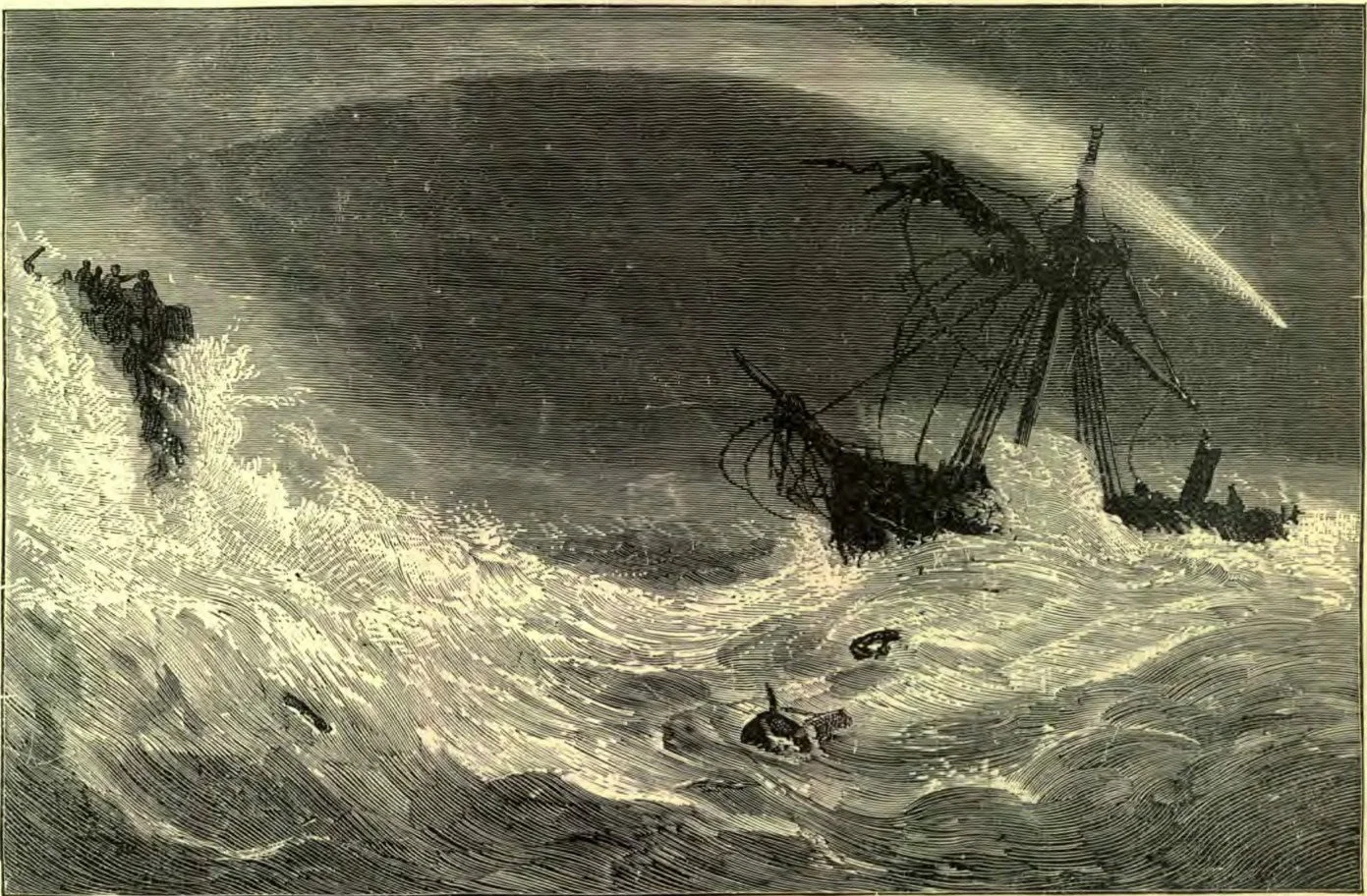
People who never had an opportunity to witness the ocean shore and to behold the mountain waves breaking against the rocks and cliffs in a heavy tempest, can have but a faint idea of the sight; and seeing it for the first time, one is reminded of the words of Job, where he gives the decree of God by which the waters are kept in their place: “Hitherto shalt thou come, but no further: and here shall thy proud waves be stayed.”
FIRING THE LIFE-LINE.
Many imagine that a sailor’s life is a very pleasant one, and this causes so many to become sailors; but the reality is quite different when it comes to be experienced; and after a little they try to get something else to do. Like everything else in this nineteenth century, shipping has increased largely; and as a consequence, old Neptune has added to the number of his yearly sacrifices, although the science of navigation has advanced nearly to perfection.
It is a heart-rending sight to behold a stranded vessel, and to witness one after another of the poor sailors swallowed up by the merciless waves, without being able to extend to them a helping hand.
Friends of sailors have exhausted their skill in inventing life-saving apparatus, until finally the United States has taken the lead, and in this, as well as in other things, has excelled all others, showing to the world what can be done in rescuing the perishing from stranded vessels.
When the captain of a ship sees no way to save the vessel, and a “L. S. S.” is marked on the chart for lee shore, the only thing to do is to steer for the life-saving station, and make preparation to coöperate with it. Signals of distress are shown, to call the attention of the life-saving crew, who are keeping a constant watch, night and day.
Besides having one or more life-boats, the life-saving station possesses what is called the “Beach Apparatus,” which consists of a small cannon, bullets, shot, powder, shot-line, whip-line, hawser, breeches-buoy, sand-anchor, shovels, and a crutch. All these are placed properly on a hand-cart, and are always ready for use. This apparatus is occasionally brought out to a drilling place, where the crew practises. Each man has his number and his own work to perform, so that in case of disaster, the work can be carried out with perfect order, whether by night or by day.
The crew consists of eight or nine chosen men besides the captain. In case of a disaster, the apparatus is brought to the most convenient place for operation. Each of the crew takes his proper place, and at a given signal all go to work according to regulations laid down.
When the cannon is placed on the ground, powder is put in according to distance. The shot is put in, and the shot-line connected to the shot by a wire which will not burn. At the same time the sand-anchor is put down if necessary, and the rest made clear. The captain points the cannon, gives it the proper elevation, and makes ready to fire. If any of the wreck’s rigging is left, the gun is pointed to windward, so that the shot-line can be caught by it. When the shot-line is aboard, the whip-line, which is rove through a tail-block, is fastened on it, and signal is given to the vessel to haul away. The tail-block is made fast to a mast, if any, or to the highest part of the vessel. Both ends of the whip are on shore. A four-inch hawser is now fastened on the whip-line, and by it hauled off to the wreck, and made fast by the sailors on the ship. The hawser is then hauled taut by the crew on shore, the block for the breeches-buoy clasped on the hawser, and both ends of the whip-line made fast in the same. All in readiness, the breeches-buoy is hauled off to the wreck; and if all goes well, all are on shore in a short time. If there are passengers on board, a life-car can be used in place of the buoy, and six or seven can land at once.
It is not only at sea that a sailor is exposed to danger; but when on shore, traps even more destructive than the hidden shoals, await him, and more become a prey to these than to the ocean storm. Each one of these sailors was once a mother’s darling and one for whom Christ died; so those whose lot in this world is better, have certainly a duty to perform in behalf of the sailors. If any one can say of a truth,—
“Go for my wandering boy to-night; Go search for him where you will; But bring him to me with all his blight, And tell him I love him still.”
it certainly is a sailor’s mother.
CAPTAIN J. CHRISTIANSEN.

Works of the Lord in the Deep

THEY that go down to the sea in ships, that do business in great waters; these see the works of the Lord, and his wonders in the deep. Ps. 107:23, 24.

A VISIT TO JEYPORE.

IN FOUR PARTS.—PART I.

Jeypore, the capital of the territory of Amber, is one of the most beautiful, and in many respects one of the most interesting, Hindu cities in India. It is about two miles long and one mile in breadth. It is entirely surrounded by a wall of masonry with lofty towers and well protected gateways.
We will begin our visit twenty-five miles from the city, on the Rajpootana State Railroad, as the maharajah (king) of Amber, who resides at Jeypore, has a law with very severe penalties, that no wild animal or game of any kind shall be killed within the circumference of a circle whose radius is twenty-five miles from Jeypore. After entering a few miles within this limit, wild animals were seen on either side of the road. Many little red foxes were busily burrowing after mice, and apparently manifested no alarm at the rumbling cars. Some of our readers may have wondered how Samson, of whom we read in the Bible, caught three hundred foxes, which he turned tail to tail, putting a firebrand in the midst between two tails, after which he sent them into the Philistines’ standing corn. I am sure that if they were as numerous and tame in Samson’s country as they are in this territory, he could have secured them very easily.
The jackal, which is about twice the size of a fox, but not so cunning, is very numerous in many parts of India. Large numbers of them have gathered to this haven for wild animals. They go in packs, and at night their howling is extremely annoying. Being fond of sweets, they are very destructive to the sugar corn fields and to the ripening fruits of various kinds. This is the animal to which the wise man referred when he said: “Take us the foxes [sins], the little foxes, that spoil the vines [character].” Jackals are abundant in Palestine, and the Hebrew word “shual,” that is here rendered “foxes,” should be rendered “jackals.”
Large numbers of wild deer were grazing or running about. Some of them were brown or fawn-colored, while others were spotted, very much resembling the Virginia deer of America. During the dry season, these deer are fed a certain portion of grain every day, from the royal store-house.
A part of this territory is under cultivation, and the peasants have erected mud fences from four to six feet high, with a moat, or ditch, around, to protect their growing crops from the wild beasts. The wild pigs are a great annoyance, and to scare them away the mud fences are painted with scare-crows of the most imaginative kind; yet the poor peasant finds it necessary to stay in his field night after night, until his grain is garnered.
The peasants of India have a very hard struggle to keep the spark of life burning. Many of them have not the necessaries of life sufficient to prevent suffering from cold and hunger. How my heart has ached, when I have been none too warm with a heavy suit of woolen clothes and an overcoat, as I have seen little Indian children—poor little fellows—shivering in the cold, without a particle of clothing to protect them from the inclemency of the weather, and without sufficient food to quell the gnawings of hunger.
Even in this favored portion, man seems to fare worse than the wild beasts with which he is surrounded; for the king owns the territory, and claims a large portion of all that is produced. How sad that it should be thus in this country which is so beautiful. Tropical forest trees are very numerous, and the attractiveness of the country is enhanced by orchards of dark-leaved mangoes and bright, broad-leaved banana palms.
But far from the railroad station at Jeypore, and without the city wall, is a beautiful and comfortable hotel, controlled by a Mohammedan widow and her son, for the accommodation of Europeans and tourists. The three days I was at the hotel the number of boarders averaged about thirty, more than half of whom were American tourists. It seemed such a treat to dine once again with some fellow-citizens. I enjoyed their company so much after being in the interior of India for three months, during which time I dined with white people but twice. WILLIAM LENKER.

DELAY NO LONGER.

THE gospel of Christ makes progress in every human agent that is consecrated to the Lord’s service. The Holy Spirit takes possession of every one who has a willing mind, not that that person may work the Holy Spirit, but that the Holy Spirit may work its miracle through the grace that is poured upon the human agency. The goodness of God becomes a working power through a consistent life, through fervent love for Jesus, and through heaven-inspired zeal. Those who are in association with Jesus will partake of his melting love, and manifest his overflowing sympathy for souls who are yielding to Satan’s specious temptations. They will plan and study and exercise tact, in order that they may make a success of so presenting the unselfish love of Christ that sinful and impenitent hearts may be won to loyalty to Jesus, who gave his life for them.
My young friends, I call upon you now to make your decision without a moment’s delay, that you will no longer stand under the banner of the power of darkness or remain in captivity to Satan. You are Christ’s property; you have been bought with a price. You are privileged now in having the precious truth to appeal to your conscience and understanding. Light shines in clear rays about you. Reasons are presented to you why you should become the sons and daughters of God, why you should believe in Christ as your personal Saviour, why you should confess him while mercy’s sweet voice pleads with you. “He that covereth his sins shall not prosper: but whoso confesseth and forsaketh them shall have mercy. Happy is the man that feareth always: but he that hardeneth his heart shall fall into mischief.” “Whosoever therefore shall confess me before men, him will I confess also before my Father which is in heaven. But whosoever shall deny me before men [by a godless, frivolous life and conversation], him will I also deny before my Father which is in heaven.” “Whosoever therefore shall be ashamed of me and of my words, in this adulterous and sinful generation, of him also shall the Son of man be ashamed, when he cometh in the glory of his Father with the holy angels.” “If thou shalt confess with thy mouth the Lord Jesus, and shalt believe in thine heart that God hath raised him from the dead, thou shalt be saved. For with the heart man believeth unto righteousness; and with the mouth confession is made unto salvation.”
Lose no time; confess Christ without delay. It is the Holy Spirit, the Comforter, the Spirit of truth that testifies of Christ. Jesus said, “Ye shall receive power, after that the Holy Ghost is come upon you; and ye shall be witnesses unto me both in Jerusalem, and in all Judea, and in Samaria, and unto the uttermost part of the earth.” To grieve the Holy Spirit which would make you a witness of Christ is a terrible thing. You know not when you may grieve the Spirit for the last time. The Holy Spirit does not work upon the human heart to compel you to give yourself to Christ, to force you to yield your conscience: but it shines into the chambers of the mind in a way to convict of sin, and to entice you unto righteousness. If you do not confess Christ now, the time will come when, overwhelmed with a sense of the great things that you have lost, you will make confession. But why not confess Christ now while mercy’s voice invites you? “Look unto me, and be ye saved, all the ends of the earth: for I am God, and there is none else. I have sworn by myself, the word is gone out of my mouth in righteousness, and shall not return, that unto me every knee shall bow, every tongue shall swear.” “We shall all stand before the judgment seat of Christ. For it is written, As I live, saith the Lord, every knee shall bow to me, and every tongue shall confess to God. So then every one of us shall give account of himself to God.” MRS. E. G. WHITE.

THE BALANCE OF LIFE.

I FEAR no more the coming years What they may bring. Days will be sunless, night bereft of stars; Mayhap the brightest blossoms of the spring Shall first be bound with winter's icy bars. But still beyond the cloud is always light; The stars are in the sky all night, And deepest snows are they which hide the bright Green heart of spring.
Not all of life is dreamed away In summer skies. Time holds a loss, a loneliness for me; But Hope is strong, and Faith dare not be weak, And Love abides, the greatest of the three. Enough if sweet to-morrow will repay The disappointment of to-day; Light follows dark; sun, rain; seas ebb away Again to rise.
And if the rugged road of life Doth wind around The mountain side where heavy clouds hang low, And, as I climb, the pilgrim staff be changed Into a cross, still onward would I go! The peaks of only highest mountains rise Above the clouds to bluest skies, And round the heaviest cross is hung the prize,— The brightest crown.
— Amy Seville Wolf.

LITTLE WORRIES.

We have read of a battle against cannibals gained by the use of tacks. They had taken possession of a whaling vessel, and bound the man who was left in care of it. The crew, on returning, saw the situation, and scattered upon the deck of the vessel a lot of tacks, which penetrated the bare feet of the savages, and sent them howling into the sea.
We brace ourselves up against great calamities. The little tacks of life, scattered along our way, piercing our feet and giving us pain, are hard to bear. A pastor was absorbed in studying the question of socialism, when his wife came in with despair on her face, and wanted advice about the servants. “O, my dear,” he replied, “I cannot give my time to little matters like domestic service. I am trying to solve the social problem of the universe.” “Well,” replied the wife, “you solve the problem of the kitchen, and I will promise you to solve the problem of the universe in twenty-four hours.” Really it is easier to dispose of those great questions which cover the world than it is to meet and successfully overcome the little worries which present themselves day by day.— Rev. A. C. Dixon.

THE CUBAN REBELLION.

The Cubans have, by some kind of election, both in that part of the island held by the insurgents and in the United States, elected Tomas Estrada Palma to be the president of the provisional government of Cuba, to succeed Jose Marti, who has been killed in battle. Palma bore an active part in the ten-years’ war in Cuba. For several years he has stood at the head of a seminary at Central Valley, N. Y. He is said to be a man of great energy, and thoroughly devoted to the idea of Cuban independence. His first official act was to appoint Gonzalo de Quesada his secretary. Quesada was serving in that capacity for Jose Marti when the latter was killed. Mr. Palma will direct the operations of the provisional government of Cuba from New York City. The Cubans feel much encouraged since their great ally, the yellow fever, has attacked the Spanish troops. Spain, hard pressed as she is, has consented to the “Mora claim,” brought by the United States government. This is the claim of a citizen of the United States, by the name of Mora, against Spain. His plantation in Cuba was destroyed by the Spanish government at the time of the previous war in Cuba. The claim amounts to about two million dollars. Fear that the United States would recognize the belligerent rights of the Cubans has no doubt had much to do with the willingness of Spain to pay this large sum of money. These increased expenses for Spain will lead to increased taxation for the subjects of Spain. Should the Cubans be defeated, the burden of defraying the expenses of the war will undoubtedly be thrown upon the Cubans, as was the one hundred million dollars which the previous war cost. This will add to their burdens, and make material for another rebellion. If the Cubans succeed, the people of Spain will be asked to pay the war bills, and this would be likely, in that impoverished country, to lead to the upsetting of the Spanish throne, which now is in a rather shaky condition. So tyranny leads to war and the general unsettling of all established authority.

THE TRIUMPH OF THE TORIES.

The great event of the week in England has been the elections. Every question of international affairs has been obliged to take a back seat while Liberal and Tory struggled for the mastery of that government, whose extent is so great that the sun never sets upon it. English elections do not occur at set times; but at any time, when the government may be defeated in the Commons, there may be a new election, and the people be allowed to state again what party and what principles they desire to support. The Liberal party started out in high hopes. It would grant “home rule” to Ireland, and would walk in the way of reforms generally; but it was not able to keep its promises. All the Liberals did not favor home rule for Ireland. It looks too much to some like a disruption of the time-honored British empire. So while willing to work for reform, the Liberal Unionist does not spell the word “reform” with the letters “h-o-m-e r-u-l-e,” as the Irish members invariably spell it. This divided state of the Liberal camp greatly crippled the Roseberry government; and when Mr. Gladstone withdrew his moral support from the Liberal party, it was obliged to step down and out, and the Tories were able to step up and in.
Lord Salisbury, however, would not take the premiership without the promise of an immediate new election. He seems to have known by a feeling of the British political pulse that a new election would give the Tories a greater working majority than they then had; and so a new election was ordered. The result has fully justified the wisdom of Lord Salisbury in demanding an election. The Tories have swept the country like a cyclone, and the Liberals have scarcely received enough seats to form a respectable opposition. Some of the leading Liberals, like Sir William Harcourt, have not been returned.
It may be asked what difference a change from a Liberal to a Tory government will make in the administration of British affairs. In some things not much, in others very much. In matters of foreign policy there is very little difference. All Englishmen labor to extend the trade and influence of England everywhere, although both parties may not agree upon the same method of operation. The Tory party, however, is a little more inclined to maintain the dignity of the nation. Disraeli, a Tory premier, restored British prestige on the continent of Europe, at the close of the Russo-Turkish war in 1877, when it had almost ceased to exist. A Tory government, which is the same as a conservative government, will maintain things about as they have been. The privileged classes will be maintained. The House of Lords will not be abolished, the English Church will not be disestablished, and Irish hopes of home rule will not be realized. If the common people are granted any more rights than they now possess, it will be because they cannot safely be denied, not because the Tory party is anxious to give them. Of course no one can predict how long the Tories will hold the reins of power. The English people vote as they please, and should they not be pleased with a Tory administration, they will turn it down with the most cheerful alacrity.

THE CROPS.

By the aid of State and United States crop reports we are able to estimate approximately the amount of grain that will be raised a long time before the actual harvest tells the more exact account. The reports this season have been such as greatly to unsettle the grain market, and to keep the price of grain fluctuating in such a series of rises and falls that people are unable to tell whether the increase which the earth will yield this year will be meager, fair, or full. We are glad to note that those portions of our country which have for several years past suffered so exceedingly from drought, have this year been blessed by plentiful showers, and at the present time there is, in those States, a prospect of abundant harvests.
The uneven distribution of the rainfall has been very marked this season. We read of six inches of rain in some places at one great downpour, and great washouts and destruction of crops as a result; while in other places, but a few hundred miles away, not more than two inches of rain has fallen since the snow went off, and in these places the drought has already greatly reduced some crops, and is now threatening others.
On the whole there seems to be no prospect of anything more than a fair crop, perhaps not that. The wheat crop will be much smaller than usual, but with the increased prices, farmers will make as much money as before. The consumers will be obliged to pay more; but since wages are generally on the increase, the coming year will probably be no harder for the laboring men than the previous one, and we will hope not so hard. Much grain, particularly barley, rye, and corn, will be made into intoxicating liquors; and so while those who raise the grain may be benefited by the crop, the final consumers of this perversion and abuse of the products of the earth, will spend their money for that which is not bread, but which would have been but for man’s perverted appetite. A thousand times more grain has been wasted this way than would be sufficient to feed all the famine-stricken people who have ever lived. As it is with this, so it is with many other things: God gives freely, often lavishly, but man perverts and destroys the blessings of God, and often ruins and destroys himself.

AN ARMENIAN REVOLUTION.

The slowness of the European powers to do anything for the amelioration of the condition of the suffering people of Armenia is having the effect to cause the Armenians to make a heroic effort for themselves, with the certain expectation that it will bring down upon themselves the full wrath of the Turk; and the destruction of thousands of Armenians. The revolutionists in Armenia are active, and thousands of rifles which have been bought are on the way to Armenia. The Armenians hope to use these weapons against the Kurds before the summer is over. At the present time the people of Armenia are robbed, and suffer all kinds of cruel exactions from the ferocious and ruthless Kurds; the murder of an Armenian by a Kurd is so common as scarcely to excite a remark. The Kurds are evidently of the opinion that the powers will not interfere, and so they are beginning again on a career of high-handed outrage. The condition of the Armenians has now become so insufferable that anything, even death itself, is preferable to a further existence under the government of the “unspeakable Turk,” and they will wait no longer for European help.
It is now said that several hundred young Armenians have pledged themselves as a sacrifice for their country. They will precipitate a rebellion, expecting to be killed, and expecting, and actually hoping, that thousands of women and children will also be slain. They hope by this means to stir the nations of Europe to action in their behalf, that at least some of the Armenian nation may be spared from the fate such as has been the lot of this unhappy people for many years. This is a dreadful expedient, but those who are suffering untold agonies from Turkish misrule, whose wives, mothers, and children are liable to be taken from them at any time to be subjected to the outrages of the Kurds, can probably see no other way to a better state of things. Just now Armenia is a great storm center, and what may occur there at any time in her mountain retreats is liable to cause an upheaval in Europe that will send the ships of war of England, France, and Russia to the Bosporus, and perhaps cause the permanent occupation of Armenia by Russia. That this ancient country may be relieved from the spoliation of the Kurds and Turks is a consummation devoutly to be wished; it is also very desirable that the country should be independent, and that the people be given a chance to rise in civilization and progress. At the present time it appears likely that the whole Eastern question will be reopened; and if this shall be done, the future of Armenia will be fully discussed and settled. M. E. K.

A COERCIVE RELIGIOUS LAW.

A POPULAR minister, Rev. B. B. Taylor, D. D., lately preached a sermon in New York City from the text, “Righteousness exalteth a nation, but sin is a reproach to any people.” In the course of his remarks, while describing the union which once existed between the church and the state in this country, he made this statement: “It was not until March 13, 1877, that the last coercive religious law was repealed in the United States.” Now we confess to entire ignorance as to what religious law was abolished in 1877. If a coercive religious law was at that time abolished, we are glad of it; but we are quite sure that there are still coercive religious laws in full force in this country, which are much more harmful than the law repealed in 1877. It seems to be generally admitted that coercive religious laws are wrong; the question is, What constitutes such a law? That we still have such laws in our States, and that people are coerced by them, is susceptible of the clearest proof.
There are the laws making cessation of labor a duty on Sunday and pronouncing honest labor on that day to be a crime! These laws are either the unrepealed parts of the laws which once compelled people to go to church on that day, or the lineal descendants of the same. These laws do not now say that people must go to church, but they do say that people must not work, and the object of such laws is to compel idleness in the interest of the church. And this explains why Sunday, the first day of the week, is singled out as a different day from the other days, and that work on that day is pronounced a crime, while on the other days, warmed by the same sun, work is regarded as laudable and right. The reason is a church reason which is embodied in our laws. It is generally believed that Jesus Christ arose from the dead on that day. A belief of this led to the observance of Sunday as a holiday, and finally, in many countries, to a stricter observance, sanctioned by law. The Sunday laws of the States of the American Union can show a clear pedigree back through church-and-state England to church-and-state Rome.
But we now ask, Is there anything religious in the observance of Sunday? That depends upon whether there is anything religious in Christianity, or what professes to be, or not. What does the name of Christ stand for in this world? Does it stand for science, political economy, agriculture, civil government, or what? It stands for none of these things, but it does stand for religion and for nothing else. Then a law growing out of any real or supposed relation of individuals, or of a nation to Christ, is a religious law, and the enforcement of such a law is “coercive religious law.” Any one who will deny this conclusion may just as well attempt to deny that a law compelling people to be baptized, or prescribing the mode of baptism, is not a religious law.
Are these laws enforced? Is there any coercion taking place in this country since 1877? Let the court rooms and jails of Maryland, Massachusetts, Georgia, and Tennessee answer. They bear eloquent testimony that “coercive religious law” does now exist, and that it is enforced in these States. As stated before, we do not know what law was repealed in 1877, but we doubt if it was half as cruel as the unrepealed Sunday laws now in force.
Cruel? yes; the very essence of cruelty. At this very time eight Christian men are working in the chain gang in Rhea county, Tennessee, because they will not obey this religious law! Here is coercion with a vengeance! These men deny that Sunday-keeping is any part of the Christian religion, and even if it were, the State has no right to enforce distinctively Christian duties. It seems unaccountably strange that otherwise intelligent men cannot see that Sunday laws are religious laws, and as such have no place in our country. Why is it that a man who can see a gnat clear back in 1877, can now swallow a camel in 1895, and never see him nor be choked in the least! What reason can be given for such blindness except that popular prejudices blind the mind and deceive the heart? Let no one forget this truth: Coercive religious laws do exist in this country, and will exist until every vestige of a Sunday law is swept from our statute books. If that time never comes, we shall go down to the end of time with the shame of it resting as an everlasting stigma upon us. M. E. K.

WHAT IS YOUR LIFE?

Life is made up of moments. What we do we would better do immediately. The second-hand of our watch is onward, denoting that seconds are fast flying. Moments that are here now will soon be gone forever. Like the fire on the hearth, which burns brightly when fresh wood is laid upon it, so is our life. We must hasten to make the best of our present opportunities, or the fuel of life will soon be burned out; and then, when the fire is burning low, we will be unable to perform that for which the Creator formed us.
Life is like a voyage across the ocean. The ship which fears to go out into deep waters is almost sure to run onto sand-bars or rocks; but the vessel that pushes out into the midst of the ocean is the safest in time of storm. The keel never rubs the bottom; and if properly ballasted, she is sure to weather the gale and safely enter the haven.
Young men who dare not venture, who hang about the coast and explore lagoons, or swing at anchor in wind-sheltered bays—who fear to trust in the great Pilot—nearly always meet with shipwreck. Beecher once said: “Some men put their keel into riches, some into sensuous pleasures, some into friendship; and all these are shallow for anything that draws as deep as the human soul does. God's work in each age, indicated by the great movements of his providence, is the only thing deep enough for the heart. We ought to begin life as the source of a river, growing deeper every league to the sea; whereas, in fact, thousands are like men who enter the mouths of rivers and sail upward, finding less and less water every day; and in old age lie shrunk and gaping upon dry gravel.” God gives us opportunities in order that we may grow in knowledge, with a clearer insight into truth, and a greater capacity for service to our fellowmen; and if we will let him, he will order all our affairs himself. With Jesus for our guide, we shall be able to avoid many dangerous pitfalls.
Let Jesus handle the wheel, and we can move out to sea with the assurance that we shall go through. Young man, lean upon God, and make your life a success. J. H. D.

RESPECT FOR MOTHER.

The wise man says, “There is a generation that curseth their father, and doth not bless their mother.” Prov. 30:11. The apostle Paul tells us that this is in the last generation. (See 2 Tim. 3:1–5.) It is said a “foolish man despiseth his mother.” Prov. 15:20. A foolish man is one who has not good mental powers, and looks upon everything in the wrong light. How often do we hear young men and women speak slightingly of the mother who cared for them when they could not care for themselves—that mother who bent over them in their infant days, hoping that the future would reveal a life of usefulness in the tiny form now lying in her arms. How often during illness has she sacrificed her own ease, and watched by the side of the sick-bed, refusing to intrust the care of her darling one even to a father’s care. She thinks not of herself until she is sure that all danger is past.
God has spoken of a mother’s love as next to his own. (See Isa. 49:15.) When the child is wayward, the mother has hope, even after all others have given up. Her prayers go up daily for the wayward son who is tramping through the country, or out on the wild ocean. Her love keeps up her courage, and she still hopes. Many a young woman who by an unwise marriage has taken herself from a comfortable home to one of brutal treatment and sorrow, has been held up before the throne of God by a devoted mother until relief came.
It is the mother who gives the child the first impressions. She may have many defects in her character, yet the love bound up in her bosom leads her to seek to implant right principles in the minds of her children. Many of the great men of the world owe their success to the early training of the mother. Many of the rough characters that have been reformed, have been touched by appealing to their remembrance of a mother’s love.
Then why should not the boy or girl, young man or woman, respect mother? What is more noble in a youth than to see him ready to lighten his mother’s burdens? Mother’s word is not a harsh law to such a one, but a delight to the willing son or daughter. What gives a man a better recommendation for a position in the world than his fidelity to his mother? A young woman needs no better commendation than that she is known as being closely united to her mother. She, who under the most adverse circumstances is not ashamed of her mother, need never fear but what she will have true friends wherever she goes. The young man who is willing to deny himself of life’s luxuries, or even necessities, to make his mother comfortable, will be blessed of God. God has connected with the fifth commandment that which he has with no other: “That thy days may be long upon the land which the Lord thy God giveth thee.”
But the unruly children who speak unkind words to this dearest friend on earth, will one day call it back in a way that will cut their hearts as their course did the mother’s. It may be at the side of the casket, while they take the last look at the lips that cannot admonish any longer. At that time, my young friend, you would give all you ever expect to have to confess your faults and hear the words of forgiveness. It may be that you have yet the opportunity to speak to that one you have wronged. If so, be sure you attend to this at once. Whatever may have been in the past, ask God to help you, from this time onward, to respect your mother. J. H. D.

Honor Thy Father and Mother

HONOR thy father and mother; which is the first commandment with promise. Eph. 6:2.
Continue reading: LESSON 7.—THE APOSTASY AND THE SABBATH