THE following description of a once prosperous but now dilapidated city, we copy from the Hartford Times:—
“One hundred years ago there were 6,000 residents in St. Mary’s City, Maryland. To-day there are two houses here. One is an Episcopal church, and the other is a prosperous female academy. St. Mary’s City is in St. Mary’s County, in the southern part of the State. It is pleasantly situated on the St. Mary’s River, a branch of the Potomac. Last summer St. Mary’s City celebrated its 250th anniversary. It was at this city that Lord Baltimore and his party landed when he settled Maryland. To-day there is but one family residing here. During the school season there are about fifty young ladies here. There are but few signs of the lost city. Here and there are yet to be seen traces of the foundation walls of the little city that was; but even these are about obliterated. At this place was built the first State House in Maryland. Years afterward Annapolis was made the capital. The outlines of the old State House are still visible. Many of the imported bricks, which came from England, were used in the construction of the church that was built many years after the capital was changed to Annapolis. Others were used in building the academy. Imported bricks were used in the construction of many of the original houses in this country. They are about one-third longer, a half inch wider, and a half inch thicker than the modern-made brick. They are also much harder, and have more the appearance of stone than red-clay brick which are now in use.
“The mulberry tree under which Lord Baltimore offered prayer upon his arrival, 251 years ago, still stands, though many branches have been cut off, from time to time, to be worked up into canes and other relics, so dear to Marylanders, as well as to some others.”
Letter Budget.
KITTIE JACOBS, of Waupaca Co., Wis., writes: “DEAR EDITORS: I have taken your paper some time, and like it very much, so I thought I would write to you. The church here is small, but we have a good Sabbath-school. Papa bought me an organ, and I have taken over four terms of music lessons. I mean to be a soldier in God’s army all my life. How many of the INSTRUCTOR boys and girls will join hands with me and be brave soldiers in the noblest and grandest battle ever fought, with Jesus for our captain?”
The beginning of the new year is a good time to enlist in the army Kittie speaks of,—to battle with sin. One needs to be brave, who conquers this foe; but there is One stronger than the strongest temptation you will have to meet. If you lean hard upon his strong arm, victory is sure. Who will enlist in the army of the Lord?
JOHNNIE E. TERRELL writes from Canada. He says: “I am a little boy seven years old. I go to Sabbath-school, and learn my lessons in Book No. 2. I like to hear Eld. Camright’s pieces in the INSTRUCTOR read, because they are most always for little boys; and when he tells about Johnnie, I think he means me. I have two grandmas, and they both live with us. I have one brother fifteen years old. I want to be a good boy, so when I grow up, I will be a good man. I can’t write very well, so I tell mamma what I want to say, and she writes it for me.”
Well, Johnnie, Eld. Camright does mean you in his talks; and he means all the Johnnies, and all the other boys; yes, and the girls too. He wants to help the whole INSTRUCTOR family to become real Christians, and then they will be real ladies and gentlemen, and will be useful everywhere. We have a grandma in our family, who is eighty-four years old; and she is almost as spry as a girl. Don’t you think grandmas are real nice?
HENRY L. BURG writes from Munn Co., Cal. He says: “I am a little boy eleven years old. I am very much interested in the Budget, and thought I would try to write a letter. My parents and brothers and sisters all keep the Sabbath. I go regularly to Sabbath-school, and get my lessons in Book No. 1. There are twenty-three Sabbath-keepers here, and we all began about the same time—seven months ago—to keep the truth. My parents and two of my sisters were baptized the 24th of last October. I see so many letters in the paper, it seems to me the INSTRUCTOR family must be pretty large. I would like to see them all in one group. I feel quite happy to see so many little folks keeping the Sabbath. Pray for me, that I may overcome and be saved when Jesus comes to gather his jewels. This is my first letter; I hope you will have it printed.”
The INSTRUCTOR family would make a large group, Henry; for the paper has nearly 14,000 subscribers, besides a great many others who read it with interest and claim a sort of relationship to the family. If every one of its readers could help make up the 144,000, wouldn’t it be the grandest thing possible?
Here we have a letter from a younger sister of Henry’s,—BELLE BURG. She writes: “I have seen many loving letters from many different places, but I have never seen any from where I live, so I thought I would try to write one, and send at the same time with one my brother will write. I am a little girl, nearly ten years old. I have six brothers and two sisters. My oldest brothers and sister take the INSTRUCTOR, and I love to read it. I love to go to Sabbath-school. I go to day-school also. Our school will close in about two weeks. I hope you will all pray that I may have a home in the new earth.”
We welcome your loving letter, Belle, and shall pray that you may strive earnestly for eternal life.
MARY MYNDERSE writes from Lorain Co., Ohio. She says: “I am a little girl twelve years old. I keep the Sabbath with mamma and my sister Leona. Our Sabbath-school was organized in February. It has fifty-two members, and the interest is good. I attend every Sabbath, and get my lessons in Book No. 2. I have taken the INSTRUCTOR ever since I have kept the Sabbath. I have a Bible which I received for saying the commandments perfect. This is my first letter to the Budget, and I hope it will be printed. I hope to meet you all in the earth when it is made new. I send love to all.”
The commandments which you have learned contain the will of the Father. The first thing is to know them; and then it is to do them. Whosoever doeth the will of God, the same will be loved of him.
ENCOURAGING TO THE WORKERS!
By M. J. C.
WITH this number closes the thirty-third volume of the INSTRUCTOR, which means that for thirty-three years this paper has been going on its mission of good to the young. The aim of its managers has ever been to make it the best paper published for youth and children; and the steady growth of its subscription list, together with the appreciative words constantly coming to hand from its patrons, are the best of proofs that it meets with favor. From a very small beginning, the INSTRUCTOR has nearly reached its 14th thousand of subscribers, having a gain of 1,800 during the last sixteen months.
Since this year began, some changes have been made in the general appearance of the paper, which you have no doubt noticed. New type, new headings, and a better quality of paper give it a more attractive look; and by the change we are enabled to give the reader about one-fourth more reading matter each week.
The present managers of the INSTRUCTOR are agreed that no pains shall be spared to make it what it should be for 1886—a little better than it has ever been before, feeling assured that by so doing its subscription can be greatly extended. If a corresponding effort could be made by canvassers and agents, there is no reason why thousands of new names may not be added to the list before the close of the year. Are there not scores of our boys and girls who are just now waiting this opportunity?
The same premium, “Golden Grains,” will be used for 1886; but the publishers offer better terms than ever before to canvassers! Let all who wish to avail themselves of their liberal proposition, send at once for “Special Instructions to Agents.” No boy or girl should miss this opportunity; and the offer is just as desirable for any of the workers.
M. J. C.
THE LAPLANDER AT HOME.
By W. E. L.
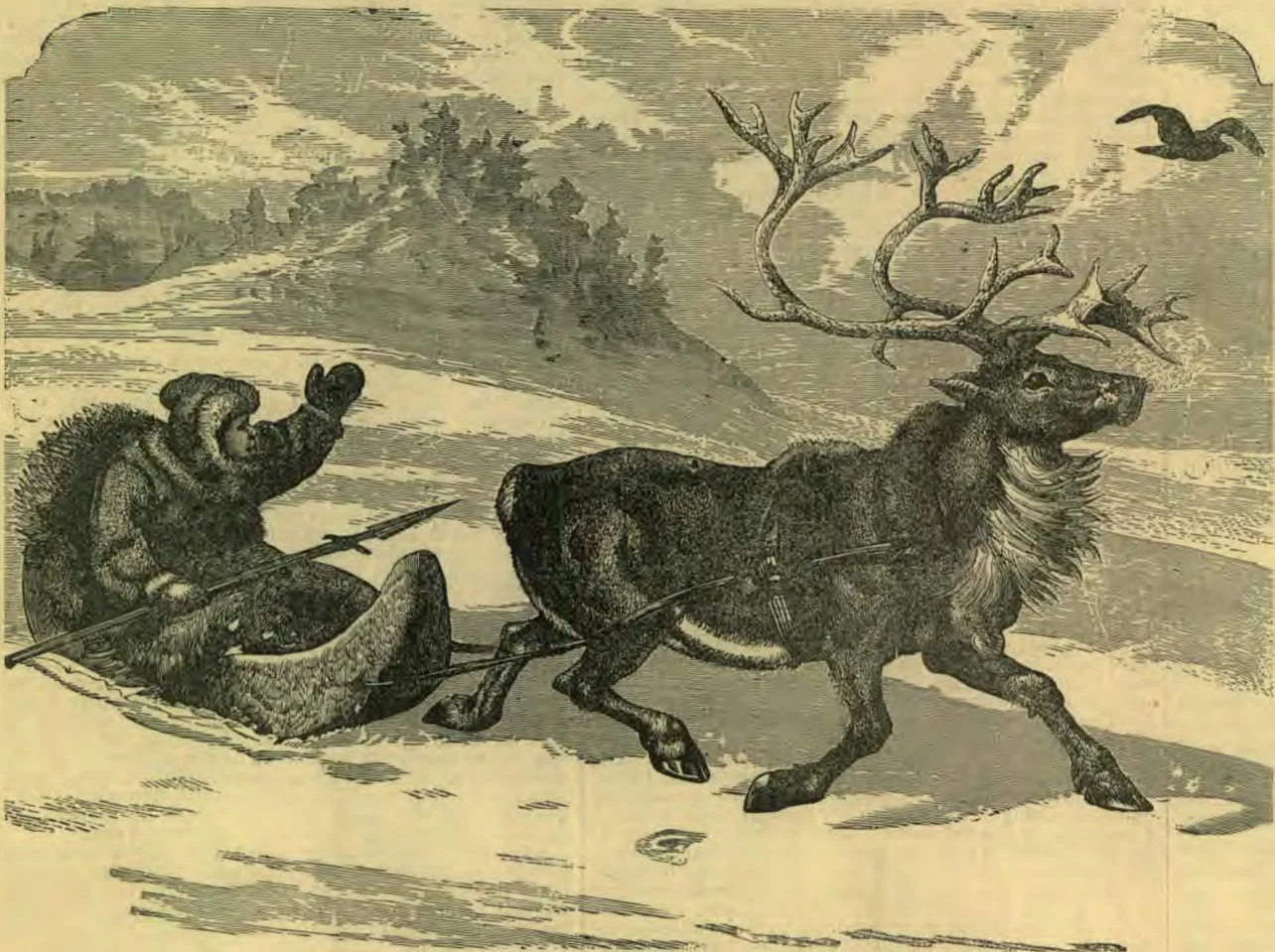
AWAY to the far, far north, where the nights are long and cold, live some very happy and contented people. You can see one of them in the picture. I am afraid that if you lived there, you would find it hard to be as contented as he is.
His house is nothing but a tent, and not a very good one at that. To build it he sets up some poles in a circle so that their tops will meet together at the center. His floor is not more than six feet wide, or eighteen feet all the way around it. He covers the poles with coarse cloth in the summer; and in the winter he spreads on another covering of skins. The floor is carpeted with reindeer skins, and in the center is a stone hearth where he builds his fire. The smoke goes out at the open place in the top of the tent; and there, too, the rain, wind, and snow come in. I wonder if he gets cross when a flurry of snow almost puts out the fire, and sends the smoke into his eyes. All around the sides of the tent, hang bowls and kettles, and everything used about the cooking.
The Laplander's pantry is in a queer place. It is on a shelf way up between two tall trees. There he keeps the milk, curds, cheese, and dried reindeer's meat. You wonder how he ever gets at the things? He has a tall tree pole, full of cross sticks, that he uses for a ladder. He is obliged to have his pantry in this airy place, or else the dogs and wolves would eat up his food. I suppose he would build a better house, with a pantry in it, if he ever stayed long in one place.
All a Laplander's wealth lies in his reindeer. If he has a thousand or more reindeer, he is thought to be a wealthy man; all the poor Lapps look up to him, and respect him very much. If he has five hundred, he is respectable; but if he has no more than fifty, he is a very poor Lapp indeed, and gladly serves his wealthy neighbor.
The reindeer live on the lichens that grow on the cold, gray rocks. The lichens are not very plentiful; so when the reindeer have eaten up all there are in one place, the Lapps have to move to another. They hardly ever stay more than two weeks in a place. As it takes the lichens a long while to grow, it may be years before the Lapps will come that way again.
The people have long skidders, or skates, made of fir-wood, and covered with young reindeer's skins. These skidders are as long as the Laplander himself. It would be hard to travel in the winter without them. With them he can run as fast as the wild beasts. He has a long pole, with a knob near the end of it, so that it will not sink deep in the snow, and with this he stops himself when he wants to rest.
He also has a small sledge, or “pulka,” which he hitches to the reindeer, as you see in the picture. The sledge is rounded on the bottom, and he has to be very careful, or he will fall out.
The Lapp lives in a beautiful country in the summertime. Then the sun hardly goes to bed at all. For days his round face is to be seen above the horizon, except for a few short hours when he dodges behind the mountains to take a short nap. Beautiful streams of clear cold water flow down the mountains to the sea, and the land is clothed in green.
But when the short summer is over, then comes the long cold winter. For days the sun hardly glances above the horizon. Now the Lapps move away from the sea-shore to the forest. The long, dark nights are lit up by the gay northern lights, that flame and dance in the sky like fire-works. You could not get a Lapp to change his wild, cold country for any other in the world.
W. E. L.
WHAT RELIGION DID FOR A LITTLE GIRL.
RELIGION helps children to study better and do more faithful work. A little girl of twelve was telling, in a simple way, the evidence that she was a Christian. “I did not like to study, but to play. I was idle at school, and often missed my lessons. Now I learn every lesson well, to please God. I was mischievous at school when the teachers were not looking at me, making fun for the children to look at. Now I wish to please God by behaving well and keeping the school laws. I was selfish at home; didn't like to run errands, and was sulky when mother called me from play to help her in work. Now it is a real joy for me to help mother in any way, and to show that I love her.”—Sel.
Smiles and the Heart's True Influence
SMILES are smiles only when the heart pulls the wires.