The Youth’s Instructor, Vol. 33, No. 52 (Pacific Coast Edition).
THE STORY OF A BRAVE MAN
Page 1
The Youth’s Instructor
Jan 13, 1886
S. D. A. Publishing Association · Battle Creek, Mich. · Jan 13, 1886
THE STORY OF A BRAVE MAN.
By Henry Williges
A LONG time ago, in the year 1717, there occurred an incident in Hermannsburg, Germany, which a preacher by the name of Stock relates. This incident happened during the great Turkish war in which the brave general, Prince Eugene, won such glorious victories over the Turks. Troops from all parts of Germany were assisting the Emperor’s army, and a few from our country had gone with them. From our village went Count von Staffhorst with two servitors,—Peter Paash and Hans Puffel.
In the great battle near Belgrade, where the Germans were victorious, Hans Puffel lost his life while rescuing his master from the hands of the Turks. In storming the town, Count von Staffhorst fell, having already forced his way into the city. Peter Paash, full of grief at the death of his beloved master, was so abstractedly following the Turks that when he reached the outside of the city, he was surrounded and taken prisoner. Tying him to his horse’s tail, a Turk mounted the horse; and Paash, naked and barefooted, had to run beside them, for they had taken everything away from him.
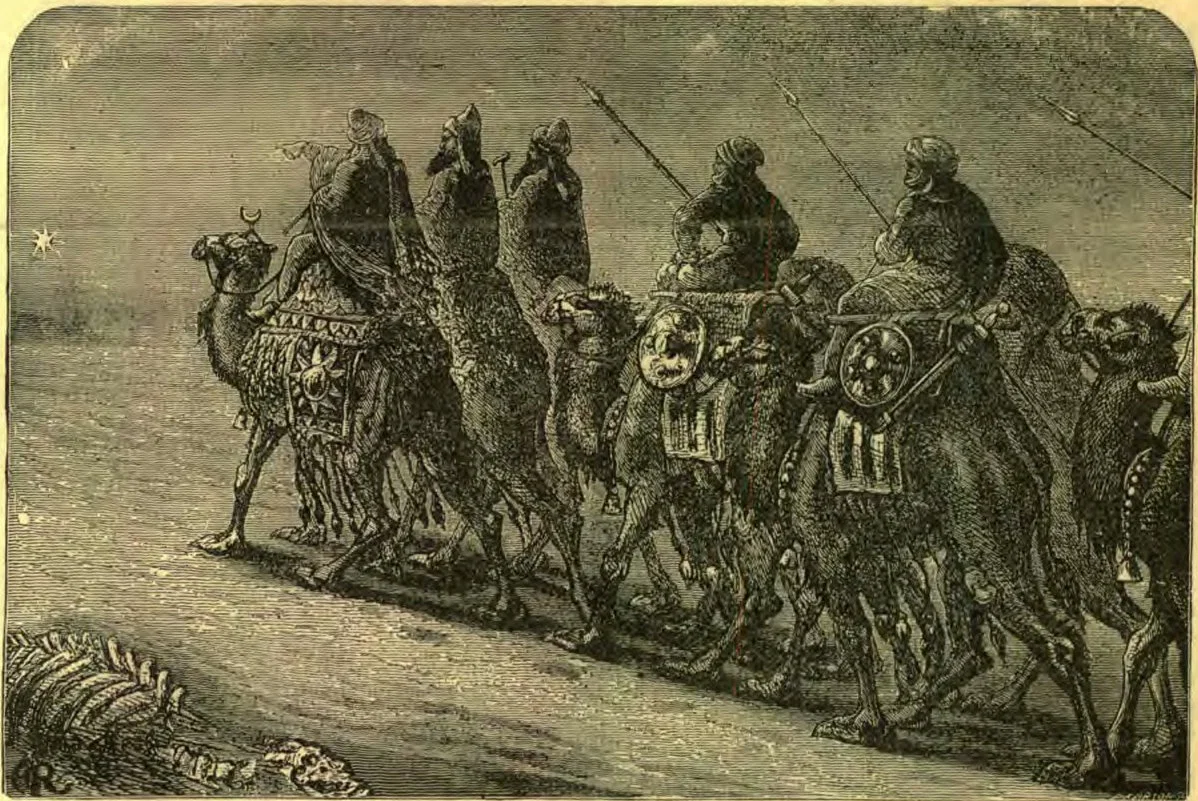
“We have seen his star in the east, and are come to worship him.” Matt. 2: 2.
Late in the evening they entered a forest. Believing themselves secure from the interference of all Christians, they thought they would wreak their vengeance on Paash for hewing down their comrades in battle. Placing two sticks in the form of a cross, they all spit at it, and tried, by whippings and torture, to make their prisoner do the same. But Paash, from whom they no longer expected any resistance, boldly hit on the head every Turk that spit at the symbol of his religion. They now tied his hands and feet; and piercing him with knives and daggers, tried to force him to repeat the indignity. These efforts proving unavailing, they put both his hands together over his head and nailed them to a tree, and by whipping and otherwise wounding him, tried to make him pronounce the name of Mohammed; but as often as they said Mohammed, he said Jesus Christ. Then the enemies of Christ kindled a fire under his feet, intending to make him deny Christ or die by the fire.
As Paash now saw that death was near, he prayed, with a devout voice, the Lord’s prayer, and repeated the articles of faith; and the Lord gave the brave soldier such peace that he was enabled to pray even for his enemies, as the Lord and Stephen had done. Scarcely had he finished praying, when his heart was filled with such heavenly joy that he could not refrain from singing in a loud voice that glorious old Passion hymn, “O innocent Lamb of God, thou hast died for us on the cross.” As he sung the third verse, and was finishing with the words, “Give us thy peace, O Jesus, amen!” the clear notes of a trumpet sounded forth, and German horsemen dashed into the forest. The Turks scattered in every direction.
With astonishment the soldiers beheld Paash nailed to the tree, with a slow fire at his feet. They quickly loosed him, and he fell fainting into their arms. After they had dressed his wounds, and cared for him, he recovered his senses; and his first question was, “How did you come to be sent at just the right time?”
Then the horsemen answered, “We were sent out to pursue the Turks, and heard some one singing in the forest, ‘O innocent Lamb of God.’ ‘That,’ cried we, ‘is a Christian.’ The God in whom thou hast trusted hath saved thee.”
The horsemen brought Paash to Belgrade. When the affair came to the ears of the brave Prince Eugene, he took pains that the best care should be given to the poor soldier. He visited him several times himself, and rejoiced at his child-like, innocent faith; and since Paash was no longer fit for war service, he sent him back to his fatherland.
Paash lived for ten years on the paternal farm in the community of Bonstorf. And he wore on his body the marks of the wounds, like those of the Lord Jesus, to the strengthening of the community in the faith. He died in the year 1728, as he was singing, “O innocent Lamb of God.”
May the Lord impress us all with this verse: “Whosoever, therefore, will confess me before men, him will I also confess before my Father which is in heaven.”
HENRY WILLIGES.
MORE THAN PUBLIC HONORS.
A man died in Boston, about five years ago, who never held a public office, neither was he rich, nor of high social position. Yet more than a thousand merchants were present at his funeral, and that, too, in the busiest hour of the day.
Strong men, as they passed by the bier, wept, and stooping, kissed the face of the dead.
“Why do you weep?” asked one of a negro.
“He fed and clothed me,” was the sobbing reply, “when I escaped from Richmond; and ever since, he has been to me a brother.”
A tremulous old woman came hobbling up to the coffin to look for the last time on the face of the man who had saved her from a life of dissipation and crime.
A young man followed her. He had been raised from the gutter and snatched from ruin by him over whose lifeless form he wept.
When friends and kinsmen had passed before the silent bier, there came clerks, laborers, and seamen, whom the dead man had employed. They were there because, knowing him better than all others, they loved him.206
The man thus mourned was Deacon Franklin Snow. Thirty-eight years before, he had come to Boston, a poor orphan boy. His first service was in a fish-house, at a salary of two hundred and fifty dollars a year.
Though poor, he had brought with him valuable capital. He was a Christian, with a pure spirit in a sound body. Though his own master since he was fourteen, he had no evil habits.
His employers had taken him on probation; they soon found that they needed both his influence and his services. He, on his part, valued them because they taught him correct business principles.
He also connected himself with another company,—a Christian church—that he might be about his Master's business. Both in the counting-room and in the sanctuary, he regarded God as equally near him. What ought to be done he did, whether it was easy or difficult.
He made money, but he never suffered himself to become rich; for he considered himself the Lord's cashier, whose every check he was bound to pay whenever presented. Thousands of such drafts were presented by all sorts of persons. Not one, if sent by the Master, ever heard Deacon Snow say, “No funds.”
So active was he in business that he seemed indifferent to recreation. But he had one holiday each week; it was the holy day of the Sabbath. “Blot out the Sabbath,” he once wrote to a friend, “and half the pleasure of my life will be gone.” On that day he re-created himself.
His life was filled up with little deeds of service. His was a great heart, which took in the intemperate and the profligate. The worse a man was, the warmer glowed his sympathy for him. “That man is worth saving,” he would say, “and I ought to try to save him.”
Many a man whom the good deacon had helped to come to himself, dropped a tear over his lifeless body.—Selected.
THE THREE KINGS.
By Henry Wadsworth Longfellow
Three kings came riding from far away,
Melchior and Gaspar and Baltasar;
Three wise men out of the East were they,
And they traveled by night, and they slept by day,
For their guide was a beautiful, wonderful star.
The star was so beautiful, large, and clear,
That all the other stars of the sky
Became a white mist in the atmosphere,
And by this they knew that the coming was near
Of the Prince foretold in the prophecy.
Three caskets they bore on their saddle-bows,
Three caskets of gold with golden keys;
Their robes were of crimson silk, with rows
Of bells and pomegranates and furbelows,
Their turbans like blossoming almond-trees.
And so the three kings rode into the West,
Through the dusk of night, over hill and dell,
And sometimes they nodded with beard on breast,
And sometimes talked, as they paused to rest,
With the people they met at some wayside well.
“Of the child that is born,” said Baltasar,
“Good people, I pray you, tell us the news;
For we in the East have seen his star,
And have ridden fast, and have ridden far,
To find and worship the King of the Jews.”
And the people answered, “You ask in vain;
We know of no king but Herod the Great!”
They thought the wise men were men insane,
As they spurred their horses across the plain,
Like riders in haste, and who cannot wait.
And when they came to Jerusalem,
Herod the Great, who had heard this thing,
Sent for the wise men and questioned them;
And said, “Go down into Bethlehem,
And bring me tidings of this new king.”
So they rode away, and the star stood still,
The only one in the gray of morn;
Yes, it stopped, it stood still of its own free will,
Right over Bethlehem on the hill,
The city of David, where Christ was born.
And the three kings rode through the gate and the guard,
Through the silent street, till their horses turned
And neighed as they entered the great inn-yard;
But the windows were closed, and the doors were barred,
And only a light in the stable burned.
And cradled there in the scented hay,
In the air made sweet by the breath of kine,
The little child in the manger lay,
The child that would be king one day
Of a kingdom not human, but divine.
His mother, Mary of Nazareth,
Sat watching beside his place of rest,
Watching the even flow of his breath,
For the joy of life and the terror of death
Were mingled together in her breast.
They laid their offerings at his feet;
The gold was their tribute to a king,
The frankincense, with its odor sweet,
Was for the Priest, the Paraclete,
The myrrh for the body's burying.
And the mother wondered, and bowed her head,
And sat as still as a statue of stone;
Her heart was troubled yet comforted,
Remembering what the angel had said
Of an endless reign and of David's throne.
Then the kings rode out of the city gate,
With a clatter of hoofs in proud array;
But they went not back to Herod the Great,
For they knew his malice, and feared his hate,
And returned to their homes by another way.
—Longfellow.
A DISCONTENTED BOY.
By Dudley Marvin Canright
“Papa, can’t I have a new overcoat? I saw a splendid one for sale at Jones’s for only five dollars. It’s real cheap. Tommy Martin’s father got him one; and all the boys have got one. Can’t I, papa?” So said ten-year-old Sammy Brown to his father one winter day.
“I thought you had a pretty good overcoat,” said his father.
“It’s old, and I have had it ever so long now,” said Sammy. “I should think I might have something new once in a while as well as everybody else;” and he looked as though he felt very much neglected and abused.
“Bring your coat here, my son,” said his father, “and we will see how bad it is. I hoped you could wear it another winter.” Sammy reluctantly brought the coat, evidently wishing it was worse than it was.
“Why, Sammy,” said Mr. Brown, “I don’t see any holes or patches. It is faded a little, I know; but it is whole and warm. It will do you for this winter. You ought to be thankful for so good a coat. Many a boy hasn’t one half as good, and some have none at all. I do not earn much money, and I have many things to buy which we must have. So you must learn to be contented and thankful that you are even comfortable.”
“I never can have anything anyway, like other boys,” Sammy replied, half crying, and making himself very miserable.
“That will do now,” answered Mr. Brown. “Sit down there, and consider what you are saying; for it is not right to feel and talk so. While your things are not as rich and fine as some, they are comfortable. You have enough to eat, a good bed, a warm room, books to read, a wagon, a sled, a knife, and other things which many boys cannot have. The Lord is displeased when we are unthankful for what we do have. It is a sin to complain and murmur. You said that ‘all the boys’ have new overcoats. Is that just the truth?”
Sammy hung down his head, pinched his toes, and finally said, “Well, anyway, a lot of ’em have.”
“How many, my son?” urged the father.
Sammy’s shoe seemed to bother him very much just then; but, as his father was waiting, he said, “Tommy Martin got one, and Bert Howard, and—and—and Harry said he guessed he’d have one too.”
“Two out of fifty is far short of all, my boy,” said Mr. Brown.
Sammy did not mean to be ungrateful, either to his parents or to God; but, like many others, he did not appreciate the many good things which he did have, while he thought so much about what he didn’t have.
Shortly after this, Mr. Brown was going into the country for a few days on business. He asked Sammy if he would like to go along. Sammy was delighted at this. So his mother fixed him up well for his journey. Though it was quite cold, he did not mind it, as he was warmly clad. They soon overtook a boy about Sammy’s age going to school. Mr. Brown took him in to ride. The boy had no mittens, and his hands were blue with cold. He had no overcoat, and his pants were so short that they did not reach to his boots. This left a portion of his legs bare. There were holes in his boots, and all his clothes were thin. Yet the boy was cheerful, and much animated over the hope of being at the head of his class that day.
“Papa, I should think he would freeze,” said Sammy, as the boy left them.
“Don’t you think he would be glad of as good an overcoat as you have?” asked his father.
Sammy made no reply, for he saw what it meant. That night they stayed with a friend who lived in a little, old log house. There was no carpet on the floor, and some of the chairs were broken. The supper was not very inviting to Sammy, though the children ate it heartily, leaving nothing for another meal. Sammy and his father slept in a small, cold bedroom where the snow blew in. He said nothing, though he often wished he was at home.
The next day they stopped on business at the house of a widow. She and her three little children lived there alone. The oldest boy was only eleven. He had to milk the cow, cut up the wood, and do the chores. They were very poor, and not very neat, either. The house was empty, bare, and cold; and the children were ragged and quarrelsome. Mr. Brown went back into the woods, and left Sammy there about two hours. It was a new world to him, so different from his own pleasant home—no pictures, no books, no papers, no order, and few pleasant words. Those two hours—how long they were! He thought that if he ever reached home again, he would never tease for another thing.
We will not say that it was an accident, but the next place they stopped at was at the home of a boy who was a cripple. He could not walk a step. Day after day, and week after week, he sat there with his feet curled up under him, making baskets to help his mother get a living. Yet the boy was not at all unhappy. In fact, Sammy thought he was the happiest boy he had ever seen. He talked and laughed, and showed the neat baskets he had made, the pictures he had drawn, the books he had bought, and other little things of interest.
“Well, Johnny,” said Mr. Brown, “you have a pretty hard time in life, don’t you?”
“Me?” answered the boy. “Oh, no; I am better off than most boys. I don’t have to bring in the wood, go out in the snow, or build fires cold mornings;” and he laughed heartily.
“Did you have a new overcoat this fall?” asked Mr. Brown, with a glance at Sammy.
“Oh, I am ahead of all the boys on that,” said Johnny. “I don’t have to get overcoats, nor boots either. So I can use my money for something else. You know the Bible says, ‘Godliness with contentment is great gain. For we brought nothing into this world, and it is certain that we can carry nothing out. Therefore, having food and raiment, let us therewith be content.’”
This lesson was not lost upon Sammy. He saw how discontented and unhappy he had been, while he had so many things to be thankful for. Glad enough he was to get back to his home. It looked better to him than ever before. About the first thing he said was, “Mamma, I don’t want any new overcoat this winter. This is good enough for me. Lots of boys haven’t any at all.” By his request, his mother hung in his room this text as his motto: “Be content with such things as ye have.”
D. M. CANRIGHT.
THE LIVING SEED.
HERE is a singular story which we found in the local columns of a Pennsylvania paper. In fact, it is a tragedy; yet we find it instinct with a strange lesson of hope and good cheer.
Michael Dunn was born fifty odd years ago in England. His parents were thieves. He was taught to pick pockets as soon as he could walk. At eight years of age he was sent to the Old Bailey for stealing a silk dress.
As he grew older he was trained as a burglar by the most accomplished “cracksmen” of England. In prison or out, his sole companions were convicts, thieves, and murderers. He served out terms of imprisonment in England, Ireland, Van Dieman’s Land, Canada, and three of our State prisons. Could any good come out of such a life?
One man, however, hoped for him; a man who never lost hope of any human being, however debased. This was Joseph R. Chandler, the journalist, who gave up the later years of his life to the reform of prisons and prisoners.
He observed Dunn’s affection for a dog that was in the Philadelphia jail, and, one day, his eager, tender manner to a little child who visited the prison.
“All is not lost,” said Mr. Chandler to the chaplain. “The good seed is alive still.”
He saw Dunn daily, and strove to elevate and rouse his moral nature, and hoped he had succeeded. The man was discharged. But six months later he was again convicted of stealing in New York.
The good seed, however, was not dead.
When he was released, under the influence of Mr. Chandler’s teaching he went to a religious meeting held for discharged convicts, became a sincere penitent, and then—the best proof of sincerity—set about helping men who had sunk as low as himself. He opened in New York a House of Industry where discharged convicts were set to work, or allowed to stay until work was found for them. In three years he had found employment for over four hundred men, and started them on the road to honesty and honor.
Says the old proverb, “He who plants a blade of grass where before was a barren waste, is a benefactor of mankind.”
But what shall we say of him who in a ruined soul finds the germ of goodness, and nurses it to eternal life?—Selected.
MEMORIES OF BETHLEHEM.
My soul, awake! The veil of night
Is from the skies withdrawn,
And memories of Bethlehem bright
Like angels fill the dawn.
O Bethlehem, fair Bethlehem,
What hopes thou bringest me!
The Lord of life and glory left
The golden spheres for thee.
Toward the brightness of the dawn
Of his eternal light,
Take thou life's staff and travel on,
A pilgrim of the night.
Still singing, singing, as He leads
Thy way through valleys calm,
As shepherds touched the pastoral reeds
When ceased the angels' psalm.
—Youth's Companion.
A PICTURE THREE MILES LONG.
Most of our readers have heard of, and many may have seen, Barnard’s great “Panorama of the Mississippi.” It is said that the author of this immense work conceived its idea and determined on its execution when he was a mere boy, during a trip across the Mississippi in a row-boat at sunset. The story of his after-life is a record of singular persistence and success in carrying out a boyish dream.
When his father died, John Barnard was left a poor, friendless lad, and obtained employment with a druggist. But so fond was he of sketching with chalk or coal, on the walls, the likenesses of those about him, that his master told him he made better likenesses than pills; so poor John lost his situation.
He then tried other plans, and met with many disappointments. Finally he obtained enough money to begin his great work. He bought a small skiff, and set off alone on his perilous adventure.
He traveled thousands of miles, crossing the Mississippi backwards and forwards to secure the best points for making his sketches. All day long he went on sketching, and when the sun was about to set, he either shot wild fowl on the river, or hauling the little boat ashore, went into the woods, with his rifle, to shoot game.
After cooking and eating his supper, he turned his boat over on the ground, and crept under it, rolling himself up in a blanket to sleep for the night, safe from the falling dews and prowling animals.
Sometimes for weeks together he never spoke to a human being. In this manner he went on sketching for more than four hundred days before the necessary drawings were finished, and then he set to work in good earnest to paint the picture.
He had only made sketches in his wanderings. After these were completed, there were colors and canvas to be bought, and a large wooden building to be erected, for he determined to paint them on one piece of canvas, and thus make a panorama.
When it was finished, it covered three miles of canvas, and represented a range of scenery three thousand miles in extent; and that all this magnificent work was executed by a poor, fatherless, moneyless lad, ought to make us ashamed of giving up any undertaking worth pursuing, merely because it would cost us some trouble.—Youth’s Companion.
HE DID NOT THINK.
Down in the fire-room of a big steamer that was lying recently at the wharf in New York, a young man was told to do a certain piece of work in connection with the pumps. There were two pumps close together in the room; one was for feeding the boiler, the other to use in case the ship should take fire. This latter one was capable of throwing a volume of water as large as a man's body.
The young man, who had been employed on the ship for three years, and had always proved himself efficient and reliable, was the only person left in charge of the fire and engine rooms. After the order was given to attend to the work necessary for the engine pump, he removed the cap from the fire pump. In a moment he discovered his error, but the force of the water was so great that he could not replace the cap on the pump. Without a word he ran to the deck, jumped ashore, and took the cars for his home in another State. The water soon filled the hold of the vessel, and in spite of every effort the steamer sank. Thousands of dollars' worth of damage was done to the engine and furniture of the cabin and state-rooms, and the vessel was prevented from sailing on the usual date, thus causing another loss to the owners, and great inconvenience to the public.
What do you suppose was the man's answer to the questions as to the cause of the accident? “I did not think.”
You see, he had not learned, when a little boy, to give his whole attention to the work in hand. “Whatever thy hand findeth to do, do it with thy might.” And to do with all the power of which a man or woman is capable, it is necessary to learn to give full attention when a child, whether it be work or play; if it is worth doing at all, it is worthy of the whole attention. Never make “I didn't think” an excuse for a stupid action. It is the part of wisdom to think.—Christian Union.
A Family Without Prayer Is Exposed
A GOOD woman used to say that a family without a prayer is like a house without a roof—exposed to all the injuries of the weather, and to every storm that blows.
IMPORTANT BIBLE SUBJECTS.
LESSON 1.—THE BIBLE SANCTUARY.
[NOTE TO THE STUDENT.—Do not consider the lesson learned until you can give at least the substance of every text, with the correct reference for each. The references in black letters indicate those texts that should be committed to memory. A little diligent application each day will enable you to learn them, although this need not be considered a test of scholarship.]
1. WHAT command did the Lord give Moses in Exodus 25:8?
2. Did Moses have it in his heart to do such a work as this? Ex. 15:2.
3. Why did the Lord desire a sanctuary built?
4. What is the meaning of the term sanctuary? (See note.)
5. What method of instruction did the Lord use in teaching Moses how to make the sanctuary? Ex. 25:9, 40.
6. Name the materials used in its construction. Verses 3–7.
7. How were these materials to be furnished? Ver. 2.
8. From whom were these offerings to be accepted?
9. How did the people respond to the call? Ex. 36:5–7.
10. How does God regard such a spirit in this dispensation? 2 Cor. 9:7.
11. Who did the Lord say should perform the work of making this structure? Ex. 35:10.
12. Whom did he especially call by name? Ex. 31:1–6.
13. What other qualification did these men possess besides being skillful workmen? Ex. 35:34.
19. What were these two apartments called? Ex. 26:33.
20. What divided them?
21. How does the apostle Paul speak of this vail? Heb. 9:3.
23. What purpose did the first vail serve? Ex. 26:36. (See note.)
NOTES.
Sanctuary.—A sacred place; a consecrated spot; a holy inviolable site.—Webster.
Dimensions.—It will be noticed there were six boards across the end of the sanctuary, standing upright. On the lower end of each board were two tenons, and these were inserted in sockets of silver. These boards were one and a half cubits wide, making nine cubits for the six boards; then there were two more boards spoken of “for the corners of the tabernacle in the two sides.” It is evident that these corner boards were so arranged and of such a width as to make the width of the sanctuary ten cubits. The temple erected by Solomon, though it was on a much larger scale, was built from the same pattern that Moses saw; and we know that the length of the temple was just three times as great as its width, and that the Most Holy place was a perfect cube. See 1 Kings 6, and 1 Chron. 28:11–20.
“According to the pattern.” (Ex. 25:9, 40). We have in these words a beautiful illustration as well as a divine warrant, for object teaching. The earnest teacher will catch the idea.
Hanging.—The same Greek word used for vail in Hebrews 9:3, is also used in the Septuagint in Exodus 26:36 where it is translated “hanging.” This Greek word is defined by Robinson as follows: “A covering, vail which hangs down. In Septuagint, a vail, curtain, of the tabernacle and temple, of which there were two; viz., one at the entrance of the outer sanctuary (Ex. 26:36; 40:5); and the other before the holy of holies, separating it from the outer sanctuary. Ex. 26:31; 27:21; 40:3.”
ICE SLEDS AND SLEDGES.
In that part of the far-away North visited by Lieut. F. Schwatka, the inhabitants have no wood only what they find floating on the water, that which drifts to them on the sea, and so they think the trees grow in the bottom of the ocean, and that the floating cakes of ice break them off. These people use all the drift-wood they can find, in the manufacture of their tools; but it is so scarce, they have only enough to make their sledges, shafts to their harpoons, spears, etc., and little Boreas, if he has sleds and toys like other little boys, must make them of something else than wood. But if they do not have much wood there, they have much ice; and the Eskimo boys make sleds out of the clear ice they cut from some lake or river near by. This they do with their rude knives, described in No. 25 of the present volume of the INSTRUCTOR.
It is true the ice sleds are heavier than wooden ones; yet they are so smooth they can be drawn more rapidly, and they are fine for coasting down hill. They do not break easily unless accidentally run against a stone or lump of ice which protrudes from the snow. Even the grown people sometimes use ice sledges in drawing big loads over a smooth surface, because they pull so easy; and for the same reason they always ice the runners of their wooden sledges before starting on a journey. No doubt our mechanics would choose rather to make steel or iron shod than ice-shod runners. But we will let Lieut. Schwatka tell you how these novel sledge runners are made, as published in the St. Nicholas for April. He says:—
“First the sledge runner is shod with a strip of bone cut from the lower jaw of a whale into a long, thin piece, like a batten or small board, and a trifle wider than the runner. This is made fast to the runner by thin thongs of whale-bone. The sledge is thrown on its back, the slats being down, when the native sledgeman carefully ices the runners. He has a small bucket or musk-ox ladle full of water; and picking up a piece of snow about as big as his fist, he dips it in the water to render it soft and slushy, and then presses the slushy mass over the bone shoe of the runner with the open palm of the hand, until it is completely covered around and along the whole length of both runners. The open hand is kept working backward and forward over two or three feet of the runner’s length, smoothing and leveling this opaque mass until it is frozen hard (a process which generally takes only about half a minute in cold weather); then the operation is renewed farther on along the runner. The slushy snow being completely frozen, the next operation is to put on the ice itself. This is done by the sledgeman’s taking a big mouthful of water and, while he works the palm of his hand backward and forward very rapidly, slowly spurting the water over the frozen, slushy snow; this distributes the water evenly and smoothly, and the watery spray freezes almost as soon as it strikes the cold runner.”
“Thus iced, it is really wonderful how much easier the sledge will run than when it is not so treated. My largest sledge was so heavy, even when unloaded, that I could hardly turn it over sideways; yet when Tooloolah, my sledgeman, had carefully iced it, I could, with one hand, take this ponderous affair, weighing nearly half a ton, and slide it backward and forward a distance of two or three feet without any unusual effort. If Tooloolah iced the sledge on the side of a hill, and, thoughtlessly turning it over, allowed it to point downhill, away it would go like a frightened horse, unless it was stopped. Our worst luck would be to have some half-hidden stone tear the ice from one of the runners, when it would drag as if a treble-sized load had been added.”
Little Boreas likes coasting down hill; but most of the ridges and hilltops are kept bare of snow by the high winds which blow so much there. Occasionally he is so fortunate as to have a treat of this kind; but most of his rides are on ice or iced sleds, behind well-trained dogs, which travel as fast as horses.
Knowledge Increases Power for Good or Evil
INCREASE of knowledge is increase of power, to the evil as well as to the good. Teach a boy to read, and you give him a key to the best books of the world—and to its wickedest. Teach him to write, and you give him the power to throw his thought across a continent—or to blast his name with forgery and fraud. Introduce him to the science of medicine, and you thereby enable him to alleviate human suffering—or to poison his enemies secretly. And so with every other art and science, increased knowledge is increased power of evil as well as of good. It is not enough, therefore, to gather knowledge alone; much more important is the cultivation of the moral character, of which knowledge is to be but the instrument. He who fails to provide his son or his scholar with the knowledge which is essential to him, does him a grave injury; but he does him a worse injury who fails to teach him how to use his knowledge for high and noble ends, rather than for those that are ignoble and base.
MANY MANSIONS.
By T. O. P.
I AM glad that His house hath mansions,
For I shall be tired at first;
And I'm glad He hath bread and water of life,
For I shall be hungry and thirst.
I am glad that the house will be His, not mine,
For He will be in it, and near;
To take from me the grief I have brought,
And to change into smiles every tear.
—T. O. P.
THIBETAN FOOD.
It is not alone in their manner of dress and sleeping that the Thibetans differ from Americans; but in all their habits they are peculiar. If the INSTRUCTOR boys and girls were obliged to take a few meals at a Thibetan table, they might better appreciate their own home fare at times when they feel dissatisfied with what is provided. An exchange gives the following as their manner of living:—
“The ordinary food of the country is barley that, having been parched, is afterwards ground and called Tsam pa, or Tsang pa. This meal they moisten with tea made in the Thibetan manner—i. e., of boiled ‘brick-tea’ buttered and salted—or else, if too poor to use tea, moistened with soup, mixing it in a cup and working the paste round with the fingers against the side of the cup. They eat this paste soft and moist. Tea made of the filthy ‘brick-tea,’ boiled with butter, salt being added to taste, and the mixture well churned, is the ordinary drink of the country, soup taking its place among the poorer classes. There are, of course, other kinds of food; but the above is the staple. They have a kind of chupatti, or scone, a common food. They eat flesh, chiefly of pigs and fowls, but all depends upon their locality and their means. They have no established rules, customs, or fixed hours for eating, the nearest approach to a rule being to take what they can get on the spot when hungry. Tea, as stated above, is the chief drink, so much so that it has become the custom to ask people to come and ‘drink tea,’ when to come and eat dinner is really intended, and this even in cases where the family is too poor to provide tea, and no tea in such cases is expected. After tea, as a favorite beverage, comes a kind of barley beer, called Khiong in the east, Tchong in the west, and then a kind of distilled barley whisky called A ra. In the pasturages, buttermilk is the ordinary drink, and curds and whey, called Ta ra, are in favor. On the days on which they boil their meat, they prepare no tea, but use the broth as a drink instead, on economical grounds; and on broth days they mix the Tsam pa with broth instead of tea.”
A PRIMITIVE BANK.
An English lady, Mrs. E. H. Leonowens, some years ago made quite an extended visit in India; and in a book entitled, “Life and Travels in India,” written by herself, among other things of interest noticed is a Hindu bank. She thus describes it:—
“We visited a banker’s office in the native city of Poonah. This bank, in which large sums are deposited and extensive business transacted, was nothing but a mud house plastered over without and within.
“The bank where our pundit [learned man] obtained his ‘hoondee,’ or money-order, was managed, in the absence of his father, by a young Hindu boy who could not have been more than twelve years of age. This youthful man astonished us with his accuracy and quickness in counting and discounting money. His only account book, as far as I could see, was a flat board covered with fine white sand. On this primitive slate he made all his calculations, writing them down with his forefinger. When he had finished, he blew away the sand, and handed over the amount due to the pundit, with interest for odd days, etc., all calculated with the nicest accuracy down to the smallest fraction. We wondered very much to see these banking establishments left in the charge of such young lads, who sit there demurely—and, what is more strange, securely—until late at night, often amid heaps of gold, silver, and other coin left temptingly in full view; but one rarely hears of any attempt to rob them.
“The bankers’ checks are written on thick, country-made paper; every check has a secret mark or sign that renders forgery difficult. It is rolled up, and fastened with gum-water; and thus lakhs upon lakhs of rupees are circulated with ease and safety throughout the country.”
POLITENESS BY TELEPHONE.
A Mexican correspondent says: “The peremptory American method of making telephone calls—‘Hello!’ ‘Hello!’ ‘Give me 1,299!’ etc.—would never do in the Castilian tongue. Courtesy of intercourse must be preserved over the telephone wires in Mexico, even between invisible communicants; and vexatiousness and petulance are never allowed to obtain utterance there. The regular response from the central office to a telephone call is ‘Mande usted!’ which is equivalent to ‘At your command!’ Then preliminaries are gone through something as follows: ‘Good morning, señorita; how do you do?’ ‘Very well, I thank you; what service may I render you?’ ‘Will you kindly do me the favor of enabling me to speak with Don So-and-so, No. 777?’ ‘With much pleasure!’ etc., etc., and when the connection is made, the usual polite introductions are gone through before proceeding the business in hand.”—Treasure-Trove.
AN ANCIENT DONKEY.
THE following record of an ancient beast we copy from the National Tribune, of Washington, D. C.:—
“An authenticated story comes from the Scotch highlands to the effect that a donkey died recently, the property of Mr. Ross, of Cromarty, in whose family it had been for 106 years. It can be traced back to the year 1779, when it came into the hands of the Ross of Cromarty of that day, though what was its age at that time no one can say. Furthermore, its death was the result of an accident; for it was ‘hale and hearty,’ when a kick from a horse ended its career.”
THE LARKS OF SCOTLAND.
It is said that the larks of Scotland are the sweetest singing birds of earth. No piece of mechanism that man has ever made has the soft, sweet, glorious music in it that the lark’s throat has. When the farmers of Scotland walk out early in the morning, they flush the larks from the grass. As the larks rise, they sing; and as they sing, they circle; and higher and higher they go, circling as they sing, until at last the notes of their voices die out in the sweetest strains that earth ever listened to.