S. D. A. Publishing Association · Battle Creek, Mich. · Jul 4, 1895
THE COTTON STATES AND INTERNATIONAL EXPOSITION.
By Rodney S. Owen
For the first time in their history, the Southern States have attempted an exposition of truly international character. Since its first inception, the proportions of this undertaking have extended far beyond what was originally contemplated. Its indorsement by the United States government with an appropriation of two hundred thousand dollars has been followed by similar movements in the legislative bodies of many of the States, both north and south, which have appropriated amounts of from seven thousand to twenty-five thousand dollars each for State exhibits. Mexico and many of the countries of South America are preparing for elaborate exhibits of their productions. The Argentine Republic leads out with the sum of twenty-five thousand dollars in gold for this purpose. Through the state department of the United States invitations have been sent to all the important countries of the old world, asking them to participate in this enterprise. Our consular officers in those countries report much interest, especially among the textile manufacturing centers. England, Germany, Austria, Hungary, Italy, France, and Belgium will send exhibits of their important industries. Several of the large railway corporations will have buildings for the exhibition of the resources of the country through which their lines pass, and the progress made in railway building in America.
THE FINE ARTS BUILDING.
The United States government exhibit will be arranged by a commission composed of gentlemen selected from each department because of their special qualifications and experience in the work. Notable among the interesting features of the state department will be a group of historical documents in which may be seen the Declaration of Independence in fac-simile, interesting relics of Thomas Jefferson and Benjamin Franklin, early treaties of our government with foreign powers, including letters from Napoleon Bonaparte, and the famous emancipation proclamation of Abraham Lincoln. The exhibit of the interior department will include the patent office, the bureau of education, the Indian office, and the geological survey. The latter exhibit will be very elaborate; especially is it intended to display as never before, the geological wealth of the South. The Indian office display will show the progress of education of the Indians at our national schools. The patent-office exhibit will be a comprehensive display of mechanical tools, particularly those relative to the cotton manufacturing industry.
One of the most complete and interesting features in the government building will be the exhibit of the fish commission. Its tanks will occupy ten thousand square feet. A great variety of rare and beautiful fish, both from the American inland waters and from the ocean, will be found here. The salt-sea fish will be supplied with water from the ocean. This vast aquarium will be arranged in a grotto, with the aisles ingeniously lighted from the water, producing a peculiarly beautiful effect.
The navy department will contain large models of many of the ships owned by the government from the beginning of the century to the present time, together with models of ships of an earlier period. These models will enable the observer to note the changes in the designs and armaments of men-of-war from the time of the Spanish Armada to those of Trafalgar, and thence to the wooden steam frigates that bombarded Sebastopol, until we reach the huge iron-clad monsters of the present day. A torpedo boat, belonging to the armored cruiser “Maine,” will also be exhibited. There will also be a full exhibition of all modern war equipments, and a large collection of war relics.
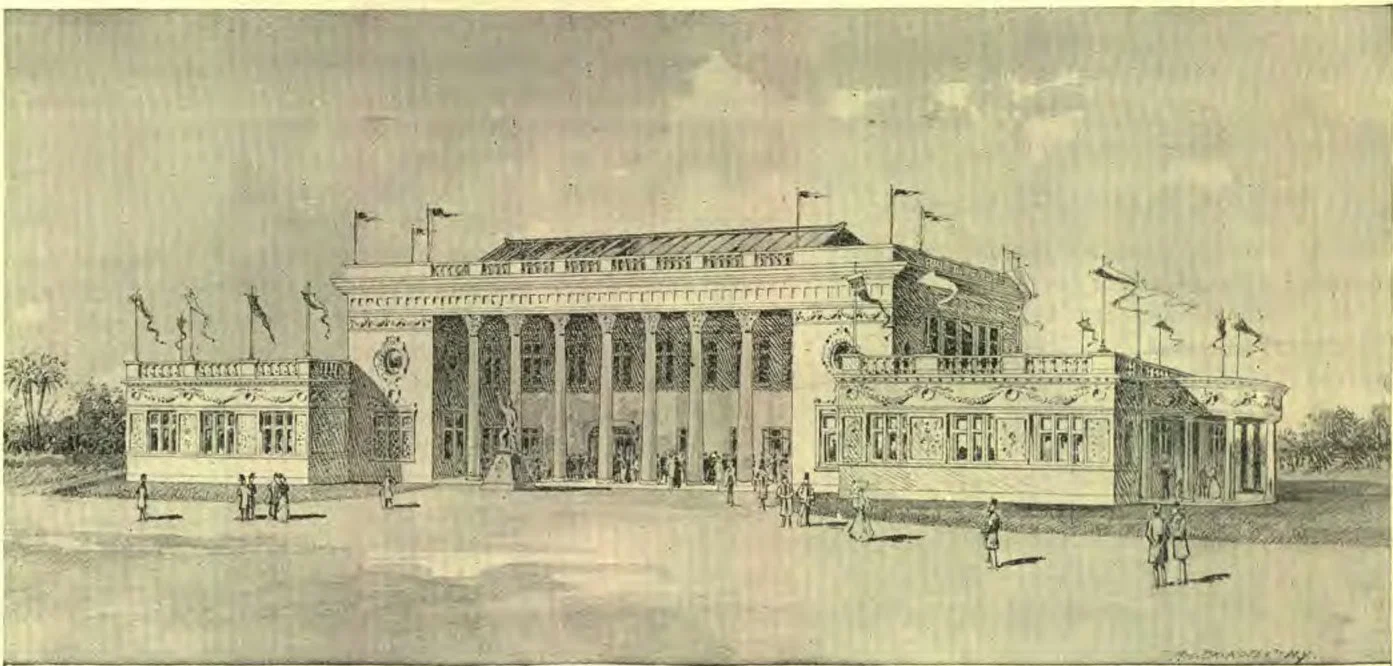
A special effort is making for a superior exhibition of the fine arts. This department is under the management of Horace Bradley, of New York. The building for this exhibit, though not among the largest, is one of the very handsome structures on the ground. The exterior is finished with beautiful designs in the Italian Renaissance style of architecture. The long fluted columns in the portico recall the stately old southern mansions of former days. The two immense galleries at the ends will be devoted to the exhibition of large oil paintings contributed by the leading artists of Europe and America. The floor space in the central part of the building will be devoted to sculpture. Special galleries will be set apart for the exhibition of water colors, pastels, pen and ink, and other drawings. Artists of the highest rank will exhibit in this art palace the most notable examples of their work. The people of the South, as well as those who visit the exhibition from abroad, will have the opportunity of seeing the finest display of artistic work ever presented in this section.
Another interesting feature of the exhibition will be a department under the management of a board of ladies for the exhibition of woman’s work. The building for this purpose is a beautiful structure one hundred and fifty feet long, one hundred and twenty-eight feet deep, and ninety feet in height. Its architectural design was the work of a lady architect, Miss Elise Mercur, of Pittsburgh, Penn. In this building will be seen a vast library of books written by women, a large collection of musical compositions and magazines which are the work of women, models of their patents and inventions, their artistic work, paintings, and sculpture. Space will also be provided in this building for educational exhibits, including industrial arts, decoration, wood carving, and sloyd work. The cooking-school and kindergarten will be notable features. There will be a large collection of woman’s work in210past ages, including valuable relics of the colonial days, and a rare collection of the works of the aboriginal women of America. The interest manifested in this department, and the demand for space, have been so great that the woman’s board having the matter in charge has been compelled to ask for an annex to the building, which will probably be granted.
One of the unique features of the exhibition will be the negro department. This race, which thirty-one years ago emerged from the bondages of slavery, without money or education, will be given the opportunity of exhibiting to the world evidences of their progress. The building, which is their own work, is a large, artistic structure, and will be a credit to the builders. They are manifesting commendable zeal in showing to the world what use they have made of their freedom since their emancipation from slavery. About fifty industrial schools will give exhibition of their work. Models of the more important inventions patented by them will be exhibited. The literary advancement of this people will be seen by the one hundred bound volumes which they have produced, and the two hundred newspapers and magazines which they are now editing. Special numbers will be prepared for inspection. Their home life will be represented by photographs of residences all the way from the Uncle Tom’s cabin of the days of slavery, to some of the better homes now owned and occupied by them.
This exhibition, which will bring large numbers from all parts of this country together at the Gate City of the South, it is confidently hoped will do much to break down all sectional feelings, and unite more closely than ever the North and the South, the East and the West, into one fraternal union.
RODNEY S. OWEN.
REMINISCENCES OF TYLER'S ADMINISTRATION.
By M. D. Counselman
In an unpretentious house on an obscure street in Washington, lives a man whose grandfather was once governor of Virginia and United States senator, and whose father was president of the United States. That man is General John Tyler, who, during his father's administration as president of the United States, occupied the position of his private secretary. Age and infirmities have laid him low, and for two years he has been confined to his room, attended and devotedly watched by his self-sacrificing daughter, whose gentle manner and vivacious spirit must be a delight to the general in his declining years. Afflicted with partial paralysis, and almost helpless, his greatest pleasure is in receiving his friends. The writer, not long since, had the pleasure of a short interview with him. Speaking of the first President Harrison, he mentioned a circumstance that occurred at the time of the inauguration of “old Tippecanoe.” It was the fact that President Harrison's first state dinner was in honor of both the retiring and the incoming cabinet. This was never known to have occurred before that time, nor has it occurred since. Possibly had our own President Harrison been aware of this fact, he might have emulated the example of his illustrious grandfather.
General Tyler related an incident in the career of a now-noted character that is worthy of mention. His father, the president, came into his room one morning with an open letter in his hand, and said: “My son, this letter is from a young man now in the city, who was too poor to pay his fare here, and has walked from Lexington, Va., to ask me to appoint him a cadet at West Point. There is metal in him, and I shall appoint him. Go yourself to the war department, and get a warrant for his appointment.” It was done, and that young man was none other than the celebrated Confederate general, Stonewall Jackson. After General Grant graduated at West Point, President Tyler commissioned him as lieutenant in the army.
Among other things related by the old general with considerable vim, was an account of the Wise-Marshall unpleasantness. Both men were prominent in the House, brilliant orators, and both skilled swordsmen. The opponents of Henry A. Wise, wishing him the worst, conspired with the distinguished Kentucky orator, Tom Marshall, to provoke him to a challenge. An opportunity soon occurred, and the orator from the Blue Grass State launched forth the most withering, scornful, and contemptuous fire of sarcasm upon the unsuspecting Wise. When Marshall had exhausted himself and taken his seat, every eye was upon Wise. It seemed impossible for him to make any reply; but he was equal to the occasion, and proceeded, in a calm, deliberate manner, to answer his adversary. Presently Mr. Marshall arose to leave the room. “Come back, Mr. Marshall,” shouted Wise, “come back, sir! I am not done with you yet!” Mr. Marshall sat down, while his opponent proceeded. A second time Marshall arose to withdraw, and a second time did Wise recall him. Returning, he sat down in Wise's chair, and deliberately swung around and looked him full in the face, as he stood bravely defending himself. As he finished amid the most intense silence, Marshall sprang to his feet, and throwing both arms around the astonished Wise, exclaimed, “Nothing on earth can induce me to attack you again!” This singular end to the contest excited the admiration of all save those who desired that a duel should have been the outcome of the intellectual combat. It is scarcely necessary to add that the friendship of the two men was mutual from that time.
For almost two generations President Tyler has been held, in popular estimation, as having been a traitor to the party which elected him, because of his having vetoed the United States Bank Bill. His son makes an ingenious and apparently successful defense of his father from this charge. He explains that his father never was a Whig, but belonged to what was known as the National Republican party, which split off at the time the original Republican party became the Democratic party. This party agreed with the Democrats in opposing the United States Bank. In 1840 the Whigs proposed a fusion with the National Republican party, and the celebrated ticket headed by Harrison and Tyler was the result. On becoming president, at the death of President Harrison (which, as every one knows, occurred only four weeks after his inauguration), Mr. Tyler found himself without pledges to the party, and free therefore to act out his own principles. In vetoing the United States Bank Bill he was simply true to the party which he represented in the fusion ticket of 1840.
Referring to his father's administration, General Tyler said that private secretaries in those days did not consider the position a very desirable one, inasmuch as there were no salaries paid, unless the president saw fit to remunerate a secretary out of his own private purse. General Tyler received no salary as his father's private secretary, and, indeed, this is not strange when the fact is known that President Tyler was compelled, in order to meet his personal expenses, to mortgage his property in Virginia so heavily that he was never able to redeem it. It is not the only case on record where the maintenance of position was an effort.
MRS. M. D. COUNSELMAN.
THE PARIS EXHIBITION OF 1900.
Some additional particulars are published concerning the plans for the Paris exhibition of 1900, which have just been approved by the special commission. The chief features are the demolition of the palace of industry erected for the 1853 exhibition, so as to give an uninterrupted view from the Invalides esplanade to the Champs Elysees, and the construction of a one-arch bridge, one hundred and eighty feet wide, opposite the Invalides. The Seine will be lined with palaces and pavilions, somewhat like the Grand Canal at Venice. The avenue of trees on the Quai d’Orsay and the Quai de Billy will remain intact. The chief entrance will be at the Cours la Reine, near the Place de la Concorde. The fine arts palace and the retrospective art palace, to be erected on each side of the new promenade, between the Champs Elysees and the river, will be permanent structures. South of the river will be erected the City of Paris building, the Horticultural Conservatory, and the Social Economy Congress Palace. The colonial exhibits will be near the Trocadero, the foreign naval and military sections being near the Champ de Mars. The existing buildings there will accommodate most of the French exhibits. The works are estimated to cost seventy million francs, and working expenses and other items will raise the total to one hundred million francs. Among the three hundred and eighty-five suggestions for subsidiary attractions which will be taken into consideration are a captive balloon, a movable platform for transport, fac-similes of mines, the exhibition of an aerolite, a fac-simile of old Paris, and panoramas of all descriptions.—Inter Ocean.
IDLING AND DAWDLING.
THERE are a great many people who waste their lives in getting ready to do something which they never accomplish, or in beginning something which never will be finished. They sometimes have great ideas of their abilities, and of the value of their services. They will not do little things, and they cannot get great things to do. They will not work for small pay, and the more remunerative positions are not open to them. So they wait and wait, and idle and dawdle, until half of life is gone, and the work of life is undone.
“Whatsoever thy hand findeth to do, do it with thy might.” If you cannot do big things, do small things. If you cannot do what you would, do what you can, and do not delay. There are persons who might do a respectable life-time’s work while they are waiting for opportunities which perhaps may never come. The Lord has work for busy men, but gentlemen of leisure who are waiting for something to turn up, are not apt to be called of God to any great work. There is so much to do,— so many weary toilers might be helped if people had helpful hands and helpful hearts,— that it is a pity that young men should waste their time, and squander their opportunities, and do nothing, when they might be doing work that would tell for God and for humanity. Work while the day lasts; work where work is needed; work for men; but see to it that the work you do is done for God as well as for man.—The Christian.
The Way to Gain a Good Reputation
THE way to gain a good reputation is to endeavor to be what you desire to appear, — Socrates.
DOWIE, DIVINE FAITH HEALER.
FOR about a year or two a man named John Alexander Dowie, who calls himself a divine healer, has been operating in Chicago. From what we are able to gather from the Chicago papers, he is making his business of divine(?) healing a very lucrative calling, and many thousands of shekels of the unrighteous mammon are being diverted from the pockets of the credulous into his capacious coffers.
There is a record of one divine Healer, who healed the bodies and souls of men. In fact, he went about doing good and healing the sick; but it is not on record that he made any money by so doing, nor did he charge anything for the board of those who came to him to be healed; but by a manifestation of the same divine power by which he healed, he fed large multitudes of hungry people. So poor was he that he had not where to lay his head; and at his death one suit of clothes was all the property he possessed; and the settlement of his estate involved no tedious process of law, but it was accomplished by the Roman soldiers with a dice box. There was divine healing and divine unselfishness blended, and they ever go together; and when we see what purports to be divine healing joined to a scheme of money-making, our faith as to the divinity of the thing is rudely shaken.
Such is the scheme of Dr. Dowie. He pretends not to ask pay for his prayers, but he asks enough for board and lodging of his poor dupes, so that he can afford to throw his prayers in gratis. Lately he has divulged a scheme to build a magnificent hospital for the further development of his healing art, taking all the money he needs for this purpose from those who believe in him, but he is to be the absolute owner! The Chicago city authorities are looking after him, and find that he is charging ten dollars a week to his patients for their board and room, when half that sum would be a fair price for what they receive. So he must get five dollars a week for his prayers for each patient! Dr. Dowie has associated with him one regular physician, who issues the burial permits according to law, which, as may be expected, are quite numerous!
The world is full of such pious frauds and humbugs, and for some reason they find a sufficient number of victims to make a good living, and some of them get rich. It is proper to pray for the sick; but those qualified for this purpose do not advertise to heal, nor do they accept pay or presents under the name of “testimonials” from those for whom they pray. When one who professes to be a child of God advertises to heal the sick by prayer, and makes money at the business, it is well to remember the words of Paul in 2 Cor. 11: 14, 15.
THE MANITOBA SCHOOL QUESTION AGAIN.
This question, which was thought to have been settled, is now up again. It will be remembered that when Manitoba was taken into the confederation known as the Dominion of Canada, the Catholic people of the province had separate schools, and one of the points which was agreed upon at the time of the union was that all rights and privileges of the Catholics should be maintained. The Catholics would not consent to join the Dominion without this provision. After the union was accomplished, the people found that the parochial schools were limiting their instruction to the Catholic catechism and a very small amount of other knowledge. So a general public-school system was devised, which has proved very successful.
It was against this public-school system that the Manitoba Catholics, or a part of them, protested, and demanded a return to the former plan of parochial schools, and a division of the school money. The case was carried through the Manitoba and Dominion courts unto the queen’s privy counsel, which not long since ordered the restoration of the Catholic schools. Accordingly the Dominion government notified the provincial government of Manitoba of this decision; but Manitoba flatly refused to obey the order. The question has slumbered for some time, but June 13 the attorney-general of Manitoba moved an address to the governor-general, setting forth the whole case, and directly and positively refusing the demand for separate schools. The protesting Catholics appear to have the present law and the authority of the highest court in the British empire on their side, but the people of Manitoba have the right. Now the question is, whether might or right will carry the day.
RUSSIAN DIPLOMACY.
IF we may credit the reports from Europe, Russian diplomacy has scored a remarkable success, and the Japanese-Chinese war gave her the opportunity to do so. For a long time England has been the money-lending power of Europe, and many great advantages has she gained by so doing; but it now appears that Russia has got ahead of her by lending China a sufficient sum of money to pay the war indemnity to Japan. Russia was able to do this through the help of the Paris bourse. M. Hanotaux, French minister of foreign affairs, invited the Frenchmen of wealth to assist Russia, to promote the growing friendship between the two powers. This will give Russia a claim on China, and it will not be strange if she now gets a concession for a southern port and a terminus for her Siberian railway,— peaceably if she can, forcibly if she must. If England should object, Russia and France will both refer to the English occupation of Egypt, a part of the territory of the Turkish empire, as a precedent for so doing. How this will affect the Japanese, who by the terms of the treaty are obliged to withdraw from the mainland of China as soon as the indemnity is paid, cannot yet be determined. Evidences are thickening that there is some kind of secret treaty between France and Russia.
AN ILLEGAL WHISKY TRUST.
By Editor
The Supreme Court of Illinois has just confirmed the decision of a lower court that the big concern in that State, known as the Distilling and Cattle Feeding Company, is illegal, and it will be given two years to wind up its affairs and go out of business. The question of trusts is one that is now very frequently brought before the courts, but generally the enormous sums of money which are controlled by the trusts are put to such a skilful use that laws against them are a dead letter. But the whisky trust of Illinois is now compelled to yield.
But why strike down the whisky trust and let the sugar trust, the oil trust, and so many other trusts, go scot-free? There seems to be a reason. Trusts restrict trade. Indeed, that is the specific reason the whisky trust of Illinois is dissolved by the Illinois court. Now mankind can stand a restriction of the trade in sugar, oil, and many other useful things for an indefinite period of time; but they cannot put up with anything that restricts the sale of whisky! Hence the majesty of the law is invoked to put an end to that which would have the effect to restrict its sale. This may seem like a radical statement, but we shall hold to this opinion until some other trusts are dissolved.
PLATFORM-MAKING
By Editor
EVEN NOW we see the incipient stages of the preparation for the presidential contest a year and a half later. Party conventions have been held in Ohio, Indiana, and other States, and statements of the political theories of the parties, commonly called platforms, are being given to the world. It looks now as if the question of tariff, which was the main issue two years ago, is, temporarily, at least, laid upon the shelf, and the great question of the immediate future in the political field of this country will be, What shall be the money of the nation?
In the discussion of this question, party lines have been broken to pieces in all directions. There is division in each political camp, and there is union among thousands of the adherents of the most adverse parties. No party can hold all its former adherents to any one position. Some stand on gold alone, and some on silver only; others think paper money, with no promise of redemption, just as good as gold, if the government will only say it is money. Platform-makers are trying to make statements of principles that will please the believers in all these various theories, so as to get their votes, which, if successful, will demonstrate that the American politician is equal to India-rubber in stretching qualities! It is probably too early to tell the position of the different parties or the different parts of the country with any accuracy. Sixteen months’ more time will clarify the political situation somewhat, and each partisan will be able to recognize his own clan.
A DANGEROUS BUSINESS.
By M. E. K.
FROM the report of the Interstate Commerce Commission just issued, it is found that the number of men employed upon the railroads in the United States during the year 1894 was 779,608. This number was 93,994 less than was so employed the previous year. This falling off in the number of employees was because of the general slackness of business. The passenger traffic was much greater during 1893, the number of passengers carried in the United States in 1894 being 610,688,199. This was an increase over that of the previous year of 26,127,587. The increase of the passenger traffic was largely due to the World's Fair. An appalling number of accidents are reported. Two thousand one hundred and forty persons were killed, and 25,726 persons were injured, the most of whom were railway employees. More men, however, were killed the previous year. Probably more men are killed and wounded each year in this country on the railways than Japan has lost in her late war with China. Of the men employed upon the railways in the United States one out of every 428 was killed, and one out of every thirty-three was injured. This shows the railway service in the United States to be very dangerous business, but there are thousands ready to take the risk. M. E. K.
OBSCURE BIBLE EXPRESSIONS.
By M. E. K.
THERE are many expressions in the Scriptures whose meaning is not readily understood, and perhaps there are some that we can never fully understand; but most of them by study may be understood. One may be found in Ps. 16: 6: “The lines are fallen unto me in pleasant places; yea, I have a goodly heritage.” This is often quoted in meeting; it has become a common expression of thankfulness to God for his mercies. But what is the meaning of the “lines” falling in “pleasant places”?
The clue to the thought may be obtained from the word “heritage.” A heritage is what one receives by right of birth from his ancestors, and generally directly from his parents. The word as used in the Scriptures usually means “land.” The psalmist then really said that he had received a good piece of land; but how did the people of Israel get that land? The book of Joshua (chapters 12–19) describes the division of the country among the tribes of Israel. It was surveyed, and lines were drawn, giving each tribe a portion of land. Then Joshua cast lots to see which tribe should have the land. It is also probable that the land given to each tribe was also divided, marked out into small holdings, and the names of every member of the tribe being taken, lots were cast dividing the land severally—to each man a portion; and here, we believe, is the origin of the expression in Ps. 16: 6. Some persons, by these lines of survey, would get a very fine heritage. Such would say: “The lines are fallen unto me in pleasant places; yea, I have a goodly heritage.”
From this primary meaning it passed into a proverb, and any one who felt that he was especially blessed would repeat the expression. It was no doubt in the latter sense that it was used by the psalmist.
The Christian can use these words in both senses. We have a heritage,—the earth made new,—of which the land of Canaan, divided by Joshua for Israel, was a type. Those who keep the Sabbath are told that they will feed upon that “heritage.” Isa. 58: 14. That heritage includes a mansion for each child of God. John 12: 2. Yes, we have a goodly heritage; and in all the mercies of our God to us here we can also say: “The lines are fallen unto me in pleasant places.” This text is very precious and comforting; it is fulfilled both here and hereafter. M. E. K.
BIBLE STUDY.
By J. H. D.
It is no very uncommon thing to meet with young people who ask, “How can I become interested in the study of the Bible?” Other books are read with interest. Text books in our schools, containing the history of ancient occurrences, are studied until a late hour at night, while the word of life is scarcely looked into. Why is this? We think a moment’s thought will divulge the secret.
We must have some motive higher than that of learning a certain number of paragraphs or pages of any book, before we will become interested in it. In the text books used in schools we often find matter that is at first very dry; but our ambition to complete a certain course of study puts new life into the book, and we find ourselves interested in what we first thought we should never like. The interest manifested in a story book comes from our interest in the characters it brings before us. If we should be persuaded before reading that the persons spoken of in the book were uninteresting, we should lay the book aside before we had read the introduction.
If we would become interested in studying the Bible, we must first make up our mind that there is something there that we need. We need eternal life, and that is found in the word of God. We need a new birth, and that is found in the word, for we are born of the word. We need to be kept from sin. But it is the seed, the word, that keeps us from sin. 1 John 3: 9. Knowing this much of the truth of God, are we not prepared to dig deep into the treasures of life, that we may be witnesses for Christ? J. H. D.
CAREFUL FOR NOTHING.
By J. H. D.
To “be careful for nothing” seems contrary to the habits of our natures. We cannot wonder at some rejecting it as destitute of reason and good common sense when we see that it is so different from the ways of the world; but it is a precept of Christianity, and not of nature or philosophy. Christianity never lays a precept to be observed which seems impracticable, without associating with it another which is practicable, and the practice of which leads into the performing of the other. Thus in connection with the above precept we read: “But in everything by prayer and supplication with thanksgiving let your requests be made known unto God.” Here is a substitute for carefulness if we will accept it, which is much easier in itself and much more beneficial in its results.
What is it to be careful?—It is to be distracted, or troubled. Be not distracted about the sin which remains in you as a Christian. This will not eradicate or destroy it; but in prayer take it to God, and there confess it to him, and ask him to remove it by his love and grace. Thank him for your justification and the peace he grants you.
Be not troubled about the present temptations of Satan. This will not bring deliverance. In prayer speak to your all-conquering Lord, and ask his aid to succor or defend you. He was tempted on all points like as we are, yet was without sin; and he is able to help in every time of need. At the same time, give him thanks for all former deliverances from the tempter's power.
Be not troubled for the success of the church. This will not carry it forward. It is His cause. He will care for it, and make it prosper. Pray for it; supplicate his blessing upon it. You may be a co-worker with Christ for the success of his church, and render thanks to God for the success that attends its efforts.
Be not distracted about your temporal affairs. Distraction and trouble in regard to your affairs around you will not supply you with food or raiment if you are needy. Take your case to God in prayer; remember that he will supply all our needs. “But in everything by prayer and supplication with thanksgiving let your requests be made known unto God.” If we will do this, not trying to carry our own burdens, but in loving faith and trust in Christ giving them to him, we shall find a blessing in so doing. J. H. D.
FREEDOM
By M. E. K.
We live in a land and age of boasted freedom; and from the standpoint of earthly rights and privileges, we do enjoy a large measure of liberty. Tyrants cannot rule now as they have in the past. A king who would command that a man should have his head struck off for some trifling offense, as was not an uncommon thing two thousand years ago, would not now be tolerated on the throne of the worst kingdom on earth. The people of the world have been limiting the power of their kings; some nations have dispensed with them altogether as unnecessary; and on the whole, as far as civil rights are concerned, the world breathes easier than it used to. There is still much oppression; the rich oppress the poor, the strong the weak; there are evidences of backward tendencies in this and other countries. Still there is far more freedom now than there was one hundred years ago.
But in another sense,—in relation to the power of humanity to gain its freedom from the things within the individual self and the sin that binds it down,—there seems to be no more freedom now than in former days. The chief reason for this bondage to self and to sin is that man does not recognize the bondage of sin; and not sensing the slavery he is in, he has no desire to be free.
This was the trouble with the Jews when Christ was upon the earth. He said to them, “Whosoever committeth sin is the servant of sin. And the servant abideth not in the house forever: but the Son abideth ever.” What a graphic picture is here presented! A sinner is a servant; he serves sin. A servant cannot expect to abide in one place. His future home is not assured. He may be sent from place to place; he may be turned adrift with no provision made for him. How different this position from that of a son! His place is assured. The Jews could not understand this; they thought only of natural bondage; they said they were free. Jesus showed them that they were the servants of sin. He would gladly have given them their freedom. He is the Son, and he said: “If the Son therefore shall make you free, ye shall be free indeed.” Yes; free from sin,—that is freedom indeed.
The Son still lives; he abides in the house forever. “If we believe not, yet he abideth faithful: he cannot deny himself.” And he still offers to every one, to you and to me, just what he offered to the Jews,—freedom. Shall we, while suffering the bondage of sin, deny it, and say that we are free? Will we talk of the Declaration of Independence, and of our national heroes who gave us freedom, as the Jews spoke of Abraham? That will never do. Civil freedom may be gained by men acting in harmony with the providence of God, but freedom from sin is accomplished by a special act of God’s power and pardon, and is only granted through the Son. Through him is this freedom from sin. The Son is free, and he makes us his brethren, and we are like him. He abides, and we abide with him and in him. Blessed freedom! Sin removed from us as far as the East is from the West, condemnation gone, adopted into God’s family, heirs of God, and joint heirs with Christ! Do we want a freedom like this? Such freedom is in the Son. He has said: “Come unto me, . . . and I will give you rest.” Rest and freedom are in the Son of the Highest. May this, dear reader, be your experience:—
“I came to Jesus as I was,—
Weary, and worn, and sad;
I found in him a resting-place,
And he has made me glad.”
M. E. K.
SOCIETY
By F. D. Starr
THERE is in the hearts of all, especially of the young, a natural longing for society. Man is a social being. The Creator intended he should be such. It was never designed that human beings should become hermits. Society of the right kind, properly improved, is very beneficial. Society of the wrong kind tends to degrade, and one would better live a solitary life than choose the society of those whose influence is of a worldly, corrupt character.
The word “society” is of Latin derivation. From the Latin translation of the New Testament we may learn what is the most desirable and profitable society. Let us turn to 1 John 1: 3, 6, 7. Here the Latin word societas, from which our word “society” is taken, occurs four times. See how beautifully it reads: “That which we have seen and heard announce we unto you, that ye also may have society with us: and truly our society is with the Father and with his Son Jesus Christ. . . . If we say that we have society with him, and walk in darkness, we lie, and do not the truth: but if we walk in the light, as he is in the light, we have society one with another, and the blood of Jesus Christ his Son cleanseth us from all sin.” Who would not choose such society as this? These words plainly indicate the society for us to select,—the society of Jesus Christ and of his children. Is this the society in which we are found?
To mingle in society,—as the expression is commonly used,—with society constituted as it now is, is usually a dangerous thing; but here is society of the highest order, and entirely safe for all; and really, our society, or fellowship, is in a manner restricted to these limits, for we cannot have fellowship with Christ and his people and at the same time have fellowship with the world and with the arch-enemy of the race. F. D. STARR.