23. What does the transgression of one precept amount to? James 2: 10, 11.
NOTE.
We have no account of any other document that God ever wrote. Moses wrote laws of various kinds in a book. When Christ was upon the earth, he wrote men's sins upon the sand; but the writing of that document which embodied the eternal righteousness of God, which embraced in itself all duty, God left not to man. He engraved it with his own finger on the rock, showing its permanent character.
ADDITIONAL NOTES.
It may be said of sin that it is unexplainable and inexcusable. If it could be explained and a satisfactory reason given for its existence, then it might be excused. This cannot be done; and in all the dealings of the Lord with man, he makes no excuse for sin. Why people should do what their Creator and greatest benefactor has told them not to do, knowing at the same time, as thousands do, that this disobedience is the worst thing for them, and that it will end in death, is entirely unaccountable; and for such conduct there can be no excuse. Man has made many excuses, and still does so; but they are all idle. While God has not excused sin, he has made provision for it, that it may be eradicated from the hearts of men, and that they may be delivered from it. Sin is made known and condemned by the law; the provision for salvation is in the Son of God.
Many people talk about the bondage of the law, and think that Christ came to relieve them from the bondage of keeping the law. Those who have this idea mistake license to sin for deliverance from sin. Christ relieved us from bondage to something that is closely related to the law, but it is not the law. He delivers the believer from the bondage of sin; but sin is not the law; it is the transgression of the law. The sinner is in bondage to sin, not to the law. The law makes the bondage known. A pardon for past transgressions, and an indwelling power to obey God in all things,—not grudgingly, but heartily and joyfully,—such is the deliverance Christ gives us.
Jesus kept the law. It was his delight to do it. He is our example in all things. He did not pray that his disciples might be kept from keeping the law, but that they might be kept from evil, the same as he had been kept. He was here on the earth as a man. As a man he kept the law. He did this through the power that he received from God. With his example and his help, why may not we overcome as he overcame? He invites us to do this, and to sit down with him in his throne, even as he overcame and sat down with the Father in his throne. Deliverance from obligation to keep the law which is “holy, just, and good,” and which Christ, our Master and example, kept, would be a shameful surrender of God to Satan,— a lowering of man's standard of duty from God's to Satan's standpoint.
The plan for man is to bring him up by giving him in Christ the power to live as Christ lived. The law is not lowered, nor its just claims abated; but in and through Christ man is raised to the holiness required by the law.
M. E. K.
“AS THY DAYS.”
AND what does your anxiety do? It does not empty to-morrow, brother, of its sorrows; but, ah, it empties to-day of its strength! It does not make you escape the evil; it makes you unfit to cope with it when it comes. It does not bless to-morrow, and it robs to-day; for every day has its own burden. Sufficient for each day is the evil which properly belongs to it. Do not add to-morrow’s to to-day’s. Do not drag the future into the present. The present has enough to do with its own proper concerns. We have always strength to bear the evil when it comes. We have not strength to bear the foreboding of it. As thy day, thy strength shall be. In strict proportion to the existing exigencies will be the God-given power; but if you cramp and condense to-day’s sorrows by experience, and to-morrow’s sorrows by anticipation, into the narrow round of the four and twenty hours, there is no promise that as that day thy strength shall be. God gives us—his name be praised!—God gives us power to bear all the sorrows of his making; but he does not give us the power to bear the sorrows of our own making, which the anticipation of sorrow most assuredly is.— Maclaren.
SAINT AND SCHOLAR.
Few passages in the history of literature have a more touching and pathetic interest than those relating to the last scenes in the lives of men of letters who have retained their grasp upon the pen until death has given them release. Such a scene is that depicted by the historian Green in his account of the death of Beda,—or the venerable Bede,—the father of English history. The good monk was engaged at the time in finishing his version of St. John’s Gospel. It was two weeks before the Easter of 755 that the shadows began to creep over him. “I don’t want my boys to read a lie,” he answered those who would have had him rest, “or to work to no purpose after I am gone.” A few days before Ascension-tide his sickness grew upon him, but he spent the whole day in teaching, only saying cheerfully to his scholars: “Learn with what speed you may; I know not how long I may last.” The dawn broke upon another sleepless night, and again the old man called his scholars around him, and bade them write. “There is still a chapter wanting,” said the scribe, as the morning drew on, “and it is hard for thee to question thyself longer.” “It is easily done,” said Beda; “take thy pen and write quickly.” Amid tears and farewells the day wore on to eventide. “There is one sentence unwritten, dear master,” said the boy. “Write it quickly,” bade the dying man. “It is finished now,” said the little scribe, at last. “You speak truth,” said the master; “all is finished now.” Placed upon the pavement, his head supported in his scholar’s arms, his face turned to the spot where he was wont to pray, Beda chanted the solemn “Glory to God.” As his voice reached the close of his song, he passed quietly away.—New York Observer.
THE ISLAND OF MADEIRA.
By August Kunz
This isle is celebrated all over the world for its healthful climate, and consumptives, more especially, find here a most salubrious atmosphere to bring about their convalescence. It is situated west of the northwestern border of northern Africa. Its length is about thirty miles, and its breadth thirteen miles. It has a coast-line of eighty or ninety miles. The mean altitude of its elevations is about four thousand feet, its highest summit being sixty-one hundred feet. The name “Madeira” is Portuguese, and signifies woodland, the whole island having originally been covered with woods, which, of course, have disappeared long ago. As seen from the dimensions just given, it has an almost oblong form, and is ribbed, as it were, from east to west by a chain of volcanic mountains. Its population ten years ago was as high as one hundred and thirty-five thousand inhabitants, wholly Portuguese in nationality, excepting some half-breed mixtures of African blood among the lower classes.
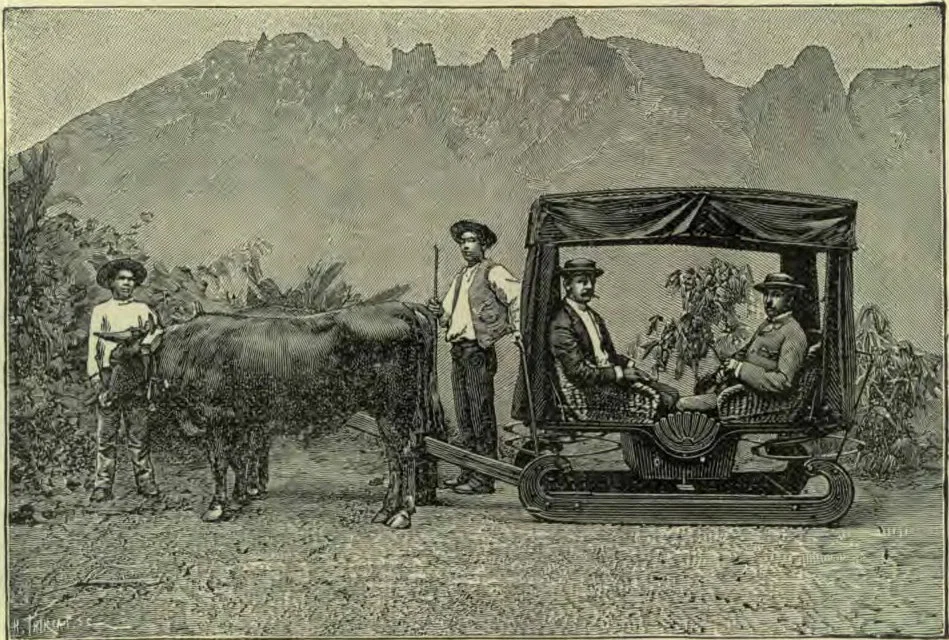
A CARRO.
Funchal, the capital, is situated upon a large bay on the southern edge of the island; its white houses, surrounded by shady gardens in terracing tiers, are the first thing to please the visitor upon his arrival. Here all the foreigners upon the island spend the winter months; it is likewise the residence of the authorities and the corps of consuls.
The city of Funchal, although it has but a population of some nineteen thousand, covers nevertheless a very extensive tract of territory. Its villas lie very much scattered at different heights in the environs, and whoever visits here must expect to spend almost any length of time to get from one place to another; for it must be conceded, from the start, that the means of locomotion in use here, as well as the pavements of the streets, are of such a nature that one is not able to shorten distance in any way. In general one travels on horseback, and is followed by an armed attendant that carries a fly-chaser, made of long horse-hair, and who does not quit the rider for one single instant, his position being at the heels of the cavalier whether this one travels at a walk, a trot, or a gallop. To get over rough or steep places the attendant clings to the horse’s tail. These persons bear the name of arrieros (rear-runners), and seem indefatigable. But often travelers use the carro. It is a conveyance built on the sleigh, or cutter, principle, with seating room for four persons, and having a cover and curtains. The carro is drawn by a pair of oxen, whose yoke is adorned with little bells. The span is preceded by a child or boy that leads the way, and followed by a man who incites the cattle by whip and voice, and steadies and directs the carro wherever the road has a turn or a descent. Wheeled vehicles are not found here.
Many people prefer the hammock to this mode of locomotion altogether, the hammock being less fatiguing, and more adapted for sick persons.
A sidewalk is a thing almost wholly unknown in Madeira, and the stranger that has but just disembarked must be resigned to getting his feet bruised and sore during the first part of his stay here; for the pavement consists of little stones of fragmentary basalt rock, having sharp edges which are very disagreeable.
The foreign colony is for the larger part composed of Englishmen, a considerable number of whom have become fixtures at Funchal, and have erected comfortable homes for themselves here. The commercial intercourse of the isle is almost wholly with England, and a thousand vessels of all kinds of tonnage cast anchor here during a single year. Men-of-war ships also run into the harbor from time to time, and their officers are always welcomed with joy by the leading residents.
The health-seekers, with but few exceptions, can go out of doors almost every day. Even in the winter season there are hardly three weeks at the utmost during which one would not be able to walk out into the open air,— and such air!—soft, pure, without miasma and without dust, except when the wind blows. This hot wind, called leste, by the natives, is the sirocco of Madeira, and blows from east southeast, carrying a fine sand dust that gives the sky a yellow coloring, though otherwise it is invariably clear and cloudless. When this wind begins, the inhabitants endeavor as soon as they can, to get home, and see that the doors and windows are shut, for the sand penetrates mercilessly through everything. This leste, quite irregular as it is, blows most often in summer; sometimes, however, two years go by, and it is not seen. This wind once past, the temperature returns immediately just as it was before it rose, the dryness disappears completely, and the air is charged anew with a pleasant moisture like that of a hot-house.
Some almost miraculous cures are said to take place on Madeira; for how many consumptives that have been pronounced incurable in Europe have not at some time or other landed at Funchal, and saw their strength gradually come back, and found themselves soon in the way to complete recovery!
This island is a convenient stopping-place for steamers from the north to points on the African coast; and may we not believe that soon God’s last message of mercy will find entrance here, too? AUGUST KUNZ.
GLIMPSES OF ANIMAL LIFE.
By T. J. Allen
7.—MOLLUSCA.
PERHAPS you all have read about the poor sailor, who, when he had no other pet, on a long voyage kept an oyster in a glass jar of water, and called it Tom; but we have so many intelligent beings from which to choose our companions, that perhaps we never thought of petting a headless animal.
Yet of all our many playthings during our early childhood, were there any we loved better, or cherished longer, than the shells we gathered from the seashore, or perhaps from the margin of some of our inland lakes or rivers? They may have been the most common shells; still we felt instinctively that they were more beautiful than any artificial toys; and even among older people, is there any place in the world where shells are not admired? The savage strings them into necklaces, and so does the refined lady of fashion. Shells also figure as ornaments in even the poorest dwellings.
But how few ever think of the builder of this beautiful architecture! Yet the delicate marking and tints of color which each has left upon his pearly house, pleases our eye more than gaudy pictures or painted playthings.
Each one of these millions of shells, in all parts of the world, as well as the countless multitudes which lie crushed on the seashore, has once been the home of a living animal born wrapped in a transparent mantle which has the wonderful power to extract the lime out of the water, at the same time tinting it with beautiful colors, and building it up into a solid house. This division of life is naturally divided into two classes,—the headless mollusks, and those which have heads. We will study first the headless class.
These are represented by the oyster, clam, mussel, quahog, and scallop. It will be necessary only for us to study the life of one of these animals to obtain a fair idea of the whole class. So we will consider them all as a single animal.
This wonder-working mantle which life has given these headless bodies, lines the inside of the shell; and when the animal is open, two transparent flaps, with thickened edges, may be seen, the one lying above and the other below the animal in his shell. This mantle, clinging to the inside of the shell, is continually, as the creature grows, forming an internal layer and a new rim to the opening. In this way the mantle builds up the shell for the animal to live in.
The different shapes in shells come from peculiarities of the mantle. If this is crumpled, the shell will have a crumpled form; and the sunlight falling upon the mantle seems to help in forming the bright pigment with which it paints its house, so that the shells near the surface, and those in the tropics, are more215highly colored than those in the deep sea or in a dull climate.
Again: if the mantle lines a smooth surface, inside the shell, it will produce white; but when this soft mantle is crumpled in very fine folds, these reflect the light, and produce the beautiful color known as “mother-of-pearl”; while if this membrane be irritated at any point, it will form a little bead of lime afterward to be increased into a pearl, such as are sought for so eagerly by the pearl-fishers.
This class has, though they are somewhat rude, a mouth, heart, liver, and digestive canal; and lifting up the upper flap, you will find, edging the body and growing to the mantle, a delicate, transparent frill of four striped bands. These are the gills, or breathing apparatus.
“The fingers that circle its body,
Which epicures think should be cleared,
Are the animal’s lungs—for ’tis odd, he,
Like a foreigner, breathes through his beard.”
The stripes in these gills are little tubes which run up and down, and through which the sluggish, colorless blood flows, so that as the lungs lie bathed in the water, the blood takes in oxygen through the delicate membrane, and flows back to the heart purified and refreshed, ready for circulation again.
This class secures its food by means of a forest of lashes waving over the surface of the gills in one direction, toward the mouth, which drives the helpless microscopic plants and animals past its thin lips, to be drawn in and swallowed.
The mollusks have below their bodies a muscular flap, called a “foot,” which is made up of layers of muscles crossing each other. In this foot there is a deep groove, out of which they force a milky fluid; this hardens into threads, which anchor them to the rock. These “mantle-covered animals” are generally sluggish and inactive. The scallop is the most active, though it, too, forms a slight cable, and anchors itself to the rock; yet it can withdraw the cable at will, and dart through the water in long, rapid leaps. Another peculiarity of the scallop is that it has all around the rim of its mantle beautiful jeweled eyes, like precious stones set in a ring, which enable it to go boldly out into the sea. The Pholadidæ have learnt to find a home in the solid rock. These are small animals, with beautiful, delicate shells; but slowly and gradually they bury themselves in the solid stone.
These creatures have not yet got their heads above water. In fact, they have no heads, so far, to put anywhere; still they silently perform a work which cannot be imitated by human beings, showing forth the wisdom, and power, and glory of our heavenly Father.
T. J. ALLEN.
ELECTRIC ILLUMINATING OF OUR MEN-OF-WAR.
THE navy department has arranged for spectacular displays by the American war ships at Kiel, which can hardly fail to create a sensation. Admiral Kirkland’s four ships will be especially well equipped for displays at night. Each is provided with two or more powerful search lights, and each will be resplendent with thousands of incandescent lights. As a special decoration, each will carry before and around the pilot house an immense shield representing the American coat of arms, the red and white bars and the stars on a blue background being reproduced by electric lamps.
The name of each ship will be brilliantly displayed in large electric letters running around the stern. In addition to these two special features, incandescent lights will be strung along each vessel’s stem and stern from the water to the deck, and along the deck rail from end to end, on both sides. Lights will be placed along the water line on each side, just high enough to be out of the swash, thus outlining the hull. More lights will be strung up the masts and down the side stays, and up and down and around the tops of the smoke-stacks. The lights will be set three feet apart, and at a distance will appear to be unbroken lines. There will be about two thousand of these electric lights on the “New York,” and about fifteen hundred on each of the other three ships. The finest display on the vessels will be the electric shield, which will be sixteen feet high, and extend back on each side of the pilot house twenty-four feet.—Scientific American.
ENGLISH AT THE HEAD.
MORE people speak English than any other language now in use in the civilized world, and the increase in the use of English is so rapid that it may ultimately outstrip all the European languages collectively. At the beginning of the present century French stood at the head of languages in general use. Then twenty per cent of the people of Europe and America spoke French. Then followed in the order named: Russian, nineteen per cent; German, eighteen per cent; Spanish, sixteen per cent; English, twelve per cent; and Italian, nine per cent. French was the language of treaties, of fashion, of international correspondence, and, to a considerable extent, of commerce. At the beginning of the present century twice as many people in Europe spoke French as English, and twice as many spoke German as English. More persons in Europe spoke Italian than English, and, in fact, English had a subordinate rank.
Colonization in America and Australia, and particularly the enormous increase of population in the United States, favored the extension of English. Colonization in South and Central America favored Spanish, and, in Brazil, Portuguese. One reason of the rapid and general extension of the English language has been that colonization from Great Britain has been very much larger than from other countries, and the English have made their influence felt more decisively than have the people of other nations in colonies. Thus, for instance, Holland has to-day extensive colonies in various parts of the world. The present population of Holland is four million, and of the Dutch colonies, twenty-four million. The area of Holland in square miles is twenty thousand, and of the Dutch colonies, six hundred and sixty thousand; but the Dutch language has never been extended to any great extent by reason of these colonies, the inhabitants of which have never learned Dutch. The French, Italian, and Russian languages have not been extended greatly through colonization. As a consequence of the changes through colonization and otherwise, one hundred and ten million people now speak English instead of twenty million, as at the beginning of the century. German has held its own without variance for nearly one hundred years, and is still spoken by eighteen per cent of those speaking any European language: Russian has fallen off a little,—not in numbers but in percentage,—and so have all the Latin languages. The number of persons speaking French at the beginning of the century was thirty-one million, and now it is fifty-one million. The number of persons speaking Spanish at the beginning of the century was twenty-six million; now it is forty-five million. The number of those persons speaking Italian has increased from fifteen to thirty million—just double.
In Europe to-day German stands at the head. It is the language of sixty-eight million people. Russian follows with sixty million, French with forty-five million, English with thirty-eight million, Italian with thirty-one million, and Spanish with seventeen million. In the United States the growth of English has been and continues to be most rapid, and the two countries which are gaining most by the increase of population,—the United States and Australia,—are both English-speaking countries, and bid fair to keep English at the head.—Inter Ocean.
HOW GEMS ARE PROVED.
An accurate scientific method has at last been discovered whereby precious stones may be distinguished from the fraudulent gems which are now so numerously manufactured in the laboratories of Paris and other Continental cities. This is by testing them for their specific gravity,—but not by the scales occasionally used for large stones, and which, however delicate, are unreliable.
The new means of detection of bogus gems is simple and ingenious, and is likely to be widely adopted in the jewelry trade. It is the chemist who has added this knowledge to the lapidary’s art. Several liquids have been discovered which are more than three and one-half times as dense as water, and in which, therefore, the amethyst, the beryl, and other light stones will actually float.
The most useful of these liquids is methylene iodide, which has a specific gravity of three and three tenths, and in which the tourmalin readily floats. Moreover, it is not corrosive or in any way dangerous. It being impossible for the lapidary to prepare a number of liquids each having the specific gravity of a different gem stone, the methylene iodide is easily diluted by adding benzine to it. Each drop of benzine added makes the liquid less dense, and so it may be used to separate the tourmalin and all the lighter gem stones from each other.
If it be doubtful whether a certain gem be an aquamarine or a chrysoberyl, all that is necessary is to place it in a tube of the liquid, together with a small fragment of true aquamarine to serve as an index. If it be a chrysoberyl, which has a specific gravity of three and six tenths, it will sink like lead. If it be an aquamarine, which has a specific gravity of two and seven tenths, it will float. If the liquid be then stirred and diluted until the index fragment is exactly suspended, the gem also will neither float nor sink, but will remain poised beside it. This method may be adopted with all of the lighter stones.
But for heavier gems, like the carbuncle, the jargon, the sapphire, the ruby, the spinel, the topaz, and the diamond, a different liquid is necessary. This has lately been discovered by the Dutch mineralogist, Retgers. He has found a colorless solid compound which melts, at a temperature far below that of boiling water, to a clear liquid five times as dense as water, and therefore sufficiently dense to float any known precious stone. This compound is the double nitrate of silver and thallium.
Its most remarkable property is that it will mix in any desired proportion with warm water, so that by dilution the specific gravity may be easily reduced. This fused mass may be reduced in density by adding water, drop by drop, so as to suspend in succession carbuncle, sapphire, ruby, and diamond.—Mineral Collector.
AFTER THE RAIN.
By Elizabeth Kellogg Edmonds
He shall be as the light of the morning,
When the sun riseth,
Even a morning without clouds;
As the tender grass springing out of the earth
By clear shining after rain. 2 Sam. 23: 4.
How delightful is the morning
After a refreshing shower;
Nature then, herself adorning,
Cometh from her spicy bower.
Regal is she in her bearing,
Firm her step, and bright her eye;
Green the robe which she is wearing,
Blue her vaulted canopy.
Look abroad upon creation!
Everywhere you see good cheer;
What a truly grand ovation!
Hark, what welcome do we hear?
Bursting buds bloom into beauty;
Birds sing gaily all day long;
Hearts are moved to love and duty,
To be patient, to be strong.
Praise the Lord for sending showers,—
Showers of cool refreshing rain,
Blessing earth with fruit and flowers,
Fields of waving, growing grain.
God of mercies, may we never
From thy loving care remove;
Draw us nearer to thee ever:
Fill our hearts anew with love.
ELIZABETH KELLOGG EDMONDS.
THE POWER OF NIAGARA.
THE immense power of the falls and river of Niagara has often been the subject of mathematical calculation. When one takes into consideration the area of the Great Lakes, and remembers that all their outlet is by way of the Niagara River, leaping a perpendicular precipice two hundred feet high, and rolling on in a rushing current to Ontario, he may have some idea of the magnitude of the energy that goes to waste for the want of being utilized. But no description is adequate; Niagara must be seen and heard to be understood. It is probable that if all the power of Niagara could be used, the machinery of the world could be set in motion by it. One channel has been cut through the rocks from below the falls to the water above, and through this flume a small stream of water has been turned upon a wheel, furnishing a power of tremendous force for man's use. But this, in comparison with the vast power that goes to waste, is a fraction of power too small to be appreciable.
The latest device to get the benefit of some of the energy of this mighty flood, is the invention of a Chicago man. He will build a steel bridge across Niagara River where the current runs seven hundred feet a minute, and from this bridge he will suspend an undershot wheel. The wheel will be two hundred feet long and thirteen feet in diameter. It can be raised or lowered at will. Such a wheel would run an immense amount of machinery. The mayor of Buffalo has signed the bill authorizing the project.
MODERN NAVAL WARFARE.
We have seen several descriptions of the naval battle off the Yalu River, where the fleet of China was shattered by the Japanese ships. Some of these accounts were so manifestly overdrawn and sensational that we could not use them, since fact and not fancy is preferred for our columns. Lately we have seen an authentic account of the battle, written by an American officer, who commanded one of the Chinese ships. His description is doubtless true. It gives such a picture of modern naval warfare as to show, in all of its grim hideousness, the horrors of war. The article originally appeared in the New York Mail and Express. It is written by Captain Mc Giffin, who was educated at the naval school of Annapolis, Md.
“A layman has no conception of the awful nature of battle in modern naval vessels. Even the cruisers have steel sides, and the air of the inclosed spaces is very confined. The din made by the impact of a heavy projectile against the metal sides is awful beyond description. I wore cotton in my ears; but in spite of that I am still deaf from that cause. The engineers in the ‘Chen Yuen’ stuck to their work, even when the temperature of the engine-rooms was above two hundred degrees Fahrenheit. The skin of our hands and arms was actually roasted off, and every man was blinded for life, the sight being actually seared out.
“Late in the action, after my hair had been burned off, and my eyes so impaired by injected blood that I could see out of only one of them, and then only by lifting the lid with my fingers, I was desirous of seeing how the enemy was delivering his fire. As I groped my way around the protected deck, a hundred-pound shell pierced the armor about eighteen inches in front of my hand. In a second my hand touching the steel was so burned that part of the skin was left upon the armor. That shows how intense is the heat engendered by the impact of a shot, and how rapidly the steel conducts that heat.”
“One shell struck an open gun-shield of the ‘Chen Yuen’ early in the action, and glancing thence, passed through the open port. Seven gunners were killed and fifteen wounded, by that shot. Early in the fight the Maxim gun in our foretop was silenced. The holes pierced by a shell could be seen from the deck. After the fight, we found the officer and men on duty there all dead, and frightfully mangled. That one shell had wrought the havoc.”
“The detonations of the heavy cannon and the impact of hostile projectiles produce concussions that actually rend the clothing off. The Chinese soldiers deserve all credit for their courage and obedience in that action. No duty was too difficult or dangerous. When the ‘Chen Yuen’s’ forecastle was ablaze from Japanese shells, I ordered several officers to cross the shell-swept place to fight the fire. They shirked that duty; but when I called upon the men to volunteer to follow me, they did it promptly, and the ship was saved. It was while on this duty that a shell passing between my legs threw me aloft, and let me down upon the deck with such violence that I became unconscious, and was out of the fight. All of the officers, however, were not cowards. On my ship were several who had been educated in this country, and they were as brave and devoted as men could be. Others, however, were in the safest place they could find amidships.”
Some Men Fitter for a Corner
Some men, like pictures, are fitter for a corner than a full light.—Seneca.
THE SPOT WHERE MOTHER PRAYED.
RICHARD KNILL, a devoted and useful minister, and at one time a missionary in Russia, on returning home to his native village in England, slept in the chamber where he had slept when a boy. All night long he lay awake thinking of the mercy and goodness of God to him through life. Early in the morning he looked out of the window, and saw a tree in the garden beneath which his mother had prayed with him forty years before. He went out, and on the same spot knelt down, and thanked God for a praying mother. What blessings come through mothers who train their children in the ways of prayer and peace!
“O happy house, where, with the hands of prayer,
Parents commit their children to the Friend,
Who, with a more than mother's tender care,
Will watch and keep them safely to the end;
Where they are taught to sit at Jesus' feet,
And listen to the words of life and truth,
And learn to lisp his praise in accents sweet,
From early childhood to advancing youth.”
— The Christian.
THE FOURTH OF JULY.
BEFORE this paper reaches our readers, the “glorious Fourth” will be past. The boys will have fired their crackers and burned their fingers; the smoke will be blown away and the burns healed; and that is about all that the “Fourth” seems to mean to the majority of the people now. Time was when the people assembled on that day to listen to patriotic speeches, and the civil and religious liberty achieved with the blood of our sires was exalted as worth something, and the young were told to prize and maintain these liberties. But now firecrackers are about all there is to remind us of what was pledged to be accomplished in 1776. The new holiday, Decoration Day, has taken the attention of the nation, and in the honoring of the soldiers of the civil war, the heroes of the Revolution are forgotten.
And it is to be feared that the principles for which these men fought, and which they fondly believed they had incorporated into the fundamental law of the land, are being forgotten with the men of those days. Could Jefferson see good Christian men thrust into jail for their religion, as has been repeatedly done the last few years in our country, he would think that the Declaration of Independence and the Constitution of the United States were written in vain. Such men as Jefferson and Madison labored against much opposition to establish civil and religious liberty. They were not able to eradicate all the seeds of bigotry and evil from the laws, and the result now is a springing to life of these evil principles; and under their influence religious liberty is slowly being strangled in our land. With the destruction of religious liberty, civil liberty must go, and then will come the ruin of America and of the world.