“Uncle Walter,” said the children one morning, “do tell us about when you were a missionary away off in India.”
Uncle Walter, who had just returned from his long voyage, had been for many years teaching the heathen about the only true God; and now he had come home to get well and visit his dear friends.
“Well, Harry,” said his uncle, “get your geography, and we will see if we can find India on the map.”
When the children had gathered around him, Uncle Walter opened the book and turned to the map of Asia.
“Now, then,” said he, “see if you can find Burmah.”
Carrie’s sharp eyes were the first to find it, away down in the southern part of Asia, east and north of the Bay of Bengal.
“That’s right,” said Uncle Walter; “now I’ll tell you a little about the people who live there.”
“India, you know, is a hot country, and the people wear very little clothing. Their dress is usually a long, flowing robe of cotton, but a great many wear nothing but short, full cotton drawers. The richer class wear a great deal of jewelry, in the shape of chains, nose-rings, ear-rings, bracelets, and the like, while the very poorest wear chains of rusty iron.
“They have a curious carriage to travel in. It is not like the buggies that you see here, but looks more like a bed with a canopy over it. In this sits the rich man who makes the journey. There are bolsters and pillows inside, so that he can sit up or lie down as he pleases. This palanquin, as it is called, is not drawn by horses, but is carried on the shoulders of four or six men.”
“That’s a lazy way to travel,” said Carrie. Harry thought it would be real nice, and said he would like to live there.
“I have seen a great many of them when walking in the streets early in the morning,” said Uncle Walter.
“They have,” he continued, “a very queer religion. If Harry will go to my satchel up in my room, he will find a little image which he may bring down stairs.”
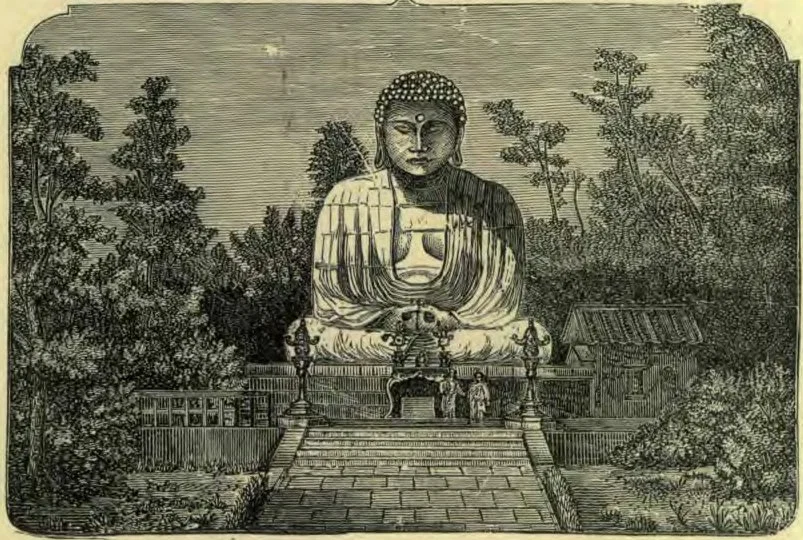
When he had brought it, his uncle said, “This is the image of Buddha. Buddha is the god the people worship. The images are not all as small as this; some of them are quite large, and the people build beautiful temples to put them in. This idol is made of wood, but many of them are made of stone, brass, or ivory.
“When you walk along the road, you quite often see among a cluster of trees a little temple with a long, tapering spire. Perhaps you will see a man going in to worship. He has in his hands an offering for Buddha. He goes and lays this down quite a way from the idol, and then drops on his knees, and putting the palms of his hands together, bends over till his face touches the ground. Then he mutters his prayers, and laying his offering at the feet of the god, goes home. They do not go to worship in companies as we do here, but each one goes by himself. They have no weekly meetings, and the little heathen children have no Sabbath-school to go to.”
“Oh, I’m so glad,” said Carrie, “that we live in a country where we are taught about the true God, and have a chance to go to Sabbath-school.”
“Dear me! there goes the school-bell,” said Harry.
“Well, get your things and run right along,” said their uncle, “and I’ll go and write some letters; then may be this evening we’ll have time to talk some more about this curious people.”
W. E. L.
SILK
By Little Star
THIRTY-FIVE hundred years ago there lived in China a woman named Si-ling-che. That appears to us a great while ago, and we are accustomed to fancy that the people who lived then were very different from ourselves; but I think Si-ling-che was much like the women of the present day. She was a great lady, the wife of the emperor, and all the people did her honor. She was not forced to toil for her daily bread, but she was not an idle woman. While her husband, Hoang-ti, was busy, laying the foundations of the government that has survived all the changes of these centuries, she was looking about to see what she could do for her people. I doubt not, queen though she was, she understood the art of spinning linen, and kept the maidens around her, busy manufacturing the robes worn by the royal household.
One day, this lady, Si-ling-che, was walking in her garden. A colony of silk worms had established themselves on a mulberry tree, and their soft, delicate cocoons hung thickly on the low branches. She filled her hands with them, and caught the tiny threads on her fingers, exclaiming, “How soft and beautiful it is—how much better than the linen or the finest of the wools!” Day after day she returned to the tree, and the desire to reel the silk from the cocoons grew to a determination to do it. She applied herself with patience and care to her task. How long she was baffled we do not know. Long enough to try her patience we are sure, and to provoke the smiles of those who did not believe in her undertaking. But at last—perhaps it was by accident—she discovered the secret of success. The long threads were unwound from the cocoons, and twisted together. Then all the maidens were taken from their spinning, and taught to reel the silk, and soon the fair queen and her husband, Hoang-ti, were arrayed in robes more beautiful than had ever before been seen by mortal eyes. Si-ling-che must have been pleased with her beautiful robe, and proud of her success; but I wonder if she dreamed that she had made her name immortal, that in far-off lands and distant ages those who would wear the silk-worm’s thread would remember her with gratitude, and in her own country divine honor would be paid to her?
For twenty-two centuries the Chinese kept the art of manufacturing silk a secret in their own country. The merchants carried it into other countries, and sold it to kings and queens, who reckoned a silken robe among their choicest treasures. In the early part of the Christian era it was worth its weight in gold in the cities of Greece and Rome.
Two Nestorian monks, who had traveled into China as missionaries, and who had there discovered the methods of reeling the cocoons, returned to Rome in the year A. D. 555. They brought with them silk-worms’ eggs, concealed in the hollow canes which they used as walking-sticks. They revealed to the Emperor Justinian the Chinese methods of raising the silk-worms, and of manufacturing the silk. This industry soon spread through the south of Europe, and the silks of Italy and France filled the markets of Europe.
The invention of machinery has lessened the cost of manufacturing silk, and now it is so cheap that few of us are so poor that we cannot have more than kings and queens could once afford.—Little Star.
Maxims on Wisdom, Strength, Wealth, and Honor
Who is wise? He that is teachable. Who is mighty? He that conquers himself. Who is rich? He that is contented. Who is honored? He that honoreth others.
SNOW-BALLING
The snow, the snow, the fairy snow, the pure white falling snow!
How pulses leap and hearts beat high, and cheeks with color glow,
To throw the soft white balls about, with shouts of boisterous glee;
And mirth and mischief, hand in hand, show friendly rivalry.
O children! whilst in rude, hale health snow-balling ye enjoy,
And whilst the snowy pastime doth your play-time hours employ,
Think of the poverty that creeps unheeded by the door,
And of abundance give your mite unto the suffering poor.
The Love of God Inspires Pleasing Him
THE love of God makes us try to please him in all things, and we, by this, gain the love of him who is able to help at all times of need.
CHILDREN'S HYMN
From the sunny morning
To the starry night,
Every look and motion
Meets our Father's sight;
From our earliest breath
To our latest year,
Every sound we utter
Meets our Father's ear.
Let us, then, be careful
That our look shall be
Brave and kind and cheerful
For our Lord to see.
Help us, O our Father!
Hear our earnest plea—
Teach thy little children
How to live for thee. —Selected.