The Youth’s Instructor, Vol. 31, No. 6.

THE DEAD SEA

The Youth’s Instructor

Feb 7, 1883

S. D. A. Publishing Association · Battle Creek, Mich. · Feb 7, 1883

THE DEAD SEA.
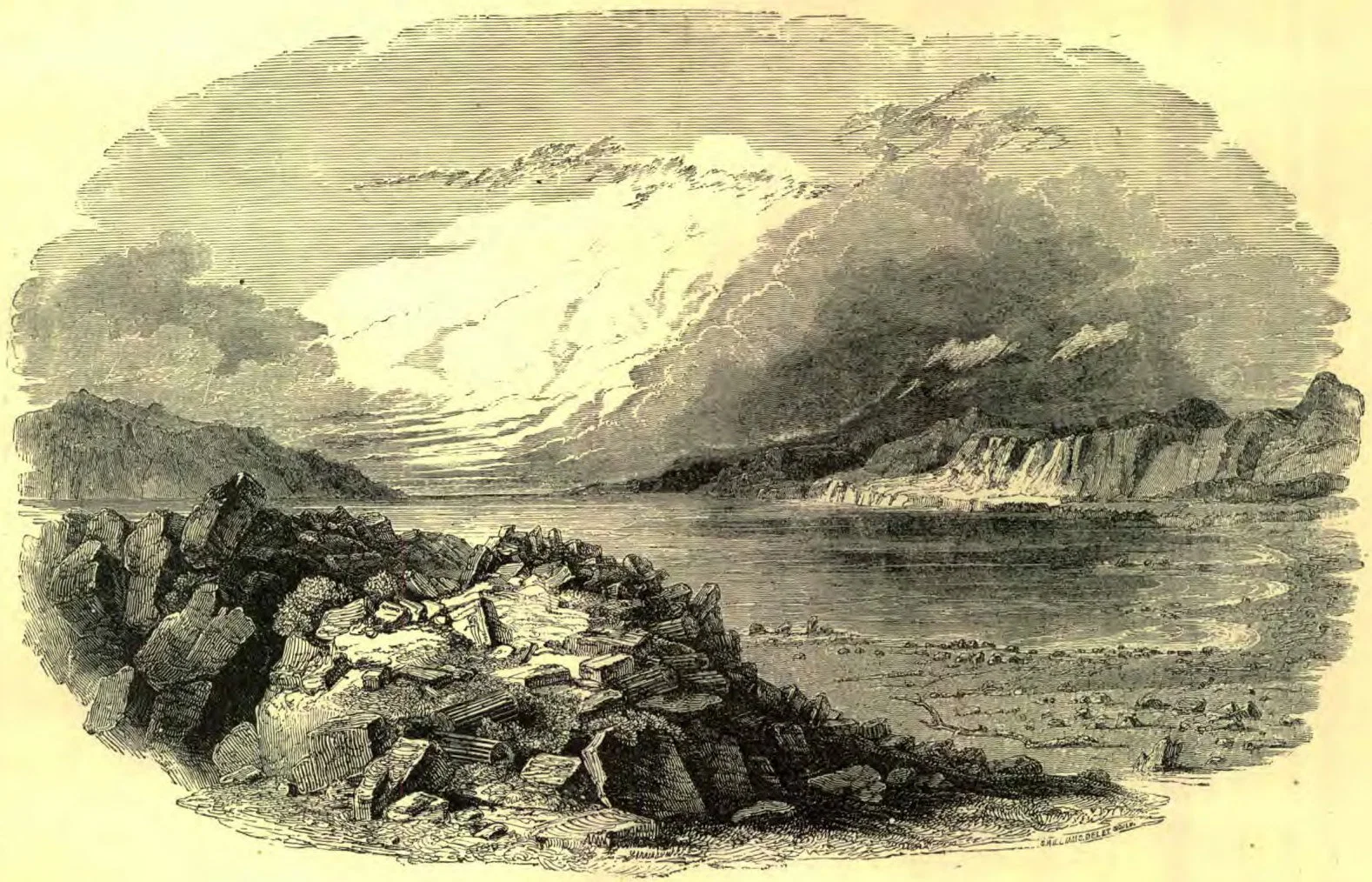
THE Dead Sea fills up the southern end of the Jordan valley. The mountain chains which shut in the valley become here steeper, wilder, and bleaker. In some places they rise in lofty precipices of naked rock from the bosom of the waters; in others they retire, forming wild nooks and yawning ravines, fitting homes for the wild goats which still inhabit them. The scenery of the lake is bare and desolate, but grand. The water is clear and sparkling, a deep and beautiful azure when the sky is cloudless, but reflecting vividly every changing hue of the firmament. In summer, when the heat is intense, a thin, whitish, quivering vapor hangs over the surface of the water, and gives a strange dreamy indistinctness to the mountains. At the northern and southern ends, the flat plains are parched and barren, in part covered with fine sand, and in part with a white nitrous coating like hoar frost. Brackish and sulphur springs occur at intervals around the whole borders of the lake. Some of them are warm, and send up clouds of steam. At one or two places along the western shore, and also at the southern end of the lake are slimy pools and marshes, whose exhalations of sulphuretted-hydrogen taint the atmosphere for miles. Strewn along the northern shore, especially near the mouth of the Jordan, lie large quantities of drift-wood, brought down by the swollen river, and it is everywhere encrusted with salt crystals. The great depression, the fierce rays of an unclouded sun, the white soil below reflecting the sun’s rays, give the whole basin of the Dead Sea a temperature like that of a furnace. Never did I suffer so much from intense, suffocating heat as during the days I spent on the shores of this lake.
Yet still it cannot be called a “sea of death,” in that sense in which travelers in former ages were wont to represent it. It has been stated that no vegetation could exist along its shores, and that no bird could fly over it; that, in fact, its poisonous exhalations are fatal alike to animal and vegetable life. This is altogether untrue. At every little fountain along the shores, the vegetation has a tropical luxuriance. I have seen the oleander dipping its gorgeous flowers into the lake; and I have seen the willow and the tamarisk, and numerous other shrubs flourishing where their stems were at certain seasons immersed in the waters. The cane-brakes on the shore abound with wild fowl; and occasionally flocks of ducks may be seen swimming far out on the sea. The water, however, is intolerably salt and bitter, and no fish could live in it. Yet it is not altogether destitute of living creatures, a few inferior organizations having been found in it by recent naturalists. Its specific gravity is so great that the human body will not sink in it. I have tried it myself, and can, therefore, testify to the truth of the fact. This is easily accounted for. The weight of water increases in proportion to the quantity of salt it contains in solution. Ordinary sea-water has about four per cent of salt, whilst that of the Dead Sea contains more than twenty-six per cent.
—Porter.
This sea is forty geographical miles in length, and its greatest width is nine miles, although these dimensions vary somewhat according to the time of the year. Its greatest depth is about thirteen hundred feet; and the surface of the sea is some thirteen hundred feet below the level of the Mediterranean Sea, thus making it the most depressed sheet of water in the world. For this reason it can have no outlet; but though the Jordan and its tributaries daily pour an immense amount of water into the sea, the evaporation is amply sufficient to carry off the supply.

A Fault Confessed Is Half Redressed

A FAULT confessed is half redressed.

A STORY OF THE PAST.

A WARM bright afternoon in August. Plenty of work going on in Mrs. Kilburn’s log cabin. Such a pretty spot as that cabin stood in! Just at the foot of one of the New Hampshire hills, lovely green meadows stretching out before it, and in the distance the Connecticut River slipping lazily by. Inside the house, as I said, work was going on. Mrs. Kilburn and her young daughter always had work to do. What with cutting and contriving and planning all the clothes for their own household, even the coats and pantaloons for father and the boys, added to everything else that they had to do, kept them busy enough.
On this particular afternoon, it was cooking that was being done. To-morrow some of the friends who lived quite a distance away were coming to see them, and mother and daughter were very anxious to show how nicely they lived in their log cabin, and how many comforts they had.
Out in the field Mr. Kilburn and his son John, with a neighbor and his young son, were at work with the wheat. A splendid crop they had, and while they worked, they talked together about the coming winter, and how the great harvests that were gathering in would save them from many of the trials of last winter. Cheery, hopeful talk, and hard work.
Suddenly came Ruff, the dog, bounding along at full gallop, his hair seeming to stand up all over his back, his ears set as if in rage, and uttering low growls.
“Look at Ruff,” said Mr. Pike, the neighbor. “What is the matter with him?”
Mr. Kilburn dropped his scythe and seized his gun.
“Indians!” he said briefly. “Come on, boys. Let’s make for the house! There is no time to lose when Ruff looks like that.”
John was acquainted with Ruff’s habits, and had seized his own gun even before his father spoke, and was now taking long steps toward home and mother.
“The Indians are coming!” he said to his mother the instant he pushed open the cabin door.
Do you suppose she screamed, and the little girl fainted? Not a bit of it. She dropped the tin she was setting in the oven, it is true; but she said quietly,—
“Get the guns.”
And in less time than it takes me to write it, mother and daughter each were armed with a gun, the men were inside, their guns leveled, the doors barred, and two hundred Indians were yelling around them outside.
There was one thing about their log house that you will not be likely to see in any house nowadays. All over the roof there were loop-holes for guns to be pushed out! The Indians yelled at the family to come out, and promised to save their lives if they would give themselves up as prisoners.
“Come out, old John! Come out, young John!” they said.
Do you suppose the father and son went out? Not they! Instead, they pushed their guns through the loop-holes and fired. So did Mr. Pike and his son; and as they fired, Mrs. Kilburn and her little daughter loaded other guns, and pushed them up through loop-holes for the men to fire.
What a battle it was! Bang, bang, bang! went gun after gun, mother and daughter loading them so fast that the firing could be kept up all the time; and the Indians were made to think that the house was full of armed men. One after another their number fell, as the guns of the two brave men and the two brave boys were aimed at them. Meantime the Indians had guns too, and as they grew angry, they began to creep nearer the house and fire their bullets down through the roof. Down they battered like great drops of hail about that mother and daughter, yet not one hit them, and not for a second did they stop their work of loading guns. At last Mrs. Kilburn said,—
“We are almost out of bullets!”
Then, in another instant,—
“Why, no, we are not! Run, child, run for a thick blanket; I’ll hang it up and catch the bullets that come through the roof. Get the ladle, child, hold them in the fire; we’ll melt their bullets and run them again; and they shall furnish us the means to save our lives!”
How fast they worked! How speedily the great fire, ready for baking, ran those spent bullets into melted lead, and with what eager haste they were run into shape again! Then out they whizzed to do their duty, and to defend the lives inside.
Think what an afternoon it was! Think of the hills of New Hampshire looking down on such a scene as that! Think of the Connecticut River flowing by amid such sounds as those! All the long August afternoon the fight continued. One bullet slipped the blanket and hit poor, brave Mr. Pike, and he fell down; but he said,—
“Don’t stop for me; go on.”
And they had to go on, while he lay suffering. But at last, at last, the Indians having lost so many men, grew frightened; and when an Indian is frightened, he runs. They concluded that a great army was hidden in the log cabin; or that the Great Spirit was helping the people inside. So they killed all the cattle they could find, set fire to the lovely fields of wheat, and went yelling away, conquered by two men and two boys, and a woman and a girl.
When was all that? Can you believe that it was not so very much over a hundred years ago? Does it seem possible?
Dear me! I don’t suppose John Kilburn lay in bed until seven o’clock in the morning, and then grumbled because he had to get up so early, and wished there was no such thing as school. But that is what I heard John Barlow say one day. Neither do I believe that the little girl who melted bullets cried all that evening because she could not have her new blue dress trimmed with velvet; yet Katie Lewis, who studied about this very girl in her history lesson this morning, spent this very evening in tears over just such an important matter. Are the girls and boys really worth less than they used to be?
“I don’t care,” said John Barlow. “I’d just like to have lived in those days; there was something worth living for. There is nothing to be brave about nowadays; a fellow hasn’t half a chance. I’d like to fight Indians first-rate.”
The idea! There was an Indian had him in his grasp only yesterday, and he made not the slightest attempt to fight him. The name of the Indian was Ill Temper. Do you know him?—The Pansy.

MAKING CHARACTER.

MANY people seem to forget that character grows; that it is not something to be put on, ready-made, with manhood or womanhood; but, day by day, here a little, and there a little, it grows with the growth and strengthens with the strength, until, good or bad, it becomes almost a coat of mail.
Look at a model man of business—prompt, reliable, conscientious, cool and cautious, yet clear-headed and energetic. When do you suppose he developed all these admirable qualities? When he was a boy. Let me see the way in which a boy of ten years gets up in the morning, work, plays, studies; and I will tell you what kind of man he will make. The boy that is late at the breakfast-table, late at school, who never does anything at the right time, stands a poor chance to be a prompt man.
The boy who half washes his face, half does his sums, half learns his lessons, will never make a thorough man. The boy who neglects his duties, be they ever so small, and then excuses himself by saying, “Oh, I forgot! I did n’t think!” will never be a reliable man.
The boy who finds pleasure in the pain and suffering of weaker things, will never be a noble, generous, kindly man—a gentleman.

FRED IN THE ARMY.

FRED thought he would like to be a soldier. He had read in history about the great wars of Cæsar, Alexander, and Napoleon. He never lost a chance to see a military parade. The sound of the drum and fife set his feet and hands going in time to the quick movement, and he was longing for the time when he should be old enough to be a soldier himself. Fred’s mother did not like these martial tastes of her boy. She thought war was a terrible thing. She could not bear to think that men who ought to help one another should do all they could to fight and kill those to whom life was as sweet and friends as dear as to themselves.
One day Fred said to her, “Mother, when I get older, I mean to be a soldier.”
“You are old enough to be a soldier now,” answered his mother, with a smile.
“Why, mother, what do you mean by that?” asked Fred, in amazement. “You know I am only thirteen years old, and I could not think of being a soldier until I am eighteen or twenty at least. Perhaps you mean that I could be a drummer-boy, for I was reading in my war history about some drummer-boys who were only twelve; but it seems to me that the drummer-boys don’t have very much to do.”
“We are now at peace with the world,” said his mother, “and our soldiers do not have to fight; but there is a war which is going on now. It is a war which always has been going on, and I think it never will stop.”
“What war is that, mother? I am sure I didn’t know that there was any great war in the world anywhere now.”
“I mean the war against sin,” said she. “And in this war I want very much to have you a soldier, enlisted on the right side. You know we are all on one side or the other.”
“Well, mother,” said the frank-hearted boy, “I believe I should like to be a soldier in that war, and of course I want to be on the right side; but sometimes it is hard to tell which the right side is.”
“No, my son,” said the kind mother; “the right side is that of Jesus Christ, and I want you to be on his side.”—Youth’s World.

A Boy's Religion: Leigh Richmond's Counsel to His Son

“My son,” said Leigh Richmond, “remember you must die, and you may die soon, very soon. If you are to die a boy, you must look for a boy’s religion, a boy’s knowledge, a boy’s faith, a boy’s Saviour, a boy’s salvation; or else a boy’s ignorance, a boy’s obstinacy, a boy’s unbelief, a boy’s idolatry, a boy’s destruction. Remember all this, and beware of sin; dread the sinfulness of an unchanged heart; pray for a new one; pray for grace and pardon, and a mind conformed to the image of Christ.”

TRUST

MAKE a little fence of trust About to-day, Fill the space with loving work, And therein stay.
Look not thro’ the sheltering bars Upon to-morrow; God will help thee bear what comes Of joy or sorrow. —Friend’s Intelligencer.

SCENES IN THE LIFE OF CHRIST.

LESSON 107.—THE CRUCIFIXION.

“And when they had mocked him, they took off the purple from him, and put his own clothes on him, and led him out to crucify him.” “And as they led him away, they laid hold upon one Simon, a Cyrenian, coming out of the country, and on him they laid the cross, that he might bear it after Jesus.”
“And there followed him a great company of people, and of women, which also bewailed and lamented him. But Jesus turning unto them, said, Daughters of Jerusalem, weep not for me, but weep for yourselves, and for your children.”
On his way to be crucified, Jesus was accompanied by two thieves, who were also to be put to death. When they had come to a place called Golgotha, they gave Jesus a drink consisting of sour wine mingled with myrrh. This they put to his lips, but he refused to drink it.
About the third hour, which was nine o’clock in the forenoon, they crucified him, and also the two thieves, the one on his right hand and the other on his left. Then Pilate wrote a title or superscription, and put it on the cross. The title read as follows:—
“JESUS OF NAZARETH, THE KING OF THE JEWS.”
“This title then read many of the Jews; for the place where Jesus was crucified was nigh to the city; and it was written in Hebrew, and Greek, and Latin. Then said the chief priests of the Jews to Pilate, Write not, The King of the Jews; but that he said, I am King of the Jews. Pilate answered, What I have written I have written.”
While Jesus was thus hanging upon the cross, his heart was moved with the deepest pity for those who treated him with such cruelty. He knew that they did not fully realize the enormity of the sin they were committing, and put forth a most touching and remarkable prayer, saying, “Father forgive them, for they know not what do.”
“Then the soldiers, when they had crucified Jesus, took his garments, and made four parts, to every soldier a part; and also his coat: now the coat was without seam, woven from the top throughout. They said therefore among themselves, Let us not rend it, but cast lots for it, whose it shall be: that the Scripture might be fulfilled, which saith, They parted my raiment among them, and for my vesture they did cast lots. These things therefore the soldiers did.”
“And they that passed by reviled him, wagging their heads, and saying, Thou that destroyest the temple, and buildest it in three days, save thyself. If thou be the Son of God, come down from the cross. Likewise also the chief priests, mocking him, with the scribes and elders, said, He saved others; himself he cannot save. If he be the King of Israel, let him now come down from the cross, and we will believe him. He trusted in God; let him deliver him now, if he will have him; for he said, I am the Son of God.”
“And one of the malefactors which were hanged, railed on him, saying, If thou be Christ, save thyself and us. But the other answering, rebuked him, saying, Dost not thou fear God, seeing thou art in the same condemnation? And we indeed justly; for we receive the due reward of our deeds; but this man hath done nothing amiss. And he said unto Jesus, Lord, remember me when thou comest into thy kingdom. And Jesus said unto him, Verily I say unto thee, To-day shalt thou be with me in paradise.”
“Now there stood by the cross of Jesus his mother, and his mother’s sister, Mary the wife of Cleophas, and Mary Magdalene. When Jesus therefore saw his mother, and the disciple standing by, whom he loved, he saith unto his mother, Woman, behold thy son! Then saith he to the disciple, Behold thy mother! And from that hour that disciple took her unto his own home.”

QUESTIONS.

1. How did the soldiers treat Jesus when he was given into their hands to be crucified? Mark 15:20.
2. Who was compelled to bear the cross of Jesus as they led him away? Luke 23:26.
3. Who followed him as he was on his way to Calvary? Verse 27.
4. What did Jesus say to the women who bewailed and lamented him? Verse 28.
5. What malefactors accompanied Jesus to the place of execution? Verse 32.
6. When they came to the place called Golgotha, what did they give Jesus? Mark 15:22, 23.
7. How did he receive it?
8. At what time of day was Jesus crucified? Verses 25, 27.
9. What title, or superscription, did Pilate put upon the cross above the head of Jesus? John 19:19.
10. By whom was this title read?
11. What circumstance favored its being read by so many people?
12. In what languages was it written?
13. What change did the chief priests want Pilate to make in this superscription?
14. What did he say to them?
15. While Jesus was hanging upon the cross, how did he feel toward those who were treating him with such cruelty?
16. How did he show his compassion for them? Luke 23:34.
17. How did the soldiers dispose of the garments of Jesus? John 19:23.
18. What was there peculiar about the garment called his coat?
19. What did they conclude to do with it?
20. What scripture was thus fulfilled?
21. How was Jesus treated by those who passed by the cross? Mark 15:29.
22. What did they say to him?
23. What did the chief priests, the scribes, and the elders mockingly say to him?
24. How did one of the malefactors who were crucified with him join in railing on Jesus? Luke 23:39.
25. How did the other malefactor answer him?
26. What did he say to Jesus?
27. What encouragement did our Lord give him?
28. What women were among those who stood near the cross? John 19:25.
29. How did Jesus show that he wished his mother to be adopted by the disciple John?
30. How were his wishes carried out?

NOTES.

Coat.—The Jews wore two principal garments, an interior and an exterior one. The interior one, commonly called the coat, or the tunic, was usually made of linen, and covered the whole body, extending down to the knees. It seems, however, that this garment of the high priest was made without seam, and so woven as to give openings for the head and the arms. Thus the Lord Jesus, the great High Priest of his people, had also a seamless coat.
“And Jesus said unto him, Verily I say unto thee, To-day shalt thou be with me in paradise.”—It is thought by some commentators that the comma before to-day should be placed after it, thus making it read, Verily I say unto thee to-day, thou shalt be with me in paradise. This certainly seems to be the most reasonable view to take of it. “Yes, says the suffering Saviour, in the hearing of the mocking multitude, I say unto thee to-day—to-day, in this hour of my darkness and agony—to-day, when the fatal cross is apparently giving the lie to all my pretensions—to-day, a day of forlorn prospects and withered hopes, so far as human eyes can see—verily, to-day, I say unto thee, thou shalt be with me in paradise, when my kingdom shall be established in triumph and glory.”

NEW-TESTAMENT HISTORY SERIES.

LESSON 121.—THE JEWS UNDER THE PERSIANS.

1. WHEN was Babylon conquered by the Medo-Persians?—Before Christ 538.
2. Who ruled in Babylon for the first two years after this conquest?—Darius the Mede.
3. Who took the throne after the death of Darius?—Cyrus.
4. How long did he reign?—Probably about seven or eight years.
5. Who then reigned about seven months?—Wicked Smerdis.
6. How long did his successor, Cambyses, occupy the throne?—About eight years.
7. Who reigned next?—Darius Hystaspes.
8. In what year of his reign was the temple at Jerusalem completed?—The sixth.
9. How long did he reign after that?—About thirty years.
10. What caused the Babylonians to revolt during the first years of this monarch’s reign?—They were enraged because the seat of government had been removed from Babylon to Susa.
11. How did Babylon suffer in consequence of this rebellion?—Its gates were taken away, and its walls were reduced one-fourth their original height.
12. How did Darius succeed in his attempt to conquer the Greeks?—His immense army was defeated on the plains of Marathon, and before he could raise another, he was overcome by death.
13. Who succeeded Darius Hystaspes?—His son Xerxes.
14. How long did Xerxes reign?—About twenty or twenty-two years.
15. For what was he noted?—For invading Greece with the greatest army ever known.
16. What was the result of this project?—The Persians were driven back into Asia with immense loss of life, shipping, and stores.
17. Who reigned for the next forty-one years after the death of Xerxes?—Artaxerxes Longimanus, who is supposed to have been the Ahasuerus of the Book of Esther.
18. How did he favor the Jews?—He married a Jewess; made Mordecai, the Jew, his prime minister; and sent Ezra and Nehemiah, with men and means, up to Jerusalem to complete the restoration and rebuilding of Jerusalem.
19. When did these men go up to Jerusalem?—Ezra in B. C. 457, and Nehemiah in 445.
20. How long were the Jews subject to the Babylonians?—About seventy years.
21. How long had they been under the control of the Persians when Malachi gave his prophecy?—About one hundred and twenty years.
22. How much longer did they remain subject to that power?—About eighty-three or eighty-five years.
23. What Persian kings have we already noticed?
24. When did the reign of Artaxerxes Longimanus terminate?—B. C. 423.
25. Who was the next monarch of Persia?—Darius Nothus.
26. When did he die?—B. C. 404.
27. Who reigned from 404 to 358 B. C.?—Artaxerxes Mnemon.
28. For what was this king noted?—For the mildness and magnanimity of his reign.
29. Who succeeded him?—Ochus.
30. For what was he noted?—For the conquest of Egypt.
31. How was Ochus, with most of his family, destroyed?—By Bagoas, an Egyptian eunuch in the employ of the Persian government.
32. How did Bagoas conduct the affairs of state?—He first put upon the throne Arces, the youngest son of Ochus, but slew him in the third year of his reign, and made Codomannus, the governor of Armenia, king.
33. How was the reign of Darius Codomannus brought to a close in about four years?—Alexander the Great completed the conquest of Persia B. C. 331.
34. How long was Persia the leading kingdom of the world?—About two hundred and seven years.
35. What was the prevailing attitude of the Persian kings toward the Jews?—They treated them with kindness, leaving them, in the main, to the control of their own high priest.

Pastors and Teachers Who Neglect Their Duties

Suppose the pastor, every few Sabbaths, should fail to appear in his pulpit at the hour of service, with no substitute and no notification of his absence, leaving the elders to hold some kind of a meeting or send the people away—how long could such a pastor retain his place? Teachers who stay away from their classes and make no provision for them, can work out the meaning of this paragraph.—Westminster Teacher.

Sabbath School Lessons in the Home

Do not omit to have the Sabbath-school lessons a matter of study and discussion in your homes. Every Christian home should be a kind of Biblical Seminary. What exercise so profitable, or what fellowship so sweet and so lasting, as that which is linked with the study of the word of God? Down deeper into this blessed work! There is no time to waste. Remember, your own time, as well as that of the young, is precious.
Continue reading: BUDDHA