Senior No. 9—Lesson 15: “History of William Miller,” Pages 11-114
1. WHERE did the compilers of this biography get their material? See preface.
2. What characteristics did William Miller inherit from his ancestors?
3. Describe briefly the era in which he was born. What is known of his childhood home? What shows his great love for books?
4. Describe the young woman whom Mr. Miller married. What public office did he hold? What led him to become a deist? What double warning may we receive from this experience?
5. During what war was Mr. Miller connected with the army? What qualifications for leadership did he possess? What experiences in the army helped to lead him back to God?
6. Describe Mr. Miller’s conversion, and the changes it brought into his home and daily life. How did he study the Bible? What conclusions did he reach concerning it?
7. How many rules did Mr. Miller lay down for Bible interpretation? Read carefully his proof for each rule. Make a list of the prophecies and doctrinal points mentioned on pages 81-85. How did the Bible chronology strengthen his faith? What three important dates does he mention?
8. What points in Bible doctrine do Mr. Miller’s twenty articles of faith cover? What important points are omitted?
9. Why did Mr. Miller not enter public work at once? What dream came to him? What text kept ringing in his ears? Describe his visits with Mr. Hendryx and his neighborhood physician.
Junior No. 8—Lesson 15: “Friends and Foes in Field and Forest,” Pages 105-135
1. WHY is the mantis called a hypocrite? Why do the natives in South Africa worship it? How are the baby mantises treated? Why does the gardener like the mantis? How does the mantis sometimes deceive bees and other insects?
2. What decides the color of the katydid’s dress? Why does this insect begin to sing about the first of August? Do all katydids sing?
3. What is the walking-stick insect? Where does it live? What peculiar little insect is found in Sumatra?
4. Give some of the different names by which the dragon-fly is known. To what family does it belong? What have you learned about its eyes? its wings? its food?
5. How long does the dragon-fly live under water? How does it breathe and move? What does it eat? How does it leave its home to live in the air?
6. What did the children find the day they visited the waterfalls? What did they learn about the fly that carries its home with it? about the fly that can swim both in air and in water? about the fly that has no mouth, and lives only one day?
7. How do you think the ant-lion got its name? Where does it live? How does it walk? Why is it called a clever trapper? Mention three lessons boys and girls may learn from the ant-lion.
8. Where do the white ants live? To what family do they belong? How do the workers and soldiers differ from the kings and the queens?
9. What have you learned about the eyes of the workers? How do the blind soldiers protect the homes? Tell about the way they fight, and how the natives in New Guinea attack them.
10. Describe the house the white ant builds. Prove that the walls of its house are very strong. What does it keep in its storerooms?
11. Describe the king and the queen. How many eggs does the queen lay daily? Name some of the enemies of the white ant, and tell what they do?
12. What do white ants eat? What happened when they9visited a church in Sydney, Australia? What had they done to the book seen in the museum? to the arsenal in France? to the dining room?
13. What lesson may be learned from these destructive little creatures?
Up in a Zeppelin
THE building of a Zeppelin is not the work of a day. The construction takes months; and when that is done, still more time must be spent in testing the airship.
To think of a Zeppelin leaving its shed and flying straight into the fight is folly. Each new vessel means a certain amount of experimentation, and until it has been carefully tried and tested it would be unwise to undertake serious work with it.
A Zeppelin is as large as a battleship, and as complicated. Stretched in a framework of girders, there are from seventeen to twenty-five balloonettes. Over these and over the girders is an outer skin of waterproofed canvas. Slung under the great length of the balloon frame is a line of cabins for the engines and the crew.
Right in front is the station of the lookout man who is in charge of the starting and the landing; the anchors are slung beneath him. In the first cabin, which is entirely covered in, are two petrol engines. Behind this is the gangway, fitted up with sleeping berths for the crew. In the center is the observation station. It is from here that the bombs are dropped, and here the gun is mounted, if the airship carries one. Here are the marvelous steering and sighting apparatus and the wireless plant.
An experienced aviator went up in a Zeppelin for a nine-hour flight. It was an interesting experience, although the noisy creaking of the great hull whenever the engines back-fired, or a gust of wind caught the huge surface, was disturbing. When the engines jumped, the entire Zeppelin jumped with an awful jar in all its joints; the wind currents took it and made it pitch at a dozen angles at once, and the passenger looked fearfully aloft, fearing every minute that the back of the monster would break and send him and the crew all hurtling to the earth.
When he disembarked, he watched one of the crew open the skin stretched over the framework of the aluminum girders, and go inside. Then he saw the man begin throwing out bolts and nuts by the handful. The strain of the flight had had its effect on the hundreds of aluminum girts that support the balloon inside the outer skin. Aluminum is a soft metal, and under the jarring all those bolts had worked loose and fallen out.
It seemed to the watcher that half the nuts and bolts in the dirigible had worked loose, and he was told that after every voyage of any length, hundreds of nuts have to be replaced.—Christian Endeavor World.
The Last Hired, First Fired: The Boozer
“THE last to be hired, the first to be fired—the boozer.”
NOTE.—Three weeks’ outlines are given in the Bible Year this week, in order that those in the INSTRUCTOR and the Review may be in harmony.
The Bible Year and the Morning Watch
By A. B. E.
Plans for 1916
THE daily assignments for reading the Bible through by course are given, without notes or comments of any kind, in the Morning Watch booklet. Beginning with this issue, these assignments are given in the same way in the INSTRUCTOR. These are merely a guide to the reading. However, so many of the older believers have expressed a desire to follow this course, and so many of the young people are planning to take it, that it has been decided to carry it in the Review during the year 1916, somewhat as was done last year in the INSTRUCTOR. In this way the plan will reach all our people, young as well as old.
In addition to the daily assignments for Bible reading, in the Review, suggestive helps will also be given. The historical setting of the books, the history of their writers, the great themes treated and the underlying purpose of their presentation, with various outlines, helpful lessons, illustrations, etc., will appear from week to week. These are not intended to take the place of original study and research on the part of those reading the Bible by course, but especially as aids to those whose opportunities for outside reference work are limited.
In the Review of December 30 the assignment for the first week of the new year was given. This number of the Review will be in the hands of the believers in the Eastern and mid-Western States in time for them to begin the reading promptly. Those living at a greater distance may not receive the Review till the following Monday, but they will still be able to use the helps through the week.
During the last twelve months this plan of daily Bible study proved a great blessing to many; and it is earnestly hoped that, by this new arrangement, many more will avail themselves of this systematic plan of Bible reading during the coming year.
While the Review will have, during 1916, this special helpful material on the Bible Year, the INSTRUCTOR will give space each week to matter prepared especially for the Morning Watch. This is designed to be of a nature to aid in spiritual growth, in prayer, and in forming the habit of meditating on God’s Word.
Remember, the Bible Year and the Morning Watch do not in any way conflict, neither is the one to take the place of the other. The Bible Year looks to the reading of the Bible through once a year, by course, a few chapters every day. The Morning Watch looks to the special study of a certain text (this year the texts are on Christian experience) and a few moments’ meditation and prayer early in the morning, that the young Christian may be prepared and strengthened for the day’s duties. The memorizing of the texts given will, in the course of a year, add a great deal to his “preparedness” to meet the assaults of the enemy of souls. Both plans have a place, and both are needed to make you “athletic Christians,” and “to add muscle and sinew to your piety.” A. B. E.
The Morning Watch
By A. B. E.
What Jesus Is to Me
WHAT Jesus is to those who love him, what he longs to be, and what he will be during the endless ages, is a subject no mortal thought can grasp, no mortal pen do more than approach. It is fitting that the first month of the new year be given to a grouping of texts bearing on this matchless theme.
For what we need more than anything else is to know Jesus. Not to know about him, but to become acquainted with him. He knows us,—all our pretending, all our carelessness, all our neglect, all our selfishness, all our secret thoughts, all our hidden sins. He knows, too, all our temptations, our sorrows, our hopes, our plans, our ambitions, our longing for purity of heart and life, our desires — alas, how feeble and how few! — to be like him. And he longs to have us know him,—the power of his resurrection, with all that it means; the fellowship of his sufferings, with all that it involves,—know him as our Creator, Saviour, Guide, Leader, Example, Friend, Elder Brother, and Advocate.
But he will not thrust himself into our company; he will not enter the heart or the life unbidden. He comes to the door, he knocks, he gently calls,—but we must bid him enter; we must sit down with him, and let him speak to us through his Word and by his Spirit; we must think of him and talk to him. Only thus can we begin really to know him. And “the knowledge of the heavenly character of Christ’s person and work is what alone can make heavenly Christians.”
“Precious, gentle, holy Jesus,
Blessed Bridegroom of my heart,
In the secret, inner chamber,
Thou wilt show me what thou art.”
A. B. E.
A Suggestion
It will be helpful in keeping the thought of the daily texts in mind to make a brief outline. Cards, or a small blank book with ruled pages, may be used. The first text, 1 Peter 2: 24, presents Jesus as our Saviour. That is the first entry to be made. At the end of the week, the outline would be about as follows:—
Saviour 3. Saviour 5. Helper
Saviour 4. Creator 6. Guide
Witness, Leader, Commander
Using one page for each week will allow room for a brief record of special help, victories gained, progress made, prayers answered, or other notes that you may wish to make.
Life Is a Sheet of Paper White
“LIFE is a sheet of paper white,
Whereon each of us may write
His line or two, and then comes night.”
The Aborigines of Australia
By Bertha Shanks Chaney
(Concluded from last week)
BERTHA SHANKS CHANEY
NOT so long ago it was thought that skill in the making and using of weapons was a standard of culture to be applied only to savage races. Public opinion has apparently changed during the last fourteen months, and this test of culture is now being applied to highly civilized nations.
Judged by their weapons and their skill in using them, the Australian aborigines are not the lowest peoples of the earth. For purposes of offense they use a formidable reed spear, and to make it go farther and more violently, it is propelled by a curious “throwing stick.” This womera, or wommerah, to use the widely known native term, acts as does the cord of a sling in flinging a stone. The well-known boomerang is peculiar to Australia. Having found a piece of root of the proper curve, the black fellow laboriously chars and scrapes it to the desired thickness, sometimes ornamenting it with rude carvings. It is skillfully flung from the hand, and will rise in the air as high as a hundred and fifty feet, in circular courses, and return to the owner if it does not strike any object in its course. The natives are adept in hitting an emu or a wallaby with it.
There is a variety of clubs, some fairly light, to be used in the chase; others heavy and carved with prominences to increase the severity of the blow, for hand-to-hand fighting.
All these weapons were used as much in bringing down game as in warring with hostile tribes, but the defensive wooden shield was for war only. Shields, light and heavy, broad and narrow, may be found, all held by a handle scooped out of the wood at the back.
Three remarkable defects have been found universal among the blacks of Australia: they nowhere cultivated the soil for any food crop; they never built any kind of permanent dwelling; and they raised no cattle, nor kept any domestic animal except the dog. When the white man first came into contact with them, he found the dingo, a wild, savage kind of dog, domesticated; but now the introduced dog has supplanted the dingo, and in all their camps scores of mongrels lie about, living on a par with the children, and snapping and snarling at the intruder.
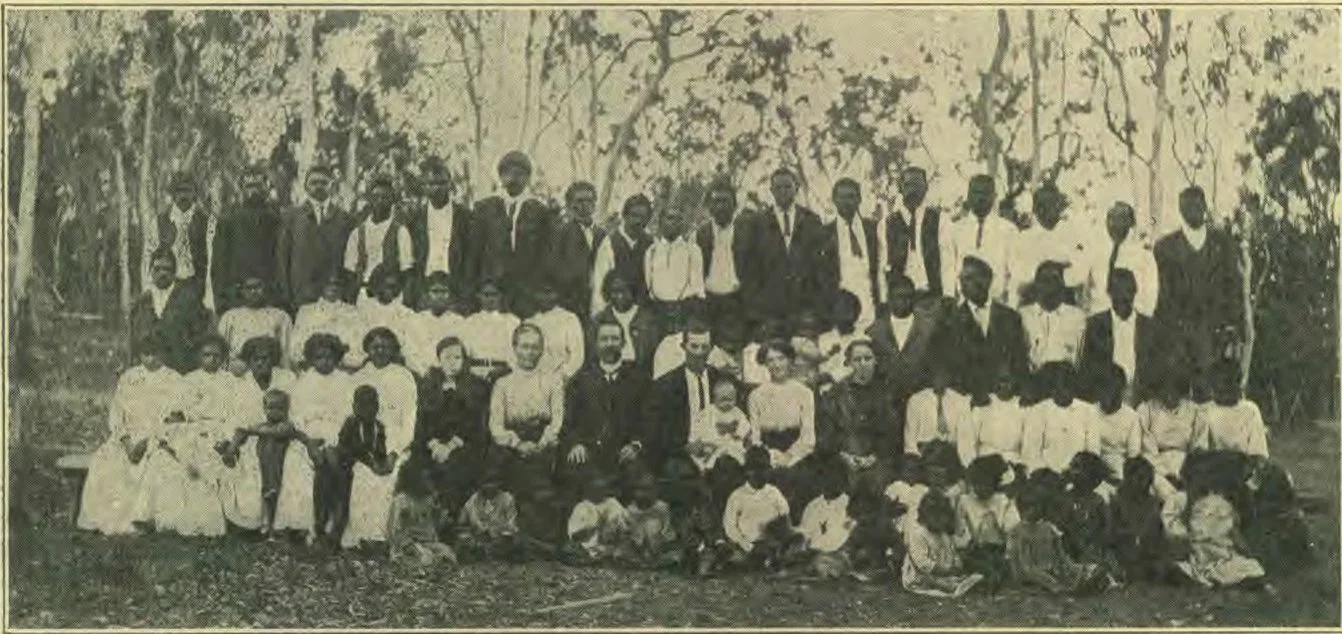
OUR MISSION FAMILY AT MONAMONA, AUSTRALIA
Perhaps in no other part of the world do the natives build poorer shelters for themselves than do these nomadic children of the bush. Their wurleys, miamias, or gunyahs, as they are diversely called by different tribes, are mere lean-tos, built of strips of bark or of branches daubed over with earth or clay to keep out the wettest of the rain. So low are the walls, and so narrow and small the entrance, that the owner must drop onto his hands and knees to creep in. Their glorious land of purple hills and sunlit plains furnishes an ideal climate for living out of doors, the main protection being made against a long, heavy downpour. Their huts, which are grouped together in camps or villages, are five or six yards from one another, and each family occupies its own quarters. Usually there is a separate wurley for the young men not yet initiated into manhood, or unmarried. In front of each, burns ever a small fire, which serves the double purpose of being ready for the cooking and of keeping away the dreaded evil spirits.
Nothing that creeps or walks or crawls or flies is scorned as food. Luscious grubs found in green trees, cicadas dug from the soil, bandicoots, snakes, porcupines, emus, all kinds of wallabies and kangaroos, fish and eels from the rivers and lagoons, all help to stock the family larder; and in the golden romantic past, men were also included in the list. In their netted bags the women gather seeds from grasses, tubers, fern roots, edible plants, and wild fruits, and clean them in their pichis, or wooden troughs. The men are expert in catching and spearing fish, often diving silently and transfixing them under water.
A change in fashion is the least trouble a black gin [a native woman] ever has to worry over. Blacks who live near or mingle with white people, have perforce to wear European clothes (after their own fashion), but there are still places where primitive styles prevail. About the only garment worn by men or women is an opossum rug. Sometimes a covering is made of a kangaroo’s hide. These are particularly needed and used in severe winter weather, and they make a fine receptacle in which the mother may carry her infant.11
The gins prepare the pelts by thoroughly cleaning them of the flesh, and after rubbing them with free-stone to make them pliable, the small skins of the opossums are neatly sewed together with sinews to make a garment of suitable size. Girdles with fringes are worn, too, more especially by the girls and women. Ornaments that are purely for vanity’s show are not many; strings of bright-yellow reed beads or of dog’s teeth, or a piece of polished shell,—these, and feathers for the hair on certain occasions, are all their simple natures have invented. But they love European beads and trinkets. A safety pin or a watch wheel makes a beautiful ear ornament.
We vision the untrammeled life of the black—his days spent in basking in the sunshine of the warm and fertile southland; his nights in dreamless sleep as he and his family lie curled around the smoldering camp fire. In our imagination he is a free child of nature, unfettered by creed or custom, with no memory of the past to oppress, no thought of the future to dread.
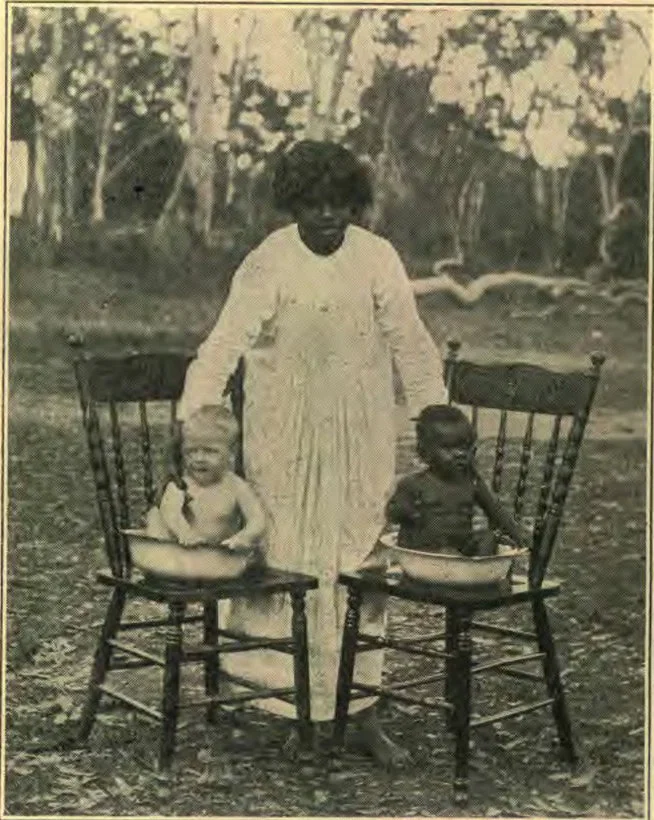
A FULL-BLOODED ABORIGINAL GIRL WITH HER CHARGES
But our vision is false. Nature does not provide bountifully in Australia without a great deal of sweating and hard work and heart-breaking failure, as the white settler knows to his cost. To provide game for a precarious living takes weary miles of travel and hours of stalking before it can be struck with spear or club. The black gin’s life is a toilsome quest for nardoo and fern roots, or of gathering wood for the fire, or catching lizards, rats, and other small creatures for the roasting oven. But beyond any hardship of work or endurance is the slavish chain of sorcery which binds him in every thought and act. No native, unless he may have come under the strong influence of a white man, was ever strong-minded enough to disbelieve or disregard its power. It is the bane of his life, waking or sleeping.
The mysterious, horror-filled art of sorcery may be practiced to a limited extent by any one, but to a few in every community was given in a dream extraordinary skill in its practice. These are the medicine men, or koradjis, who have power as they wish, to become invisible or invulnerable, to fly through space, to kill or cure, to bring thunder and lightning. Sickness or death is always laid at the sorcerer’s door. Death is caused by pointing a bone in the direction of the victim, and he dies. The koradji may cure by sucking a pebble or a piece of glass or a plug of tobacco or a half brick out of one’s leg or face or back.
Although the blacks live in a wretchedly low state of nomadic savagery, yet they have a remarkably complex social organization. There are laws or rules which govern a great many things—their relationship to one another, crude property rights, burial, and so forth. Marriage regulations prevent the union of near relatives, and these are rigidly kept. A man guilty of running off with a woman who is not his by tribal right, is killed, or else he must be strong enough to outclub those who try to put the law into execution.
The initiation ceremonies are positively forbidden to women, and a woman caught spying on the excited party of men who are going through them would be killed on the spot. Hints are thrown out to the women that something is to take place at which their presence is not wanted. Then the men from the different tribes, taking their young men with them, go off to a spot previously decided upon by the head men, and here long and intricate ceremonies are gone through, which last for days. During this time the bull-roarer is frequently sounded, warning the women and children off. The bull-roarer and some other sacred objects—pebbles, etc.—are never seen by the women, on pain of death. Years of study and inquiry have been given by men in government official positions, or otherwise closely connected with the native tribes, into the strange customs which hold these people. Long they held their tribal secrets very tenaciously.
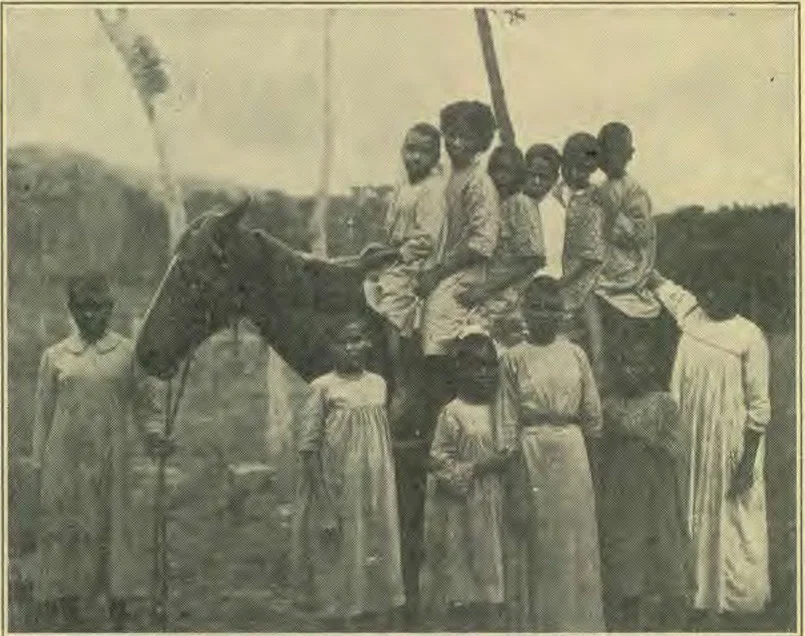
THE MISSION HORSE AND HIS FRIENDS
When the English first began to occupy Australia, using the colony as a dumping ground for the overflowing jails and correction houses of England, the blacks looked doubtfully on their arrival, and it was not long before the fatal clash began which ended in the white man possessing the land. Even when Cook, one of the wisest of heads in dealing with natives, was cruising up the eastern coast, the natives became hateful toward a party of his men who were obliged to spend a few days ashore, and set fire to the grass and partially destroyed the camp and stores.
The black man was, however, a very different antagonist from the red man of America, or the Maori of New Zealand. He was never the serious problem that either of the others was, as he was not of the fighting stamp, nor did he possess formidable weapons. Not only were the Australian natives too few and too scattered to start a general uprising, but they were incapable of organizing against a common foe. They could not successfully attack and destroy the first settlements, but there was continuous hostility between the two races.
If a small batch of convicts cleared off into the bush, they were killed. Any white person who heedlessly wandered from the settlement was overpowered and promptly dispatched. Cattle, brought from South Africa and raised with much difficulty by the starving, incompetent settlers, were driven away and killed. Hateful, petty deeds were constantly committed. Ceaseless retaliations were made, and blacks were abused, tortured, and killed at every chance. The treatment of the Australian aborigines is neither a12bright nor an honorable chapter in the history of English colonization.
But if in those early days they endured some unspeakable cruelties, we must not forget that the age itself was partially responsible. If in England itself the hangman’s noose was adjusted for the man who stole forty shillings, and a pickpocket was sentenced to death, we could not look for tender mercies to be extended in that unknown savage land at the ends of the earth, to miserable, naked, degraded savages who possessed not an attractive quality.
At the present day there are government reserves in some places for them; in other more or less inaccessible parts of the continent, where the climatic conditions have so far prevented white settlement, they roam at will, not far removed from their primitive state.
For many years blacks have been connected with the police force as trackers, their powers in this respect being positively uncanny. Not even the American Indian can equal them. A few are employed as shepherds and stockmen on the cattle runs, but they are too indolent naturally to be easily trained into habits of industry.
Since the European war started, the question has been discussed of training mounted regiments of half-castes, or even of aborigines. Half-castes are, according to reputation the best cattlemen and the best shots in the territory. Some think that the forming of strictly native military camps would help to solve the question of how to preserve this fast-dying race of the southern continent.
There are several admirably conducted organizations which watch over the welfare of the natives, but the problem of preserving a colored race when it comes in contact with a white race, is one that remains unsolved.
For many years attempts have been made by several religious bodies to establish and carry on missions among these dark people of the island continent. The Anglicans, the Presbyterians, the Catholics, and other denominations have missions among them. In these the natives are taught useful trades as well as the principles of the gospel, and a certain degree of success has crowned these noble efforts. But too often it has been found that the civilization with which they come in contact while being Christianized proves their undoing. It is not that the principles or the teachers of Christianity are at fault.
Our own denomination—the Seventh-day Adventist—has been interested for some time in this people, and an attempt was first made about four years ago, in the southern part of Queensland, to work for them. At first, two of our workers, as they could find time, visited and taught among them, on the government settlement at Barambah. Later, Brother and Sister P. B. Rudge were sent to spend their whole time and effort at Barambah. But, as Brother Branford in his report at the 1914 union conference, says, “it was soon found that the conditions prevailing on a government settlement hindered the progress of our work.
“Time after time, as Brother and Sister Rudge labored hard and long, and obtained a few interested ones, these would immediately be sent away, and the work would seem to be in vain. The difficulty with which the work was carried on, soon showed the great need of establishing a mission entirely under the control of our own denomination. Finally, it was decided by the union conference that the Queensland government be approached with the object of securing suitable land for mission purposes. This was done, and our request was very favorably received by the home secretary. Two brethren were sent to north Queensland to inspect blocks of land that were available for the purpose. In due time, a grant of a piece of land comprising four thousand acres was received. This land consists of grassy forest ridges, and abounds with permanent creeks. There are about seven or eight hundred acres of jungle scrub.
“The property is now known as the Monamona Mission, and is situated thirty-six miles from Cairns, and eight miles from the railway.”
The photos which accompany these articles were made by Brother Branford on the Queensland mission, and show some of those now connected with the mission.
A patriarchal system of control must be followed in dealing with so primitive a people. All the natives on the station are fed and clothed by the whites in charge. The cooking is supervised very carefully by the white women, as the natives are so wasteful. Brother and Sister Branford have others now to help them in their work.
Since the Queensland mission was established, another attempt has been made to interest the aborigines in the gospel message for the closing days, at Kempsey, in the state of New South Wales. Here it is not a mission station that has been established, but a tent effort that is being held, and some very interesting reports have been sent in. The natives at this place have long been in contact with civilization, and know the ways and language of the English people, so that different ones of our workers go and preach to them. Unstable in character, they sometimes respond to the preaching and teaching, and run well for a little season, and then fall away.
“The restless heathen wait
That light whose dawning maketh all things new;
Christ also waits, but men are slow and late.
Have we done what we could? Have I? Have you?”
The Game of Big Words
By Auntie Wince
A True Story
AUNTIE WINCE
Catherine, past two,—fast learning to talk,
Near small as some dollies and shy as the birds,
But sure of her footing when taking a walk,—
Was taught by her mamma the “Game of Big Words.”
The mother would say them, and baby repeat,—
’Twas the gleefulest game, no other was like it;
It pleased her far more than at table to eat,
And for “Pigs in the Clover” she cared not a whit.
But one day when again she begged for the game,
And said, “Mamma, let’s play it, do give me some more;
I can say Philadelphia, Ohio, and Maine,
Lusetta, Lucretia, Luella, galore,”
Her mamma said, “Catherine.” And there she was stalled,
She could only say “Tannie,” try hard as she might;
And that is how “Tannie” she came to be called,
Whene’er she needs petting by day or by night.
A True Missionary Story
BARNABAS SHAW was a Methodist preacher who lived a hundred years ago. He had a wife and babe. Mr. Shaw decided that England and America had plenty of preachers, and that he would go to Africa; so with his family he boarded a ship, and sailed to the very southern extremity of Africa, the Cape of Good Hope. A sad thing befell them on the way. While the waves of the old ocean were rocking their ship, far away from the comforts of home, the death angel came and took their little one, and they buried its precious body in the depth of the sea. When their ship landed at Cape Town, they thought to begin the work for which they had sacrificed so much, but the authorities said, “You can’t preach here.”
“What shall we do?” said the missionary to his wife. “We could go far into the jungles and find many of Adam’s wretched children, but the missionary society has not furnished us enough money for that.”
“We cannot wait to hear from the society,” said his wife. (It took long months in those days to get a letter from so far.)
So Mrs. Shaw, having some property at home, pledged it as security, and they bought supplies, and a wagon and a yoke of oxen, and started into the interior of that dark continent. They providentially met a missionary of the London society, who showed them part of the way and told them how to go. They soon passed the limits of civilization, and the thermometer was sometimes a hundred and ten degrees in the shade. For twenty-seven days they pulled onward through the jungles, till they had gone three hundred miles. That night, when they camped, they saw another camp close by. They could see that these campers, though Hottentots, were traveling in the same direction from which they had come. The missionary made signs and learned to talk with them, and discovered that the Hottentots had come two hundred miles, and were going to Cape Town. One of them was the chief of a heathen tribe five hundred miles from Cape Town, and he had heard of the “Great Word.” God’s Spirit was moving on his heart, and he had started to seek a Christian missionary to teach him and his tribe. But he had yet three hundred miles to go, and there was no one at Cape Town whom he could get. If the missionary or the chief had started half an hour earlier, they would have missed each other; but how wondrously God had made their plans! When the old chief learned that Mr. Shaw was a missionary and would go home with him, he wept aloud for joy as one who had found great spoil.
The chief hastened home to tell his people the good news, and the missionary followed him slowly through the mountains, finding places so steep that it took seven yoke of oxen to pull his wagon. On the last day of their journey, a troop of heathen cavalrymen, mounted on oxen, came to meet them and welcome them with demonstrations of joy. When they arrived at their destination, the whole town joined in the greeting. The next day a “city council” was held, opened by a sermon from the missionary.
Mr. Shaw began at once to work every day, setting an example of industry. He preached at night. But it was some time before he began to see the people powerfully converted. One night, while he was walking in solitude, he heard a voice in prayer, and found it was one of the natives who had attended the evening service, calling upon God for salvation. From this time his work went on until a church was organized and extensive victory came. Other missionaries came to his assistance, and they finally prepared a grammar of the barbarous language, taught the natives to read, and translated the Scriptures into their tongue.