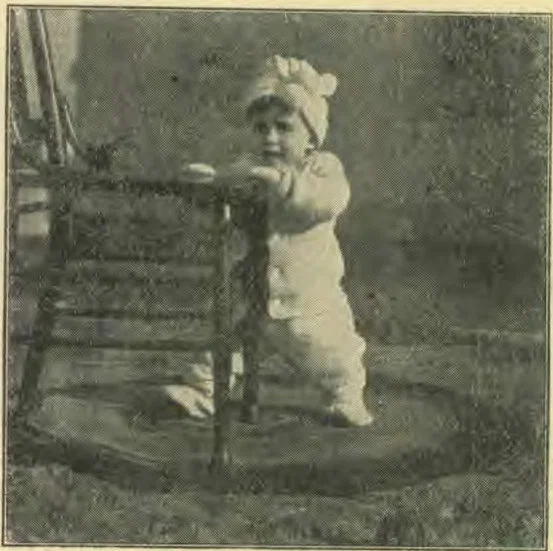
LITTLE George lived in a nice home with a kind father and mother. But he had no brothers or sisters to play with.
How do you think he played? Why, he had a big woolly lamb, which he played with nearly all day. It was not a real live lamb, you know, only a toy; but it was just as good as a live one to Georgie. He took the woolly lamb to bed with him, took it out walking, told it all his troubles and joys.
One sad day little Georgie fell down, and the little lamb was broken all to pieces. How he cried about it! Then he picked up all the broken pieces and took them to mother. “Please, mother, mend it.”
But it was too much broken, and mother could not mend it. So she said, “Has my little boy told Jesus?”
Georgie had forgotten.14
He had learned that all in trouble should go to Jesus. So he took the broken pieces of his lamb and put them neatly on the cover of his little cot, and knelt down, and this is what he told Jesus:—
“Jesus, please look here! You see my poor lamb is broked. I want you to send me another just like it, and please be very quick.”
After this Georgie seemed very happy. He was quite sure the lamb would come.
This all happened a long time ago, when toys were not so easy to buy as they are now, and Georgie’s mother could not afford to give him a lamb just then. She hoped that Jesus would answer Georgie’s prayer, but Georgie was sure he would. He knew his lamb was “tummin’ soon.”
A lady came to see his mother a few days after. Georgie was out in the garden at the time. Soon the woman said to Georgie’s mamma:—
“I have brought a toy for your little boy, but I am afraid you will think it is a funny one. There were a lot of pretty things, but I felt I must buy this.” Then she showed her a big woolly lamb, just like the broken one.
Soon Georgie was called in from the garden, and was given the new lamb. How happy he was, and he shouted, “Another lamb! Jesus has sent another lamb!”
The lady told Georgie’s mother that she had bought the toy just a week before, which was the very day when Georgie told Jesus about his broken lamb.
Georgie is grown up now, but he has never forgotten how Jesus answered his prayer when he was a little boy.
And the Saviour is just the same now, and will listen to all little boys and girls who will tell him their troubles; and he will answer their prayers in his own way, which will be the best way.—Young Soldier.
SOMEWHAT UNCERTAIN AS TO BEARINGS
League of the Helping Hand
SOME one in a far-off land suggests as a member of a “League of the Helping Hand,” the young daughter of one of our missionaries in Algeria. We have no regularly organized league bearing this name; but if we are true Christians, we are all members of the League of the Helping Hand. The first inspiration of the one who gives himself to the Lord is to reach out a helping hand to others, and so long as one has the spirit of Jesus in the life, he cannot withdraw from the Helping Hand League. Jesus was ever serving others, and his followers are constrained to do the same.
The following incident illustrates the habitual spirit of helpfulness that should characterize the members of the league: The wife of Sir Bartle Frere had to meet him at the railway station. She took with her a servant who had never seen his master. “You must go and look for Sir Bartle,” she ordered. “But,” answered the nonplused servant, “How shall I know him?” “Oh,” said Lady Frere, “look for a tall gentleman helping somebody.” The servant, obeying instructions, found a man helping an old lady out of the car, and recognized him at once as his master.
Sir Bartle Frere was a member of the League of the Helping Hand. He was not content even with a “good turn daily,” the slogan of the Boy Scouts; but was ever seeking to aid, comfort, and strengthen others.
Let us be as ready to lend a helping hand as was Sir Bartle; but let us not forget to do all we do for the sake of Jesus, who did so much for us. This motive beautifies the humblest service, and places it on heaven’s honor roll.
Let every young reader of the INSTRUCTOR regard himself as a member of the League of the Helping Hand, and let him tell the rest of the league what he has done for others. Not that he has any cause for boasting; but merely that he may encourage others to work, and possibly that he may suggest to another some new way of serving.
Let him tell how he earned his dollar for the thirteenth Sabbath, how he gives away tracts and papers, how he endeavors to bring cheer and helpfulness into his home, and how he ministers to the needy.
The children of our missionaries in India, China, Japan, Africa, and the islands of the sea, do not, I am sure, leave all the missionary work to their parents. Will they not write to the INSTRUCTOR some of their experiences in trying to help others, or write what some of their friends have done? We are better acquainted with our missionaries and their wives in the foreign fields than we are with their sons and daughters. So, our young friends across the waters, we should like to hear from every one of you. Tell us about the country in which you live, how you like the people, and what you do to help spread the good news of salvation among them. Who will be the first to write from a foreign land, and who the first from the homeland?
Who Makes Us Good?
By Carrie M. Nichols
My mother went to town one day, To look at dolls and such; And when I said Good-by to her, I whispered just this much— “I will be good.”
When she came back, and I had failed To keep my sacred vow, I lost the doll she bought for me, And sister has it now.
And after that I tried so hard, And wished I could be good, And mother said I must reform— If I’d known how, I would.
’Twas not enough to vow to her; I’ve promised God above, And he gives strength to keep my pledge By his unfailing love. He makes us good.
2. What did he say concerning the scribes and Pharisees? Verse 2. Note 1.
3. How should the people relate themselves to the teaching of these men? Verse 3, first part.
4. What were the people not to do? For what reason? Verse 3, last part. Note 2.
5. How does Jesus describe the “works” of the Jewish teachers? Verse 4, first part.
6. What was their own attitude toward these burdens? Verse 4, last part.
7. With what motive did they do all their works? Verse 5, first part.
8. How did this motive show itself in their dress? Verse 5, last part. Note 3.
9. What did they love in assemblies of the people? Verse 6.
10. What other things did they love? Verse 7.
11. What warning did Jesus give? For what reasons did he give it? Verse 8.
12. Why should no one upon earth be called “our father”? Verse 9.
13. Why are we not to be called masters? Verse 10.
14. What rank will the greatest among Christ’s followers occupy? Verse 11.
15. What is said of the one who exalts himself? Verse 12, first part.
16. What is said of the one who humbles himself? Verse 12, last part.
Notes
1. Moses was a giver and interpreter of the law. The scribes and Pharisees were successors to Moses, or pretended to be. As Jesus goes on to show, their sitting in Moses’ seat was little more than a form.
2. In directing the people to observe and do what the Jewish teachers bade them, Jesus honored the office of “Moses’ seat;” but from what follows, we must understand the expression “all . . . whatsoever” to mean only that which was in harmony with Moses’ law. The teaching and the practice of these interpreters of the law were so at variance that Jesus bade the people, in brief, to do what the teachers said, but not to do what the teachers did. This has an important application today. The inconsistent life of a minister or teacher excuses no one from observing what he teaches according to the Word. The vital thing for us is to receive the implanted Word with meekness, and order our own lives accordingly, leaving the Lord to deal with the inconsistencies of the teacher.
3. To the children of Israel the Lord had given through Moses the following direction concerning his words: “Thou shalt bind them for a sign upon thy hand, and they shall be as frontlets between thine eyes.” Losing sight of the spiritual meaning of this scripture, the Jews applied it literally in the wearing of phylacteries. Of these, Carr, in his notes on Matthew, says: “They were slips of parchment inscribed with four portions of the law (Ex. 12: 3-10, 11-16; Deut. 6: 5-9; 11: 13-21), inclosed in little cases or boxes made of calfskins, and fastened by leather straps to the left arm and on the forehead. . . . To make the phylacteries, or rather the cases which contained them, broad and conspicuous, was to assume a character of superior piety.”
The Finding-Out Club
STORIES of exploration and discovery are always of interest to young people. They like to hear of Columbus, Captain Cook, the Norsemen, Balboa, and De Soto. Other stories of famous events also claim their interest; but many enjoy even better to explore for themselves the avenues of knowledge, making discoveries in the world of nature, science, industry, and social ethics.
In order to give some of these an opportunity to spend profitably and interestingly a part of their pastime, there will be given in the INSTRUCTOR from time to time during the new year a list of questions that will in some way be a test of knowledge. In looking up answers, one will become better acquainted with the dictionary, nature, the Bible, history, works of etiquette, science, and current events.
Every one who sends in a correct list of answers to any set of questions will be entered as a member of the Finding-Out Club, if the list is received within three weeks after the date of the paper containing the list. Membership lists of answers to be accepted must follow the rules given below:—
The list must be written neatly.
Pen and ink must be used.
Writing must appear upon only one side of the sheet of paper.
The answers must reach the editor's desk within three weeks after the date of the paper containing the questions answered.
All lists must be folded and not rolled.
The questions must not be repeated in the list of answers.
Each answer must bear the same number as the question it is intended to answer.
Every list must give the date of the INSTRUCTOR containing the list of questions being answered; for example, “Answers to questions in INSTRUCTOR of December 8.”
Every list must bear at the bottom the name of the one sending in the list.
Failure to heed any one of these rules is sufficient to bar one from membership in the Finding-Out Club. Let us watch the membership grow.
No Alabaster Box
By May Cole Kuhn
Saviour, I bring no alabaster box,
But, like the Magdalene,
I bring my sins, and lay them at thy feet.
Make thou me clean.
I bring no perfume to anoint thy brow;
Not worthy I to pour it, Holy One,
But let my thoughts and deeds as incense rise,
Till time be done.
Amid the strife and murmur of the throng,
Would that the better part might fall to me,
To sit a humble listener at thy feet,
And learn of thee.
MAY COLE KUHN.
The Oldest Storybook
By Claude Allen McKay
WHEN you have been sighing for another good collection of stories to read, why have you never thought of the Bible?
“What!” you say, “the Bible a storybook?”
Yes, indeed. The most interesting storybook ever written.
Are you willing to be shown?
Then read:—
1. The story of a big beginning that has no ending. Genesis 1.
2. The story of a carpenter who built for a rainy day. Genesis 7 and 8.
4. The story of the servant who was sent to find a wife for his master’s son. Genesis 24.
5. The story of a boy who was sold by his brothers. Genesis 37.
6. The story of a man who looked pleasant when everything went wrong, of a man who looked sad when he was in trouble, and of a man who forgot his best friend. Genesis 46.
7. The story of a man who was taken from prison to live in a palace. Genesis 41.
8. The story of the meeting of a son with a father who for years had given him up for dead. Genesis 46.
9. The story of a little girl who watched by her brother’s odd cradle; and of a mother who was hired to take care of her own baby. Exodus 2.
10. The story of a bush which blazed with fire, and was not burned up. Exodus 3.
11. The story of a hard master who told his servants they must make bricks for him, and find their own material. Exodus 5.
12. The story of the order which changed a nation’s calendar, and why it was given. Exodus 12.
13. The story of the first great Lawgiver and his ten greater laws. Exodus 20.
14. The story of the day when God told his people to get their Sabbath provisions on the day before. Exodus 16.
15. The story of how a rock furnished water to a multitude of thirsty travelers. Exodus 17.
16. The story of a calf made out of earrings. Exodus 32.—Rev. Claude Allen McKay.
(To be continued)
Questions for the Finding-Out Club
1. WHY will a bullet from a rifle shot at a window cut a smooth hole through the glass, but if thrown against it by hand shatter it?
2. Why does an automobile run easier with pneumatic tires than with solid rubber ones?
3. Why will a cord supporting a weight generally break if the weight be lifted and then let fall?
4. At what speed must a cyclist ride around a circular track one mile in diameter in order to go around it in half an hour?
5. Why can a boy throw a stone farther with a sling than without it?
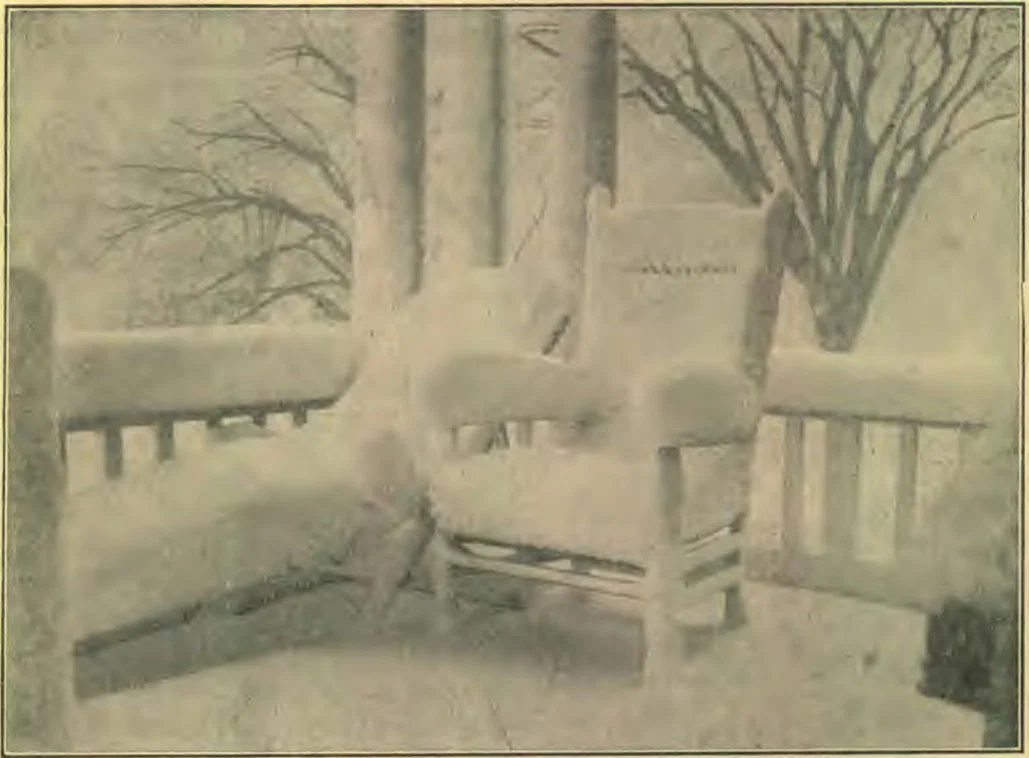
UPHOLSTERED BY WINTER'S WHITENING SHOWER AS IT DESCENDED THROUGH THE HUSHED AIR