Pacific Press Publishing Company · Oakland, California · Apr 1, 1903
THE FORM, BUT NOT THE POWER.
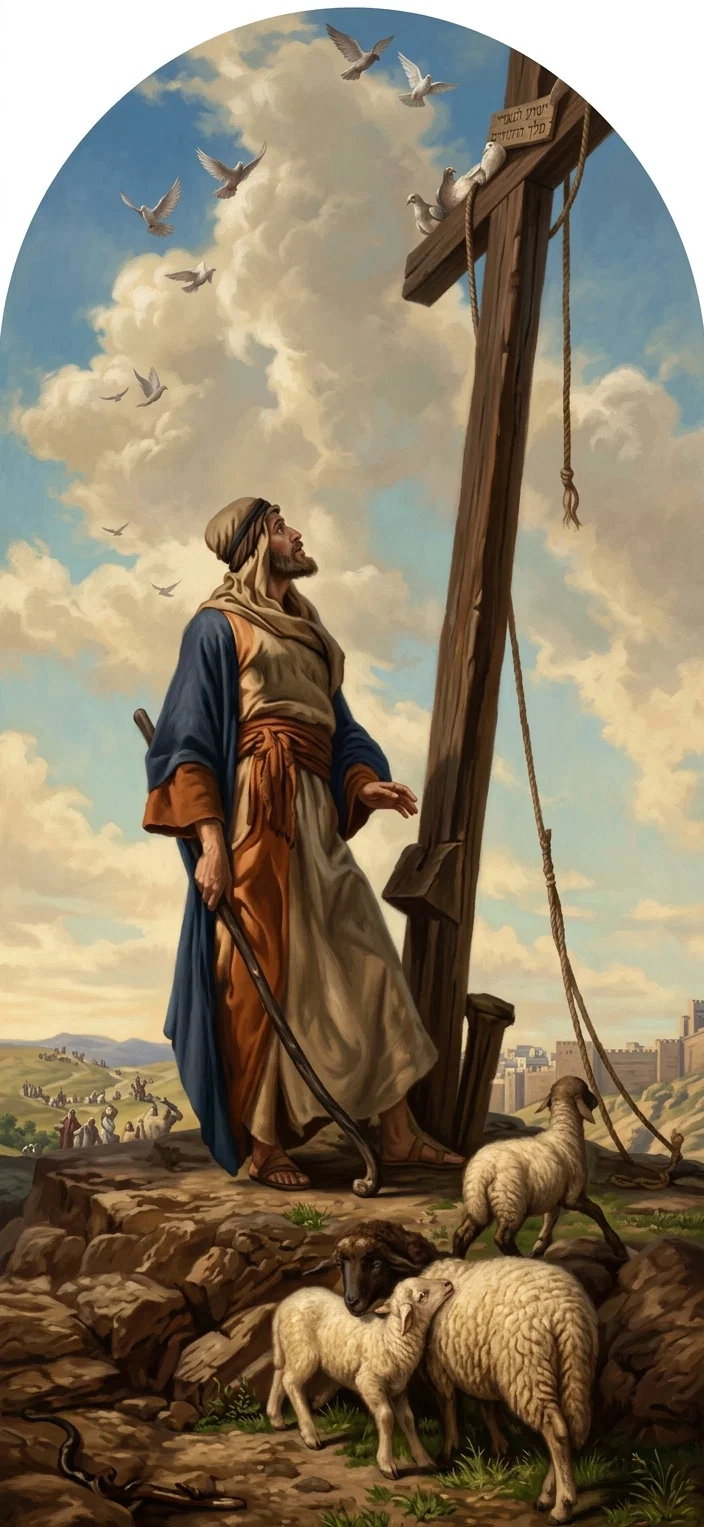
THE picture on this page is, doubtless, only the conception of the artist, but it might have been a fact. At any rate it teaches a useful lesson.
Its time is A. D. 31, in the spring of the year. Jesus of Nazareth and two malefactors had just been crucified on a hillside near Jerusalem, Jesus as the King of the Jews. His execution was by the Romans at the demand of His own people, the Jews. A few hours later the body had been removed for sepulture, and the cross left standing ugly and bare, outlined against the Judean sky. The people had dispersed, the curiosity of the crowd satisfied, and again the shepherd with his flock comes upon the scene. The sheep feed thoughtlessly by, while the shepherd wonders, perhaps, why such a man should die, and the meaning of His death. He still reads the inscription,—
“THIS IS JESUS OF NAZARETH, THE KING OF THE JEWS.”
Nails are in the wood, a loose rope hangs from the cross-beam, and the doves fly idly about and rest upon the cross as tho it were placed there for that very purpose.
TO-DAY every part of the instruments of the cruel death would be carried away as souvenirs by the curious, as sacred relics by the superstitious. To-day men look with fear and reverence upon what are said to be pieces of the true cross, nails used in the crucifixion, which in the aggregate would make a dozen crosses and a keg of nails. Men seek the supposed spot of our Lord’s crucifixion and burial, erect costly memorial churches over them, make long pilgrimages to the spot, as tho there were life and power in these material things.
READER, let this truth sink deep into your heart: There is no merit in a dead past. Whether it be Noah’s ark, the robe of Elijah, the staff of John the Baptist, the seamless vesture of Jesus, the cross upon which He suffered, the cruel nails which fastened Him to the tree, the sepulcher in which He was laid, the napkin wound about His head—not any one, nor all, possess any merit whatsoever. Could we find the very sepulcher above its stone-cut vault, faith would hear ringing the cry of the messenger of the Lord spoken nineteen centuries ago, “He is not here; He is risen.” We might look upon the wood of the veritable cross on which He died, but it could be as truly said, “He is not here.”
Shepherds of Jerusalem.
THE JEWS of old looked upon their magnificent temple pile, upon all its appointments and services, and said, “The temple of the Lord, the temple of the Lord, the temple of the Lord, are these,” but Jesus declared that those who had faith in the material things alone, had made that temple “a den of thieves.” The holiest instruments of God are made so because of His indwelling presence, but when He departs, that holy thing becomes common. How forcibly God revealed this when, at the death of Christ, a strong, invisible hand rent the heavy veil which separated the sanctuary from forbidden eyes, thus declaring that they had rejected Christ, and the glory had departed. The thing we cherish as the holiest is profane unless Christ be in it.
THE cross of Christ in itself is nothing. It stands for eternal sacrifice on the part of God; it stands for death to sin. “Cursed is every one that hangeth on a tree.” But the Victim of Calvary was not there because of His sins, because of the curse that came to Him on account of His conduct. He was there because of our sins. “He hath made Him to be sin for us, who knew no sin; that we might be made the righteousness of God in Him.” “He was wounded for our transgressions, He was bruised for our iniquities; the chastisement of our peace was upon Him; and with His stripes we are healed. All we like sheep have gone astray; we have turned every one to his own way; and Jehovah hath made to light on Him the iniquity of us all.” That cross stands for His amazing love, and for death to sin.
DO WE love it? Do we wish like Paul to glory in it?—Then “reckon ye also yourselves to be dead unto sin;” “our old man,” “crucified with Him, that the body of sin might be done away, that so we should no longer be in bondage to sin.” It is the privilege of every soul to glory in the cross of Christ as the slayer of our sins. But, then, it is not in the material cross, but in the sacrifice of Jesus Christ. Reckon that sacrifice yours, and yourself, like Him, dead to sin forevermore.
CHOOSE TO-DAY.
It is often said that most men live in the present. In one sense that is true; in another sense it would be nearer the truth to say that few men really live in the present, in any profound sense of the word “live” at all. The old man lives proverbially in the past, with its memories of the good, old times: the young man lives in the future, when the toils and hardships of the present have won for him means and leisure. We live in any day and every day but the day that is ours, the day that is passing,—to-day.
It is so hard to realize the infinite value of the present day. The past, which we think to be so fair as it lies in the golden light of memory, was once the present. Did we think it fair then? The future, whose rosy brilliance beckons us across the years, will one day be the present. Shall we think it so radiant then? No sane man would dream of despising the pleasures of memory or hope; but the present, with its clamant opportunities and its solemn responsibilities, ought to be as inspiring a force in our lives as the past with its memories or the future with its hopes. The present, which we think so commonplace, will, some day, be a past, which we shall probably think beautiful. Why should we not think it beautiful now? This day holds in its bosom the memories of the past and the hopes of the future. But it is greater than the future and the past, for we have it, but we have not them. We, then, who are alive this day, breathing God’s air, looking up to His heaven, have still the present in our hands, therefore, let us choose. It is to-day that is the accepted time—to-day, and no other day. Day by day God is pouring upon His thoughtless children His treasure of golden2hours. They will pass all too soon away—and then?
We are yet in the enjoyment of health and strength, and unclouded mental vision. Whether our brain will be clear to-morrow, and our power of resolution unimpaired, we do not know. Reverses come like a thief in the night. The indecision of to-day cripples the resolution of to-morrow. “It is always to-day with God,” said Origen,—but it is not always to-day with us. Therefore, while it is called to-day, let us harden not our hearts, but choose. If we refuse to enter now into the beautiful house in which Christ is longing to spread His table before us, there may come a time when the door will be shut.—Sunday School Times.
The Third Day—The Sea
By W. A. Sweany
THE GOSPEL IN CREATION. NO. 4.
The Third Day—The Sea.
And God said, Let the waters under the heaven be gathered together unto one place, and let the dry land appear; and it was so. And God called the dry land Earth; and the gathering together of the waters called He Seas; and God saw that it was good.” Gen. 1:9, 10. No more impressive manifestation of the power of God has been nor can be seen than that which forms and controls the mighty waters. Until the mandate of the Creator gathered the waters together unto one place and caused the dry land to appear, the face of the whole earth was covered by the waters of “the great deep.” Let us now study carefully in the words of Inspiration how all this was accomplished. “God said, Let the waters under the heaven be gathered together unto one place, and [as a result of this] let the dry land appear.” “He gathereth the waters of the sea together as an heap; He layeth up the depth in storehouses.”Ps. 33:7. “Who shut up the sea with doors, when it break forth, as if it had issued out of the womb? When I made the cloud the garment thereof, and thick darkness a swaddling-band for it, And brake up for it my decreed place, and set bars and doors, And said, Hitherto shalt thou come, but no further; and here shall thy proud waves be stayed?”Job 38:8–11. “He hath compassed the waters with bounds” (Job 26:10), and “gave to the sea His decree that the waters should not pass His commandment” (Prov. 8:29). The literal truth and deep significance of these statements will be more fully realized when the scientific fact, well known to scholars, is learned and remembered, that the surface of the sea is not level, but is literally piled up, being much higher along the equator than elsewhere. To be level, the surface of the sea must be equally distant at every point from the center of the earth, or exactly round. But that this is not the case is a well-known fact, the earth being materially flattened at the poles. That the waters of the ocean are piled up is seen in the fact that the Black Sea (part of the ocean) is eighty-four feet higher than the Caspian Sea, which is an inland body of water; and the Mediterranean Sea is nearly 1,400 feet higher than the near-by Dead Sea.
“Centrifugal force” generated by the revolution of the earth is the cause assigned by scientific men for this piling up of the waters. But “centrifugal force” is only a scientific technical term for what is really the power of God whose word piled up the water in heaps, and whose decree and commandment prevented them from finding a level that water continually seeks. It was the exercise of this power that “divided the waters of the Red Sea,” causing them to stand upright as an heap—“a wall on either side” of the marching hosts of Israel. And when that power was withdrawn, the waters immediately sought and found their former place, drowning the pursuing Egyptian host. Ex. 14:21–31; 15:8, 19; Ps. 78:13. Again, the waters of Jordan, when at flood-tide, were divided and piled up that the host of Israel might pass through to possess a goodly land. Joshua 3:1–17. And this wonder3was twice repeated that Elijah and Elisha might pursue their journey unhindered. 2 Kings 2:1–15.
We are wont to speak of these events as miracles, and properly so, for such they truly were. But let us not make the mistake of thinking that the day of miracles is past, while overlooking the operation of God’s wondrous power in the great waters as well as in all the other works of His hands. “He gathereth the waters of the sea together as an heap; He layeth up the depth in storehouses. Let all the earth fear the Lord; let all the inhabitants of the world stand in awe of Him.”Ps. 33:6–8. “Fear ye not Me? saith the Lord; will ye not tremble at My presence, which have placed the sand for the bound of the sea by a perpetual decree, that it can not pass it; and tho the waves thereof toss themselves, yet can they not prevail; tho they roar, yet can they not pass over it?”Jer. 5:22. In the symbolism of Scripture waters represent peoples and nations. Dan. 7:1–3, 17, 23; Isa. 8:5–8; Rev. 17:1, 15. And so while the experience of the imperiled disciples on storm-tossed Galilee (Matt. 8:23–27), as well as many other tempest-driven mariners before and since that time (Ps. 107:23–31), assures us that He “rulest the raging of the sea; when the waves thereof arise, Thou stillest them” (Ps. 89:9), it also teaches us that He is able to still “the tumult of the people.”Ps. 65:7. When the disciples, realizing their peril, called upon the Master for deliverance, His “peace be still”“made the storm a calm,” and “brought them to their desired haven.” And so when the wicked, who have no peace, but “are like the troubled sea, when it can not rest, whose waters cast up mire and dirt” (Isa. 57:20), truly call upon God He will speak peace unto them, as He does to His people and His saints, “but let them not turn again to folly.”Ps. 85:8. To those who hearken to God’s commandment the promise is given that their peace shall be as a river, which unceasingly flows on and on, unhindered by what its surroundings may be. “Great peace have they which love Thy law; and nothing shall offend them.”Ps. 119:165. Such can truly sing with the spirit and with the understanding (1 Cor. 14:15), with grace in their hearts (Col. 3:16), making melody to the Lord (Eph. 5:19).
“As flows the river calm and deep,In silence toward the sea,So floweth ever and ceaseth neverThe peace of God to me.”
All who have ever stood on the sea-beach have noticed how the swells or waves unceasingly roll upon the shore, even tho there be not sufficient breeze to create a ripple on its glassy surface, and the becalmed boat with drooping sails still rises and falls in the swells that never entirely subside. In the presence of this fact how precious is the promise that the righteousness of those who hearken to His commandments shall be “as the waves of the sea.”Isa. 48:18. And so in all the everchanging features of the mighty deep, the bounding billows, or the quiet calm, we may see the wisdom and power of Him “who hath measured the waters in the hollow of His hand.”Isa. 40:12.
W. A. SWEANY.
WHAT DO THESE THINGS MEAN?
By Alonzo T. Jones
The Spirit of Combine.
TO-DAY many remarkable things are occurring, so openly before the eyes of all, that every thoughtful person is compelled to query, What do these things mean? One, among the most remarkable of these remarkable things of to-day, may be best defined as the universal spirit of combine. Everywhere, among all classes, and in all lines of effort, there prevails this spirit of combine.
This spirit of combine is not merely an extension of the sound principle of co-operation or unity of action of individuals acting collectively toward a common purpose. It is not, in any sense, the principle of co-operation or unity of action of individuals acting as such, collectively toward a common purpose. It is instead the principle of one mind, of one individual, dominating all others possible, and using all these to the one purpose of that one mind or individual.
This truth and this distinction is demonstrated in the universally-known fact that the first effect of this spirit is to deny, to override, and to crush out, all right and all freedom of the individual; as instanced in the trust, whether it be the Standard Oil Trust, the Steel Trust, or a fruit trust. Whatever business it may be that is comprehended in the trust, no individual is allowed to do anything in that line of trade, except as the servant of the trust, and absolutely subject to the dictation of the trust. If the “combine” takes the form, not of the trust as such, but of the labor union, then no individual is allowed to work, except as the servant of the union and under the absolute dictation of the union.
The second effect of this spirit, wherever entertained, is to destroy all individuality of the individual himself; so that he can not do the simplest and easiest thing, a thing the virtue of which consists entirely in its being individually done, unless a combine, a club, or a society, is first created, and he do that simple and easy individual thing in the name and by the power of the combine. If for instance, a person wants to rest one day in the week, he insists that he can not rest unless everybody else rests at the same time; and so a combine must be formed, requiring everybody to rest when he wants to, so that he can rest because they do. A member of the church knows that it is only plain, simple Christianity to visit and help the afflicted, the poor, and the needy; and he knows that this is what the church is for; yet he can not do this simple, Christian thing as an individual Christian; but must first form within the church a combine, called a “band” or a “society,” for the purpose, and then do it in the name of this combine, and because the combine requires it.
Another effect, and the direct logic of the combine, is a one-man power. This is to-day manifest on every hand; the head of the trust can dictate daily what the whole people shall pay for their sugar, their kerosene, their nails, etc.; the head of the union can dictate just what the employer shall do, and how he shall conduct his business, or whether he shall conduct it at all. In the railroad strike of 1894, that reached from Buffalo to San Francisco, it occurred that two governors of sovereign States could not travel on official business within their own respective States without permission of the one-man head of the strike combine, who dominated from Chicago the greater part of the whole country of the United States.
The logic of a one-man power is always a despotism. This is certain, because of the nature of man himself. And it has proved so universally true that it is universally understood. Indeed, it was the character of the rule of the man who held the innocent office of despot that gave to that word its terrible meaning.
The logic of a one-man power is a despotism, and it is a despotism in all relations, religious as well as other. This, too, is inevitable, because, as we have already seen, the spirit of the combine is the spirit that leads one mind to usurp the place and power of God over the minds, the rights, the persons, and the property of others, and by force compel them to his one purpose. And as it is certain that a man in the place of God will always act unlike God, it is also certain that his power will always be exerted in compelling them to things contrary to the righteousness of God. This has been the unvarying history of it from the mighty despotism of Nimrod, the first that arose since the Flood, to the paltry but growing ones of to-day. For Nimrod was not only a mighty hunter of beasts, but of men, also. He pursued and compelled men to recognize his authority in all things; they must worship as he dictated, and his example has been invariably followed. It was followed by Pharaoh, by Nebuchadnezzar, by Darius, by the Cæsars, and by the popes.
It never has failed, and it never will fail, that a one-man power develops a despotism, and a despotism in religion as well as other affairs of life. And those who disregarded the spirit of the combine and maintained their individual integrity, have always been in the right, and are the true heroes of the ages. Abraham disregarded the spirit and power of the combine established by Nimrod, and maintained his individual integrity with God; and God vindicated him, called him out of it unto an eternal reward, and made him an example unto all men, “the father of all them that be of faith,” and “the friend of God.” Moses did it in Egypt. God maintained his cause, delivered him and his whole people from it, made him the greatest legislator of all times, and took him to an eternal reward. In the face of a blazing furnace of sevenfold heat the three Hebrews did it in the presence of Nebuchadnezzar of Babylon. God vindicated their course, preserved them in the midst of the fire, brought them forth unscathed, changed the king’s word, and made the circumstance a lesson to all kings and all combines forever. Daniel did it individually alone in the presence of the Medo-Persian combine and the den of hungry lions. God vindicated him, because of his “innocency” in the matter, and again made the individual an example to all men, and the circumstance a lesson to all one-man powers and combines, forever. John the Baptist did it, Jesus Christ did it, Stephen did it, all the apostles and early Christians did it, not in a “combine,” but wholly as individuals, each for himself alone, in disregard of the greatest one-man power, and so the greatest despotism, of all ancient times. John Wycliffe, John Huss, and Martin Luther did it against the greatest one-man power, and so the greatest despotism, of all time, ancient or modern. These are the ones who have kept alive liberty and the rights of mankind through the ages, and have saved the world from being engulfed long ago in the vortex of unmitigated despotisms.
ALONZO T. JONES.
SIN OR SIN-OFFERING. WHICH?
By H. A. St. John
It is recorded in Gen. 4:7 that the Lord said to Cain, “If thou doest not well, sin lieth at the door.” The primary meaning of the word sin is, “the transgression of the law.” Now for the Lord to tell Cain, who was already a transgressor of the law, had already done evil, that transgression had come as near to him as the door, would seem both unnecessary and absurd. We think the word sin is used here as elsewhere in the Scriptures, meaning sin-offering; instance, 2 Cor. 5:21; Heb. 9:28. Christ, who knew no sin, transgression, was made sin—a sin-offering for us. And when He comes the second time He comes without sin, that is, without a sin offering.
How condescending and merciful on the part of the Lord to counsel with Cain, who was already in transgression. His cherished anger toward his brother, and that, too, without just cause, was incipient murder. It was sin nearer than the door, but in him already, and was revealed by outward act a short time afterward.
Cain very well knew that doing well and doing evil were in the matter under consideration, and he deliberately and stubbornly did the evil. In tender mercy the Lord told him that if he did well his service would be accepted just as readily and gladly as the service of Abel or anyone else. And if he did evil a sin-offering, such as would be well-pleasing to God, was accessible, easily accessible, “at the door.” Now if Cain had heeded the Lord’s counsel then and there, he would have penitently presented the sin-offering at hand, and in this way found acceptance with the Lord without delay.
The truth in this for us is, First, that God accepts all alike who do well; there is no respecter of persons with God. Secondly, if we have done evil we should ever remember that we have an Advocate with the Father, Jesus Christ the righteous, who is ever as a lamb slain before the throne of God, a sin-offering always and in all places accessible to us—always at our door. Hence we may readily regain and always retain the loving favor of God, always be accepted with Him. Let, therefore, no soul go from day to day with a fallen countenance, a sad heart, a sour or sullen temper when an infallible remedy is at hand, a remedy that never fails to cure when taken according to the Lord’s directions.
Keep free from sin; the remedy is at your door. Keep a conscience void of offense toward God and toward man; the strength from above is brought to your door by ministering angels. Keep growing up into Christ our living Head, in all things, for all the elements of such growth are ever at the command of every one. H. A. ST. JOHN.
“EVERY DAY ALIKE.”
By Clarence M. Redfield
SOME persons have thought that the words, “Another esteemeth every day alike” (Rom. 4:5), include the Sabbath. But this by no means follows. A parallel is found to this in Ex. 16:4. God told Moses that the children of Israel should gather a certain portion of manna “every day,” and immediately goes on to say that He gives this command that He may prove them whether they will walk in His law or no. Then He explains what His law is by providing that they shall gather a double amount on the sixth day and none on the Sabbath. Are we, then, to infer that Jehovah commanded His people to break the Sabbath in order that He might prove them, whether they would keep it or no?—Not at all. And, yet, that is what we must conclude if we take the term “every day” to include the Sabbath. “Every day” included only the “six working days.” Eze. 46:1. Let all beware that they do not accuse God of inconsistency or of commanding the violation of His own immutable law in their efforts to uphold a man-made day of rest.
CLARENCE M. REDFIELD.
Augusta, Mont.
LIP SINS, OR CHRISTIAN CANNIBALISM.
By M. C. Israel
1. How does the apostle Paul express the cannibalistic propensities of some professing Christians?
“But if ye bite and devour one another, take heed that ye be not consumed one of another.” Gal. 5:15.
2. What is the principal instrument of their warfare, and what makes it effective?
“The tongue can no man tame; it is a restless evil, it is full of deadly poison.” James 3:8, R.V.
3. What does the Lord say about the warfare of this class of people?
“They bend their tongue as it were their bow for falsehood; . . . for they proceed from evil to evil, and they know not Me, saith the Lord. . . . Their tongue is a deadly arrow; it speaketh deceit; one speaketh peaceably to his neighbor with his mouth, but in his heart he layeth wait for him.” Jer. 9:3–8, R.V.
4. How did the prophet feel to have his brethren engage in this kind of work?
“O that my head were waters, and mine eyes a fountain of tears, that I might weep day and night for the slain of the daughter of my people! O that I had in the wilderness a lodging-place of wayfaring men; that I might leave my people, and go from them!” Verses 1, 2.
5. If this evil is not repented of and put away, what will be the result?
“Therefore, thus saith the Lord of hosts, Behold, I will melt them, and try them; for how else should I do, because of the daughter of My people? . . . Shall I not visit them for these things? saith the Lord; shall not My soul be avenged on such a nation as this?” Verses 7–9.
6. Where does all the poison come from that supplies their deadly weapon?
“The things which proceed out of the mouth come forth out of the heart; . . . for out of the heart come forth evil thoughts, murders, false witness, railings.” Matt. 15:18, 19, R.V.
7. To what different uses do persons often put the same tongue?
“Therewith bless we the Lord and Father; and therewith curse we men, which are made after the likeness of God; out of the same mouth cometh forth blessing and cursing. My brethren, these things ought not so to be.” James 3:9, 10, R.V.
8. What illustration does James draw from nature, to show that poisoned words do not come from a converted heart?
“Doth the fountain send forth from the same opening sweet water and bitter? can a fig-tree, my brethren, yield olives?” Verses 11–16, R.V. “So can no fountain both yield salt water and fresh.” Verse 12.
9. In relation to this subject, what does God say He hates?4
“A lying tongue, and hands that shed innocent blood, an heart that deviseth wicked imaginations, . . . and he that soweth discord among brethren.” Prov. 6:16–19.
10. What has He strictly forbidden in both the Old and the New Testaments?
“Thou shalt not go up and down as a talebearer among thy people.” Let “evil-speaking be put away from you, with all malice.” Lev. 19:16; Eph. 4:31.
11. What does God say through David to persons who are guilty of this sort of cannibalism?
“Have all the workers of iniquity no knowledge? who eat up my people as they eat bread, and call not upon the Lord.” “Thou givest thy mouth to evil, and thy tongue frameth deceit. Thou sittest and speakest against thy brother; thou slanderest thine own mother’s son. . . . Now consider this, ye that forget God, lest I tear you in pieces, and there be none to deliver.” Ps. 14:4; 50:19–22.
12. Who do the Scriptures say give heed to wicked lips, and give ear to a mischievous tongue?
“A wicked-doer giveth heed to false lips; and a liar giveth ear to a naughty tongue.” Prov. 17:4.
13. Then, is not a person who gives ear to an evil report, and reports it, about as much of a cannibal as the one who starts it?
“Thou shalt not take up a false report.” “I will not justify the wicked.” Ex. 23:1, 7, R.V.
14. Who does the Lord say shall abide in His tabernacle (remain members of the true church)?
“He that slandereth not with his tongue, nor doeth evil to his friend, nor receiveth or endureth a reproach against his neighbor.” Ps. 15:3.
15. What is the cure for all who have the propensity “to bite and devour one another”?
“Create in me a clean heart, O God; and renew a right spirit within me.” “A new heart also will I give you, and a new spirit will I put within you. . . . And cause you to walk in My statutes, and ye shall keep My judgments, and do them.” Ps. 51:10; Eze. 36:26, 27.
16. A people must be developed before the coming of the Lord, among whom there will not be a deceitful tongue, or a mouth speaking guile.
“The remnant of Israel shall not do iniquity, nor speak lies; neither shall a deceitful tongue be found in their mouth.” Zeph. 3:13. “And in their mouth was found no guile; for they are without fault before the throne of God.” Rev. 14:5.
17. What should be the prayer of all who would be of that company?
“Set a watch, O Lord, before my mouth; keep the door of my lips. Incline not my heart to any evil thing, to be occupied in deeds of wickedness with men that work iniquity.” “O Lord, open Thou my lips; and my mouth shall show forth Thy praise.” Ps. 141:3, 4; 51:15, R.V.
18. Rules in regard to evil reports about others:—
(a) To hear as little as possible what is said to the prejudice of others.
(b) To believe nothing of the kind, till I am absolutely forced to do it.
(c) Never to drink in the spirit of the one who circulates the report.
(d) Always to moderate, as far as I can, the unkindness expressed toward others.
(e) Always to believe that, if the other side were heard, a very different account would be given of the matter. M. C. Israel.
MY SAVIOUR FIRST OF ALL.
By Gertrude von Giers
Jesus, may we ne’er forget Thee
In the dark or in the light;
When the sun our world is bright’ning,
Or when fall the shades of night.
Shall earth’s trifles, quickly passing,
In the mind be stored away,
While the things of God, eternal,
O’er the mem’ry bear no sway?
When we gather round the table,
Jesus, may we ever think
That to do Thy Father’s pleasure
Was Thy daily meat and drink;
When our earthly cares are pressing
May we heed what Thou hast said:
“Labor not for what must perish,
But for Me, the Living Bread.”
When we’re tempted, Saviour, aid us;
Thou wast tempted e’en as we,
Through a long and lonely conflict
With our mortal enemy.
Bring the wilderness before us;
Bring the pinnacle and hill;
May Thy answer—“It is written,”
Be our own through good or ill.
Should the body be afflicted,
May we trust amid the pain
In Thy power, Divine Physician,
Who will make us whole again.
Thou of us art ever mindful,
May we e’er remember Thee,
Loving Friend, who ever liveth
And whose face we soon shall see.
GERTRUDE VON GIERS.
MINISTERING SPIRITS.
By Augusta W. Heald
Angelic beings are not permitted to lead a life of ease. All heaven is engaged in the service of God. They "that excel in strength" hearken unto the "voice of God" and do His commandments. They are God's ministers that do His pleasure. "But to which of the angels said He at any time, Sit on My right hand, until I make thine enemies thy footstool? Are they not all ministering spirits, sent forth to minister for them who shall be heirs of salvation?" Heb. 1:13, 14.
Who They Are.
1. Angels are not the spirits of our departed friends, for they, in their dreamless repose, have no knowledge of earthly events. "The dead know not anything, neither have they any more a reward; for the memory of them is forgotten. Also their love, and their hatred, and their envy, is now perished; neither have they any more a portion for ever in anything that is done under the sun." Eccl. 9:5, 6.
2. They are celestial beings of a higher order than man, and existed before man was created. "Thou madest him a little lower than the angels." Heb. 2:7.
Their Work.
1. Angels on Judea's plains announced the Saviour's birth: "And suddenly there was with the angel a multitude of the heavenly host praising God, and saying, Glory to God in the highest, and on earth peace, good will toward men." Luke 2:13, 14.
2. Angels ministered unto our Saviour, when fainting after His conflict with Satan. See Matt. 4:11. An angel appeared in the Garden of Gethsemane and strengthened our Lord for His last dread conflict with the powers of darkness. See Luke 22:43.
3. Angels announced to the disciples the risen Lord: "Why seek ye the living among the dead? He is not here, but is risen." Luke 24:5, 6.
4. As they ministered to Christ, so do they minister to every child of God. See Heb. 1:14.
5. They are commissioned to preserve our lives: "For He shall give His angels charge over thee, to keep thee in all thy ways. They shall bear thee up in their hands, lest thou dash thy foot against a stone." Ps. 91:11, 12.
6. They accompany our Lord when He comes as judge of all the earth: "When the Son of Man shall come in His glory, and all the holy angels with Him." Matt. 25:31. In that glad resurrection morning the saints are carried by angels "to meet the Lord in the air."
AUGUSTA W. HEALD.
God's Preparation for Service, No. I: Why?
By Augusta C. Bainbridge
GOD'S PREPARATION FOR SERVICE. NO. I.
Why?
Is it a mournful fact that many Christians are not happy? Look over a congregation. Count the cheerful, restful faces that you see. Many are dissatisfied; others fretful, care-burdened, weak with constant yielding to sin; and still others are seeking, yet doubting while they seek; but few have the glad expression of peace within and victory over sin. If they would confess it, they have been greatly disappointed in their Christian life.
When they recognized and accepted truth, the prospect was full of promise; it seemed as if there had dawned a cloudless day of peace and joy. Ere long, darkness between has obscured the Sun of Righteousness, and there have since been only occasional gleams of light.
Conflict was expected; but contrary to expectation, the conflict has often ended in defeat. Evil has triumphed where it was thought conquered; and questioning, doubt, dejection, have, in turn, taken the joy out of life. To this is added the sorrowful knowledge that such an experience is contrary to that given in the Word of God, and unbelief in that Word has increased the helplessness of the situation.
It is true we are in a far country, among the enemies of God, where we are exposed to Satan's wiles and entanglements; where our rest and comfort are disturbed by the afflictions and trials of the scenes through which we are passing; where our bodies are subject to suffering of every kind; but not one of these—no, nor all combined—according to the Word of God, ought to cloud the life of the soul. David says, “Yea, tho I walk through the valley of the shadow of death, I will fear no evil.” Ps. 23:4. Paul says, “Rejoice evermore.” 1 Thess. 5:16; “Rejoice in the Lord” (Phil. 4:4); and even goes so far as to say something about glorying in tribulation. Rom. 5:1–5.
We find in Philippians that a Christian can be perfectly happy in prison; and, even while facing death, can have Christ for his only object and aim—his only desire to be like Him in character and service; that he may be entirely superior to circumstances, be content in any state, and be able to do all things through Christ who fills him with inward strength. How different from the experience of most believers!
What is the matter? As God's Word is true there must be something the matter with the believer. What is it?
Paul, it is true, was an apostle, and his attainments were high, but our standard is higher than Paul. Christ is our Pattern. Not a single blessing was enjoyed by Paul that the humblest believer may not share. Was he a child of God?—So are we. Had he been begotten again?—So have we. Did he possess the in-dwelling Spirit of adoption?—It is also ours. Was he a member of the body of Christ?—So are we. In all things we are enriched in Him. If the privileges of all Christians are the same, why do we not have a like experience?
The first cause, the prime cause, is the neglect or unwillingness of God's people to advance in the Christian life. We are too lazy, spiritually, to “follow on to know” all that God has given us in Christ. We are prone to be content that our sins are forgiven, and we desire little besides. By neglecting the study of the Word, we do not see the Lord; hence, do not appreciate our need; and relief from guilt of sinning, while continuing to sin, gives us no message of deliverance to bear to a sin-burdened world. The giving of this message is our life in Christ. Less than this is to live for self. The consequence is that the first days are the best days.
Let us settle it now, in all loving plainness. If we desire nothing beyond the forgiveness of our sins, we shall soon discover that we have no power to resist the solicitations of the flesh within or the temptations of Satan without. It is an indispensable requisite to a happy Christian life that a daily dying with Christ be practically known. Less than this is hopeless conflict; with this, is continual victory.
I thank God that there is victory through Jesus Christ our Lord. Rom. 7:25. And this victory is the message we bear.