A very helpful book might be made up of the little happenings, the little deeds of kindness, the little exhibitions of unselfishness and brotherly love seen and heard on the streets by those who are on the lookout for the better and brighter things of life. It was the unselfishness of a little child that made up the wayside incident of which I write.
She was a child of the slums, a ragged, unkempt, forlorn little girl of about ten years of age. Some one had given her a penny, and she had hurried away to the penny store, and there purchased a long stick of striped red-and-white candy. She was running along the street, proud and happy in her new and rare possession, when I saw her. Suddenly another little girl, equally ragged and forlorn looking, came limping out of the dark hallway of a dilapidated old rookery of a tenement house. She was very lame, and had evidently suffered much in her short life. Her face had a drawn and prematurely old look, such as one is always sorry to see in the faces of children.
The two little girls met, and the one with the candy held it aloft, exclaiming: “See what I’ve got! Just see what I’ve got!”
“Where’d you git it, Janie?”
“Bought it.”
“Where’d you git the money?”
“A man give it to me for scooting after his hat when the wind blowed it off.”
“Gimme some of it, won’t you, Janie? Please do.”
There was a wistful, eager, hungry look in the drawn little face.
Janie hesitated. Evidently sticks of candy came rarely to her. She looked longingly at the candy and then at the little girl. Suddenly she rushed forward, saying, eagerly, joyously: “You take it all, Maggie; you take it all. You can’t scoot after gentlemen’s hats and earn pennies, and I can. So you take it all; and if I git a chance to earn another penny, I’ll give it to you to buy anything you want to with it.”
Generous little heart, in which love of self had not yet found an abiding place! What a lesson it taught to the grasping and the self-centered, who care not for the wants, the weakness, or the woes of others! —Young Reader.
RIVERS OF INK AND MINES OF GRAPHITE.
WASHINGTON, D. C., Sept. 27.—The office material used in the executive departments here is sufficient to keep thousands of operatives busy the year round, and foots up surprising aggregates. Rivers of ink, forests of cedar, and mines of graphite are reasonably mild exaggerations when applied to the total of clerical supplies for the Governmental service.
The War Department annually uses 861,408 pens, 32,500 pencils, 1,927 quarts of mucilage, 4,634 quarts of black ink, 3,167 bottles of red ink, and 7,000 gross of rubber bands of different sizes.
There are used annually by the Post-office Department 8,250 pounds of rubber bands, 300,000,000 facing slips, 3,500 dozen indelible pencils, 240,000 black and colored pencils, and 13,225 gross of pens. There are 300,000 penholders used annually. Each of these is inscribed, “Property of the United States Post-office Department.” The headquarters of the postal service uses each year 12,000 quarts of black ink, 1,300,000 pounds of small jute twine put up in half-pound balls, 9,500 steel erasers, and more than 2,228,000 black carbon sheets.
The Interior Department uses annually 146,000 lead pencils, 6,925 gross of steel pens, 5,000 quarts of black ink, and 2,500 quarts of mucilage.
Unestimated millions of pins and uncomputed reams of paper, with millions of envelopes, are used each year in the Governmental service. The Treasury Department and other branches of the public service use supplies in proportion to the figures given for the War, Post-office, and Interior Departments.
CHINAMEN IN AMERICA.
[From Leslie's Monthly for February.]
It is estimated that there are about 100,000 Chinamen in the United States, and that 20,000 of them are in San Francisco. There is a considerable Chinese colony in New York and there are small colonies in Philadelphia, Boston, and Chicago. Though they do not belong to the educated classes, 95 per cent of them can read and write. A daily paper in the Chinese language is published in San Francisco and another in New York.
Nearly all the Chinamen in the United States come from the single province of Kwong Tung, the most populous of the eighteen provinces of the Chinese Empire. Its capital is Canton. Six counties of this province send out most of the emigrants to the United States. The inhabitants of this province have for centuries been more adventurous and fonder of traveling than the rest of their fellow countrymen, and they are always ready to face danger if there is a good chance of profit.
FILIPINOS' THICK SOLES.
THE most of the Filipino people do not wear shoes, and the consequence is their feet have soles on them that protect them from injury. It is not an unusual thing to find natives with the skin on the bottom of their feet one-eighth of an inch thick. Nature makes provision in cases of that kind, and they can walk all day long and they are never troubled with corns.
IT IS NOT AN EXAGGERATION.
“Papa,” said the sweet girl graduate, “wasn’t my commencement gown a whooperino? I had the other girls skinned alive!”
“And this is the girl,” said papa, sadly, “whose graduating essay was ‘An Appeal for Higher Standards of Thought and Expression’!”—Chicago Tribune.
GINSENG
By F. B. Mills
Great opportunities offered. Book explaining about the Ginseng Industry free. Send for it.
F. B. MILLS, Box 40, Rose Hill, New York
Low Rates From the East To California
In effect March 9th to June 15th
$33.00 from Chicago
$25.00 from Kansas City, Atchison, St. Joseph, Ft. Worth, Houston, and common Missouri River points
Corresponding rates from other points
SANTA FE Agent will receive deposits for tickets and give full information
Santa Fe
SAN FRANCISCO
Refreshing Sleep Comes after a bath with Glenn's Sulphur Soap
It heals while it cleanses. Its medicative qualities render the skin free from impurities. Prickly heat, burns, cuts, dandruff, submit quickly to its healing effects.
CAUTION!—Glenn's Sulphur Soap (the only “original”) is incomparable and wonderful in its remedial effects. Take no other.
At all drug stores, or mailed on receipt of 30 cents by THE G. N. CRITTENTON CO., 115 Fulton Street, New York
Be Convinced
I had one trial of your E-Z Washing Tablets and am much pleased with them. Will not do without them. I enclose postal order for one dozen bars. Mrs. S. B., Sprague, Wash.
The tablets are slowly but surely making friends. Those who have used them are loud in their praise. After a little I am sure I shall have a good sale for them. M. B., Keene, N. Y.
Enclosed please find stamps for two bars of E-Z Washing Tablets. I have used the sample you sent me and am delighted with results. Please send Tablets at once as I am entirely out. Mrs. C. M., Barre, Vt.
Your samples of E-Z Washing Tablets received, and am well pleased with them. Find enclosed postage stamps for more. I find no fault whatever with your Tablets. I think they are all they are represented to be. Mrs. S. H., Orland, Cal.
I send you stamps for your Washing Tablets. I used the samples and find them as represented. Mrs. E. J. R., Fort Ripley, Minn.
Your Washing Tablets will do all you claim for them, and without injury to the clothes. I have used them over a year and would not want to wash without them. Washing is so much easier, as very little rubbing is required; indeed, plain clothes need no rubbing at all when boiled with the Tablet. I heartily recommend them. Mrs. S. N. C., New York City.
We could print many more such testimonials, but the above are sufficient to prove to any one that E-Z Washing Tablets are the best for washing clothes.
We positively guarantee them to be free from all injurious substances and will pay $10 to anyone disproving it.
We will send 2 bars, (8 Tablets) sufficient to do eight washings for 25 cents, post-paid.
We want agents to represent us in every town from Maine to California. Exclusive Territory.
Liberal Terms. Write for them
Manufactured by ALFRED MALLETT,
Nyack, N. Y.
COLONIST RATES TO CALIFORNIA VIA SOUTHERN PACIFIC
Every Day February 15 to June 15
NEW YORK
$50.00
PITTSBURGH
42.00
BUFFALO
42.50
CINCINNATI
39.00
LOUISVILLE
38.00
CHICAGO
33.00
PEORIA
31.00
ST. LOUIS
30.00
MEMPHIS
30.00
NEW ORLEANS
30.00
SIOUX CITY
25.00
OMAHA
25.00
KANSAS CITY
25.00
MINEOLA
25.00
HOUSTON
25.00
The cost of a ticket can be deposited at once with any Southern Pacific Agent in California, and the ticket will be furnished to the passenger in the East, while these low rates are in effect.
Illustrated California Literature Mailed Free to Any Address
ACAPULCO, the famous old sea-port known the world over, was the birthplace of organized Protestant work in Guerrero, a quarter of a century ago.
The historian notes with interest that Cortez discovered the bay in 1531 and from Acapulco he sailed to conquer Sinaloa. On May 9, 1540 set sail from here Hernando de Alarcon, the discoverer of California.
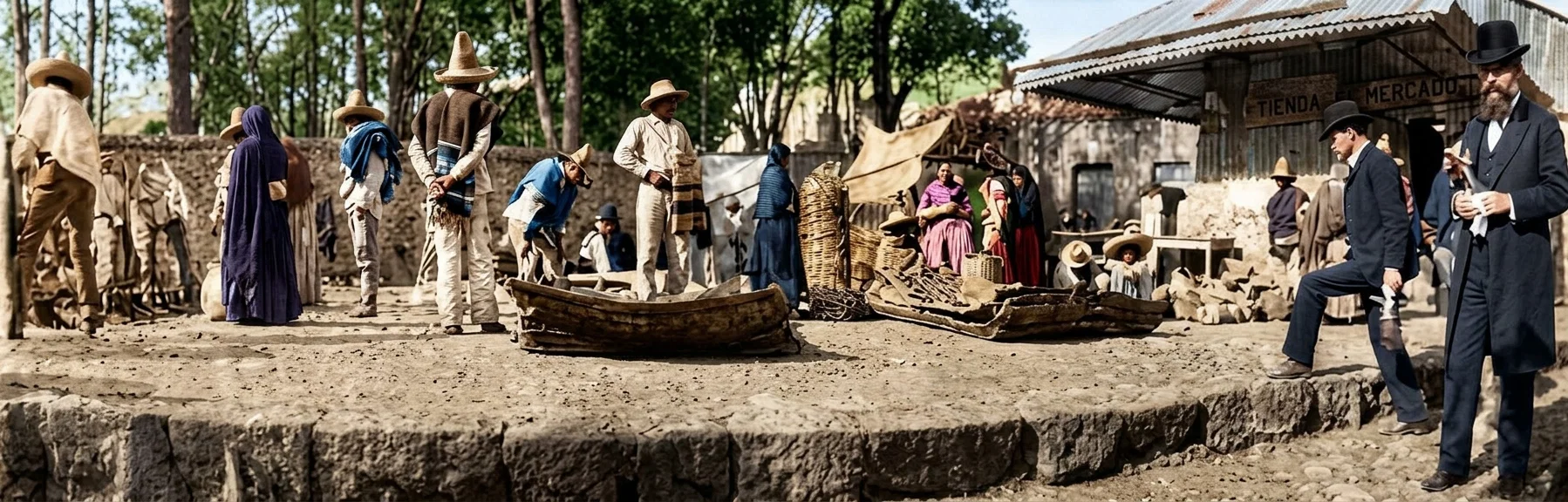
Market Scene in Mexico.
From Acapulco the galleons of Spain returned to their native land bearing the silver and gold and precious things of the New World. Here was once the gateway of China and the far-off Indies of the East; the place where the old world reached across the new to clasp the still older world beyond. From here in 1591 Felipe Jesus sailed for Japan to meet a martyr death in missionary work. In 1773 the Viceroy Bucareli came down from the capital to build the fortress of San Diego on the threshold of the western seas. Here the wars of independence and after, raged fiercely, and here the heroic Vicente Guerrero was betrayed into taking the voyage that cost him his life.
To the traveler there will come the never-to-be-forgotten picture as one descends from the interior to the coast,—the laborious climb up to the last ascent and then the sudden flash of the blue waters of the bay far below with the waves breaking in white foam for miles around the long curves of gray sand edged with green, and beyond all, the placid majesty of the limitless Pacific Ocean. A little further and the road passes through the palm gardens and fields of green pará grass and the music of the surf sounds louder and nearer. Soon the town comes into view: —the gaily colored red tiled houses, the portales and high sidewalks; the brightly dressed people—and one is in Acapulco. But above all, to the Christian, this little seaport is interesting as the cradle of organized Protestantism in the State of Guerrero.
Here in 1874 Procopio Camilo Diaz, a native of Tixtla and an old school liberal who had risen to the rank of colonel in the wars of reform, was engaged in his trade of printer. José Matilde Rodriguez gave him a tract and then spoke to him about the Bible. Catarino Franco described to him the Protestant services he had attended in San Francisco, California, and the Word took root, and Procopio Diaz became the first Gospel preacher not only of the port of Acapulco but of the whole State of Guerrero. Towards the closing months of 1874 it was resolved to send a committee of four up to Mexico City to investigate the methods of church government. Of this committee only one, Simon Diaz, was able to make the arduous trip of nine days on horseback to the capital of the republic. He lodged with Arcadio Morales, and on his invitation Rev. M. H. Hutchinson, our first missionary to Mexico, visited the new congregation. Previously the services had been in a private house, but upon Mr. Hutchinson's arrival, the abandoned Romanist chapel of San José, situated on the rocky bluff close to the waters of the bay and only a short distance from the fortress of San Diego, was rented. January 23, 1875, the first service was held and the Lord's Supper celebrated.
On January 24th the enthusiastic worshipers again assembled to worship, and on January 25th the end came. The priest Don Justo D. Nava had viewed with alarm the spread of Protestant influence in his parish, and had preached against the new believers. His words bore terrible fruit. At 8.15 P.M. while the sixty worshipers were singing the hymn, “A nuestro Padre Dios, Demos en alta voz” a mob of about 300 ruffians, drunken Indians from the neighboring mountain villages, together with those desperadoes always found in port towns, broke in and began a murderous assault with machetes, rifles, and pistols. The believers gathered round their leader, Don Procopio, and on the pulpit a desperate struggle took place. About thirteen Protestants were killed and more than twenty seriously injured, among them Señor Diaz himself, who with one hand crippled from a machete cut was only saved from death because his wife interposed a chair between the murderous blade and her husband's head. It was not long before the uproar brought the soldiers down from the fortress to quell the riot, but in the meantime the attacking party had fled. The dead were carried to the municipal building, and the wounded were helped to their homes. Mr. Hutchinson was not present that night, as illness confined him to his room. On the tumult arising, however, John Sutter, the American consul (the same John Sutter who discovered the gold in California) put him on an American ship and sent him to San Francisco.
Tree of the Sad Night Where Cortez and Party Were Captured.
Thus God stirred up the nest of Protestantism. Governor Dr. Diego Alvarez came in person to investigate the affair. On the “Quebrada,” the cut above the town made to let in the cooling breeze of the ocean, the people of Acapulco gave him a banquet, and the fanatics presented a petition asking to have the Protestants exiled or punished. The governor offered the wounded a room in the castle while they were convalescing. This was refused, for it was justice and not favors that they asked. But if the authorities were slow to act, evidence was not lacking to show that God Himself took vengeance on the murderers. Of these Juan Fajardo was found dead one morning soon after, his body thrown out near the old cemetery and the dogs and vultures feasting on it. Victor Maya became blind soon after, and within a short time Petronilo Mendoza died vomiting blood. The priest himself, robust and vigorous at the time, died, and those who know say that he died soon after in the far-off hot country of the lower Balsas, wasted to a mere skeleton.
For a few weeks services were continued in Acapulco in the house of Juan Tunes until this, too, was wrecked by the fanatical populace. Then it was decided best to separate. On March 18, 1875, Don Procopio came to Chilpancingo and founded the Protestant work there. From here he and his brother Adrian, together with Matilde Rodriguez, Simon Diaz, worked out to Tixtla and the neighboring towns and villages. Others went up the coast north of Acapulco and even penetrated through the Sierra to the lower Balsas country, and everywhere founded groups of believers and preached the Gospel. It was a hard struggle for ten years. In Chilpancingo there were two uprisings against the Protestants, but for some reason they both failed. Several attempts were made to break up the services, as the door of Julian Alarcon's house, riddled with Winchester balls, silently testifies to this day. At one time the church members were imprisoned on a charge of burning the crosses of the Romanists. At last the leaders were virtually banished and told never to return. But in 1885 the church had rest; for General Arce became governor and at once enforced the laws granting equal religious liberty to all. “Hitherto hath the Lord helped us.” Out of that persecution came the greatest blessing that Guerrero has ever known, for the Gospel was not confined to one place, but spread east and north and south. In the new century we cry for more fervor, more Pentecostal power and Pentecostal results, and more of the Spirit's influence on the hearts and lives of our converts.
THE OUTLOOK IN PORTO RICO.
By A. B. Rudd
[A. B. Rudd, in the Baptist Argus.]
THE people of Porto Rico, however dubious they may have been at the beginning, are now convinced that the Gospel has come to stay. Four years of preaching from shore to mountain-top is now telling in the life, hopes, inspirations of this people. Some fifty or more missionaries—Baptist, Methodist, Presbyterian, Episcopalian, United Brethren, Christian Plymouth brethren and others still—are taking a hand in the work of evangelizing the island. Surely13with such a multiplicity of forces the work should not be delayed. The Lord has given us five native brethren who are proving themselves efficient helpers. May their numbers be greatly increased!
Results have been encouraging, tho not so large as we could have wished. Twelve churches with about 530 members serve to incite us to more earnest work for the future.
“Hitherto hath the Lord helped us,” expresses the earnest conviction of missionaries and churches as the old year draws to a close, and with confidence and hope we look forward to even better things for the year 1903.
I NEVER KNEW.
I never knew before the world
So beautiful could be,
As I have found it since I learned
All care to cast on Thee;
The scales have fallen from my eyes,
And now the light I see.
I never knew how very dear
My fellow-men could be,
Until I learned to help them with
A ready sympathy;
Their inner lives have made me know
A broader charity.
I never knew how little things
As greater ones could be,
When sanctified by love for One
Who doth each effort see;
But now a daily round of care
May win a victory.
I never knew; and still, dear Lord,
As through a glass I see,
And perfect life can only come
When I shall dwell with Thee.
When, in Thy likeness, I awake
For all eternity.
—Living Church.
OUR WORK AND WORKERS.
ON the 14th of February a church was organized at Shreveport, La., with a former Baptist minister as local elder.
AT the first ordinance meeting of the church recently organized at Barron, Wis., nine members were added.
THE new church building at Erin, Tenn., was dedicated on the 15th ult. Brother W. J. Stone conducted the service.
ON the 8th ult., the new house of worship at Connersville, Ind., was formally dedicated to the Lord. Brother S. H. Lane preached the dedication sermon.
MEETINGS held in a “large dug-out” at Faulkner, O. T., by Brother J. R. Bagby, have resulted in ten converts to the faith, and a Sabbath-school of twenty-two members.
SIXTEEN meetings held in Olivett, Ohio, by Brother C. C. Webster, have closed with ten new Sabbath-keepers, a church organization of fourteen members, and a Sabbath-school of twenty-five members.
IN the Workers’ Bulletin Brother Henry Johnson reports meetings being held in a union church at Estherwood, La., which are attended by a number of Catholics and Jews, with a good interest and prospect.
FEBRUARY 21 the first service in the new house of worship near Hewitt, Wis., was conducted by Brother Wm. Covert. They have a church-school in the building, but as yet have no church organization. However, an organization of about twenty members will soon be effected.
HEALDSBURG (Cal.) COLLEGE has issued a new Calendar for 1902–03. It is a neat pamphlet of 80 pages, well illustrated, and containing elaborate descriptions of the various industries and courses of studies that engage the attention of the faculty and students. The pamphlet is a credit to the institution.
OF the work in Egypt, Brother W. H. Wakeham says: “Our great immediate need is a tent in which to hold our meetings in the native towns and villages. This is a much better country for tent work than any place I have seen in America or Europe, and we hope that in some way this need will be speedily supplied.”
BROTHER ETHAN BROWN writes as follows to the Minnesota Worker:—
Believing it would be of interest to the readers of the Worker I will relate an experience I had while employed by the Government installing a gasoline engine in a boat at Onigum, Minn., the Leech Lake Indian Agency. While there I was permitted to keep one Sabbath and work Sunday, which aroused such an interest that every Indian who could read English wanted me to send them reading on the subjects of our faith, and especially about the Sabbath. A young Swedish lady, with whom I boarded, decided to close her boarding house, go to Battle Creek, and become a trained nurse. The Indian agent, Major Geo. L. Scott, said at the table that “Saturday is the Sabbath, and no one can get around it.” I had a chance to send reading matter to all the principal government employees at the agency.
THE sanitarium building at Caterham, Surrey, England, which we noted some weeks ago, has been purchased, and is ready for operation free of debt. The brethren of the British Union Conference have gratefully acknowledged the $10,000 (two-thirds of the cost) sent from America, which enabled them to make the desired purchase.
BROTHER A. O. BURRILL writes from Salamanca, N. Y., as follows: “A church of nineteen members was organized at this place March 7. Twenty-six were baptized, twenty-three of whom were students from the school. Others united with other churches. This school, which has been conducted by Brother H. W. Carr and his wife, has proved to be productive of great results.”
AN item in the New York Indicator says: “A letter has recently reached the office from Brother and Sister B. E. Connerly, Mayaguez, Porto Rico. They were well, and of good courage. They are hard at work studying the language, and hopeful for good results. They are contemplating printing a little paper, that they may better reach the people who sit in the grossest darkness.”
THERE are many evidences that our system of industrial schools is appreciated by those who have the privilege of attending them. The following testimonial is from a student at Bethel Academy, Wis., which we cull from the Reporter:—
No doubt our young people throughout the State like to hear of our school here at Bethel. It is indeed a grand school. I have found the Lord here since I have been in this place, and I can see His power working in this school. It is indeed a blessing to know that our teachers, who stand before us every day teaching us the truth, are filled with the spirit and love of God, so that we can see nothing but Christ in them. I very much appreciate being here, and hope that others who hear of this school will make an effort to be with us, and enjoy the blessings God has in store for them.
GOSPEL WORK IN INDIA.
As an evidence that the Gospel of Christ has the same power over souls in India that it has in England or America we quote the following from the Missionary Herald (Congregational) of March, which was written by a missionary from Aruppukottai, India:—
Two men from the Madras Y. M. C. A. arranged to hold a four days' evangelical service with our people. We prayed much for the meetings and brought all our Christian workers in. Four services a day were held, and all was aimed at the workers. Sin was held up in all its enormity. God was at work there, for the men came to me in private, one after another, made the most humiliating confession of sin, asked my forgiveness, and restored money which they had stolen from the mission. They were all small sums, varying from ten cents up to one or two dollars. But this dishonesty had hardened the conscience and robbed them of power. Their consciences were unusually tender, and sins of all kinds and description were confessed with tears and sobs. It broke them all up. I just wanted to put my arms around them, as we took the matter to the Lord and told Him all about it. I loved those men as I never had loved them before. Eighteen of them came to me of their own accord. It was truly wonderful, and I never had such an experience in all my life. I now know the men and they know me as never before. From this time we shall be a new band of Christian workers. Pray for us, that this may be the beginning of a great blessing throughout the station.
The second item of interest is that twenty-one families of the Maravar caste, making in all about eighty-five souls, within two months have decided to become Christians. These men are the highway robbers of the district—bold, rough fellows, whom all fear and at whose door all robbery and crime are laid. But they are worth saving and make splendid Christians when converted. God's hand is in this movement, and we expect more from it still.
A third item is of another nature. Satan has waked up and is very angry. In this place the Bible-women are doing a great work. Many of their pupils give evidence of being truly converted, and wish to come to church. Some of them have done so, altho forbidden by husbands and friends. Last week two of them, on their way to the house of God, were beaten and carried back. One woman, named Veerakkal, of the Naick caste, has had to go through a fiery furnace. She has been married ten years, but has no children, and consequently is hated and scolded by husband and friends. The husband always speaks in anger to her and makes her work in the fields like a slave. Last year she fell sick and was near to death's door. Her hearing was gone and she was just alive, but she said that if the missionary and missionary lady would come and pray with her, she would recover. Very reluctantly the husband called us. We went, and while Mrs. Hazen was praying, Veerakkal's hearing came back to her, and she immediately began to amend. In two or three days she was up and at work. All acknowledged that she was saved by prayer. But her friends did not keep their promise to let her be a Christian. She still held on to Christ, and they held on to their bitter opposition. They said she had better die than be a Christian, took her Bible away from her, and threatened all sorts of things. She stole away from her wretched home and came here to us and said, “Take my jewels, take my clothing, take all I have, but let me have that blessed Bible.” She even said that she would run away from home and be a mere servant to us if we would take her. But we said, “Stay at home and bear witness for Christ there, and try to win husband and friends to Him.” What was our horror three days ago to learn that they had poisoned her, and now she is at death's door. She sends word to us (for we can not get at her) to pray that she may die, O, the cruelties of heathenism!
But in spite of opposition, the work of the Gospel is going forward in India. The Christian population of India at the present time is 2,775,716, an increase of 840,486 in the last ten years. These figures are taken from the government census, and are authentic. While Christian zeal is far below what it should be, and not a tithe of the work is being done that might be done, yet this material evidence of Christian growth should warm the heart and increase the zeal and courage of every loyal follower of Christ.
WASHINGTON, D. C.
By J. S. Washburn
The readers of the SIGNS OF THE TIMES who have responded so generously to the appeal for the Memorial Church will, I am sure, be pleased to know that we have been able to pay $6,200 on the church debt. A balance of $6,700 with interest at 5½ per cent or $1.01 per day still remains to be paid. With the exception of Sunday, when there is no delivery of mail in Washington, I have received money every day since February 2—up to the present day (March 12). Believing that it will interest all readers of the SIGNS and encourage others to give to this worthy enterprise, I will here insert a partial list of donations sent directly to me by those who are not members of the Washington Seventh-day Adventist Church.
Hattie H. Weller . . . $1500.00 A. H. Schafer . . . .50
Dr. and Mrs. Capehart . . . 225.00 Oakland Church . . . 31.07
A friend . . . 144.34 J. A. Coffes . . . .50
H. W. Cottrell . . . 100.00 J. B. Coney . . . .75
Wm. Hurlock . . . 100.00 Woodland Church . . . 41.30
R. L. Simpson . . . 5.00 Mrs. M. H. Hughes . . . 5.00
Mrs. Alice Gage . . . 2.00 T. R. Angove . . . 2.00
Spokane, Wash. Church per W. H. Saxby . . . 10.00 W. G. Buckner . . . 20.00
Mr. and Mrs. Ira E. Johnson . . . 1.00 D. T. Richardson . . . 1.00
Total . . . $2189.46
This list is only partial. Other names will follow in later numbers of the SIGNS OF THE TIMES.
J. S. WASHBURN.
PUBLICATIONS WANTED.
Any or all of our publications suitable for missionary work. Address, post-paid, Mrs. Esther Stone, Portland, Ore.
CURRENT and back numbers of the SIGNS, Life Boat, Review, and tracts, for missionary work. Address, post-paid, Walter Krusen, 11 Monmouth Street, Newark, N. J.
LATE clean copies of the SIGNS, Review, and Instructor for rack work. Address, post-paid, F. M. Gourley, Neoga, Ill.
ADDRESS WANTED.
Any one knowing the address of A. J. Burneson, or of Robert and John Heywood, will confer a favor by sending the same to J. W. Huddlestone, Antlers, I. T.
Annual Meetings.
By Alonzo Trevier Jones; C. H. Jones; M. H. Brown
The thirty-second annual meeting of the California Conference of Seventh-day Adventists, and the seventh annual meeting of the California Conference Association of the Seventh-day Adventists, a corporation, will convene at 2:30 P. M., April 13, 1903, at the Seventh-day Adventist Church, corner of 12th and Brush Sts., Oakland, Cal., for the purpose of electing the officers of the Conference, a board of seven directors of the California Conference of Seventh-day Adventists, and the transacting of such business as may properly come before the meeting. Each organized church will be entitled to one delegate, and an additional delegate for every twenty members.
A. T. Jones, President Cal. Conf.
C. H. Jones, " " Ass'n.
M. H. Brown, Secretary.
PACIFIC PRESS PUBLISHING COMPANY.
By A. G. Miller
THE annual meeting of the stockholders of the Pacific Press Publishing Company, a corporation organized and existing under and by virtue of the laws of the State of California, will be held at the office of the company, corner of Twelfth and Castro Streets, in the City of Oakland, County of Alameda, State of California, on Monday the 27th day of April, A. D. 1903, at 9:30 A. M., for the purpose of electing a board of seven directors, and transacting any other business that may properly come before the meeting.
By order of W. T. KNOX, President of Pacific Press Publishing Company.
A. G. MILLER, Secretary of Pacific Press Publishing Company.
NOTICE OF STOCKHOLDERS’ MEETING.
By W. T. Knox; L. M. Bowen
Notice is hereby given that the annual meeting of the Stockholders of the Rural Health Retreat Association will be held in the St. Helena Sanitarium Chapel at Crystal Springs, now Sanitarium, near St. Helena, Cal., on Thursday the thirtieth day of April, 1903, for the purpose of electing a Board of seven directors, and for the transaction of such other business as may properly come before the meeting.
W. T. KNOX, President.
L. M. BOWEN, Secretary.
ANNUAL MEETING.
By E. A. Chapman
The regular annual meeting of the Society of the Seventh-day Adventist Church of Oakland, Cal., will be held at the house of worship, corner Twelfth and Brush Sts., Wednesday evening, April 1st, 1903, at 7:30 o'clock. E. A. Chapman, Sec.
Colored Goods
By Mrs. Rev. M. E. M.
I prefer PEARLINE to any other powder I have used. I do not think it will injure colored clothes, which is more than I can say for most other washing powders.