Your ShelfYour Projects

Signs of the Times, Vol. 29, No. 13.

THE FORM, BUT NOT THE POWER
Earlier text: A WAYSIDE INCIDENT

INTERNATIONAL SERIES

THE SUNDAY SCHOOL

LESSON 2.—APRIL 12.—THE RESURRECTION.

Lesson Scripture, 1 Cor. 15: 20, 21, 50-58, A. R. V.
(20) “But now hath Christ been raised from the dead, the first-fruits of them that are asleep. (21) For since by man came death, by man came also the resurrection of the dead.”
(50) “Now this I say, brethren, that flesh and blood can not inherit the kingdom of God; neither doth corruption inherit incorruption. (51) Behold, I tell you a mystery: We all shall not sleep, but we shall all be changed, (52) in a moment, in the twinkling of an eye, at the last trump: for the trumpet shall sound, and the dead shall be raised incorruptible, and we shall be changed. (53) For this corruptible must put on incorruption, and this mortal must put on immortality. (54) But when this corruptible shall have put on incorruption, and this mortal shall have put on immortality, then shall come to pass the saying that is written, Death is swallowed up in victory. (55) O death, where is thy victory? O death, where is thy sting? (56) The sting of death is sin; and the power of sin is the law: (57) but thanks be to God, who giveth us the victory through our Lord Jesus Christ. (58) Wherefore, my beloved brethren, be ye steadfast, unmovable, always abounding in the work of the Lord, forasmuch as ye know that your labor is not vain in the Lord.”
Note.—The lesson includes the entire chapter, with a brief review of Christ’s resurrection and the forty days following. It is suggested that the teacher win the attention of the class by asking what most men fear most. The answer will be death; but it should be sin. For the Christian, the promise of the resurrection removes the fear of death.
Golden Text.—“Now is Christ risen from the dead, and become the first-fruits of them that slept.” 1 Cor. 15: 20.

SUGGESTIVE QUESTIONS.

(1) What positive truth does Paul affirm in regard to Christ? What did He thus become? Verse 20. Note 1. (2) How did death enter the world? What followed? and through whom? Verse 21. Note 2. (3) What declaration does Paul make in regard to flesh and blood? In regard to corruption? Verse 50. Note 3. (4) What does Paul proceed to expound? What experience would some escape? But what experience would be common to all? Verse 51. (5) How much time would be consumed in this change? When will it take place? What two events will immediately follow the sounding of the trumpet? Verse 52. Note 4. (6) What must the corruptible do? What must the mortal do? Then what are all up to the time of the resurrection? Verse 53. (7) When this great change has been wrought, what glorious fact will then be realized? Verse 54. Note 5. (8) What triumphant questions will then be asked of death? Verse 55. (9) What constitutes the sting of death? What relation does the law sustain to sin? Verse 56. Note 6. (10) What should this victory over sin and death lead us to exclaim? Through whom was that victory won for us? Verse 57. (11) Because of this what does Paul exhort the followers of Christ to do? Because that victory has been achieved, what may the Christian know? Verse 58.

NOTES.

1. “The first-fruits.”—Christ is the first-fruits of them that are asleep because His resurrection is the pledge and assurance of the resurrection of His people. He is the first sheaf in the great harvest of life, the precursor of the treasures of the harvest field to follow. On the fact of His resurrection hangs the whole plan of salvation. Without that, the Gospel itself would be nothing.
2. “Since by man came death.”—Romans 5:12 states it in this way: “Therefore, as through one man sin entered into the world, and death through sin; and so death passed unto all men, for that all sinned.” “Man” and “one man” in these texts refer to Adam and to Christ, as we see by 1 Cor. 15:22: “As in Adam all die, so also in Christ shall all be made alive.” In Adam’s sin the whole world is counted as sinning; but in Christ’s righteousness every repentant sinner is counted righteous. How is it possible, then, to accuse God of injustice in counting all sinners when He has made such ample, such free provision for the righteousness of all?
3. “Neither doth corruption inherit incorruption.”—One of the strongest texts in the Bible to prove that man is mortal. We do not inherit or enter into heaven now, because we are mortal, corruptible, perishable. There is coming a time when those who have been loyal to God will be imperishable, incorruptible, immortal. Then they can enter heaven. That time is pointed out in verse 52—the time of the resurrection, at the sounding of the trumpet of God. This is described in 1 Thess. 4:16. The expression quoted at the beginning of this note is but another way of saying, “neither doth mortality inherit immortality.” It means just that. We are not mortal and immortal at the same time; but we are mortal now and will remain so until after the resurrection; and only those who are Christ’s will have immortality then. This is the teaching of the whole chapter—and of the Bible.
4. “We shall be changed.”—Changed from mortal to immortal, receive the resurrection body. When will that change be made, that gift be given? The verse itself tells: “We shall be changed” at the sounding of “the last trump;” the dead will “be raised incorruptible”—receive their resurrection bodies—after “the trumpet shall sound.” Then they have not been incorruptible, immortal, until the trumpet of the resurrection sounds. The only possible conclusion is that the dead have remained dead until that time, and that immortality is given at that time.
5. “So when this corruptible.”—Paul, as if to leave men without excuse for ignorance on this point, reiterates the truth of the mortality of man; that incorruption, immortality, comes only at the resurrection, when “the Lord Himself shall descend from heaven, with a shout, with the voice of the archangel, and with the trump of God.” That shout is the shout of victory over Satan and sin, the command to the sleeping saints to arise. See also Isa. 26:19-21.
6. “The sting of death is sin,” because sin has stung the race, and death is the result. Death is the result of sin as well as the wages for it. “By the law is the knowledge of sin.” The law makes the sin to appear what it is; it points out sin. Paul says: “I had not known sin, except the law had said, Thou shalt not covet,” etc. It is in this sense that the law is said to be the power, or strength, of sin.

THE SABBATH SCHOOL INTERNATIONAL SERIES

LESSON 3.—APRIL 18, 1903.—THE MANNER OF THE PREACHER.

Lesson Scripture, 1 Thess. 2: 1-12, A. R. V.
(1) “For yourselves, brethren, know our entering in unto you, that it hath not been found in vain: (2) but having suffered before and been shamefully treated, as ye know, at Philippi, we waxed bold in our God to speak unto you the Gospel of God in much conflict. (3) For our exhortation is not of error, nor of uncleanness, nor in guile: (4) but even as we have been approved of God to be intrusted with the Gospel, so we speak; not as pleasing men, but God who proveth our hearts. (5) For neither at any time were we found using words of flattery, as ye know, nor a cloak of covetousness, God is witness; (6) nor seeking glory of men, neither from you nor from others, when we might have claimed authority as apostles of Christ. (7) But we were gentle in the midst of you, as when a nurse cherisheth her own children: (8) even so, being affectionately desirous of you, we were well pleased to impart unto you, not the Gospel of God only, but also our own souls, because ye were become very dear to us. (9) For ye remember, brethren, our labor and travail: working night and day, that we might not burden any of you, we preached unto you the Gospel of God. (10) Ye are witnesses, and God also, how holily and righteously and unblamably we behaved ourselves toward you that believe: (11) as ye know how we dealt with each one of you, as a father with his own children, exhorting you, and encouraging you, and testifying, (12) to the end that ye should walk worthily of God, who calleth you into His own kingdom and glory.”

QUESTIONS.

  1. What could be said of Paul's preaching to the Thessalonians? Verse 1. Note 1.
  2. Did his treatment at Philippi discourage him under like circumstances at Thessalonica? Verse 2.
  3. Of what three things did his teaching not partake? Verse 3. Note 2.
  4. Of what had he been made steward? How did he fulfil his trust? Verse 4.
  5. What did he not use in respect to them? What did he not have to conceal? Before whom had he fulfilled his mission? Verse 5.
  6. What did he not seek? What did he not assume when he had the right? Verse 6. Note 3.
  7. What was his manner toward them? Verse 7.
  8. How dear were these souls to the apostle? Verse 8.
  9. What did he call to their remembrance? How earnestly did he labor? Verse 9.
  10. What example did he set? Verse 10.
  11. How did he deal with them? Verse 11.
  12. To what object did he testify? To what had God called them? Verses 11, 12.

NOTES.

1. WHEN the grace of the Gospel of God came to the apostle Paul, it came “not in vain.” It was revealed not only to him, but in him. Gal. 1: 16. The proof that it was not in vain was the service he rendered for God: “I labored more abundantly than they all; yet not I, but the grace of God which was with me.” 1 Cor. 15: 10.
2. THESE things in the negative imply their positives. His exhortation was not of error; it was therefore of truth. It was not of uncleanness. It was unlike the teaching of paganism, in which licentiousness and lewdness were taught as a part of its abominable nature worship, and which is ever regarded lightly by carnal man where the rays of the Gospel have not shone. He taught purity of motive, of heart, of thought, of word, of life. He was without guile. He did not hide the principles of God's truth; he did not need to. The blessed things of Christianity are not a cloak to deceive, a fair thing to hide something which will not bear the light. Paul did not teach thus, though he was so charged with doing. He shunned not to declare the whole counsel of God.
3. THAT they who preach the Gospel shall live of the Gospel, is apostolic and divine. Paul brought to the Thessalonians the higher life: surely he had a right to partake of their things which supported the physical man. But he did not do it. He did not seek glory from them or from others, nor was he burdensome. His course was an example of unselfishness, and it demonstrated that he did not break from traditional Judaism and become a Christian for gain. But it is the duty of the church to remedy this by supporting the servants of God. The unselfishness of the servant of God should not develop unhospitable, selfish churches.

CHICAGO IN LESS THAN 3 DAYS

From San Francisco at 10 a. m.

CHICAGO UNION PACIFIC & NORTHWESTERN LINE

Pullman fourteen-section Drawing-Room and Private Compartment Observation Sleeping Cars, with Telephone. Electric-reading Lamps in every Berth, Compartment and Drawing-Room. Buffet, Smoking and Library Cars, with Barber and Bath, Dining Cars—meals a la carte. Electric-lighted throughout.
Daily Tourist Car Service at 6 p. m. and Personally Conducted Excursions every Wednesday and Friday at 8 a. m. from San Francisco. The best of everything.
R. R. RITCHIE
617 MARKET STREET (PALACE HOTEL) GEN. AGENT PACIFIC COAST SAN FRANCISCO

“The Greatest Want of the World”

“is the want of men,—
“Men who will not be bought or sold; men who in their inmost souls are true and honest; men who do not fear to call sin by its right name; men whose conscience is as true to duty as the needle to the pole; men who will stand for the right though the heavens fall.”
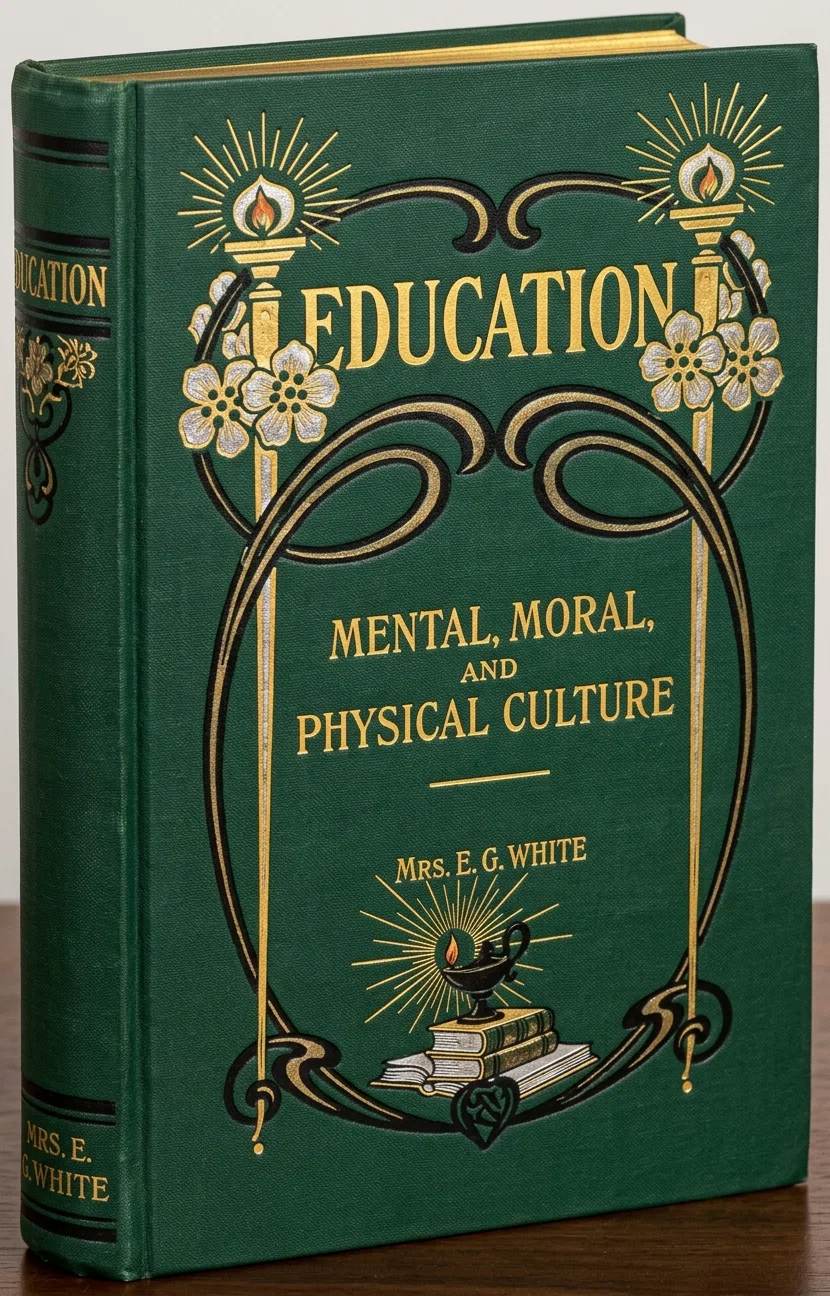
The above extract seems to us to be the keynote to the splendid volume which has just been published, entitled

EDUCATION

By MRS. E. G. WHITE
It is impossible in a brief way to adequately present to our readers the practical value and beauty of this truly great work. It must be read and reread to be fully appreciated. It may truthfully be termed the life-work of the author, and it is in every sense a masterpiece.
In view of the priceless truth it contains, and the great and eternal issues faithfully presented, we earnestly urge all to secure copies as early as possible.
Perhaps an understanding of the nature of the contents can be best imparted by a list of the chapter headings, with short extracts of each. They are as follows:—
FIRST PRINCIPLES.— “Since God is the source of all true knowledge, it is, as we have seen, the first object of education to direct our minds to His own revelation of Himself.”
THE EDEN SCHOOL.— “On every leaf of the forest and stone of the mountains, in every shining star, in earth and sea and sky, God’s name was written.”
THE KNOWLEDGE OF GOOD AND EVIL.— “Though marred by sin, nature speaks not only of creation, but of redemption. Though the earth bears testimony to the curse in the evident signs of decay, it is still rich and beautiful in the tokens of life-giving power.”
RELATION OF EDUCATION TO REDEMPTION.— “In the highest sense, the work of education and the work of redemption are one.”
THE EDUCATION OF ISRAEL.— “What an industrial school was that in the wilderness, having for its instructors Christ and His angels!”
THE SCHOOLS OF THE PROPHETS.— “These schools proved to be one of the means most effective in promoting that righteousness which exalteth a nation.”
LIVES OF GREAT MEN.— “The same mighty truths that were revealed through these men, God desires to reveal through the youth and the children of to-day.”
THE MASTER TEACHER.— “Through Christ has been communicated every ray of divine light that has ever reached our fallen world.”
AN ILLUSTRATION OF HIS METHODS.— “A miracle of divine tenderness was Peter’s transformation. It is a life lesson to all who seek to follow in the steps of the Master Teacher.”
NATURE TEACHING.— “The world is a lesson book, life a school.”
LESSONS ON LIFE.— “All things both in heaven and in earth declare that the great law of life is a law of service.”
OTHER OBJECT LESSONS.— “The little rill that makes its noiseless way through grove and meadow, bearing health and fertility and beauty, is as useful in its way as the broad river.”
MENTAL AND SPIRITUAL CULTURE.— “The science of redemption is the science of all sciences.”
SCIENCE AND THE BIBLE.— “Only under the direction of the omniscient One shall we, in the study of His works, be enabled to think His thoughts after Him.”
BUSINESS PRINCIPLES AND METHODS.— “No man can lay up treasures in heaven without finding his life on earth thereby enriched and ennobled.”
BIBLE BIOGRAPHIES.— “No truth does the Bible more clearly teach than that what we do is the result of what we are.”
POETRY AND SONG.— “Great have been the blessings received by men in response to songs of praise.”
MYSTERIES OF THE BIBLE.— “In the natural world we are constantly surrounded with wonders beyond our comprehension. Should we then be surprised to find in the spiritual world also mysteries that we can not fathom?”
HISTORY AND PROPHECY.— “The present is a time of overwhelming interest to all living.”
BIBLE TEACHING AND STUDY.— “As the miner digs for the golden treasure in the earth, so earnestly, persistently, must we seek for the treasure of God’s Word.”
STUDY OF PHYSIOLOGY.— “The health should be as faithfully guarded as the character.”
TEMPERANCE AND DIETETICS.— “Let the youth be impressed with the thought that they are to be masters, and not slaves.”
RECREATION.— “No recreation helpful only to themselves will prove so great a blessing to the children and youth as that which makes them helpful to others.”
MANUAL TRAINING.— “No man or woman is degraded by honest toil. That which degrades is idleness and selfish dependence.”
EDUCATION AND CHARACTER.— “The world does not so much need men of great intellect as of noble character.”
METHODS OF TEACHING.— “Many students devote their time to higher mathematics, when they are incapable of teaching simple accounts.”
DEPORTMENT.— “The essence of true politeness is consideration for others.”
RELATION OF DRESS TO EDUCATION.— “A refined taste, a cultivated mind, will be revealed in the choice of simple and appropriate attire.”
THE SABBATH.— “On this day more than on any other, it is possible for us to live the life of Eden.”
FAITH AND PRAYER.— “In the prayer of faith there is a divine science; it is a science that every one who would make his life work a success must understand.”
THE LIFE WORK.— “The heaven-appointed purpose of giving the Gospel to the world in this generation is the noblest that can appeal to any human being.”
PREPARATION.— “The teacher can gain the respect of his pupils in no other way than by revealing in his own character the principles which he seeks to teach them.”
CO-OPERATION.— “The teacher’s work should supplement that of the parent, but it is not to take its place.”
DISCIPLINE.— “The divine Teacher bears with the erring through all their perversity.”
THE SCHOOL OF THE HEREAFTER.— “Heaven is a school; its field of study, the universe; its teacher, the infinite One. There will be open to the student history of infinite scope and of wealth inexpressible.”
THE DEDICATION reads thus: “To parents, teachers, and students, all pupils in earth’s preparatory school, this book is dedicated. May it aid them in securing life’s greatest benefits, development and joy in service here, and thus a fitness for that wider service, the ‘higher course,’ open to every human being in the school of the hereafter.”
THE AUTHOR’S PURPOSE AND DESIRE is also expressed in the opening text: “That our sons may be as plants grown up in their youth; that our daughters may be as corner-stones, polished after the similitude of a palace.”
We sincerely trust that the author’s desire may be richly fulfilled, and to this end hope for a wide circulation.
321 pages. Attractively bound in gray cloth, with beautiful three-color cover design. Clear print and good paper.
Besides having complete scriptural and general indexes, the whole of the book is subtitled in such a way as to enable the reader to rapidly refer to any desired portion. This is a valuable feature that will be much appreciated.
To secure copies of first edition order early. Cloth binding as illustrated above, price $1.25, post-paid
_ADDRESS YOUR TRACT SOCIETIES_

Pacific Press Publishing Company

OAKLAND, CALIFORNIA 11 West Twentieth Street, NEW YORK CITY 18 West Fifth Street, KANSAS CITY, MO.

Religious Freedom in Russia.

According to the New York Independent, there is much skepticism in European circles concerning the czar's manifesto of freedom. “The common criticism is that the terms of the decree are so vague as to mean anything or nothing, according to the manner in which they are carried out.” The Berlin Post declares that the czar has not come forward with definite proposals or with any well-considered plan, but has only mentioned those matters in which he thinks reforms may be made. “While every lover of liberty will wish earnestly and hope faintly for good results, he should be prepared to expect disappointment. It was many centuries ago that Inspiration warned us: ‘Put not your trust in princes, nor in the son of man, in whom there is no help.’” Ps. 146:3. There is a greater liberty which the people of Russia need, which the millions of the world need, and that is liberty from sin, obtained from God through faith in Jesus Christ. “Happy is he that hath the God of Jacob for his help, whose hope is in the Lord his God; which made heaven, and earth, the sea, and all that therein is; which keepeth truth forever.” Verses 5, 6.

Jews Excluded from Canadian Public Schools

By a recent court decision the children of Jews in Canada are practically denied the privilege of the public schools. Like many other oppressive measures in these last days, this decision is based upon an old law supposed to be obsolete. The law, it is said, was designed to limit the public-school privilege to people who paid taxes on real estate; and, as the Jews do not usually invest in that way, they are, in the main, ineligible to the schools. A writer in the Montreal Gazette says: “Their owning or not owning real estate has nothing to do with the question involved, and in no degree diminishes liability to be taxed to the fullest extent of citizenship. If they do not pay taxes on land, they pay these taxes in rent. . . . The exclusion of the Jews from equal rights in the matter of an educational system maintained by public taxation is the relic of an age of which we should all be ashamed. If this is the law, it is an anachronism in modern civilization. It is equally at variance with the genius of the British Constitution and the Spirit of that great Lawgiver who came to proclaim peace, justice, and universal good-will and fraternity among men.” Of course, there must be many other people in like position with the Jews, but this law, like some ancient Sunday laws, has been resurrected for the purpose of satisfying prejudice against a certain class.

Idol-Makers and Idol-Worshipers

Idol-makers and Idol-worshipers.—The so-called Christian nations are supplying, not only opium and rum to the idolators of the Orient, but images and idols, and America is the last in the race. But the opium and the rum are worse than the images. The strife for commercial supremacy in this respect ought to open the eyes of the thinking pagan. Would that with each idol, rendered into the language or dialect of the purchaser, there could go a copy of the following from Psalm 115:—
“Not unto us, O Lord, not unto us, But unto Thy name give glory, For Thy mercy, and for Thy truth’s sake. Wherefore should the heathen say, Where is now their God? But our God is in the heavens; He hath done whatsoever He hath pleased. Their idols are silver and gold, The work of men’s hands. They have mouths, but they speak not; Eyes have they, but they see not; They have ears, but they hear not: Noses have they, but they smell not; They have hands, but they handle not; Feet have they, but they walk not; Neither speak they through their throat. They that make them are like unto them; So is every one that trusteth in them.”

Prayers for the General Conference

The article by Sister White on “Child-Training” is so decidedly a home article that we have placed it in our Home department.
Do not pass over the first article on “What Do These Things Mean?” by Alonzo T. Jones, on page 2. Read it and keep the connection with those which follow.
At this writing, March 23, delegates are rapidly coming, and when this paper reaches our readers the General Conference will be well under way. Some preliminary councils have been held, but no cut-and-dried plans have been adopted. The earnest prayer is that God may guide, and will guide this conference to His glory. To Him we are looking for the blessings of guidance and power. Let all our readers join us in our prayers.

The Permanent International Bureau of Peace

“The Permanent International Bureau of Peace” has been organized in Berne, Switzerland, the promoters of which have a noble purpose, namely, to use its influence, and to correlate all the influences of national peace societies to effect permanent peace in the earth. May God bless their efforts to some good; but the permanent peace will not come till Christ comes. There is but one Permanent Peace Bureau in this universe now, namely, the Throne of God. And the peace which comes from Him is the effect of righteousness. All may possess it who will accept of His way.

JESUS CHRIST AND UNIONISM.

A LABOR-UNION document recently issued to defend a boycott of a non-union establishment, says:—
While speaking of unionism and religion, it might be well to remind ourselves that Christ was the son of a carpenter. Our conception of Him compels us to believe that, if He returned to earth to-day, and followed that trade, that He would be a union carpenter.
And we know, and so does every other well-instructed Christian, that He would not. We know by the life He lived while here on the earth. Christ had some Jewish union disciples, and they sometimes expressed themselves, and so called out an expression of the Master’s principles. One instance will suffice. He sent them out to do His work, to preach the Gospel, heal the sick, cast out demons, etc. The union-spirit disciples felt that a monopoly of the matter belonged to them, so when they found others doing the same work, they forbade them. Here is the record of a conversation between one of the leaders and Christ:—
“And John answered and said, Master, we saw one casting out demons in Thy name [doing our work], and we forbade him, because he followeth not with us. But Jesus said unto him, Forbid him not.”
There is a true unionism and its counterfeit confederacy. The only true unionism between men is life-union through Jesus Christ; all else is confederacy to carry out some scheme or device of men, whether that confederacy be called a union, alliance, guild, or church. The Bible has much to say of these, but the only principles of unionism it knows are life-union with Jesus Christ and charity and helpfulness to all men, Christians or otherwise.

Hypocrisy

Hypocrisy is the sure result of observing the traditions of men. The Pharisees and scribes asked Jesus, “Why walk not Thy disciples according to the tradition of the elders?” and He answered in the words of the prophet Isaiah, “This people honoreth Me with their lips, but their heart is far from Me.” This principle is so plain that even the men of the world can see it. The Tribune of this city says, editorially:—
Not a few people borrow the garb of piety to wear during the season of Lent. They make a pretense of fasting as an atonement for being fast. What fools these mortals be! As if the Lord can be cheated by devices that do not deceive men even!
Those Protestants who are just now being carried away with the Lent and Easter traditions would do well to note this comment, and ponder the effect of their folly. The fact can not be too strongly emphasized, that walking according to the traditions of men is walking away from the commandments of God. The words of Christ are plain and pointed: “Laying aside the commandment of God, ye hold the tradition of men.” “Full well ye reject the commandment of God, that ye may keep your own tradition.” “Thus have ye made the commandment of God of none effect by your tradition.” See Matt. 15: 1-9; Mark 7: 5-13.

Tyrant Tobacco

Leslie's Magazine for March has an article on the “Tobacco War,” which is of interest in showing how money has been piled up in the tobacco trust. The article says:—
The trust has gone into the manufacture of cigars. It has been in business less than two years, and, during the past twelve months, it produced about a billion cigars. As the total production of the country is approximately seven billions, this represents a very fair amount of business for an infant concern.
The enormous extent of the tobacco business in America may be realized from the fact that seven billion cigars, three billion cigarettes, and two hundred and eighty million pounds of manufactured tobacco, and fifteen million pounds of snuff are produced every year. The retail value of all the smoking and chewing tobacco, in its various forms, approaches $500,000,000 annually.
It is for this business, in all its fulness, the trust is fighting. On one brand of plug tobacco $4,000,000 was spent in advertising, but since that $12,000,000 profits have been made from that brand.

Education

"Education."—There has been placed upon our table at this day and hour (4 P. M. March 22) a beautiful book, entitled, "Education," by Ellen G. White. It is not a book of forms and methods, but of principles and life. It treats the subject, not from the viewpoint of culture, but of character. It pleads for an education which will make characters, strong, pure, noble, refined, uplifting characters, helpful in every useful service. It treats of the question in the light of man's highest interest, not only the here, but the hereafter, the long eternal ages which will come after this brief life is over. But this will suffice for the present. We note this to call attention to a fuller notice of the book on page 15. It is a veritable mine of wealth on the subject. Parents, teachers, educators, ought to study this little volume.

God’s Book Stands Forever

God's Book stands, and will stand forever. Men may despise it, revile it, seek to destroy it; but one word of God will be found to be more than all the power of His enemies, "because the foolishness of God is wiser than men; and the weakness of God is stronger than men."

Blessings unused become curses.

You have reached the end of this edition.

Signs of the Times · Apr 1, 1903