A few years ago a professed Christian woman and a missionary worker were having a conversation in regard to looking after one’s own interests and looking after the interests of others. The Christian worker was emphasizing the blessedness that is the natural result of a life of unselfish devotion, when the other remarked, “You may do as you please, but I have learned from experience that if I don’t look out for number one, nobody else will.”
This statement, when viewed from a human point of view, appears very plausible, while in reality, it is precisely the other way. The person whose mind is most thoroughly absorbed in looking after the welfare of others will soon discover that the Lord, who is the source of all blessings, is devoting his attention to looking after his personal interests; and he who has had a trial experience of both ways must have been thoroughly impressed with the fact that his interests are much safer when God is looking after them than when he himself is devoting his whole time and attention to this work.
“He that hath pity upon the poor lendeth unto the Lord; and that which he hath given will he [God] pay him again.” Even the most shrewd business man sometimes fails to collect his debts, but the sincere Christian worker who, from a genuine pity for the condition of the unfortunate, is imparting of his blessings to them, is lending that which will as certainly be repaid to him as God’s word is true. Consequently, it is perfectly safe to carry out the divine instruction, “Give to every man that asketh of thee.” We are not necessarily to give the particular thing that is asked for. Even God himself does not always give us the things we pray for; but he does give us what we most need. So we are to give to the unfortunate that which he most needs. Frequently a word of advice will be worth far more to him than money. Let us ever remember the wonderful principle, “With what measure ye mete, it shall be measured to you again.”
DAVID PAULSON, M. D.
REST A WHILE
By Marianne Farningham
Come ye apart from off the toilsome road,
And spend a quiet hour, alone with God.
Put off the troubled thought, the weight of care;
Let the soul's peace be your unspoken prayer.
A couch of heather for your sleep is spread;
A scented pillow for the weary head.
Lie down and slumber; let the world go on
A while without you as it oft has gone.
Take time for meditation, time for dreams;
See how clouds travel, how the river gleams,
How the flowers worship, and the golden corn
Whispers God's praises eventide and morn.
To work for God is good, but not the best;
Hearts grow most strong in him through love and rest.
— Marianne Farningham.
HELPING TO REMEMBER
By Ida Hibben
“Lura, why have you that red cord tied around your finger?”
“Oh, Lila wants me to bring my Nature Book to school to-morrow, and she was afraid I would forget it, so she tied this string around my finger to help me remember.”
“Do you think it will help you?”
“I’m sure it will, for every time I look at my hand, I think of Lila, and what she wants me to do.”
“Lila’s plan reminds me of some of the ways our Heavenly Father has taken to keep us from forgetting the wonderful things he has done and will do for us. Can you think of anything God has told us to remember?”
“‘Remember the Sabbath day, to keep it holy,’ said Lura.”
“Yes, and why does he want us to remember it?”
“Because, mama, he doesn’t want us to forget that he made this great world and everything in it, and he did it without anything to make it of, or any tools to make it with, and then we’ll rest in him to make us what he wants us to be.”
“Very good; and just as the red cord on your finger makes you think of what Lila wants you to do, so the Sabbath makes us think of what God wants us to do, and of his power to help us.”
“Do you remember anything he did on purpose to make the children ask questions, and thus find out some great work of his?”
“Since you have never heard of it, I will have to tell you about it. When the Lord caused the waters of the River Jordan to wall up so his people could pass over on dry ground, he told twelve men to each pick up a stone from the bed of the river, and when they had reached the other side, to put the twelve stones all in a pile on the bank.”
“What for, mama?”
“So when the children passed by, they would ask, ‘What mean these stones?’ and then their fathers would tell them how the Lord had led his people through the River Jordan.
“Now I want to tell you about something the Lord wants the children of to-day to remember, and his plan to help them.”
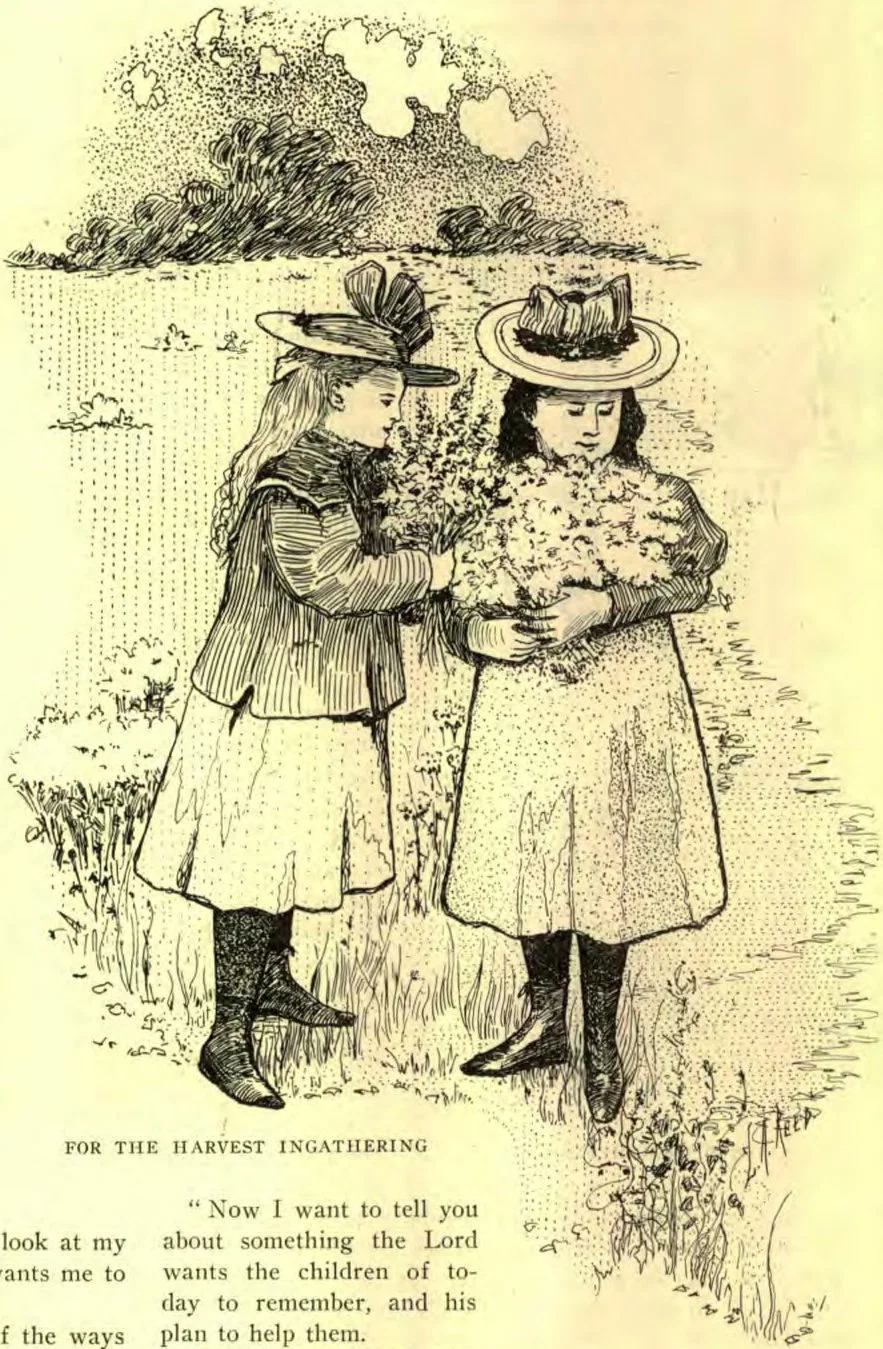
FOR THE HARVEST INGATHERING
“When Adam and Eve disobeyed God in the garden of Eden, he came to talk with them, and to tell them about Jesus, whom he called ‘the Seed.’”
“He told them that Jesus would come to this world, be killed, and be buried in the grave, like seed; and because he was willing to do this for poor sinners, very many of them would love him, and be saved in the kingdom of heaven.”
“Jesus came long ago, as God promised, and became the seed of a great harvest, which will be gathered when God sends the angels (his reapers) to gather the faithful (his sheaves) into heaven (his granary). How much like a real harvest it is, isn’t it? So to keep us from forgetting his harvest, which is the end of the world, he wants us each year after we have harvested, or gathered in, our grains and fruits, to decorate our place of worship with beautiful things from the woods and fields, and then sing and talk about his goodness in giving us such a bountiful harvest. He wants each one of us to bring him an offering, too, to show how much we love him. He knows that if we will do this, it will make us think of his harvest time, and we shall all want to do something to hasten its coming. Isn’t that much nicer than red cords or stones to remember by?”
“Now the Sabbath-school is going to have such a meeting, called the Harvest Ingathering service, and I have wondered if you and Lila could not bring some pretty leaves from the woods, or grasses from the fields, to make the church look pretty. I know you will not forget an offering for the Lord, to help in his great harvest work. You can tell Lila about it to-morrow. Some day we will have another talk about helping to remember, but I will not keep you any longer at this time.”
IDA HIBBEN.
WHAT MEAN THESE STONES?
By Mrs. M. Eugenia McKee
“WHAT mean these stones?” the children cried,
As they paused in their eager play;
“And why in regular order laid?
Can you tell us, father, pray?”
“Oh, they’re to show that wondrous work
Our God performed for us,
When Israel came to this surging stream,
Which the Lord had bidden us cross.
“When our feet came down to the river’s brink,
The waters parted wide,
And stood in a heap like a wall of ice,
Till we crossed to the other side.
“Then were we bidden to take these stones,—
Each tribe a stone, you see,—
And place in a heap, that in years to come
A memorial they should be.
“So never forget, my children dear,
Our God is a God who saves;
And the wrath of man he can subdue,
As well as the roaring waves.”
MRS. M. EUGENIA MCKEE.
TOGGLES AND THE BEES
In the beginning Toggles had been very much afraid of them, and when he heard a “buzz-buzz” coming nearer and nearer to his head, he had wanted to strike with his hat, or run away into the house. But that was when he first came to the farm. Grandpa explained to him that the bees could hurt him, of course, but they did not want to. They were only very busy at this time of the year, and did not like to be interfered with; and when once Toggles had learned that, he and the bees became great friends.
They usually went to work before he was up, but sometimes he was awake early enough to see the last of them setting off; and however far he might wander during the day, he was almost certain to meet some of them flying home with their loads or balancing upon the clover blossoms, which grandpa told him they “tapped” in something the same way that people tap the maple-trees in the early spring.
After tea, when their busy day was over, Toggles would walk down among the hives, all so quiet now, with not a worker in sight except the little bee sentry pacing back and forth in front of the entrance, and it was as interesting as anything he had ever seen.
He was not afraid of them any more. Except when he was helping grandpa, he never wore a “bee veil,” and even then his hands were always bare. Grandpa would open the hives and show him about them, until he could tell what was honeycomb and what “brood” comb; knew “bee-bread;” and could pick out at a glance the queen with her little train of attendants, who never left her, and the great lazy drones, who did no work at all, and ate just as much as any other bees.
When grandpa was somewhere else, he would hammer together the little honey-boxes, which318grandpa paid him ten cents a hundred for making. That was fun; but when the day was warm, and grandpa was not watching, it was work, too; and to make a hundred boxes took a good while, no matter how industriously he worked.
But Toggles was learning much those days, so much that when grandpa went away to the city, he left the bees partly in charge of the hired man and partly in charge of Toggles, and that is how there came to be a story for me to tell you.
They had been cutting some bits of comb from the bottom and sides of the hives, where bees ought not to put honey, and the hired man said, “What does he do with these?”
Toggles thought, but could not remember.
“Let’s put them down in front of the hives,” he suggested. “Then the bees can take the honey in, and put it somewhere else.”
They did so, and the bees went to work at once.
The next day, after dinner, Toggles went down among the hives, and the very first thing a bee flew straight in his face, and stung him right on the end of his nose. He had out the stinger in a second, and rubbed on some ammonia; but it seemed such an outrageous thing for a bee to do that he put on his veil, and went back to see, if he could, what was the matter.
A bit of honey in front of one of the hives was covered with bees, and all around it were bees struggling and fighting, locked together, and rolling over and over in the grass. Around at the back some others seemed to be trying to get in where the cover fitted loosely, and inside the buzzing was an angry roar. Toggles went from hive to hive, and in several there seemed to be trouble. What it all meant he could not guess.
FOR THE HARVEST INGATHERING
Grandpa came at two o’clock, and driving up from the depot Toggles told him all about it. Grandpa did not say much, but as soon as he reached home, he changed his clothes, and they went out to the bee-yard. Toggles watched him while he scraped the honey from in front of the hives, stopped up the cracks with bits of rags, moved the blocks in front to make the entrances smaller, and quite closed some of the hives. Then they walked over to the honey-house together.
“What was the matter, grandpa?” asked Toggles.
“They were stealing from one another.”
“But what made them steal?” said Toggles.
Grandpa sat down upon a pile of “supers,” and lifted Toggles to his knee.
“I think,” he said, “that some little boy put some honey down in front of a hive, and the bees came out to get it, and then the bees from another hive came to get it, and the bees from the other hive went inside to get more, and then other bees did the same thing, and by and by they were all stealing and fighting.”
“But, grandpa,” exclaimed Toggles, “I only did it to help them! I thought it would be easier for them.”
“Yes,” said grandpa, “so it was. But I’ll tell you something worth while to remember. It isn’t a good thing for bees or for boys to have things too easy. Now some boys, when they want money, think the best way is to go to their mamas or their grandpas and ask for it. Now I think it’s a great deal better for them to earn it.”
“Yes,” said Toggles; “so do I.”—Selected.
HALF-WAY TOWN
By Frank Walcott Hutt
AN easy road runs smoothly down
To Half-Way Town;
For everything that's but begun,
And everything that's never done,
Just rolls aside, one by one,
Goes into Half-Way Town.
Half-finished walls are tumbling down
In Half-Way Town.
Half-finished streets are always lined
With half-done work of every kind;
And all the world just lags behind
In dreary Half-Way Town.
*Keep straight along, and don't look down
Toward Half-Way Town.
They say, if every one should try
To keep on moving, brisk and spry,
We should discover, by and by,
There'd be no Half-Way Town.
—Frank Walcott Hutt.
BIRD FRIENDS
By Grandma Alderman
I HAVE been very much interested in the bird stories that have been coming in our good paper; and as I read about the wrens a few weeks ago, I thought of a pair of these dear little birds which once made their nest close by my kitchen door, in the pocket of an old army overcoat, which hung on a post in the wood-house, where I almost brushed it every time I opened the door. It was the dearest little nest—sticks at the bottom, finer material at the top, and softly lined. They were the happiest of birds. I feared lest some cat should discover their home, but none did, and in a few weeks they had reared their little family, and were gone.
In that same home, where I lived several years, I learned many things about the affection and love of these little feathered minstrels. In a summer arbor covered with vines a pair of robins built their nest one season. While the mother bird sat on her nest, her mate was always busy bringing her food, singing, or flitting among the trees of the yard. One morning I heard a most pitiful scream from the birds, and hastening out, found that the mother bird had been killed by a cat. Her mate was as near as he dared come, and was uttering the most pitiful cries. I took the dead bird from the cat, and, laying it on the grass, went into the house. When I returned, its mate was lying beside it—quite dead. It had died of a broken heart.
One winter when the ground was covered with snow, several bluejays came regularly to my pantry window to be fed. Sometimes I would hang a doughnut on a limb of a tree near by, and that seemed to please them best of all. They would pick off all the outside of the cake first.
I love all the little feathered creatures, and it pains me deeply ever to see one worn on a hat.
GRANDMA ALDERMAN.
CONCLUSION OF CHAPTER V
By Dr. O. C. Godmark
Our Earth Before the Flood
§50. The Garden of Eden, which God placed on this earth at the time of creation, and upon which the curse never fell, was transported bodily to heaven; for Paul speaks, in 2 Cor. 12:4, of being “caught up to the third heaven.” Some consider this merely a half-way place toward heaven; but in Rev. 2:7 the Saviour says, “To him that overcometh will I give to eat of the tree of life, which is in the midst of the paradise of God.” And in Rev. 22:1, 2, we are told of that “pure river of water of life, clear as crystal, proceeding out of the throne of God and of the Lamb. In the midst of the street of it, and on either side of the river, was there the tree of life, which bear twelve manner of fruits, and yielded her fruit every month.” This paradise of God, then, with the tree of life “in the midst” thereof, is in heaven, before the throne of God; for that is where the throne of God is situated. Ps. 11:4.
§51. “The Garden of Eden remained upon the earth long after man had become an outcast from its pleasant paths. The fallen race were long permitted to gaze upon the home of innocence, their entrance barred only by the watching angels. At the cherubim-guarded gate of paradise the divine glory was revealed. Hither came Adam and his sons to worship God. Here they renewed their vows of obedience to that law the transgression of which had banished them from Eden.
“When the tide of iniquity overspread this world, and the wickedness of man determined their destruction by a flood of waters, the hand that had planted Eden withdrew it from the earth. But in the final restitution, when there shall be ‘a new heaven and a new earth,’ it is to be restored, more gloriously adorned than at the beginning. Then they that have kept God’s commandments shall breathe in immortal vigor beneath the tree of life; and through unending ages the inhabitants of sinless worlds shall behold, in that garden of delight, a sample of the perfect work of God’s creation, untouched by the curse of sin,—a sample of what the whole earth would have become had man but fulfilled the Creator’s glorious plan.”—“Patriarchs and Prophets,” page 62.
§52. “The earth came forth from the hand of the Creator exceedingly beautiful. There were mountains, and hills, and plains; and interspersed among them were rivers and bodies of water. The earth was not one extensive plain, but the monotony of the scenery was broken by hills and mountains, not high and ragged as they now are, but regular and beautiful in shape. The bare, high rocks were never seen upon them, but lay beneath the surface, answering as bones to the earth. The waters were regularly dispersed. The hills, mountains, and very beautiful plains were adorned with plants and flowers, and tall, majestic trees of every description, which were many times larger, and much more beautiful, than trees are now. The air was pure and healthful, and the earth seemed like a noble palace. Angels beheld, and rejoiced at the wonderful and beautiful works of God.
“After the earth was created, and the beasts upon it, the Father and the Son carried out their319purpose, which was designed before the fall of Satan, to make man in their own image. They had wrought together in the creation of the earth and every living thing upon it. And now God says to his Son, ‘Let us make man in our image.’ As Adam came forth from the hand of his Creator, he was of noble height, and of beautiful symmetry.”—“Spirit of Prophecy,” Vol. I, page 24.
§53. Imbedded within the coal-mines and peat-beds of to-day are the imprints and remains of vast trees, plants, ferns, and flowers that far surpass, in size and beauty, anything the world now knows. The giant redwood trees of California give us, perhaps, a fair sample of the size attained by trees before the third and final curse of the flood rested upon the earth.
§54. When we saw the skeleton of Barnum’s “Jumbo,” the largest elephant that ever visited this continent, standing side by side with the remains of a mammoth that had been brought from his now frozen home in the arctic regions, we realized, as never before, how very inferior in size are our largest animals of to-day as compared with those mighty monsters that roamed through the gigantic forests in the days that were before the flood.
A mastodon, whose remains we examined shortly after they were exhumed from a swamp near Bellevue, Mich., was certainly a monster, such as this present world knows no more. God must in mercy have caused these creatures of both land and sea to become extinct; for how could our race, weakened and degenerated by sin, have ever stood before these terrible monsters?
§55. Man was not always so small of stature as he now is. The writer was present at the opening of a mound-builder’s cemetery in Indiana some years ago, and measured the skeletons of men whose height could not have been less than eight and nine feet. In a collection of casts exhibited in New Orleans, we noted not only the same vast proportions as compared with what men now are; but we also found them to have been intelligent, having large reasoning and reflective faculties, also being domestic and unwarlike in their habits. When we pause to consider that these remains belonged to a race who inhabited this continent some centuries this side of the flood, and that, too, at the very time when man’s life was being rapidly cut down from eight hundred and nine hundred years to that of three-score and ten, we do not wonder that Moses, in describing the mighty race that inhabited this earth before the flood, says that “there were giants in the earth in those days.” Gen. 6:4.
§56. Sin alone has brought about this weakness, degeneracy, and decay. That powerful race gave itself up to luxury and vice of every kind. They became so engrossed in their departure from God that the whole imagination of their thoughts and the purposes and desires of their hearts were only evil continually. Gen. 6:5, margin. We see about us to-day something of the iniquity that existed then; “for as in the days that were before the flood they were eating and drinking, marrying and giving in marriage, until the day that Noe entered into the ark, and knew not until the flood came and took them all away; so shall also the coming of the Son of man be.”
QUESTIONS
Where now is the Garden of Eden? Prove that it is really in heaven. How long did it remain here on earth after the fall? Where did Adam and his faithful children come to worship? Why? What parallel can you draw between this and the worship during the Jewish age? Describe the earth before the flood. Tell what you can of its landscape; its atmosphere; its vegetation; its animals and its people. In point of time, what relation did the creation of this earth bear to the fall of Satan? What was the moral condition of the people just prior to the flood? To what other time in our world’s history is that age compared? Dr. O. C. GODSMARK.
Honor Thy Father and Mother
“Honor thy father and mother;
Love little sister and brother;
Ever be kind to each other,—
This is what Jesus has said.”
Honey Production in the United States
MORE honey is produced in the United States than in any other nation. Iowa produces nine million pounds annually, a great deal of which is sent to England.
4. Song.—“O, List to the Songs That Are Swelling.”
5. Children’s Exercise from Psalm 136.—Let the first clause of each verse be repeated by different children, and the last clause by a chorus of voices. (If the class is small, select only a few of the verses.)
When God calls for laborers, how shall we respond? — Isa. 6:8.
8. Song.—“Here Am I, Send Me.”
9. Lessons from Nature.—Let twenty or thirty minutes be spent in drawing interesting spiritual lessons from the beauties of nature. The decorations will furnish the basis for many such.
The Scripture exercises are so arranged that each member may take a part. Let twenty-four from the audience take part in the dialogue. Be sure that each knows just when to read, that no delay may occur. At close of dialogue arrange to have school burst forth into song immediately.
After the collection is taken, let two persons be chosen to call off the various amounts, with the fields to which each offering is to go; also others, to take the amount of the offerings, and the number of different fields to which they go. During the final summing up, sing the last song. Announce the whole amount given, and the number of fields contributed to. Then let the elder read his text.
IDA HIBBEN.
DAVID PAULSON, M. D
By David Paulson, M. D.
THE Bible gives us a glimpse of the wonderfully close relationship we have with the divine Creator, even here in our earthly existence. In him it is we live, move, and exist. Consequently, “he is not far from every one of us.” Christ is not only all, but in all; and since it is God who worketh all in all men (1 Cor. 12:6, Syriac translation), every function of the body is a continual manifestation of present creative power. Isa. 48:7. As, little by little, the thought of this immediate presence grows upon us, it becomes more and more easy to exercise a childlike trust and confidence in that God who, although he fills all things, was yet represented in supreme tenderness and love in the earthly life of Christ, and longs to reproduce that same character in us, even here in our earthly existence.
DAVID PAULSON, M. D
A Baby's First Wardrobe
By Mrs. F. M. Kellogg
Is the most trying proposition a young mother can meet. Often everything she makes is wrong. For 30 cents in stamps you can get twenty-two guaranteed patterns drawn on anatomical and hygienic lines, with full instructions for making. Also an illustrated booklet on care of the body—free. All in plain envelope. Everything essential to know. For information on garments for other ages, send stamp.
MRS. F. M. KELLOGG,
207 Hubbard St., - - Battle Creek, Mich.
GRAND TRUNK R'Y. SYSTEM.
By W. C. Cunliffe
Taking Effect June 2, 1901.
Trains leave Battle Creek.
WEST-BOUND.
No. 9, Mail and Express, to Chicago ........................ 12.15 P. M.
No. 7, Limited Express, to Chicago .......................... 7.00 A. M.
No. 1, Chicago Express, to Chicago .......................... 9.23 A. M.
No. 3, Lehigh Valley Express, to Chicago .................... 3.50 P. M.
No. 5, International Express ................................ 2.17 A. M.
No. 75, Mixed, to South Bend ................................ 7.30 A. M.
Nos. 9 and 75, daily, except Sunday.
Nos. 1, 3, 5, and 7, daily.
EAST-BOUND.
No. 10, Mail and Express, East and Detroit .................. 3.45 P. M.
No. 8, Limited Express, East and Detroit .................... 4.00 P. M.
No. 4, Lehigh Express, East and Canada ...................... 8.22 P. M.
No. 6, Atlantic Express, East and Detroit ................... 2.10 A. M.
No. 2, Express, East and Detroit ............................ 7.00 A. M.
No. 74, Mixed (starts from Nichols yard) .................... 7.15 A. M.
Nos. 10 and 74, daily, except Sunday.
Nos. 4, 6, 8, and 2, daily.