The Desert Shall Rejoice and Blossom as the Rose—The Redeemed Will Behold the Face of the Redeemer in Glory—They Shall Not Build and Plant for Usurpers—Eternity of Bliss Their Inheritance
By ALLEN MOON
IT is interesting to note the definite manner in which the future abode of the saints is set forth in the word of God. In order that there be no room for doubt, a positive form of expression is used. For example, the Saviour said, "Blessed are the meek: for they shall inherit the earth." Matt. 5: 5. Not some particular generation of the meek, but the meek of all generations shall inherit, is God's decree.
THE MOUNTAINS REMOVED
Having promised that the upright shall inherit the earth in place of all the children of Adam, the Lord proceeds in the same positive manner to state His purpose as to conditions that will prevail in the new earth. Speaking of the mountains, which were not in His original plan for this world, but came after sin entered, the Lord has said, "The mountains shall depart, and the hills be removed" (Isa. 54: 10); and again, "The mountains shall be thrown down, and the steep places shall fall" (Eze. 38: 20).
Mountains and hills and steep places have impeded man's progress in the earth, evidently because God purposed it; but He would make known His purpose to remove all these, and the manner of accomplishing it: "For, behold, the Lord cometh forth out of His place, and will come down, and tread upon the high places of the earth. And the mountains shall be molten under Him, and the valleys shall be cleft, as wax before the fire, and as the waters that are poured down a steep place." Micah 1: 3, 4.
The Lord drew the curtain aside, and gave another of His servants a view, that he might bring to us the story of what he saw. He says: "And I saw a new heaven and a new earth: for the first heaven and the first earth were passed away; and there was no more sea." Rev. 21: 1.
Mountains, hills, and sea are all gone. These, by divine wisdom, were found to be necessary to the sin-cursed earth, but do not belong to the eternal world, the home of the ransomed.
THE WILDERNESS AND THE DESERT TO BLOSSOM AS THE ROSE
God will, in His own way, beautify the place of His people, as He has promised. He says: "The wilderness and the solitary place shall be glad for them; and the desert shall rejoice, and blossom as the rose. It shall blossom abundantly, and rejoice even with joy and singing: the glory of Lebanon shall be given unto it, the excellency of Carmel and Sharon, they shall see the glory of the Lord, and the excellency of our God." Isa. 35: 1, 2.
The glory and excellency of our God will be revealed in His wonderful works for the children of men. For "instead of the thorn shall come up the fir-tree, and instead of the brier shall come up the myrtle-tree: and it shall be to the Lord for a name, for an everlasting sign that shall not be cut off." Isa. 55: 13.
A beautiful picture of this home of the saved is presented in the following words: "I will open rivers in high places, and fountains in the midst of the valleys: I will make the wilderness a pool of water, and the dry land springs of water. I will plant in the wilderness the cedar, the shittah-tree, and the myrtle, and the oil-tree; I will set in the desert the fir-tree, and the pine, and the box-tree together: that they may see, and know, and consider, and understand together, that the hand of the Lord hath done this, and the Holy One of Israel hath created it." Isa. 41: 18-20.
THE WILDERNESS TO BE LIKE EDEN
In another place we have what the Lord caused His servant to say by way of summing up the glory and beauty of His new creation, and His purpose for His loved ones: "For the Lord shall comfort Zion: He will comfort all her waste places; and He will make her wilderness like Eden, and her desert like the garden of the Lord: joy and gladness shall be found therein, thanksgiving, and the voice of melody." Isa. 51: 3.
The garden in which the Lord placed man in the beginning was a representation of his future home. Had not man sinned, his home would have been eternal. He was a candidate for immortal life. But he having sinned, the Lord shut him away from the tree of life and out of the garden before all the earth had been included in Eden. The Lord has reserved the completion of His work of beautifying the whole earth and making it like Eden until sin shall be no more.
AFFLICTION SHALL NOT RISE UP AGAIN
"He will make an utter end: affliction shall not rise up the second time." Nahum 1: 9. Sin and affliction are inseparable, therefore sin and iniquity shall not rise up a second time to mar God's beautiful handiwork. "Joy and gladness shall be found therein, thanksgiving, and the voice of melody." Isa. 51: 3. "For the earth shall be filled with the knowledge of the glory of the Lord, as the waters cover the sea." Hab. 2: 14.
Many like words of promise are found in the word of God. His people are assured of an added joy not found in connection with the garden before the fall. The word is: "Be ye glad and rejoice forever in that which I create: for, behold, I create Jerusalem a rejoicing, and her people a joy. And I will rejoice in Jerusalem, and joy in My people: and the voice of weeping shall be no more heard in her, nor the voice of crying." Isa. 65: 18, 19.
PREPARING MANSIONS
Jesus said He was going to prepare mansions for His people. Afterward, when He had gone to heaven, and His beloved disciple was in exile, the dear Redeemer opened up to John's vision the fulfilment of His promise: for he wrote: "And I John saw the holy city, New Jerusalem, coming down from God out of heaven, prepared as a bride
adorned for her husband. And I heard a great voice out of heaven saying, Behold, the tabernacle of God is with men, and He will dwell with them, and they shall be His people, and God Himself shall be with them, and be their God." Rev. 21: 2, 3.
God will dwell among His people. How glorious the thought that the ransomed shall forever look upon the face of the Redeemer in the home that He has prepared for them! As He has said again: "Therefore are they before the throne of God, and serve Him day and night in His temple: and He that sitteth on the throne shall dwell among them. They shall hunger no more, neither thirst any more; neither shall the sun light on them, nor any heat. For the Lamb which is in the midst of the throne shall feed them, and shall lead them unto living fountains of waters: and God shall wipe away all tears from their eyes." Rev. 7: 15-17.
THE CITY DESCRIBED
John had such a near view of the city which came down, that he has given a description; notably, twelve gates having in them names corresponding to the twelve tribes of Israel; and twelve foundations, after the twelve apostles of the Lamb; walls great and high made of precious stones so radiant that the saved might walk in the light thereof; and the streets of the city were of pure gold.
Those who inherit this beautiful home will have nothing to mar their happiness, for He has said: "The inhabitant shall not say, I am sick: the people that dwell therein shall be forgiven their iniquity." Isa. 33: 24.
NO MORE DESOLATION
Still further concerning the earth, its capital city, and the people that dwell therein, God says: "For Zion's sake will I not hold My peace, and for Jerusalem's sake I will not rest, until the righteousness thereof go forth as brightness, and the salvation thereof as a lamp that burneth. And the Gentiles shall see thy righteousness, and all kings thy glory: and thou shalt be called by a new name, which the mouth of the Lord shall name. Thou [Jerusalem] shalt also be a crown of glory in the hand of the Lord, and a royal diadem in the hand of thy God. Thou shalt no more be termed Forsaken; neither shall thy land any more be termed Desolate: but thou shalt be called Hephzibah, and thy land Beulah: for the Lord delighteth in thee, and thy land shall be married. For as a young man marrieth a virgin, so shall thy sons marry thee: and as the bridegroom rejoiceth over the bride, so shall thy God rejoice over thee." Isa. 62: 1-5.
In the above, the Lord makes reference to Jerusalem of old having been forsaken, and the land of Israel lying desolate, when His people were removed during their captivity in Babylon, in spite of the fact that God had chosen Jerusalem to dwell in, and the land had been given to the families of Israel by lot. But Jerusalem the golden, the city that John saw, the Lord has named Hephzibah, His delight and never forsaken, and her land Beulah, married; for when God again brings His people into the land of promise, He will apportion it to the families of the redeemed.
NO TEMPORARY INHERITANCE
In the case of the typical promised land, the inheritance was only temporary, but the119allotment was designed to convey to the mind of God's people an understanding of His purpose for the future world. The term "married" indicates the perpetuity of the individual inheritance. See Ezekiel 48. He says finally of His people who have married the land: "They shall build houses, and inhabit them; and they shall plant vineyards, and eat the fruit of them. They shall not build, and another inhabit; they shall not plant, and another eat: for as the days of a tree are the days of My people, and Mine elect shall long enjoy the work of their hands." Isa. 65: 21, 22.
The elect will have a right to the tree of life, and will never again be shut away from it. In short, their inheritance is eternal, and throughout the ages of eternity they will enjoy the work of their hands. "And it shall come to pass, that from one new moon to another, and from one Sabbath to another, shall all flesh come to worship before Me, saith the Lord." Isa. 66: 23.
"Ye Shall Not Surely Die"
By C. P. Bollman
WHEN God created man and placed him in the Garden of Eden, He forbade him to eat "of the tree of the knowledge of good and evil," saying, "Thou shalt not eat of it: for in the day that thou eatest thereof thou shalt surely die." Gen. 2: 17. The marginal reading of this text is, "Dying thou shalt die." While Adam and Eve "lived" for many years after eating of the forbidden fruit, their so-called life was rather a living death than life in the Bible sense. Says the Saviour, "He that believeth on the Son hath everlasting life: and he that believeth not the Son shall not see life; but the wrath of God abideth on him." John 3: 36.
Adam and Eve actually died spiritually in the very act of disobedience. And in that very act they also became mortal, or subject to death. By that act they cut themselves off from access to the source of life, and began to die. From that day to this, every human being has had within himself the seeds of death. In fact our bodies are constantly dying, and the dead matter is thrown off in various ways. In early life the process of growth goes on more rapidly than the waste. In middle life the two processes are about equally balanced. In old age decay, or death, is more rapid than growth; and dying, eventually the individual does really die in the sense of ceasing to have any of the life inherited from our first parents. Of course this result may be reached much sooner through acute disease.
But Satan in the very beginning denied what God had said:
"Now the serpent was more subtle than any beast of the field which the Lord God had made. And he said unto the woman, Yea, hath God said, Ye shall not eat of every tree of the garden? And the woman said unto the serpent, We may eat of the fruit of the trees of the garden: but of the fruit of the tree which is in the midst of the garden, God hath said, Ye shall not eat of it, neither shall ye touch it, lest ye die. And the serpent said unto the woman, Ye shall not surely die: for God doth know that in the day ye eat thereof, then your eyes shall be opened, and ye shall be as gods, knowing good and evil." Gen. 3: 1-5.
Notwithstanding Satan's denial, man did die. He began to die at once, and dying he continued to die until he sank into the grave, and returned to the dust whence he was taken. But the tempter would not admit even the plainest evidence of death, and said, "That which seems to be death is only transition, or change." "Man is immortal, and can not die." "Man has in him a part of the divine essence, which it is impossible for even God Himself to destroy," etc. These and similar statements are to be heard and read everywhere, and have been made so long and so confidently that with many, belief in conditional immortality for man as taught in the Bible is regarded as rank heresy or even infidelity.
But "let God be true," and if need be, "every man a liar." Rom. 3: 4. The Bible makes life absolutely dependent upon God. It teaches in effect that what we call life is only slow death. But the doctrine of the immortality of the soul, and its companion philosophy, evolution, teach that the tendency of sin, instead of being downward toward the grave, is upward and ever upward; that "there is no death, but only change."
But the only hope of eternal life held out to anybody in the Bible is through the Lord Jesus Christ and His resurrection. Says the apostle:
"If Christ be preached that He rose from the dead, how say some among you that there is no resurrection of the dead? But if there be no resurrection of the dead, then is Christ not risen: and if Christ be not risen, then is our preaching vain, and your faith is also vain. Yea, and we are found false witnesses of God; because we have testified of God that He raised up Christ: whom He raised not up, if so be that the dead rise not. For if the dead rise not, then is not Christ raised; and if Christ be not raised, your faith is vain; ye are yet in your sins. Then they also which are fallen asleep in Christ are perished." 1 Cor. 15: 12-18.
But the doctrine of immortality without Christ has made the resurrection seem unnecessary, and to-day very many even of professed Christians deny not only a general resurrection, but the physical resurrection of Christ. This they do because they know not "the Scriptures, nor the power of God." Matt. 22: 29.
Let Your Torch Light Another
By T. E. Bowen
EVEN a child can light a candle, and that, too, with a feeble little match, just ready, perhaps, to go out. You may think your torch a feeble one. And so it may be, but from it some other may be lighted that shall flame with great brilliancy from high upon Zion's wall. Christ is the light, His word the flame. So though your taper, dear struggling child of God, seems feeble and may be flickering, use it in lighting those of your fellow pilgrims. It will not lessen your ray, and think of what may be accomplished by having done so. T. E. BOWEN.
Real Christianity Means Constant Giving
REAL Christianity means constant giving, but not giving up. Yet it is hard for some people to get away from the idea that friendship with Christ means the loss of much that is desirable. It does not. One who is familiar with the beech-tree knows that its dead leaves often adhere all through the autumn and winter, but that when spring comes, and the sap begins to run through every fiber, the old dead leaves fall. But this is not loss. Life banishes death. He who gives Jesus Christ the right of way in his life will not count it a loss to have his sins cast away.—Selected.
Before man sinned, he was not subject to physical weariness, hence his Sabbath rest was spiritual, or that which comes through worship. Gen. 4:3. (See margin, "at the end of days," or the Sabbath.)
Man's rest may include works of necessity (Luke 6:1-5) and of mercy (Luke 6:7-10), and work for God (Num. 28:9). A double offering was made on the Sabbath.
God's rest, or Sabbath, remains for us. Heb. 4:9, margin.
b. BLESSING.—To bless is to make holy. Man can keep a day holy, but he can not make one holy.
The man must be holy to keep the day holy. A day that is blessed of God must be a blessed day to those who observe it.
The Sabbath was blessed because God had rested on it, hence every succeeding seventh day was included in the blessing.
What God blesses is a blessing to others. Gen. 12:2.
c. SANCTIFICATION.—To sanctify a day is to set it apart for a holy use. Ex. 19:23; Joshua 20:7, margin; Joel 2:15, 16. Also see dictionary.
The Sabbath was sanctified for the use of man. Mark 2:27.
"That the Sabbath for man was designed,
The Bible most clearly has stated.
It also as plainly declares
That woman for man was created.
Yet people insist that the Lord,
For the Jews the Sabbath intended;
But if they all the women should claim,
Would the rest of the world be offended?"
The Sabbath was sanctified before sin entered the world. Hence it is not a type, pointing forward. The word "remember" points backward.
It is, however, a pledge of man's eternal rest. Heb. 4:4-9.
The Sabbath, because of its sanctification, became a sign between God and man,—a sign of His power to sanctify His people. Ex. 31:13, 17; Eze. 20:20. It is a sign to those only who hallow it, and may be a sign to the Gentiles as well as the Jews. Isa. 56:2-6.
A MEMORIAL TO WILLIAM TYNDALE
By W. A. S.
His Promise for the Boy at the Plow—His Life-Work Sheds Its Blessings on Us Still—His Martyrdom
WE who thank God to-day for the open Bible and the liberty to turn its pages, must never cease to give thanks also to God for the testimony of those servants of His who gave their lives in the dark times of papal supremacy to spread abroad the blessed Word that has brought light and liberty over the world wherever it has gone.
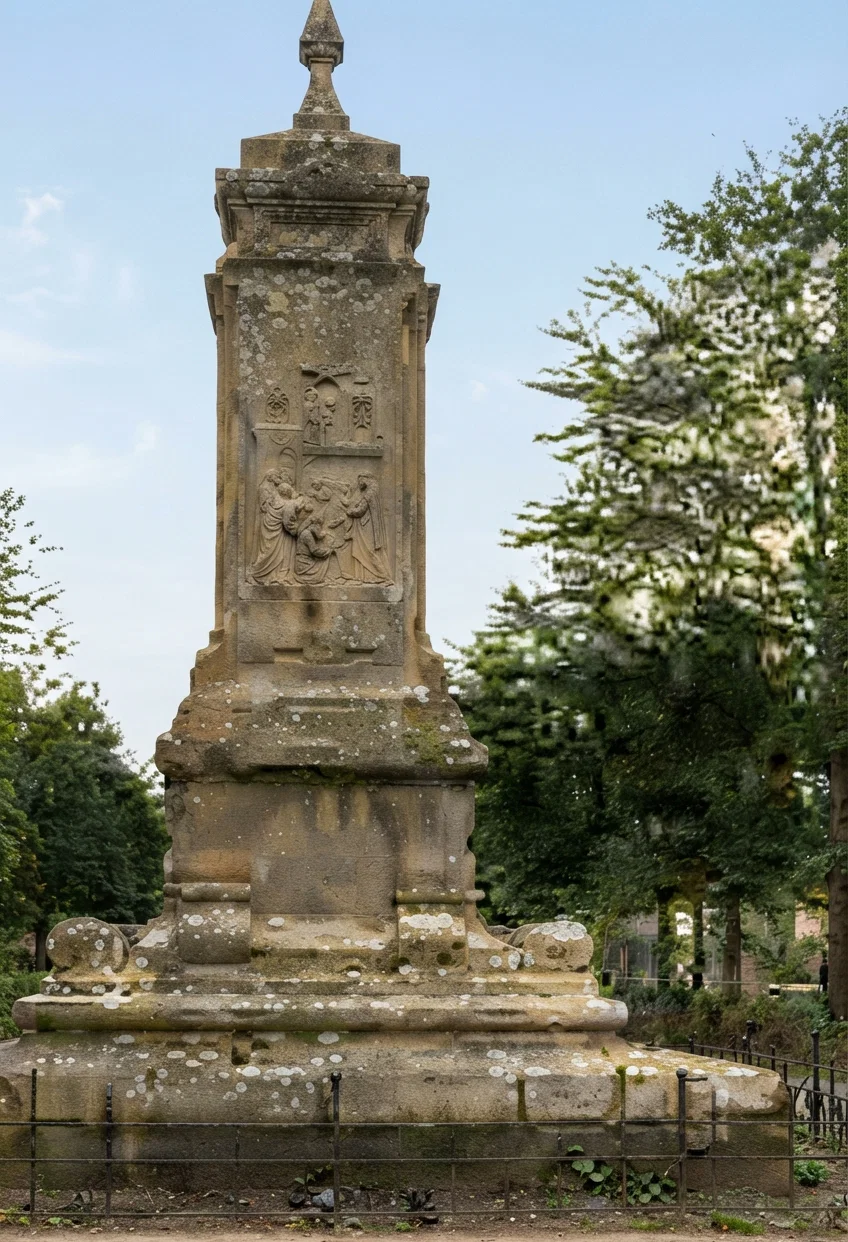
One of our workers in Belgium, Evangelist R. G. Klingbeil, sends us a photograph of a monument to William Tyndale, recently erected at the place of his martyrdom in Belgium. It will be recalled that when young Tyndale in England was rebuked by his bishop for reading the Greek New Testament, he declared that he would, by the grace of God, make it possible for the boy at the plow to become more familiar with the word of God than the bishop in his palace; and to this end he fled, an exile from England, to the continent of Europe, there to bring out edition after edition of the New Testament in the stately English which became the foundation of our common King James Version. Evangelist Klingbeil writes:
TYNDALE'S MONUMENT AT VILVORDE, BELGIUM
"The monument to William Tyndale was set up near the place of his martyrdom, in the town of Vilvorde, Belgium. William Tyndale was put to death on the sixth of October, 1536, in this little town, about five miles from the city of Brussels. The Trinitarian Bible Society of London and the Belgium Bible Society have erected this monument. There were about one thousand Protestants in attendance at the dedication of this memorial. Thousands of New Testaments were distributed in the place, and we hope for better days for Belgium, where infidel unbelief and Catholic superstition make the work so difficult. Our efforts are, however, being blessed of the Lord in Belgium, and we have at present seven churches, whose members are endeavoring to spread the light. We are now commencing our own evangelistic work in this little city of Vilvorde, and the Lord is blessing."
Near the memorial is the site of the old castle of Vilvorde, where Tyndale spent his last months, following his arrest by the Spanish authorities in Flanders, at the request of the king of England. The only letter of Tyndale's that has come to us from this period of imprisonment affords an interesting parallel to that last epistle of Paul to Timothy, written from the prison in Rome, asking him to bring the cloak that had been left at Troas, and the books, but "especially the parchments." William Tyndale wrote to the governor of the castle:
"I entreat your lordship, and that by the Lord Jesus, that if I am to remain here during the winter, you will request the procureur to be kind enough to send me from my goods which he has in his possession, a warmer cap, for I suffer extremely from cold in the head, being afflicted with a perpetual catarrh, which is considerably increased in the cell. A warmer coat also, for that which I have is very thin; also a piece of cloth to patch my leggings. My overcoat has been worn out. My shirts also are worn out. He has a woolen shirt of mine, if he will be kind enough to send it. . . I wish also his permission to have a candle in the evening, for it is wearisome to sit alone in the dark. But above all, I entreat and beseech your clemency to be urgent with the procureur that he may kindly permit me to have my Hebrew Bible, Hebrew grammar, and Hebrew dictionary, that I may spend my time with that study."
So faithful servants of God overcame by the blood of the Lamb and the word of their testimony, loving not their lives to the death; and to-day we honor their memory in the truest way by loving the blessed Word which they have passed on to us, and by following its precepts and proclaiming its message. Tyndale's last words at the stake, Foxe says, were the prayer, "Lord, open the king of England's eyes." And truly the prayer was answered when the version that still is our daily treasure, of which Tyndale's work was the foundation, was christened the King James Version, because brought out under royal direction and authority.
While the word of the King of kings and Lord of lords can receive no glory or honor from earthly kings, it is nevertheless interesting, in recalling Tyndale's last prayer, to note that in the form of service for the coronation of the kings of England occurs the passage:
"Last of all, the Holy Bible is brought from off the altar, and delivered to the king by the archbishop and bishops, with the words:
"'Our gracious king, we present you with this Book, the most valuable thing that this world affords. Here is wisdom; this is the royal law; these are the lively oracles of God.'"
The Reformation is not ended yet; and we who enter into the heritage of the open Bible left us by those who toiled and suffered in olden times, may show ourselves children of the Reformers only by following the teachings of the blessed Word for our day and generation, as they loyally followed the light that came to them.
W. A. S.
BOTH REWARDS AND PENALTIES ARE INHERENT IN LAW
Love the Foundation Principle with God—The Old Testament Prophets, as Well as Christ, Taught This Great Fact—Those Who Are Under the Law
"God is love." His law is therefore love. When the Lawgiver was on earth, He was asked by a lawyer, "Which is the great commandment in the law?" He did not hesitate, but openly announced: "Thou shalt love the Lord thy God with all thy heart, and with all thy soul, and with all thy mind. This is the first and great commandment. And the second is like unto it, Thou shalt love thy neighbor as thyself. On these two commandments hang all the law and the prophets." Matt. 22:37-40. This is not an introduction of a new law, but a statement of what is in the law of the kingdom of God. All of the law and the prophets hang upon these two principles—love to God, and love to man.
LOVE AND NOT HATRED BRINGS HAPPINESS
These are the inherent principles in the law, which, obeyed, insure rewards, and disobeyed, require penalties. "Love is the fulfilling of the law." Rom. 13:10. And love is the basis of happiness. The Lord did not give a law in the beginning because He desired to control His subjects arbitrarily. He gave the law of love because it was fundamental to the happiness of His children. Hatred results in wretchedness, sorrow, and death. Love insures happiness and life. No one ever became truly happy while engaged in hating another. One may, from no other cause than hatred of others, become wretched, emaciated, and ill. "A sound heart is the life of the flesh: but envy the rottenness of the bones." Prov. 14:30.
PROCLAIMED BECAUSE IT WAS THE BASIS OF HAPPINESS
The law of love did not become the basis of happiness because God proclaimed it to be the law of His kingdom. He proclaimed it the law of His kingdom because it was the basis of happiness. Written law is the statement of proper relations of parties embraced in its scope. In the law of the kingdom of God, the first four precepts present the proper relations of subjects to their Sovereign; the last six, the proper relations of subjects to each other. Love121fulfils the entire law. One who loves God will not break any of the first four precepts, and thus invade the rights of one's King. One who loves his fellow men will not invade their rights by breaking any of the last six commands.
HE PAID THE PENALTY
Inherent in the law of love there is an unqualified requirement that obedient subjects be rewarded and disobedient ones punished. Without this support, law is null and its precepts are powerless. That this is the innate character of the law of the kingdom of God is manifested in its relation to the Lawgiver when He voluntarily stepped beneath the penalty of man's disobedience. Three times, in that last dark hour of suffering while facing the doom of the lost, without hope, He pleaded so piteously, "O My Father, if it be possible, let this cup pass from Me." But having taken the place of the transgressor before the law, the penalty for sin could not be averted without disannulling the law, and it must fall upon Him as upon a transgressor.
If there had been any plan known to God by which the inherent penalty for disobedience could be withheld, and the dignity of His law maintained, it would have been produced in response to the heart-rending plea of One who was innocent in Himself but a voluntary victim because of others' guilt. No other plan was known. The dignity of the law must be maintained by the enforcement of its penalty upon the transgressor, or the kingdom of God must be surrendered.
Calvary is God's everlasting testimony to a fallen world that the law of His kingdom must eternally endure. Paul, viewing Christ dying upon the cross under the penalty of sin as a transgressor, saw the import of His death as He suffered the penalty inherent in the law, as a testimony to the fact that the law must be maintained or the government of God surrendered, and he said: "Do we then make void the law through faith? God forbid: yea, we establish the law." Rom. 3:31.
HE EARNED ITS REWARDS, BUT SUFFERED ITS PENALTIES
But there was another side to the life of Christ on earth. He was perfectly obedient during His entire life for man, as well as obedient in death to the inherent demands of the law upon transgressors. "And being found in fashion as a man, He humbled Himself, and became obedient unto death, even the death of the cross." Phil. 2:8. According to the principle inherent in law, He must therefore be rewarded for obedience. In conformity to this principle, it is said of death that it was "not possible that He should be holden of it." Acts 2:24. He therefore arose from the dead and was rewarded. "Wherefore God also hath highly exalted Him, and given Him a name which is above every name: that at the name of Jesus every knee should bow, of things in heaven, and things in earth, and things under the earth; and that every tongue should confess that Jesus Christ is Lord, to the glory of God the Father." Phil. 2:9-11.
Christ recognized the demands of the law for perfect obedience, and the penalty of death upon transgressors, both to be equally just. It is therefore very apparent that both rewards and penalties are inherent in law; and further, that wherever just rewards are offered, they are in recognition of obedience to the law. Ps. 19:11. Wherever sin is imputed and punished, this is a clear testimony to the binding obligation of the law. "For until the law sin was in the world: but sin is not imputed when there is no law." Rom. 5:13.
TIME, PLACE, OR CIRCUMSTANCES DO NOT CHANGE IT
Since from the time the kingdom of God was established until the present, there has never been a period when sin has not been imputed to transgressors and rewards promised to obedient subjects, there has never been a period when the law of the kingdom of God has not held dominion. Time, place, circumstance, can never make necessary a change in a perfect law. To alter a perfect law would necessitate making it imperfect. Human laws may be changed because of their imperfection; but the law of God's moral government never can be altered until immorality ceases to be a sin.
PRESENT CONDITIONS IMPERFECT
Under present conditions the operation of the law is imperfect at times, not because there is imperfection in the law, but because of imperfections in sinful men with whom it has to do. The innocent white slave, forced into a life of shame, must meet the consequences of a life of vice. The son must bear the iniquity of his father's sinful heredity, visited to the third and fourth generation. Ex. 34:7. But the innocent victim, remaining in a life of vice only while it is enforced, and springing back into a life of sinless purity at the first opportunity, will be accounted sinless in the execution of penalties against transgressors. The motive is considered in the execution of justice in the righteous administration of God's law.
LIFTED ABOVE EFFECTS OF HEREDITY
Regardless of sinful heredity, the man who desires to break from the sins of his ancestors is lifted by the hand of divine justice from the effects of sinful heredity, when he surrenders his heart for cleansing, and is counted free from any share in the penalty attaching to the sins of his father. "Yet say ye, Why? doth not the son bear the iniquity of the father? When the son hath done that which is lawful and right, and hath kept all My statutes, and hath done them, he shall surely live. The soul that sinneth, it shall die. The son shall not bear the iniquity of the father, neither shall the father bear the iniquity of the son: the righteousness of the righteous shall be upon him, and the wickedness of the wicked shall be upon him." Eze. 18:19, 20.
Hence in the final execution of penalties for transgression and the final distribution of rewards, every man will receive according to his voluntary relation to God's divine law. "Be not deceived; God is not mocked: for whatsoever a man soweth, that shall he also reap. For he that soweth to his flesh shall of the flesh reap corruption; but he that soweth to the Spirit shall of the Spirit reap life everlasting. And let us not be weary in well-doing: for in due season we shall reap, if we faint not." Gal. 6:7-9.
OBEY AND LIVE
In the beginning, it was possible for angels and man to live the law of the kingdom inviolate, and thus to remain forever innocent, and receive the reward of an endless life. But "the wages of sin is death." Inherent in the law, there were, therefore, both life and death. Obey and live, disobey and die, were the inherent reward and penalty placed originally before every subject of the kingdom of God. "And the commandment, which was ordained to life, I found to be unto death." Rom. 7:10.
When God called the prophet Jeremiah down to the potter's house to reveal to him His power in shaping character and fixing destinies, He informed him that the nation would be rewarded or punished upon the basis of voluntary obedience or disobedience. "At what instant I shall speak concerning a nation, and concerning a kingdom, to pluck up, and to pull down, and to destroy it; if that nation, against whom I have pronounced, turn from their evil, I will repent of the evil that I thought to do unto them. And at what instant I shall speak concerning a nation, and concerning a kingdom, to build and to plant it; if it do evil in My sight, that it obey not My voice, then I will repent of the good, wherewith I said I would benefit them." Jer. 18:7-10.
God is here represented as the great Potter molding the clay. But He most emphatically declares that in molding and fashioning characters and executing judgment which fixes destinies, He limits Himself to the inherent relations of rewards and penalties in the law. Being Himself the Author of the law, and having therefore fixed its inherent relations, He does not merely respect the inherent relation of the law in His administration, and leave the law to operate independently of its Author. But as the potter molds and shapes the clay in harmony with the inherent natural law governing it, so are fixed the destinies of nations and individuals according to their obedience or disobedience of His law. He is not an indifferent spectator to the operations of His moral law, but He is momentarily its operator and its executor. The subject's relation to the law controls His execution of judgment.
There is therefore nothing arbitrary in God's administration of the law of His kingdom. He "will render to every man according to his deeds." Rom. 2:6.
UNDER THE LAW
To be under the law of the kingdom of God and subject to its penalty is to transgress voluntarily its moral precepts. Such as do this are, by the law, denied admission to the kingdom of God. But those cherishing the fruits of the Spirit will find the gates of the kingdom wide open to welcome them as its loyal subjects. "But if ye be led of the Spirit, ye are not under the law. Now the works of the flesh are manifest, which are these; adultery, fornication, uncleanness, lasciviousness, idolatry, witchcraft, hatred, variance, emulations, wrath, strife, seditions, heresies, envyings, murders, drunkenness, revelings, and such like: of the which I tell you before, as I have also told you in time past, that they which do such things shall not inherit the kingdom of God. But the fruit of the Spirit122is love, joy, peace, long-suffering, gentleness, goodness, faith, meekness, temperance: against such there is no law." Gal. 5:18-23.
This is a striking parallel to Christ's instruction given in His Sermon on the Mount. "Ye shall know them by their fruits. Do men gather grapes of thorns, or figs of thistles? Even so every good tree bringeth forth good fruit; but a corrupt tree bringeth forth evil fruit. A good tree can not bring forth evil fruit, neither can a corrupt tree bring forth good fruit. Every tree that bringeth not forth good fruit is hewn down, and cast into the fire. Wherefore by their fruits ye shall know them. Not every one that saith unto Me, Lord, Lord, shall enter into the kingdom of heaven; but he that doeth the will of My Father which is in heaven. Many will say to Me in that day, Lord, Lord, have we not prophesied in Thy name? and in Thy name have cast out devils? and in Thy name done many wonderful works? And then will I profess unto them, I never knew you: depart from Me, ye that work iniquity. Therefore whosoever heareth these sayings of Mine, and doeth them, I will liken him unto a wise man, which built his house upon a rock: and the rain descended, and the floods came, and the winds blew, and beat upon that house; and it fell not: for it was founded upon a rock." Matt. 7:16-25.
THE LAW DEMANDS OBEDIENCE EVERY MOMENT
The law demands perfect obedience for every moment of life. This demand of the law is inexorable. It is a demand upon rich and poor, high and low, alike, and there is no respect of persons in its demands. It is for this reason that justice is said to be blind. Justice is not blind, it is unqualifiedly just. The ignorant transgressor who dies in sin must perish, although in the execution of his sentence he is judged by a different standard from that by which the one is judged who transgresses with a full knowledge of the law. Only doers of the law can be justified. No subterfuge can excuse disobedience. It is an inherent demand in the law that subjects must be absolutely obedient if they are to be justified in the final act of judgment before the law. "For there is no respect of persons with God. For as many as have sinned without law shall also perish without law: and as many as have sinned in the law shall be judged by the law; for not the hearers of the law are just before God, but the doers of the law shall be justified." Rom. 2:11-13.
In a later article will be considered the possibility of perfect obedience to God's just law by sinful men. R. C. P.
A WORD TO OUR READERS
By Editor
We send no papers from this office to individuals without pay in advance. When persons receive copies without ordering them, they are sent by other parties, and we can give no information in regard to them. Persons thus receiving copies of the SIGNS are not indebted to the office, and will not be called upon to pay for them. Please read the papers you may receive, and hand them to your friends to read.
DATE OF EXPIRATION
By Editor
The SIGNS wrapper bears date of last issue due on your subscription. Unless renewed in advance, paper stops with expiration date.
If herewith is an order-blank, you will know you have overlooked sending renewal. You will not wish to miss a single issue. Back numbers often can not be furnished.
SCRIPTURE QUOTATIONS
Our authority for the doctrines we teach is the Bible. Quotations are usually from the King James Version or the American Standard Revised.